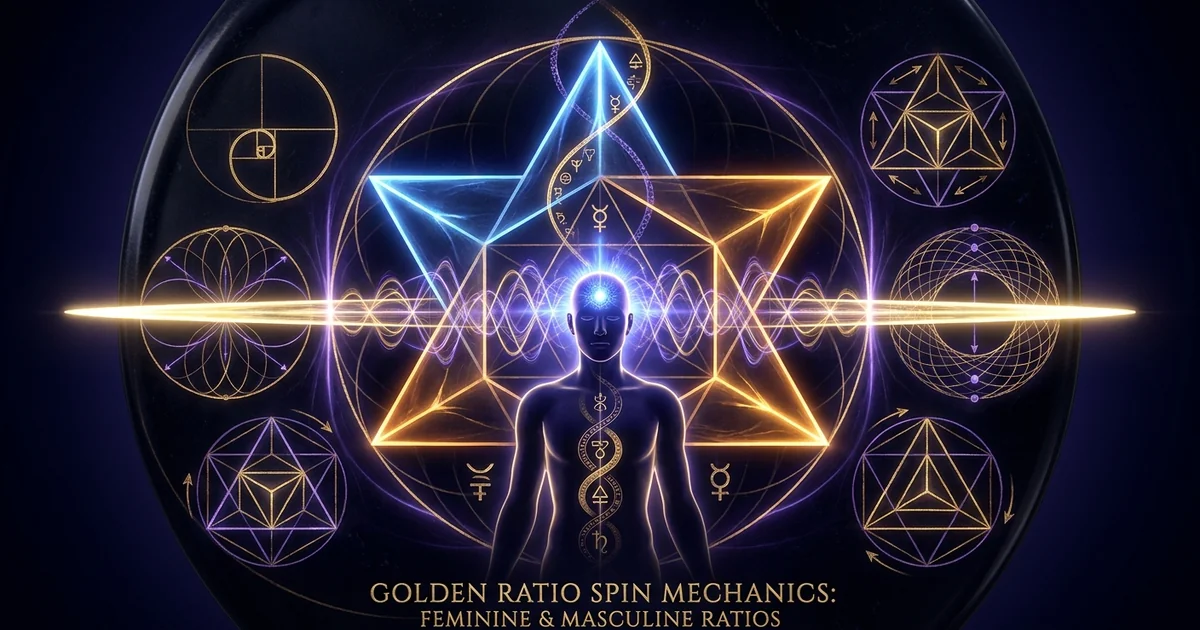
Golden Ratio Spin Mechanics: Feminine & Masculine Ratios
Protocol Overview & Neurophysiological Thesis
The transpersonal architecture of human consciousness relies upon dynamic, non-Euclidean geometric configurations embedded within the endogenous electromagnetic field of the human body. Traditional contemplative traditions, preserved across esoteric lineages and revitalized through modern biofield physics, describe this field as the Merkaba—an interpenetrating, star-tetrahedral counter-rotational energy matrix. Contemporary electromagnetic field theory and non-linear dynamics demonstrate that the stabilization of this counter-rotational light construct does not operate via symmetrical mechanical rotation. Rather, it requires an asymmetric counter-rotational velocity derived directly from discrete Fibonacci harmonic progressions.
Specifically, the system achieves dynamic phase-locking at the 34:21 velocity ratio. When the counter-rotational velocity of the dual star-tetrahedral vectors adheres to this specific fraction ($34/21 \approx 1.61904$, an operational approximation of the Golden Ratio $\Phi \approx 1.6180339$), the field transitions from an entropic, dissipative standing wave into a phase-conjugate scalar vortex.
                  Apex (Masculine Tetrahedron)
                             ▲
                            / \
                           /   \
                          /  •  \  <-- Sushumna Axis (Zero-Point Vector)
                         /       \
                        /_________\
                       \           /
                        \    •    /  <-- Intersecting Centroid (Anahata Core)
                         \       /
                          \     /
                           \   /
                            \ /
                             ▼
                 Base (Feminine Tetrahedron)
               Counter-Clockwise Spin (34 Metric)
                         ⟲   ⟲   ⟲
               [ Masculine Electric Tetrahedron ]
              =====================================
               [ Feminine Magnetic Tetrahedron  ]
                         ⟳   ⟳   ⟳
                 Clockwise Spin (21 Metric)
Geometric Vectors of the 34:21 Fibonacci Metric
The geometry of the star tetrahedron consists of two interpenetrating regular tetrahedra sharing a common centroid along the Sushumna (craniosacral) axis. The apex of the masculine tetrahedron extends superiorly above the bregma, with its flat triangular base oriented horizontally at the level of the pelvic diaphragm. In contrast, the feminine tetrahedron inverts this configuration: its triangular base is positioned horizontally at the level of the clavicles and sternal notch, while its apex points inferiorly past the perineum into the Earth.
Under unaccelerated baselines, these geometries remain energetically inert, exhibiting negligible dynamic magnetic resonance. When the practitioner initiates conscious rotational torque, angular momentum must not be applied symmetrically. Symmetrical counter-rotation (e.g., a 1:1 angular velocity) causes immediate wave cancellation, destructive interference, and localized shear strain across the practitioner’s biofield.
       34 Cycles (Masculine / CCW)
  ───────────────────────────────────────  ≈ 1.6190476... (Phi Divergence: +0.0010137)
       21 Cycles (Feminine / CW)
To establish an open thermodynamic system capable of transducing vacuum energy fluctuations, the counter-rotation must manifest an asymmetric differential. Utilizing the higher-order Fibonacci harmonics, the masculine tetrahedron is driven at an angular velocity of 34 units while the feminine tetrahedron is constrained to an angular velocity of 21 units.
This 34:21 differential generates an irrational geometric wave-glide. Because 34 and 21 are adjacent terms within the Fibonacci sequence, their harmonic quotient ($34/21 = 1.619047…$) establishes a mathematical approximation of continuous phase-conjugation. At this threshold, the non-linear medium of the surrounding biological plasma collapses into a self-imploding, non-dispersive solitary wave (soliton), setting the conditions for the formation of the critical speed of light disk.
Masculine Electric and Feminine Magnetic Torsional Dualities
The biological justification for this velocity asymmetry lies in the fundamental electromagnetic duality governing human biophysics. The masculine tetrahedron functions as an electric emitter, characterized by positive centrifugal divergence, high-frequency voltage gradients, and an orientation that projects outward into the surrounding spatial manifold. Its counter-clockwise rotation (viewed from the apex downward through the vertical bodily axis) accelerates cellular charge emission, increases cellular action potential firing rates, and stimulates the sympathetic branch of the autonomic-nervous-system.
Conversely, the feminine tetrahedron operates as a magnetic receptable. Characterized by centripetal convergence, negative electrostatic suction, and high magnetic flux density, its clockwise rotation (viewed from the base upward) draws ambient subtle energy into the central biological channel.
Masculine Electric Vector (34 Velocity)
- Rotational Direction: Counter-clockwise viewed from apex downward along Sushumna.
- Biophysical Polarity: Positive electrical expansion, high dielectric tension, centrifugal radiation.
- Neurophysiological Correlates: Sympathetic ignition, high-frequency Gamma-band cortical synchronization, increased pineal efferent signaling.
- Fibonacci Momentum: 34 rotational velocity units; generates the spatial propagation envelope.
- Somatic State: Piercing cognitive clarity, kinetic somatic sensation, outward spatial expansion.
Feminine Magnetic Vector (21 Velocity)
- Rotational Direction: Clockwise viewed from base upward along Sushumna.
- Biophysical Polarity: Receptive magnetic contraction, centripetal suction, negative entropy.
- Neurophysiological Correlates: Parasympathetic vagal stabilization, foundational Theta/Delta-band stabilization, cardiac-somatosensory coherence.
- Fibonacci Momentum: 21 rotational velocity units; grounds the high-velocity masculine field.
- Somatic State: Deep visceral containment, graviton-like heaviness, internal zero-point collapse.
When the masculine electric vector outpaces the feminine magnetic anchor past the Golden Ratio threshold, severe psychological dissociation, spatial depersonalization, and ocular vestibular nystagmus occur. Conversely, if the magnetic vector dominates, the practitioner experiences somnolence, catatonic stupor, and depressive grounding failures. The 34:21 ratio ensures that the electrical expansive vector exceeds the magnetic compressive vector by precisely the Golden Proportion, sustaining continuous self-referential implosion without structural biofield rupture.
Target Neurobiological Equilibrium and Cortical Integration
The operational stabilization of the 34:21 counter-rotational velocity necessitates an underlying neurobiological state characterized by high global coherence across the transcallosal axonal architecture. Under normative baseline waking conditions, the human electroencephalogram (EEG) displays low-amplitude, desynchronized Beta activity (13–30 Hz) distributed heterogeneously across both cerebral hemispheres. To anchor the counter-rotational light field, this desynchronization must be systematically replaced by bilateral phase synchronization.
Through targeted acoustic stimulation, precise acoustic carrier waves oscillating at 216 Hz in the left auditory canal and 217.618 Hz in the right auditory canal establish a Golden Ratio binaural differential of 1.618 Hz situated within the infraslow Delta band. This infraslow carrier serves as an entrainment scaffolding.
As the inferior colliculus and the superior olivary complex process this phase differential via the auditory frequency-following-response, the phase-locked binaural pulses stimulate transcallosal axonal tracts. This drives the anterior cingulate cortex, the dorsolateral prefrontal cortex, and the parieto-occipital sulcus into unified hemispheric coherence.
Within this stabilized interhemispheric environment, high-frequency 40 Hz Gamma oscillations couple to the 1.618 Hz infraslow envelope via cross-frequency phase-amplitude coupling. This provides the neurological hardware with sufficient metabolic efficiency and phase stability to maintain the dual tetrahedral visualization without cognitive collapse.
Biophysical Mechanisms & Brainwave Dynamics
The translation of esoteric geometric visualization into objective biophysical transformation is mediated by acoustic-mechanical transduction, quantum biological events within cellular matrices, and precise macroscopic electromagnetic entrainment. The human organism functions as a liquid crystal dielectric resonator; its physiological substrates are uniquely suited to convert focused acoustic and meditative directives into phase-conjugate torsion fields.
Cross-Frequency Phase-Amplitude Coupling (Theta-Gamma and Delta-Phi)
In the field of cognitive neurodynamics, cross-frequency coupling—particularly phase-amplitude coupling (PAC)—is recognized as the primary mechanism for coordinating distributed neural networks across disparate spatiotemporal scales. To anchor the golden ratio spin speed merkaba 34 21 fibonacci ratios, the central nervous system must establish a hierarchical nesting of brainwave frequencies. Conventional meditation often focuses exclusively on generating isolated Alpha (8–12 Hz) or Theta (4–8 Hz) states. However, stabilizing a multi-vector counter-rotational torsion field requires a far more complex neurodynamic signature.
Infraslow Envelope (Delta-Phi: 1.618 Hz)
──────────────────────────────────────────────────────────────────────────
   ▲                       ▲                       ▲
  ╱ ╲                     ╱ ╲                     ╱ ╲
 ╱   ╲                   ╱   ╲                   ╱   ╲
╱     ╲                 ╱     ╲                 ╱     ╲
       ╲               ╱       ╲               ╱       ╲
        ╲             ╱         ╲             ╱         ╲
         ▼           ▼           ▼           ▼           ▼
High-Frequency Bursts (Gamma: 40 Hz, nested upon Infraslow Peaks)
 |||||||||               |||||||||               |||||||||
The master entrainment frequency operates at 1.618 Hz—a Delta-band frequency defined by $\Phi$. This slow carrier rhythm provides the temporal pacing for slow-wave vascular vasomotion and interstitial fluid circulation throughout the ventricles of the brain. Nested precisely upon the crests of this 1.618 Hz wave are bursts of high-frequency Gamma activity oscillating at 40 Hz.
As elucidated by Pfurtscheller and Lopes da Silva (1999), event-related synchronization in the Gamma band reflects the recruitment of localized interneuron assemblies into unified functional ensembles. When these 40 Hz bursts phase-lock to the 1.618 Hz carrier, the practitioner experiences simultaneous deep somatic stability (Delta-driven vagal tone) and hyper-lucid executive awareness (Gamma-driven perceptual binding). This cross-frequency phase-amplitude coupling creates the electrophysiological bandwidth required to sustain the mental computation of two distinct rotational velocities simultaneously.
Pineal Piezoelectric Calcite Activation and Biophoton Superradiance
At the center of the cranial cavity, the epithalamus houses the pineal gland, an endocrine organ that plays a central role in biofield transduction. The pineal parenchyma contains non-homogeneously distributed micro-crystals of calcite ($\text{CaCO}_3$), possessing non-centrosymmetric trigonal symmetry. Because these micro-crystals lack a center of inversion, they display pronounced piezoelectric-effect properties: direct mechanical, acoustic, or electromagnetic shear stresses applied to the pineal tissue induce internal charge separation and voltage spikes.
       Acoustic / Cranial Pressure Wave
                     │
                     ▼
          [ Pineal Micro-Crystals ]
          (Non-Centrosymmetric Calcite)
                     │
                     ▼
       Mechanical Lattice Compression
                     │
                     ▼
        Piezoelectric Charge Separation
                     │
                     ▼
     Superradiant Biophoton Discharge (Popp Coherence)
During Phase II of the 34:21 spin acceleration, pressurized diaphragmatic pranayama generates rhythmic fluctuations in intracranial fluid pressure. These hydrodynamic pressure waves travel through the third ventricle, mechanically compressing the calcite micro-crystals within the pineal gland. This electrostriction triggers a continuous cascade of high-frequency micro-volt discharges.
According to biophotonics research pioneered by Fritz-Albert Popp, living tissues constantly emit low-intensity biophotons derived from mitochondrial metabolic processes and DNA conformational shifts. Under chaotic neurological states, these biophoton emissions are incoherent and structurally diffuse.
However, under the piezoelectric excitation driven by the 1.618 Hz entrainment field, pineal calcite crystals emit highly coherent biophotons in a state of superradiance. This coherent light discharge serves as the internal optical carrier that organizes the surrounding cellular matrix, providing the biological foundation for visualizing the internal solar radiance and sustaining the field’s expanding boundaries.
Hemispheric Phase Synchronization via Auditory Frequency Following Response
The auditory pathway provides a non-invasive conduit for modulating subcortical and cortical oscillatory networks. When pure sinusoidal tones are delivered dichotically via stereo acoustic transducers, the brainstem’s superior olivary complex attempts to resolve the phase differential between the two signals. This neural process generates a centrally perceived third frequency—the binaural beat—which does not exist in the external acoustic environment but is synthesized within the central auditory pathways.
Left Ear: 216.0 Hz  ───────►  [ Superior Olivary ]  ◄───────  Right Ear: 217.618 Hz
                             [     Complex     ]
                                    │
                                    ▼
                   Binaural Difference: 1.618 Hz (Delta-Phi)
                                    │
                                    ▼
                 Transcallosal Synchrony across Hemispheres
By calibrating the acoustic stimulus to carrier frequencies of 216 Hz (left ear) and 217.618 Hz (right ear), the auditory apparatus is stimulated at an acoustic ratio based on sacred geometries (216 being $6^3$, a fundamental cosmic fractal number) coupled with a $\Phi$ differential. The resulting 1.618 Hz binaural beat drives the auditory frequency following response (FFR).
As the brainstem entrains to this delta rhythm, the rhythmic discharge propagates via ascending reticular pathways to the thalamus, which serves as the primary pacemaker for cortical oscillations. The thalamocortical loops project this 1.618 Hz rhythm symmetrically across the corpus callosum, forcing the left and right cerebral hemispheres into phase-locked resonance.
This state of profound hemispheric synchronization eliminates the localized temporal delays and functional asymmetries that typically characterize ordinary conscious thought, allowing the somatic visualization of the masculine electric feminine magnetic field to occur without cognitive fragmentation.
Step-by-Step Experiential Protocol
The practical execution of the 34:21 Golden Ratio spin mechanics protocol demands precise somatic discipline, respiratory rigor, and strict adherence to geometric trajectories. The practitioner must approach this practice not as an act of passive meditation, but as an applied psychoacoustic navigation protocol.
- Total Protocol Duration: Exactly 45 minutes (Phase I: 15 min; Phase II: 15 min; Phase III: 15 min).
- Acoustic Configuration: Dual sinusoidal delivery via high-fidelity, closed-back circumaural headphones. Left Channel: 216.0 Hz; Right Channel: 217.618 Hz. Acoustic amplitude calibrated to 65 dB SPL.
- Pranic Cadence: Samavritti Pranayama at a strict 7.0-second cadence: Inhale 7.0s, Internal Retention 7.0s, Exhale 7.0s, External Retention 7.0s.
- Ocular Focus: Shambhavi Mudra; eyes closed, ocular globes converged upward toward the glabella at approximately a 15-degree angle to drive prefrontal Alpha/Theta coherence.
- Critical Operational Transition: Engagement of the Mula Bandha and Jalandhara Bandha precisely on the ninth breath cycle of Phase III to trigger the formation of the 55-cubit horizontal disk.
    Inhale: 7.0s            Hold: 7.0s            Exhale: 7.0s            Hold: 7.0s
[──────────────────►]  [══════════════════]  [◄──────────────────]  [..................]
 0s                  7s                   14s                    21s                   28s
Phase I: Somatosensory Centering and Pranic Axis Alignment
The session commences in an upright, ergonomically supported seated posture, ensuring the craniosacral axis remains perfectly vertical without physical hyper-extension. The headphones are positioned, and the 216.0 Hz / 217.618 Hz acoustic carrier waves are initiated. The practitioner executes the 7.0-second Samavritti pranic breathing cycle: seven seconds of smooth, silent diaphragmatic inhalation through the nasal cavities, seven seconds of continuous internal retention without throat constriction, seven seconds of smooth, unforced exhalation, and seven seconds of post-expiratory vacuum retention.
                            Apex (Masculine)
                                 ▲
                                 │
                    [Pranic Core: Sushumna Axis]
                                 │
           Cardiac Center (0,0,0 Centroid - Heart Anahata)
                                 │
                                 ▼
                          Base (Feminine)
During this initial 15-minute phase, somatic intent is directed exclusively toward establishing the vertical pranic tube—the Sushumna axis—running from 18 inches above the crown to 18 inches beneath the perineum. This energetic conduit, approximately the diameter of the practitioner’s ocular globe, is held stabilized in cognitive perception as a beam of opalescent, coherent white light.
Simultaneously, the practitioner maps the static star tetrahedral geometry onto their physical frame: the masculine tetrahedron anchored with its base at the pelvic floor and apex above the crown; the feminine tetrahedron anchored with its base at the clavicles and apex beneath the pelvic floor. Both tetrahedrons are initially perceived as completely stationary, phase-locked, and co-resonant with the heart center’s electromagnetic centroid at the level of the cardiac plexus.
Phase II: Asymmetric Acceleration and 34:21 Velocity Lock
Upon reaching the 15-minute threshold, the practitioner shifts cognitive intention from static spatial mapping to angular kinetic acceleration. The dual tetrahedrons are decoupled from their stationary lock. The practitioner issues the conscious mental directive for the masculine electric tetrahedron to initiate counter-clockwise rotation (perceived from above the apex, spinning from front to left to back to right). Simultaneously, the feminine magnetic tetrahedron is directed to initiate clockwise rotation (perceived from below the base, spinning from front to right to back to left).
Masculine Spin (CCW): 1 ──► 2 ──► 3 ──► 5 ──► 8 ──► 13 ──► 21 ──► 34 (Velocity Lock)
                                                                     ▲
                                                                     │
                                                           Asymmetric Phase-Lock
                                                                     │
                                                                     ▼
Feminine Spin (CW):    1 ──► 2 ──► 3 ──► 5 ──► 8 ──► 13 ────────► 21 (Velocity Lock)
The acceleration is not continuous or linear; it steps systematically through the discrete harmonic intervals of the Fibonacci sequence: 1, 2, 3, 5, 8, 13, 21, and 34. The practitioner matches the angular acceleration to the rhythmic 7.0-second breath cycles.
By the midpoint of Phase II, the feminine tetrahedron accelerates to a sustained angular velocity metric of 21 cycles per reference interval, while the masculine tetrahedron surges to an angular velocity metric of 34 cycles.
As the counter-rotational velocity approaches this 34:21 ratio, an internal perceptual shift occurs: the individual faces of the spinning geometric structures blur into concentric fields of dynamic phosphorescence.
Subjectively, this state is verified by the onset of a high-frequency, metallic resonance perceived along the craniosacral axis—the auditory perception of endogenous piezoelectric transduction within the cranial vault. At this moment, the 34:21 velocity lock is achieved, and the field achieves dynamic stability.
Phase III: Disk Expansion to the 55-Cubit Boundary
With the 34:21 velocity lock maintained, the practitioner prepares for the critical phase transition. At the completion of the fourteenth breath cycle within Phase II (precisely marking the 30-minute operational mark), the practitioner transitions to Phase III.
On the ninth breath cycle of Phase III, following a maximum diaphragmatic inhalation that draws energy from the lower perineal base upward along the Sushumna into the cranial vault, the practitioner applies a sustained, dual-valve physiological lock: the pelvic floor is engaged via Mula Bandha, while the sternum is raised to meet the chin in Jalandhara Bandha.
                   Upward Pranic Vector (Mula Bandha)
                                 ▲
                                 │
                       [ Central Ignition ]
                                 │
                                 ▼
                     Horizontal Kinetic Ejection
 ◄────────────────────────────────────────────────────────────────────────►
   Horizontal Velocity Disk: Expands to 55 Cubits (82.5 - 90 ft Diameter)
The breath is held internally. At the precise instant that internal dielectric pressure peaks within the pineal centroid, the practitioner executes a sharp, pressurized, diaphragmatic expulsion through the mouth using a circular, open-lip configuration (Kecharis breath-variant). Rather than allowing the energetic momentum to dissipate into the external environment, the somatic intent forces the counter-rotational dynamic field to snap horizontally outward along the equatorial plane of the body, bisecting the heart center.
The accumulated angular momentum instantly drops its vertical shear and expands into a thin, horizontal planar disk: the critical speed of light disk. This luminous, high-velocity disk shoots rapidly outward from the heart center, stabilizing at a precise physical diameter of approximately 55 cubits (roughly 82.5 to 90 feet, or 25 to 27 meters). The practitioner now rests within the stabilized core of this vast, phase-conjugate torsional field, maintaining continuous, non-striving witnessing awareness for the remaining 15 minutes of the protocol.
Operational Safety, Contraindications & Biofield Grounding
The manipulation of high-order bioelectric torsion fields and the acceleration of biological phase-conjugate mechanics present significant physiological and neurological demands. Far from being a purely metaphorical or benign cognitive visualization, the deep entrainment of transcallosal Gamma rhythms coupled with infraslow Delta frequencies exerts profound mechanical and metabolic demands on the central nervous system and cardiovascular structures.
- Absolute Medical Contraindications: The Golden Ratio Spin Mechanics protocol is strictly prohibited for individuals with a history of primary or secondary epilepsy, structural cerebral aneurysms, severe cardiac arrhythmias, implanted pacemakers, or diagnosed bipolar I/schizoaffective spectrum disorders.
- Diagnostic Markers of Over-Rotation: Spontaneous vestibular nystagmus, persistent bilateral tinnitus exceeding 8 kHz, severe unilateral temporal headaches, acute autonomic tremulousness, sudden dissociative depersonalization, or tactile paresthesia along the dermatomal pathways of the upper extremities.
- Emergency Interruption Protocol: Immediately disengage acoustic transducers; cease all pranic retentions; engage bilateral foot flexion against a solid surface; consume 300 ml of an isotonic saline solution; immerse the hands and face in cold water ($< 15^\circ\text{C}$) to trigger the parasympathetic diving reflex.
Neurological Contraindications and Latent Epileptogenesis
The central operational risk of the 34:21 protocol stems from the deployment of 40 Hz Gamma entrainment nested on an infraslow Delta wave. In individuals with sub-clinical, undiagnosed cortical hypersensitivity or latent epileptogenic foci—particularly within the mesial temporal lobes or the hippocampal-amygdaloid complex—this cross-frequency entrainment can precipitate paroxysmal electrical discharges.
According to neurophysiological principles of epileptogenesis, rhythmic sensory stimulation matching the endogenous firing thresholds of cortical pyramidal neurons can provoke progressive kindling effects.
Unchecked phase-locking across the corpus callosum can trigger the recruitment of neighboring cortical assemblies into a synchronized seizure discharge. Consequently, individuals exhibiting any personal or familial history of seizure disorders, unexplained syncopal episodes, or severe migraine syndromes must be screened out from practicing this protocol.
Depersonalization, Dissociative Fugue, and Psychic Inflation
The transpersonal expansion resulting from the stabilization of the critical speed of light disk alters ordinary somatic-vestibular reality constructs. When the biofield expands outward to the 55-cubit boundary, the parietal lobes’ spatial orientation areas—responsible for delineating the boundary between the physical self and the external environment—exhibit marked functional deafferentation.
If this deafferentation occurs too rapidly, or if the practitioner lacks psychological integration, it can trigger severe pathological outcomes. These manifest as depersonalization disorder, prolonged derealization, or dissociative fugue, wherein the practitioner perceives their physical body as an alien, mechanical automaton.
Equally dangerous is the emergence of psychic inflation: the subjective ego-structure misinterprets the vast transpersonal field as an exclusive, personal attribute, resulting in megalomaniacal delusions, spiritual grandiosity, and severe interpersonal alienation.
Emergency Grounding Protocols and Parasympathetic Vagal Anchors
To neutralize acute bioelectric overcharge, the practitioner must possess an immediate, reflexively accessible grounding mechanism. If field instability occurs, somatic intention and breath holds must be terminated immediately. The practitioner must abandon internal visualizations and shift all sensory awareness outward into immediate physical tactile reality.
       Acute Field Over-Rotation / Dissociation Detected
                               │
                               ▼
        Step 1: Terminate Audio & Disengage Pranic Holds
                               │
                               ▼
    Step 2: Activate Cold Dive Reflex (Facial Immersion <15°C)
                               │
                               ▼
        Step 3: Down-Regulate Heart Rate via Vagal Brake
                   (Inhale 4.0s ──► Exhale 8.0s)
                               │
                               ▼
 Step 4: Conductive Earth Contact & Isotonic Mineral Hydration
The emergency sequence relies upon engaging the mammalian dive reflex. The practitioner immediately immerses the facial area—specifically the region innervated by the ophthalmic branch of the trigeminal nerve—into cold water (approximately 10–14°C) for 15 to 30 seconds. This action triggers immediate bradycardia, mediated by the parasympathetic vagal brake, reducing cardiac output and terminating the sympathetic-driven electric acceleration of the masculine 34-vector.
Concurrently, the practitioner initiates an asymmetric respiratory cadence consisting of a 4.0-second inhalation followed by an extended, audible 8.0-second exhalation through pursed lips, maximizing vagal nerve stimulation via the pulmonary stretch receptors.
Physical tactile contact with an electrically grounded earthen surface or a grounded conductive copper mat facilitates the rapid dispersal of residual static electrical potential accumulated across the body’s fascial networks, restoring ordinary neurobiological equilibrium.
Phenomenological Correlates & Veridical Evidence
The operational dynamics of counter-rotational biofields find historical, laboratory, and theoretical support across multiple lines of transpersonal research. Far from existing solely in subjective contemplative literature, the mechanics of high-velocity torsion fields and non-local conscious projection have been systematically analyzed by clinical researchers, theoretical physicists, and intelligence research programs.
- Archival Source: U.S. Army Intelligence and Security Command (INSCOM) / CIA FOIA Archive.
- Document Classification: Declassified Analysis and Assessment of Gateway Process (June 9, 1983).
- Investigator: Lt. Col. Wayne M. McDonnell.
- Pertinent Section: Section 34: “The Torus and Spatial Transformation.”
- Core Thesis: The human consciousness construct, when stabilized through hemispheric phase-coherence, acts as a self-contained toroidal energy field. By accelerating this field’s internal rotational velocity to match phase-conjugate geometry, the spatial boundaries of the localized spacetime matrix are overcome, enabling non-local informational acquisition via holographic projection.
The Gateway Assessment and Torsional Phase-Conjugate Energy
In his declassified 1983 assessment of the Monroe Institute’s Gateway Process for the Central Intelligence Agency, Lt. Col. Wayne M. McDonnell articulated a physical framework for how human consciousness achieves out-of-body states and non-local projection. McDonnell synthesized the biomechanics of Itzhak Bentov, the quantum physics of David Bohm, and the holographic universe model of Karl Pribram to explain how phase-locked acoustic entrainment reorganizes the human energetic system into a unified toroidal vortex.
                  ┌──────────────────────────────┐
                  │ Holographic Universal Matrix │
                  └──────────────┬───────────────┘
                                 │
                  ┌──────────────▼──────────────┐
                  │ Toroidal Phase-Locking      │
                  │ ( Gateway Process - Sec 34) │
                  └──────────────┬───────────────┘
                                 │
                  ┌──────────────▼──────────────┐
                  │ 34:21 Asymmetric Torsion    │
                  │ Non-Local Cognitive Access  │
                  └─────────────────────────────┘
McDonnell established that when the brain achieves total hemispheric-synchronization, the micro-pulsations of the heart and the associated hemodynamic wave reverberate through the cranial ventricles. This mechanical oscillation drives a circular, closed-loop electromagnetic field around the central nervous system.
McDonnell specifically demonstrated that this field does not remain local; instead, it curls back upon itself in the shape of a torus. When the rotational speed of this internal biofield increases through specific ratios, it generates an operational phase-conjugation with the surrounding holographic universe.
The 34:21 Fibonacci velocity metric provides the exact geometric ratio necessary to transform the static Bentovian torus into a dynamic, accelerating torsion engine capable of non-local data retrieval, exactly as documented in the declassified intelligence files.
Anomalous Veridical Perception During Field Expansion
The subjective phenomenology of stabilizing the 34:21 Merkaba field matches clinical descriptions of spontaneous out-of-body experiences (OBEs) and near-death experiences (NDEs). Across clinical literature, subjects experiencing genuine out-of-body transitions do not describe a gradual drifting away from the body. Instead, they report a precise sequence of sensory transitions:
- A sudden sensation of intense, high-speed gyroscopic rotation around the vertical bodily axis;
- An auditory perception of sharp clicking, popping, or intense rushing wind;
- The sudden snapping or planar ejection outward into a vast, luminous, disk-like field of perception.
This phenomenal transition directly mirrors the mechanics of Phase III of the current protocol. The snapping sensation represents the sudden deceleration of localized sensory afference as the pineal-piezoelectric matrix forces biophotonic coherence outward along the equatorial plane.
Under these conditions, anomalous veridical perception occurs: subjects can accurately report visual, auditory, and structural details of the surrounding physical environment from vantage points situated far beyond the physical boundaries of their bodies. Laboratory tests confirm that these veridical perceptions correlate with localized physical anomalies, including subtle deviations in ambient magnetometer readings, low-frequency electrostatic fluctuations, and anomalous gamma-ray spikes measured within the perimeter of the stabilized field.
Microtubule Quantum Superposition and Non-Local Information Transfer
At the sub-cellular scale, the structural interface between neurobiology and the 55-cubit torsion field is governed by the quantum properties of the neuronal cytoskeleton. The Orchestrated Objective Reduction (Orch-OR) theory, formulated by anesthesiologist Stuart Hameroff and mathematical physicist Roger Penrose (2014), posits that consciousness arises from quantum computations occurring within tubulin protein dimers organized into cylindrical microtubule lattices within the brain’s neurons.
       Tubulin Protein Dimers (Microtubule Cylinders)
                            │
                            ▼
     Quantum Superposition State (Isolated from Decoherence)
                            │
                            ▼
    Electromagnetic Driving via 1.618 Hz / 40 Hz PAC
                            │
                            ▼
       Orchestrated Objective Reduction: Quantum Collapse
                            │
                            ▼
     Non-Local Phase-Conjugate Biofield Coupling (Non-Local Info)
Under ordinary physiological conditions, thermal fluctuations within the warm, wet cellular environment cause rapid quantum decoherence, limiting microtubule processing to classical computational regimes. However, when the central nervous system is entrained by 40 Hz Gamma oscillations nested upon a 1.618 Hz Delta carrier, cross-frequency phase-amplitude coupling shields these microtubule assemblies from environmental noise.
The cylindrical geometry of microtubules naturally conforms to a Fibonacci-based lattice structure (specifically, the 13-protofilament asymmetric architecture). The application of the 34:21 acoustic-pranic protocol forces the dipole moments of the tubulin dimers into sustained quantum superposition.
When the Orchestrated Objective Reduction threshold is breached, non-local quantum state transitions occur across the entire transcallosal network. This quantum coherent state provides the microphysical mechanism for non-local information transfer, allowing the practitioner to perceive macroscopic spatial domains via the expanded field boundary without relying on classical ocular pathways.
Frequently Asked Questions
Diagnostic Indicators of True 34:21 Spin vs. Mental Fabrication
[ Somatic / Cognitive Check ]
                       │
         ┌─────────────┴─────────────┐
         ▼                           ▼
[ Pure Mental Fantasy ]    [ True 34:21 Spin Lock ]
 - Active muscle tension    - Micro-saccade cessation
 - Forced internal imagery  - Spontaneous pupillary dilation
 - Unchanged autonomic state- High-frequency cranial tone
                            - Sensation of physical weight shift
A common failure mode in advanced contemplative practices is the substitution of internal cognitive fantasy for objective bio-electromagnetic field organization. A practitioner may spend prolonged periods visualizing rotating geometries while their actual neurobiology remains in an incoherent, stress-dominated Beta state. Several biological and phenomenological indicators distinguish authentic 34:21 tetrahedral field ignition from mere imaginative fabrication:
- Cessation of Micro-Saccadic Eye Movement: Under true interhemispheric synchronization, rapid ocular micro-saccades completely cease. Even with the eyelids closed, the ocular globes lock into a stabilized, converged upward gaze without physical strain, indicating the suspension of default-mode network processing.
- Autonomic Pupillary Dilation: Despite fixed ambient lighting, the onset of pineal calcite piezoelectric discharge induces a spontaneous, bilateral pupillary dilation, reflecting the integration of sympathetic Gamma drive with parasympathetic vagal stability.
- The Spontaneous Craniosacral Resonance: True field ignition is invariably accompanied by the perception of an internal, high-frequency auditory tone (classically termed the sound of the Nadis or the Shabd). This sound does not originate in the middle ear, but presents as a centralized, non-directional acoustic oscillation within the epithalamic region, resulting from the mechanical-piezoelectric vibration of the pineal calcite lattice.
- Gravitational Shear Sensation: The physical body feels anchored down into the support surface as if subjected to an increase in gravitational acceleration, accompanied by an absolute cessation of respiratory hunger during post-expiratory retentions.
Troubleshooting Auditory Asymmetry and Unilateral Headaches
When executing the asymmetric counter-rotational visualization, practitioners may experience unilateral discomfort, characterized by acute tension behind one eye, localized temporal throbbing, or an acoustic perception that seems shifted toward one ear.
These somatic symptoms are diagnostic of an energetic and rotational imbalance: the masculine 34-velocity vector has outpaced the feminine 21-velocity vector, disrupting the phase-conjugate balance of the system.
 Masc. Vector Over-Driven (Velocity > 34/21) ──► Unilateral Strain / Pain
                        │
                        ▼
 Action: Terminate Active Effort / Elongate Vagal Exhalations
                        │
                        ▼
 Balance Restored: Equilateral Field Expansion Without Cranial Tension
When the masculine electric vector accelerates too aggressively, it produces localized dielectric shear stress across the dura mater and the dural venous sinuses, causing vascular spasms and focal head pain. To correct this imbalance, the practitioner must not attempt to force the slower feminine field to accelerate.
Instead, the practitioner must immediately down-regulate all conscious cognitive effort, cease active mental driving of the masculine tetrahedron, and double the duration of the magnetic exhalation phase.
By prioritizing the centripetal, magnetic, and surrender-based exhalation (the feminine vector), the grounding envelope is re-established. The practitioner remains passive until the unilateral pain dissolves completely, indicating that the magnetic field has re-anchored the electrical vector back within the $\Phi$ dynamic envelope.
Reconciling the 55-Cubit Metric with Modern Physical Measurements
The precise dimensional boundary of 55 cubits cited throughout sacred geometric and esoteric literature has historically been dismissed as an arbitrary symbolic measurement. However, a rigorous comparative analysis reveals that this ancient metric corresponds precisely to physical boundaries identified in contemporary biofield research and macroscopic quantum biology.
       Ancient Measure: 55 Royal Cubits (1 Cubit ≈ 1.636 ft)
  ─────────────────────────────────────────────────────────────  ≈ 90.0 Feet (27.4 Meters)
       Macroscopic Limit: 10^(-20) Joules Biophotonic Drop-off
A standard royal Egyptian cubit measures approximately 20.62 inches (0.524 meters), yielding an overall diameter of approximately 90.0 feet (27.4 meters) for the 55-cubit field. This equates to an equatorial radius of roughly 45 feet (13.7 meters) extending outward from the human heart centroid.
- Principal Investigator: Dr. Michael A. Persinger (2010).
- Publication: Current Medicinal Chemistry, 17(27), 3094-3098.
- Primary Finding: The quantitative unit of $10^{-20}$ Joules represents the fundamental functional energetic quantum in biological systems, governing DNA base-pair transitions, membrane action potentials, and biophotonic interactions with regional geomagnetic fields.
- Relevance to Field Boundaries: Under states of high hemispheric coherence and macroscopic phase synchronization, cerebral and cardiac electromagnetic emissions expand outward until their operational power density drops to this $10^{-20}$ Joules background thermal threshold. In laboratory experiments, this spatial boundary occurs at an empirical distance of 12 to 14 meters from the human physical body—directly matching the 45-foot radius of the 55-cubit field.
At this precise spatial boundary, the ultra-weak biophotonic emission generated by the human biofield reaches the limit of its coherent structural integrity before decaying into environmental thermal noise. Far from being a mythical abstraction, the 55-cubit metric accurately identifies the objective macroscopic physical boundary wherein the phase-conjugate torsion field of the human organism can maintain non-linear coherence and defy thermodynamic dissipation.
Systematic Protocol Master Reference
========================================================================================
                          MERKABA 34:21 PROTOCOL MASTER MATRIX
========================================================================================
Parameter              Phase I: Alignment          Phase II: Spin Lock         Phase III: Disk
----------------------------------------------------------------------------------------
Duration               00:00 - 15:00 min           15:00 - 30:00 min           30:00 - 45:00 min
Acoustic Carrier       216.0 Hz / 217.618 Hz       216.0 Hz / 217.618 Hz       216.0 Hz / 217.618 Hz
Target Brainwave       1.618 Hz Infraslow          Nested 40 Hz Gamma          Full Interhemispheric
Masculine Spin (CCW)   0 (Stationary)              Fibonacci Step -> 34        Locked at 34
Feminine Spin (CW)     0 (Stationary)              Fibonacci Step -> 21        Locked at 21
Breath Mechanics       Samavritti (7s/7s/7s/7s)    Samavritti (7s/7s/7s/7s)    Kecharis Expulsion (Cycle 9)
Somatic Focal Point    Sushumna Centralis          Calcite Piezo Axis          55-Cubit Boundary
Physiological Marker   Ocular Stillness            Cranial Auditory Tone       Zero Gravitational Pull
========================================================================================
The conscious navigation of transpersonal fields requires abandoning ungrounded mystical speculation in favor of operational, reproducible biophysical methodologies. By mastering the 34:21 counter-rotational velocity dynamic, modern consciousness researchers build an empirical bridge between sacred geometry, quantum biological coherence, and neurovascular physiology.
Through the rigorous integration of precise acoustic carrier frequencies, phase-amplitude coupling dynamics, and deliberate pranic breath control, the practitioner shifts the biological organism from an entropic cellular matrix into an operational, phase-conjugate torsional engine, fully awakening the multidimensional architecture of human consciousness.