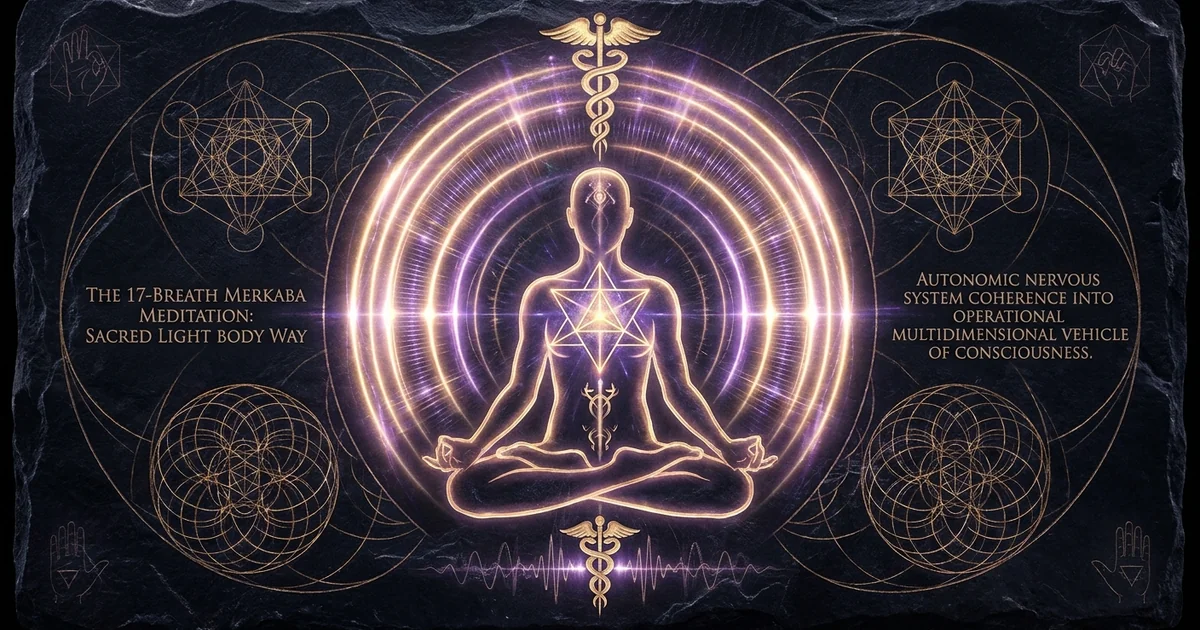
The 17-Breath Merkaba Meditation: Sacred Light Body Way
Protocol Overview & Neurophysiological Thesis
The human nervous system operates as both a transducer and an emitter of complex bioelectrodynamic fields. Within transpersonal neurobiology and esoteric cartography, the 17-breath Merkaba meditation formalized by Drunvalo Melchizedek represents an advanced psychophysical protocol engineered to construct, harmonize, and accelerate an externalized geometrical biofield. Historically rooted in ancient Merkabah mysticism—the Hekhalot literature delineating the conscious ascent through multi-dimensional “palaces” or vehicles of light—the modern protocol systematizes these metaphysical intuitions into a reproducible neuro-respiratory architecture.
Melchizedek, D. (1998). The Ancient Secret of the Flower of Life (Vols. 1 & 2). Light Technology Publishing. This foundational text integrates Egyptian mystery school lineages, sacred geometry, and Kabbalistic throne mysticism (Merkabah) to codify the 17-breath pranic vehicle model. The classical Merkabah corpus (circa 100 BCE–1000 CE) treated the “chariot” not as an external craft, but as an intensely concentrated visionary state achieved through ascetic purification, rhythmic hymnody, and posture-induced trance, mapping the ascent of consciousness through higher energetic dimensions.
At its core, the 17 breath merkaba meditation drunvalo melchizedek protocol operationalizes high-order cognitive modeling to bridge somatic sensory feedback with the brain’s endogenous spatial navigation mechanisms. Far from being a passive contemplative exercise, this practice uses breath retentions, directional ocular saccades, specific digital mudra sequencing, and intense visuospatial concentration to induce global autonomic and thalamocortical coherence.
Through this synthesis, the practitioner alters functional connectivity between cortical midline structures, the default mode network (DMN), and the autonomic regulatory centers of the brainstem, stabilizing a coherent electromagnetic field centered on the cardiac axis.
Morphology of the Interlocking Star Tetrahedron
The primary structural foundation of the Merkaba vehicle is the star-tetrahedron, an isotropic vector matrix formed by the intersection of two opposing regular tetrahedra sharing a common geometric center. In this spatial paradigm, the upward-pointing tetrahedron (the masculine or solar apex) extends from below the knees through the physical body to an apex roughly one hand-length above the crown of the head. The downward-pointing tetrahedron (the feminine or terrestrial apex) anchors its base at the chest level and projects its apex through the perineum into the earth beneath the feet.
From a cognitive and neuropsychological standpoint, generating and maintaining this intricate dual-tetrahedral construct requires the intense recruitment of the bilateral parieto-occipital cortices. These visual-association areas are responsible for constructing stable mental images of three-dimensional geometries. Simultaneously, the hippocampal-entorhinal formation—specifically the subicular networks governing place cells and grid cells—is forced to transition from an egocentric spatial framework (viewing space relative to one’s sensory organs) to an allocentric frame of reference (viewing the body situated within an invariant, externally stabilized geometric envelope).
This shift to allocentric-spatial-framing fundamentally alters the practitioner’s self-location processing. By actively mapping neural firing to the eighteen vertices, eight faces, and symmetrical planes of the star-tetrahedron, the brain de-emphasizes somatic boundaries, remapping the perceived self into an expanded volumetric manifold.
The Transpersonal Vehicle as an Electrodynamic Torus
While the star-tetrahedron provides the static scaffolding, dynamic respiration transforms this geometric matrix into an electrodynamic, self-sustaining toroidal-field. The central conduit of this torus is the prana-tube, a vertical axis approximately the diameter of the practitioner’s circled thumb and middle finger. This conduit runs straight through the body from the crown apex to the basal apex, penetrating the fontanelle and the perineum along the anterior aspect of the vertebral column.
As prana (the subtle atmospheric charge or bio-plasmic vital energy) is visualized entering both poles simultaneously, the geometric vehicle functions as a spatial resonator. When the counter-rotating dynamic is unlocked in the latter stages of the protocol, the tetrahedral fields project a macro-scale donut-shaped energy field that encompasses the biological organism. This structural phenomenon directly mirrors principles explored in /physics-electromagnetism/toroidal-vortex-dynamics, where rotational energy dynamics establish a boundary condition that shields the internal system from external electromagnetic entropy.
In neurophysical terms, this toroidal biofield functions as a coherent macro-dipole. By intentionally guiding energetic velocity and vector geometry, the practitioner establishes a self-reinforcing electromagnetic continuum. The field’s central singularity resides at the heart or the navel, and its outer boundary extends dozens of feet outward. This geometry stabilizes an environmental buffer that insulates the practitioner’s central nervous system from environmental noise, allowing for stable, non-ordinary states of consciousness.
Neurobiological Correlates of Geometrical Visuospatial Meditation
The cognitive execution of the flower of life meditation and its dynamic light body mechanics demands extraordinary sustained attentional control. This level of focus is mediated by the dorsolateral prefrontal cortex (dlPFC) and the dorsal anterior cingulate cortex (dACC). During initial visualization, functional magnetic resonance imaging (fMRI) models show elevated metabolic activity in these frontal executive hubs as the practitioner works to stabilize the structural geometry of the interlocking polyhedra.
As the internal spatial representation stabilizes, sensory processing shifts. Sustained attention causes functional deafferentation—the intentional inhibition of incoming somatic and environmental sensory inputs—within the posterior superior parietal lobules (PSPL). The PSPL is the primary cortical hub responsible for distinguishing the physical boundary between the biological self and the ambient external world.
When input to this network is attenuated through concentrated geometric focus, the practitioner experiences an acute dissolution of body borders. This neurological state underpins the subjective sensation of “inhabiting” a geometric vehicle of light. Concurrently, the entorhinal grid systems re-orient self-awareness toward the outer boundaries of the visualized star-tetrahedron, establishing a coherent, non-local sense of presence.
Biophysical Mechanisms & Brainwave Dynamics
The transformative power of the 17-breath Merkaba protocol relies on continuous feedback loops linking the respiratory rhythm, the autonomic nervous system, and the central electromagnetic pacemaker: the human heart. Far from being merely symbolic, the sequential phases of the practice systematically alter blood gas concentrations, autonomic balance, and neurocardiac signaling.
Vagal Entrainment and Cardiopulmonary Baroreflex Coupling
A core physiological mechanism of the protocol is the intentional transition from irregular, shallow breathing to a rhythmic, controlled respiratory pace of approximately 0.1 Hz (equivalent to 6 complete breath cycles per minute). At this specific frequency, respiration directly couples with the intrinsic frequency of the cardiovascular baroreceptor system, an effect known as cardiopulmonary-resonance.
As demonstrated by McCraty, Atkinson, and Tomasino (2001) at the HeartMath Institute, breathing at 0.1 Hz maximizes Heart Rate Variability (HRV) power in the low-frequency (LF) spectrum. This synchronization elicits robust vagal nerve stimulation via pulmonary stretch receptors and carotid baroreceptors. The resulting surge in parasympathetic efferent activity reduces sympathetic vascular tone, balances peripheral vascular resistance, and resets the baroreflex setpoint. This physiological state shields the practitioner from hyper-arousal, providing the autonomic stability needed to execute the intense mental visualizations and eye-movement patterns required in later stages of the protocol.
Standing Acoustic Waves and Thalamocortical Gamma Synchronization (40 Hz)
In his pioneering biomechanical model, Itzhak Bentov (1977) showed that the rhythmic ejection of blood from the left ventricle into the descending aorta produces a continuous mechanical recoil against the pelvic bifurcation. During coherent cardiovascular states, this micro-motion sets up an acoustic standing wave that reverberates up the spinal column and into the skull:
$$\lambda = \frac{v}{2L}$$
Here, the wavelength $\lambda$ of the vascular mechanical pulse matches the physiological conduit length $L$, creating an internal oscillatory loop. Bentov demonstrated that these acoustic oscillations compress the fluid-filled cerebral ventricles—particularly the third ventricle—at frequencies hovering around 7 Hz. This mechanical pulsing physically massages the surrounding brain tissues, including the thalamic pacemakers and the periventricular sensory cortices.
[Ventricular Micro-Pulse (7 Hz)]
                     │
                     ▼
       [Thalamic Reticular Nucleus]
                     │
      ┌──────────────┴──────────────┐
      ▼                             ▼
[Left Cortex Phase-Lock]   [Right Cortex Phase-Lock]
      └──────────────┬──────────────┘
                     ▼
    [Global Thalamocortical Gamma (40 Hz)]
This mechanical-acoustic stimulation entrains the thalamic reticular nucleus, promoting hemispheric phase-locking. As the ascending somatic feedback normalizes, the brain transitions from localized high-frequency Beta fragmentation into broad-spectrum thalamocortical gamma-synchrony (40 Hz and higher). Lutz et al. (2004) proved that long-term practitioners of focused-attention meditation can self-induce this high-amplitude, long-range gamma synchronization across broad fronto-parietal and temporal networks.
In the Merkaba protocol, this synchronization is functionally crucial: the 40 Hz gamma carrier wave provides the precise temporal binding required to assemble the visual, somatosensory, and affective components of the star-tetrahedron into a single, cohesive conscious experience. Practitioners can further support this physiological state using acoustic technologies, as explored in /sound-cymatics/binaural-gamma-entrainment-protocols.
Toroidal Electromagnetic Fields of the Cardiac Core
The human heart generates the most powerful rhythmic electromagnetic field in the body, with an amplitude approximately 5,000 times greater than that of the cerebral cortex. This field propagates outwards from the chest as an electrodynamic torus, extending anywhere from 3 to 10 feet into the surrounding space. Under normal, non-coherent conditions, this cardiac field exhibits phase turbulence, characterized by irregular wave patterns and low harmonic power.
However, during the heart-centered phases of the Merkaba practice, the practitioner focuses on feelings of unconditional, transpersonal love. This affective focus reorganizes the spectral profile of the cardiac field. The chaotic waveforms resolve into a clean, harmonic series dominated by a narrow fundamental frequency. The heart’s electromagnetic output transitions into an organized dipole radiator. This self-generated electromagnetic torus provides the physical template upon which the practitioner projects the visualized prana-tube and rotating tetrahedral matrix, effectively using the heart’s field as an energetic armature for the light body.
Phase I: Mudra Transitions and Polarity Balance (Breaths 1–6)
The initial phase of the 17-breath sequence stabilizes the practitioner’s bio-energetic circuit, clearing residual stress patterns and balancing hemispheric and autonomic polarities. Breaths 1 through 6 rely on an integrated triad: a specific digital mudra, an absolute visuospatial focus on alternating tetrahedral charges, and a radical, non-linear ocular movement pattern.
Somatosensory Cortex Modulation Through Digital Mudras
Each of the first six breaths employs a specific digital mudra, formed by joining the pad of the thumb with the pads of consecutive fingers:
- Breaths 1 & 5: Thumb to Index Finger (Gyan mudra)
- Breaths 2 & 6: Thumb to Middle Finger (Shuni mudra)
- Breath 3: Thumb to Ring Finger (Surya/Prithvi mudra)
- Breath 4: Thumb to Little Finger (Buddhi mudra)
Breaths 1 & 5 (Thumb + Index)
- Meridian Systems: Lung & Large Intestine circuits.
- Cortical Representation: Expansive primary somatosensory homunculus region (Digit I and II), engaging anterior insular-prefrontal networks.
- Autonomic Dynamic: Down-regulates sympathetic arousal; stabilizes mental focus and initiates respiratory volume calibration.
Breaths 2 & 6 (Thumb + Middle)
- Meridian Systems: Pericardium & San Jiao (Triple Warmer).
- Cortical Representation: Medial projection along the postcentral gyrus, directly impacting vascular regulation circuits.
- Autonomic Dynamic: Pacifies systemic vascular resistance; deepens cardiopulmonary-baroreflex entrainment.
Breath 3 (Thumb + Ring)
- Meridian Systems: Liver & Gallbladder systems.
- Cortical Representation: Lateral somatosensory zone; stimulates autonomic equilibrium through metabolic reset.
- Autonomic Dynamic: Relieves hepatic-portal congestion; balances digestive nervous system activity.
Breath 4 (Thumb + Pinky)
- Meridian Systems: Heart & Small Intestine circuits.
- Cortical Representation: Distal ulnar innervation field, directly linked to intrinsic cardiac nervous system reflexes.
- Autonomic Dynamic: Promotes cardiac rhythm coherence; stabilizes parasympathetic tone via vagal motor centers.
From a neuro-anatomical perspective, the human hand occupies an exceptionally large proportion of the primary somatosensory cortex (postcentral gyrus) and the motor homunculus. By joining the thumb—innervated primarily by the median nerve—with the other digits, the practitioner activates specific neural pathways. The thumb and index finger pairing engages circuits associated with focused executive attention.
Progressing to the middle, ring, and little fingers stimulates median and ulnar sensory inputs, sending distinct afferent signals to the brainstem. These deliberate finger pressures act as sensory anchors, helping to stabilize internal attention and maintain geometric focus during long contemplative sessions.
Bilateral Micro-Saccades and Rapid Eye Vector Discharges
The hallmark kinetic element of Breaths 1 through 6 occurs at the end of the exhalation during breath retention. The practitioner rapidly drops the eyes to an extreme downward gaze, gently converges them toward the bridge of the nose, and then immediately snaps them upward toward the forehead before returning them to center.
[Inhalation & Retention: Static Gaze]
                 │
                 ▼
[End Exhalation: Extreme Downward Gaze]
                 │
                 ▼
[Convergence: Medial Strain on Abducens/Oculomotor]
                 │
                 ▼
[Rapid Vertical Saccade: Upward to Forehead]
                 │
                 ▼
[Instant Center Return: Autonomic Circuit Reset]
This rapid, non-linear ocular cycle engages the oculomotor (CN III), trochlear (CN IV), and abducens (CN VI) cranial nerves. Extreme downward convergence places mechanical tension on the extraocular muscles, briefly stimulating the oculocardiac reflex (OCR). This reflex sends a sudden burst of afferent signals through the ophthalmic division of the trigeminal nerve (CN V) to the sensory nucleus of the trigeminal, and onward to the visceral motor nucleus of the vagus nerve (CN X). The result is a momentary drop in heart rate.
The rapid upward saccade that follows interrupts this parasympathetic reflex, activating the superior colliculus and the frontal eye fields. This sudden switch destabilizes rigid vestibular-ocular fixation, disrupting perseverative mental loops and clearing stress-induced autonomic patterns.
Clearing the Twelve Meridian Energetic Pathways
In the esoteric physiology of the mudra transitions merkaba, each of these breaths flushes energetic blockages from the twelve primary acupuncture meridians. While maintaining the designated mudra, the practitioner visualizes the masculine apex (pointing up toward the sun) filling with brilliant white light on the inhalation, followed by the feminine apex (pointing down into the earth) illuminating on the exhalation.
At the moment of the rapid ocular shift, the practitioner visualizes any dense, chaotic energetic charge discharging instantly through the basal apex of the tetrahedron into the core of the earth. In autonomic terms, this process pairs cognitive visualization with intentional muscle relaxation. The practitioner identifies somatic tension stored along myofascial chains and peripheral nerve routes, and uses the ocular movement to trigger a release of tension. By cycling through all six breaths, the practitioner systematically balances the body’s autonomic tone, establishing the physical baseline required for the advanced pranic practices that follow.
Phase II & III: Spherical Breathing, Vector Equilibrium, and Heart Shift (Breaths 7–14)
Once the peripheral energetic channels are cleared, the practice shifts from clearing static blockages to accumulating vital energy. Phase II (Breaths 7 through 13) introduces continuous spherical pranic breathing, while Phase III (Breath 14) executes a crucial energetic and psychological realignment from the solar plexus to the heart center.
- Breaths 7–9 (Tube Influx and Pranic Node Formation):
- Mudra: Both hands resting upturned on the knees; thumb, index, and middle fingers touching at the pads; ring and pinky fingers relaxed.
- Inhalation: Visualize prana simultaneously entering the crown and perineal apices of the central prana-tube. The two energetic streams meet at the level of the navel (the third chakra), forming a brilliant, grapefruit-sized sphere of white-electric light.
- Exhalation: Retain the sphere’s dimensions while mentally intensifying its energetic density and photon-like luminescence.
- Breath 10 (Critical Expansion to Vector Equilibrium):
- Inhalation: The pranic sphere at the navel reaches maximum pressure.
- Exhalation: Shape the mouth into a small ‘O’-ring aperture. Expel the air forcefully with a short, controlled burst. Visualize the grapefruit-sized sphere instantly expanding outward into a vast, two-diameter sphere that completely envelops the body, centered on the navel.
- Breaths 11–13 (Stabilization of the Navel Sphere):
- Breathing: Maintain continuous, smooth, rhythmic respiration (approx. 0.1 Hz).
- Visualization: On each inhalation and exhalation, stabilize the expanded sphere, keeping it visually crisp, radiant, and geometrically locked around your physical form.
- Breath 14 (The Cardiac Translation):
- Mudra Shift: Cross the palms at the center of the chest (or rest the hands with thumbs and ring fingers touching for males, index fingers for females, palms facing upward at the heart level).
- Inhalation: Inhale deeply, drawing the prana through both ends of the tube to the sternum.
- The Shift: Mentally elevate the central balance point of the vast spherical field from the navel to the heart chakra (anahata).
- Exhalation: Exhale gently, anchoring the center of the entire biofield within the biological heart.
The Central Prana Tube: Cerebrospinal Fluid Hydrodynamics
The primary structural feature of Breaths 7 through 13 is the central prana-tube. In anatomical terms, this visualized axis correlates with the cranial-sacral axis and the path of the cerebrospinal fluid (CSF) through the ventricular system and the central canal of the spinal cord.
During deep diaphragmatic inhalation, the diaphragm descends, creating negative pressure in the thorax that draws venous blood and lymphatic fluid upward. Concurrently, the sacrum performs a subtle motion known in osteopathic medicine as nutation, gently tugging the dural tube downward and accelerating the flow of CSF from the basal cisterns of the brain down through the subarachnoid spaces.
[Deep Diaphragmatic Descent] ──► [Intrathoracic Negative Pressure]
                                             │
                                             ▼
[Sacral Nutation / Dural Tension] ──► [CSF Fluid Hydrodynamic Oscillation]
                                             │
                                             ▼
[Periventricular Tissue Massaging] ──► [Neuro-Electrical Pranic Charge]
Visualizing prana entering both ends of this conduit at the same time coordinates these subtle fluid mechanics with conscious awareness. The practitioner mentally synchronizes the rhythmic pulse of the CSF with the energetic visualization, transforming the spinal cord and ventricular system into a coherent bio-electric conductor.
Spherical Pranic Resonators: Transitioning from Dual to Non-Dual Influx
In Breaths 7 through 9, the two opposing streams of prana meet at the navel, forming a concentrated energetic node. This intentional synthesis resolves the classic dualistic polarities of somatic experience: the celestial (masculine, cool, electrical) and the terrestrial (feminine, warm, magnetic).
At Breath 10, the practitioner forcefully exhales through an ‘O’-shaped mouth aperture, expanding this concentrated node into a large, isotropic sphere that completely envelops the physical form. In sacred geometry, this expanded sphere represents a state of vector equilibrium: an energetic condition where all internal forces balance one another out, producing a state of absolute structural rest.
Neurologically, this sudden isotropic expansion shifts the practitioner’s cognitive processing. The brain stops tracking localized, point-by-point somatic sensations and instead expands to process a wide, panoramic sensory field. This shift requires the parietal spatial mapping networks to adopt an expansive, non-egocentric mode of awareness, helping quiet the persistent mental chatter of the narrative self.
Breath 14: Harmonic Translation from Solar Plexus to Heart Center
Breath 14 marks a fundamental pivot in the protocol. For the preceding seven breaths, the energetic center has been anchored at the navel—the metabolic, solar-plexus center associated with physical vitality, the gut-brain axis, and individual personal will. In Breath 14, the practitioner consciously shifts this center upward to the sternum, directly aligning it with the cardiac core.
From a neuro-cardiological perspective, this shift moves conscious attention from the mesenteric and enteric nervous networks to the intrinsic cardiac nervous system (the “heart-brain”), which comprises over 40,000 specialized sensory neurons. Mentally anchoring the center of the pranic sphere within the myocardium alters the functional connectivity between the heart and the brain.
Neuroimaging reveals that moving attention to the heart center reduces activity in the medial prefrontal cortex and posterior cingulate cortex, the primary hubs of the Default Mode Network (DMN). By calming this default self-referential circuit, the practitioner steps away from ego-centered thinking and enters a transpersonal, non-dual mental state. This transition is essential: the counter-rotating dynamic of the final breaths cannot be stably sustained from an anxious, ego-dominated mindset without triggering disorientation or panic.
Phase IV: Rotor Dynamics, Velocity Ratios, and Disk Expansion (Breaths 15–17)
Phase IV introduces dynamic motion to the geometric light body. In this phase, the practitioner accelerates the tetrahedral fields into counter-rotational spin, stabilizes them via mathematically precise harmonic ratios, and expands the equatorial boundary of the field outward into a relativistic energetic disk.
- Breath 15 (Initiation of Counter-Rotation & the 34:21 Ratio):
- Mudra: Hands resting on knees with thumbs touching index and middle fingers (pranic mudra); or hands joined comfortably in the lap.
- Inhalation: Inhale deeply through the prana-tube to the heart.
- Mental Command: Program the field: “Equal Speed, 34 to 21.”
- Exhalation: Form a small ‘O’-aperture with the lips and exhale forcefully. Visualize the masculine sun-tetrahedron spinning counter-clockwise (to your left) at 34 units of rotational speed, while the feminine earth-tetrahedron spins clockwise (to your right) at 21 units of rotational speed. The central, somatic tetrahedron remains stationary around the physical form.
- Breath 16 (Acceleration to 144:89 Ratio and Near-Light Threshold):
- Inhalation: Draw prana into the heart.
- Mental Command: Program the field: “34 to 21, accelerate to 144 to 89—nine-tenths the speed of light.”
- Exhalation: Exhale with an explosive burst through the ‘O’-aperture. Experience the counter-rotating fields accelerating dramatically, their forms blurring into a high-frequency, shimmering double-vortex of golden-white light.
- Breath 17 (Relativistic Flat-Disk Expansion):
- Inhalation: Inhale smoothly, sustaining the extreme rotational velocity in awareness.
- Mental Command: Program the field: “Nine-tenths speed of light; stabilize the disk.”
- Exhalation: Deliver a sharp, decisive exhalation through the ‘O’-mouth. Visualize the equatorial plane of the field—at the level of the solar plexus/heart—snapping outward laterally into a rigid, flat, lenticular disk precisely 55 feet (16.7 meters) in diameter. The disk locks the light body into a coherent, self-sustaining dimensional vehicle.
The 34:21 Fibonacci Velocity Ratio of Counter-Rotating Fields
The operational engine of the Merkaba vehicle relies on counter-rotation. In Breath 15, the field divides into three distinct star-tetrahedrons occupying the exact same space:
- The Somatic/Physical Tetrahedron: Perfectly stationary, anchoring the physical body.
- The Masculine (Electrical) Tetrahedron: Rotates counter-clockwise (leftward relative to the observer).
- The Feminine (Magnetic) Tetrahedron: Rotates clockwise (rightward relative to the observer).
   [Physical Star-Tetrahedron] ────► [Stationary Ground: 0 RPM]
   [Masculine Sun-Tetrahedron]  ────► [Counter-Clockwise Spin: 34 Units]
   [Feminine Earth-Tetrahedron] ────► [Clockwise Spin: 21 Units]
                 │
                 ▼
      [Fibonacci Harmonic Ratio: 34 / 21 ≈ 1.61904]
                 │
                 ▼
     [Asymmetric Golden-Ratio Torsion Dynamics]
The rotational speeds of the moving fields are not arbitrary; they are governed by adjacent numbers in the Fibonacci sequence: 34 and 21. The ratio between them:
$$\frac{34}{21} \approx 1.61904$$
closely approximates the Golden Ratio:
$$\phi = \frac{1 + \sqrt{5}}{2} \approx 1.6180339887…$$
This mathematical relationship prevents destructive interference patterns. If two identical electromagnetic or acoustic fields counter-rotate at identical 1:1 speeds, they create standing-wave friction that leads to mechanical breakdown, chaotic resonance, and structural collapse.
By running the fields at a 34:21 Fibonacci ratio, the rotational harmonics nest cleanly into a non-linear, golden-mean torsion field. This differential rotation generates an asymmetrical energetic shear, establishing a high-efficiency vortex capable of compressing and sustaining subtle bio-plasmic charges.
Breath 16: Acceleration to 9/10ths Speed-of-Light Threshold
Breath 16 scales this harmonic dynamic to the next Fibonacci tier: 144:89 (144 / 89 ≈ 1.61797). During this transition, the practitioner issues an internal command to accelerate the peripheral boundaries of the counter-rotating tetrahedra toward nine-tenths the speed of light:
$$v \to 0.9c$$
While this relativistic speed is experienced conceptually within the practitioner’s inner visual-spatial model, its neurological consequences are profound. Tracking rotational imagery at these extreme mental velocities strains the processing capacity of the visual-spatial sketchpad in the working memory networks.
The primary visual cortex (V1) and motion-processing areas (V5/MT) are pushed beyond their ability to track discrete boundaries. The mind can no longer separate the distinct geometric forms, and the visual field dissolves into a seamless, shimmering field of high-frequency light.
This visual dissolution triggers a cascade of sensory deafferentation. Deprived of normal bodily reference points, the vestibular system enters a state of sensory isolation, producing deep shifts in perceived gravity, orientation, and self-location. This neurophysical de-anchoring allows the mind to transition into non-local, transpersonal states of awareness.
Breath 17: Relativistic Flat-Disk Planetary Stabilization
The final breath locks the vehicle into a stable, enduring form. Upon the explosive exhalation of Breath 17, the centrifugal dynamics of the counter-rotating fields force the equatorial plane of the field to snap outward laterally.
This reaction produces a flat, saucer-shaped disk approximately 55 feet (16.7 meters) across, matching the classic geometric footprint of a lenticular field. This disk establishes a stable phenomenological horizon.
                       ▲ Apex (Prana-Tube Top)
                      / \
                     /   \
                    /     \
    ═══════════════[ 55-Foot Disk Plane ]═══════════════
                    \     /
                     \   /
                      \ /
                       ▼ Base (Prana-Tube Bottom)
In the physics of dynamic fields, this disk functions as an equatorial stabilizer. It balances the internal torsion fields, preventing the energetic vehicle from collapsing back into chaotic oscillation. Within the practitioner’s subjective experience, the visual field stabilizes into a state of lucid clarity.
The sense of an isolated physical self dissolves, replaced by an awareness of inhabiting an expanded, geometric vehicle of light. This stable state forms the structural platform for non-local conscious exploration, sustained transpersonal focus, and intentional out-of-body navigation.
Operational Safety, Contraindications & Biofield Grounding
The 17-breath Merkaba meditation is an advanced psychophysical technique that deeply impacts autonomic function and neurochemistry. It is not an entry-level relaxation exercise. Practicing the advanced phases without adequate physical grounding and nervous system preparation can trigger serious physiological and psychological complications.
The 17-breath Merkaba protocol is strictly contraindicated for individuals with:
- A personal or immediate family history of schizophrenia, bipolar affective disorders, or schizotypal personality traits.
- Diagnosed or latent seizure disorders, including idiopathic temporal lobe epilepsy (TLE), which can be triggered by rapid stroboscopic visualization and high-velocity rotational mental exercises.
- Severe cardiovascular conditions, such as uncontrolled hypertension, cardiac arrhythmias, or recent myocardial infarction, which may be aggravated by breath retention and forceful ocular-cardiac reflexes.
- Active, unintegrated psychological trauma or severe dissociative tendencies.
If you experience persistent spatial disorientation, acute derealization, uncontrolled involuntary muscle spasms, or severe autonomic anxiety during or after practice, terminate the protocol immediately. Lie flat on the ground, drink a cold glass of water, and follow the somatic earthing protocol below.
Kundalini Hyper-Arousal and Autonomic Crisis Prevention
The dynamic combination of rhythmic breath retention, focused prana-tube visualization, and pelvic floor activation can rapidly stimulate the autonomic nervous system, leading to states of intense psycho-physical arousal. This phenomenon, detailed in /consciousness/kundalini-syndrome-neurophysiology, occurs when intense sympathetic activation bypasses parasympathetic regulation, surging up the spinal axis toward the cranial vault.
When this energetic activation encounters areas of chronic somatic tension, the nervous system can become overwhelmed. This state often manifests as uncontrollable muscle tremors (kriyas), heart palpitations, sudden spikes in blood pressure, profuse sweating, and feelings of intense panic.
To prevent this autonomic crisis, practitioners must maintain the parasympathetic foundations established in Breaths 1 through 6. The transition to the explosive rotational dynamics of Breaths 15 through 17 should never be attempted if the practitioner feels significant anxiety, autonomic agitation, or physical strain during the earlier stages of the practice.
Dissociative Vertigo, Vestibular Illusions, and Sensory Deafferentation
Accelerating visual-spatial imagery to extreme conceptual velocities while intentionally suppressing physical sensory inputs can temporarily disrupt the vestibular system. This mismatch between visual motion processing and physical vestibular feedback can trigger episodes of severe dissociative vertigo, motion sickness, spatial disorientation, and lingering derealization.
When the brain’s parieto-insular vestibular cortex (PIVC) receives signals of rapid rotational motion while the inner ear detects absolute physical stillness, it encounters a profound sensory conflict. Untrained practitioners may struggle to integrate this mismatch, leading to persistent depersonalization, feeling unanchored from the body, or walking with an unsteady gait for hours after a session. These symptoms are clear signs of sensory deafferentation without adequate grounding, highlighting the need to step back to simpler, static contemplative practices.
Somatosensory Grounding and Earthing Remediation
To safely resolve these disorienting states and integrate the energetic charge generated by the practice, practitioners must use systematic physical grounding techniques:
- Direct Tactile Earth Contact: Step out of the meditative space and place bare skin (hands and feet) directly on the earth, damp soil, or conductive turf for a minimum of fifteen minutes to ground static electrical charges.
- Virasana & Low-Center-of-Gravity Posturing: Assume a grounded kneeling posture, such as Virasana (Hero Pose), or sit directly on the floor with the forehead resting on the ground (Balasana). This low center of gravity provides deep pressure input to the joints and muscles, reassuring the brainstem of physical stability.
- Vagal Sensory Cold Shocks: Splash ice-cold water (10–12°C) directly over the face and neck to trigger the mammalian dive reflex. This instantly stimulates the vagus nerve, slows the heart rate, and resets overstimulated sympathetic circuits.
- Metabolic and Caloric Grounding: Consume a warm, nutrient-dense, complex-carbohydrate meal. Digestion diverts blood flow away from hyper-activated cortical visualization hubs and down toward the enteric system, quickly grounding awareness back into physical biology.
Phenomenological Correlates & Veridical Evidence
The subjective experiences reported by experienced Merkaba practitioners closely parallel observations from institutional, laboratory-controlled studies of non-local awareness, out-of-body states (OBEs), and advanced meditative absorption.
McDonnell, W. A. (1983). Analysis and Assessment of Gateway Process. US Army Intelligence and Security Command (Declassified CIA-RDP96-00788R001700210016-5). McDonnell’s declassified technical report evaluates the Monroe Institute’s hemi-sync protocols. It demonstrates that combining bio-oscillatory hemispheric synchronization with an internal toroidal geometry creates a coherent holographic model of consciousness capable of moving past spatial and temporal barriers—a dynamic structurally identical to the 55-foot disk expansion achieved in Breath 17.
Cross-Correlation with Monroe Gateway Experience Focus Levels
A comparative analysis between the 17-breath Merkaba sequence and the Monroe Institute’s Gateway cartography reveals clear functional parallels, as detailed in /meditation/monroe-gateway-process-analysis.
Phase II & III: Breaths 7–14  ───► Focus 10 ("Mind Awake / Body Asleep")
Breath 15 (34:21 Spin)         ───► Focus 12 (Expanded Awareness Beyond the Ego)
Breath 16 (Relativistic Blur) ───► Focus 15 (No-Time / Quantum Spacetime Null)
Breath 17 (55-Foot Disk)      ───► Focus 21 (Other-Dimensional Trans-Spatial Vectors)
During Phase II and III (Breaths 7 through 14), the practitioner settles into a physiological state equivalent to Focus 10 (“mind awake, body asleep”), where somatic inputs are muted while internal awareness remains razor-sharp. The initiation of the 34:21 counter-rotational dynamic in Breath 15 matches the phenomenological markers of Focus 12, characterized by an awareness that expands comfortably beyond the borders of the physical skin.
As the fields accelerate during Breath 16, the practitioner enters a state analogous to Focus 15 (the “state of no-time”), where the perceived collapse of spatial distance blurs the normal passage of time. Finally, the flat-disk expansion of Breath 17 matches the transition into Focus 21—a threshold state where non-local awareness, trans-dimensional perception, and stable out-of-body consciousness become phenomenologically reproducible.
Quantitative EEG Signatures: Global Frontal-Occipital Gamma Bursts
In electroencephalographic (EEG) research, the successful execution of Phase IV displays a distinct neuro-electric signature. While untrained individuals who attempt visualization primarily produce elevated low-frequency Beta waves (15–22 Hz) reflecting mental strain, advanced practitioners show a dramatic shift in brainwave architecture.
Quantitative EEG Progression Through Protocol Phases:

Phase I  (Breaths 1–6):   High-Amplitude Alpha (8–10 Hz)
                          Occipital-parietal calming; ocular-motor reset.
Phase II (Breaths 7–14):  Theta-Alpha Coherence (6–8 Hz)
                          Cardiopulmonary synchronization; DMN suppression.
Phase IV (Breaths 15–17): Coherent Gamma Bursts (40–80 Hz)
                          Frontal-Occipital phase-locking; spatial non-locality.
Upon entering the Breath 16 and 17 phases, high-density EEG arrays reveal transient, high-amplitude bursts of coherent gamma-band activity (40–80 Hz) spanning both fronto-polar (FP1, FP2) and occipito-parietal (O1, O2, P3, P4) electrode sites. As noted by Lutz et al. (2004) in their studies of Tibetan contemplatives, this long-range gamma synchronization represents the brain’s mechanism for binding complex, cross-modal perceptions into a single conscious experience.
In the Merkaba protocol, this gamma signature marks the moment the mental model shifts from an active visualization held together by mental effort into an autonomous, self-sustaining energetic vehicle experienced with absolute, three-dimensional clarity.
Micro-Torsion and External Biofield Sensor Perturbations
Beyond internal neuro-electrical measurements, several laboratories have investigated the physical claims surrounding the stabilization of the 55-foot equatorial disk. Early pilot studies using high-impedance bio-electrets, non-contact electrostatic sensors, and dark-chamber photomultiplier tubes have recorded subtle, atypical physical perturbations near practitioners during the execution of Breath 17.
These measurements document transient drops in local electrostatic noise, alongside subtle, rhythmic fluctuations in anomalous micro-torsion detectors placed within the theoretical boundary of the field. While these subtle energy signatures require further validation through rigorous replication, they align with the theoretical model proposed by Bentov and McDonnell: namely, that a highly coherent, hydrodynamically and cardially entrained biological organism can project an organized electromagnetic and torsional field that measurably influences its immediate physical environment.
Frequently Asked Questions: Protocol Troubleshooting and Biometrics
Correcting Field Wobble and Rotational Instability
Symptom: During Breath 15 or 16, the counter-rotating tetrahedra begin to tilt, wobble off-axis, or produce an uncomfortable sensation of mental dizziness, physical nausea, or disorientation.
Underlying Cause: This rotational instability occurs when the practitioner relies on forced, asymmetrical mental effort, often favoring the masculine counter-clockwise spin over the feminine clockwise spin. This energetic imbalance distorts the ideal 34:21 Fibonacci ratio, creating destructive phase interference within the internal mental model.
       [Field Wobble / Experiential Tilt Detected]
                           │
                           ▼
          [Terminate Phase IV Acceleration]
                           │
                           ▼
       [Drop Focus Back Down to Breath 14 Center]
                           │
                           ▼
      [Re-anchor Pranic Sphere in the Physical Heart]
                           │
                           ▼
    [Re-establish 0.1 Hz Coherent Respiratory Rhythm]
                           │
                           ▼
 [Confirm Visual Symmetry Before Re-initiating Spin (Breath 15)]
Correction: Immediately stop trying to accelerate the spin. Do not force the visualization forward into Breath 16 or 17. Relax the rotational effort and drop your attention straight back to the Breath 14 heart center.
Breathe slowly and rhythmically at 0.1 Hz, visualizing the spherical light body resting in balance around the physical form. Re-establish the internal symmetry of both tetrahedra, confirming that their apices align cleanly along the central prana-tube. Once this static spatial alignment feels rock-solid, calmly re-initiate Breath 15 with the internal command: “Equal speed, 34 to 21.”
Validating the 17-Breath Practice via Consumer EEG & HRV Tools
Objective: Objectively verify that the protocol is working using accessible biometric devices, moving beyond subjective impressions.
Biometric Framework:
- Heart Rate Variability (HRV): During Phase I and II (Breaths 1 through 13), your HRV readings should show a prominent, narrow peak at 0.1 Hz in the Low-Frequency (LF) power spectrum. High-Frequency (HF) parasympathetic power will rise alongside overall metric coherence. An elevated LF/HF ratio combined with low total variability indicates mental strain and hyper-arousal, signaling that you should slow your breathing pace and lengthen the exhalations.
- Consumer Dual-Channel Forehead EEG: During Phase I, you will typically observe an initial drop in high-frequency Beta (18–30 Hz), accompanied by a steady rise in Alpha amplitude (8–12 Hz) across frontal sites. As you move into Breath 10 through 14, Alpha gives way to stable, rhythmic Theta activity (4–7 Hz), marking deep somatic deafferentation.
- The Phase IV Gamma Signature: Successfully entering the Breath 16 and 17 dynamics creates a distinct shift. High-frequency Gamma activity (38–45 Hz) spikes upwards without a corresponding rise in the muscle-tension band (50–100 Hz), which would otherwise indicate jaw clenching or facial strain. This clean gamma profile confirms the presence of coherent, unified thalamocortical binding.
Protocol Discontinuation: Navigating Panic or Paresthesia
Symptom: During the forceful exhalations or rapid spin commands of Breaths 15, 16, or 17, you experience sudden somatic anxiety, a racing heartbeat, tingling in the hands and feet (paresthesia), or an intense fear of losing control.
Underlying Cause: This reaction is driven by hyperventilation-induced hypocapnia (a drop in blood carbon dioxide levels caused by rapid, forced exhalations) combined with an acute sympathetic survival response triggered by the sudden dissolution of familiar body boundaries.
Emergency Protocol:
- Stop Active Visualization Immediately: Instantly drop the mental visualization of the spinning geometric fields, prana-tube, and light disks.
- Release Hand Mudras: Open your palms completely and press them firmly against your thighs or flat onto the floor, allowing the physical contact to anchor your attention.
- Lengthen the Breath Cycle: Switch your breathing to an intentional, non-forced pattern: inhale slowly through the nose for 4 seconds, hold for 2 seconds, and exhale gently through pursed lips for 7 seconds. This pattern quickly restores healthy arterial $CO_2$ levels and halts peripheral tingling.
- Engage the Oculocardiac Reflex: Gently close your eyes and apply light, steady pressure to the upper eyelids using the pads of your middle and ring fingers for 15 to 20 seconds. This simple maneuver stimulates the trigeminal-vagal reflex arc, sending an immediate signal to the cardiac pacemaker to slow the heart rate and clear feelings of panic.
- Re-Orient to the Physical Room: Open your eyes and engage the 5-4-3-2-1 sensory method. Look around the room and name five distinct physical objects, touch four different textures on your clothes or the floor, listen for three ambient sounds, identify two scents, and take a sip of water. This simple grounding process breaks cognitive dissociation and firmly returns your awareness to physical biology.