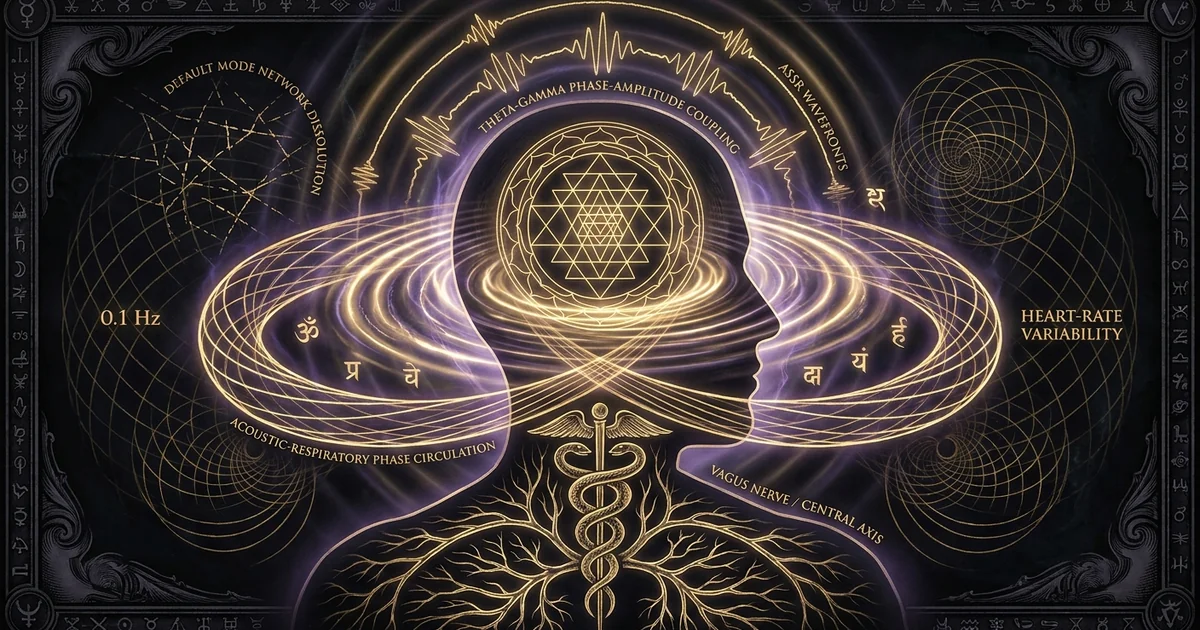
Kirtan and Mantra Repetition: Acoustic Neuromodulation
Protocol Overview & Neurophysiological Thesis
Acoustic Phonemic Transduction and Vagal Sensory Afferents
Mantra japa and communal kirtan operate not merely as devotional expressions or contemplative cognitive strategies, but as rigorous biophysical protocols for acoustic neuromodulation. The mechanical genesis of vocalized sound begins with pulmonic air streams traversing the adducted vocal folds of the larynx, oscillating the surrounding tissues and producing an acoustic pressure wave defined by specific harmonic series. As these sonic frequencies propagate outward through the pharyngeal, oral, and nasal cavities, their acoustic kinetic energy reflects inward into the cranium through osseous pathways. The primary transduction interface resides at the palatine vault: vocalized phonemes exert cyclical mechanical compression upon the palatine mucosa, activating mechanoreceptors coupled to peripheral terminals of the maxillary division of the trigeminal nerve ($CN\ V_2$) and the glossopharyngeal nerve ($CN\ IX$).
Simultaneously, the continuous sensory afference driven by sustained phonation recruits the recurrent and superior laryngeal branches of the vagus nerve ($CN\ X$). This mechanical stimulation transforms into bioelectric cascades that terminate within the brainstem, specifically targeting the nucleus tractus solitarius (NTS). The NTS functions as the central relay station for visceral afference, directly translating mechanosensory vocal signals into broad regulatory shifts across the central autonomic network. Through these pathways, targeted vocalizations function analogously to peripheral vagal-nerve-stimulation, directly recruiting cholinergic anti-inflammatory networks and modulating the autonomic balance toward parasympathetic predominance.
PULMONIC DRIVE ──> LARYNGEAL OSCILLATION ──> PALATINE & CRANIAL OSTEOPHONY
                                                       │
                                      ┌────────────────┴────────────────┐
                                      ▼                                 ▼
                           Mechanoreceptor Discharge        Auricular/Laryngeal Afference
                           (Trigeminal CN V₂ & CN IX)               (Vagus CN X)
                                      │                                 │
                                      └────────────────┬────────────────┘
                                                       ▼
                                          Nucleus Tractus Solitarius
                                                       │
                               ┌───────────────────────┴───────────────────────┐
                               ▼                                               ▼
                Dorsal Motor Nucleus of Vagus                     Nucleus Ambiguus
           (Visceral Slowing & Parasympathetic Tone)           (Cardiorespiratory Phase-Locking)
Modulation of the Central Autonomic Network via Paced Vocalization
The autonomic nervous system is dynamically recalibrated by the respiratory constraints enforced during mantra repetition. In typical spoken dialogue, expiration and inspiration oscillate unpredictably in response to linguistic syntax and affective volatility. Mantra recitation imposes an unyielding, rhythmic duty cycle upon the pulmonary apparatus. Expiration is dramatically prolonged as the practitioner sustains vocal phonation, while inspiration is compressed into a rapid, controlled diaphragmatic phase. This artificial respiratory geometry directly induces respiratory-sinus-arrhythmia (RSA), wherein heart rate systematically decelerates during the prolonged vocal expiration and subtly accelerates during inhalation.
This oscillatory cycle optimizes baroreflex-sensitivity. The arterial baroreceptors located within the carotid sinus and aortic arch detect the cyclic pressure alterations induced by prolonged thoracic exhalation, relaying signals via the glossopharyngeal and vagal nerves to the NTS and the caudal ventrolateral medulla (CVLM). The CVLM subsequently inhibits the rostral ventrolateral medulla (RVLM), dampening sympathetic outflow to the peripheral vasculature and the heart. The resulting autonomic reorganization is marked by an immediate elevation in high-frequency heart rate variability (HF-HRV, 0.15–0.40 Hz), reflecting heightened cardiovagal tone, accompanied by an absolute reduction in sympathetic vasomotor tone. In this context, mantra japa kirtan chanting neuromodulation vagal resonance emerges as a repeatable mechanical intervention capable of structurally realigning neurovascular and autonomic equilibrium.
Functional magnetic resonance imaging (fMRI) investigations conducted by Kalyani et al. (2011) demonstrated significant bilateral hemodynamic deactivation within the limbic and paralimbic systems—specifically the amygdala, anterior cingulate gyrus, hippocampus, and insula—during repetitive audible vocalization of the syllable ‘OM’, in direct contrast to resting baseline and non-linguistic sustained phoneme controls. The spatial profile of this limbic attenuation precisely mirrors the neurofunctional changes observed during therapeutic transcutaneous and implantable vagal nerve stimulation (VNS), establishing that the acoustic and mechanosensory feedback loops generated by traditional vocal mantras exert equivalent central neuromodulatory effects.
Target States: Down-Regulated Default Mode Network and Theta Synchronization
At the cortical level, continuous mantra phonation drives a systemic reallocation of neural resources away from introspective autobiographical loops and toward sensorimotor and auditory integrative networks. The principal cortical target of this acoustic protocol is the default-mode-network-deactivation, predominantly its core functional nodes: the medial prefrontal cortex (mPFC) and the posterior cingulate cortex (PCC)/precuneus axis. During task-unfocused resting states, hyper-connectivity within the default mode network (DMN) facilitates spontaneous self-referential mentation, rumination, and temporal mental travel. The continuous motor planning, phonemic articulation, and auditory sensory integration required by mantra execution impose an immediate cognitive load that decouples the mPFC from posterior midline structures.
As the subjective sense of a localized narrative ego recedes via DMN down-regulation, electroencephalographic (EEG) spectral profiles demonstrate an emergence of frontal midline theta ($Fm\Theta$, 4–8 Hz) activity, accompanied by widespread temporal and parietal alpha rhythms (8–12 Hz). Frontal midline theta oscillations reflect the synchronized firing of neuronal assemblies in the dorsal anterior cingulate cortex (dACC), a state linked to sustained focal attention and internalized emotional integration. This synchronized theta cadence acts as an informational filter, dampening exteroceptive distractors and stabilizing the subjective continuum of consciousness in an alert, hypometabolic, non-referential state.
Biophysical Mechanisms & Brainwave Dynamics
Auditory Evoked Potentials and Acoustic Entrainment Bands
When an acoustic signal is cyclically received by the tympanic membrane, mechanical motion is transduced through the ossicular chain of the middle ear into hydraulic pressure waves within the perilymph and endolymph of the cochlea. The resulting deflection of the basilar membrane stimulates the inner hair cells, triggering tonotopically organized bioelectric action potentials across the cochlear division of the vestibulocochlear nerve ($CN\ VIII$). These impulses project sequentially through the cochlear nuclei, superior olivary complex, lateral lemniscus, and inferior colliculus to the medial geniculate body (MGB) of the thalamus, before terminating within the primary auditory cortex (A1; Brodmann areas 41 and 42).
COCHLEAR TRANSDUCTION ──> BRAINSTEM RELAYS (Cochlear Nuclei & Superior Olive)
                                               │
                                               ▼
                              INFERIOR COLLICULUS & THALAMIC MGB
                                               │
                                               ▼
                              PRIMARY AUDITORY CORTEX (A1)
                                               │
                                               ▼
                       Thalamocortical Phase-Locking (ASSR Loop)
                                               │
                    ┌──────────────────────────┴──────────────────────────┐
                    ▼                                                     ▼
    Cortical Entrainment: Alpha/Theta                      Transient High-Amplitude
      (Temporal, Parietal, Frontal)                          Gamma-Band Bursts
Under the influence of rhythmic, repetitive acoustic input such as sustained mantra japa or kirtan refrains, this sensory hierarchy generates an auditory-steady-state-response (ASSR). When the frequency of the input matches endogenous thalamocortical resonance parameters, the firing rates of broad populations of pyramidal neurons synchronize with the stimulus envelope. At repetitive tempos ranging from 60 to 120 beats per minute (1 to 2 Hz temporal periodicity), the rhythmic acoustic cadence facilitates a progressive down-shift of high-frequency, low-amplitude beta rhythms (13–30 Hz)—indicative of active cortical arousal and divergent cognitive processing—into highly synchronized alpha (8–12 Hz) and mid-range theta (4–8 Hz) oscillations across temporal, frontal, and parietal derivations.
Sanskrit Vibrational Phonetics and Cranial Osteophony
The phonetic matrix of classical Sanskrit (Sanskrit vibrational phonetics) is systematically categorized by anatomical points of articulation across the palate: guttural (kanthya), palatal (talavya), cerebral or retroflex (murdhanya), dental (dantya), and labial (oshthya). This taxonomic organization carries profound neuro-mechanical implications. The retroflex consonants (e.g., ṭa, ṭha, ḍa, ḍha, ṇa) require the tongue to curl back, causing its rigid dorsal tip to strike the hard palate near the sphenoid base, while the nasal resonance (anusvara, “ṃ”) and labial nasals (m) terminate in sustained, unvoiced phonation with the mouth sealed or constricted.
This acoustic mechanic generates bone conduction (cranial osteophony) that circumvents the tympanic apparatus entirely. Nasal humming and sustained m phonemes generate cranial osseous vibrations peaking between 120 Hz and 150 Hz. This frequency domain directly vibrates the sphenoid, ethmoid, and vomer bones, driving acoustic pressure oscillations through the paranasal sinuses. This localized mechanical resonance stimulates the sinus endothelial lining to produce transient surges of endogenous nitric oxide (NO), a potent vasodilator that enhances local cerebral blood flow. Furthermore, these acoustic vibrations propagate into the ventricular system, where they induce micro-mechanical pulsations within the cerebrospinal fluid (CSF), promoting interstitial waste clearance through the glymphatic pathway and modulating intracranial microvascular tone.
Inter-Hemispheric Synchronization and Transient Gamma Modulation
As vocal and acoustic immersion deepens, the continuous sensory-motor loop of vocalization coupled with auditory feedback triggers extensive inter-hemispheric coherence. In baseline waking states, electrophysiological recording reveals marked hemispheric lateralization: the left hemisphere exhibits dominance in syntactic parsing, temporal sequencing, and analytic segmentation, while the right hemisphere manages spatial processing, non-linguistic tonality, and affective prosody. Chanting disrupts this functional segregation. Because mantras encode phonemic precision (traditionally left-hemispheric) embedded within musical rhythm and melodic contour (traditionally right-hemispheric), both cerebral hemispheres are forced to process congruent sensory-motor streams simultaneously.
This concurrent processing drives high inter-hemispheric phase coherence across transcallosal projections. Advanced practitioners transitioning through peak phases of contemplative absorption frequently display transient, cross-cortical gamma-synchronization (30–100 Hz, with strong concentrations near 40 Hz). Unlike the localized gamma bursts associated with sensory binding in standard waking cognition, this chanting-induced gamma state is characterized by high amplitude and macroscopic phase synchrony across wide spatial distributions, spanning frontal, parietal, and temporal leads. This gamma burst phenomenon correlates phenomenologically with states of expanded unified awareness, the cessation of subject-object dualism, and heightened cognitive clarity, providing an electrophysiological correlate for deep meditative absorption (samadhi).
Comparative Architecture: Solitary Japa vs. Communal Kirtan
Solo Mala Beads 108 Count as Hypo-Arousal Neuromodulation
Solitary mantra japa mediated by the kinesthetic manipulation of a 108-bead rosary (mala-beads-108) represents a targeted hypo-arousal neuromodulatory protocol. In this modality, exogenous sensory input is minimized. The practitioner typically assumes a stable, immobilized posture (asana), dampening vestibular and gross motor feedback. The tactile progression across precisely 108 beads acts as a somatosensory pacing mechanism that continuously engages the primary somatosensory cortex ($S1$) and the motor cortex ($M1$) via the thumb and middle finger. This rhythmic, precise motor activation gates out extraneous sensory input without inducing autonomic excitation.
The continuous loop of solitary japa—whether executed audibly (vaikhari), whispered (upamshu), or mentally represented (manasika)—creates an enclosed internal auditory-motor circuit. The supplementary motor area (SMA) and Broca’s area coordinate with Wernicke’s area and the superior temporal gyrus, sustaining the phonetic loop of working memory on a single intentional point of focus. Because external relational stimuli are absent, metabolic expenditure steadily drops. Core body temperature decreases, peripheral vascular resistance drops, metabolic rate declines, and the central nervous system settles into a state of hypo-metabolic quiescent alertness dominated by stable, high-amplitude posterior alpha and frontal theta rhythms.
SOLITARY JAPA (Hypo-Arousal Vector)
Solitary Posture ──> Tactile S1 Pacing (Mala) ──> Internalized Auditory Loop ──> Parasympathetic Dominance & Hypometabolism

COMMUNAL KIRTAN (Hyper-Arousal Vector)
Antiphonal Prosody ──> Mirror Neuron Activation ──> Neurochemical Cascade (β-endorphin/DA) ──> Dual Autonomic Co-Activation
Call-and-Response Kirtan and Inter-Personal Autonomic Coupling
In stark contrast to the inward trajectory of solitary japa, communal kirtan utilizes antiphonal musical structures (call-and-response) to drive interpersonal neurobiological synchrony. Kirtan integrates dynamic prosody, melodic harmonic changes, rhythmic acoustic acceleration, and collective synchronized physical action (clapping, swaying, dancing). According to the Polyvagal Theory outlined by Stephen Porges (2011), vocal prosody acts as a biological signifier of safety, mediated via the social engagement system. This system is anatomically grounded in the myelinated vagus (ventral vagal complex) and cranial nerves $V$, $VII$, $IX$, $XI$, and $XII$, which govern facial expression, middle ear acoustic filtering, vocalization, and social signaling.
The call-and-response architecture constructs an iterative communicative loop:
As the assembly echoes the leader’s vocalization, the participants’ respiratory cycles synchronize, locking individual respiratory-sinus-arrhythmia and heart rate variability patterns into a single collective rhythm. This collective bioacoustic entrainment activates mirror neuron assemblies within the inferior frontal gyrus and inferior parietal lobule, inducing a shared neurobiological state marked by high interpersonal coherence, boundary dissolution, and significant increases in circulating oxytocin.
Dual Pathways: Endogenous Opioidergic Ecstasy vs. Hypo-Metabolic Stillness
The neurochemical landscapes divergent between solitary japa and group kirtan delineate two distinct evolutionary adaptations of contemplative acoustic engineering:
                    ┌─────────────────────────────────────────┐
                    │     ACOUSTIC NEUROMODULATION AXIS       │
                    └────────────────────┬────────────────────┘
                                         │
                 ┌───────────────────────┴───────────────────────┐
                 ▼                                               ▼
     SOLITARY JAPA (Static)                          COMMUNAL KIRTAN (Dynamic)
     ├── Hypo-arousal inward vector                  ├── Hyper-arousal outward vector
     ├── GABAergic & cholinergic ascent              ├── Dopaminergic & opioidergic cascade
     ├── Selective limbic quiescence                 ├── Dual autonomic co-activation
     └── Hypometabolic still-point                   └── Devotional bhakti ecstasy
Solitary japa recruits a GABAergic and cholinergic neurochemical cascade. By minimizing novelty and behavioral orientation responses, the locus coeruleus dampens its noradrenergic tone, reducing baseline sympathetic arousal. This facilitates an elevation in cortical gamma-aminobutyric acid (GABA), stabilizing neural membranes against spontaneous firing and fostering the profound, motionless quietude characteristic of deep concentration (dharana and dhyana).
Communal kirtan, conversely, triggers a massive surge of endogenous opioids and monoamines, driving states of devotional bhakti-ecstasy. The rhythmic acoustic progression—advancing from slow, foundational meters to rapid, accelerating tempos—elicits profound activation of the ventral striatum and nucleus accumbens. The reward architecture of the brain floods with dopamine, while the combined stressors of continuous high-volume vocalization, physical entrainment, and social bonding trigger the release of $\beta$-endorphins. This surge dampens nociception and induces states of affective euphoria. Autonomically, kirtan produces a state of sympathetic-parasympathetic co-activation, wherein intense adrenergic arousal (elevated heart rate, hyper-kinetic movement) is paradoxically grounded by the parasympathetic safety signals of musical harmony and ventral vagal activation, preventing acute panic and sustaining a transcendent ecstatic peak.
Solitary Japa (Mala Protocol)
- Acoustic Amplitude: Sub-audible, whispered, or purely internal mental representation ($0\text{–}30\text{ dB}$).
- Tactile Feedback: Unilateral somatosensory grounding via rhythmic bead manipulation (thumb and middle finger).
- Autonomic Profile: Profound parasympathetic predominance; decreased heart rate; high baroreflex efficiency.
- Metabolic State: Hypo-metabolic; reduced core temperature, oxygen consumption, and peripheral vascular resistance.
- EEG Biomarker: Sustained frontal midline theta ($Fm\Theta$, 4–8 Hz) and posterior alpha synchrony.
- Phenomenological Vector: Stillness, inward sensory retraction (pratyahara), and non-dual cognitive silence.
Group Kirtan (Sankirtan Protocol)
- Acoustic Amplitude: High volume, polyphonic, communal resonance ($75\text{–}95+\text{ dB}$).
- Tactile Feedback: Bilateral motor entrainment via syncopated clapping, instrumental playing, and swaying.
- Autonomic Profile: Sympathetic-parasympathetic co-activation; rapid cardiorespiratory shifts.
- Metabolic State: Hyper-metabolic; increased core temperature, cardiac output, and peripheral circulation.
- EEG Biomarker: Inter-hemispheric coherence, widespread desynchronization transitioning to high-amplitude gamma bursts.
- Phenomenological Vector: Devotional ecstasy (bhakti), affective release, and self-other boundary dissolution.
Step-by-Step Experiential Protocol
Phase I: Grounding Asana and 0.1 Hz Autonomic Respiratory Pacing
The initiation of acoustic neuromodulation requires precise somatic stabilization to establish a baseline of autonomic balance. The practitioner must assume a stable seated posture (Padmasana, Siddhasana, or Virasana), ensuring the pelvis is elevated above the knees to preserve lumbar lordosis. The vertebral column must be completely aligned, extending vertically through the cervical spine with the chin slightly retracted to balance the cranium effortlessly over the sacral axis. This postural alignment optimizes diaphragmatic excursions and prevents vascular compression along the carotid sheath.
Before producing acoustic output, the practitioner systematically establishes a 0.1 Hz respiratory cadence—translating to precisely six respiratory cycles per minute. Inhale diaphragmatically through both nostrils for an unforced count of 5 seconds, allowing the lower abdomen and lateral rib cage to expand without upper thoracic elevation. Exhale smoothly and evenly for an identical count of 5 seconds. This 10-second respiratory loop directly stimulates the arterial baroreceptors, maximizing heart rate variability and stabilizing central autonomic oscillations prior to phonetic execution.
0.1 Hz Respiratory Pacing Loop:
[ Diaphragmatic Inhalation: 5 Seconds ] ──> Baroreceptor Unloading ──┐
                                                                    │
┌───────────────────────────────────────────────────────────────────┘
│
└─> [ Controlled Phonetic Exhalation: 5 Seconds ] ──> Baroreceptor Loading & Vagal Surge
Phase II: Audible Articulation (Vaikhari) to Whisper Repetition (Upamshu)
Following five minutes of autonomic respiratory stabilization, the practitioner transitions into active phonetic output, moving sequentially through the classical tiers of vocalization. The initial stage is Vaikhari—direct, fully articulated, audible vocalization. The chosen mantra (e.g., the Maha-Mantra, Om Namah Shivaya, or the Gayatri Mantra) must be sounded with absolute phonetic accuracy, ensuring the retroflex, dental, and nasal consonants physically impact their intended palatal reflex points. The vocal volume should remain at a moderate conversational amplitude ($60\text{–}70\text{ dB}$), with each syllable projected through the complete length of the exhalation, while maintaining the established ~0.1 Hz breathing rate.
After a minimum of 108 repetitions in Vaikhari, the practitioner transitions into Upamshu, or whisper repetition. In this phase, the vocal cords cease their audible oscillation, but the lips, tongue, and jaw sustain their precise mechanical movements. The acoustic amplitude drops to near-zero ($10\text{–}20\text{ dB}$), yet the internal tactile feedback from the tongue striking the palate remains clear. Upamshu shifts the neural dynamic: the primary auditory cortex reduces its registration of external sound pressure waves, while the motor cortex and supplementary motor areas maintain precise kinetic mapping. This step acts as a bridge, insulating the mind against external acoustic distractions while sustaining the rhythmic cadence of the practice.
Vocal Register Continuum:
[ Vaikhari (Audible Articulation) ]
  │  └── High acoustic osteophony, heavy vagal laryngeal motor drive
  ▼
[ Upamshu (Whisper / Sub-Vocal) ]
  │  └── Attenuation of external sound, preservation of palatal motor mechanics
  ▼
[ Manasika (Internal Silent Resonance) ]
     └── Full cortical internalization, deep frontal midline theta synchronization
Phase III: Internal Silent Sonic Resonance (Manasika) and 108 Mala Integration
The protocol culminates in Manasika, pure internal mental repetition. In this tier, all gross physical movement of the articulatory apparatus—including the micro-movements of the tongue and larynx—is consciously brought to stillness. The sound of the mantra is now generated and perceived solely within the internal phonological loop of working memory. To prevent the consciousness from lapsing into hypnagogic sleep or undirected default mode network rumination, tactile kinesthesis is maintained via the 108-count mala.
- Kinetic Grip: Drape the 108-bead mala over the distal interphalangeal joint of the right hand’s middle finger. The index finger (tarjani) must be extended away from the hand and remain entirely disengaged from the mala, eliminating habitual pointing/grasping reflexes associated with aggressive motor signaling.
- Bead Navigation: Use the pad of the right thumb to pull each bead inward toward the heart, advancing exactly one bead per internal recitation of the mantra.
- The Meru Boundary: Upon completing 108 repetitions, the large terminal bead (meru or guru bead) is reached. The practitioner must never cross over the meru. Instead, rotate the entire mala $180^\circ$ on the middle finger using the thumb, reversing direction to initiate the subsequent cycle of 108 recitations.
- Temporal Architecture: Execute Phase I for 5 minutes, Phase II (Vaikhari to Upamshu) for 15 minutes, and Phase III (Manasika) for a minimum of 20 to 40 minutes to establish stable cortical theta entrainment.
Operational Safety, Contraindications & Biofield Grounding
Acoustic Hypocapnia and Hyperventilation Hazards in Accelerated Kirtan
While contemplative acoustic practices offer clear therapeutic benefits, rapid, emotionally charged vocal chanting—such as the escalating crescendo phases of ecstatic sankirtan—carries distinct physiological risks. During rapid call-and-response chanting, the respiratory rate frequently exceeds 30 to 45 breaths per minute, accompanied by forceful, high-volume vocalizations. If this sustained ventilation outpaces metabolic carbon dioxide production, the practitioner risks developing acute hypocapnia, where arterial partial pressure of carbon dioxide ($PaCO_2$) drops well below the normal physiological range ($35\text{–}45\text{ mm Hg}$).
The reduction in circulating $PaCO_2$ triggers respiratory alkalosis, raising systemic blood pH. This biochemical shift induces cerebral vasoconstriction, substantially diminishing cerebral blood flow (CBF). Concurrently, the reduction in free serum ionized calcium caused by elevated pH destabilizes peripheral nerve membranes, manifesting as paresthesias (tingling in the perioral tissues and fingertips), lightheadedness, muscle twitching, and ultimately carpopedal spasm (tetany). Practitioners often misinterpret these somatic sensations as profound biofield ascensions or energetic awakenings (kundalini manifestations), when they are fundamentally direct reflections of hypocapnia-induced cerebral ischemia and peripheral neuro-muscular hyperexcitability.
RAPID CHANTING / FORCED EXHALATIONS (Hyperventilation)
                         │
                         ▼
        Acute Drop in Arterial CO₂ (Hypocapnia)
                         │
                         ▼
       Elevated Blood pH (Respiratory Alkalosis)
                         │
        ┌────────────────┴────────────────┐
        ▼                                 ▼
Systemic Cerebral Vasoconstriction   Hypocalcemic Peripheral Excitability
  (Lightheadedness / Syncope)          (Paresthesias, Spasms, Tremor)
Vagal Over-Stimulation, Syncope, and Dissociative Tendencies
A second physiological hazard stems from excessive parasympathetic activation. Prolonged, deep, continuous chanting with extreme exhalations continuously stimulates the pulmonary stretch receptors and carotid baroreceptors. In susceptible individuals—particularly those with histories of dysautonomia, orthostatic intolerance, or vasovagal syncope—this can trigger a sudden drop in cardiac output and systemic blood pressure via excessive cardiovagal efference through the nucleus ambiguus. The resulting cerebral hypoperfusion can cause dizziness, cold diaphoresis, or sudden loss of consciousness.
Furthermore, on a neuropsychiatric level, the profound down-regulation of the Default Mode Network and disintegration of ordinary sensory gating can destabilize individuals with underlying structural trauma, severe dissociative disorders, or borderline personality organization. The rapid dissolution of the autobiographical ego and body-schema boundaries—frequently encountered during extended immersion in ecstatic kirtan—can precipitate acute depersonalization/derealization episodes, triggering panic attacks or prolonged dissociative episodes if the practitioner lacks the necessary psychological integration to navigate states of non-referential consciousness.
- Epilepsy & Seizure Disorders: Individuals with photosensitive, auditory, or idiopathic epilepsy must avoid rapid, high-intensity kirtan. The acoustic steady-state driving frequencies, paired with hyperventilation-induced hypocapnia, can lower the seizure threshold and precipitate clinical seizures.
- Vasovagal Predisposition: Practitioners with a clinical history of neurocardiogenic (vasovagal) syncope must avoid extreme prolonged exhalations during Phase II and III.
- Active Psychotic or Borderline States: Chanting protocols that systematically dismantle the Default Mode Network and ego boundaries are contraindicated for individuals experiencing active psychosis, severe mania, or clinical dissociation.
- Mandatory Termination Criteria: Immediately suspend practice, lower the head between the knees, and resume unpaced, shallow tidal breathing if visual graying, acute dizziness, carpopedal cramping, or disorienting panic manifests.
Somatic Grounding Procedures and Energetic Integration
Following the completion of intensive acoustic neuromodulation protocols—especially those involving communal kirtan or extended manasika japa—the practitioner must not immediately stand up or return directly to complex exteroceptive tasks. A deliberate somatic grounding protocol is required to reintegrate peripheral proprioceptive awareness, stabilize blood pressure, and re-engage the ventral vagal complex within ordinary relational space.
The practitioner should gently shift from the formal asana into a reclined supine position (Savasana) for a minimum of five to ten minutes. In this posture, the gravitational load is evenly distributed across the entire dorsal surface of the body, allowing cerebral blood flow to normalize without orthostatic strain. Deep, slow, non-retentive diaphragmatic breathing should be maintained, focusing tactile attention on the feet, heels, sacrum, and hands. Consuming room-temperature water or a light, mineralized electrolyte beverage helps restore metabolic hydration and activates the swallowing reflex, disengaging the profound theta-absorptive brainstem circuits and safely re-anchoring the central nervous system within everyday functional reality.
Phenomenological Correlates & Veridical Evidence
Neuroimaging Biomarkers of Devotional Bhakti Ecstasy
The phenomenological states achieved during advanced devotional kirtan (bhakti-ecstasy) display distinct neuroimaging biomarkers that refute dismissive explanations attributing the experience to emotional hysteria. Advanced functional neuroimaging platforms (fMRI, PET, and continuous high-density EEG) illustrate that intense devotional states share functional profiles with pharmacological entheogenic states, while preserving clear signs of self-regulation and lucidity.
                      ┌───────────────────────────────────────┐
                      │    NEUROFUNCTIONAL SIGNATURE OF       │
                      │       DEVOTIONAL ECSTASY             │
                      └──────────────────┬────────────────────┘
                                         │
     ┌───────────────────────────────────┼───────────────────────────────────┐
     ▼                                   ▼                                   ▼
Default Mode Network                 Striatal Reward                 Thalamocortical Loop
mPFC & PCC Uncoupling            Ventral Striatum / NAcc               Frontal Midline
(Loss of Ego Boundaries)         (Dopaminergic Flood)               Theta Synchrony
PET and fMRI assessments show that during peak devotional kirtan, marked by the subjective experience of boundary dissolution, radiant heart-centered warmth, and emotional weeping (ashru), there is a significant reduction in regional cerebral blood flow (rCBF) to the posterior superior parietal lobule (pSPL). Because the pSPL is responsible for maintaining the physical boundary between the self and the environment, its functional down-regulation directly correlates with the felt experience of unity with the acoustic field and the divine other. Concurrently, dense hyper-activation is observed within the caudate nucleus and the nucleus accumbens, tracking an acute surge of endogenous dopamine comparable to the euphoric phases of deep interpersonal bonding.
Cardiovascular Rhythms: Baroreflex and Vagal Nerve Entrainment Data
The empirical cardiovascular data validating mantra-based acoustic neuromodulation is grounded by the landmark clinical investigations of Bernardi et al. (2001). Their research compared continuous cardiovascular and respiratory metrics across healthy human cohorts reciting both the classical Sanskrit mantra Gayatri and the Catholic Ave Maria rosary prayer.
The clinical investigation led by Bernardi et al. (2001), published in the British Medical Journal, demonstrated that the rhythmic vocal recitation of both the Sanskrit Gayatri mantra and the Latin Ave Maria prayer systematically synchronized intrinsic cardiovascular rhythms, slowing the respiratory rate of all subjects down to precisely six breaths per minute (0.1 Hz). This rhythm matched the endogenous circulatory frequency known as the Mayer wave. This entrainment maximized baroreflex sensitivity, optimized tissue oxygenation, and drove striking phase-synchrony across arterial blood pressure, cerebral blood flow velocity, and continuous electrocardiographic R-R interval oscillations.
The implications of this physiological synchronization are far-reaching. The Mayer wave represents the natural resonant frequency of the human sympathetic baroreflex loop. When vocal acoustic recitation is systematically executed at this exact 0.1 Hz interval, the cardiovascular system enters a state of hydrodynamic resonance. The fluctuations in heart rate, arterial blood pressure, and central sympathetic outflow converge into a single, unified wave. This resonance provides maximum hemodynamic efficiency with minimal physical exertion, relieving myocardial strain and inducing deep parasympathetic stabilization.
Vocal Acoustic Cadence (~0.1 Hz / 6 breaths/min)
                       │
                       ▼
Baroreflex Mechanoreceptor Oscillations (Carotid / Aortic)
                       │
                       ▼
Resonant Entrainment with Endogenous Mayer Wave (0.1 Hz)
                       │
                       ▼
Maximum Heart Rate Variability (HRV) & Cardiorespiratory Coherence
Epistemology of the Sound Body: The Classical Nada Brahma Framework
Contemporary biophysical discoveries regarding acoustic neuromodulation validate ancient contemplative frameworks rather than rendering them obsolete. Classical traditions grounded in Nada Yoga and the Shaiva non-dual traditions did not conceptualize mantra as arbitrary symbolic language, but as vac—cosmic sound vibration operating along a continuum of density. The universe was framed epistemologically as Nada Brahma (creation structured of sound).
In this traditional model, sound descends through four primary structural phases:
- Para (the transcendent, unmanifest potential of sound beyond physical vibration)
- Pashyanti (the visual, intuitive, undifferentiated subtle vibration)
- Madhyama (the internalized mental representation of acoustic thought and syntax)
- Vaikhari (the manifest, physical kinetic pressure wave produced by the physical vocal cords)
Classical Nada Yoga Sound Continuum:
[ Para (Unmanifest) ] ──> [ Pashyanti (Intuitive) ] ──> [ Madhyama (Cognitive) ] ──> [ Vaikhari (Acoustic) ]
When Patanjali addressed the mechanics of liberation through sound in the Yoga Sutras, he presented this systematic trajectory not as mystical belief, but as a direct mechanical injunction for transmuting the movements of consciousness (chitta vritti nirodha).
तस्य वाचकः प्रणवः ॥ २७ ॥
tasya vācakaḥ praṇavaḥ
“The acoustic vibrational signifier of Ishvara (the supreme witnessing consciousness) is the sacred syllable Pranava (OM).”
तज्जपस्तदर्थभावनम् ॥ २८ ॥
taj-japas tad-artha-bhāvanam
“The practice requires continuous, rhythmic repetition (japa) of that sonic vibration, coupled with profound meditative absorption upon its essential frequency and ontological meaning.”
This foundational formulation demonstrates that classical yogic epistemology understood mantra not as a request addressed to an external entity, but as a repeatable, psychoacoustic key. The continuous iteration (japa) coupled with internal resonance (bhavanam) systematically guides neural architecture back from fragmented gross-motor dissipation (vaikhari) to the coherent silent ground of conscious awareness (para).
Frequently Asked Questions
Neurobiological Distinction Between Sanskrit and Non-Linguistic Chanting
The distinction between traditional Sanskrit chanting and simple non-linguistic humming lies in the mechanical activation of cranial reflex pathways. While continuous non-linguistic humming (such as a simple sustained “mmm”) effectively stimulates the vagus nerve and elevates nitric oxide production in the paranasal sinuses, it lacks dynamic, structured articulatory transitions.
Sanskrit vibrational phonetics utilize an exacting map of oral articulation designed to stimulate the hard and soft palates. The interior palatine vault contains a dense concentration of sensory nerve terminals and neuroendocrine reflex points. The sequence of tongue movements required by Sanskrit phonology—specifically the transitions from guttural roots to cerebral/retroflex roof strikes and terminal labial nasals—generates an alternating sequence of mechanical pressure pulses across the sphenoid base. This kinetic pattern drives structured cranial osteophony, dynamic CSF micro-pulsation, and direct sensory-motor sensory gating that simple, non-linguistic humming cannot replicate.
SANSKRIT PHONETIC TRAJECTORY
Gutturals (Soft Palate) ──> Retroflex (Sphenoid Impact) ──> Labial Nasal (Anusvara Resonance)
                     │
                     ▼
Targeted Osseous Micro-Pulsation & Neuroendocrine Reflex Signaling
Troubleshooting Somatosensory Agitation and Kundalini Sensations
When practitioners maintain intense, hyper-focused auditory concentration over extended sessions, they occasionally experience localized somatosensory agitation: sensations of heat along the spine, intracranial tension, spontaneous muscular tremors (kriyas), or acute cognitive agitation. In neurophysiological terms, these phenomena often reflect cortical hyperexcitability and sensory gating breakdown caused by rapid shifts in local synaptic plasticity and focal thalamocortical driving.
To resolve this somatosensory tension:
- De-escalate the Vocal Register: Drop immediately from rapid vaikhari (audible) chanting down to slow, soft upamshu (whispering), or completely silent manasika recitation.
- Lengthen Exhalations: Artificially extend the exhalation phase to twice the length of the inhalation (a 1:2 ratio, e.g., inhale 4 seconds, exhale 8 seconds) to maximize cardiovagal activation and lower sympathetic firing from the locus coeruleus.
- Broaden Somatosensory Attention: Intentionally expand focal attention outward to include peripheral bodily sensations—specifically the contact of the sit-bones with the floor, the soles of the feet, and the palms resting on the knees. This redistributes neural activation away from focused thalamocortical loops and re-anchors it across the primary somatosensory cortex ($S1$).
Mathematical and Astrological Signatures of the 108 Count
The structural mandate of repeating mantras precisely 108 times (using the traditional mala) serves a concrete neuro-cognitive function while encoding sophisticated cosmological mathematics.
                                ┌─────────────────────────┐
                                │   THE 108 CONFLUENCE    │
                                └────────────┬────────────┘
                                             │
               ┌─────────────────────────────┼─────────────────────────────┐
               ▼                             ▼                             ▼
       Cognitive Plateau             Cosmic Proportions             Somatic Geometry
108 repetitions: ~15-20 min        Sun-Earth & Moon-Earth         108 Primary Nadis converging
Optimal working memory cycle        astronomical distance-to-       at the Anahata (Heart)
   for stable theta entry             diameter scale ratios                 Chakra
From a neuro-cognitive standpoint, executing 108 rhythmic vocal repetitions at a standard ~0.1 Hz breathing cadence requires approximately 18 minutes of sustained attention. This timeframe matches the neural endurance threshold of working memory and executive focus, allowing sufficient time for neurotransmitter synthesis and baseline autonomic resetting to take hold without inducing mental fatigue or motor habituation.
Cosmologically, 108 represents an elegant bridge between celestial mechanics and anatomical design. The average distance between the Earth and the Sun is roughly 108 times the diameter of the Sun, and the average distance between the Earth and the Moon is roughly 108 times the diameter of the Moon. Anatomically, classical tantric physiology asserts that precisely 108 subtle energy channels (nadis) radiate from the heart center (anahata chakra) to form the subtle body network. By navigating the 108 beads of the mala, the practitioner integrates bodily attention within this unified cosmic-anatomical ratio, sustaining an alert, structured focus that carries consciousness cleanly into contemplative absorption.