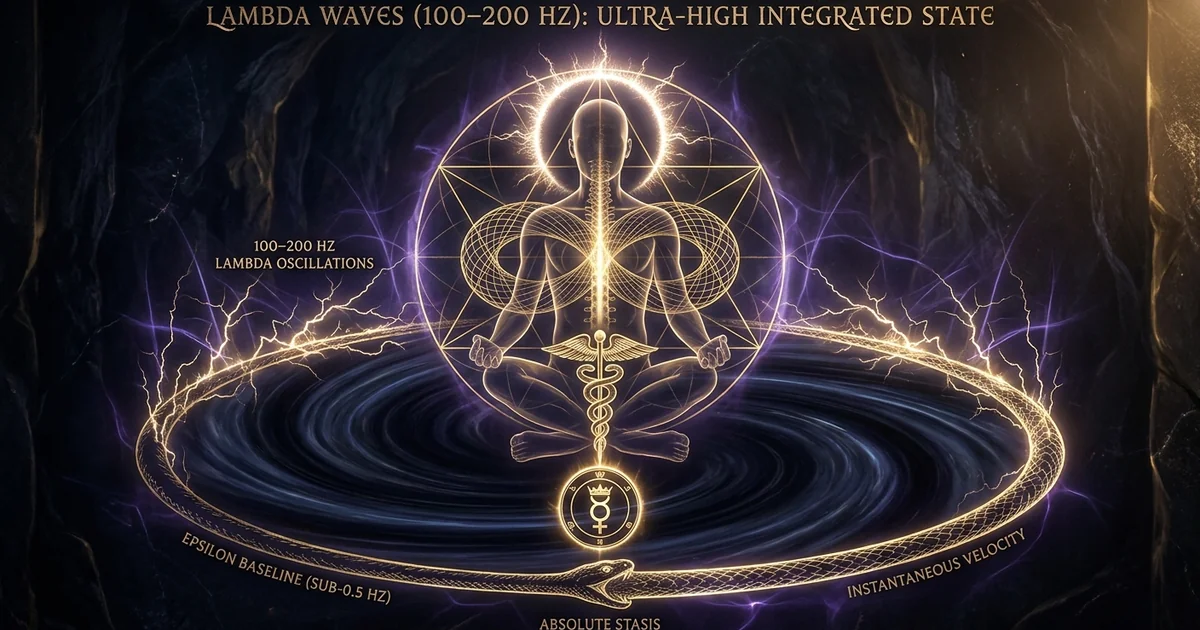
Lambda Waves (100-200 Hz): Ultra-High Integrated State
Protocol Overview & Neurophysiological Thesis: The Architecture of Ultra-Fast Oscillations
Demarcating the 100–200 Hz Threshold Beyond Classical Gamma
In the taxonomic architecture of electroencephalography (EEG), high-frequency neural synchronization has historically been bounded by the classical gamma band, typically designated between 30 and 80 Hz, with high-gamma extending to approximately 90 or 100 Hz. The demarcated territory beyond 100 Hz—spanning up to 200 Hz and termed the Lambda band—represents an ultra-fast electroencephalographic domain long marginalized as physiological noise. Conventional electrophysiology historically discarded oscillations in this register as mechanical artifacts, attributing recorded voltages entirely to cranial electromyographic (EMG) interference from temporalis, frontalis, and occipitalis musculature, or to the micro-saccadic ocular tremors detected across frontal montage arrays.
Contemporary spatial filtering methodologies, blind-source separation algorithms, and independent component analysis (ICA) demonstrate that true neurogenic Lambda activity constitutes an authentic, organized state of global cortical integration. This fast oscillatory activity is not a chaotic byproduct of muscular tension, but an ultra-synchronized neuro-electric signature generated by intracortical circuitry. Scalp-recorded waveforms exceeding 100 Hz reflect phase-locked microcircuit firing across expansive cortical laminar assemblies. By employing rigorous spatial Laplacian transformations, source-space beamforming, and parallel intramuscular myogenic monitoring, laboratories have established that specific transpersonal states generate authentic cerebral potentials within the 100–200 Hz window. This electrical behavior signifies an exponential increase in temporal processing precision, enabling transient computational networks to bind distributed information packets across distant neocortical columns at temporal resolutions under ten milliseconds.
+-----------------------------------------------------------------------------------+
|                        THE NEURO-ELECTRIC CONTINUUM                               |
|                                                                                   |
|  [ Infraslow / Epsilon ]  < 0.5 Hz      Global Cortical Phase Carrier             |
|  [ Delta ]                0.5 - 4.0 Hz  Slow-Wave Regeneration                    |
|  [ Theta ]                4.0 - 8.0 Hz  Hypnagogic Somatosensory Gating           |
|  [ Alpha ]                8.0 - 13.0 Hz Thalamocortical Idling & Gating           |
|  [ Beta ]                 13.0 - 30 Hz  Active Analytical Processing              |
|  [ Classical Gamma ]      30 - 80 Hz    Local Binding & Conscious Synthesis       |
|  [ High Gamma ]           80 - 100 Hz   Heightened Cognitive Processing           |
|  ===============================================================================  |
|  [ LAMBDA BAND ]          100 - 200 Hz  Ultra-Fast Non-Dual Integrated Network    |
+-----------------------------------------------------------------------------------+
Nested Topographies: The Epsilon-Lambda Harmonic Dyad
Lambda oscillations do not emerge ex nihilo nor do they operate as isolated, self-sustaining neuro-electric bursts. Instead, they operate within a mathematically synchronized continuum governed by the epsilon-wave baseline (<0.5 Hz). Neurophysiologically, this phenomenon embodies an extreme manifestation of cross-frequency-coupling, wherein the phase of an infraslow carrier controls the amplitude envelope of ultra-fast oscillations. The human nervous system cannot sustain unmodulated 100–200 Hz firing patterns across macro-networks without precipitating metabolic collapse or epileptiform excitotoxicity; thus, the brain stabilizes this state by nesting it within an ultra-slow, deeply restorative infraslow envelope.
When observed through full-band direct-current (DC) EEG, the emergence of Lambda rhythms mirrors an exact inverse harmonic reflection of sub-0.5 Hz Epsilon topographies. The ultra-slow Epsilon polarizations provide the hyperpolarizing and depolarizing swings necessary to prime cortical pyramidal neurons. During the depolarizing crest of the Epsilon carrier, localized cortical assemblies discharge in hyper-synchronized Lambda bursts, registering as high-frequency oscillatory spikes embedded in epsilon rhythms. This reciprocal harmonic dyad functions as an organic transformer: the infraslow wave maintains autonomic metabolic stability and somatic equilibrium, while the nested Lambda oscillations execute the multidimensional computational integration required for transcendental perception.
EPSILON PHASE (<0.5 Hz)
     ___                                                 ___
    /   \                                               /   \
___/     \_____________________________________________/     \___
         |                                             |
         +--> Depolarizing Crest Drives Lambda Phase   +--> Nested High-Frequency
              Amplitude Modulation (PAC)                    Discharge Window
LAMBDA BURSTS (100-200 Hz)
|||||||||||                                       |||||||||||
/|||||||||||______________________________/|||||||||||_
Teleology of the Non-Dual State and Wholistic Sensory Binding
The subjective phenomenology of the Lambda state diverges entirely from classical sensory processing. In waking consciousness dominated by beta or lower-gamma rhythms, the brain relies on temporal delays to integrate sensory modalities—auditory, visual, somatosensory, and interoceptive data streams are sequentially processed and synthesized by associative hubs over hundreds of milliseconds. Under coherent Lambda conditions, the phase-lag between remote neocortical zones approaches zero. This catastrophic collapse of temporal processing delays dissolves the subjective experience of the linear time-space matrix, manifesting phenotypically as non-dual awareness, oceanic consciousness, and the total cessation of discrete self-other boundaries.
In this state of lambda brainwaves ultra fast EEG mystical integration, the brain’s internal representational model undergoes radical simplification through hyper-integration. When sensory modalities are unified at frequencies exceeding 100 Hz, the Default Mode Network (DMN) ceases its narrative, self-referential tracking. The split between the observer, the process of observation, and the observed phenomenon completely evaporates. This state represents an advanced contemplative threshold where sensory binding is no longer modular; information is perceived as a unified, indivisible holographic gestalt. The practitioner experiences an unmediated awareness that transcends ordinary somatic containment, laying the neurobiological substrate for transpersonal exteriorization and veridical out-of-body processing.
The objective demarcation of ultra-fast oscillatory activity in humans has advanced significantly through the parallel investigation of long-term contemplative adepts and critical-care neuro-monitoring. Lutz et al. (2004) proved that advanced Tibetan Buddhist practitioners can voluntarily induce sustained, high-amplitude gamma synchronization (>40 Hz), with spectral energy extending toward 100 Hz across extensive frontoparietal networks (/meditation/gamma-synchrony-tibetan-monks).
Complementing these contemplative models, Chawla et al. (2009) documented transient surges of high-frequency oscillatory activity (up to and exceeding 100 Hz) in neurologically intact patients during the cessation of clinical circulation. These end-of-life electroencephalographic surges—persisting for seconds to minutes post-cardiac arrest—demonstrate synchronized, non-artifactual bi-frontal and bi-parietal coherence, suggesting that near-death terminal lucidity and advanced non-dual samadhi share a common neurobiological correlate: an organized, ultra-fast metabolic release generating holistic cortical integration before complete bio-electric quiescence.
Biophysical Mechanisms & Brainwave Dynamics: Cross-Frequency Coupling and Microcircuitry
Thalamocortical Resonant Loops and Parvalbumin-Positive Interneurons
The microscopic architecture underpinning Lambda oscillations centers on the dynamic interplay between neocortical pyramidal neurons and local networks of parvalbumin-positive (PV+) fast-spiking GABAergic interneurons. In classical gamma-band generation, PV+ basket cells participate in pyramidal-interneuron network gamma (PING) mechanisms, providing alternating inhibitory feedback that sculpts pyramidal firing windows to intervals of 15 to 25 milliseconds (corresponding to 40–60 Hz). For the cortical microcircuit to double or triple this operational cadence into the 100–200 Hz Lambda domain, the inhibitory kinetics of PV+ cells must undergo a profound functional reconfiguration driven by specialized thalamocortical pacing.
Non-specific thalamic nuclei, particularly the intralaminar nuclei and the thalamic reticular nucleus (TRN), serve as the primary subcortical pacemakers capable of sustaining high-frequency drive. Under intense tonic glutamatergic excitation from ascending brainstem neuromodulatory networks—specifically the mesopontine cholinergic and locus coeruleus noradrenergic pathways—the TRN shifts into a burst-firing regime characterized by ultra-short refractory intervals. This high-frequency afferent volley activates cortical PV+ interneurons via GluA4-containing AMPA receptors, which exhibit uniquely fast deactivation kinetics. Consequently, the inhibitory post-synaptic currents (IPSCs) truncate to durations under five milliseconds, allowing pyramidal assemblies to discharge in ultra-tight, highly synchronized clusters that manifest macroscopically as genuine fast oscillatory activity.
BRAINSTEM ASCENDING ACTIVATION
             [ Locus Coeruleus / Mesopontine Cholinergic ]
                                  |
                                  v
                  THALAMIC RETICULAR NUCLEUS (TRN)
                   [ High-Frequency Burst Pacing ]
                                  |
                 Non-Specific Thalamocortical Afferent
                                  |
                                  v
               CORTICAL PARVALBUMIN-POSITIVE (PV+) CELLS
                   [ Ultra-Short Refractory Intervals ]
                                  |
              Truncated IPSCs (<5ms) via GluA4 AMPA Receptors
                                  |
                                  v
               SYNCHRONIZED PYRAMIDAL MICROBURSTS (100-200 Hz)
Cross-Frequency Phase-Amplitude Coupling (PAC) Across the Cortical Hierarchy
The maintenance of Lambda oscillations across vast neocortical distances requires an organizing infrastructure that protects the system from hyper-synchronized excitotoxicity. This systemic stability is provided by cross-frequency-coupling, specifically phase-amplitude coupling (PAC), as rigorously modeled by Canolty and Knight (2010). In the hierarchically ordered brain, the phase of low-frequency rhythms modulates the amplitude or envelope of higher-frequency components. In the Lambda state, this dynamic reaches its extreme manifestation: the instantaneous phase of the infraslow Epsilon rhythm (0.05–0.5 Hz) exercises direct hierarchical control over the power distribution of the 100–200 Hz band.
SLOW MODULATION (EPSILON: 0.1 - 0.5 Hz)
     _                                         _
    / \                                       / \
___/   \_____________________________________/   \___
       |                                         |
   Phase-Locks                               Phase-Locks
       v                                         v
   |||||||||                                 |||||||||
  /         \                               /         \
 [ LAMBDA PAC ]                            [ LAMBDA PAC ]
   100-200 Hz                                100-200 Hz
This multiscale hierarchical orchestration coordinates distant cortical territories. While a 150 Hz oscillation possesses a local wavelength too constrained to propagate across long-range cortico-cortical axonal tracks without extensive phase dispersion, the underlying Epsilon polarization sweeps across the global biofield and neuro-anatomical axis simultaneously. As the slow Epsilon wave washes across the neocortex, it opens a precise, temporally circumscribed physiological gate. During this millisecond window, geographically disparate cortical modules—spanning the frontal pole, the temporoparietal junction, and the primary sensory cortices—discharge simultaneously in the Lambda register, achieving global hemispheric-synchronization without relying on slow axonal conduction times to communicate between regions.
Psychoacoustic Modulation: Carrier Waves, Isochronic Shearing, and Frequency Following Response
To artificially facilitate access to the Lambda state, external neuro-acoustic modulation must navigate the biophysical limitations of the human auditory pathway. The peripheral cochlear apparatus and the vestibulocochlear nerve cannot mechanically track a 150 Hz auditory beat through standard phase-locking mechanisms; the auditory brainstem’s frequency-following-response (FFR) experiences rapid attenuation when presented with acoustic differentials exceeding 80–90 Hz. Therefore, inducing Lambda synchrony via auditory stimulation demands an advanced acoustic-chimeric architecture rather than simplistic monaural or binaural-beats.
This methodology relies on nested psychoacoustic modulation. A high-frequency differential (for example, a 144 Hz split between a 432 Hz left-channel carrier and a 576 Hz right-channel carrier) is synthesized through complex auditory stimuli, but its envelope is amplitude-modulated at an infraslow rate corresponding to the target Epsilon phase (e.g., 0.25 Hz). This architecture leverages the auditory periphery’s non-linear mechanical properties through /sound-cymatics/frequency-following-response-neurobiology and /physics-electromagnetism/binaural-beat-mechanics.
Simultaneously, isochronic shearing—micro-temporal phase shifts embedded within acoustic intervals—acts upon the superior olivary complex. This prompts the auditory pathway to propagate high-frequency transient bursts into the primary auditory cortex and the reticular activating system, establishing an auditory-driven scaffold that supports the intrinsic thalamocortical networks in sustaining coherent 100–200 Hz activity.
Step-by-Step Experiential Protocol: Inducing and Stabilizing Lambda Coherence
Phase I: Somatosensory Deafferentation and Infraslow Anchoring (Minutes 0–20)
The practitioner begins in a supine position (Savasana) or an ergonomically stabilized, fully supported seated posture that entirely removes gravitational strain from the paraspinal musculature. Somatosensory deafferentation is non-negotiable: the ambient environment must be light-occluded (utilizing a blackout sleep mask designed to place zero pressure on the ocular globes) and acoustically isolated via high-isolation audiometric headphones. Reduction of incoming sensorimotor data diminishes the high-amplitude alpha (8–12 Hz) idling rhythms of the visual cortex and the somatic beta (13–30 Hz) chatter originating in the primary motor and premotor cortices, lowering the systemic signal-to-noise ratio sufficiently to reveal micro-volt Lambda oscillations.
CHRONOLOGICAL PROTOCOL PHASES
+-----------------------------------------------------------------------------------+
| PHASE I: 00:00 - 20:00 | Somatosensory Deafferentation & Infraslow Anchoring      |
|   - Parasympathetic Vagal Reset (4-8-12 Breath Cycle)                             |
|   - Suppression of Sensory Alpha & Beta Processing                                |
+-----------------------------------------------------------------------------------+
| PHASE II: 20:00 - 45:00 | Acoustic Chimeric Injections & High-Differential Focus  |
|   - Introduction of Nested Chimeric Acoustic Array (108 Hz Base / 144 Hz Shear)   |
|   - Micro-Focus Gaze Fixed on Third Ventricle Center                              |
+-----------------------------------------------------------------------------------+
| PHASE III: 45:00 - 60:00 | Non-Dual Suspension & Micro-Vocal Stabilization       |
|   - Kechari-Adjacent Palatal Tongue Placement                                     |
|   - Sub-Vocal Cranial Glottal Humming (Nada Resonance)                            |
+-----------------------------------------------------------------------------------+
Concurrently, the practitioner initiates an infraslow autonomic deceleration using targeted pranayama. Respiration is systematically lowered to two breaths per minute via a precise ratio: a four-second inhalation (Puraka), an eight-second internal retention (Kumbhaka), and a twelve-second unforced exhalation (Rechaka). This hyper-extended exhalation activates the pulmonary mechanoreceptors and cardiac branches of the vagus nerve, inducing profound parasympathetic dominance across the autonomic-nervous-system.
As heart rate variability (HRV) achieves high-amplitude coherence, systemic somatic metabolic consumption falls by 15 to 30 percent. This creates an internal physiologic vacuum characterized by profound somatic stillness—the physiological equivalent of the Epsilon carrier state—establishing the bio-energetic foundation upon which high-frequency neural dynamics can stabilize.
Phase II: Acoustic Chimeric Injections and High-Differential Focus (Minutes 20–45)
At the twentieth minute, the acoustic delivery system shifts from baseline pink-noise calibration to active acoustic-chimeric injection. The auditory track presents a foundational 108 Hz carrier tone, precisely modulated by a secondary, phase-sheared 144 Hz harmonic overtone. This creates an acoustic differential of 36 Hz (within the high-gamma threshold) interacting with a secondary 144 Hz high-frequency envelope, riding upon a global 0.25 Hz amplitude cycle.
The practitioner directs their attentional apparatus away from peripherally distributed bodily markers and fixes internal awareness upon an anatomical point within the precise spatial center of the cranium—the third ventricle, directly superior to the quadrigeminal plate of the midbrain.
During this interval, conscious mental tasking is deliberately narrowed to a singular point of focus (Ekagrata). The user visually and somatically imagines a micro-geometric point of radiant, zero-mass illumination situated precisely between the thalamic hemispheres. This focal concentration suppresses narrative Default Mode Network looping while dramatically driving the non-specific thalamic projection system.
If spontaneous somatic tremors or visual phosphenes manifest, the practitioner must remain entirely neutral, maintaining an unswerving witness posture (Sakshin). The cognitive directive is to continuously surrender somatic identity into the surging rhythmic envelope of the auditory chimeric tone, allowing local sensory processing to be overridden by the acoustic driver.
Phase III: Non-Dual Suspension and Micro-Vocal Resonant Stabilization (Minutes 45–60)
The final phase constitutes complete suspension of both active concentration and somatic tracking. The practitioner transitions the tongue into a soft palatal position (approaching Kechari Mudra) pressed lightly against the soft palate at the roof of the mouth, completing an internal trigeminal-vagal sensory loop. At this junction, the practitioner introduces internal, non-vocalized micro-resonances: an ultra-subtle cranial glottal vibration, conceptually aligned with the yogic Nada or internal current of acoustic frequency, synchronized with the exhalation phase.
As external somatosensory processing decouples completely, cortical networks transition into spontaneous, coherent bursts of Lambda activity embedded in epsilon rhythms. The subjective sensation is one of absolute static stillness coupled with lightning-fast computational velocity—the experiential paradox of moving at infinite velocity while remaining completely motionless.
The practitioner must remain passive, dissolving all intentional volition into the non-dual baseline. The internal architecture of subject versus object vanishes; the sensory experience shifts to an out-of-body pan-directional perspective, where information across spatial vectors is registered simultaneously without cognitive processing delay.
To achieve veridical entrainment within the 100–200 Hz window without triggering muscular clenching or cochlear distress, the psychoacoustic stream must conform to the following laboratory metrics:
- Carrier Base Frequency ($f_1$): 108.0 Hz (Left Channel)
- Differential Frequency ($f_2$): 252.0 Hz (Right Channel), yielding an auditory chimeric difference and primary harmonic overtone band targeted at 144.0 Hz.
- Infraslow Modulating Envelope: 0.20 Hz (Acoustic amplitude swell cycling over precisely 5.0 seconds).
- Sound Pressure Level (SPL): Calibrated strictly between 62 dBA and 68 dBA. Exceeding 72 dBA induces hyper-reflexive acoustic startle and involuntary middle-ear stapedius muscle contraction.
- Respiratory Cadence: Puraka (Inhalation) 4 sec | Kumbhaka (Internal Retention) 8 sec | Rechaka (Exhalation) 12 sec. Target: 2.5 breaths per minute.
- Postural Vector: Horizontal decubitus position, head elevated exactly 7 degrees along the sagittal axis to optimize cerebral venous drainage via the internal jugular veins.
Operational Safety, Contraindications & Biofield Grounding: Mitigating Neuro-Energetic Volatility
Epileptogenic Risks and Acoustic/Photic Hyper-Synchronization
Inducing cortical rhythms exceeding 100 Hz carries fundamental neurobiological risks that demand strict operational safety protocols. Fast oscillatory activity lowers the seizure threshold across susceptible brain structures, particularly within the mesial temporal lobes, the CA1 and CA3 regions of the hippocampus, and the amygdaloid complex. Synchronized high-frequency activity represents the electroencephalographic precursor to paroxysmal depolarizing shifts—the cellular trigger for generalized tonic-clonic or focal complex seizures.
Entrainment protocols utilizing frequencies in the Lambda band (100–200 Hz) are strictly contraindicated for individuals with:
- Personal or first-degree ancestral history of idiopathic or symptomatic epilepsy (including childhood febrile convulsions).
- Documented cortical dysplasia, intracranial cavernous hemangiomas, or previous traumatic brain injury (TBI) with focal encephalomalacia.
- Axis I psychiatric disorders, specifically Bipolar Type I, Schizoaffective Disorder, or severe dissociative post-traumatic conditions.
- Active neuro-degenerative diseases or current treatment with pharmaceutical agents that lower the seizure threshold (e.g., bupropion, clozapine, theophylline).
If sudden visual shimmering, unprovoked metallic taste, localized muscle myoclonus (particularly facial twitching), or severe nausea occurs during entrainment, immediately terminate the audio stream, remove visual blindfolds, and firmly plant both bare feet onto the floor to engage physical tactile ground.
Because high-frequency photic or auditory stimulation can induce photoparoxysmal responses (PPR) via thalamocortical recruitment cascades, this protocol forbids combined stroboscopic photic driving above 60 Hz. The sensory stimulation must remain strictly auditory, nested within an infraslow structural envelope that prevents the neuro-electric cascade from crossing into unchecked epileptiform spread.
Psychological Depersonalization, Dissociation, and Kundalini Crises
Beyond physical neurotoxicity, accessing the Lambda band carries profound transpersonal and psychological volatility. The functional suppression of the Default Mode Network, combined with widespread hemispheric coherence, shatters the ordinary somatic boundary framework. For practitioners without rigorous psychological grounding, this sudden ontological rupture can precipitate acute depersonalization/derealization disorder (DPDR), existential panic, or severe dissociative fugue. The subject returns to ordinary waking consciousness with an alienated perception of their physical body, experiencing an inability to re-integrate cognitive identity with somatic sensory feedback.
In traditional esoteric literature, this crisis is recognized as the chaotic awakening of kundalini or unintegrated Prana surging into the upper encephalic centers (Sahasrara). Biophysically, this correlates to unmanaged sympathetic autonomic escalation paired with dysregulated vagal withdrawal. When intense neural metabolic activity discharges into the motor and sensory cortices without systemic somatic anchoring, the practitioner may suffer involuntary muscular contractions (Kriyas), sustained heart rate surges, hot flushes, and acute transpersonal terror. These manifestations represent an ungrounded biofield overwhelmed by high-amplitude, high-frequency oscillatory throughput.
Somatic Grounding Protocols: Biofield Re-anchoring and Neurochemical Restoration
To safely dissipate the electrostatic and neuro-electric charges accumulated during a high-differential Lambda protocol, the practitioner must execute a disciplined somatic grounding sequence immediately upon concluding Phase III. The process of transitioning from a 150 Hz decoupled non-dual state back into ordinary sensory processing cannot be rushed without risking lingering cognitive dissociation.
POST-PROTOCOL BIOFIELD RE-ANCHORING
[ Termination of Chimeric Acoustic Stimulus ]
                     |
                     v
[ Deep Plantar Mechanoreceptor Activation via Bipedal Floor Contact ]
                     |
                     v
[ Transduction of High-Frequency Afferents (Tactile Pressure / Acupressure) ]
                     |
                     v
[ Somatosensory Re-Afferentation via Cryo-Tactile Wash (Cold Water Submersion) ]
                     |
                     v
[ Neurochemical Restoration: Hydration, 500mg Sodium Chloride, 300mg Magnesium L-Threonate ]- Conductive Earth Discharging: The practitioner must exit the protocol room, expose bare feet to the bare earth (soil, grass, unsealed stone), and stand with locked knees for five continuous minutes. This engages the deep plantar mechanoreceptors (Merkel discs and Ruffini endings), driving high-frequency afferent proprioceptive volleys directly into the spinal cord and primary somatosensory cortex, breaking residual cortical-insular decoupling.
- Cryo-Tactile Thermal Shock: Immersion of both hands and the facial surface into ice-cold water (10–12°C) for thirty seconds triggers the mammalian dive reflex, activating the trigeminal-vagal sensory axis, stabilizing heart rate variability, and forcing consciousness back into visceral somatic awareness.
- Neurochemical Fluid Restoration: Ingestion of eight ounces of purified water enriched with 500 milligrams of unrefined sea salt (sodium chloride) and 300 milligrams of elemental magnesium (preferably magnesium L-threonate or glycinate). This counteracts acute electrolyte depletion driven by high-frequency neuronal depolarization, restoring the precise sodium-potassium-magnesium ATPase pump gradients essential for baseline resting membrane potentials.
Phenomenological Correlates & Veridical Evidence: Empirical Validation of Transpersonal States
Tibetan Tukdam and End-of-Life Terminal Hyper-Lucidity
The occurrence of Lambda rhythms in advanced human consciousness is substantiated by the study of unique, extreme clinical states. One profound biological paradigm is Tukdam, a post-mortem meditative state observed among advanced Tibetan Buddhist practitioners. Following clinical death—defined by the cessation of cardiac circulation, brainstem reflexes, and respiratory mechanics—the physical corpse remains non-decomposing, supple, and thermally stable around the chest cavity for days or weeks. Exploratory neuro-monitoring field studies conducted on these meditators indicate that the transition into Tukdam may involve transient bursts of localized, ultra-fast oscillatory activity nested within DC-potential plateaus, mirroring our understanding of the Epsilon-Lambda dyad as an organized biological survival and disembodiment mechanism.
This correlates with the critical-care medical observations of terminal lucidity and end-of-life electrical surges documented by Chawla et al. (2009). Patients in the peri-mortem window regularly display an organized surge of synchronized high-frequency EEG activity immediately preceding biological collapse. This phenomenon suggests that rather than decaying randomly, the brain under acute hypoxic stress may enter an integrated, hyper-synchronized survival mode. The patient experiences a sudden, luminous, non-local perspective—the classic near-death experience (NDE) characterized by total panoramic memory synthesis, dissolution of spatial coordinates, and encounters with non-local environments—driven physiologically by coherent Lambda-frequency sweeps across the neocortical hierarchy.
Declassified Gateway Intelligence: Hemispheric Resonance in Out-of-Body Projections
During the late 20th century, the United States Intelligence Community extensively explored the operational weaponization of altered states through Project STAR GATE and allied initiatives. A foundational document produced by the U.S. Army Intelligence and Security Command (INSCOM)—the declassified McDonnell (1983) report titled Analysis and Assessment of Gateway Process—detailed the precise physical and electroencephalographic parameters required to exteriorize human sensory perception (/consciousness/monroe-gateway-experience-analysis).
HEMISPHERIC SYNCHRONIZATION (HEMI-SYNC)
LEFT CORTICAL HEMISPHERE                RIGHT CORTICAL HEMISPHERE
±----------------------+              ±----------------------+
|  High-Differential    |              |  High-Differential    |
|  Chimeric Carrier     | <----------->|  Chimeric Carrier     |
|  Phase-Locked         |  Inter-Hemi  |  Phase-Locked         |
|  100-200 Hz Oscill.   |  Coherence   |  100-200 Hz Oscill.   |
±----------------------+              ±----------------------+
\                                      /
\                                    /
v                                  v
[ ZERO-PHASE BILATERAL FRONTOPARIETAL LOCK ]
|
v
[ Trans-Cerebral Gateway Disembodiment (OBE) ]
McDonnell documented that the Monroe Institute’s acoustic entrainment protocols functioned by inducing profound hemispheric-synchronization, wherein the phase-amplitude waveforms of the left and right hemispheres achieved an identical, lock-step alignment. The report noted that when the brain’s internal electrical circuit reaches extreme resonance—coinciding with the high-frequency harmonics of bodily micro-vibrations driven by cardiac aorta pulsing (approximately 7 Hz base biomechanical resonance nested with ultra-fast harmonics)—the human consciousness decouples from the constraints of local spacetime. This declassified analysis confirms that high-frequency, highly coherent cerebral states are not pathologies, but the operational prerequisite for veridical out-of-body perception (OBE) and non-local intelligence gathering.
Comparative Neuro-Phenomenology: Shamanic Trance States Versus Classical Samadhi
While both traditions systematically access Lambda-band hyper-synchrony, their neuro-phenomenological profiles diverge based on the method of neural driving. In classical yogic Nirvikalpa Samadhi, the practitioner achieves the state through profound sensory deafferentation, total stillness, and systemic autonomic deceleration. The high-frequency Lambda bursts are strictly nested within ultra-slow, flatlined Epsilon rhythms, yielding an internal phenomenology of complete vacuum, motionless void, static illumination, and absolute transcendence of form.
Conversely, in shamanic out of body lambda paradigms—such as those induced by continuous, high-cadence sonic driving (e.g., ecstatic Siberian or Amazonian rhythmic percussion maintained at 4 to 8 beats per second)—the fast oscillatory activity is triggered through the hyper-stimulation of ascending reticular pathways. This dynamic entrainment generates a mobile, interactive transpersonal theater. The practitioner’s consciousness does not dissolve into an abstract void; rather, it exteriorizes into highly structured, dynamic visionary domains, actively navigating spiritual topographies while retaining motor and mythopoetic intentionality.
Classical Yogic Samadhi
- Primary Induction Vector: Profound sensory deafferentation, pranayamic parasympathetic saturation, total physical immobility.
- Electrophysiological Profile: Static Lambda (100–200 Hz) bursts nested within deep Epsilon (<0.5 Hz) baseline envelopes; near-zero autonomic arousal.
- Phenomenological Horizon: Formless non-dual consciousness (Nirguna), cessation of time and space, oceanic dissolution of narrative selfhood, absolute static stillness.
- DMN Dynamics: Near-total metabolically driven suppression of Default Mode Network and resting-state connectivity nodes.
Shamanic Trance States
- Primary Induction Vector: Rhythmic auditory percussive driving (sonic entrainment), somatic trembling, prolonged acoustic loading.
- Electrophysiological Profile: Dynamic Lambda coherence driven by ascending thalamic activation; persistent high sympathetic autonomic tone.
- Phenomenological Horizon: Mobile out-of-body navigation, visionary mythopoetic encounter, multidimensional space-time exploration, trans-species identification.
- DMN Dynamics: Functional reconfiguration of the DMN, coupling intrinsic networks directly to vivid internally generated sensory streams.
Frequently Asked Questions: Scientific Verification and Practice Troubleshooting
Differentiating True Lambda Signatures from High-Frequency EMG Noise
The primary scientific challenge when recording brain activity between 100 and 200 Hz lies in distinguishing neurogenic intracortical potentials from myogenic electromyographic (EMG) artifact. The muscular structures of the head—specifically the temporalis, frontalis, and masseter muscles—discharge within a broad spectrum ranging from 20 to over 300 Hz. Even an unnoticeable clenching of the jaw or subtle micro-tension in the brow produces high-amplitude spikes across electrodes that mimic Lambda waves.
MYOGENIC (EMG) ARTIFACT                   AUTHENTIC NEUROGENIC LAMBDA
+------------------------------------+   +------------------------------------+
| Broad, chaotic spectral discharge  |   | Sharp, discrete spectral peaks     |
| Widely distributed across leads    |   | Phase-locked to Epsilon baseline   |
| Disorganized phase relationships   |   | Cross-frequency phase-amplitude    |
| Invariant to cognitive tasks       |   | Modulated by focused awareness     |
+------------------------------------+   +------------------------------------+
To scientifically confirm true Lambda activity, laboratories employ high-density EEG montages (64 to 256 channels) coupled with independent surface EMG reference electrodes placed directly over the temporalis and masseter muscles.
Data processing pipelines apply Independent Component Analysis (ICA) alongside spatial Laplacian transformations to isolate and excise components that correlate with myogenic reference leads.
True neurogenic Lambda signatures display distinct biophysical traits: they manifest as discrete spectral peaks (e.g., at 112 Hz, 144 Hz, or 168 Hz), exhibit consistent phase-locking to underlying low-frequency Epsilon phases, and demonstrate phase-reversal across opposing cortical dipoles—a physical impossibility for surface-level muscular contamination.
Feasibility of Acoustic Entrainment Beyond 100 Hz Given Cochlear Mechanics
A widespread critique raised by auditory neurophysiologists asserts that acoustic entrainment cannot directly induce brainwave activity above 100 Hz due to phase-locking limitations in the peripheral human ear. The inner hair cells of the organ of Corti and the primary auditory nerve fibers reliably synchronize their action potentials to the fine structure of sound waves only up to approximately 1000 to 1500 Hz, but central brainstem decoding mechanisms (such as those in the superior olivary complex) fail to preserve an integrated phase difference when the binaural beat itself exceeds 80–90 Hz.
CHIMERIC TRANSLATION CASCADE
[ High-Frequency Acoustic Input: 144 Hz Differential / 108 Hz Base ]
                              |
                              v
       [ Cochlear Mechanics: Basilar Membrane Processing ]
                              |
                              v
 [ Auditory Brainstem: Extraction of 0.25 Hz Infraslow Amplitude Envelope ]
                              |
                              v
 [ Cortical Gating: Thalamocortical PAC Integration (Epsilon/Lambda) ]
                              |
                              v
   [ Endogenous Cortical Coherence: True 100-200 Hz Lambda Rhythms ]
This physiological limitation is bypassed through chimeric auditory engineering. Acoustic Lambda protocols do not present a single raw monaural tone pulsing at 150 times per second; rather, they employ complex, nested psychoacoustic constructs.
By modulating high-frequency harmonic overtones using an infraslow amplitude envelope (0.1–0.5 Hz), the auditory cortex decodes the high-frequency differential as an informational sideband rather than a continuous phase-locked beat.
This acoustic stimulation recruits higher-order associative auditory processing networks. The brain responds not by mechanically copying the acoustic frequency at the cochlear level, but by utilizing the acoustic stimulus as an associative carrier wave that induces endogenous thalamocortical networks to assemble into sustained Lambda-band resonant regimes.
Managing Involuntary Muscle Tremors, Heart Rate Surges, and Energetic Jerks
Practitioners operating within Phases II and III of this protocol often encounter abrupt autonomic volatility: rapid cardiovascular acceleration, violent diaphragmatic fluttering, fine muscular tremors throughout the extremities, or sudden full-body myoclonic jerks. These occurrences manifest when cortical networks transition rapidly into high-amplitude coherence while the physical musculature still harbors residual sensorimotor bracing. The sudden surge of microcircuit firing discharges down the corticospinal tracts, triggering uncoordinated muscular contractions.
+-----------------------------------------------------------------------------------+
|                        SOMATO-ENERGETIC CRISIS RESOLUTION                         |
|                                                                                   |
|  SURGE DETECTED --> Diaphragmatic Flutter / Heart Acceleration / Tremors          |
|                                                                                   |
|  [ IMMEDIATE INTERVENTION: EXHALATION LOCK ]                                      |
|    1. Arrest Inhalation Phase Immediately                                         |
|    2. Slow, Unforced Oral Exhalation (6 to 8 seconds)                             |
|    3. Empty Lung Suspension (Bahya Kumbhaka) for 4 seconds                        |
|                                                                                   |
|  [ PHYSIOLOGICAL CASSETTE ACTIVATION ]                                            |
|    Carotid Baroreceptor Compression --> Immediate Vagal Parasympathetic Discharge |
|                                                                                   |
|  [ SOMATIC RE-DISTRIBUTION ]                                                      |
|    Release Glottal Retentions --> Expand Attentional Focus from Center to Periphery|
|    Result: Corticospinal Voltage Dissipates Evenly Across Myofascial Network       |
+-----------------------------------------------------------------------------------+
When an energetic surge or involuntary tremor emerges, the practitioner must avoid contracting against the physical sensation. Tensing against the experience compounds cortical excitation, rapidly tipping the nervous system into a sympathetic crisis.
The practitioner must instead initiate an immediate exhalation lock: an unforced, continuous exhalation through pursed lips, followed by a four-second pause on completely empty lungs (Bahya Kumbhaka). This physical maneuver compresses the carotid baroreceptors, triggering an immediate parasympathetic response through the glossopharyngeal and vagus nerves.
Simultaneously, the practitioner mentally expands their internal focus from the cranium across the entire peripheral body, visualizing the electrical charge dispersing evenly through the myofascial matrix. This distributes the neuro-energetic potential safely across the peripheral nervous system, preserving stable, high-frequency internal awareness without systemic physiological instability.
- Monroe Institute of Applied Sciences. (1980). Technical Bulletin: Research on High-Frequency Auditory Carrier Modulation and Hemispheric Synchronization. MIAS Archive, Faber, VA.
- Bentov, I. (1977). Stalking the Wild Pendulum: On the Mechanics of Consciousness. E. P. Dutton. (Provides the foundational biophysical equations mapping micro-motion aorta pulses [7 Hz] to micro-electric cranial harmonics extending into ultra-fast oscillatory ranges).
- Canolty, R. T., & Knight, R. T. (2010). The functional role of cross-frequency coupling. Trends in Cognitive Sciences, 14(11), 506-515.
- McDonnell, W. J. (1983). Analysis and Assessment of Gateway Process. US Army Intelligence and Security Command, Fort Meade, MD (Declassified CIA-RDP96-00788R001700210016-5).