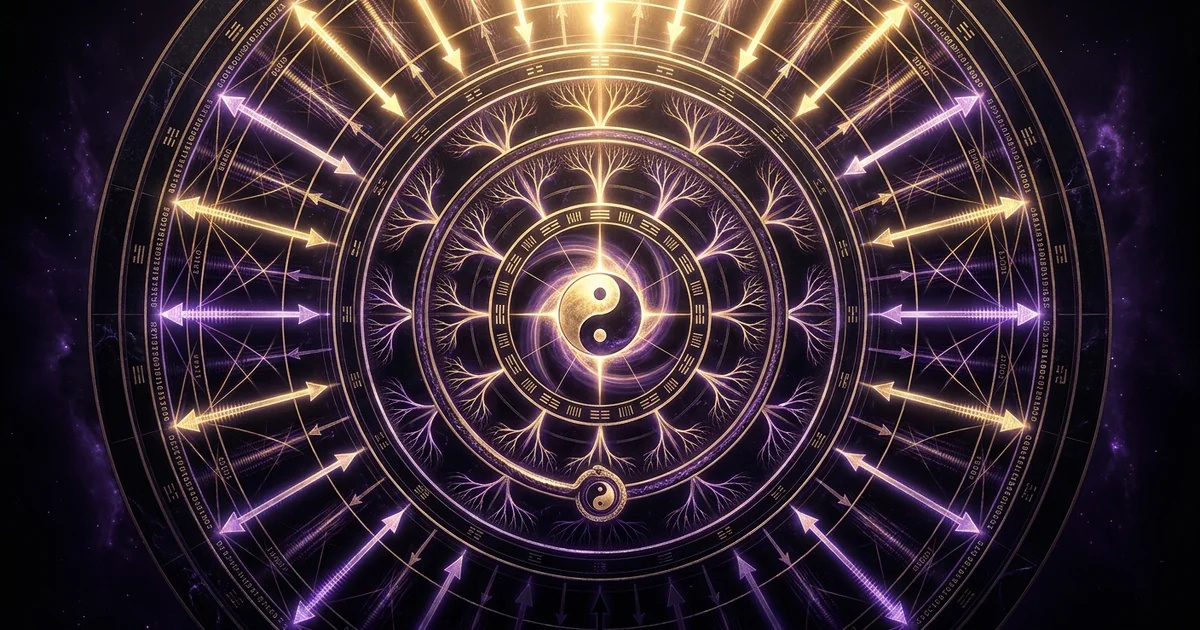
Shao Yong and Circular Fu Xi Hexagram Arrangement Math
Archetypal Thesis & Systemic Paradigm: The Xiantian Mandala as Binary State-Space
The Xiantian (Prior to Heaven) Paradigm Shift
The intellectual trajectory of eleventh-century Song Dynasty cosmology achieved a watershed moment in the work of Shao Yong (1011–1077 CE). Through his structural reordering of the I Ching (Yijing), Shao Yong rescued the archaic oracle from fragmented, purely mantic divination and situational phenomenological narratives, re-establishing it as an axiomatic mathematical ontology. Central to this epistemological shift was his reconstruction of the Xiantian Tu (先天圖), the “Earlier Heaven” or “Prior to Heaven” diagram, historically attributed to the mythic culture-hero Fu Xi. Whereas the received textual sequence attributed to King Wen preserved an empirical, dialectical, and often asymmetric path through human trials and political statecraft, Shao Yong’s shao yong circular fuxi hexagram arrangement established an idealized, trans-temporal state-space. This arrangement does not describe historical contingency, but rather models the pristine, self-generating mathematical architecture of the cosmos before its precipitation into physical form.
In the Xiantian paradigm, reality unfolds through an unyielding process of binary branching originating from an undifferentiated cosmic singularity. By organizing the sixty-four hexagrams into a contiguous, radially balanced wheel surrounding a central concentric square, Shao Yong formalized a coordinate system of the cosmos that operationalized Chinese cosmology alongside strict geometric axes. The circle represents the dynamic, moving, spherical flux of Heaven (Tian), governing temporal cycles and celestial mechanics, while the interior square anchors the stable, orthogonal symmetry of Earth (Di), governing terrestrial spatial distribution. In establishing this dual topology, Shao Yong detached the hexagrams from the immediate socio-historical reading of the received Zhou dynasty tradition, elevating them to universal glyphs within an invariant, relational field of energetic potential.
This mathematical reframing constituted a profound revolution in song dynasty cosmology. Through it, the sixty-four hexagrams ceased to be mere literary compositions or disparate records of Bronze Age omens; they became quantized registers of cosmic information. By stripping away narrative contingency to reveal the underlying structural symmetry, Shao Yong established that the universe operates in accordance with precise numerical principles (li and shu). This realization anticipated the formalization of information systems centuries later, mapping ontological generation through pure polar mechanics.
Topological Geometry of the Cosmic Coordinate System
The circular Fu Xi arrangement operates as a continuous archetypal state-space manifold. In modern dynamic systems theory, a phase space or state space constitutes a space in which all possible states of a system are represented, with each unique state corresponding to a unique point. When mapped across Shao Yong’s sixty-four-fold perimeter, each hexagram functions as an invariant vector describing the precise equilibrium between dark, compressive, receptive potentiality (yin) and luminous, expansive, actuating force (yang). The continuous perimeter does not exhibit arbitrary jumps between disparate thematic situations; instead, it establishes a continuous geometric curve along which topological transitions occur with absolute systemic coherence.
Within this circular geometry, each adjacent hexagram represents a minimal or ordered state transition across the dyadic parameter space. The circle closes upon itself, providing an unbroken topology where the absolute maximum of entropic, receptive potential seamlessly engenders the birth of dynamic kinetic energy, and vice versa. This spatial arrangement serves as a chronotopology: an integrated space-time continuum wherein temporal succession is translated into geometric orientation. To study this archetypal geometry is to observe how cyclic time becomes spatialized into an analytical mandala, a theme explored extensively across comparative sacred architecture and detailed within /sacred-geometry/mandala-symbolism-archetypal-geometry.
The implications of this geometric formalization are directly relevant to psycho-cosmological cartography. The circular ring acts as an ontological boundary condition, delineating the full spectrum of archetypal situations accessible to human consciousness and physical manifestation. Because every point along the circular perimeter is equidistant from the unmanifest center—the geometric locus of the Taiji—no single archetype or state of being holds ontological precedence over another. Every developmental phase, psychological crises, and seasonal zenith is revealed to be a necessary, deterministic modulation of the overarching cyclic field, mathematically bound to its diametrical opposite.
       [ Qian (111111) ] - Summer Solstice / Zenith of Yang
            /        \
           /          \
[ Fu (100000) ]     [ Gou (011111) ]
Ascending Yang       Descending Yin
           \          /
            \        /
        [ Kun (000000) ] - Winter Solstice / Zenith of Yin
Consciousness as an Oscillating Dyadic Waveform
Viewed through the combined lenses of Jungian archetypal psychology and cybernetic feedback theory, Shao Yong’s circular schema demonstrates that consciousness functions as an oscillating dyadic waveform traversing a sixty-four-fold cyclical continuum. The human psyche does not experience reality in static snapshots; it oscillates perpetually between polarities—conscious ego illumination (yang) and unconscious archetypal absorption (yin), creative inflation and melancholic mortification. The circular Fu Xi arrangement maps these psychic oscillations with absolute mathematical precision, providing an analytical framework for what Carl Jung identified as enantiodromia: the inevitable psychological rebound of any one-sided dynamic into its structural mirror opposite.
Shao Yong’s architecture demonstrates that information generation requires a continuous, six-bit modulation. Each line (yao) of a hexagram represents a discrete binary register—broken or solid, zero or one—stacked vertically from the inner foundation to the outer manifest edge. As consciousness moves along the wheel, it does not experience random psychic disruptions; it processes an iterative transformation of cognitive wavepackets. The circular arrangement mirrors the rhythmic pulse of biological systems, circadian rhythms, and macroscopic epicycles, establishing that the experiential unfolding of the mind is intrinsically linked to the same structural mechanics governing celestial bodies.
By formalizing this cyclical progression, Shao Yong anticipated the fundamental tenets of cybernetic control systems: every output feeds back into the loop as an input, and every extreme state generates the corrective information necessary to restore systemic equilibrium. Consciousness is thus understood not as an isolated, subjective epiphenomenon, but as a dynamic feedback mechanism operating within the self-regulating matrix of the universal archetypal field. The Xiantian diagram provides the structural blueprint of this mechanism, rendering visible the mathematical rhythm through which the mind engages with macrocosmic flux.
“The Chinese mind, as I see it, is exclusively preoccupied with the chance aspect of events. What we call coincidence seems to be the chief concern of this peculiar mind, and what we worship as causality passes almost unnoticed… The matter of interest, upon which the I Ching is built, is the way things happen to occur together at a given moment.” — Carl Gustav Jung, Foreword to The I Ching or Book of Changes (trans. Richard Wilhelm and Cary F. Baynes, Bollingen Series XIX, Princeton University Press, 1950).
Coupled with Marie-Louise von Franz’s thesis in Time: Rhythm and Repose (Thames & Hudson, 1978), which posits that ancient qualitative time systems measure the specific archetypal frequency of a moment through numerical rhythm rather than uniform quantitative duration, Shao Yong’s spatialized circle is recognized as an apparatus for calculating synchronistic resonance across discrete psycho-cosmological states.
Classical Provenance & Textual Lineage: From Fu Xi Mythology to Song Dynasty Rationalism
The Epistemological Lineage: Chen Tuan, Chongfang, and Mu Xiu
The historical transmission of the Xiantian diagrams represents an intriguing nexus where esoteric Daoist inner-alchemy traditions converged with the rationalizing, socio-ethical imperatives of Northern Song Neo-Confucianism. According to Song historiographical records, the diagrams that underpinned Shao Yong’s breakthrough did not emerge ex nihilo, nor were they extracted unmediated from canonical Confucian classics. Instead, they were transmitted through an esoteric, semi-legendary lineage tracing back to the Daoist hermit Chen Tuan (ca. 871–989 CE), who dwelled in the sacred seclusion of Mount Hua. Chen Tuan synthesized archaic shamanic diagrams, inner-alchemical (neidan) energy circulation schemas, and cosmological numerology into visual maps known broadly as the Hetao (Yellow River Chart), Luoshu (Writ of the Luo River), and various forms of the Xiantian Tu.
This esoteric knowledge transitioned into the scholarly elite through a discrete line of transmission: Chen Tuan conveyed his teachings to the Daoist master Chongfang, who subsequently passed them to Mu Xiu (979–1032 CE). Mu Xiu, a scholar of both literary arts and mathematical cosmology, directly transmitted these diagrams, alongside their structural operational keys, to Shao Yong in the city of Luoyang. Upon receiving these materials, Shao Yong executed an unprecedented intellectual translation. He stripped away the occult Daoist terminology and alchemical arcana, identifying the universal mathematical order latent within the visual geometry.
Where Daoist practitioners utilized the circular arrangements as internal maps for guiding the circulation of vital essence (jing) and spiritual breath (qi) through physiological meridians, Shao Yong recognized them as objective laws of cosmic generation (li). In doing so, he integrated an esoteric transmission into the vanguard of Northern Song rationalism, converting an occult hermetic technique into a universal metaphysical science accessible to rigorous philosophic scrutiny.
[ Chen Tuan (Mount Hua Daoist Hermit) ]
                   │
                   ▼
       [ Chongfang (Esoteric Adept) ]
                   │
                   ▼
        [ Mu Xiu (Scholar-Cosmologist) ]
                   │
                   ▼
     [ Shao Yong (Northern Song Rationalist) ]
Huangji Jingshi Shu: The Mathematization of Neoconfucian Metaphysics
Shao Yong’s magnum opus, the Huangji Jingshi Shu (皇極經世書, Supreme World Ordering Principles), stands as one of the most intellectually ambitious systematic treatises in the global history of philosophy. In this comprehensive work, Shao Yong attempted nothing less than the complete mathematization of Neo-Confucian metaphysics. Rooted in the premise that “the mind is the supreme Ultimate (Taiji), and the Dao is the standard of order,” Shao developed a hyper-rationalized system of universal calculation designed to track cosmic, natural, and human history through invariant numerical structures.
The operational foundation of the Huangji Jingshi Shu rests upon the generative multiplication of base cosmological numbers, primarily deploying the modular cycles of twelve and thirty to construct vast macro-historical epicycles. Shao established a hierarchical architecture of cosmic time:
- A single Generation (shi) comprises 30 solar years.
- A single Turn (yun) comprises 12 Generations (360 years).
- A single Assembly (hui) comprises 30 Turns (10,800 years).
- A single Epoch (yuan) comprises 12 Assemblies (129,600 years).
This grand cycle of 129,600 years constitutes a complete cosmic day, an ontological pulse during which the cosmos precipitates from pure void through elemental condensation, biological life, human civilization, decline, and cataclysmic dissolution back into undifferentiated potentiality. The foundational matrix regulating the internal mechanics of these nested epicycles is precisely the sixty-four-fold Xiantian hexagram arrangement. Each phase of history, each astronomical precession, and each sociopolitical rise and fall is governed by the rotational activation of specific hexagrams within the circular system. By integrating the hexagrams into this rigorously quantified framework, Shao Yong transformed the I Ching from an episodic consulting oracle into a predictive, macroscopic chronometer of deep time.
"The Supreme Ultimate (Taiji) unmoving divides, and through this division is called the Two Modes (Liangyi). The Yang descends and intersects with the Yin; the Yin ascends and joins with the Yang. Thus do the Two Modes generate the Four Images (Sixiang). The Yin and Yang transform and mutate, and through their interpenetration generate the Eight Trigrams (Bagua). The Eight Trigrams interlock and multiply to yield the Sixty-Four Hexagrams (Liushisi Gua).
Hence it is said: One generates Two, Two generates Four, Four generates Eight, and Eight generates Sixty-Four. Like unto a tree possessing branches, every branch further bifurcates into twigs; the deeper the division, the more wondrous the order. This is the spontaneous mathematics of Heaven and Earth." — Shao Yong, Huangji Jingshi Shu (觀物外篇, Outer Chapters on the Observation of Things), Song Dynasty Codex.
The 1703 Leibniz-Bouvet Correspondence and the Western Rediscovery
The mathematical elegance of Shao Yong’s circular schema remained an isolated phenomenon of East Asian intellectual history until the turn of the eighteenth century, when a pivotal cross-cultural exchange occurred between the German polymath Gottfried Wilhelm Leibniz and the French Jesuit missionary Father Joachim Bouvet. Stationed at the imperial court of Emperor Kangxi in Beijing, Bouvet was a leader of the “Figurist” movement within the Jesuit mission, which sought to demonstrate that the canonical texts of ancient China contained veiled prophetic remnants of primordial Christian revelation and universal scientific truths.
Leibniz had independently formulated his system of binary arithmetic (dyadics) in 1679, articulating a computational architecture utilizing only the characters 0 and 1, which he viewed as a theological representation of Creatio ex Nihilo—God (1) creating the universe out of the Void (0). In November 1701, Bouvet sent Leibniz a package from Beijing containing a reproduction of Shao Yong’s circular and square Xiantian woodcut diagrams. Upon opening Bouvet’s letter, Leibniz experienced a profound shock of intellectual recognition. He observed that if one systematically replaces every broken line (yin, - -) with the digit 0, and every solid line (yang, —) with the digit 1, Shao Yong’s circular sequence ceases to be an opaque mystical emblem and resolves into a rigorous, sequential enumeration of binary integers running continuously from $000000_2$ ($0_{10}$) through $111111_2$ ($63_{10}$).
This realization culminated in Leibniz’s landmark 1703 paper presented to the Royal Academy of Sciences in Paris, titled Explication de l’Arithmétique Binaire. In this treatise, Leibniz explicitly credited the ancient Chinese diagram—transmitted through Shao Yong’s preservation of Fu Xi—with priority in the historical emergence of binary arithmetic. This cross-cultural intellectual contact proved that the universal laws of combinatorial logic and dyadic computation had been recognized six centuries prior to modern Western formalization, operating as the structural foundation of a comprehensive metaphysical system.
Structural Mechanics & Symbolic Geometry: Binary Combinatorics and the 64-Fold Ring
Dyadic Bifurcation: From Taiji to the 6-Bit Word
The generative mechanics of Shao Yong’s circular Fu Xi sequence adhere to an immutable algorithm of continuous dyadic bifurcation. This algorithmic progression is governed by the exponential expression:
$$N = 2^k$$
where $k$ represents the dimensional tier or stratum of division (corresponding directly to the line level of the hexagram, from $k = 0$ to $k = 6$), and $N$ represents the resultant number of systemic states.
The generation originates in the Taiji ($2^0 = 1$), the undifferentiated cosmic singularity characterized by absolute symmetry and the absence of polarity. The primary symmetry-breaking event generates the Liangyi (the Two Modes, $2^1 = 2$), polarizing reality into the cosmic constants of pure Yin (broken line, assigned the binary value of 0) and pure Yang (unbroken line, assigned the binary value of 1).
From this foundational polarity, a secondary bifurcation generates the Sixiang (Four Images, $2^2 = 4$):
- Greater Yang (Tai Yang): $[1, 1]$
- Lesser Yin (Shao Yin): $[1, 0]$
- Lesser Yang (Shao Yang): $[0, 1]$
- Greater Yin (Tai Yin): $[0, 0]$
A tertiary bifurcation yields the Bagua (Eight Trigrams, $2^3 = 8$), which establish the foundational three-bit structural vocabulary:
| Trigram | Chinese Name | Bit String (Base to Top) | Binary Value | Decimal Value |
|---|---|---|---|---|
| ☷ | Kun (Earth) | $000_2$ | $000$ | 0 |
| ☳ | Zhen (Thunder) | $001_2$ | $001$ | 1 |
| ☵ | Kan (Water) | $010_2$ | $010$ | 2 |
| ☱ | Dui (Lake) | $011_2$ | $011$ | 3 |
| ☶ | Gen (Mountain) | $100_2$ | $100$ | 4 |
| ☲ | Li (Fire) | $101_2$ | $101$ | 5 |
| ☴ | Xun (Wind) | $110_2$ | $110$ | 6 |
| ☰ | Qian (Heaven) | $111_2$ | $111$ | 7 |
By extending this process through three additional strata of bifurcation ($2^4 = 16$, $2^5 = 32$, and finally $2^6 = 64$), the system produces the complete set of sixty-four hexagrams. Each hexagram constitutes an exact six-bit binary word. In Shao Yong’s circular configuration, this algorithmic expansion is projected radially onto a two-dimensional circumference. The base line of each hexagram is oriented inward toward the cosmic center, while the sixth, uppermost line faces outward toward the perimeter of manifest phenomenological space. The system models the emergence of physical complexity as a progressive outward crystallization of binary information.
Polar Inversion and Diametrical Complementarity
The most striking mathematical feature of the circular Fu Xi sequence is its diametrical complementarity. In this arrangement, any straight line drawn through the central origin of the circle connects two hexagrams that are strict bitwise complements of one another—a structural inversion identical to the logical NOT operator in modern boolean algebra.
For every line position $i$ (where $i \in {1, 2, 3, 4, 5, 6}$), if the hexagram at angle $\theta$ possesses a value of $x_i \in {0, 1}$, its polar counterpart at angle $\theta + 180^\circ$ possesses the value:
$$\overline{x_i} = 1 - x_i$$
This mathematical law holds true without exception across all thirty-two diametrical pairs spanning the circumference:
- Hexagram 1, Qian (乾, Heaven, $\mathbf{111111_2}$), situated at the absolute celestial zenith (traditionally the South in ancient Chinese cartography), stands directly opposed to Hexagram 2, Kun (坤, Earth, $\mathbf{000000_2}$), positioned at the absolute terrestrial nadir (North).
- Hexagram 24, Fu (復, Return, $\mathbf{100000_2}$), marking the initial emergence of Yang at the Winter Solstice, is positioned diametrically opposite Hexagram 44, Gou (姤, Coming to Meet, $\mathbf{011111_2}$), which marks the initial infiltration of Yin at the Summer Solstice.
- Hexagram 11, Tai (泰, Peace, $\mathbf{111000_2}$), is set in diametrical tension with Hexagram 12, Pi (否, Stagnation, $\mathbf{000111_2}$).
This spatial orientation guarantees that the circular field is held in a state of continuous structural tension and dynamic equilibrium. No single vector within the sixty-four-fold ring exists in isolation; it is constantly held in balance by an opposing energetic counter-pole across the unmanifest center. The circular mandala constitutes a zero-sum energetic manifold. When the binary values of any opposing pair are combined via bitwise addition, the sum produces the uniform vector $[1, 1, 1, 1, 1, 1]$—the fully realized state of systemic integration.
The Directional Paradox: Clockwise Involution and Counter-Clockwise Evolution
A prominent source of confusion in modern commentaries on Shao Yong’s circular arrangement concerns the directional flow of the hexagrammatic progression. Unlike a standard mechanical clock that moves unidirectionally across twelve hours, the shao yong circular fuxi hexagram arrangement operates via a double-spiral or dual-hemispheric vector field, reconciling two distinct movements: clockwise involution (shun, following the past) and counter-clockwise evolution (ni, anticipating the future).
The progression begins at the lowest point of the circle (the North, absolute midnight, the Winter Solstice) with the zenith of pure Yin, Hexagram 2 (Kun, $000000_2$). As the dynamic pulse moves into motion, the generation does not advance through a simple clockwise sweep. Instead:
- The Eastern Hemisphere (The Left Path): Tracing from the nadir upward through the East toward the zenith (South), the movement proceeds counter-clockwise. Here, the Yang forces ascend sequentially from Hexagram 24 (Fu, $100000_2$, with one Yang line at the base) through progressively denser Yang hexagrams, culminating in Hexagram 1 (Qian, $111111_2$) at the top. This ascending trajectory represents the forward, expansive, evolutionary drive of solar and psychic energy into manifest form (ni xing).
- The Western Hemisphere (The Right Path): Upon reaching the absolute zenith of pure Yang at Hexagram 1, the trajectory shifts. The sequence now proceeds clockwise as it descends through the Western hemisphere back down toward the nadir. Beginning with Hexagram 44 (Gou, $011111_2$, with one Yin line entering at the base), the Yin force steadily increases, stripping away the Yang lines layer by layer until it returns to Hexagram 2 (Kun).
This dual-directional mechanics encodes the profound Chinese philosophical doctrine that “the movement of the Dao consists in reversal” (fan zhe dao zhi dong). The cosmic wheel 64 hexagrams maps reality not as a static linear progression, but as an oscillating vortex. Energy expands counter-clockwise into manifestation, reaches its structural limit of complexity, and then involutes clockwise, returning inward toward the primordial undifferentiated void.
Comparative Topologies: Xiantian (Earlier Heaven) vs. Houtian (Later Heaven) Dynamics
Ontological Equilibrium vs. Phenomenological Flux
To grasp the unique computational achievement of Shao Yong’s Xiantian diagram, it must be juxtaposed directly with the Houtian (後天, “Later Heaven”) sequence, traditionally attributed to King Wen. The structural divergence between these two arrangements reflects an ancient, sophisticated distinction between fundamental ontology and empirical phenomenology.
The Xiantian circular order represents reality in potentia—the immutable, mathematical laws of form prior to material manifestation. It is characterized by absolute symmetry, bitwise parity, and uniform geometric progression. In this state-space, balance is preserved across every axis; the cosmos exists in a state of frictionless ontological equilibrium. It models the realm of “Substance” (Ti, 體)—the pristine, transcendent matrix of universal code.
Conversely, the Houtian order represents reality in actu—the world of embodied matter, thermodynamic friction, seasonal fluctuation, and biological struggle. As explored in the architectural analysis of /iching/king-wen-sequence-structure, the King Wen sequence deliberately breaks the pristine mathematical symmetry of the Xiantian arrangement. It pairs hexagrams not through pure bitwise complementation, but primarily through physical inversion (turning the physical hexagram upside-down, $180^\circ$ rotation) and secondarily through complementation when a hexagram is structurally symmetrical (such as Qian, Kun, Kan, or Li). The King Wen order models “Function” (Yong, 用)—the chaotic, turbulent, asymmetrical flow of phenomenological existence within historical time.
Xiantian (Fu Xi) Architecture
- Ontological Status: Primordial blueprint (Ti - Substance).
- Mathematical Structure: Strict continuous binary sequence ($000000_2$ to $111111_2$).
- Symmetry Principles: Bitwise logical NOT complementation across diametrical axes.
- Temporal Model: Closed-loop, timeless archetypal state-space continuum.
- Geometric Configuration: Continuous concentric circular wheel enclosing an orthogonal square.
- Energetic State: Frictionless equilibrium, zero-sum energetic conservation.
Houtian (King Wen) Architecture
- Ontological Status: Manifest phenomenological reality (Yong - Function).
- Mathematical Structure: Asymmetric, non-linear sequence driven by thematic and narrative pairings.
- Symmetry Principles: Spatial inversion (turning glyph upside-down) with selective complementation.
- Temporal Model: Irreversible historical flux, seasonal entropy, thermodynamic dissipation.
- Geometric Configuration: Directionally asymmetric grid tied to the Magic Square of the Luoshu.
- Energetic State: Dynamic non-equilibrium, existential crisis, cyclical crisis-resolution cycles.
Symmetry Breaking: The Transition from Fu Xi to King Wen
The cosmological transition from the Xiantian blueprint to the Houtian manifestation constitutes a metaphysical symmetry-breaking event, directly analogous to the spontaneous symmetry breaking observed in modern quantum field theory and inflationary cosmology. In the primordial state of the universe (the Xiantian condition), all fundamental forces are unified; the field exhibits high symmetry, and binary potential is distributed with uniform parity. However, for a universe of material diversity, temporal duration, and subjective experience to exist, this primordial symmetry must undergo rupture.
In Song Dynasty metaphysics, this rupture occurs when the pristine celestial forces intersect with the fragmented conditions of terrestrial space. In the Xiantian wheel, the primal polar axes of Heaven (Qian, ☰) and Earth (Kun, ☷) occupy the supreme vertical axis of South and North. In the manifest Houtian arrangement, this pure axis is displaced: Fire (Li, ☲) moves to the South, and Water (Kan, ☵) claims the North.
This displacement marks the descent from ideal, transcendent polarity into thermodynamic, energetic work. Fire and Water are the functional, combustive engines of terrestrial life; their interaction produces transformation, evaporation, condensation, and chemical work. By shifting from the Qian-Kun axis of pure form to the Li-Kan axis of physical combustion, the system transitions from the realm of mathematical invariance into the turbulent, entropic domain of historical time and human experience.
Spatial vs. Temporal Coordinate Mappings
A critical structural distinction between the two arrangements lies in how they map space and time. Shao Yong’s circular Fu Xi sequence is fundamentally a spatialized representation of cyclic time. By mapping the sixty-four hexagrams sequentially around the circumference of a circle, time is stripped of its chaotic arrow and integrated into a geometric coordinate manifold. Every moment in time corresponds to an invariant point along the circumference, allowing the observer to calculate the past, present, and future through the mechanical rotation of the mathematical ring. Time is comprehended as an eternal, holographic present whose localized states are determined by spatial orientation.
In contrast, the Houtian arrangement operates as a temporalized engagement with physical space. Tied intimately to the directional geometry of the Luoshu nine-palace grid, the King Wen arrangement assigns trigrams and hexagrams to specific terrestrial compass points, agricultural shifts, and environmental conditions. It does not measure the sterile, abstract cycles of pure number, but the qualitative, visceral experience of seasonal change: the scorching heat of the South, the chilling despair of the North, the stirring winds of the East, and the harvesting decay of the West. While Shao Yong’s Xiantian arrangement provides the structural, trans-temporal coordinate system for celestial observation, the Houtian system offers the pragmatic, tactical compass required for somatic navigation through the trials of the physical realm.
Psychological Dynamics & Operational Praxis: The Cosmic Wheel as an Engine of Archetypal Time
The Circular Hexagram Wheel as a Chronobiological Mandala
Applied within analytical and depth psychology, Shao Yong’s circular Fu Xi arrangement acts as a chronobiological mandala—a psychotronic diagnostic map for tracing the movement of psychic energy (libido) through cyclic time. Just as the biological body is synchronized to planetary oscillations via circadian gene expressions and hormonal fluctuations, the human psyche is embedded within macrocosmic archetypal cycles. The sixty-four-fold wheel spatializes these cycles, providing an objective framework for tracking the rising and falling of unconscious contents into the field of conscious awareness.
When contemplated as a closed circular continuum, the wheel mirrors the individuation process as formulated by Carl Jung. The progression of hexagrams around the circumference maps the ego’s periodic descent into the unconscious underworld, followed by its regenerative resurrection into conscious illumination. The mandala format serves an integrative function: by gazing upon the complete circumference, the individual psyche is reminded that its current experiential state—regardless of how agonizing, disorienting, or joyous it may be—is not an immutable reality, but a fleeting, localized coordinate along an eternal structural cycle. The circular geometry immediately contextualizes psychic fragmentation within a broader, teleological framework of wholeness.
                  [ Zenith: Qian (111111) ]
                 Conscious Ego Illumination
                     /               \
                    /                 \
  [ Ascending Consciousness ]    [ Descending Introspection ]
                  /                     \
                 /                       \
[ Nadir: Kun (000000) ] ─────── [ Nadir: Fu (100000) ]
Total Ego Dissolution           Rekindling of the Self
Active Contemplation: Diagnosing Entropy and Atrophy in Consciousness
The primary therapeutic and diagnostic utility of the circular Fu Xi sequence lies in its capacity to identify entropy and atrophy within the human psychic apparatus. In clinical psychology, neurosis often manifests as psychological fixation: the ego desperately clings to a specific state of conscious inflation, material stability, or relational identity, refusing to yield to the natural, entropic cycle of decline and renewal.
Within the mechanics of the shao yong circular fuxi hexagram arrangement, such fixation is revealed as an ontological impossibility. Consider the critical threshold spanning Hexagram 23, Bo (剝, Stripping Away, $000001_2$), and Hexagram 24, Fu (復, Return, $100000_2$):
Hexagram 23: Bo (Stripping Away)     Hexagram 24: Fu (Return)
          —                                 - -
         - -                                - -
         - -                                - -
         - -                                - -
         - -                                - -
         - -                                 —
      [000001]                           [100000]
 (Last Yang at the Crown)           (First Yang at the Base)
In Hexagram 23, the last remaining vestige of conscious Yang energy sits perched at the uppermost line, threatened with immediate extinction by the overwhelming rising tide of unconscious Yin from below. Psychologically, this represents the agonizing phenomenology of ego-collapse, existential depression, and the systematic dismantling of outworn cognitive structures. The naive ego perceives this state as total annihilation.
However, because the Fu Xi arrangement is circular rather than linear, Hexagram 23 does not terminate in absolute nullity. It traverses through the zero-point of Hexagram 2 (Kun, pure void, $000000_2$) to immediately ignite Hexagram 24 (Fu, $100000_2$), wherein the single Yang line reconstitutes itself at the lowest, foundational stratum. This marks the rekindling of the archetypal Self from the depths of psychic mortification. Active contemplation of this structural dynamic allows the practitioner to consciously yield to the dissolution of the ego (mortificatio), safe in the mathematical certainty that the cycle intrinsically guarantees the re-emergence of vital illumination (solificatio).
Mapping Synchronicity across the 64-Bit State Continuum
The operational integration of the Xiantian wheel fundamentally redefines the mechanics of divination. In secular or superstitious approaches, casting an oracle is viewed as an attempt to compel the future to reveal its secrets. Through the sophisticated lens of Song Dynasty cosmology and Jungian synchronicity, consulting the hexagram wheel functions as a cybernetic feedback mechanism designed to pinpoint the precise archetypal coordinates of the subjective observer at a given moment in linear time.
The sixty-four hexagrams represent a 6-bit discrete state continuum. When a synchronistic event occurs—such as the physical division of fifty yarrow stalks or the falling of three bronze coins—the resulting hexagram is not a causal prediction of future events. Rather, it is a qualitative temporal measurement. It reveals the exact resonance frequency between the psychic state of the querent and the macrocosmic state of the universal field.
By locating the derived hexagram upon the circular Xiantian wheel, the practitioner can immediately identify:
- The Trajectory of Inertia: Where the system is coming from (the immediately preceding hexagram in the binary sequence).
- The Inevitable Shadow: The diametrically opposed hexagram across the $180^\circ$ axis, revealing the unconscious, unacknowledged counter-pole currently being suppressed by the conscious attitude.
- The Impending Enantiodromia: The structural point at which the current condition will inevitably exhaust its thermodynamic potential and flip into its functional opposite.
Divination is thereby transformed into an analytical diagnostic procedure, substituting predictive anxiety with systemic self-awareness.
Embedded within the sixty-four-fold circular ring are twelve foundational coordinates known as the Xiao Xi Gua (消息卦), or the Twelve Tidal/Sovereign Hexagrams. These hexagrams model the rhythmic waxing and waning of Yin and Yang lines in pure, uncorrupted succession, serving as the master calibration anchors for the circular arrangement:
- Fu (復, 100000): Winter Solstice (11th Lunar Month / Midnight). The birth of one Yang line beneath five Yin lines.
- Lin (臨, 110000): 12th Lunar Month. Two Yang lines advancing.
- Tai (泰, 111000): Vernal Equinox (1st Lunar Month / Dawn). Balance: Three Yang below, three Yin above.
- Dazhuang (大壯, 111100): 2nd Lunar Month. Four Yang lines surging.
- Guai (夬, 111110): 3rd Lunar Month. Five Yang lines; only one Yin line remains at the summit.
- Qian (乾, 111111): Summer Solstice (4th Lunar Month / Midday). Absolute culmination of pure Yang.
- Gou (姤, 011111): Post-Solstice (5th Lunar Month). The birth of one Yin line beneath five Yang lines.
- Dun (遯, 001111): 6th Lunar Month. Two Yin lines advancing; Yang begins strategic retreat.
- Pi (否, 000111): Autumnal Equinox (7th Lunar Month / Dusk). Balance: Three Yin below, three Yang above.
- Guan (觀, 000011): 8th Lunar Month. Four Yin lines surging upward.
- Bo (剝, 000001): 9th Lunar Month. Five Yin lines; only one Yang line remains at the summit.
- Kun (坤, 000000): Pre-Solstice (10th Lunar Month). Absolute culmination of pure receptive Yin.
These twelve coordinates anchor the cyclical mechanics mapped in /iching/sovereign-hexagrams-circadian-cycle, proving that the circular arrangement was explicitly engineered as a chronobiological and astronomical clock.
Philosophical Synthesis & Macrocosmic Correspondence: Hermetic Axioms and Modern Cybernetics
As Above, So Below: The 64 Codons and Hexagrammatic Isomorphism
The Hermetic axiom quod est superius est sicut quod est inferius (“That which is Above is like that which is Below”) finds an astonishing mathematical validation in the structural isomorphism existing between Shao Yong’s circular sixty-four-fold Xiantian diagram and the molecular architecture of terrestrial genetics. In 1953, with James Watson and Francis Crick’s discovery of the double helix structure of deoxyribonucleic acid (DNA), molecular biology revealed that all terrestrial organic life is encoded through a digital, quaternary information system composed of four nitrogenous bases: Adenine (A), Cytosine ©, Guanine (G), and Thymine (T) / Uracil (U).
When messenger RNA reads these bases to synthesize proteins, it reads them in non-overlapping discrete sequences of three bases known as codons. The total number of permutations possible within this triplet reading frame is precisely:
$$4^3 = 64 \text{ Codons}$$
This mathematical reality establishes an exact algebraic and structural correspondence with the I Ching:
Molecular Biological Architecture
- Fundamental Polarity: Purines (Adenine, Guanine) vs. Pyrimidines (Cytosine, Uracil/Thymine).
- Secondary Permutations: Four Nitrogenous Bases ($A, U, C, G$).
- Functional Unit: Triplet Codon ($4^3 = 64$ biological permutations).
- Strand Polarity: Complementary Double Helix (Base-pairing: $A=U$, $C \equiv G$).
- Systemic Purpose: Directs the translation and transcription of biological life.
Shao Yong Xiantian Architecture
- Fundamental Polarity: Liangyi (Yin [- -] vs. Yang [—]).
- Secondary Permutations: Sixiang (Four Phenomenological Images).
- Functional Unit: Six-Line Hexagram composed of two Trigrams ($2^6 = 64$ structural permutations).
- Strand Polarity: Diametrical Bitwise Complementarity (Logical NOT pairings).
- Systemic Purpose: Directs the generation and transformation of archetypal reality.
This isomorphism is not a trivial numerological coincidence; it reveals an invariant structural law of information systems. To generate a sustainable, complex, and self-regulating dynamic architecture—whether that architecture encodes biological proteins or cosmic archetypes—an information system requires a base polarity (2), structured through a quaternary intermediate alphabet (4), expressed through a sixty-four-fold combinatorial matrix ($2^6 = 4^3 = 64$). Shao Yong’s circular mandala maps the exact structural constraints required for information storage, replication, and metabolic transformation in any complex adaptive system.
The Cybernetic Loop: Feedback, Feedforward, and Shao Yong’s Universal Time Engine
Centuries prior to Norbert Wiener’s formalization of cybernetics in 1948, Shao Yong conceived of the cosmos as an autonomous, self-correcting computational engine governed by recursive loops of feedback and feedforward. In cybernetic systems, equilibrium is maintained through negative feedback (damping fluctuations to preserve homeostasis) and transformed through positive feedback (amplifying deviations to drive system evolution toward higher complexity or systemic restructuring).
In Shao Yong’s system, the sixty-four-fold circular ring functions as the ultimate universal feedback loop. The universe does not march toward an absolute entropic heat death; instead, it utilizes entropy (the surging of Yin) as the very condition necessary to trigger the re-emergence of syntropy (the injection of Yang). As the sequence approaches the extreme dissipation of energy at Hexagram 2 (Kun), the system executes an automated feedforward command, initiating Hexagram 24 (Fu).
The circular geometry ensures that no deviation can run runaway indefinitely. Every operational vector is bound to an automated homeostatic governor: the diametrical opposite across the mandala. The Xiantian diagram models the universe as an unceasing, autopoietic processor executing a grand cosmic algorithm, continually balancing dark, material condensation with radiant, structural illumination.
"What is surprising in this calculation is that this arithmetic by $0$ and $1$ turns out to contain the mystery of the lines of an ancient King and Philosopher named Fohi [Fu Xi], who is believed to have lived more than four thousand years ago, and whom the Chinese regard as the founder of their empire and their sciences…
The Chinese lost the meaning of the characters of Fohi, perhaps more than a thousand years ago, and they have written commentaries upon them in which they have sought I know not what obscure meanings, so that it has needed that the true explanation should now come from the Europeans. It is through Father Bouvet, the celebrated French Jesuit, who lives at Peking, that I have received the figure of the 64 hexagrams sent to me… and it has sufficed to let me recognize that it is binary arithmetic." — Gottfried Wilhelm Leibniz, Explication de l’Arithmétique Binaire, Mémoires de l’Académie Royale des Sciences, 1703.
Transcendence of the Linear: Time as a Self-Similar Fractal Hologram
By unifying binary combinatorics with circular geometry, Shao Yong accomplished an intellectual feat that modern theoretical physics is only beginning to formalize: the transcendence of linear, irreversible time through the construction of a self-similar fractal hologram of the cosmos. In conventional post-Enlightenment Western thought, time is conceived as a flat, unrepeating vector stretching infinitely from a forgotten past toward an unreachable future—a model governed by the second law of thermodynamics and relentless entropic decay.
In the Huangji Jingshi Shu, Shao Yong rejects this flat trajectory. Time is demonstrated to be scale-invariant and structurally self-similar. The internal mechanics of a single day (24 hours) mirror the mechanics of a single solar year (365 days), which in turn mirror the mechanics of a single cosmic Epoch (129,600 years). At every scale of temporal observation—microscopic, human, or macrocosmic—the same sixty-four-fold binary progression executes its inexorable cycle.
Because the system is scale-invariant, any single point on the circular wheel contains the encoded structural information of the entire system. Just as every fragment of a broken optical hologram retains the capacity to reconstruct the complete three-dimensional image, a precise analysis of any single moment’s hexagrammatic coordinate reveals the past trajectory and future potential of the entire macrocosmic system. Time is not an arrow; it is a revolving, multidimensional sphere whose surface records the mathematical permutations of the eternal unmanifest center. In this radical Song Dynasty synthesis, linear duration dissolves into a profound archetypal geometry of eternal return. This structural mapping underpins modern systemic integrations of the I Ching, including the Rave Mandala framework explored in /human-design/64-gates-rave-mandala-iching-origins.
Frequently Asked Questions
Resolving Technical, Historical, and Symbolic Misconceptions
How does Shao Yong’s circular arrangement differ mathematically from the standard King Wen sequence found in most translations of the I Ching?
The standard King Wen sequence, preserved in the received text of the I Ching and utilized by Richard Wilhelm, is not structured according to binary mathematical logic. Instead, it is arranged in thirty-two thematic, phenomenological pairs. In the King Wen order, a hexagram is paired with its successor primarily through inversion—the physical glyph is rotated $180^\circ$ (for example, Hexagram 11, Tai, ䷊, inverted becomes Hexagram 12, Pi, ䷋). When a hexagram is an invariant mirror image that cannot be visually altered by rotation (such as Hexagram 1, Qian, ䷀, or Hexagram 2, Kun, ䷁), the King Wen sequence pairs it through complementation (flipping every line to its opposite).
Mathematically, this generates an irregular, non-linear sequence with no continuous binary progression. In contrast, Shao Yong’s shao yong circular fuxi hexagram arrangement ignores visual rotation and is generated strictly through recursive dyadic bifurcation ($2^0 \to 2^1 \to 2^2 \to 2^3 \to 2^6$). This produces an invariant, continuous binary enumeration from $000000_2$ to $111111_2$, wherein diametrically opposed hexagrams across the circle are always strict bitwise logical NOT complements.
Did Shao Yong consciously understand binary numbers in the modern computational sense, or was his system an emergent byproduct of his philosophical pursuit of balance?
Shao Yong did not conceptualize binary arithmetic as a mechanical computational tool for algebraic calculation in the manner established by Gottfried Wilhelm Leibniz or George Boole. He did not perform addition, subtraction, or logic-gate operations using 0 and 1 as numerical abstractions. Instead, Shao Yong operated as a metaphysical mathematician and structural cosmologist. His objective was the formalization of the fundamental order (li) and number (shu) governing the generation of reality from the Taiji.
However, his operational algorithm—“dividing the One into Two, the Two into Four, the Four into Eight, and the Eight into Sixty-Four”—is identically the generative algorithm of binary tree construction. The resulting circular mapping is mathematically identical to an ascending binary register. Therefore, while Shao Yong lacked the modern technical lexicon of binary computation, the logical, structural, and combinatorial mechanics of his system are fully formed binary mathematics, emerging naturally from his rigorous pursuit of cosmological symmetry and ontological parity.
How is the circular Fu Xi diagram applied in contemporary esoteric systems such as Human Design and modern astrology?
In contemporary psycho-spiritual systems, most notably Human Design (formulated by Ra Uru Hu in 1987) and various branches of Archetypal Evolutionary Astrology, Shao Yong’s circular sixty-four-fold wheel is directly overlaid onto the $360^\circ$ tropical zodiac. Because $360^\circ$ divided by 64 yields precisely $5.625^\circ$ ($5^\circ 37’ 30"$) of celestial arc per hexagram, each hexagram operates as an exact spatial and archetypal gate along the ecliptic path.
In these modern synthetic cartographies, the hexagrams cease to be ancient oracles consulted through coin tosses; instead, they serve as an immutable coordinate matrix for mapping planetary imprints, psychological centers, and unconscious dynamic patterns. This contemporary application validates Shao Yong’s original eleventh-century vision: treating the circular Fu Xi sequence as a universal, trans-temporal chronotopology that spatializes archetypal consciousness across an objective geometric continuum.