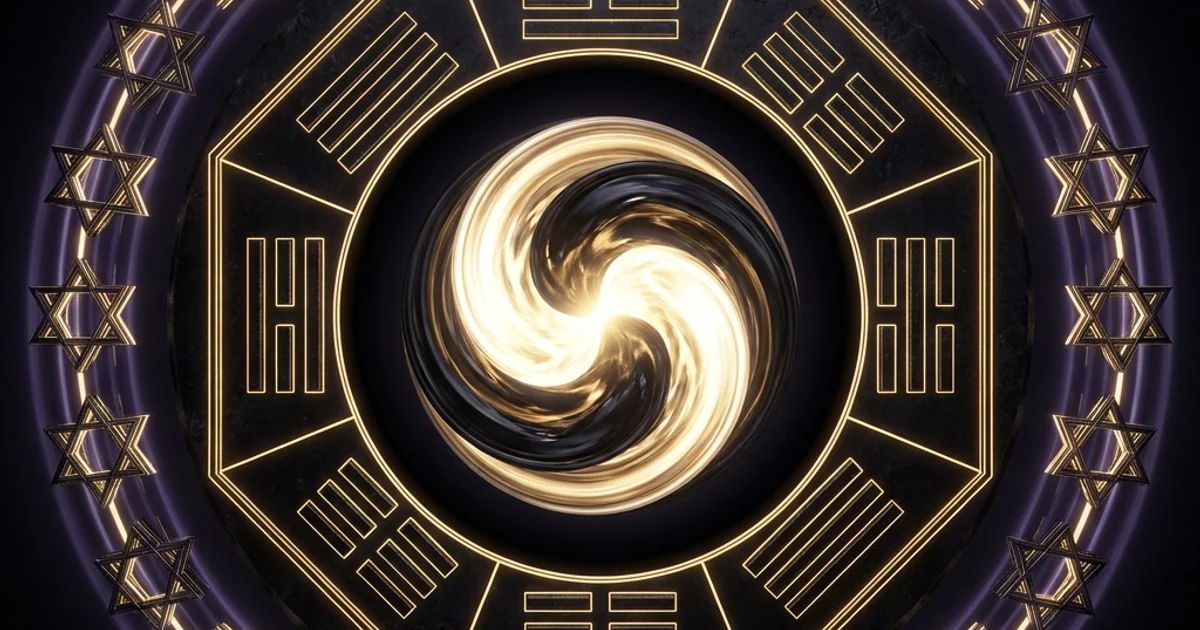
Daoist Yin-Yang Polarity: The Great Void and Taiji Art
Archetypal Thesis & Systemic Paradigm: The Cosmogenetic Phase Transition from Wuji to Taiji
Ontological Emptiness and the Primordial Matrix (Wuji)
The cosmogony foundational to classical Chinese thought and operationalized within the Yijing (Book of Changes) does not proceed from an ex nihilo act of divine creation, nor does it posit an eternal Cartesian split between mind and matter. Instead, it models existence as a topological unfolding from an unconditioned, non-differentiated ground known as Wuji (無極)—literally the “Ultimate of Non-being” or “Without Ridgepole.” Within the rigorous framework of Daoist metaphysics and archetypal psychology, Wuji does not indicate an absolute nihilistic void or mere ontological absence. Rather, it designates the zero-point state of undifferentiated potentiality: a vacuum state of consciousness wherein all archetypal configurations remain co-present, unmanifest, and thermodynamically symmetrical.
In this apophatic matrix, neither time nor spatial vectors possess operational validity. Phenomenologically, Wuji functions as the absolute latent space of the cosmos—an infinite-dimensional manifold before the projection of any dimensional axis. When early Daoist and proto-Confucian texts designate this state as empty (xu or kong), they describe a pregnant void analogous to the quantum vacuum, brimming with uncommitted virtual fluctuations. The dynamics of wuji to taiji cosmology govern this threshold: until differentiation occurs, consciousness has no object, energy possesses no vector gradient, and form remains an unactualized mathematical probability.
Symmetry-Breaking and the Self-Actualization of Taiji
The emergence of Taiji (太極), the “Supreme Ultimate,” constitutes a primordial symmetry-breaking within the unconditioned continuum of Wuji. This cosmological phase transition is instigated by Dong (動, movement)—not a physical relocation across empirical space, but an intrinsic, self-referential stir within the vacuum of potentiality. In philosophical terms, Taiji is the primary boundary condition: the ridgepole that introduces spatial orientation, distinction, and relational measurement into the undifferentiated plenum. Through this initial pulsation, the unified ground polarizes into complementary tensions, instantiating the archetypal mechanics of daoist yin yang polarity taiji wuji iching.
Taiji does not replace Wuji; it is the kinetic self-actualization of Wuji. As the Song Dynasty Neo-Confucian synthesizer Zhou Dunyi documented, Taiji generates Yang through movement; when that movement reaches its operational climax, it transitions into quiescence (Jing, 靜). This quiescence engenders Yin. When quiescence reaches its saturation point, movement resumes. Movement and rest become mutual causal vectors, establishing an eternal feedback loop. This dialectic establishes cosmological polarity not as a static metaphysical antagonism, but as a perpetual engine of systemic transformation. Far from being a localized cultural belief, this phase transition models how non-dual, unified substrates inevitably self-partition to generate observable phenomenal structures.
Polarity as Generative Dialectic in the Yijing
Within the symbolic architecture of the Yijing, Yin and Yang serve as the fundamental binary operators (Liangyi, 兩儀, the Two Modes) derived from the symmetry-breaking of Taiji. Unlike Western ontologies that historically cast light and darkness, or spirit and matter, into moralized dualisms of good versus evil, the Daoist generative dialectic positions Yin (陰) and Yang (陽) as strictly relational, complementary thermodynamic and psychic polarities. Yang designates kinetic expansion, radiating warmth, centrifugal motion, symbolic masculinity, cognitive focus, and hard topological boundaries; Yin denotes potential integration, receptive darkness, centripetal consolidation, structural interiority, affective immersion, and fluid topological continuity.
The recursive self-bifurcation of these two modes yields the entire architectural state-space of the 64 hexagrams. By superimposing dynamic lines upon one another, the system charts a multi-dimensional state-space representation of consciousness and matter. Binary alternation produces the Four Bigrams (Sixiang), which through further self-referential differentiation produce the Eight Trigrams (Bagua), ultimately culminating in the 64-hexagram matrix. Each hexagram operates as a discrete, systemic coordinate state within a non-linear phase space, tracking the perpetual oscillation of systemic entropy and self-organization across both macrocosmic cycles and inner psychic developments.
Classical Provenance & Textual Lineage: The Canonical Emergence of the Taijitu and the Ten Wings
The Xici Zhuan (Great Treatise) and Proto-Daoist Cosmology
The canonical codification of Yin-Yang polarity within the textual tradition of the Yijing achieved its definitive philosophical maturity in the Xici Zhuan (繫辭傳, The Great Treatise), traditionally attributed to Confucius but recognized by modern historical-critical scholarship as a multi-layered synthesis of proto-Daoist cosmology, Naturalist philosophy (Yinyangjia), and late Warring States metaphysics. The Xici Zhuan transformed what had been an archaic divination manual of the Western Zhou into a sophisticated psycho-cosmological coordinate framework. It declares unequivocally: “Change has an ultimate limit, which generates the Two Modes (Yi you Taiji, shi sheng Liangyi). The Two Modes generate the Four Images; the Four Images generate the Eight Trigrams.”
In this formulation, the Xici Zhuan establishes change (Yi, 易) as the absolute ontological ground of reality. Reality is not composed of stable, static substances endowed with transient qualities; it consists entirely of transition vectors, dynamic processes, and transformation thresholds. The commentary provides an analytical lexicon for these dynamics, observing: “One Yin and one Yang—that is the Dao (Yi yin yi yang zhi wei dao).” This classical assertion affirms that the Dao is neither exclusively Yin nor exclusively Yang, but the overarching rhythm, harmonic syntax, and regulatory logic that governs their cyclic alternation. The text demonstrates that human cognition, ethical decision-making, and macrocosmic ecological patterns are governed by this identical operational syntax.
Song Dynasty Neo-Confucian Synthesis: Zhou Dunyi and Shao Yong
During the Northern Song Dynasty (960–1127 CE), the structural model of the Yijing underwent an intellectual renaissance through the works of Neo-Confucian philosophers who integrated esoteric Daoist cosmological diagrams with rationalist systemic metaphysics. Principal among these thinkers was Zhou Dunyi (1017–1073 CE), whose seminal masterwork, the Taijitu Shuo (太極圖說, Explanation of the Diagram of the Supreme Ultimate), synthesized Daoist internal alchemical diagrams with cosmological metaphysics, providing the intellectual blueprint for all subsequent interpretations of the Taijitu.
“Wuji er Taiji! Taiji dong er sheng yang, dong ji er jing, jing er sheng yin, jing ji fu dong. Yi dong yi jing, hu wei qi gen; fen yin fen yang, liangyi li yan.”
(The Limitless, and yet the Supreme Ultimate! The Supreme Ultimate moves and generates Yang; when movement reaches its limit, it becomes quiescent. Being quiescent, it generates Yin. When quiescence reaches its limit, it moves again. Movement and quiescence alternate, each becoming the root of the other. Dividing into Yin and dividing into Yang, the Two Modes are thereby established.)
Zhou Dunyi’s enigmatic opening phrase—Wuji er Taiji (無極而太極)—sparked centuries of rigorous philosophical debate, notably between Zhu Xi and Lu Xiangshan. Zhu Xi maintained that er signified “and yet,” confirming that the unmanifest non-polar ground and the polar Supreme Ultimate are identical in substance (ti) while distinct in functional application (yong). Concurrently, the computational philosopher Shao Yong (1011–1077 CE) developed the Xiantian (Earlier Heaven) binary arrangement of the 64 hexagrams. By organizing the hexagrams according to their mechanical binary progression, Shao Yong established a dynamic structural matrix that systematically mapped polar states across cyclical time, presaging modern dynamic systems theory by nearly a millennium.
Esoteric Transmission: From Chen Tuan to the Hetu and Luoshu Diagrams
The visual iconography of the Taijitu and the structural underpinnings of the Yijing flow directly from esoteric lineages preserved by Daoist recluses of Mount Hua, most prominently the legendary master Chen Tuan (d. 989 CE). Chen Tuan transmitted a lineage of sacred cosmological diagrams, including the Wujitu (Diagram of the Boundless), the Hetu (Yellow River Map), and the Luoshu (Luo River Writing). These glyphs served as the mathematical and alchemical prototypes from which Zhou Dunyi derived his standardized Taijitu.
The Hetu and Luoshu are numerical matrix configurations based on balanced permutations of odd (Yang, celestial) and even (Yin, terrestrial) integers. The Hetu, correlated with the Xiantian (Pre-Heaven) order, portrays an idealized, self-equilibrating cosmos governed by dynamic generation, mapping numerical pairings (1–6 Water, 2–7 Fire, 3–8 Wood, 4–9 Metal, 5–10 Earth) along the cardinal axes. The Luoshu, which takes the form of a 3×3 magic square whose rows, columns, and diagonals sum uniformly to 15, corresponds to the Houtian (Post-Heaven) world of manifested, thermodynamic flux. Through this lineage, esoteric practitioners recognized that the visual art of the Taiji was not merely decorative symbolism, but a precise topological map indexing the conservation of energy, systemic momentum, and psychological equilibrium across dimensional states.
Structural Mechanics & Symbolic Geometry: Binary Permutations, Trigram Dyads, and Dynamic Vector Fields
The Progression of Liangyi (Two Modes) and Sixiang (Four Images)
The architectural calculus of the Yijing is founded upon rigorous, recursive bifurcation governed by the formula $2^n$, where $n$ represents the dimensional tier or line-level of structural manifestness. Beginning from the undifferentiated state-space of Taiji ($2^0 = 1$), the first operational subdivision yields the Liangyi ($2^1 = 2$): the continuous, unfragmented Yang line (⚊) and the broken, bifurcated Yin line (⚋). The unbroken line represents coherent kinetic force, directed intention, and structural density, while the broken line models receptivity, open-ended potentiality, structural cleavage, and capacity.
       Taiji (2^0 = 1)
        /          \
   Yang (⚊)       Yin (⚋)          <- Liangyi (2^1 = 2)
   /      \       /      \
Taiyang Shaoyin Shaoyang Taiyin    <- Sixiang (2^2 = 4)
By superimposing a second line upon this initial polarity, the system derives the Sixiang ($2^2 = 4$, the Four Images), representing fundamental phase transitions:
- Taiyang (Greater Yang, ⚌): Doubled kinetic energy; extreme expansion, midday, summer, dynamic exhaustion.
- Shaoyin (Lesser Yin, ⚍): A Yin line supervening over Yang; nascent cooling, interior consolidation within an active field, autumn.
- Shaoyang (Lesser Yang, ⚎): A Yang line breaking through Yin; emergent kinetic activity, dawn, spring, embryonic growth.
- Taiyin (Greater Yin, ⚏): Doubled receptive energy; absolute structural consolidation, midnight, winter, maximal latency.
The addition of a third line generates the Bagua ($2^3 = 8$), the fundamental trigram dyads that configure the structural mechanics of the experiential macrocosm.
Topological Vector Alignments: Xiantian (Pre-Heaven) vs. Houtian (Post-Heaven)
The eight trigrams are distributed across two primary topological matrices: the Xiantian (Pre-Heaven) arrangement, attributed to the culture-hero Fuxi, and the Houtian (Post-Heaven) arrangement, formulated by King Wen of Zhou. These two arrays represent entirely distinct phenomenological geometries. The Pre-Heaven arrangement models the archetypal blueprint of reality prior to temporal instantiation—a state of dynamic balance Daoist metaphysics conceptualizes as pure, symmetrical stasis. Here, polar opposites occupy exact counter-positions along spatial axes: Heaven (Qian, ☰) faces Earth (Kun, ☷) along the vertical north-south polar axis, while Fire (Li, ☲) and Water (Kan, ☵) maintain perfect energetic balance across the horizontal east-west axis.
In contrast, the Post-Heaven arrangement maps the phenomenal world of temporal duration, friction, thermodynamic expenditure, and biological generation. The symmetrical perfection of the Pre-Heaven array breaks: Fire and Water shift to the south-north axis, modeling the energetic dialectic of sunlight and moisture, heating and cooling, which sustains empirical life. The Post-Heaven arrangement depicts entropy, seasonal succession, and human existential struggle. Navigating between these two frameworks requires understanding that the Pre-Heaven geometry serves as the invisible, archetypal attractor, while the Post-Heaven geometry represents the localized, turbulent trajectory of manifest reality.
Xiantian (Pre-Heaven / Fuxi Arrangement)
- Phenomenological Dimension: Unmanifest archetypal blueprint, trans-temporal structural balance, non-physical implicate order.
- Topological Symmetry: Absolute polar symmetry; opposite trigrams stand diametrically opposed along central axes (e.g., Qian/Kun, Kan/Li).
- Energetic State: Perfect static equilibrium, frictionless potential, conservative dynamic balance.
- Governing Axiom: Spatial symmetry dictates stability; systemic forces cancel out into zero-point ground.
- Divinatory Application: Identifies root archetypes, core existential premises, and original internal alchemical potentials.
Houtian (Post-Heaven / King Wen Arrangement)
- Phenomenological Dimension: Manifest physical reality, sequential temporal execution, thermodynamic explicate order.
- Topological Symmetry: Asymmetrical and cyclical; trigrams are ordered according to the diurnal cycle and seasonal transformations.
- Energetic State: Dynamic disequilibrium, entropic friction, generative cyclical movement.
- Governing Axiom: Temporal succession dictates process; systemic friction drives continual evolution and decay.
- Divinatory Application: Maps pragmatic situational transitions, temporal trajectories, and chronological behavioral vectors.
Phase Transmutation Mechanics: Old Yin, Old Yang, and Stochastic Transformation
The operational vitality of the Yijing is grounded in its mechanism of phase transmutation. The system does not merely assign an individual to a static classification; it captures systemic metamorphosis in real time. This dynamic behavior is mathematically mediated through the four numbers utilized in classical mantic operations: 6, 7, 8, and 9.
The numbers 7 (Young Yang, designated as an immutable Yang line) and 8 (Young Yin, designated as an immutable Yin line) denote stable energetic fields capable of maintaining internal systemic coherence under baseline pressure. Conversely, the numbers 6 (Old Yin) and 9 (Old Yang) denote operational saturation points. In classical Daoist systems dynamics, whenever an energetic vector reaches its asymptotic maximum, it cannot sustain its direction without catastrophic collapse or structural inversion. Thus, 9 represents Yang at the peak of kinetic velocity, which must invert into its structural opposite, Yin. Similarly, 6 represents Yin compressed to its maximal density, instigating an explosive rupture into Yang.
Through this mechanic, an initial hexagram containing changing lines (dongxiao) generates a derived hexagram (bianzhuang). The transition vectors delineate the exact structural trajectory through which a system equilibrates its energetic imbalances, providing a precise roadmap of morphological change across complex systemic states.
Psychological Dynamics & Operational Praxis: The Yijing as a Cybernetic Consciousness Engine
Jungian Synchronicity, Enantiodromia, and the Transcendent Function
In his pioneering psychological investigations, Carl Gustav Jung recognized that the operational mechanics of the Yijing operated on a principle fundamentally distinct from Western mechanistic causality. Jung formulated the concept of synchronicity—an acausal connecting principle—to explain how the psychic condition of an observer and an objective, external physical event (such as the fall of yarrow stalks or coins) could coincide meaningfully without a direct linear-causal nexus. As Jung noted in his famous Foreword to the Wilhelm/Baynes translation of the I Ching (1950), the ancient Chinese mind did not inquire what caused an isolated event, but what likes to occur together with what within a unified, holistic moment of time.
       CONSCIOUS ONE-SIDEDNESS (Extreme Yang)
                       │
                       ▼
          CRITICAL SATURATION THRESHOLD
                       │
       ┌───────────────┴───────────────┐
       ▼                               ▼
UNCONSCIOUS RESISTANCE        ENANTIODROMIA
(Latent Yin Constellates)     (Spontaneous Polarity Inversion)
       │                               │
       └───────────────┬───────────────┘
                       ▼
             TRANSCENDENT FUNCTION
           (Emergence of Taiji Union)
This dynamic mirrors the Heraclitean and Jungian principle of enantiodromia—the regulatory psychological law whereby any extreme, one-sided conscious posture constellates its exact unconscious polar opposite. When an individual or collective consciousness identifies exclusively with an unyielding Yang modality (e.g., hyper-rationality, unilateral expansion, dogmatic assertiveness), the unconscious psyche steadily accumulates an equivalent counter-charge of Yin energy (e.g., irrational affect, somatic collapse, systemic receptivity).
If conscious integration fails to occur, this polarized tension triggers an involuntary, often destabilizing phase inversion. The Yijing acts as a cognitive mirror for this process, deploying the archetype of dynamic balance to facilitate the transcendent function—the psychic mechanism that synthesizes opposing conscious and unconscious factors into a renewed, self-regulating configuration of the Self.
Divinatory Protocol as an Acausal Diagnostic of Psychic State-Space
Approached through the lens of cognitive science and depth psychology, the divinatory protocol of the Yijing functions not as an exercise in superstitious fortune-telling, but as an acausal diagnostic of the subject’s immediate psychic state-space. Casting a hexagram establishes a cybernetic feedback loop between the inquirer’s conscious situation and the structural topology of the collective unconscious. The symbolic architecture of the hexagram serves as an external projection screen, exposing the systemic blind spots, hidden vectors, and structural tensions inherent to the inquirer’s conscious stance.
By interacting with the hexagram’s structural geometry, the practitioner bypasses conscious defenses and linear cognitive biases. The oracle does not dictate an unalterable fate; it delivers a topological reading of the energetic vector field at the exact moment of inquiry. If the inquirer’s trajectory proceeds unchanged, the probable future mapped by the changing lines will actualize.
However, by illuminating the invisible Yin currents underpinning apparent Yang phenomena (and vice versa), the hexagram equips the user with metacognitive awareness. This enables conscious course corrections that restore equilibrium before systemic enantiodromia violently forces phase reversal. Divination thus becomes a reflective technology for navigating nonlinear dynamics in psychic and operational domains.
The statistical topology of traditional yarrow stalk manipulation exhibits an intentional mathematical asymmetry, reflecting the dynamic bias inherent to systemic phase shifts:
| Operational Line State | Value | Traditional Designation | Yarrow Stalk Probability | Operational Systemic Signification |
|---|---|---|---|---|
| Old Yang (Moving) | 9 | Moving Yang (⚊ $\to$ ⚋) | $\frac{3}{16}$ (18.75%) | Kinetic exhaustion; irreversible shift into structural receptivity |
| Young Yin (Static) | 8 | Stable Yin (⚋) | $\frac{7}{16}$ (43.75%) | Stable receptive field; durable structural containment |
| Young Yang (Static) | 7 | Stable Yang (⚊) | $\frac{5}{16}$ (31.25%) | Stable directed vector; sustained intentional coherence |
| Old Yin (Moving) | 6 | Moving Yin (⚋ $\to$ ⚊) | $\frac{1}{16}$ (6.25%) | Extreme saturation; rare, destabilizing rupture into dynamic force |
The yarrow stalk method renders Old Yin three times rarer than Old Yang ($\frac{1}{16}$ versus $\frac{3}{16}$). This reflects the deep Daoist observation that receptive, compressed states require immense pressure to reach spontaneous criticality, whereas kinetic, expressive states routinely overreach their energetic margins, accelerating their own structural collapse.
Internal Alchemy (Neidan): Kan-Li Transmutation and the Return to Wuji
Within the contemplative traditions of Daoist Internal Alchemy (Neidan), the hexagrams and trigrams of the Yijing cease to be theoretical models and become internal cartographies for energetic transmutation. The principal focus of Neidan centers on the systematic inversion of the trigrams Kan (Water, ☵) and Li (Fire, ☲). In the mundane, Post-Heaven configuration of human biology and psychology, Fire naturally flares upward toward dissipation (representing conscious intellectualization, sensory distraction, and emotional volatility), while Water naturally flows downward toward depletion (representing somatic drive, procreative dissipation, and physical exhaustion).
Through specific psycho-physical practices, the practitioner reverses these vectors: Water is placed above Fire. This spatial inversion constitutes the dynamic state-space of Hexagram 63, Jiji (After Completion, ䷾), wherein the central lines of both trigrams achieve ideal thermodynamic coupling.
The inner Yang line latent within the Yin core of Water (Kan) represents original vitality (Yuan Jing), while the inner Yin line within the Yang core of Fire (Li) represents original consciousness (Yuan Shen). Through meditative sustained heat, the alchemist extracts the true Yang from Kan to replenish the hollow center of Li, transmuting somatic energy into breath (Qi), and breath into pure spirit (Shen). This process reverses the cosmogenetic descent, tracing the recursive vector backwards from the 64 states, through the Bagua and Liangyi, past the boundary of Taiji, and ultimately dissolving localized identity back into the unconditioned ground of Wuji.
Philosophical Synthesis & Macrocosmic Correspondence: Hermetic Axioms, Quantum Complementarity, and Universal Cyclicality
The Hermetic Principle of Polarity and the Daoist Liangyi
The ontological mechanics articulated within Daoist Yin-Yang polarity share deep structural parallels with Western esoteric traditions, particularly the Hermetic tradition codified in late antiquity and preserved throughout the Renaissance. The fourth Hermetic principle articulated in the foundational literature—the Principle of Polarity—states: “Everything is Dual; everything has poles; everything has its pair of opposites; like and unlike are the same; opposites are identical in nature, but different in degree; extremes meet; all truths are but half-truths; all paradoxes may be reconciled.”
This Hermetic formulation matches the operational logic of the Liangyi. Both systems insist that opposition does not represent a bifurcated reality of mutually antagonistic substances, but the dual aspects of a unified, self-partitioning continuum. In Hermeticism, vibration connects all polar manifestations; in Daoism, Qi (氣, vital energetic-breath) fulfills precisely this mediating role.
The Hermetic understanding that “extremes meet” states the Western equivalent of Daoist enantiodromia: when an energetic state is driven to its qualitative maximum, it touches its own boundary condition and loops into its polar counterpart. Both Hermetic and Daoist traditions recognize that mastery over phenomenal existence requires transcending naive identification with a single pole. It demands learning to navigate the dynamic balance Daoist philosophy envisions as the axis of the wheel—the motionless center from which all polar transformations are observed and orchestrated.
Niels Bohr, Quantum Complementarity, and the Implicate Order
The conceptual convergence between ancient Chinese polarity and twentieth-century physics was famously acknowledged by Niels Bohr, one of the chief architects of quantum mechanics. When tasked with developing a personal coat of arms upon receiving the Danish Order of the Elephant in 1947, Bohr selected the traditional Taijitu as his central heraldic device, inscribing above it the motto: Contraria sunt complementa (“Opposites are complementary”).
“Contraria sunt complementa.” (Opposites are complementary.) Chosen for the Danish Order of the Elephant to formally articulate that wave-particle duality and complementary quantum observables reflect the non-dual topological dialectic mathematically encoded in the Daoist Taijitu.
Bohr recognized that the classical Cartesian-Newtonian framework—which insisted on deterministic, mutually exclusive descriptions of physical reality—collapsed at subatomic scales. An electron behaves either as a localized particle or as a spatially dispersed wave depending strictly upon the experimental apparatus chosen by the observer.
Neither the particle model nor the wave model alone exhaustively characterizes quantum reality; both are mutually exclusive yet mutually necessary complementary descriptions of a single underlying phenomenon. This is precisely the operational architecture of Yin and Yang: two complementary perceptual frames required to model a non-dual reality that exceeds the limits of dualistic cognition.
                    UNDIFFERENTIATED VACUUM
           [ Wuji / David Bohm's Implicate Order ]
                             │
            FIRST SYMMETRY BREAKING / COLLAPSE
                             │
              ┌──────────────┴──────────────┐
              ▼                             ▼
       PARTICLE MATRIX                 WAVE MATRIX
     (Localized, Bounded,          (Non-local, Continuous,
       Explicate Yang)                 Receptive Yin)
              │                             │
              └──────────────┬──────────────┘
                             ▼
                    OBSERVABLE UNIVERSE
           [ Phenomenal Manifestation / Explicate ]
This structural insight was developed further by theoretical physicist David Bohm in his formulation of the Implicate and Explicate Order. Bohm proposed that the manifest world of classical reality (the explicate order, analogous to the 64 hexagrams and the Post-Heaven world) is an enfolded projection arising from an undivided, multidimensional holistic ground (the implicate order, analogous to Wuji and the Pre-Heaven matrix). Matter and consciousness do not interact as separate causal agents across physical space; rather, they unfold continually from this unified, unmanifest matrix through self-referential cycles of explication and implication.
“The natural numbers… appear to be the most suitable instruments for investigating the properties of the archetypal ground… The quaternary and binary structures bridging the I Ching and modern quantum physics demonstrate that qualitative number is not a mere product of human discursive reasoning, but an autonomous structural element of the objective psyche and the physical continuum, functioning as an ordering factor of synchronicity.” (pp. 112–115, Northwestern University Press)
Genetic Codon Isomorphism and Molecular Binary Logic
The mathematical structure of the Yijing extends deep into the molecular architecture of terrestrial biology. In the late twentieth century, researchers such as Martin Schönberger and Marie-Louise von Franz highlighted the structural isomorphism between the 64 hexagrams of the Yijing and the 64 triplets of the universal genetic code (messenger RNA codons). This correspondence is not a superficial numerological coincidence, but an expression of the mathematical constraints governing information encoding across complex binary systems.
The genetic code is built from four nitrogenous bases: the purines (Adenine [A] and Guanine [G]) and the pyrimidines (Cytosine [C] and Uracil [U] in RNA, or Thymine [T] in DNA). These four bases map directly onto the Sixiang (Four Images). Because a single base cannot provide sufficient combinatorial complexity to encode the 20 fundamental amino acids, biological systems organize these bases into linear triplets: codons. The total number of permutations available to a three-base sequence drawn from a four-letter alphabet is mathematically fixed:
$$4^3 = 64 \quad \Longleftrightarrow \quad 2^6 = 64$$
This formula is identical to the permutation of two binary line types across a six-position hexagram.
  MOLECULAR GENETIC CODE            YIJING BINARY SYSTEM
─────────────────────────          ──────────────────────
Purines / Pyrimidines       <--->  Liangyi (Yin / Yang: 2^1)
4 Nitrogenous Bases (A,U,C,G) <--->  Sixiang (Four Images: 2^2)
Base Triplets (Codons: 4^3) <--->  Hexagrams (6-Line States: 2^6)
64 Total Permutations       <--->  64 Archetypal Vector States
Both systems deploy a 64-element discrete combinatorial state-space to transcribe information into operational form. In genetics, these 64 codons translate nucleotide sequences into dynamic physical proteins. In the Yijing, the 64 hexagrams translate archetypal tensions into phenomenological and psychological states. Both architectures deploy a recursive, error-correcting binary logic to balance structural stability against evolutionary adaptation. This reveals a universal syntax governing self-organizing systems across both biological morphogenesis and psychic transformation.
Frequently Asked Questions: Epistemological and Practical Clarifications
Does Yin Signify Passivity or Moral Inferiority Relative to Yang?
A persistent error within Western receptions of Daoist philosophy is the moralized conflation of Yin with pejorative passivity, physical weakness, or ethical evil, while equating Yang with goodness, divine authority, and creative supremacy. This misinterpretation stems from imposing patriarchal, Cartesian-Christian moral dualisms onto an indigenous Chinese non-dual system. Within the classical Chinese intellectual framework, Yin is entirely distinct from moral failure or inert helplessness.
Yin represents receptivity, structural consolidation, interiority, and the indispensable matrix within which kinetic energy takes form. Yang without Yin is undirected, hyper-kinetic volatility that rapidly dissipates into entropic heat-death. Conversely, Yin provides the mass, containment, and structural resistance required for work to occur. The earth (Kun) possesses the same cosmic dignity as heaven (Qian); indeed, the Xici Zhuan insists that the receptive power of Yin is what grants material reality its enduring form.
Neither pole possesses absolute primacy. Pathological conditions arise exclusively when a system loses dynamic balance—either through hyper-Yang calcification and tyranny, or through hyper-Yin stasis and entropic collapse.
How Does the Non-Dual Transition from Wuji to Taiji Avoid Cartesian Dualism?
The transition from Wuji to Taiji avoids Cartesian substance dualism (the split between res cogitans and res extensa) because Wuji and Taiji are not two distinct substances interacting across an ontological divide. They are topological states of a single, continuous reality viewed through different orders of observation. Wuji is the unmanifest, infinite-dimensional vacuum; Taiji is that exact same vacuum observed in its state of localized, self-referential operational movement (Dong).
In Cartesian dualism, mind and matter possess completely incompatible, non-overlapping essences, requiring an ad hoc theological bridge (such as Descartes’ invocation of the pineal gland) to account for interaction. In the Daoist framework, mind, energy, and matter are continuous, differentiated gradations of a unified medium: Qi.
When Qi is dense, slow-moving, and coagulated, it manifests as physical matter (Yin); when it is rarefied, rapid, and luminous, it manifests as consciousness and spirit (Yang). Because every phenomenon retains this underlying energetic continuity, the system avoids dualistic fragmentation, preserving an unbroken non-dual feedback loop between the observer and the observed universe.
What Dictates the Critical Threshold for Dynamic Phase Reversal?
Dynamic phase reversal within the hexagram architecture occurs when a changing line reaches an operational threshold designated by the extreme numerical values 6 (Old Yin) or 9 (Old Yang). In systemic and physical terms, this critical threshold is reached when an internal dynamic vector exhausts its available kinetic capacity and encounters an absolute structural limit. This operational mechanics can be formalized through non-linear dynamics: a system driven far from equilibrium experiences self-amplifying positive feedback loops until its internal structural coherence can no longer withstand the energetic tension.
At this asymptotic maximum, the system hits a bifurcation point. For Old Yang (9), the kinetic energy of directed assertion overextends its communicative or structural base, causing the coherent vector to shatter; it must invert into receptive, consolidative containment (Yin). For Old Yin (6), compression and interiorization reach maximum density, creating a systemic vacuum that violently pulls in dynamic motion, catalyzing an explosive expansion into Yang.
Phase reversal is governed not by an arbitrary chronological clock, but by an internal limit: whenever an entity exhausts its directional trajectory, the latent counter-force residing in its core activates, instigating an enantiodromic transformation into its structural opposite.
Technical Concordance & Correspondences
| Archetypal Dimension | Wuji (無極) | Liangyi: Yang (⚊) | Liangyi: Yin (⚋) | Taiji (太極) |
|---|---|---|---|---|
| Ontological Mode | Unmanifest Matrix | Kinetic Differentiation | Receptive Consolidation | Self-Regulating Wholeness |
| Thermodynamic Vector | Zero-Point Ground | Centrifugal Expansion | Centripetal Compression | Continuous Dynamic Cycle |
| Psychic Equivalent | Collective Unconscious Void | Conscious Directed Ego | Receptive Archetypal Matrix | The Transcendent Self |
| Alchemical Phase | Original Emptiness (Shen) | Creative Fire (Li / Kan-Yang) | Nurturing Water (Kan / Li-Yin) | Reintegrated Elixir (Dan) |
| Information Logic | Unwritten Substrate | Binary State: 1 | Binary State: 0 | Recursive Binary Matrix |