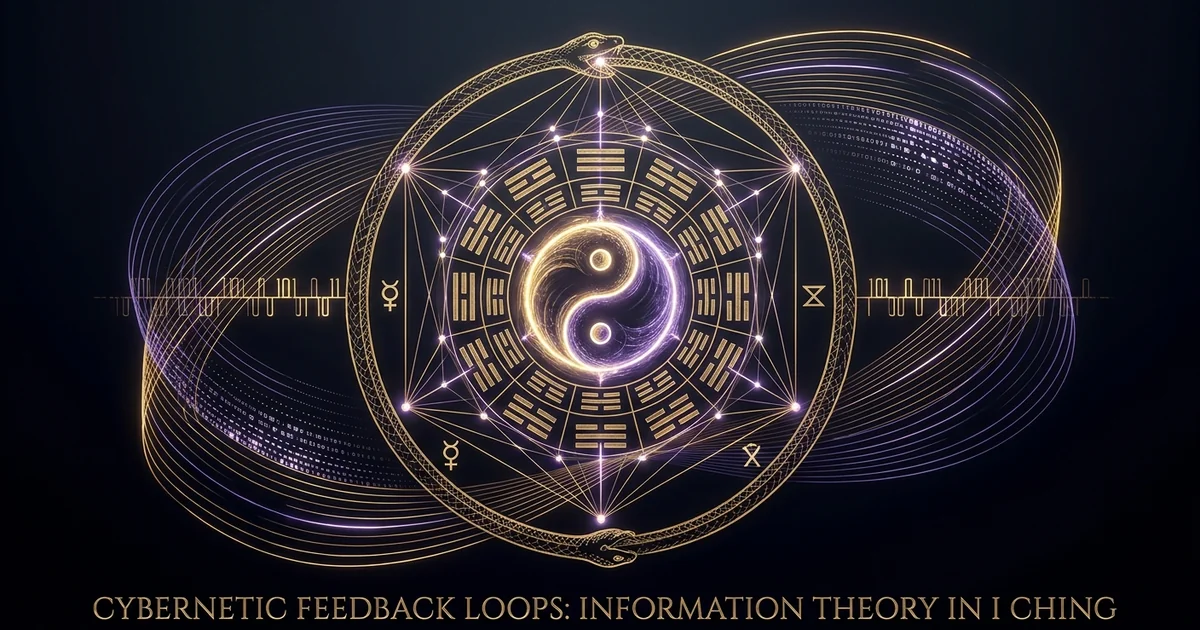
Cybernetic Feedback Loops: Information Theory in I Ching
Archetypal Thesis & Systemic Paradigm: The Zhouyi as an Informational Engine
Epistemic Closure and Binary State-Space Representation
The Zhouyi (Book of Changes) is fundamentally a discrete mathematical apparatus designed to map dynamic transformations within open, non-equilibrium systems. Long before the formalization of cybernetics by Norbert Wiener (1948) or the quantification of signal uncertainty by Claude Shannon (1948), classical Chinese cosmology formalized phenomenal reality as an informational field mediated by binary alternation. The system operates via operational closure: phenomenal reality is not treated as a collection of isolated, static substances, but as continuous relational processes structured by the dialectical tension between Yin (broken, yielding, discrete, 0) and Yang (unbroken, firm, continuous, 1). Through this foundational polarity, the text establishes a psycho-cosmological coordinate system wherein subjective psychological states and objective environmental matrices are integrated into a single systemic calculus.
Within this architecture, the casting of a hexagram is an act of epistemic measurement that induces observer-dependent state collapse. Far from operating as fatalistic augury or passive superstition, the mechanics of divination function as a cybernetics information theory iching binary feedback engine. The querent presents an unorganized, high-entropy psychological or situational problem to the system. Through ritualized randomization, this high-entropy scenario is mapped onto a strictly bounded state-space. By translating qualitative turbulence into a discrete topological address within a 6-bit configuration space, the consultation establishes a cybernetic feedback loop. The system takes the unintegrated variance of an open human-environment system, processes it through an invariant binary lattice, and yields a systemic diagnosis that feeds back into the querent’s cognitive apparatus, immediately altering their decision landscape and trajectory.
In classical information theory, Claude Shannon defines the informational entropy $H$ of a discrete random variable as:
$$H(X) = -\sum_{i=1}^{n} P(x_i) \log_2 P(x_i)$$
When applied to a state-space of maximum uncertainty where all configurations possess equiprobable distribution, entropy reaches its theoretical ceiling:
$$H_{\max} = \log_2(N)$$
For a system governed by six discrete binary variables ($n = 6$), the phase space comprises $N = 2^6 = 64$ distinct configurations. Thus:
$$H_{\max} = \log_2(64) = 6 \text{ bits of information}$$
Each hexagram in the Zhouyi constitutes a precise 6-bit information matrix. By assigning Yin to 0 and Yang to 1, the sixty-four hexagrams correspond directly to the complete combinatorial set of 6-bit binary integers ($000000_2$ to $111111_2$). Biologically, this identical state-space governs terrestrial life: the universal genetic code maps sixty-four mRNA codons ($4^3 = 64$, or $2^6$) to twenty amino acids plus termination signals, revealing an invariant structural logic between biological information processing and archetypal transformation matrices.
The Hexagram as a 6-Bit Information Matrix
The hexagram (gua) represents a formalized 6-bit information matrix capable of modeling sixty-four baseline states of systemic equilibrium, disequilibrium, and transition. Each hexagram is constructed from the bottom upward in six sequential strata (yao), where each position constitutes an individual bit holding a binary value. These six bits are not functionally homogeneous; they denote an escalating spatial, temporal, and hierarchical scalar field. Line 1 governs initial emergence and subterranean conditions; Lines 2 through 4 govern interpersonal mediation, spatial maneuvering, and intra-systemic stress; Line 5 represents sovereign systemic control and teleological alignment; and Line 6 characterizes systemic exhaustion, overextension, or transcendence beyond the boundary conditions of the current state.
Because each of the six lines can manifest as either static or dynamically transforming (“changing”), the actual computational state-space exceeds the static sixty-four hexagrams. When changing lines are engaged, each bit position expands from a base-2 variable into a base-4 variable, generating an operational matrix of $4^6 = 4,096$ micro-states. This dynamic resolution prevents the Zhouyi from collapsing into static typological classification. Instead, it operates as a granular state-space model where any given situation is plotted not only as a position, but as a directional vector possessing internal velocity and imminent bifurcation thresholds. The structural arrangement models Ludwig von Bertalanffy’s (1968) open systems, wherein dynamic balance is preserved only through continuous exchange and structural metamorphosis across system boundaries.
Wienerian Homeostasis in Psycho-Cosmological Dynamics
Norbert Wiener defined cybernetics as the study of control and communication in the animal and the machine, positioning feedback—the circular transmission of information from an operational output back into an operational input—as the fundamental mechanism of self-governing systems. In the Zhouyi, this principle is formalized through the structural relationship between the primary hexagram (ben gua) and the resultant hexagram (zhi gua). The emergence of changing lines signifies specific locus-points of energetic saturation where an element has exceeded its structural capacity for homeostatic maintenance, triggering an inversion into its polar opposite.
This polarity shift formalizes a self-organizing homeostatic engine. When a system’s internal variables deviate beyond viable operational limits, negative feedback loops are activated to dampen the fluctuation and restore baseline stability, or positive feedback loops are initiated to accelerate systemic mutation toward a new dissipative attractor. The consultation protocol establishes a conscious homeostat between the subjective consciousness of the observer and the objective systemic field. By identifying the precise points of energetic decay or hyper-accumulation, the Zhouyi provides corrective instructions designed to minimize systemic friction (loss of De), avoid catastrophe (Xiong), and optimize energetic alignment (Yuan Heng Li Zhen). The querent is not presented with an unalterable destiny, but with an informational steering mechanism: a compass detailing the corrective vector needed to preserve homeostatic equilibrium amid environmental fluctuations.
Classical Provenance & Textual Lineage: From King Wen to Leibnizian Binaries
The Shici and Ten Wings as Early Systems Epistemology
The operational philosophy of the Zhouyi reached systemic clarity during the late Zhou and early Han dynasties with the compilation of the Ten Wings (Shi Yi), particularly the Dazhuan (The Great Treatise). The Dazhuan stripped the text of bronze-age oracular provincialism, reconstructing the oracle as an epistemological instrument and a universal theory of systemic transformation. Within the Dazhuan, the cosmos is described as a recursive, open computational matrix driven by dialectical polarity: “The changes: this is what has made the holy sages so exalted. For the changes are the means by which they penetrated all wills and determined all fields of action under heaven” (Wilhelm & Baynes, 1950). The text explicitly conceptualizes change (yi) through three unified dimensions: bianyi (continuous transformation), jianyi (simplicity through reduction to binary rules), and buyi (invariable systemic laws).
[ Taiji: The Great Primal Beginning (1) ]
                  |
         +--------+--------+
         |                 |
     [ Liangyi: The Two Polarities (2^1 = 2) ]
     ( Yin: 0 )        ( Yang: 1 )
         |                 |
     +---+---+         +---+---+
     |       |         |       |
  [ Sixiang: Four Emblems (2^2 = 4) ]
   (6)   (8)       (7)   (9)
     |   |   |   |     |   |   |   |
 [ Bagua: Eight Trigrams (2^3 = 8) ]
 Kun  Gen  Kan  Xun  Zhen  Li  Dui  Qian
The Dazhuan articulates an explicit algorithm for the progressive differentiation of information, outlining an iterative $2^n$ branching process that proceeds from singularity to infinite systemic complexity. This model establishes that the cosmos generates structure through recursive bifurcation, mirroring modern algorithmic generation and cellular automata.
“Therefore, in the system of the Changes there is the Great Primal Beginning (Taiji). This generates the Two Modes (Liangyi). The Two Modes generate the Four Emblems (Sixiang). The Four Emblems generate the Eight Trigrams (Bagua). The Eight Trigrams determine good fortune and misfortune, and good fortune and misfortune produce the great field of action.”
— Translated from the Chinese text in Wilhelm & Baynes (1950), The I Ching or Book of Changes, Bollingen Series XIX.
Shao Yong’s Xiantian Sequence and Circular Binary Topologies
During the Northern Song Dynasty, Neo-Confucian metaphysician Shao Yong (1011–1077 CE) revolutionized the structural understanding of the Zhouyi by recovering and systematizing the Xiantian (Prior to Heaven, or Earlier Heaven) sequence. Departing from the historically contingent, socio-political arrangement of the King Wen sequence, Shao Yong organized the hexagrams according to an invariant, naturally emergent mathematical logic. By applying a rigorous recursive bifurcation algorithm—halving and alternating Yin and Yang at each hierarchical level from the bottom line to the top—Shao Yong derived a completely symmetric array of the sixty-four hexagrams.
Shao Yong displayed this sequence in both a linear continuum and a circular topology. In the linear array, the hexagrams form an unbroken sequence running from pure Yin (Hexagram 2, Kun, represented as $000000_2$) to pure Yang (Hexagram 1, Qian, represented as $111111_2$). In the circular array, the hexagrams are mapped as an ontological cycle of systemic expansion and contraction, tracking the thermodynamic influx and exhaustion of energy across temporal and seasonal domains. Shao Yong demonstrated that the sixty-four hexagrams are not an arbitrary catalog of poetic metaphors, but a geometrically closed, mathematically rigorous mapping of systemic state-space. His linear arrangement mirrors modern binary counting, establishing that natural transformation follows an orderly progression through binary coordinates. For an exhaustive breakdown of this progression, see the analysis of the binary code mechanics of Shao Yong and Leibniz.
Gottfried Wilhelm Leibniz and the Discovery of Arithmetic Dyadics
In the late seventeenth century, Gottfried Wilhelm Leibniz was actively developing his characteristica universalis—a universal formal language meant to reduce conceptual reasoning to calculation—and his system of binary arithmetic (dyadics). In 1697, Leibniz initiated a historic correspondence with Joachim Bouvet, a French Jesuit missionary stationed at the court of the Kangxi Emperor in Beijing. Bouvet was an adherent of Figurism, believing that the ancient Chinese classics contained remnants of a universal, divinely revealed proto-science. When Bouvet examined Leibniz’s binary system, in which all integers are expressed exclusively via 0 and 1, he recognized an identity between Leibniz’s arithmetic and the circular and linear hexagram charts of Shao Yong.
In November 1701, Bouvet dispatched from Peking a woodcut copy of Shao Yong’s Xiantian diagrams to Leibniz. Upon receiving the woodcut in Hanover in the spring of 1703, Leibniz experienced a profound intellectual revelation. He observed that if one substitutes a broken line with 0 and an unbroken line with 1, Shao Yong’s sixty-four hexagrams form a precise, sequential count from 0 to 63 in binary notation ($000000_2 = 0_{10}$ to $111111_2 = 63_{10}$). Leibniz immediately finalized his landmark treatise, Explication de l’Arithmétique Binaire (1703), published by the Académie Royale des Sciences in Paris. In this work, Leibniz explicitly credited the Zhouyi as historical confirmation of his mathematical framework:
“What is amazing in this reckoning is that this arithmetic by $0$ and $1$ turns out to contain the mystery of the lines of an ancient King and Philosopher named Fohy [Fu Xi], who is believed to have lived more than four thousand years ago… It provides an easy means of finding the reasons for the mutations or changes of things, which the Chinese have not been able to explain.” (Leibniz, 1703).
Leibniz understood that the hexagrams represented an advanced computational logic designed to map cosmic mutation through binary arithmetic, validating his conviction that the universal foundation of ontology, logic, and mathematics is dyadic.
Structural Mechanics & Symbolic Geometry: Feedback Dynamics of Changing Lines
Trigrammic Vector Fields: Lower Inner Attractor and Upper Outer Field
The computational utility of a hexagram stems from its internal structural polarity: each 6-bit matrix is formed by the synthesis of two 3-bit sub-matrices, known as the trigrams (bagua). The lower trigram (zhen gua, inner) represents the subjective, internal, structural, and energetic disposition of the system under observation. It functions as an inner attractor state, characterizing the system’s momentum, endogenous resources, cognitive assumptions, and thermodynamic potential. Conversely, the upper trigram (hui gua, outer) represents the environmental, relational, external boundary conditions and macro-systemic vectors into which the internal system must project itself or respond.
The dynamic tension of the hexagram emerges from the vector intersection between these two fields:
$$\vec{V}{\text{system}} = \vec{T}{\text{inner}} \times \vec{T}_{\text{outer}}$$
The eight trigrams—Qian (Heaven, pure generation), Kun (Earth, pure receptivity), Zhen (Thunder, initiating kinetic discharge), Xun (Wind/Wood, penetrating dispersion), Kan (Water, structural crisis and high informational entropy), Li (Fire, entropy reduction and radiating clarity), Gen (Mountain, systemic boundary enforcement and stasis), and Dui (Lake, expressive resonance and open exchange)—function as directional vector operators. When combined, the resulting sixty-four permutations describe every functional intersection between endogenous agency and exogenous constraints, illustrating how an internal state either aligns with, resists, or succumbs to macrocosmic boundary dynamics.
       UPPER TRIGRAM: EXTERNAL FIELD (Vector B)
       [ Bit 6 ] Exogenous Exhaustion / Transcendent Boundary
       [ Bit 5 ] Environmental Apex / Systemic Attractor
       [ Bit 4 ] Structural Boundary / Interface Threshold
   ------------------------------------------------------- [ Systemic Membrane ]
       [ Bit 3 ] Operational Limit / Intra-Systemic Stress
       [ Bit 2 ] Endogenous Equilibrium / Core Dynamic
       [ Bit 1 ] Latent Emergence / Initial Conditions
       LOWER TRIGRAM: INTERNAL ATTRACTOR (Vector A)
Stochastic State Transitions: Old Yin (6), Young Yang (7), Young Yin (8), Old Yang (9)
The generation of a hexagram is governed by a stochastic, non-equiprobable sampling protocol. Whether conducted via the traditional fifty yarrow stalks (Achillea millefolium) or the three-coin method, the operation generates four potential values for each line. These four states represent four discrete energy tiers within the phase space:
- Young Yang (7): Stable Yang line ($p = \frac{5}{16} = 0.3125$). Non-mutating binary 1.
- Young Yin (8): Stable Yin line ($p = \frac{7}{16} = 0.4375$). Non-mutating binary 0.
- Old Yang (9): Metastable/Changing Yang line ($p = \frac{3}{16} = 0.1875$). Binary 1 mutating to 0.
- Old Yin (6): Highly unstable/Changing Yin line ($p = \frac{1}{16} = 0.0625$). Binary 0 mutating to 1.
The deliberate asymmetry in the yarrow-stalk probabilities is a profound structural feature of the system. Young Yin (8) occurs with a probability of 43.75%, while Young Yang (7) occurs at 31.25%. Furthermore, Old Yang (9) is three times more likely to appear (18.75%) than Old Yin (6) (6.25%). This demonstrates that the Zhouyi does not model a static, balanced Newtonian cosmos, but an entropic, dissipative thermodynamic reality. Yang (energy, organization, active work) is volatile, expansive, and inherently prone to collapse into stability through transmutation; Yin (inertia, darkness, potentiality) exhibits higher systemic resistance to mutation, requiring a greater threshold of accumulated stress to invert into generative activity. The stochastic yarrow protocol acts as a biased Markov chain, where the transition probabilities reflect real-world thermodynamic asymmetries.
Topological Phase Shifts: The Mutating Hexagram as Dynamic Trajectory
The presence of changing lines (6 and 9) transforms the hexagram from a static snapshot into a topological trajectory across phase space. A hexagram containing changing lines is designated as the primary hexagram (ben gua). It defines the initial state: the current parameters, constraints, and energetic distribution of the system. When the changing lines undergo polarity inversion (every 9 flips from 1 to 0; every 6 flips from 0 to 1), a new 6-bit configuration crystallizes: the resultant hexagram (zhi gua).
In cybernetic terms, the zhi gua acts as a strange attractor or teleological target state. The transformation path between the ben gua and the zhi gua demonstrates the trajectory the system will follow if its internal momentum proceeds uninterrupted along current operational parameters. This bifurcated reading allows the observer to assess both the present configuration and the structural destination of their systemic vector. It establishes a feedforward control system: by observing the predicted target state, the querent can introduce intentional, corrective behavioral parameters to either stabilize the system or catalyze transformation toward a more optimal basin of attraction.
Psychological Dynamics & Operational Praxis: The Consultation as Self-Organizing Feedback
Analytical Synchronicity: Jung and von Franz on Non-Causal Informational Bundles
In his Eranos lectures and his historic foreword to the Wilhelm/Baynes translation, Carl Gustav Jung conceptualized the operational mechanics of the I Ching through his principle of synchronicity: an acausal connecting principle. Jung recognized that the mechanistic determinism of post-Cartesian Western science—founded exclusively on linear causality—was incapable of accounting for meaningful coincidences where an internal, psychological state coincides with an external, physical event without direct physical mediation. Jung, working in close collaboration with theoretical physicist Wolfgang Pauli, argued that synchronicity indicates the existence of an underlying psychophysically neutral reality, which they termed the unus mundus.
From an informational and cybernetic perspective, synchronicity can be reframed as acausal informational coupling. When an observer executes the stochastic yarrow consultation, their unintegrated, non-local psychological field entrains with the macrocosmic informational matrix. Marie-Louise von Franz expanded this epistemological breakthrough, demonstrating that ancient divinatory techniques are operational instruments designed to measure time qualitatively rather than quantitatively. The hexagram generated through stochastic resonance captures an archetypal cross-section of the cosmic state at that precise moment. It operates as an informational bundle where subjective unconscious dynamics and objective environmental vectors converge, collapsing probability into an interpretable symbolic configuration.
“Divination is a method of using synchronicity to assess the quality of the moment… Number, when used in divination, is not an instrument of quantitative measurement as in modern mathematics, but an archetypal, qualitative idea representing an ordered dynamic of psychic energy. The sixty-four hexagrams of the I Ching represent an archetypal continuum of dynamic energy states, a psycho-physical coordinate system where each hexagram defines a specific qualitative time-field.”
— Marie-Louise von Franz (1980), On Divination and Synchronicity: The Psychology of Meaningful Chance, Inner City Books, pp. 28–33.
Dissipative Structures: Prigogine’s Chaos Resolution within Cognitive Frameworks
When an individual or social collective approaches the Zhouyi, they are invariably operating within a state of cognitive dissonance, perceptual paralysis, or systemic crisis. In the terminology of Nobel laureate Ilya Prigogine (1977), the psychological system has transformed into a high-entropy dissipative structure pushed far from equilibrium. Under conditions of non-equilibrium thermodynamics, open systems cannot maintain baseline stability; they accumulate internal entropy until reaching a critical bifurcation threshold, where they must either spontaneously self-organize into a higher order of coherence or collapse into fragmentation.
[ FAR-FROM-EQUILIBRIUM COGNITIVE CRISIS ]
                                             |
                         [ Entropic Accumulation / Bifurcation Point ]
                                             |
                   +-------------------------+-------------------------+
                   |                                                   |
      [ Hexagram Consultation: ]                             [ Absence of Symbolic Boundary: ]
   Injects 6-Bit Symbolic Boundary                        Uncontrolled Entropy Dispersal
                   |                                                   |
   [ Dissipative Self-Organization: ]                         [ Systemic Fragmentation: ]
  Negative/Positive Feedback Loops Activated                     Cognitive Chaos / Pathological Stasis
                   |
   [ Emergence of Higher-Order Coherence ]
The consultation acts as a catalytic agent at this critical bifurcation point. By projecting the chaotic, undifferentiated variables of the crisis onto the discrete constraints of the 6-bit information matrix, the consultation injects a formal, symbolic boundary condition into the field. This intervention arrests cognitive dissipation. The system is compelled to reconfigure its internal relations according to the geometric constraints of the derived hexagram. The narrative commentaries (Tuan Zhuan, Xiang Zhuan) provide an organizing interpretive framework that lowers internal entropy, allowing the psyche to reorganize into a coherent, low-entropy configuration. The consultation resolves cognitive chaos not through wishful projection, but by forcing the observer’s cognitive apparatus through an invariant algorithmic crucible that re-establishes structural coherence.
The Consultation Workflow: Decoding Negative and Positive Feedback in Action
In operational praxis, the cybernetic reading of a hexagram is governed by identifying whether the oracle commands negative or positive feedback loops. This determination is mediated by the nature, quantity, and position of the changing lines:
- Negative Feedback (Homeostatic Maintenance): When the consultation yields an invariant hexagram (zero changing lines) or lines counseling caution, containment, withdrawal, and endurance (e.g., Hexagram 52, Gen, Keeping Still; or Hexagram 29, Kan, The Abysmal), the system is issuing a negative feedback instruction. The observer is operating within an environment where deviation from the mean will trigger catastrophic systemic disruption. The corrective strategy is deviation-counteracting: dampening emotional reactivity, adhering to ancestral protocols, consolidating resources, and reinforcing operational boundaries to protect the system from environmental fluctuations.
- Positive Feedback (Morphogenetic Bifurcation): When the consultation yields multiple changing lines (particularly three or more) or configurations centered on structural reorganization (e.g., Hexagram 49, Ge, Revolution/Molting; or Hexagram 3, Zhun, Difficulty at the Beginning), the system is issuing a positive feedback instruction. The system has passed its homeostatic threshold; attempting to enforce stability will result in stagnation and collapse. The cybernetic directive is deviation-amplifying: embracing structural breakdown, accelerating organizational redesign, cutting away obsolete relational frameworks, and actively driving the system across the bifurcation threshold into a new dissipative attractor state.
Philosophical Synthesis & Macrocosmic Correspondence: Cybernetics, Hermeticism, and the Biosphere
The Kybalion’s Principle of Polarity and Digital Ontology
The computational logic of the Zhouyi directly aligns with ancient Western esoteric traditions, particularly the foundational tenets of the Hermetic philosophy. In The Kybalion, the Second and Fourth Hermetic Principles—The Principle of Correspondence (“As above, so below; as below, so above”) and The Principle of Polarity (“Everything is dual; everything has poles; everything has its pair of opposites; opposites are identical in nature, but different in degree”)—read as metaphysical expressions of digital ontology. The Hermetic axiom posits that the manifest cosmos is generated through the continuous vibration and oscillation between polar extremes.
HERMETIC POLARITY                    CYBERNETIC BINARY               ZHOUYI DYNAMICS
    [ Active / Conscious ]    <=======>        [ Bit: 1 ]       <=======>    [ Firm / Yang ]
               |                                   |                                |
       ( Oscillation )                     ( Flip-Flop Gate )              ( Changing Line )
               |                                   |                                |
    [ Passive / Latent ]      <=======>        [ Bit: 0 ]       <=======>   [ Yielding / Yin ]
When synthesized with Wienerian cybernetics and contemporary information physics (such as John Archibald Wheeler’s “It from bit” doctrine), the Zhouyi emerges as an ancient implementation of digital ontology. It posits that the bedrock of physical reality is not material substance, but informational difference: a continuous stream of binary distinctions. Phenomenal reality is an emergent computational projection produced by the systematic alteration, combination, and permutation of fundamental binary units. Far from being cultural or historical anomalies, the sixty-four hexagrams articulate a universal structural geometry that bridges the divide between archaic esoteric cosmology and modern systems epistemology.
Cybernetics & Information Theory
- Binary Digits (Bits 0 / 1): The foundational units of informational entropy and data transmission.
- Shannon Entropy ($H$): A measure of systemic uncertainty, unpredictability, and informational disorder.
- Feedback Loops (Negative / Positive): Self-correcting circuits that preserve homeostasis or drive structural bifurcation.
- Strange Attractors & Phase Space: Multi-dimensional fields mapping all possible energetic states and systemic destinations.
- Markov Chains & Stochastic Walks: Probabilistic state transitions based on weighted, non-equiprobable parameters.
I Ching Epistemology
- Yin & Yang Lines (-- / —): The primary metaphysical polarity encoding yielding and firm structural states.
- Hundun (Primordial Chaos): Unmanifest potentiality requiring symbolic measurement to precipitate concrete reality.
- Changing Lines (6 / 9): Dynamic transition points instructing deviation-counteracting or deviation-amplifying behavior.
- Zhi Gua (Resultant Hexagram): The teleological target state toward which the system’s momentum is directed.
- Yarrow Stalk Probabilities: Asymmetric mechanics ($p = 1/16, 3/16, 5/16, 7/16$) modeling real-world thermodynamic transitions.
The Genetic Code Isomorphism: The 64 Codon and Hexagram Homology
The most profound confirmation of the structural universality of the Zhouyi’s 6-bit configuration space occurred in 1953 with Watson and Crick’s discovery of the double helix, and the subsequent deciphering of the universal genetic code in the 1960s. Genetic information in every terrestrial organism is stored, transcribed, and translated through a precise molecular calculus that is mathematically isomorphic to the sixty-four hexagrams. Deoxyribonucleic acid (DNA) and messenger ribonucleic acid (mRNA) construct biological architecture utilizing four nitrogenous chemical bases: Adenine (A), Cytosine ©, Guanine (G), and Thymine (T) / Uracil (U).
NITROGENOUS BASES (4)                FOUR EMBLEMS (Sixiang)
   ----------------------                ----------------------
   Uracil / Thymine (U/T)   <========>   Old Yin (6)
   Cytosine (C)             <========>   Young Yang (7)
   Adenine (A)              <========>   Young Yin (8)
   Guanine (G)              <========>   Old Yang (9)
BASE TRIPLETS (Codons)               HEXAGRAM (Dual Trigrams)

3 Bases = 1 Codon                     3 Lines = 1 Trigram
[Base 1]                              [Line 1]
[Base 2]  –> Triplet / Codon         [Line 2]  –> Trigram
[Base 3]                              [Line 3]
4 x 4 x 4 = 64 mRNA Codons            8 x 8 = 64 Hexagrams
These four bases are organized into discrete three-base sequences termed codons ($4^3 = 64$ combinations). Each codon instructs the cellular ribosome to either incorporate one of twenty specific amino acids into a synthesizing polypeptide chain or terminate the translation process (Stop codons). In his groundbreaking work The Cosmic Code: Forty-Eight Cases of the Book of Changes and subsequent treatises, Dr. Martin Schönberger demonstrated that the structural logic governing genetic transcription matches the generative architecture of the Zhouyi. By mapping the four nitrogenous bases to the four Sixiang (Four Emblems) based on purine and pyrimidine rings and hydrogen bonding properties, the sixty-four codons map directly onto the sixty-four hexagrams. This homology suggests that the 6-bit matrix of the Zhouyi discovered the invariant informational syntax that nature employs to translate abstract informational templates into material existence. This structural congruence is analyzed further within the study of the 64 gates and genetic codons and within the broader geometric frameworks of the Platonic solids information matrix.
Planetary and Systemic Teleonomy: The Macrocosmic Cybernetic Organism
On the macrocosmic scale, the cybernetic framework of the Zhouyi challenges mechanistic determinism, replacing it with an organic teleonomy. As articulated in James Lovelock’s Gaia hypothesis and contemporary Earth systems science, the biosphere functions as an open, self-regulating homeostat, dynamically adjusting atmospheric composition, oceanic salinity, and surface temperature to preserve optimal conditions for complex life. The ancient authors of the Zhouyi conceptualized the macrocosm identically, expressing it through the mutual resonance of Heaven (Qian), Earth (Kun), and Humanity (Ren).
Within this paradigm, planetary reality is not an inert mechanical clockwork operating along fixed trajectories, but a learning organism—an interconnected web of informational exchange mediated by discrete energetic jumps and feedback loops. The sixty-four hexagrams serve as an operational schematic of this planetary operating system, providing humanity with a cybernetic compass to navigate and maintain equilibrium within the broader environmental matrix. When human action violates macrocosmic feedback loops, systemic crises—droughts, social collapse, ecological catastrophe—manifest as negative feedback dampeners, forcing the system back into energetic realignment. By mastering the archetypal calculus of transformation, the observer transcends the status of an isolated, passive subject, becoming a conscious operator within the macrocosmic cybernetic engine. This harmonic resonance between temporal systems and organic development forms the structural core of archetypal chronobiology cycles.
Frequently Asked Questions
Is the connection between Leibniz’s binary calculus and the I Ching merely coincidental?
The historical and structural connection between Gottfried Wilhelm Leibniz’s development of binary calculus and the Zhouyi is historically documented, structurally verified, and non-coincidental. While Leibniz had begun sketching his dyadic arithmetic in an unpublished essay entitled De Progressione Dyadica in 1679, his exposure to Shao Yong’s circular and linear hexagram sequences through Father Joachim Bouvet in 1701 provided the definitive validation of his work.
Bouvet sent Leibniz a complete diagram of the sixty-four hexagrams arranged according to the Song Dynasty Xiantian sequence. Leibniz recognized that by treating the broken line (Yin) as zero and the unbroken line (Yang) as one, the Xiantian order represents a mathematically flawless progression of base-2 numbers from 0 to 63 ($000000_2$ to $111111_2$). This discovery affirmed Leibniz’s belief that his binary system was not merely a mechanical contrivance, but a rediscovery of a universal formal calculus (characteristica universalis) that had been understood by ancient Chinese natural philosophers millennia earlier.
How do the asymmetrical probabilities of yarrow-stalk casting affect information entropy?
The asymmetric probabilities native to the fifty yarrow-stalk casting protocol fundamentally alter the informational entropy of the consultation, distinguishing the Zhouyi from modern random number generators that use symmetric distributions. In the yarrow stalk method, the probabilities of deriving the four line states are uneven: Old Yin (6) has a probability of $\frac{1}{16}$ (6.25%); Young Yang (7) has a probability of $\frac{5}{16}$ (31.25%); Young Yin (8) has a probability of $\frac{7}{16}$ (43.75%); and Old Yang (9) has a probability of $\frac{3}{16}$ (18.75%).
   Yarrow-Stalk Probabilities (Total: 16/16)
   -----------------------------------------
   [  Old Yin (6)  ]  1/16 ( 6.25%) -> Transmuting to Yang
   [ Old Yang (9)  ]  3/16 (18.75%) -> Transmuting to Yin
   [ Young Yang (7)]  5/16 (31.25%) -> Invariant Yang
   [ Young Yin (8) ]  7/16 (43.75%) -> Invariant Yin
This mathematical distribution reduces the entropy of the emerging line compared to an equiprobable four-state system ($\log_2(4) = 2$ bits). By weighting Young Yin as the highest probability state and Old Yin as the lowest, the system embeds an entropic directionality into the state-space. Yang lines are three times more likely to mutate ($p = \frac{3}{16}$) than Yin lines ($p = \frac{1}{16}$), mirroring non-equilibrium thermodynamics where active energetic states exhibit higher decay rates toward equilibrium, while low-energy states require significant systemic stress before undertaking a morphogenetic leap.
Why is the I Ching considered a cybernetic feedback loop rather than traditional fatalistic divination?
Traditional fatalistic divination operates on an obsolete Newtonian-Cartesian framework: it assumes a deterministic timeline where the future exists as a static, unalterable destination, and the oracle acts as a telescope revealing that predetermined future. In contrast, the Zhouyi operates explicitly as a cybernetic feedback loop within an open, complex, self-organizing system.
In this cybernetic context, the consultation is not a passive reading of fate, but an active epistemological intervention. The human observer, experiencing high cognitive entropy (uncertainty, conflict, decision paralysis), introduces their situational variables into the binary state-space of the hexagram. The system outputs a diagnosis consisting of an initial condition (ben gua), points of systemic strain or bifurcation (changing lines), and a resultant attractor state (zhi gua). This diagnostic data feeds back into the consciousness of the observer, immediately altering their perception, behavior, and strategy. Because the observer’s subsequent choices shift their trajectory through phase space, the reading functions as an adaptive steering mechanism. The future is modeled not as a closed destination, but as a fluid field of probabilities shaped by the real-time feedback loops between the observer and the environment.
How does the 6-bit matrix of the hexagram relate to modern genetic coding?
The relationship between the 6-bit matrix of the sixty-four hexagrams and the genetic code is a structural isomorphism rooted in combinatorial mathematics. Terrestrial genetics utilizes four nitrogenous bases (Adenine, Cytosine, Guanine, and Thymine/Uracil) that combine in triplets to form sixty-four mRNA codons ($4^3 = 64$). Similarly, the Zhouyi utilizes four dynamic line states (Old Yin, Young Yang, Young Yin, Old Yang) derived from binary polarity, which combine in pairs of trigrams (two 3-bit informational units) to form sixty-four hexagrams ($2^6 = 64$).
Both systems utilize an identical computational architecture to encode transformation. In genetics, sixty-four codons translate an abstract informational blueprint into functional proteins and living organisms. In the Zhouyi, sixty-four hexagrams translate an abstract psycho-cosmological blueprint into situational trajectories and actionable decisions. Both systems employ binary parity checks, structural redundancy (degeneracy of the genetic code, where multiple codons synthesize the same amino acid, mirroring the thematic clustering of distinct hexagrams), and modular architecture to preserve systemic integrity while facilitating adaptive evolution.