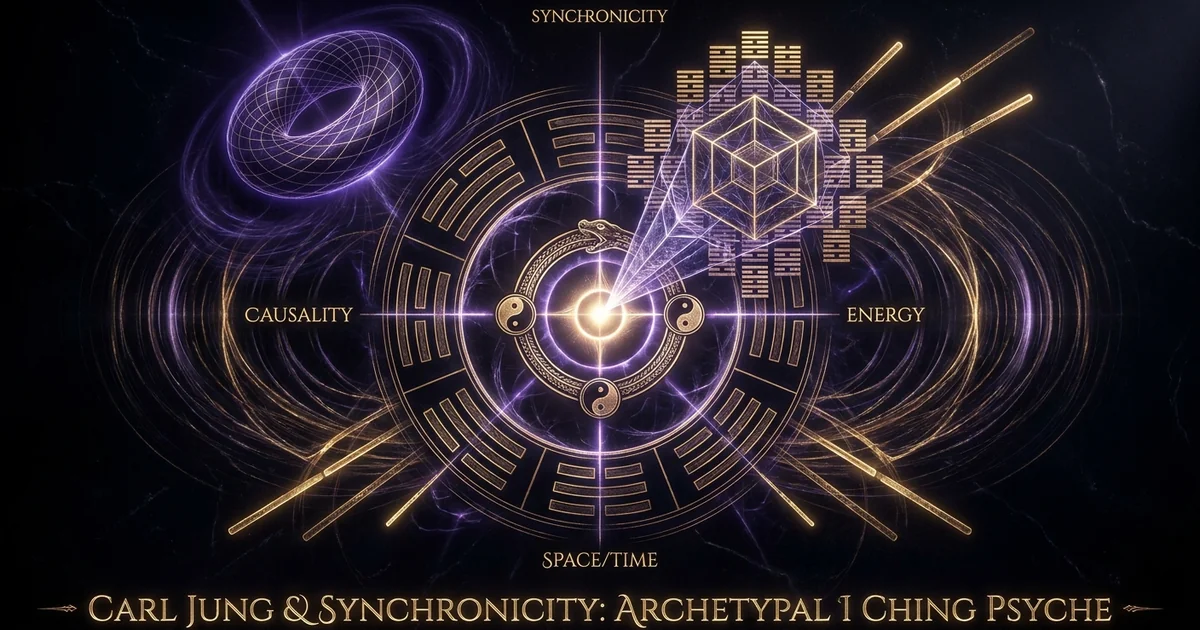
Carl Jung & Synchronicity: Archetypal I Ching Psyche
Archetypal Thesis & Systemic Paradigm: The Psychoid Interface and Acausal Order
Mechanistic Determinism versus The Acausal Connecting Principle
Western scientific epistemologies have historically anchored their axioms to mechanistic determinism and linear causality. Rooted in the Cartesian-Newtonian paradigm, this stance posits that the universe functions as an elaborate clockwork mechanism where every state transition is exhaustively accounted for by antecedent physical interactions. Within this framework, time operates merely as an abstract, quantitative coordinate—an empty, homogenous continuum along which discrete, measurable physical events unfold.
Consequently, statistical repeatability and experimental replicability became the arbiters of empirical validity. Phenomena that eluded direct causal tracing, or that manifested as singular, non-reproducible anomalies, were systematically dismissed as coincidental noise, cognitive bias, or pre-rational superstition.
In sharp divergence from this causal determinism, classical Chinese cosmological thought—crystallized across millennia within the I Ching (The Book of Changes)—conceptualized time not as an empty quantitative vessel, but as a dynamic, qualitative field. For the ancient Han philosophers and the Neo-Confucian commentators who refined the text, a given moment did not simply register “when” something occurred; it defined “what” qualities could simultaneously emerge within that temporal matrix.
When Carl Gustav Jung encountered this framework, he recognized that Western empirical science suffered from an epistemic blind spot: by prioritizing statistical averages and linear chains of cause and effect, it rendered itself incapable of deciphering meaningful configurations of simultaneous events.
To bridge this ontological chasm, Jung formalized the concept of synchronicity, which he explicitly designated as an acausal connecting principle. Synchronicity does not negate causality; rather, it introduces a complementary vector of equal epistemological weight. Jung asserted that while causality explains the sequential transformation of energy and matter across linear time via physical force, synchronicity accounts for the non-causal clustering of physical and psychic occurrences through equivalence of meaning. In this acausal schema, events do not trigger one another through energetic transfer; instead, they correspond through a shared, underlying semantic and archetypal configuration.
“I chose this term because the simultaneous occurrence of two meaningfully but not causally connected events seemed to me an essential criterion. I am using the general term synchronicity in the special sense of a coincidence in time of two or more causally unrelated events which have the same or a similar meaning, in contrast to ‘synchronism,’ which simply means the simultaneous occurrence of two events… Synchronicity therefore consists of two factors: a) An unconscious image comes into consciousness either directly (i.e., literally) or indirectly (symbolized or suggested) in the form of a dream, idea, or premonition. b) An objective situation coincides with this content. The one is as much a reality as the other.” — C. G. Jung, Synchronicity: An Acausal Connecting Principle (Bollingen Series, 1952)
The Psychoid Nature of Hexagrammatic Manifestation
The theoretical engine powering Jungian synchronicity is the psychoid archetype. In his early formulations, Jung treated archetypes primarily as primordial psychological structures—innate patterns of instinctual apprehension residing within the collective unconscious. However, his prolonged investigation into mantic arts, alchemical transformation, and quantum mechanics forced a radical recalibration of this definition. Jung realized that the deep layers of the archetypal matrix cannot be confined to human subjectivity or the psychological sphere alone; rather, they inhabit a liminal stratum that transcends the dualism of mind (psyche) and matter (physis).
The term psychoid indicates this quasi-psychic, quasi-material continuum. At this fundamental depth, the archetype is trans-spatial, trans-temporal, and structurally ambivalent: it possesses the latent capacity to project outward into the physical environment just as readily as it manifests inward as an affective image or ideational impulse.
When an inquirer consults the I Ching, the psychoid archetype operationalizes the consultation field. The casting of lots—whether through the manipulation of dried yarrow stalks or the tossing of three bronze coins—does not function through a causal-mechanical conduit, nor does it rely on arbitrary mechanical fortune-telling. Instead, the divinatory act induces an intentional collapse of the boundary separating subjective psychic states from external objective reality.
The physical fall of the coins or the mathematical division of the stalks mirrors the interior constellation of the inquirer’s unconscious field. The resulting hexagram stands as an objective correlative: an exteriorized topological mapping of the psychoid archetype constellated at that precise cross-section of qualitative time. By decoding the hexagram, the practitioner does not gaze into a deterministic future; rather, they read the structural geometry of the present, acausally rendered visible through the materialization of archetypal patterns in the physical casting.
Classical Provenance & Textual Lineage: Wilhelm, Jung, and the Bollingen Transmission
The Richard Wilhelm Translation: Bridging Neo-Confucian Metaphysics and Analytical Psychology
The dissemination of the I Ching into twentieth-century European intellectual discourse remains irrevocably linked to the intellectual synergy between Carl Jung and the Sinologist Richard Wilhelm. Stationed in Qingdao during the profound sociopolitical upheavals of early twentieth-century China, Wilhelm was initiated into the esoteric depths of the Book of Changes by the venerable Neo-Confucian scholar Lao Naixuan.
This master-disciple lineage was critical: Lao Naixuan did not instruct Wilhelm in the I Ching as an archaic, desiccated artifact of Bronze Age divination, but as a living, self-consistent psycho-cosmological system. This system integrated the early King Wen and Duke of Zhou commentaries with the philosophical sophisticated metaphysics of the Ten Wings (Shi Yi) and Song Dynasty Neo-Confucian thought.
Wilhelm’s translation, executed with painstaking philological fidelity and cross-checked through meticulous back-translation into German, arrived in Zurich at a critical juncture in Jung’s intellectual trajectory. Jung had spent the decade following his break with Sigmund Freud navigating the depths of his own unconscious—a process documented in The Red Book—and seeking historical, cross-cultural parallels for the autonomous patterns he observed in the clinical analyses of his patients.
Wilhelm’s German edition (published in 1924) provided analytical psychology with the very vocabulary it required: an ancient, mathematically rigorous taxonomy of macrocosmic-microcosmic identity that systematized psychic transformations without pathologizing them.
The historical Bollingen transmission, facilitated by Cary F. Baynes’s subsequent translation of Wilhelm’s German into English (published by Pantheon Books in 1950 under the Bollingen Series XIX), irrevocably cemented the text within the canon of Western depth psychology. Jung’s collaborative relationship with Wilhelm—which also yielded their joint commentary on the Taoist internal alchemy manual The Secret of the Golden Flower (Das Geheimnis der Goldenen Blüte) in 1929—crystallized the foundational insight that the dynamic polarity of Yin and Yang represents an empirical, archetypal model of the enantiodromic rhythms governing human psychic energy (libido).
   [ Lao Naixuan ]
          │ (Classical Lineage & Hermeneutics)
          ▼
   [ Richard Wilhelm ] ──(German Translation, 1924)──► [ C. G. Jung ]
          │                                                  │
          ▼                                                  ▼
   [ Cary F. Baynes ] ──(English Bollingen Series, 1950)──► [ Analytical Psychology /
                                                              Synchronicity Formulation ]
Jung’s Historic Foreword: Deconstructive Reading of Hexagram 50 (Ting)
The apex of this cross-cultural encounter is preserved within Jung’s legendary 1949 foreword to the Wilhelm/Baynes English edition. In composing this introduction, Jung abandoned the detachment of normative academic commentary. Recognizing that the I Ching resists passive discursive analysis, Jung elected to interrogate the oracle itself regarding its readiness to be introduced to the Western mind. In an extraordinary act of clinical praxis, he sat down with the two volumes, cast three coins, and allowed the Book of Changes to articulate its own historical destiny.
The consultation yielded Hexagram 50, Ting (The Cauldron), with moving lines in the second and third positions, dynamically transforming into Hexagram 35, Chin (Progress). In his structural analysis of this result, Jung conducted a deconstructive, self-referential reading of astonishing epistemological depth. In the Chinese ritual canon, the Ting was a sacrificial bronze vessel designed to prepare and cook ritual food for ancestral communion—a vessel symbolizing spiritual transformation, ethical nourishment, and the containment of divine forces. The oracle, Jung observed, was presenting itself to the West as a spiritual vessel: a cultural technology capable of cooking, refining, and transforming the raw psychic material of an increasingly alienated modern consciousness.
THE JUDGMENT: TING. Supreme good fortune. Success.
THE IMAGE: Fire over wood: The image of THE CAULDRON. Thus the superior man consolidates his fate by making his position correct.
Jung’s Psychological Commentary on the Moving Lines: The second line (Nine in the second place) states: “There is food in the ting. My comrades are envious, but they cannot harm me. Good fortune.” Jung notes that the Ting contains real nourishment. The envy of “comrades” reflects the skepticism of Western academia, which, bounded by deterministic prejudices, envies or dismisses the internal psychic richness of the esoteric text, yet remains powerless to neutralize its inherent psycho-spiritual potency.
The third line (Nine in the third place) states: “The handle of the ting is altered. One is impeded in his way of life. The fat of the pheasant is not eaten. Once rain falls, sorrow is spent. Good fortune comes in the end.” Jung diagnosed this line as the historical tragedy of the I Ching in the modern world: the “handle” by which the vessel is grasped has been damaged or altered; the rationalist intellectual cannot find an epistemic purchase upon it, and thus its rich spiritual nourishment (“the fat of the pheasant”) is neglected. Yet, as the line indicates, once the balancing waters of psychic integration descend (“once rain falls”), the tension resolves, clearing the path for Hexagram 35: Progress—the illumination of consciousness across the Western hemisphere.
Jung’s textual exegesis revealed that the oracle was not a static, inert codex. By answering Jung’s inquiry with a precise archetypal evaluation of its own cultural predicament, the I Ching demonstrated its capacity to function as a living, cybernetic mirror—an active conversational partner engaging the human investigator in an acausal dialogue. For a detailed hermeneutic breakdown of this transformation, see the study on /iching/hexagram-50-the-cauldron.
Structural Mechanics & Symbolic Geometry: Hexagram Dynamics as Archetypal State-Spaces
The Binary Combinatorics of Trigrams and Hexagrammatic Polarities
The structural architecture of the I Ching is anchored to a combinatorial binary logic that anticipates modern computer science, information theory, and state-space mathematics. At the foundational ontological level, the system posits the Taiji (the Great Ultimate), an undivided wholeness that bifurcates into the primordial polarities of Yin (the receptive, broken, entropic line: -- --) and Yang (the creative, solid, negentropic line: ------). These binary elements combine into four bigrams (Tai Yang, Shao Yin, Shao Yang, Tai Yin), which correspond to four qualitative phases of energetic emergence and decay.
By adding a third line, the system generates the eight trigrams (Bagua), each embodying an elemental vector of consciousness and physical manifestation:
- Ch’ien (Heaven / Pure Creative Yang)
- K’un (Earth / Pure Receptive Yin)
- Chen (Thunder / The Arousing)
- K’an (Water / The Abysmal)
- Ken (Mountain / Keeping Still)
- Sun (Wind/Wood / The Gentle)
- Li (Fire / The Clinging)
- Tui (Lake / The Joyous)
[ TAIJI ] (Undivided Unity)
                           │
             ┌─────────────┴─────────────┐
        [ YANG ]                      [ YIN ]
      (Creative / ───)            (Receptive / ─ ─)
             │                             │
       ┌─────┴─────┐                 ┌─────┴─────┐
    Tai Yang    Shao Yin          Shao Yang    Tai Yin
   (Great Yang) (Lesser Yin)     (Lesser Yang) (Great Yin)
       │           │                 │           │
     ┌─┴─┐       ┌─┴─┐             ┌─┴─┐       ┌─┴─┐
    Ch'ien Tui  Li   Chen         Sun  K'an   Ken   K'un
         (Eight Trigrams / Bagua: 2^3 = 8 States)
                           │
                           ▼
          [ 64 Hexagrammatic State-Spaces ] (2^6 = 64 Archetypal Topologies)
The stacking of two trigrams produces the hexagram, an assembly of six lines yielding a complete configuration space of $2^6 = 64$ discrete archetypal possibilities. These 64 hexagrams do not function as arbitrary prognostications. Rather, they comprise an exhaustive, non-Euclidean state-space representing the total permutations of human psychological situations and cosmological transformations.
The binary combinatorics of this architecture—which profoundly influenced Gottfried Wilhelm Leibniz in the seventeenth century during his development of the modern binary numerical system—maps onto the geometric permutations explored in /sacred-geometry/binary-combinatorics-64-hexagrams. Each hexagram describes a specific qualitative equilibrium, a stabilized field of archetypal tensions holding sway over a given psychological or material configuration.
Dynamic Entropy: Moving Lines and Vector Transitions in Temporal Space
The systemic sophistication of the I Ching reaches its zenith in its treatment of temporal dynamics via moving lines. In classical mantic calculation, a hexagram is rarely static. Each line possesses a numerical designation derived from the arithmetic procedures of yarrow stalk manipulation or coin casts:
- Young Yang (7): Stable, unchanging solid line (
------) - Young Yin (8): Stable, unchanging broken line (
-- --) - Old Yang (9): Unstable, dynamic solid line (
---o---), bearing an inherent entropic tendency to invert into its polar opposite (Young Yin) - Old Yin (6): Unstable, dynamic broken line (
-- x --), bearing an inherent negentropic tendency to invert into its polar opposite (Young Yang)
When a line registers as a 6 or a 9, it signifies an energetic extreme—a point of qualitative saturation where an archetypal force has reached its absolute maximum tension and must, according to the Law of Enantiodromia, undergo structural inversion.
The presence of moving lines introduces a secondary, resultant hexagram (Chih Kua). The primary hexagram delineates the structural conditions of the present topology, while the moving lines act as phase-shift vectors detailing the exact loci within the psychological field where energy is destabilizing. The resultant hexagram then maps the teleological trajectory toward which the system is evolving.
Through this mechanism, divination transcends static categorization: it models dynamic entropy, locating the inquirer not within a fatalistic cage, but within an evolving vector field of emergent probabilities.
Psychological Dynamics & Operational Praxis: The Cybernetics of Archetypal Divination
The Divinatory Act as Subconscious Exteriorization and Amplification
In analytical psychology, the divinatory act functions as a cybernetic feedback loop that bypasses ego defenses. Under normal conditions, the conscious ego operates within a defensive cognitive framework structured to minimize anxiety, maintain identity coherence, and protect its dominant conscious attitude. This cognitive architecture instinctively represses information that conflicts with ego ideals.
When an inquirer confronts an existential dilemma, rational deliberation often stalls, circling obsessively within the confines of established neuroses, complexes, and epistemic biases.
The I Ching disrupts this psychic stasis through archetypal amplification. When the inquirer projects their subjective uncertainty onto the casting of coins or stalks, the resulting hexagram confronts the ego as an exterior, unyielding empirical datum. The ego did not “invent” the hexagram; the hexagram presents itself as an objective mirror arising out of physical reality.
Confronted with the stark, archaic imagery of the text—the Abysmal Water, the Mountain, the Clinging Fire—the ego is forced to suspend its rationalizing defenses. The hexagram operates identically to an archetypal dream, yet with an operational advantage: it is experienced while awake. The imagery stimulates active imagination, compelling the inquirer’s consciousness to recognize repressed psychic configurations, project unconscious contents onto the symbolic canvas of the hexagram, and subsequently integrate those contents into a broader conscious perspective.
Mechanistic / Fatalistic Divination
- Epistemological Basis: Strict deterministic causality; reality as an unalterable, linear conveyor belt.
- Temporal Model: Quantitative, homogeneous time; future events exist pre-formed and wait to be encountered.
- Psychic Function: Externalized anxiety management; passive consumption of predictions; surrender of agency.
- Role of Inquirer: Helpless observer attempting to glean fixed outcomes from capricious fate or external deities.
- Systemic Output: Rigid, unyielding prognostications (“You will meet a stranger”; “Disaster will occur on date X”).
Jungian Archetypal Divination
- Epistemological Basis: Synchronicity and acausal connection; reality as an interconnected psychoid continuum.
- Temporal Model: Qualitative time; the present moment as a multidimensional matrix of archetypal potentials.
- Psychic Function: Subconscious exteriorization; active integration of complexes; expansion of ego-consciousness.
- Role of Inquirer: Active participant within a cybernetic feedback loop; co-creator of meaning through individuation.
- Systemic Output: Dynamic topology of systemic forces; teleological directionality and ethical correctives.
Methodological Protocols: Yarrow Stalk Probabilities versus Coin Manipulation
The mathematical mechanics employed to generate a hexagram exert an operational influence over the psychological process. Historically, two primary methods have predominated: the ancient 50 yarrow stalk method and the later, simplified three-coin method. While popular discourse treats these protocols as functionally interchangeable, their underlying combinatorial probabilities reveal a stark divergence in operational entropy and temporal pacing.
The traditional yarrow stalk manipulation—a laborious, ritualistic procedure requiring the cyclical division, counting, and gathering of dried stalks of Achillea millefolium—carries an asymmetric probability distribution. The mathematical mechanics of stalk sorting yield the following probabilities for generating a line:
$$\begin{aligned} P(\text{Old Yin } [6]) &= \frac{4}{64} = \frac{1}{16} \approx 6.25% \ P(\text{Young Yang } [7]) &= \frac{20}{64} = \frac{5}{16} \approx 31.25% \ P(\text{Young Yin } [8]) &= \frac{28}{64} = \frac{7}{16} \approx 43.75% \ P(\text{Old Yang } [9]) &= \frac{12}{64} = \frac{3}{16} \approx 18.75% \end{aligned}$$
Conversely, the three-coin method, which assigns numerical values of 2 (tails / Yin) and 3 (heads / Yang) to three identical coins thrown simultaneously, yields a strictly symmetrical binomial distribution:
$$\begin{aligned} P(\text{Old Yin } [6]) &= \frac{1}{8} = \frac{2}{16} = 12.5% \ P(\text{Young Yang } [7]) &= \frac{3}{8} = \frac{6}{16} = 37.5% \ P(\text{Young Yin } [8]) &= \frac{3}{8} = \frac{6}{16} = 37.5% \ P(\text{Old Yang } [9]) &= \frac{1}{8} = \frac{2}{16} = 12.5% \end{aligned}$$
As documented in the probabilistic analysis at /iching/yarrow-stalk-probability-mechanics, the yarrow stalk method renders an Old Yin twice as rare as in the coin method, while an Old Yang is three times more likely to appear than an Old Yin.
This asymmetry reflects deep psychological dynamics: within the yarrow stalk protocol, Yin energy is highly conservative, sticky, and slow to reach its catastrophic point of enantiodromic shift (Old Yin), whereas Yang energy ascends and tips into transformation with far greater velocity.
Furthermore, the twenty-minute duration required to cast a full hexagram using yarrow stalks alters the neurochemical and psychological state of the inquirer. The repetitive, rhythmic counting acts as an induction ritual, dampening beta-wave cortical activity, quieting the discursive internal monologue of the ego, and allowing the deeper, archetypal layers of the unconscious to rise to the threshold of awareness before the hexagram is ever decoded.
Philosophical Synthesis & Macrocosmic Correspondence: Psychophysical Monism and Quantum Parallels
The Pauli-Jung Conjecture: Unus Mundus and the Micro-Macrocosmic Matrix
The culmination of Jung’s exploration into synchronicity occurred not within the confines of psychological societies, but through his historic, decades-long dialogue with theoretical physicist and Nobel laureate Wolfgang Pauli. Their correspondence—immortalized in the archival collection Atom and Archetype—charted a revolutionary synthesis between analytical psychology and quantum mechanics.
Pauli, who had been introduced to Jung initially as a clinical patient seeking treatment for severe neurosis, quickly became Jung’s intellectual co-conspirator. Together, they recognized that the breakthroughs occurring at the quantum frontier—specifically Niels Bohr’s principle of complementarity, Werner Heisenberg’s uncertainty principle, and the observer effect—demanded an epistemological revolution that dismantled classical Cartesian dualism.
Jung and Pauli posited that physical reality and psychic reality are not two fundamentally distinct substances, but rather complementary aspects of a single, psychophysically neutral reality: the Unus Mundus (the “One World” of the medieval alchemists).
In their unified quaternary model of reality, Pauli and Jung expanded the classical triad of physics (Indestructible Energy, Space-Time Continuum, and Causality) to include Synchronicity as the fourth, balancing coordinate. In this paradigm, synchronistic events—including the meaningful alignment of an I Ching consultation—are structural manifestations of this underlying monistic substrate.
Divination does not represent a psychic force acting telekinetically on physical matter; instead, both the inquirer’s psychic state and the physical movement of the casting instruments are simultaneously informed by the archetypal dynamics of the Unus Mundus, emerging like two ripples generated by the same subterranean shift in the macrocosmic bedrock. Further explorations of this dynamic are detailed at /astrology/archetypal-cosmology-jung-pauli.
                 [ Indestructible Energy ]
                            │
                            │
       (Causality) ─────────┼───────── (Synchronicity)
     Constant Connection    │          Inconstant Connection
     through Force          │          through Meaning
                            │
                            │
                [ Space-Time Continuum ]
Biocosmological Coding: Hexagrammatic Isomorphism with Genetic and Cellular Architecture
The structural validity of the I Ching’s 64-hexagram matrix extends beyond psychological archetypes into the architecture of biological life. In the late twentieth century, molecular biologists, systems theorists, and informational philosophers—most notably Martin Schönberger, Gunther Stent, and Katya Walter—identified a structural isomorphism between the combinatorics of the Book of Changes and the universal genetic code governing organic life on Earth.
The universal genetic matrix relies on a digital language constructed from four nitrogenous bases: Adenine (A), Guanine (G), Cytosine ©, and Uracil (U) in RNA (or Thymine [T] in DNA). These bases combine into three-letter words called codons. Because there are four distinct bases organized into permutations of three, the complete informational code governing protein synthesis consists of exactly $4^3 = 64$ codons.
This mathematical symmetry maps with fidelity onto the architecture of the I Ching:
The formal structural parallels between molecular genetics and hexagrammatic combinatorics reveal a shared mathematical archetype:
- The Polar Basis:
- Molecular Biology: The fundamental purine/pyrimidine chemical duality; hydrogen bonding capacity (strong vs. weak bonds).
- I Ching: The basic Yin (broken) and Yang (solid) binary polarity.
- The Four Bases / Bigrams:
- Molecular Biology: The 4 nitrogenous bases: Uracil/Thymine, Cytosine, Adenine, Guanine.
- I Ching: The 4 bigrams: Tai Yang (Great Yang), Shao Yin (Lesser Yin), Shao Yang (Lesser Yang), Tai Yin (Great Yin).
- The Triplet Codon / Trigram Structure:
- Molecular Biology: Reading frames proceed via triplets of nucleotide bases ($4 \times 4 \times 4 = 64$ possibilities).
- I Ching: Hexagrams are composed of two three-line trigrams ($2^3 = 8$ basic patterns; $8 \times 8 = 64$ total states).
- Informational Completeness:
- Molecular Biology: The 64 codons account for all 20 standard amino acids, plus operational initiation (Start: AUG) and termination (Stop: UAA, UAG, UGA) signals.
- I Ching: The 64 hexagrams map the entirety of systemic life phases, containing structural initiation (e.g., Hexagram 1: The Creative) and completion/dissolution checkpoints (e.g., Hexagram 63: After Completion; Hexagram 64: Before Completion).
This biocosmological coding implies that the binary dynamics codified in the I Ching are neither anthropocentric inventions nor arbitrary products of ancient folklore. Rather, the Book of Changes represents an intuitive, phenomenological discovery of the self-organizing mathematical algorithms that structure both subjective consciousness and objective physical life. The oracle operates as a formalized systems theory, anticipating modern non-linear dynamics, dissipative structures, and self-regulating cybernetic loops millennia before their formalization in modern laboratories.
Frequently Asked Questions: Epistemological Clarifications on Jungian Mantics
Differentiating Synchronicity from Confirmation Bias and Apophenic Fallacy
A primary critique leveled by rationalist skepticism asserts that synchronicity is merely an elaborate justification for apophenia (the pathological tendency to perceive meaningful patterns in random, meaningless data) or confirmation bias (the cognitive tendency to selectively recall instances that validate an existing belief while filtering out disconfirming evidence). When an inquirer finds relevance in a hexagram, the skeptic argues that the text’s poetic ambiguity allows the individual to superimpose their personal desires onto the reading, generating an illusion of acausal correspondence through uncritical subjective projection.
Jung was acutely aware of this hazard and drew sharp boundaries to differentiate authentic synchronicity from apophenic projection. In his epistemological formulation, synchronicity does not hinge upon vague, subjective interpretations alone.
An authentic synchronistic phenomenon demands an objective, verifiable external event occurring in precise temporal alignment with an internal, highly specific psychic state. The external event must manifest with a level of structural specificity that renders the hypothesis of statistical chance improbable to the extreme.
In clinical praxis, when an individual experiences a synchronistic event, the external manifestation often features elements that were entirely unknown to the conscious ego, thus preventing confirmation bias from manufacturing the correlation in advance.
Furthermore, while apophenia is an uncritical, inflation-inducing delusion wherein the subject projects arbitrary coherence onto external randomness without ethical or contextual grounding, synchronicity functions as an ego-deflating, boundary-breaking shock that forces the individual to confront their blind spots. The synchronistic hexagram operates as an objective corrective from the collective unconscious, typically unsettling the ego’s preconceptions rather than validating its comfortable biases.
The Function of the Unconscious in Random Number Generation
The central mechanical question surrounding the divination process is this: how does the unconscious interface with the physical movements that determine the casting of lots? In both the yarrow stalk division and the tossing of coins, the process appears to reduce to a classic random number generation (RNG) mechanic, governed by micro-physical variables such as muscle contractions, atmospheric friction, tactile release velocity, and gravitational impact.
From the classical deterministic perspective, these micro-variables are completely insulated from the inquirer’s mental state. However, analytical psychology, corroborated by the Pauli-Jung hypothesis, conceptualizes this interaction through the lens of micro-physical indeterminism and quantum complementary.
At the macro-level of classical physical bodies, causal mechanics hold sway; but at the micro-level of neuromuscular actuation and sub-millimeter kinetic release, physical events are susceptible to quantum fluctuations. The unconscious mind—anchored in the psychoid archetype—does not need to physically “force” or “manipulate” the coins through mechanical telekinesis.
Instead, the act of divinatory consultation establishes an entangling field. In this state of concentrated archetypal activation, the psychoid continuum collapses indeterminacy so that the physical trajectory of the coins and the psychic requirements of the inquirer emerge as twin expressions of the same underlying moment.
The randomness is not subverted; rather, randomness (contingency) is revealed to be the very medium through which the qualitative meaning of the Unus Mundus manifests into physical reality. Jung’s foreword to the Wilhelm translation remains the historical apex where this ancient Eastern insight formally shattered the insularity of Western psychology, demonstrating that inside the architecture of chance resides the mirror of the soul.