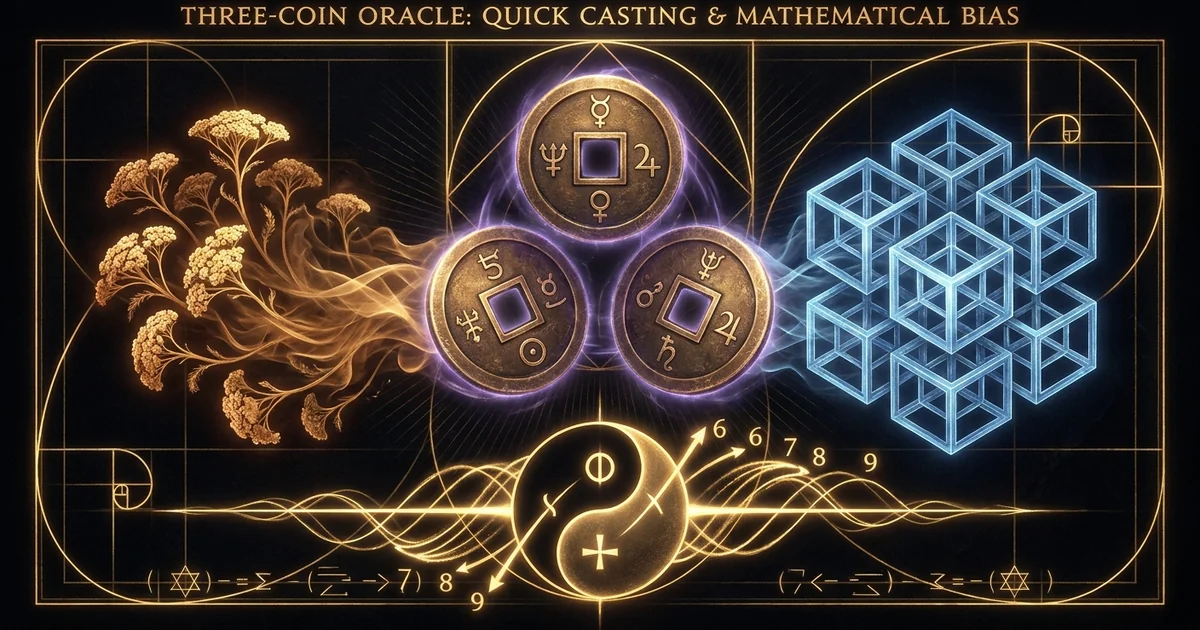
Three-Coin Oracle: Quick Casting & Mathematical Bias
Archetypal Thesis & Systemic Paradigm: The Combinatorial Architecture of Chance
Stochastic Divination as a State-Space Navigation Engine
Divination systems within the Hermetic and Sinitic traditions operate not as superstitious fatalism, but as state-space navigation engines designed to project qualitative consciousness onto formal topological coordinates. Within the framework developed by Carl Gustav Jung and Marie-Louise von Franz, the casting of an oracle provides an empirical interface with synchronicity—defined as an acausal connecting principle wherein an internal psychological crisis or archetypal constellation converges with an objective, physical, stochastic event. When the practitioner initiates a divinatory act, the macrocosmic state space is sampled through an engineered perturbation of physical matter. The resulting configuration does not predict a predestined chronology; rather, it identifies the precise vector field of psychic and phenomenological forces operating within the subjective present.
The sixty-four hexagrams of the I Ching comprise a six-dimensional binary phase space ($2^6 = 64$ discrete base states). When accounting for moving lines, which represent dynamic structural instabilities that transform into a complementary hexagram (zhigua-transformed-hexagram), the systemic field expands to $4^6 = 4096$ possible phase-transition vectors. Navigating this vast combinatorial architecture demands an operational method that translates the undifferentiated chaos of the casting medium into discrete symbolic registers. Divinatory tools—whether the classical fifty stalks of Achillea millefolium (yarrow) or the triad of bronze coins—function as stochastic transducers. They collapse the boundless continuum of potentiality into a defined set of integers that chart an individual’s trajectory across archetypal psychic coordinates.
[ 4096 Dynamic Vectors ]
                             |
                   (Collapse / Sampling)
                             v
[ Physical Medium ] ---> [ Integer (6,7,8,9) ] ---> [ Hexagram Coordinate ]
As an investigative discipline, esoteric cartography approaches this collapse through the lens of information theory and cybernetic feedback loops. Casting the coins constitutes a deliberate query injected into the psychoid substrate—the ontological threshold where mind and matter demonstrate isomorphic behavior. The spatial configuration of fallen metal acts as a mirror of dynamic psychic tension. By extracting a numerical signature from random physical dispersal, the practitioner externalizes subconscious patterns, projecting internal structural dynamics into an objective, geometrically coherent coordinate system.
The Binary Matrix: From Yin-Yang Polarity to Line Values 6, 7, 8, 9
The foundation of the Book of Changes rests upon the primordial dialectic of yin-yang-polarity. In archaic Chinese cosmology, this polarity is not merely a qualitative dichotomy but an arithmetic matrix. Yang, the active, solar, creative impulse, is fundamentally generative, odd, and dynamic; Yin, the receptive, lunar, structural ground, is condensing, even, and static. When codified into the computational language of the oracle, these two polarities diverge into four distinct operational states, mediated by the fundamental numbers 6, 7, 8, and 9. These integers do not simply represent numerical counters; they signify precise thermodynamic and directional vectors within an ongoing morphic process.
The three-coin method operationalizes the four states by assigning discrete numerical weights to the physical faces of the currency:
- Tails / Inscription Face (Yin): Assigned the numerical value of 2.
- Heads / Effigy or Blank Face (Yang): Assigned the numerical value of 3.
The instantaneous casting and arithmetic summation of three identical coins yields one of four mutually exclusive line values:
- $2 + 2 + 2 = 6$ (Old Yin / Moving Yin): Extreme receptivity on the verge of exhaustion; collapsing under dynamic tension to mutate into Young Yang. Marked as $—!! \times !!—$.
- $2 + 2 + 3 = 7$ (Young Yang / Static Yang): Stable, generative masculine force in equilibrium; structurally quiescent. Marked as $———$.
- $2 + 3 + 3 = 8$ (Young Yin / Static Yin): Stable, receptive feminine ground in equilibrium; structurally quiescent. Marked as $— \ \ —$.
- $3 + 3 + 3 = 9$ (Old Yang / Moving Yang): Extreme activity arriving at absolute expenditure; tipping into entropic collapse to mutate into Young Yin. Marked as $—!!\circ!!—$.
Within this arithmetic assignment, the even integers (6 and 8) retain the receptive Yin signature, while the odd integers (7 and 9) retain the creative Yang signature. Yet an essential metaphysical paradox is embedded within this assignment: 6 and 9 designate the “old” or “moving” lines (changing-lines), whereas 7 and 8 designate the “young” or “static” lines. The number 9, representing the apogee of Yang, contains the seed of its own transmutation; having reached the maximum limit of generative tension, it breaks and reverts to Yin. Conversely, the number 6, representing the nadir of Yin condensation, reaches the absolute density of structural contraction, cracking open to release generative Yang. The arithmetic of the oracle maps these turning points with mathematical economy, converting discrete static numbers into fluid agents of dynamic state transformation.
The Epistemological Tension Between Ritual Duration and Randomness
The systemic evolution of the I Ching from antiquity to the early modern period reveals an epistemological shift regarding the nature of divinatory noise and signal extraction. The archaic method of using fifty yarrow stalks is protracted, meditative, and physically laborious. It demands approximately fifteen to twenty minutes of focused, tactile manipulation involving the repeated division, subtraction, and counting off of bundles in modulo-four operations. This extended duration functions as an apparatus of sensory entrainment, shifting the practitioner’s cognitive baseline into an alpha-wave, contemplative state. The mechanical duration serves as an intentional cognitive buffer, allowing the subconscious complexes of the querent to fully map onto the unfolding physical ritual.
In contrast, the three-coin method is rapid, compressed, and kinetic. Six successive tosses of three bronze coins can be executed, recorded, and translated into a primary hexagram and its transformed counterpart in under two minutes. This acceleration introduces an operational compromise between computational expediency and stochastic fidelity. The accelerated temporal cadence of the coin casting ritual replaces prolonged somatic absorption with an abrupt, highly concentrated burst of kinetic force. Epistemologically, this transition raises critical questions regarding the nature of randomness: does the instantaneous collision of three metallic discs on a surface sufficiently harness the psychoid phenomenon, or does it reduce an organic cosmogram into an arbitrary mechanical lottery?
Rather than invalidating the reading, this temporal compression alters the operational modality of the oracle. The yarrow method operates through slow rhythmic accumulation, functioning like a complex analog computer that mirrors natural cycles of growth, decay, and agricultural pacing. The coin method behaves like an instantaneous cybernetic switchboard. It functions as a rapid parity-check mechanism designed for high-frequency queries, dynamic operational environments, and moments where the psychic tension of the querent is too acute to sustain the deliberate liturgical pacing of the stalks. The mathematical bias inherent in the coins emerges directly from this algorithmic compression, permanently divorcing the operational mechanics of the coin from the slow ecological harmonics native to the Achillea stalks.
Classical Provenance & Textual Lineage: The Shift from Stalks to Bronze Coins
The Han Dynasty Transition and the Wen Wang Ba Gua System
The codification of the I Ching underwent profound structural and philosophical transformations during the Western and Eastern Han Dynasties (206 BCE – 220 CE). While archaic divination under the Shang and early Zhou dynasties relied on pyromantic scapulimancy, plastromancy, and the ceremonial manipulation of milfoil stalks, the Han dynasty witnessed the emergence of systematic correlative cosmologies. Scholars such as Jing Fang (78–37 BCE) synthesized the hexagram permutations with the wu-xing-five-elements, the Heavenly Stems (Tiangan), the Earthly Branches (Dizhi), and the lunar-solar calendars. This structural integration crystallized into the Najia system and the Wen Wang Ba Gua (King Wen Later Heaven) operational grid.
[ Han Synthesizers: Jing Fang ]
  |--> Correlates 64 Hexagrams with Wu Xing & Earthly Branches
  |--> Introduces Najia System
  \--> Establishes operational demand for rapid numerical extraction
Within this scholastic crucible, the need arose for an agile, rapid method of obtaining line configurations that could be mapped against astrological branches and element cycles without requiring the prolonged liturgical manipulation of yarrow. Archaeological and textual evidence indicates that the Han period marked the earliest experimental deployments of coin-like tokens and metallic discs to derive hexagram lines. By linking each line to an Earthly Branch and an elemental phase, the Han cosmologists shifted the focus of divination from pure ancestral communion toward an intricate, clockwork analysis of civil, political, and meteorological affairs. The physical coins served as secularized, highly transportable instruments suited for military commanders, administrative magistrates, and wandering mantics who operated far from the ancestral temples where consecrated yarrow stalks were preserved.
Song Dynasty Formalization: Shao Yong and Huai Nan Zi Precedents
Although experimental coin casting occurred earlier, the rigorous formalization of the three-coin method as a standardized divinatory procedure occurred during the Tang (618–907 CE) and Song (960–1279 CE) Dynasties. A key catalyst for this systemic adoption was the philosopher and numerologist Shao Yong (1011–1077 CE). Shao Yong, a monumental figure in Neo-Confucian cosmology, developed the Xiantian (Earlier Heaven) binary progression of the hexagrams, recognizing in the sixty-four figures an inherent mathematical continuum of binary polarity that preceded physical manifestation. His work liberated the structural logic of the Changes from pure textual dependency, viewing the hexagrams as universal mathematical invariants.
In parallel with Shao Yong’s metaphysical abstractions, practical treatises from the Tang dynasty—most notably those attributed to the legendary Daoist master Chen Tuan (approx. 871–989 CE)—codified the operational protocol of bronze coins divination into what would later be known as the Huo Zhu Lin (Forest of Fire Pearls) system. This method became the dominant operational framework for coin casting in Chinese mantic practice. Influenced by early Han proto-Daoist texts like the Huai Nan Zi, which championed the hidden symmetries uniting the celestial sphere and terrestrial matter, the practitioners of the Huo Zhu Lin systematically formalized the mapping of three coins onto the line values 6, 7, 8, and 9. The rapid coin method ceased to be an informal shortcut; it was elevated into an autonomous hermeneutic discipline supported by a massive apparatus of correlative tables and diagnostic manuals.
Classical Critiques: Zhu Xi’s Defense of the Fifty Achillea Stalks
The widespread displacement of the yarrow stalks by bronze coins provoked an intense intellectual and ritualistic counter-reaction among the elite literati. The preeminent Neo-Confucian synthesizer Zhu Xi (1130–1200 CE) mounted an uncompromising defense of the classical yarrow methodology in his seminal work, Yixue Qimeng (An Introduction to the Study of the I Ching). Zhu Xi argued that the mechanical simplicity of coin tossing severed the somatic, contemplative link between the practitioner and the Dao. He contended that the fifty stalks were an irreplaceable ritual technology, explicitly encoded within the canonical texts to preserve cosmological harmony during the casting process.
“The number of the total is fifty. Of these, forty-nine are used. They are divided into two heaps to represent the two primal forces. One stalk is taken from the right heap and placed between the fingers of the left hand to represent the three powers (Heaven, Earth, Man). The stalks are then counted off by fours to represent the four seasons. The remainder is placed between the fingers to represent the intercalary month…” — Dazhuan (Xici Zhuan), Section I, Chapter 9
Zhu Xi juxtaposed this sacred algorithmic choreography against the mundane vulgarity of tossing currency into a tortoiseshell or wooden tray, warning that reducing this profound cosmic mime to the erratic collision of coins obscured the numerical and contemplative depth of the oracle: “The use of coins is a modern shortcut, convenient for vulgar practitioners who do not comprehend the principles of Heaven and Earth. The stalks embody the living spirit of the plant; their divisions reflect the operations of Yin and Yang. To abandon them for bronze is to trade the subtlety of the Dao for the swiftness of the marketplace.” — Zhu Xi, Yixue Qimeng (Treatise on the Clarification of I Ching Studies)
Beyond his ritualistic objections, Zhu Xi understood that bronze coins divination inherited a distinct sacred numismatic geometry. The circular exterior of the Chinese cash coin symbolized the rotating vault of Heaven (Tian, Yang), while the square cutout in the center represented the immovable, partitioned expanse of Earth (Di, Yin). Thus, even as the coin served as a secular medium of economic trade, it carried an internalized macrocosmic-microcosmic talismanic structure.
Nevertheless, Zhu Xi recognized that the coin’s mechanical distribution of values diverged completely from the numerical proportions generated by the yarrow divisions codified in the Dazhuan. The literati elite feared that this divergence in mathematical architecture would distort the cosmic balance between Yin and Yang, warping the dynamic flow of changing lines across the primary and transformed hexagrams.
Structural Mechanics & Symbolic Geometry: Mathematical Divergence and Asymmetry
The Yarrow Algorithm: Markovian Partitioning and the 1/16 to 7/16 Spectrum
To comprehend the profound probability divergence introduced by the coin method, one must first deconstruct the pure combinatorics of the fifty yarrow stalks codified in the Dazhuan. The ritual begins with fifty stalks; one is immediately set aside, remaining completely passive throughout the operation as an emblem of the Great Monad (Taiji). The remaining forty-nine stalks undergo a rigorous three-step recursive elimination protocol to determine a single hexagram line. This process must be repeated six times to erect a full hexagram, requiring eighteen discrete bundle divisions and counting operations.
[ 49 Stalks Active ]
                                |
             +------------------+------------------+
             v                                     v
     [ Left Heap: L ]                      [ Right Heap: R ]
             |                                     |
   (Subtract 1 for Man)                            |
             |                                     |
    (Count L modulo 4)                    (Count R modulo 4)
             \                                     /
              +-----------------+-----------------+
                                v
               [ Remainder Set: 4 or 8 Stalks ]
                                |
                   (Repeat for 3 Cycles Total)
                                v
               [ Final Sum: 36, 32, 28, or 24 ]
                                |
                       (Divide by 4)
                                v
                 [ Yields Line Value: 9, 8, 7, or 6 ]
During each pass of the stalks, the active bundle is arbitrarily split into two heaps ($L$ and $R$). A single stalk is subtracted from the right heap to represent humanity, and both heaps are systematically counted off by fours (representing the four seasons). The remainders from both heaps, along with the single stalk, are gathered and set aside. The physical remainder for any given pass can only sum to either 4 or 8 stalks (in the first pass, 5 or 9 if including the human stalk; in the second and third passes, 4 or 8).
Joseph Needham and Martin Gardner demonstrated through exhaustive combinatorial analyses that these remainder groupings do not produce equal probabilities across successive reductions. Because the removal of stalks dynamically alters the sample space of the remaining bundle, the yarrow stalk algorithm functions as an empirical, non-replacement Markovian extraction process.
The total remaining stalks after three consecutive operations are calculated and divided by 4, yielding the operative line values:
- A final bundle of 24 stalks yields $24 / 4 = 6$ (Old Yin)
- A final bundle of 28 stalks yields $28 / 4 = 7$ (Young Yang)
- A final bundle of 32 stalks yields $32 / 4 = 8$ (Young Yin)
- A final bundle of 36 stalks yields $36 / 4 = 9$ (Old Yang)
When all combinatorial paths through the eighteen iterations of the yarrow algorithm are mapped across the total state space of $2^4 = 16$ possible computational outcomes, the discrete probability distribution emerges as highly asymmetric:
- Old Yin (Line 6): $1/16 = 0.0625$ ($6.25%$)
- Young Yang (Line 7): $5/16 = 0.3125$ ($31.25%$)
- Young Yin (Line 8): $7/16 = 0.4375$ ($43.75%$)
- Old Yang (Line 9): $3/16 = 0.1875$ ($18.75%$)
This distribution reveals a profound ecological and cosmological thesis: the aggregate probability of generating a Yin line (whether static or moving) is $(1/16) + (7/16) = 8/16 = 1/2$. The aggregate probability of generating a Yang line is $(5/16) + (3/16) = 8/16 = 1/2$. Macrocosmic balance between the two cosmic polarities is strictly conserved at $50%$. However, within the internal dynamism of each polarity, an intense structural asymmetry reigns: Yang is three times more likely to be in a state of dynamic transformation ($3/16$) than Yin ($1/16$).
The Binomial Coin Distribution: The 1/8 Parity Architecture
The three-coin method fundamentally dismantles this nuanced Markovian architecture, replacing it with a classical binomial distribution derived from independent Bernoulli trials. When three identical, balanced coins are tossed simultaneously, each coin operates with an unvarying, independent probability of $p = 0.5$ for Heads (Yang, value 3) and $q = 0.5$ for Tails (Yin, value 2). The casting of the three coins constitutes the binomial expansion:
$$(H + T)^3 = H^3 + 3H^2T + 3HT^2 + T^3$$
This yields exactly $2^3 = 8$ equiprobable microstates. These microstates map onto the summative line values as follows:
- Three Tails: $T-T-T \implies 2 + 2 + 2 = 6$ (Old Yin). Permutations: $1/8$.
- Two Tails, One Head: $T-T-H, T-H-T, H-T-T \implies 2 + 2 + 3 = 7$ (Young Yang). Permutations: $3/8$.
- One Tail, Two Heads: $T-H-H, H-T-H, H-H-T \implies 2 + 3 + 3 = 8$ (Young Yin). Permutations: $3/8$.
- Three Heads: $H-H-H \implies 3 + 3 + 3 = 9$ (Old Yang). Permutations: $1/8$.
Yarrow Stalk Algorithm (Macrocosmic Entropic Decay)
- Old Yin (6) [Moving]:
- Fraction: $1/16$
- Decimal: $0.0625$
- Percentage: $6.25%$
- Young Yang (7) [Static]:
- Fraction: $5/16$
- Decimal: $0.3125$
- Percentage: $31.25%$
- Young Yin (8) [Static]:
- Fraction: $7/16$
- Decimal: $0.4375$
- Percentage: $43.75%$
- Old Yang (9) [Moving]:
- Fraction: $3/16$
- Decimal: $0.1875$
- Percentage: $18.75%$
- Overall Dynamic Mutability:
- Yang Mutation Ratio: $3/8$ ($37.5%$ of all Yang lines move)
- Yin Mutation Ratio: $1/8$ ($12.5%$ of all Yin lines move)
- Total Probability of Any Moving Line: $4/16 = 25.0%$
Three-Coin Method (Engineered Symmetrical Parity)
- Old Yin (6) [Moving]:
- Fraction: $1/8 = 2/16$
- Decimal: $0.1250$
- Percentage: $12.5%$
- Young Yang (7) [Static]:
- Fraction: $3/8 = 6/16$
- Decimal: $0.3750$
- Percentage: $37.5%$
- Young Yin (8) [Static]:
- Fraction: $3/8 = 6/16$
- Decimal: $0.3750$
- Percentage: $37.5%$
- Old Yang (9) [Moving]:
- Fraction: $1/8 = 2/16$
- Decimal: $0.1250$
- Percentage: $12.5%$
- Overall Dynamic Mutability:
- Yang Mutation Ratio: $1/4$ ($25.0%$ of all Yang lines move)
- Yin Mutation Ratio: $1/4$ ($25.0%$ of all Yin lines move)
- Total Probability of Any Moving Line: $2/8 = 25.0%$
The comparative analysis reveals the precise mathematical bias embedded within the coin casting ritual. While both systems preserve global parity between Yin ($50%$) and Yang ($50%$), and both maintain the identical gross probability that any given line will be a moving line ($25%$), the coin method introduces a massive internal restructuring. In transitioning from yarrow to coins:
- The probability of obtaining an Old Yin (6) doubles from $6.25%$ to $12.5%$.
- The probability of obtaining an Old Yang (9) decreases by one-third from $18.75%$ to $12.5%$.
- The probability of obtaining Young Yang (7) increases from $31.25%$ to $37.5%$.
- The probability of obtaining Young Yin (8) decreases from $43.75%$ to $37.5%$.
Phenomenological Consequences of Suppressed Yang Mutability
This probability divergence permanently alters the phenomenological behavior of the oracle. The yarrow stalk method is rooted in an organic, cosmological realism: it mirrors the natural asymmetry of thermodynamics and biological evolution. In the physical cosmos, structural form, order, and energy (Yang) require tremendous energetic expenditure to construct, yet they reside in a precarious, high-entropy state of dynamic instability. Yang, having achieved its zenith, naturally burns out and transforms rapidly. Conversely, material inertia, darkness, passivity, and ground (Yin) represent states of low energy, high stability, and immense resistance to transformation. Thus, in the yarrow ritual, Yin is exceptionally stubborn; it resists change, mutating only once in every sixteen trials, whereas Yang is volatile, mutating three times as often.
The three-coin method flattens this natural entropy gradient. By enforcing an artificial mathematical symmetry ($1/8$ for Old Yin, $1/8$ for Old Yang), the coins impose an idealized, mechanical equilibrium upon the cosmos. Under the coin methodology, the receptive ground becomes just as unstable and reactive as the creative fire; the feminine principle becomes twice as volatile as it is in nature, while the masculine principle has its natural mutability suppressed by thirty-three percent.
When applied to the hermeneutics of the zhigua-transformed-hexagram, coin casting significantly over-represents Yin-driven phase transformations. A querent casting with coins will witness hexagram mutations triggered by the breakdown of structural inertia far more frequently than the classical yarrow methodology would ever permit. This fundamental alteration does not represent random procedural error; it denotes a structural paradigm shift from an organic, nature-mimetic oracle to an engineered cybernetic device of symmetrical dialectical tension.
Psychological Dynamics & Operational Praxis: The Cybernetics of the Ritual
Kinetic Attunement and Motor Somatics in Bronze Casting
The physical execution of the coin casting ritual constitutes a specialized motor-somatic interface between the central nervous system and external physical reality. When a practitioner holds three bronze coins cupped loosely between the palms, a distinct biofeedback loop is initiated. The tactile texture of the metal, the weight of the planchets, their thermal conductivity absorbing body heat, and the kinesthetic feedback of shaking the coins create an intense somatic sensory focus. The characteristic, rhythmic metallic ringing produced by the tumbling coins functions as an acoustic focal point, temporarily detaching cognitive attention from peripheral sensory distractions.
This manual agitation and deliberate release constitute an externalization of internal psychic pressure. In the terminology of cybernetics, the practitioner injects kinetic white noise into a physical channel. The physical surface—whether a consecrated wooden casting tray, silk cloth, or stone tablet—acts as an entropic boundary condition that arrests the movement of the coins. When the coins strike and settle, the visual reception of their binary configuration collapses the subjective indeterminacy of the querent into an unalterable, objective reality. The sensory impact of this collapse operates as a subtle hypnagogic shock, breaking through conscious defense mechanisms and forcing the conscious ego to confront an archetypal pattern that is mathematically immutable and visually absolute.
The Observer Effect and Projection of Archetypal Vectors
In her seminal psychological work, On Divination and Synchronicity: The Psychology of Meaningful Chance, Marie-Louise von Franz demonstrates that ancient civilizations conceptualized number not as an abstract quantitative measurement, but as a qualitative, archetypal entity. Within this Jungian framework, the four line values (6, 7, 8, 9) function as qualitative indices of psychic readiness and directional momentum. The observer does not stand outside the divinatory experiment as a detached spectator; rather, through the mechanics of the psychoid archetype, the psychological state of the querent is entangled with the physical distribution of the casting medium.
When viewed through this psychological lens, the mathematical bias of the three-coin method ceases to be an epistemological defect and reveals itself as an operational adaptation. By equalizing the mutational threshold of Yin and Yang to an identical $12.5%$ probability, the coin technique attunes the divinatory instrument to the psychology of direct, active confrontation. In traditional societies, the slow, organic asymmetry of the yarrow stalks mirrored agrarian rhythms, dynastic continuity, and long-wave ancestral destiny. The coin method, historically popularized in urban, commercial, and military environments, reflects the immediate, high-stakes decision-making required by dynamic situations. The coins intentionally lower the activation threshold for the transformation of Yin, selecting for psychological states where dormant, unconscious structural inertia (Yin) must be forced into rapid, conscious articulation (Yang). The mathematical distortion matches the psychic intensity of crises where passivity must transform into decisive action.
Adjusted Interpretive Protocols for Coin-Generated Changing Lines
Because the three-coin method alters the underlying stochastic distribution, advanced operational praxis requires an adjusted hermeneutic protocol, particularly when interpreting multiple changing lines. In the classical yarrow tradition, encountering three or four moving lines is an exceptionally rare event, heavily weighted toward moving Yang. In coin casting, the mathematical equalization causes multi-line transformations to occur with heightened frequency and with a much higher proportion of moving Yin lines.
[ Hexagram Generation via 3-Coin Casting ]
                            |
           +----------------+----------------+
           |                                 |
           v                                 v
[ 1 to 2 Changing Lines ]         [ 3 or More Changing Lines ]
           |                                 |
  Privilege Textual Line            De-emphasize Line Texts;
    Oracles of 6 and 9            Privilege Macro-Structural
                                   Topology of Primary vs.
                                    Zhigua Transformation
To preserve structural integrity during coin-based divination, the practitioner should employ the following corrective protocols:
- The Principle of Textual Weighting: When one or two lines change, the interpretation remains traditional, focusing directly on the specific line texts of the primary hexagram, with special attention paid to how Old Yin (value 6) represents an immediate, structural fracture rather than a slow, natural dissolution.
- The Multi-Line Zhigua Domination Protocol: When three, four, or five lines transform simultaneously—an occurrence inflated by coin combinatorics—the practitioner must de-emphasize the individual line commentaries of the Zhouyi. Relying on four contradictory line texts generates interpretive fragmentation. Instead, operational hermeneutics dictates that the primary hexagram be read as the setting of departure, and the zhigua-transformed-hexagram be analyzed as the dominant, programmatic outcome.
- The Structural Polarity Parity-Check: If a reading yields an Old Yin line, the practitioner must recognize that this line has emerged against an engineered statistical baseline ($12.5%$) that is double its archaic likelihood. The interpretive focus must address the querent’s unconscious resistance: an Old Yin line generated by coins signals that a previously passive, hidden, or repressed situation has reached an unsustainable breaking point and will forcefully invert into manifestation.
Philosophical Synthesis & Macrocosmic Correspondence: Hermetic Axioms and Genetic Isomorphisms
The Taoist Principle of Reversion (Fan) versus Linear Entropy
The foundational dynamic animating the I Ching is the universal law of cyclic return, expressed in Chapter 40 of the Dao De Jing: “Reversion is the movement of the Dao” (Fan zhe Dao zhi dong). Western mechanistic science models the universe along a trajectory of linear thermodynamic entropy, running from initial low-entropy order toward ultimate heat death. Sinitic cosmology conceives reality as fundamentally oscillatory, an eternal, self-regulating systolic-diastolic rhythm wherein energy continually condenses into matter (Yin) and matter dissolves into energetic radiance (Yang).
                      [ Cosmic Apex: 9 ]
                      Extreme Yang Tension
                       /                 \
                      /                   \
   [ Waxing Yang: 7 ]                       [ Waning Yin: 8 ]
                     \                     /
                      \                   /
                      [ Cosmic Nadir: 6 ]
                      Extreme Yin Density
The mathematical dynamics of both the stalks and the coins serve as algorithmic models of this reversion. The line values 6 and 9 represent the critical tipping points where linear accumulation reaches its absolute limit and is forced to invert. The probability divergence between the two tools reflects the metaphysical distinction between the Xiantian (Pre-Heaven) and Houtian (Post-Heaven) realms.
The yarrow stalks, through their organic asymmetry, express the Xiantian primordial order—the unmanifest laws of nature where dynamic creative radiation precedes physical manifestation, and where structural form resists dissolution. The three coins belong irrevocably to the Houtian manifest world—the realm of human construction, technological mediation, and physical embodiment. By imposing an exact symmetry upon line transformations, the coins capture the phenomenological reality of human consciousness: a realm where the subjective experience of receptivity and action, fear and will, collapse and creation, operate in absolute dialectical parity.
Genetic Codon Degeneracy and Hexagram Symmetry
The correspondence between the combinatorial structure of the I Ching and the universal genetic code—first systematically observed by researchers following the deciphering of DNA by Watson and Crick, and later expanded by Martin Schönberger and Marie-Louise von Franz—represents an isomorphism between information theory, molecular biology, and archetypal cosmology. The binary permutations of the hexagrams and the quaternary alphabet of nucleic acids operate under an identical structural syntax:
- The Four Line Types (6, 7, 8, 9) correspond directly to the Four Nucleotide Bases: Adenine (A), Uracil/Thymine (U/T), Cytosine ©, and Guanine (G).
- The Trigram (trigram-bagua) corresponds to the Genetic Codon Triplet: A grouping of three bases that specifies an individual amino acid ($4^3 = 64$ possible triplets).
- The Hexagram (64 configurations) corresponds to the Universal Genetic Code: Exactly 64 discrete codons that map the entire cellular machinery of terrestrial life.
In molecular genetics, the phenomenon of codon degeneracy reveals that multiple distinct codons translate into the same amino acid. This redundancy is concentrated at the third base of the triplet—a phenomenon formalized by Francis Crick as the “Wobble Hypothesis.” This structural tolerance for variation at the terminal position mirrors the changing lines of the I Ching, where base lines establish structural identity while specific changing positions permit evolutionary adaptation without the catastrophic loss of systemic coherence.
The mathematical bias of the three-coin method exhibits a striking functional correspondence with codon usage bias in molecular biology. Although the genetic code contains synonymous codons that theoretically allow for equivalent translation rates, organisms selectively utilize specific codons to regulate the kinetics of protein synthesis and ensure structural fidelity during translation.
Similarly, the probability divergence between the yarrow stalks and the three coins represents an intentional systemic bias in the rate of translational mutation. The yarrow method mimics the basal, primordial rate of genetic mutation across vast evolutionary timescales, where mutations driven by energetic output (Yang) far outpace those driven by structural resistance (Yin). The coin casting method functions as an accelerated transcriptional burst, increasing the mutation frequency of structural ground (Yin) to facilitate rapid adaptation under severe environmental stress.
The Coin as Hermetic Microcosm: Mens Agitat Molem
The fundamental axiom of Western Hermeticism, codified in the Emerald Tablet of Hermes Trismegistus—“That which is Below corresponds to that which is Above, and that which is Above corresponds to that which is Below, to accomplish the miracles of the One Thing”—finds a rigorous, mechanical validation in the three-coin oracle. The physical coin is not an inert piece of metal; it is a designed talisman of cosmic order. The round perimeter captures the celestial, kinetic motion of the cosmos, while the inner square represents the terrestrial, static coordinate system. When tossed, the coin brings these two metaphysical dimensions into kinetic, tumbling interaction.
“Number is an archetypal pattern of order which has become conscious… The ancient Chinese held that number was not an invention of the human intellect, but an autonomous cosmic factor, a qualitative rhythm of the universe. In divinatory procedures such as the I Ching, number serves as the ordering factor by which the psychic state of the inquirer is synchronized with the acausal state of the universe at that precise moment. The mathematical method employed—be it the yarrow stalks or the coins—does not merely compute; it registers the qualitative intensity of meaning constellated in the psychoid realm.” — Marie-Louise von Franz, On Divination and Synchronicity (1980), pp. 38–41
This qualitative rhythm resolves the mechanical paradox of divinatory bias. The mechanical toss of three metallic discs is neither vulgar chance nor predetermined fate. It operates under the Latin maxim Mens agitat molem—“Mind moves matter.” At the precise juncture where the coins leave the hands and strike the surface, the physical parameters of velocity, angular momentum, and kinetic restitution become the physical medium through which an acausal synchronicity manifests.
The probability divergence between yarrow and bronze does not break the Hermetic link; it recalibrates the coordinate axis. The coins shift the inquiry from an agricultural, seasonal macrocosm to an urban, psychological microcosm. The tool shapes the inquiry, and the inquiry reshapes the tool, verifying the uninterrupted correspondence between the psychic architecture of the inquirer and the physical geometry of the fallen discs.
Frequently Asked Questions
Does the probability bias of coins invalidate traditional hexagram line interpretations?
The mathematical divergence of the three-coin method does not invalidate traditional hexagram line interpretations; rather, it shifts the operational mode of the consultation. In the psychological framework established by C.G. Jung and Marie-Louise von Franz, divination operates via synchronicity rather than linear mechanical causality. The physical instrument utilized is an integral part of the initial conditions of the inquiry.
When a querent utilizes the three-coin method, the psychic field constellates around the structural properties of that specific medium, including its mathematical biases. The traditional line commentaries preserved in the Zhouyi remain structurally valid because they articulate archetypal states of transition rather than statistical frequencies.
However, because the coin casting ritual inflates the likelihood of Old Yin (6) from $6.25%$ to $12.5%$ and suppresses Old Yang (9) from $18.75%$ to $12.5%$, the querent must recognize that coin-generated moving lines reflect a psychological dynamic where receptive, passive states are under heightened pressure to transform. The interpretation remains valid, but the speed and polarity of the archetypal vectors are tuned to high-stakes, crisis-driven resolutions.
Can weighted or customized coins correct the probability skew to match yarrow stalks?
It is mathematically possible to calibrate physical coins or develop modified multi-token casting procedures to reconstruct the archaic yarrow distribution ($1/16$ for 6, $5/16$ for 7, $7/16$ for 8, and $3/16$ for 9). Because a standard three-coin toss relies on an unvarying binomial distribution of $p = 0.5$ across three independent trials ($2^3 = 8$ microstates), it cannot natively divide the state space into sixteenths.
To bridge this divergence, several mathematical adaptations have been developed:
- The 16-Coin or 16-Token Array: A bag or tray containing sixteen identical tokens marked with the precise yarrow distribution—one token of 6, five tokens of 7, seven tokens of 8, and three tokens of 9. A single blind draw per line faithfully replicates the yarrow stalk mathematics without the fifteen-minute procedural duration.
- The Asymmetric Two-Coin or Four-Coin Protocol: By utilizing coins of different physical sizes or weighted centers of gravity, one can alter the binomial expansion. However, physical weighting introduces mechanical instability and irregular wear, making it challenging to maintain the exact $5/16$ and $7/16$ ratios over repeated casts.
- The Discrete 16-Sided Die: A polyhedral die engraved with one face for 6, five for 7, seven for 8, and three for 9 serves as a reliable mechanical proxy for yarrow combinatorics.
Nevertheless, historical practitioners of bronze coins divination generally avoided these mathematical corrections, recognizing that the innate symmetry of the three-coin toss represents its own internally coherent, Houtian (Post-Heaven) divinatory framework.
Why did the Chinese imperial scholars permit the three-coin method if the math was known to diverge?
The institutional acceptance of the three-coin method across imperial Chinese administrative, military, and scholastic echelons was driven by an operational compromise between computational expediency and political necessity. During military campaigns, diplomatic missions, and fast-moving civil crises, the prolonged manipulation of fifty fragile yarrow stalks was physically impractical and logistically unviable. The tactile manipulation of the stalks required a flat, wind-sheltered, and consecrated table, along with fifteen minutes of uninterrupted concentration per reading.
In contrast, three bronze cash coins were ubiquitous, resilient, and carried by every official and soldier as common currency. The casting could be completed inside a military pavilion, on horseback, or within an administrative tribunal in seconds.
Furthermore, Song dynasty numerologists such as Shao Yong established that the fundamental essence of the I Ching resided in the invariant binary polarity of Yin and Yang, rather than the physical botanical medium of the Achillea plant. Scholars recognized that the circular-square geometry of the cash coin carried a direct macrocosmic-microcosmic correspondence to Heaven and Earth.
The imperial elite accepted the altered probability distribution as a functional necessity, recognizing that the oracle dynamically adapts to the physical apparatus through which consciousness interrogates the cosmos. The rapid coin method was not viewed as an ontological error, but as an indispensable cybernetic adaptation designed for operational deployment in an unpredictable world.