The Fifth Line Sovereign: Supreme Benevolent Authority
Archetypal Thesis & Systemic Paradigm: The Fifth Line as Cybernetic Attractor
The Vector Geometry of the Hexagrammatic Core
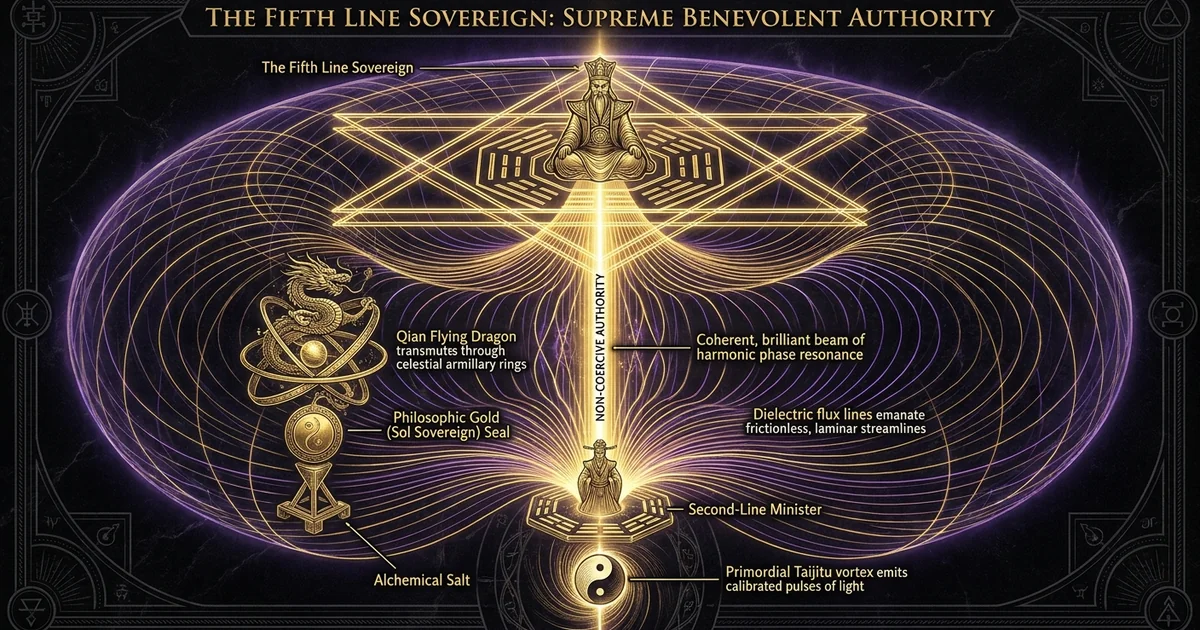
In the combinatorial architecture of the I Ching, the hexagram operates not as an arbitrary sequence of binary markers, but as a dynamic topological manifold representing discrete states of cosmic and psychological evolution. Within this stratified matrix, the fifth line functions as the ultimate systemic attractor. Positioned at the operational summit of the upper trigram, it serves as the coordinate where local energetic flux resolves into systemic coherence. The architecture delineated in /iching/structural-anatomy-hexagram-lines reveals that hexagram lines operate through an ascending vector field: line one establishes ground potential, line two stabilizes internal agency, line three confronts threshold resistance, line four executes provisional administrative transition, line five actualizes macrocosmic governance, and line six initiates entropy and detachment. The fifth line sovereign iching supreme position commands this hierarchical stack not through autocratic kinetic force, but through spatial dominance within the systemic matrix.
The fifth position occupies the nodal point of highest systemic leverage. In cybernetic terms, this line constitutes the command center of the system, receiving inputs from the peripheral boundaries and modulating the global phase space. Rather than exerting brute force down the ladder of lines, the fifth line operates as an equilibrium engine. It embodies the principle that true governance within complex dynamical systems is achieved when the controlling node exhibits the highest degree of requisite variety while maintaining pure structural fidelity to internal balance. When the fifth line is engaged, the chaotic contingencies of the lower trigram (individual impulses, relational conflicts, bureaucratic frictions) are transduced into coherent structural trajectories. It is the systemic nexus where raw potency converts into teleological purpose.
The Tao of Rulership: Transcending Coercive Domination
Western political philosophy and archetypal theory frequently conflate sovereignty with autocratic imperium—the capacity to impose an external will upon a resistant collective through the monopoly of violence or dogmatic coercion. The I Ching radically deconstructs this paradigm. The ruler line hexagram operates under the doctrine of wu-wei (effortless action or non-coercive presence). Rulership in the Sinitic cosmological framework is non-interventionist; it mirrors the celestial mechanics of the North Star (Polaris), which remains motionless at the celestial axis while the entire firmament rotates around its fixed point. Benevolent authority is fundamentally gravitational rather than kinetic. It exerts authority by cultivating an energetic sink toward which all systemic components naturally gravitate.
This effortless governance relies on absolute transparency to universal law (Li). The sovereign does not invent order; the sovereign embodies order. When imperial authority attempts to enforce its agenda through peripheral manipulation, surveillance, or punitive terror, it betrays a catastrophic decay of its central virtue. Such coercive degeneration precipitates immediate systemic degradation, pulling the fifth line down into the factional turbulence of the third or the overextended fragility of the sixth. The authority of the fifth line is designated as benevolent precisely because it liberates subordinate agencies to execute their endogenous functions without administrative friction. It preserves systemic homeostasis by minimizing executive friction, demonstrating that sovereignty is measured not by the density of decrees issued, but by the systemic equilibrium preserved.
Centrality (Zhong) Over External Imposition
Crucial to understanding the mechanics of the fifth position is the ontological primacy of Zhong (centrality) over Zheng (rectitude). While an odd line in an odd place (a Yang line in position 1, 3, or 5) or an even line in an even place (a Yin line in position 2, 4, or 6) achieves technical rectitude, canonical commentators consistently elevate centrality above mere positional correspondence. A sovereign line that holds the central station of the outer trigram (position 5) possesses an innate capacity for self-regulation, regardless of whether its polarity matches the odd numerical sign of the position. Centrality signifies the avoidance of ideological extremes, the suspension of reactive polarity, and the capacity to inhabit the dynamic mean.
Centrality guarantees that authority remains non-dogmatic and adaptable. An authority founded solely upon rigid rectitude (Zheng) without centrality (Zhong) hardens into institutional legalism, inevitably shattering under the pressure of dynamic historical shifts. Conversely, central virtue allows the sovereign to absorb, recalibrate, and integrate systemic anomalies. The sovereign does not impose an abstract symmetry upon reality from above; instead, by dwelling in the center of the outer realm, the fifth line senses the global conditions of the hexagram’s informational ecology and responds with proportional, measured adjustments. The fifth line is the supreme position because it is the position that can never be peripheralized. It holds the core of the macrocosmic trigram, ensuring that systemic intention is continually harmonized with cosmic evolution.
The hexagrammatic framework is structured around two distinct operational centers: the internal axis of line 2 (the center of the lower, inner trigram) and the external axis of line 5 (the center of the upper, outer trigram). Line 6, which caps the construct, does not represent superior authority; rather, it represents the terminus of structural manifestation—hyper-extension, exhaustion, or detachment.
Line 5 represents the optimal apex of manifest development. It is the systemic optimum before diminishing returns precipitate the decay of Line 6. While Line 6 falls prey to hubris or drifts into monastic abdication, Line 5 maintains full somatic engagement with worldly structures while holding the mathematical center of the outer field. Its authority is mathematically stable because it is reinforced from below by the ministerial apparatus of Line 2, creating an invariant bipolar axis of global systemic equilibrium.
Classical Provenance & Textual Lineage: The Canonical Construction of the Ruler
The Tuan Zhuan (Commentary on the Decision) and the Imperial Lineage
The philosophical architecture of the fifth line is preserved within the foundational strata of the Ten Wings (Shi Yi), specifically within the Tuan Zhuan (Commentary on the Decision) and the Xiang Zhuan (Commentary on the Images). Historically attributed to King Wen and the Duke of Zhou, with systemic hermeneutic apparatuses appended by the early Confucian academy, these texts consistently identify the fifth position as the nexus of the Mandate of Heaven (Tianming). The Tuan Zhuan evaluates every hexagrammatic transition through the lens of whether the ruler has secured the structural support of the subordinate lines. The imperial lineage codified in these texts does not treat kingship as personal entitlement, but as an acute existential burden conditional upon perpetual ethical alignment.
In Hexagram 1 (Qian), the canonical line judgment for Nine in the Fifth Place famously proclaims: “Flying dragon in the heavens. It furthers one to see the great man.” Here, the dragon—symbol of undifferentiated primordial Yang energy—reaches its definitive, enlightened manifestation. It is no longer hidden in the depths (line 1), nor merely appearing in the field (line 2), nor exercising nervous vigilance in the night (line 3), nor leaping tentatively across the abyss (line 4). At line 5, the dragon achieves total ontological mobilization. The commentary of the Tuan Zhuan links this mobility directly to universal visibility and cosmic benevolence. Sovereign authority is cosmic power rendered lucid, accessible, and structured for the collective flourishing of all beneath heaven.
“Nine in the fifth place: ‘Flying dragon in the heavens.’ This indicates that the great man is at work in the realm of high affairs… The Master said: ‘Things that accord in tone vibrate together. Things that have affinity in their inmost natures seek one another. Water flows to what is wet, fire turns to what is dry. Clouds follow the dragon, wind follows the tiger. Thus the sage arises, and all creatures look upon him. What is born of heaven reaches upward; what is born of earth reaches downward. Everything follows its kind.’” — Wen Yan Zhuan (Commentary on the Words of the Text), Hexagram 1 (Qian), trans. Wilhelm & Baynes (1950).
“Six in the fifth place: ‘A yellow lower garment brings supreme good fortune.’ This indicates supreme beauty and elegance. The Image says: ‘A yellow lower garment brings supreme good fortune,’ for the beauty is within.” — Xiang Zhuan (The Commentary on the Images), Hexagram 2 (Kun), trans. Wilhelm & Baynes (1950).
Wang Bi’s Metaphysical Reduction: Line Meaning vs. Line Form
The third-century scholar Wang Bi revolutionized I Ching scholarship by discarding the convoluted numerological schemes of the Han Dynasty (Xiangshu School) in favor of a radical metaphysical reduction (Yili School). Translated and analyzed by Richard John Lynn (1994), Wang Bi established that the hexagram is not a deterministic mechanical clock, but a conceptual vessel for expressing systemic phases of meaning (Yi). In his seminal Zhouyi Lüeli (General Principles of the Changes), Wang Bi posited that line positions are functionally defined by the underlying concept of the hexagram, but the fifth line consistently operates as the definitive sovereign expression of that core idea.
Wang Bi asserted that “the many cannot be governed by the many; they must be governed by the solitary and the minimal.” Thus, the fifth line acts as the philosophical reduction point of the entire hexagram. When an interpreter seeks to understand the operational trajectory of any given situation, the behavior, resonance, and relational stance of the fifth line reveal the systemic mandate. For Wang Bi, the fifth line does not dominate via administrative complexity; it dominates by grasping the essential unity (Dao) of the situation. Righteous authority is the capacity to compress systemic complexity into a solitary, tranquil principle of action, allowing subordinate components to order themselves spontaneously according to their intrinsic vectors.
Song Neo-Confucian Synthesis: Cheng Yi and Zhu Xi on Sovereign Ethics
During the Song dynasty, the integration of classical cosmology with an interiorized ethical ontology reached its zenith under Cheng Yi and Zhu Xi. Cheng Yi, in his monumental commentary (translated by L. Michael Harrington, 2018), decisively transformed the political ruler from a historical, sociological monarch into an interior psycho-spiritual archetype of the integrated Self. For Cheng Yi, the fifth line signifies the seat of pure moral intent and unswerving systemic consciousness. Rulership is interior self-cultivation amplified to institutional dimensions. If the sovereign possesses even an atom of self-interest, neurotic possessiveness, or ideological bias, the central virtue (Zhong De) collapses, and the entire hexagrammatic architecture tilts into disequilibrium.
Zhu Xi expanded this formulation by standardizing the analysis of the tuan-zhuan and the yin-yang-polarity inherent in the fifth position. Zhu Xi argued that authority devoid of central balance (Zhong) inevitably engenders systemic revolt or internal rot. When commenting on the various expressions of the fifth position across the sixty-four hexagrams, Zhu Xi highlighted that the most prosperous hexagrams are frequently those in which the fifth line demonstrates humility rather than authoritarian dominance. In this Neo-Confucian synthesis, the fifth line sovereign serves as the ethical fulcrum of reality: if the sovereign’s heart-mind (Xin) is rectified through the realization of cosmic principle (Li), the systemic manifold falls into effortless, spontaneous harmony.
Structural Mechanics & Symbolic Geometry: Zhong, Zheng, and Line Resonance
The Polar Coordinate Axis: Resonance (Ying) Between Lines Two and Five
The operational efficacy of the fifth line sovereign is strictly non-autonomous; it is structurally and energetically contingent upon its dynamic resonance (Ying) with the second line minister. In the formal geometry of the hexagram, lines correspond across the divide between the lower and upper trigrams: Line 1 resonates with Line 4, Line 2 resonates with Line 5, and Line 3 resonates with Line 6. The relationship between position 2 and position 5 constitutes the central axis of the entire six-line matrix. As mapped in /iching/line-two-receptive-minister, the second line represents immanent, functional realization within the domestic, internal, or somatic sphere, while the fifth line represents transpersonal, teleological command within the public, external, or cosmic sphere.
+-------------------------------------------------------------+
|               HEXAGRAM STRUCTURAL POLARITY AXIS             |
+-------------------------------------------------------------+
|                                                             |
|   Line 5 (Apex / Cosmic Mandate / Macro-State Sovereign)    |
|                          ^                                  |
|                          |   Resonance (Ying)               |
|                          |   Mutual Homeostasis             |
|                          v                                  |
|   Line 2 (Ground / Operative Action / Micro-State Minister) |
|                                                             |
+-------------------------------------------------------------+
True systemic resonance occurs when these two lines exhibit opposing polarities (one Yang and one Yin), creating an unbroken circuit of energetic exchange. A Yang sovereign in the fifth position requires a Yin minister in the second position to execute executive directives and feed accurate ground-state data back to the core. Conversely, a Yin sovereign in the fifth position requires a Yang minister in the second position to supply dynamic initiative, kinetic labor, and pragmatic enforcement. When this resonance is severed—such as when both lines share the same polarity and exhibit structural antipathy, or when the lines are blocked by intermediate obstructions in lines 3 and 4—the sovereign becomes isolated, and executive orders dissipate into systemic noise.
Nine in the Fifth Place (Solar Sovereign: Hexagram 1)
- Energetic Polarity: Pure Dynamic Yang situated at an Odd (Yang) station.
- Structural Dignity: Achieves both Centrality (Zhong) and Rectitude (Zheng).
- Operational Mechanics: Operates via radiant projection, illumination, and foundational archetypal patterning. The sovereign commands through unequivocal presence, cosmic creative drive, and uncompromised vision.
- Systemic Risk: Susceptibility to hyper-inflation, solipsistic autocracy, and catastrophic exhaustion if resonance with a receptive ground-level minister (Line 2) is missing or severed.
- Archetypal Signifier: The Dragon soaring across the midday zenith; the celestial patriarch; pure ontological will.
Six in the Fifth Place (Lunar Sovereign: Hexagram 14)
- Energetic Polarity: Pure Yielding Yin situated at an Odd (Yang) station.
- Structural Dignity: Achieves Centrality (Zhong); yields Rectitude (Zheng) to embody the “Empty Center.”
- Operational Mechanics: Operates via non-possessive containment, magnetic modesty, and systemic trust. The sovereign yields the executive apparatus to capable Yang subordinates (specifically the strong Yang line at Line 2), ruling by delegating operational momentum.
- Systemic Risk: Vulnerability to subversion or systemic paralysis if subordinate Yang lines lack ethical discipline or attempt to usurp sovereign centrality.
- Archetypal Signifier: The Enlightened Monarch cloaked in simplicity; the Taoist “Empty Ruler”; sovereign grace through modesty.
Zheng (Rectitude): Yin versus Yang Dignities at the Odd Station
The tension between structural position and dynamic essence lies at the heart of line diagnostics. Position 5 is canonically odd, masculine, and dynamic—a Yang station. Consequently, a Nine (solid Yang line) residing in the fifth position achieves Zheng (rectitude or positional correctness). This alignment provides immense energetic drive, directness, and declarative force, as seen in the classical manifestations of the Solar Sovereign. However, canonical I Ching analysis avoids the simplistic assumption that a Yang line at the Yang station is universally superior. In numerous hexagrammatic contexts, a Six (broken Yin line) occupying the fifth position produces a far more sophisticated and durable model of supreme benevolent authority.
When a Yin line occupies the sovereign position, as in Hexagram 14 (Da You - Possession in Great Measure) or Hexagram 11 (Tai - Peace), it achieves the supreme virtue of the “Empty Center.” A Yin line at the fifth place possesses Zhong (central balance) without the aggressive, competitive friction of Zheng. It transforms the imperial seat into a vacuum that draws forth the loyalty, competence, and service of the surrounding Yang lines. The yielding sovereign does not challenge its subordinates; it coordinates them. By acknowledging its own passivity, it sidesteps the paranoid anxieties that typically afflict autocratic rulers, providing the space within which collective intelligence can organize. Thus, Zheng represents technical alignment, but Zhong represents metaphysical mastery.
Structural Vulnerability: The Danger of the Isolated Sovereign
The sovereign position is fraught with acute systemic vulnerabilities. The higher an agent ascends through the hexagrammatic hierarchy, the greater the consequence of systemic alienation. When the fifth line loses structural rapport with the surrounding lines, it succumbs to the pathology of the isolated sovereign (Gu Jun). This occurs primarily under three topological conditions:
- When the minister at line 2 is fundamentally hostile or structurally disconnected (lacking energetic resonance).
- When the administrative buffer at line 4 acts as an obfuscating barrier, withholding vital state-space feedback from the throne.
- When the line’s inherent drive for control transforms into brittle, unilateral ego-assertion.
In these conditions, the fifth line sovereign iching supreme position degenerates into a target of systemic rebellion. Hexagrams such as Hexagram 43 (Guai - Breakthrough) or Hexagram 23 (Bo - Splitting Apart) illustrate the precarious nature of sovereignty under structural siege. If the ruler relies exclusively on inherited privilege or formal status while the ground-level lines (the populace and executive ministers) decouple from its orbit, the collapse of the sovereign is swift and absolute. Sovereignty in the I Ching is never an immutable personal possession; it is a precarious, real-time equilibrium. The moment the ruler forgets that its power is an emergent property of the entire system, its authority transforms into an existential trap.
Psychological Dynamics & Operational Praxis: The Archetype of the Integrated Self
The Analytical Unconscious: Line Five as the Seat of Archetypal Projection
In the framework of analytical psychology founded by Carl Jung and expanded by Marie-Louise von Franz (1980), the hexagram models the dynamic architecture of the psyche. Within this interior topography, the fifth line functions as the empirical seat of the Self—the regulatory center of the total psyche, distinct from the localized, subjective ego. The ego typically inhabits the lower operational strata (frequently struggling for agency in line 2 or confronting shadow-complexes at the threshold of line 3), whereas the fifth line embodies the teleological archetype of psychic wholeness. Sovereign authority, viewed psychologically, is the achievement of an integrated, non-repressive psychic state wherein the conscious ego acts in effortless service to the transpersonal center.
Because the fifth line occupies the apex of public manifestation, it functions within collective psychology as a massive projection field. Subordinate psychological elements—and within sociological environments, subordinate individuals—project their archetypal desires for salvation, paternal order, and absolute wisdom onto the carrier of the fifth line. The individual occupying this station within an organization, family, or political structure is cloaked in the collective unconscious archetype of the Wise Ruler or the Savior. If the individual’s conscious ego identifies with this archetypal projection, severe psychic inflation ensues. The ego mistakes the transpersonal brilliance of the fifth position for personal power, setting in motion an inevitable compensatory enantiodromia: the sovereign crashes from the zenith directly into psychic collapse.
“The psychological Self is a transcendent concept, expressing the totality of conscious and unconscious contents. The realization of the Self is synonymous with the optimal integration of the total systemic organism… In the I Ching, this archetypal reality is prefigured in the ruler line, which does not strive to assert its identity, but rather, through central balance and absolute self-regulation, becomes the synchronistic coordinate around which the peripheral complexes order themselves without the intervention of an anxious conscious will.” — Marie-Louise von Franz, On Divination and Synchronicity: The Psychology of Meaningful Chance (1980).
Operational Decoupling: Navigating Universal Expectations and Savior Complexes
To wield supreme benevolent authority without succumbing to psychic inflation or catastrophic burnout, the practitioner operating at the fifth line level must master operational decoupling. As explored in transpersonal psychodynamics and systems theory, operational decoupling entails executing the functional duties of leadership while remaining fundamentally detached from the projection field that surrounds the position. The fifth line sovereign must remain “empty”—an ego-less conduit through which systemic necessities are processed and resolved. The moment the sovereign seeks validation, adulation, or emotional reassurance from the peripheral lines, systemic distortion pollutes the command channel.
This operational imperative explains why the line judgments for the fifth position frequently issue solemn warnings regarding modesty, solemnity, and ethical purity. When consulting the oracle, obtaining a moving fifth line indicates that the querent is being called to occupy the seat of ultimate responsibility within their current life situation. However, this authority must be exercised with absolute cleanliness. The querent is barred from indulging in petty grievances, personal retribution, or anxious micromanagement. The savior complex must be rigorously dissolved. The leader does not save the system; the leader sets the structural parameters that allow the system to self-correct, preserving systemic homeostasis through clean, impersonal clarity.
Consultative Methodology: Interpreting the Fifth Line in State-Space Divination
In professional consultative praxis, the appearance of a moving fifth line signifies that the inquiry has reached its definitive moment of macrocosmic inflection. While changes in the first or second lines denote subterranean shifts or early tactical adjustments, a changing fifth line indicates that the primary governing principle of the querent’s entire state-space is undergoing radical transformation. The moving fifth line demands an intervention that is architectural rather than reactive. The querent must not attempt to resolve the issue through tactical maneuvering at the base; they must redefine the teleological context of the entire situation.
The operational protocol for interpreting a moving fifth line requires analyzing three diagnostic indices:
- The Nature of the Resulting Hexagram (Zhi Gua): How does the shifting polarity of the ruler transform the global field? (e.g., Nine in the fifth place of Hexagram 1 mutating to Hexagram 14 transforms pure creative drive into graceful, magnetic stewardship).
- The Integrity of the Resonant Axis: Is the second line equipped to receive and execute the transformed mandate, or does the line move in an energetic vacuum?
- The Imperative of Restraint: Almost universally, a moving fifth line cautions against tactical overreach. The querent must command through moral orientation, systemic alignment, and structural calibration. The directive is to hold the center, articulate the non-negotiable vision, and permit the peripheral components of the system to adapt naturally around the re-established axis.
Philosophical Synthesis & Macrocosmic Correspondence: Hermetic Sovereignty and Cybernetics
Human Design and the Transpersonal Heretic: Line 5 in the BodyGraph
The structural geometry of the I Ching hexagram extends directly into contemporary psycho-cosmological models, most notably within the system of Human Design. As explicated in /human-design/fifth-line-projection-field, the fifth line is designated as the “Heretic”—the transpersonal station of universalization and practical leadership. In this contemporary synthesis, the human-design-line-5 retains the exact structural characteristics identified by canonical commentators: it operates within a pervasive collective projection field where others expect the individual to provide practical, universal solutions to systemic crises.
The Heretic moniker originates from the structural necessity for the fifth line to challenge outdated institutional conventions (the entrenched Fourth Line networks) in order to restore systemic functionality. Like the sovereign of the classical I Ching, the fifth line in the BodyGraph does not govern through emotional consensus; it governs through practical systemic efficacy. If the fifth line delivers practical results, it is crowned with supreme benevolent authority; if it fails to deliver, it is burned at the stake of collective disillusionment. The structural burden remains identical across millennia: the fifth station demands that authority be justified entirely by its capacity to solve systemic crises through objective, transpersonal clarity.
[ KETHER: The Unmanifest Absolute ]
                       |
                       v
         [ CHOKMAH ] <---> [ BINAH ]
              \               /
               \             /
                v           v
            [ TIPHERETH: THE SOLAR CORE ]  <=== (Structural Correlate to Line 5)
                /     |     \
               /      |      \
              v       v       v
         [ NETZACH ] [YESOD] [ HOD ]
                      |
                      v
            [ MALKUTH: The Manifest Kingdom ]
The Qabalistic Tiphereth: The Solar Ruler at the Core of the Tree of Life
Cross-systemic analysis reveals a profound topological and metaphysical correspondence between the fifth line of the hexagram and the Sephirah Tiphereth (Beauty/Harmony) on the Hermetic Qabalistic Tree of Life. As analyzed in /hermeticism/tiphereth-solar-consciousness, Tiphereth occupies the absolute center of the glyph, situated directly on the Middle Pillar of Equilibrium. It acts as the reconciling, solar mediator between the expansive mercy of Chesed and the restrictive severity of Geburah, transforming raw, unbalanced cosmological potencies into coherent, life-sustaining illumination.
Tiphereth corresponds directly to the archetype of the Solar King and the Christic consciousness—the integrated center that reconciles the transcendent realms above (Kether) with the manifest, physical realm below (Malkuth). In exact symmetry with the fifth line sovereign, Tiphereth does not rule through aggressive conquest; it rules through systemic sacrifice, radiance, and golden equilibrium. It is the heart of the universal organism. Just as every Sephirah on the Tree of Life is oriented toward and harmonized by Tiphereth, so too are all lines within the hexagrammatic matrix coordinated by the central virtue of the fifth line ruler. Both systems map the identical cosmic architecture: sovereignty is the stabilizing, non-contingent center that preserves the entire manifest cosmos from falling into entropy.
Cybernetic Feedback Loops: The Ruler Line as Homeostatic Regulator
When stripped of cultural idiom and poetic metaphor, the fifth line sovereign represents an exact pre-modern articulation of a cybernetic homeostatic regulator. In Norbert Wiener’s classical formulation of cybernetics, a system preserves integrity amidst entropic environmental pressures only through continuous, negative feedback loops that inform an administrative center of internal systemic error. The fifth line is precisely this administrative node:
The sovereign line does not generate the systemic energy; that is the function of the peripheral lines. Rather, the sovereign line calculates the differential between the system’s current state and its optimal homeostatic equilibrium, issuing corrective dampening or amplification signals. This dynamic preserves systemic homeostasis with the absolute minimum expenditure of internal energy. The superior benevolence of the ruler is fundamentally an expression of informational efficiency. By respecting the systemic autonomy of subordinate components while holding the core parameters of systemic coherence invariant, the fifth line executes supreme cybernetic stewardship, proving that ancient Chinese cosmological cartography and advanced modern systemic mechanics converge upon a single, timeless architecture of benevolent command.
Frequently Asked Questions: Advanced Divinatory and Structural Queries
Is the fifth line always the ruler of every hexagram?
While the fifth line is canonically designated as the structural ruler position (Wei Zhu) of the hexagram due to its spatial centrality in the upper trigram, it is not invariably the governing ruler (Gua Zhu) of every single hexagram. In classical Yixue (I Ching Studies), particularly following the structural methodologies of Wang Bi and later Cheng Yi, a distinction is drawn between the Positional Ruler (which almost always defaults to line 5 as the seat of honor) and the Meaning Ruler (the specific line that encapsulates the dynamic core meaning of the hexagram).
The Meaning Ruler can reside in any position, determined by the unique energetic matrix of the hexagram. For example, in Hexagram 24 (Fu - Return), the solitary Yang line at the very bottom—Line 1—serves as the true governing ruler of the hexagram, because it represents the critical return of light into an otherwise entirely Yin environment. Similarly, in Hexagram 15 (Qian - Modesty), the solitary Yang line at Line 3 acts as the operational ruler, embodying the laborer who humbles himself beneath others.
However, even when another line acts as the Meaning Ruler, the fifth line retains its function as the Constitutional Ruler—the formal executive apparatus through which the meaning of that solitary ruler must be mediated if it is to achieve enduring political or social manifestation.
How does a receptive Yin line exercise sovereign authority without collapsing into weakness?
A Six (Yin line) in the fifth position exercises supreme authority through the Taoist paradigm of Xu Jun—the “Empty Ruler.” In Western models of autocratic leadership, yielding passivity at the apex of power is reflexively diagnosed as structural weakness or executive impotence. In the systemic philosophy of the I Ching, however, an empty center is the ultimate operational asset. When a Yin line occupies the central position of the outer trigram, it signifies that the sovereign possesses no competing private ego, no fragile vanity, and no ideological rigidity.
This total receptivity allows the Yin sovereign to function as an unclouded mirror, reflecting the actual conditions of the realm with absolute fidelity. The Yin ruler governs not by acting, but by providing an unshakeable institutional framework within which the dynamic, capable Yang ministers (most specifically the Yang line in the resonant second position) can operate without fear of imperial envy or erratic interference. The classic textual demonstration is found in Hexagram 14 (Da You - Possession in Great Measure), where a solitary Six in the Fifth Place commands the absolute devotion, service, and protective power of five surrounding Yang lines purely through its unpretentious, yielding virtue (Zhong De). Sovereign power here is magnetic, self-effacing, and fundamentally non-coercive.
What distinguishes the fifth line sovereign from the sixth line sage or recluse?
The critical divergence between the fifth line sovereign and the sixth line sage lies in the demarcation between manifest systemic responsibility and trans-systemic detachment. The fifth line represents the absolute summit of manifest engagement within the structural boundary. The sovereign is structurally committed to the maintenance of the world; the fifth line bears the existential weight of governance, ethical accountability, and systemic homeostasis. It cannot detach from the consequences of its command. It is bounded by the operational realities of the hexagram’s structural field.
In stark contrast, the sixth line occupies the post-systemic boundary. It has exceeded the apex of manifestation and is in the process of transitioning beyond the hexagram’s operational paradigm entirely. The sixth line is the sage, the retired elder, the ascetic, or the hermit. It possesses total freedom from mundane administrative responsibility, looking down upon the sovereign’s domain with objective—and frequently sorrowful—detachment.
However, this freedom carries acute operational hazards: if the sixth line attempts to exercise political command or re-impose its will upon the social matrix, it inevitably commits the error of Kang Long (the “Arrogant Dragon” of Hexagram 1, line 6, who has climbed too high and regrets his isolation). The fifth line retains sovereign authority precisely because it refuses the luxury of spiritual or monastic abdication, continuing to anchor the cosmic mandate within the concrete architecture of manifest reality.