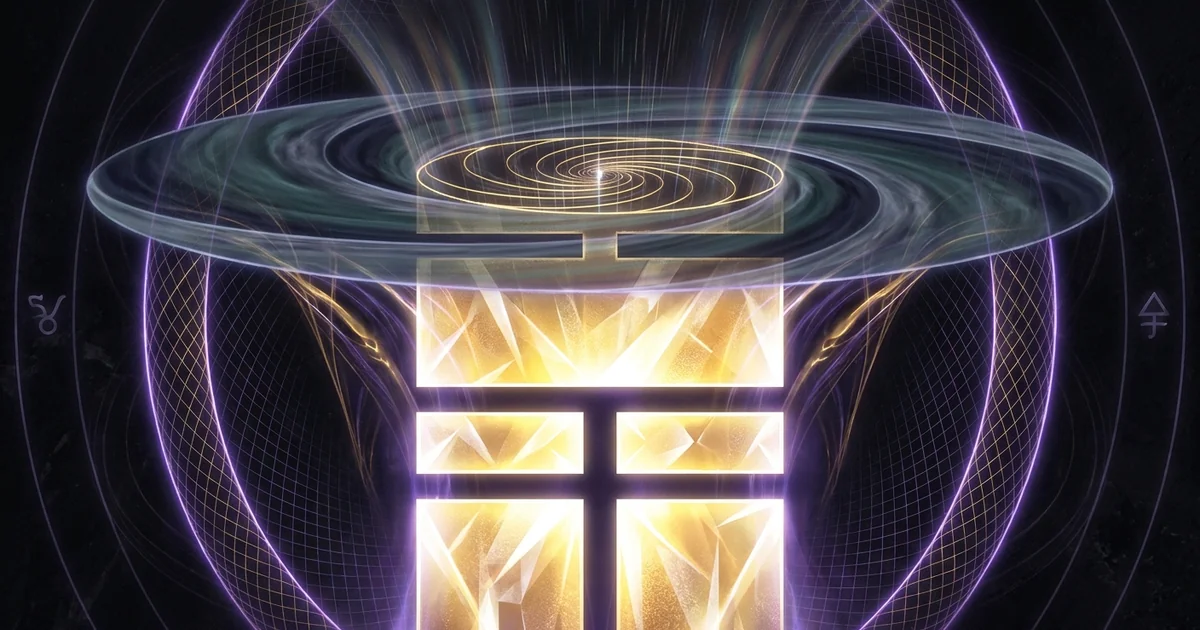
Hexagram 9 The Taming Power of the Small (Xiǎo Chù): I Ching
Archetypal Thesis & Systemic Paradigm: The Cybernetics of Minor Containment
Kinetic Drive Versus Elastic Throttle
Hexagram 9 (Xiǎo Chù, 小畜) formalizes a fundamental thermodynamic and cybernetic threshold within the architecture of the Book of Changes. Positioned immediately after the dynamic self-propagation of the creative in Hexagram 1 (Qián) and the successive stages of cosmic gestation, Xiǎo Chù establishes an energetic throttle. The archetypal engine beneath the hexagram consists of the lower trigram-qian (Heaven, ☰), characterized by unyielding, scalar, upward-surging kinetic force. Left unmitigated, this undifferentiated creative drive generates systemic turbulence or catastrophic overextension. The necessary systemic intervention arrives not through an equivalent counter-force, but via the upper trigram-xun (Wind/Wood, ☴), whose operational signature is soft penetration, horizontal dispersal, and subtle elastic containment.
Within this structural configuration, the hexagram models how a colossal quantum of energy is domesticated by a seemingly negligible agency. The systemic paradigm does not signify absolute subjugation, nor does it denote structural impotence. Instead, the interaction represents a cybernetic feedback loop wherein micro-adjustments in atmospheric drag regulate a ballistic trajectory. The sheer velocity of Qián is arrested by the yielding elasticity of Xùn, demonstrating that systemic equilibrium is frequently achieved not through massive antagonistic opposition, but through microscopic impedance matched to the frequency of the moving body.
“The Taming Power of the Small has success. Dense clouds, no rain from our western outskirts… Wind moves across heaven: The image of The Taming Power of the Small. Thus the superior man refines the outward aspect of his virtue.” — Wilhelm, R., & Baynes, C. F. (1950). The I Ching or Book of Changes, Bollingen Series XIX. Princeton University Press.
The Paradox of Xiǎo Chù: Accumulation via Gentle Arrest
The semantic scope of the ideogram Chù (畜) bifurcates into two interdependent systemic functions: containment (taming or detaining) and nourishment (rearing, pasturing, or accumulating). In the context of Xiǎo Chù, the “Small” (Xiǎo, 小) acts as the active container. The paradox of the hexagram lies in how a singular, receptive element modulates five assertive, expansive lines. Rather than arresting momentum through catastrophic collision—an outcome that occurs when unyielding structures collide—the hexagram achieves containment through continuous, infinitesimal points of friction.
This mechanism of accumulation via gentle arrest parallels laminar aerodynamic drag. As celestial wind traverses the firmament, it does not shatter the sky; rather, it weaves an envelope of variable resistance around it. The five solid lines of Qián possess an innate momentum toward unbridled vertical expansion. Xùn, occupying the upper station, functions as an atmospheric filter, continuously siphoning raw kinetic thrust into distributed kinetic energy. Consequently, the force is neither destroyed nor allowed to dissipate into entropy. It is packed, compressed, and husbanded. The taming process is therefore an act of energetic storage, converting an otherwise reckless discharge into stable potential energy capable of sustained application.
Dense Clouds Without Rain: The Archetype of Suspended Discharge
The foundational diagnostic motif of the hexagram’s Judgment—“Dense clouds, no rain from our western outskirts” (Mì yún bù yǔ, wǒ xī jiāo, 密雲不雨,自我西郊)—encapsulates an archetypal condition of suspended phase change. In the meteorological matrix of ancient China, rain is the physical manifestation of yin and yang reaching dynamic equilibrium through energetic release. Clouds represent the vaporized ascent of yin, which must coalesce with descending celestial yang to precipitate moisture. In Hexagram 9, the clouds have gathered with oppressive density, yet precipitation remains withheld.
This imagery defines a psychological and environmental state of extreme saturation without structural release. The tension is palpable, the sky swollen with humidity, yet the thermodynamic conditions for condensation are not fully realized. In the psychological framework of C. G. Jung, this atmospheric stagnation mirrors the psychic condition wherein an individual’s conscious ego experiences profound creative tension while blocked from immediate externalization. The unconscious produces an abundance of imagery and affective charge, but the pathway toward outward operational realization remains structurally sealed. Under this archetype, forced action aborts the generative potential; the subject must cultivate high frustration tolerance, remaining stationed in the pregnant liminality of the unprecipitated storm.
Classical Provenance & Textual Lineage: Historical Genesis from King Wen to Neo-Confucianism
The Western Outskirts: Historical Encoding of King Wen in Youli
The historical architecture of Xiǎo Chù is tied to the captivity of King Wen (King of the Zhou) at the hands of the Shang tyrant King Zhou at Youli. The phrase “from our western outskirts” carries acute geographic and political resonance. The Zhou homeland lay to the west of the Shang imperial center. In classical Chinese meteorological observation, moisture-laden weather systems originating from the west frequently dissipated before yielding rain to the central plains. Politically, the phrase encodes King Wen’s strategic containment: while the moral coherence and civilizational momentum of Zhou were rapidly accumulating in the west, the time for the decisive macro-political overthrow of the Shang had not arrived.
King Wen’s physical imprisonment was transformed into an internal contemplative crucible. Hemmed in by superior military force, any premature insurrection would have resulted in the annihilation of his lineage. Wen survived his incarceration not by overt rebellion, but through hyper-attentive deference, political subtlety, and meticulous administrative refinement. Xiǎo Chù crystallizes this historical moment: moral rectitude and strategic brilliance operating under severe external surveillance, husbanding resources until the cosmic and material mandates fully align.
“In the case of Hexagrams where the few rule the many, it is not because of their strength, but because of their position. When one Yin commands five Yang, though it be humble in nature, it occupies the position of ruler to which all others must bend… The firm are tamed by the yielding, for the small holds the key to the great.” — Wang Bi, as translated in Lynn, R. J. (1994). The Classic of Changes. Columbia University Press.
Wang Bi’s Metaphysical Exegesis on the Solitary Yin
In his foundational commentary, the third-century scholar Wang Bi dismantled the rigid omen-based interpretations of the Han dynasty, recasting the Book of Changes through Xuanxue (Neo-Daoist) metaphysics. Wang Bi identified Hexagram 9 as a quintessential demonstration of his core hermeneutic canon: “The Few Ruling the Many” (yǐ guǎ zhì zhòng, 以寡制眾). In Xiǎo Chù, the entire hexagram is governed by its solitary yin line, six-in-the-fourth-place. According to Wang Bi, when five strong lines are confronted by five other strong lines, structural war ensues; but when five strong lines are confronted by a single receptive line, the unyielding entities find their momentum unified and focused through their collective relationship with that lone receptive node.
Wang Bi posited that six-in-the-fourth-place exercises authority precisely because it abandons any attempt to match the five yang lines in physical power. Occupying the base of the upper trigram, it serves as the ministerial portal through which the lower trigram’s immense drive must pass. The solitary yin line tames not through imperial decree, but through strategic accommodation. It provides no hard surface against which the yang lines can push, thereby neutralizing their aggressive trajectory and forcing them to yield to its quiet, pacing rhythm.
       HEXAGRAM 9 (XIǍO CHÙ)
Line 6: ─────── (Yang)
Line 5: ─────── (Yang)
Line 4: ─── ─── (Yin)  <-- Solitary Ruler (Ministerial Node)
Line 3: ─────── (Yang)
Line 2: ─────── (Yang)
Line 1: ─────── (Yang)
Cheng Yi and Zhu Xi: Moral Cultivation through Microscopic Scrutiny
During the Song Dynasty, the Neo-Confucian commentaries of Cheng Yi (Yichuan Yizhuan) and Zhu Xi (Zhouyi Benyi) redirected the hexagram’s exegesis toward the domain of interior moral epistemology (gezhi, the investigation of things). Cheng Yi maintained that Xiǎo Chù illustrates how the gentleman systematically purifies his inner nature by disciplining micro-distractions. Raw human desire is formidable, expansive, and volatile, mirroring the lower trigram Qián. It cannot be subdued overnight through an imperial decree of the will. Instead, it must be refined through constant, incremental attentiveness (wēi, 微), associated with the penetrative nature of Xùn.
Zhu Xi elaborated on the Xiangzhuan’s (Image Commentary) directive: “Thus the superior man refines the outward aspect of his virtue” (jūnzi yǐ yì wén dé, 君子以懿文德). Zhu Xi interpreted wén not merely as literary accomplishment, but as the delicate pattern, structural form, and civil aesthetic applied to raw ethical force. Virtue without form is coarse and volatile. Xiǎo Chù demands that the practitioner shift focus from grand metaphysical ambitions to the granular details of daily conduct—speech, ritual, administrative timing, and emotional composure. Through the cumulative discipline of microscopic adjustments, cosmic integrity is anchored in somatic reality.
Structural Mechanics & Symbolic Geometry: Trigram Vectors, Rulers, and Nuclear Tensions
Trigram Polarity: Xun (Wind/Wood) over Qian (Heaven)
The structural topology of Hexagram 9 hinges upon a specific directional and elemental vector mechanics governed by trigram polarity dynamics. The lower trigram, Qián, embodies absolute upward thrust. Its three solid lines move inexorably north, symbolizing solar ascendancy, uncompromising will, and pure ideation. Conversely, the upper trigram, Xùn, consisting of a broken line beneath two solid lines, embodies the physics of the atmosphere. Wind does not move along a rigid vertical vector; it flows horizontally, disperses, navigates around obstacles, and permeates hidden chambers.
When Wind moves across Heaven, it creates atmospheric drag. The upward vector of Qián is bent into a curve by the transverse current of Xùn. This structural encounter generates a condition of high laminar shear. Rather than inducing chaotic turbulence, Xùn channels the raw power of Qián into directed, disciplined motion. It prevents the creative drive from exploding into empty space, ensuring that its immense kinetic reserves are brought into proximity with the earthly plane where practical work can be sustained.
The Sole Ruling Line: Six in the Fourth Place as Resilient Buffer
In structural I Ching analysis, Hexagram 9 possesses a single constituent-ruler: six-in-the-fourth-place. In classical line theory, the fourth position is the place of the minister, directly adjacent to the sovereign in the fifth position, but situated at the very base of the upper trigram. This line is inherently precarious. As the sole yin line in the entire hexagram, it bears the cumulative kinetic weight of the three yang lines below it (Lines 1, 2, and 3), all of which are straining upward to unite with the sovereign Line 5.
Positional Dynamics:
Line 5 (Heavenly Sovereign - Yang)
Line 4 (Receptive Buffer - Yin) <-- Focal Point of Structural Stress
Line 3 (Culmination of Earthly Kinetic Force - Yang)
The systemic survival of the hexagram depends entirely on the material properties of this fourth line. If Line 4 were a solid yang line, the hexagram would transform into Hexagram 1 (Pure Creative Force) or Hexagram 43 (Kuai / Breakthrough), resulting in an uncontrollable upward rupture. Because Line 4 is broken (yin), it functions as a hydraulic damper. It absorbs the shock of the advancing lower trigram. It does not oppose the three yang lines with a counter-strike; it opens its structural void, receives their kinetic energy, decelerates their velocity through viscous drag, and channels their unified force upward into the benevolent hand of the ruler at Line 5.
Nuclear Transmutations: The Latent Presence of Hexagram 38 (Kui)
Beneath the exterior surface of Hexagram 9 lies its hidden interior engine: the nuclear-hexagram (Hùguà, 互卦). Derived from overlapping lines 2-3-4 and 3-4-5, the nuclear core of Xiǎo Chù reveals the energetic undercurrent governing its outer behavior:
Hexagram 9 Lines:
6: ───────
5: ─────── ┐ Upper Nuclear: Li (☲) [Lines 3, 4, 5]
4: ─── ─── ┘ ┐
3: ───────   │ Lower Nuclear: Dui (☱) [Lines 2, 3, 4]
2: ───────   ┘
1: ───────

Nuclear Result: Hexagram 38 (Kui / Opposition, 睽)
The presence of Kui (Opposition: Fire above, Lake below) inside Xiǎo Chù is a crucial diagnostic revelation. Hexagram 38 represents elemental estrangement: Fire burns upward while Lake settles downward; their vectors diverge into mutual alienation. This structural reality demonstrates that the surface harmony of Hexagram 9 is not natural or effortless. Deep within the core of Xiǎo Chù sits an acute, latent tension between diametrically opposed wills.
The containment executed by the solitary yin line is necessitated by this hidden condition of opposition. If the gentle restraint of Xùn should falter, the latent divergence of Hexagram 38 will instantly erupt into open ideological conflict. The soft diplomacy of Xiǎo Chù is an active containment strategy designed to prevent the internal opposition of Kui from shattering systemic coherence.
Line-by-Line Systemic Deconstruction: The Trajectory of Measured Restraint
Lines 1 and 2: The Prudence of Voluntary Retreat (Returning to the Way)
The bottom two lines of the hexagram exemplify optimal operational calibration when entering a field of containment. They represent the lower components of Qián that possess the wisdom to self-regulate before incurring mechanical strain.
Line 1: Nine at the beginning:
"Returning to the way. How could there be blame in this? Good fortune."
Nine at the beginning is positioned at the base of the creative impulse. It possesses the native drive to advance, yet it perceives the atmospheric ceiling imposed by Xùn above. Recognizing that the macro-environment cannot support an unrestricted forward thrust, the line voluntarily halts its momentum. It executes an operational recalibration, returning to its native base without resentment. There is no structural damage because the retreat is self-initiated.
Line 2: Nine in the second place:
"He allows himself to be drawn into returning. Good fortune."
Nine in the second place is drawn forward by its resonance with the upper lines, yet it remains anchored in the central position of the lower trigram. Unlike Line 1, which halts through solo perception, Line 2 is linked to Line 1 by kinship of nature. Sensing the resistance ahead, it allows itself to be held back by the collective wisdom of its peer. It does not perceive this deceleration as an insult to its yang dignity. Through mutual restraint, the first two lines avert the catastrophe of running headlong into an immovable structural boundary.
Line 3: Structural Rupture and the Broken Axle (The Peril of Premature Force)
At the third position, the fragile balance of the hexagram experiences mechanical failure. Nine in the third place sits at the apex of the lower trigram Qián. It is unyielding, excessively strong, and located at the threshold of transition. It refuses to acknowledge the reality of the regulatory ceiling.
Line 3: Nine in the third place:
"The spokes burst from the wagon wheels. Man and wife roll their eyes."
Driven by aggressive forward momentum, Line 3 attempts to force a breakthrough into the upper trigram. The consequence is mechanical failure: the spokes are ripped from the wagon’s wheel hubs (yú shuō fù, 輿說輻). The vehicle of action is immobilized because the kinetic propulsion generated by the engine violently exceeds the tensile capacity of its chassis.
Line 3: Mechanical Hubris (Nine in the Third Place)
- Mechanism: Unmitigated Yang aggression colliding with the regulatory threshold of the upper trigram.
- Manifestation: “The spokes burst from the wagon wheels.”
- Relational Field: Domestic discord, mutual hostility (“Man and wife roll their eyes”).
- Strategic Outcome: Humiliation, structural immobilization, energy expended in friction rather than progress.
Line 4: Receptive Modulation (Six in the Fourth Place)
- Mechanism: Yin compliance acting as a structural buffer to absorb and redirect advancing momentum.
- Manifestation: “Sincerity. Blood departs and fear yields.”
- Relational Field: Integration with the sovereign (Line 5) and pacification of the lower triad.
- Strategic Outcome: Elimination of catastrophic danger, stabilization of the collective matrix.
The domestic discord mentioned in the text—husband and wife glaring at one another—is the socio-psychological reflection of this mechanical disruption. When raw force is denied its external outlet, it folds inward, converting outward creative drive into bitter interpersonal resentment. The line demonstrates the fate of unreflected yang inflation colliding with an immovable systemic boundary.
Lines 4, 5, and 6: From Sincere Dissolution of Strife to the Perils of Over-Accumulation
Line 4: Six in the fourth place:
"If you are sincere, blood departs and fear yields. No blame."
Six in the fourth place represents the operational triumph of the hexagram. Occupying the critical ministerial post, this solitary yin line confronts the immense pressure of the surging lines below. “Blood” (xuè, 血) represents systemic injury, violence, and the visceral trauma of collision. Because Line 4 acts with absolute sincerity (fú, 孚)—meaning it maintains true emptiness, receptivity, and absence of ego-inflation—it does not meet force with force. It absorbs the shock, dispels the danger of bloodshed, and neutralizes the ambient terror of the collective.
Line 5: Nine in the fifth place:
"If you are sincere and loyally attached, you are rich in your neighbor."
Nine in the fifth place represents the sovereign who recognizes the immense service rendered by the minister at Line 4. The sovereign holds the position of supreme authority, yet does not hoard power. Through genuine mutual trust (luán rú, 攣如), the creative power of Line 5 joins with the receptive diplomacy of Line 4. The wealth of virtue is shared horizontally across the entire relational matrix, demonstrating that true authority under the paradigm of the small is distributed rather than centralized.
Line 6: Nine at the top:
"The rain falls, rest comes. This is due to the lasting accumulation of virtue. Persisting brings misfortune to the woman. The moon is nearly full. If the superior man persists, misfortune comes."
Line 6 marks the terminal phase transition of the hexagram. The long-withheld condensation finally occurs: the clouds break, the rain falls, and the accumulated tension dissolves into rest (jì yǔ jì chù, 既雨既處). The power of the small has reached its absolute structural limit and fulfilled its purpose.
At this precise juncture, a grave warning is issued. The rain has fallen; the cycle of accumulation is complete. If the small, yin element seeks to push beyond this threshold—attempting to exert absolute control over the yang sovereign—calamity ensues. “The moon is nearly full” (yuè jī wàng, 月幾望). When the moon reaches the full state, it immediately stands at the precipice of its wane. Line 6 warns of the corruption of the small: the danger that patient, modest containment will transform into petulant micromanagement or passive-aggressive tyranny. The practitioner must disengage and yield, honoring the completion of the cycle.
Psychological Dynamics & Operational Praxis: The Micro-Discipline of Individuation
Taming the Ego-Complex: Frustration Tolerance as Alchemical Heat
In analytical psychology, Hexagram 9 serves as a map for managing ego-inflation. When an individual is seized by a powerful archetype, the conscious ego often identifies with the grandiosity of the archetype, demanding immediate materialization of its desires. This mirrors the upward drive of the lower trigram Qián. However, the external world frequently responds with bureaucratic delays, mundane obligations, and inexplicable pauses.
PSYCHO-ALCHEMICAL ENGINE OF XIǍO CHÙ
[Inflationary Ego / Raw Archetypal Force]
                 │ (Surge)
                 ▼
[Structural Impasse / Mundane Reality Check]
                 │ (Frustration)
                 ▼
[Vas Hermetis: Sealed Psycho-Somatic Crucible]
                 │ (Internalized Transmutation)
                 ▼
[Refined Virtue: Diamond Clarity / Sublimated Energy]
This psychological friction is not an error; it is an alchemical necessity. Xiǎo Chù establishes what alchemy terms the vas-hermetis—the hermetically sealed vessel. By refusing the ego an immediate external outlet, the hexagram forces raw psychic energy back upon itself. The resulting frustration acts as alchemical heat (calcinatio), burning away the impurities of hubris and grandiosity.
The practitioner must develop frustration tolerance, recognizing that the delay is not a permanent negation of their will, but an intentional deceleration designed to build psychic container-strength. Without this period of micro-containment, the individual remains structurally fragile, incapable of handling the immense energetic voltage of subsequent realization.
Refinement of the Outward Form: Sublimation and Aesthetic Ordering
The Da Xiang (Great Image Commentary) delivers the operational antidote to the psychological stress of containment: “Thus the superior man refines the outward aspect of his virtue.” In classical Chinese culture, wén (文) designates the patterning of nature, the civilizing arts, ritual decorum, and the aesthetic organization of reality. Under Hexagram 9, the individual is commanded to pivot away from macrocosmic conquests and concentrate upon micro-refinements.
This operational stance requires the individual to divert energy into craftsmanship, administrative hygiene, linguistic precision, and the polishing of relational boundaries. If a strategic enterprise is blocked at the macro-level, the practitioner does not kick down the locked door; they organize the workshop, verify the supply lines, rewrite the internal code, and eliminate personal idiosyncrasies that undermine authority. This is the process of sublimation: taking volatile psychic tension and giving it structured, aesthetic form. By mastering the micro-terrain, the practitioner transforms internal friction into exquisite cultural and operational mastery.
When Hexagram 9 presents as the primary or resulting gua in a consultation, the querent is operating under an energetic embargo. The following interpretive parameters must guide the strategy:
- Cease Frontal Offensives: All large-scale initiatives, public launches, and direct political demands must be suspended immediately. Frontal assaults under Xiǎo Chù result in the stripped axle-spokes of Line 3.
- Channel Energy into Peripheral Maintenance: Redirect attention to secondary and tertiary systems—administrative hygiene, legal documentation, software refactoring, emotional regulation, and home logistics.
- Adopt Soft Non-Violent Diplomacy: Emulate
six-in-the-fourth-place. Dissolve opposition by remaining unresisting, attentive, and receptive. Listen deeply rather than asserting claims. - Recognize Pre-Condensation Liminality: Reassure the querent that “Dense clouds, no rain” does not indicate drought; it indicates impending transformation. The pressure they feel is the necessary physical prelude to precipitation.
Consultation Dynamics: Navigating Periods of Withheld Fruition
In active divinatory praxis, the appearance of Hexagram 9 routinely generates profound subjective distress in querents who are dominated by yang-oriented goals. They perceive the hexagram as a frustrating delay or a denial of their legitimate ambitions. The practitioner’s task is to reorient the querent’s temporal perspective from dynamic acceleration to evolutionary pacing.
The querent must be taught that the delay is structural, not moral. The rain cannot fall until the upper atmosphere cools to the exact dew point; to demand rainfall while the clouds are still accumulating is an act of operational delusion. Under Xiǎo Chù, true strategic mastery manifests as the capacity to occupy the liminal space without panic. The querent must handle peripheral tasks with total devotion. By honoring the reign of the small, they align themselves with the rhythmic pacing of the cosmos, positioning their enterprise so that when the phase transition finally occurs at Line 6, they can receive the precipitation without being swept away by the resulting flood.
Philosophical Synthesis & Macrocosmic Correspondence: Hermetic Axioms and Genetic Architectures
The Hermetic Principle of Polarity and Rhythm: Containment as Potentiality
Viewed through the lens of Western Hermetic philosophy, Hexagram 9 provides a crystalline formulation of the Principle of Polarity and the Principle of Rhythm. The Kybalion states: “Everything flows, out and in; everything has its tides; all things rise and fall.” In this context, Xiǎo Chù represents the rhythmic pause between inhalation and exhalation—the precise moment where the rising tide is cushioned and held by the basin before receding or transforming.
The macrocosmic creative seed (Yang/Heaven) is infinite, eternal, and absolute. Yet, by itself, undifferentiated Yang can create nothing tangible; it is blinding light without an image, heat without a hearth. To manifest, the infinite must accept the discipline of the finite. The Hermetic principle of the feminine vessel—the womb, the vessel, the boundary—is precisely the work performed by Xùn in Hexagram 9. The “Power of the Small” is the sacred power of definition. It limits the limitless so that form may emerge, proving that containment is not the enemy of potentiality, but its indispensable prerequisite.
Biochemical Isomorphism: Genetic Codons and Transcription Throttles
In the biophysical mapping pioneered by Martin Schönberger (The Hidden Key to Life) and elaborated by contemporary systems biologists, the 64 hexagrams of the I Ching correspond directly to the 64 triplets of the universal genetic code (m-RNA codons). Within this isomorphism, the dynamic interaction between pure creative momentum and minor regulatory restraint describes the physical reality of protein synthesis.
NUCLEOTIDE ISOMORPHISM MATRIX (HEXAGRAM 9)
Line 6: Yang ─── Uracil / Thymine
Line 5: Yang ─── Uracil / Thymine
Line 4: Yin  ─ ─ Cytosine (Regulatory Throttling Base)
Line 3: Yang ─── Uracil / Thymine
Line 2: Yang ─── Uracil / Thymine
Line 1: Yang ─── Uracil / Thymine
In the translation of genetic data, the transcription machinery cannot operate at unregulated velocity. If RNA polymerase moves along the DNA template without pacing, lethal insertion-deletion errors, frameshift mutations, and premature terminations multiply exponentially. The cell requires precise pause sites, regulatory hairpins, and kinetic proofreading mechanisms. Hexagram 9 corresponds to these micro-regulatory checkpoints. The solitary yin line at position 4 functions as the biochemical brake that momentarily halts the polymerase, allowing the molecular machinery to verify fidelity, fold the emerging polypeptide chain correctly, and prevent catastrophic translational collapse.
- I Ching Coordinate: Hexagram 9 (Xiǎo Chù, The Taming Power of the Small).
- Trigram Dynamics: Lower Qián (Upward Kinetic Surge) | Upper Xùn (Permeative Viscous Drag).
- Genetic Codon Analogue: Regulatory pause sites within the transcription elongation complex; RNA polymerase kinetic proofreading.
- Human Design Coordinate: Gate 9 (The Gate of Focus / Detail) located in the Sacral Center.
- Channel Architecture: Channel 9–52 (The Channel of Concentration: A Design of Focused Determination).
- Cybernetic Function: High-frequency, low-amplitude negative feedback damping runaway open-loop acceleration.
BodyGraph Circuitry: Gate 9 (The Gate of Focus) in Cybernetic Design
In the cybernetic architecture of the Human Design System—which maps the 64 hexagrams directly onto the BodyGraph—Hexagram 9 corresponds to gate-9-focus (“The Taming Power of the Small”), positioned in the Sacral Center. Gate 9 resides within the Understanding (Logic) Circuit, the biomechanical engine tasked with identifying, testing, and refining patterns to ensure the safe survival of the collective.
THE CHANNEL OF CONCENTRATION (9-52)
[Root Center]                                      [Sacral Center]
┌────────────┐                                    ┌────────────┐
│   Gate 52  │ ══════════════════════════════════ │   Gate 9   │
│ (Stillness)│   Stream of Energy Concentration   │  (Focus)   │
└────────────┘                                    └────────────┘
     ▲                                                 ▲
     │                                                 │
Pressure to sit still                         Power to focus on detail
and hold the physical form                   and generate sustainable work
Gate 9 supplies the focused motor energy required to isolate, analyze, and test minute details. It does not look at the grand horizon; it looks down into the microscope. Without the stabilizing pressure of Gate 52 (Keeping Still / Mountain) from the Root Center, Gate 9 can experience frantic mental restlessness, attempting to tackle every detail at once.
However, when correctly integrated within the Channel of Concentration (9–52), Gate 9 transforms raw sacral power into targeted focus. It tames the vast creative engine of the Sacral Center, directing its infinite life force into repetitive, granular mastery. Through this focused containment, reliable patterns are tested, perfected, and deployed to stabilize society.
Frequently Asked Questions: Analytical Decodings of Xiǎo Chù
Distinction Between Hexagram 9 (Xiǎo Chù) and Hexagram 26 (Dà Chù)
A foundational point of confusion in the study of the Book of Changes is the structural and strategic difference between Hexagram 9 (The Taming Power of the Small) and Hexagram 26 (Dà Chù, The Taming Power of the Great). Both hexagrams feature the lower trigram Qián (Heaven) being contained by an upper trigram, yet their methodologies and structural consequences are radically opposed.
In Hexagram 26, the upper trigram is Gen (Mountain, ☶). A mountain represents an immovable, solid mass of rock and earth. When Heaven encounters Mountain, it experiences a hard, structural, uncompromising halt. Dà Chù operates through massive boundaries: deep trenches, fortified walls, and the profound accumulation of historical wisdom. It contains the great by means of the great, holding immense energy completely stationary until the appointed time for massive action.
In Hexagram 9, the upper trigram is Xùn (Wind, ☴). Wind has no rigid mass; it cannot build a fortress or erect a dam. Therefore, Xiǎo Chù cannot stop Heaven through blunt force. Instead, it utilizes aerodynamic resistance, atmospheric drag, and soft infiltration. Hexagram 26 is a stone dam holding back a river; Hexagram 9 is an atmospheric headwind slowing down an aircraft. The former commands total stillness and long-term storage; the latter commands continuous, flexible micro-adjustments, diplomatic nuance, and the husbanding of power within the stream of active movement.
The Paradox of Line 6: Why Rain Bringing Peace Carries a Warning of Peril
The final line of Hexagram 9 often disorients students of the Changes. After the long, agonizing tension of “Dense clouds, no rain,” Line 6 finally announces: “The rain falls, rest comes.” Yet, it immediately attaches an ominous admonition: “If the superior man persists, misfortune comes… The moon is nearly full.” Why does the long-sought release carry such acute danger?
The solution lies in the cyclical mechanics of yin and yang within the king-wen-sequence. In Line 6, the power of the small has reached its apex; it has fulfilled its purpose by bringing the upward surge of Qián to dynamic equilibrium, resulting in the rain of reconciliation. However, the nature of the small (yin) is to yield, adapt, and defer. If the small, having achieved success, now attempts to assert absolute dominance over the great (yang)—presuming upon its victory to dictate terms or enforce continuing restriction—it violates cosmic balance.
The phrase “The moon is nearly full” serves as an astronomical warning. The moment the moon reaches full illumination, the solar light begins its inexorable decline, and darkness begins to consume the night sky. For the small to press its advantage when it has reached full expression invites immediate structural retribution. In human affairs, this represents the fatal mistake of a diplomat, manager, or partner who, having secured a harmonious agreement through patient softness, becomes arrogant, demanding, or micromanaging. When the rain falls, the work is finished; one must step back, lay down control, and let nature complete the integration.
Navigating High-Stress Impasses Under the Jurisdiction of Hexagram 9
When an individual or organization finds their primary enterprise operating under the jurisdiction of Xiǎo Chù, standard strategic playbooks fail. Conventional business, creative, and political wisdom often dictates pushing harder: escalating capital deployment, launching aggressive public relations campaigns, or directly confronting bureaucratic gatekeepers. Under Hexagram 9, these actions precipitate catastrophic failure, directly invoking the broken wheel-spokes of Line 3.
STRATEGIC PROTOCOL: HIGH-STRESS IMPASSE (XIǍO CHÙ)
┌──────────────────────────────────────┐
│  RECOGNIZE THE REGULATORY CEILING    │
│  Acknowledge macro-force is blocked  │
└──────────────────┬───────────────────┘
                   │
                   ▼
┌──────────────────────────────────────┐
│      ABANDON FRONTAL OFFENSIVES      │
│   Halt public launches and demands   │
└──────────────────┬───────────────────┘
                   │
                   ▼
┌──────────────────────────────────────┐
│   PIVOT TO PERIPHERAL OPTIMIZATION   │
│  Code review, documentation, crafts  │
└──────────────────┬───────────────────┘
                   │
                   ▼
┌──────────────────────────────────────┐
│   MAINTAIN NON-VIOLENT SINCERITY     │
│   Absorb friction via Line 4 posture │
└──────────────────┬───────────────────┘
                   │
                   ▼
┌──────────────────────────────────────┐
│      AWAIT NATURAL CONDENSATION      │
│  Rain falls automatically at Line 6  │
└──────────────────────────────────────┘
The correct navigation of Hexagram 9 demands what military theorists term indirect strategy and what Daoist philosophy terms wu wei within action. The protocol requires five distinct operational steps:
- Strategic Deceleration: Acknowledge that the macro-environment has lowered an invisible ceiling. Cease all attempts to force a breakthrough, preserving capital and emotional reserves.
- De-escalation of Interpersonal Friction: When external movement is halted, internal relationships frequently fray (Line 3). Actively defuse blame, recognizing that team or domestic tension is simply displaced environmental pressure.
- Hyper-Focus on Sub-Systems: Direct all surplus cognitive and physical energy into systemic infrastructure. Clean codebases, audit financial reserves, refine physical technique, and perfect the aesthetic quality of your materials.
- Resilient Receptivity: When confronted by hostile surveillance or bureaucratic resistance, embody
six-in-the-fourth-place. Present no hard, aggressive edges. Yield graciously on non-essential points while maintaining profound internal moral alignment. - Phase-Change Vigilance: Monitor the environment for subtle signs of thermodynamic shift. When the atmospheric tension breaks and the precipitation of opportunity begins, harvest the fruit quietly and refrain from pursuing totalistic, triumphalist retribution. By mastering the small, the great is preserved, cultivated, and brought safely across the threshold of time.