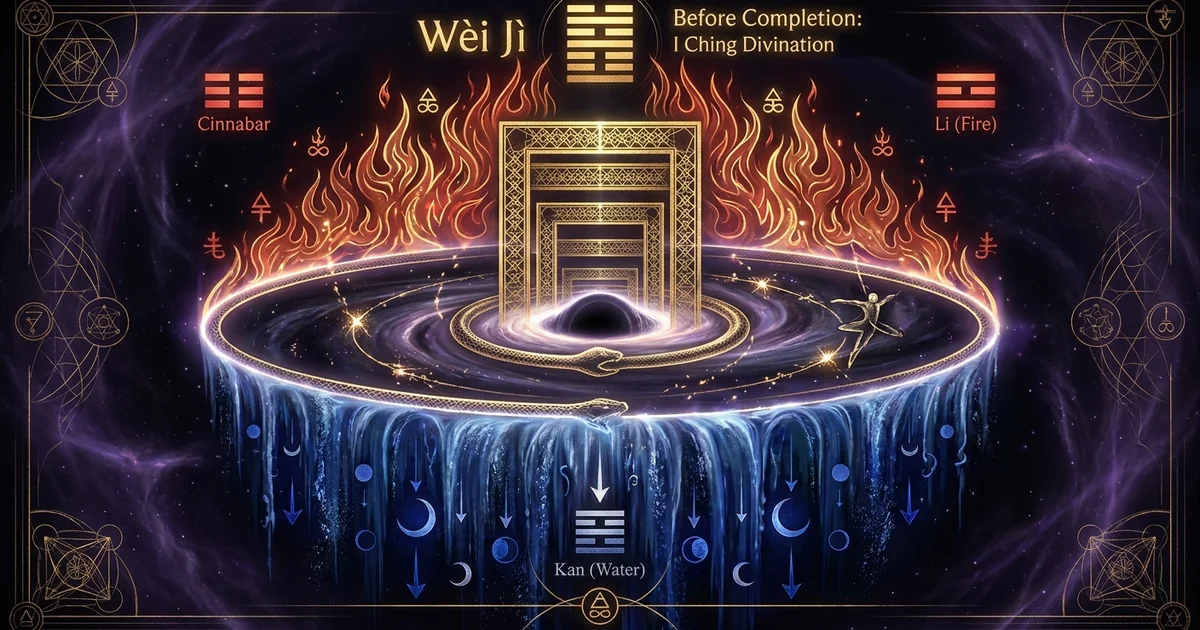
Hexagram 64 Before Completion (Wèi Jì): I Ching Divination
Archetypal Thesis & Systemic Paradigm: The Threshold of Dynamic Disequilibrium
The Open-Ended Architecture of the King Wen Sequence
The structural ordering of the King Wen sequence (king-wen-sequence) represents one of the most sophisticated cybernetic models of cyclical cosmogony preserved from antiquity. Within conventional linear paradigms, a formal sixty-four-stage matrix would terminate at a state of absolute equilibrium, systemic closure, or entropy-canceling perfection. Instead, the sequence deliberately places Hexagram 63, After Completion (Jì Jì), in the penultimate position and designates Hexagram 64, Before Completion (Wèi Jì), as the final gateway of the canon. This deliberate transposition subverts deterministic teleology, establishing that cosmic manifestation does not culminate in static crystallization, but dissolves into an open-ended, asymptotically evolving field of unresolved potential.
Where Hexagram 63 presents an architecture of total structural compliance—every yin line occupying a yin position and every yang line occupying a yang position—Hexagram 64 presents complete, systematic dissonance. In the wèi jì hexagram, every single line resides in an improper cosmic locus: yang lines occupy yin places (positions 2, 4, and 6), while yin lines occupy yang places (positions 1, 3, and 5). This inversion ensures that the sequence terminates not in an immutable monolith, but in an energetic condition characterized by radical unfulfilment. The architecture of the I Ching thus models reality as an autopoietic cycle. Rather than a closed teleological line that halts at an absolute omega point, the canon operates as a metabolic loop wherein consummation immediately decays into inertia, while incomplete transition provides the generative friction necessary to ignite the primordial forces of Hexagram 1 (Qian) and Hexagram 2 (Kun) once again.
Hexagram 63: After Completion (Jì Jì)
- Trigrammatic Architecture: Water over Fire (Kan over Li). The downward gravitational flow of water meets the upward radiation of fire, producing an immediate functional containment and localized equilibrium.
- Topological Coherence: Complete line rectitude. Every line occupies its canonically correct position (odd lines are yang, even lines are yin).
- Systemic State: Absolute stability transitioning toward entropic stagnation. The system has realized its teleological form; hence, any subsequent movement inevitably initiates decay, structural ossification, and decline.
- Archetypal Implication: The terminal point of a civilization, enterprise, or cognitive model where perfection collapses under its own systemic brittleness.
Hexagram 64: Before Completion (Wèi Jì)
- Trigrammatic Architecture: Fire over Water (Li over Kan). The upward dispersion of fire moves away from the downward descent of water, generating elemental divergence and topological tension.
- Topological Coherence: Complete line inversion. Every line occupies an incorrect locus (odd lines are yin, even lines are yang), producing systemic instability.
- Systemic State: Dynamic disequilibrium and creative negentropy. The absence of formal alignment demands perpetual conscious maintenance, vigilance, and real-time adaptation.
- Archetypal Implication: The fertile, liminal threshold preceding emergence; evolutionary momentum sustained through the conscious refusal of premature psychological closure.
Wèi Jì as a Teleological Non-Sequitur
In classical Aristotelian mechanics and Hegelian dialectics, the final term of a sequence represents the ultimate synthesis (telos) wherein anterior contradictions are resolved, integrated, and subsumed into an invariant ground. Wèi Jì constitutes a profound philosophical challenge to this model. By staging the entire canon toward a conclusion that translates literally as “not yet crossed” or “before completion,” the authors of the Zhouyi inscribed an irreducible indeterminacy into the metaphysical architecture of reality. The hexagram 64 before completion iching meaning is grounded precisely in this refusal of an ultimate structural resting point.
This teleological non-sequitur functions as an epistemic safeguard against systemic calcification. If the cycle concluded with Hexagram 63, the underlying philosophical thesis of the I Ching—that change is the only invariant property of existence—would be fundamentally compromised. Jì Jì models a closed thermodynamic state: when the water boils completely above the flame, the task is accomplished, the resources are depleted, and the kinetic potential of the system plunges toward thermal death. By displacing Jì Jì with Wèi Jì, the King Wen sequence establishes that any apparent culmination is merely a perceptual horizon. The system remains perpetually nascent. In this operative framework, reality is fundamentally performative; it requires the continuous, active participation of consciousness to weave coherence out of ambient cosmological drift.
The Energetics of Fire Over Water: Entropic Drift versus Conscious Intervention
The macrocosmic mechanics of Hexagram 64 are dictated by the elemental confrontation of fire over water: the trigram Li (Fire) rests above the trigram Kan (Water). In the energetic physics of the changes, fire inherently combusts upward (yan shang), seeking the expansive heavens, while water gravitates downward (run xia), descending into subterranean chasms. When Li sits above Kan, the two elemental vectors move away from one another along diametrically opposed trajectories. Unlike Hexagram 63, where water descends onto fire to generate thermodynamic steam, Hexagram 64 depicts an energetic divergence wherein the two constituent elements fail to intersect. Fire dissipates into the upper atmosphere, while water freezes or sinks into inert depths.
This dynamic illustrates the thermodynamic principle of entropic drift. Left to their natural vectors, the elements diverge indefinitely, resulting in a systemic expenditure of potential energy without productive synthesis. To arrest this divergence, the wèi jì hexagram demands an intervention of conscious agency. The systemic disequilibrium cannot be resolved through passive biological unfolding; it necessitates an exacting calibration of will, timing, and perceptual clarity. In divinatory praxis, the appearance of this fire-over-water signature indicates an urgent psycho-cosmic diagnostic: the constituent forces of the querent’s current environment are accelerating along divergent vectors. Without deliberate, highly conscious operational intervention, the systemic potential will be irretrievably dispersed into ambient noise.
Classical Provenance & Textual Lineage: The Canonical Exegesis of Wèi Jì
The Judgment (Tuan Zhuan) and the Fox Crossing the Ice
The foundational literature of the Zhouyi articulates the precarious mechanics of Hexagram 64 through an evocative zoological metaphor: the young fox crossing a frozen river. In ancient Chinese natural philosophy, the fox (hu) was recognized as an animal of extraordinary sensory acuity and cautious intelligence, navigating frozen waterways by placing its paws with measured deliberation while listening intently for the cracking of sub-surface ice. However, the commentary distinguishes between the seasoned fox and the young fox (ruo hu), which lacks seasoned somatic discipline.
The Judgment: Before Completion. Success. But if the little fox, after nearly completing the crossing, Gets his tail in the water, There is nothing that would further.
The Image: Fire over water: The image of the condition before transition. Thus the superior man carefully differentiates things So that each finds its place.
The image of the little fox whose tail becomes submerged (ru wei) immediately prior to reaching the dry bank captures the psychological vulnerability inherent to the final phases of a monumental transition. The wetting of the tail is not a trivial cosmetic failure; for a small mammal crossing frozen waters, a waterlogged tail adds drag, induces immediate hypothermia, disrupts vestibular equilibrium, and precipitates drowning. The Tuan Zhuan emphasizes that this failure occurs precisely when the destination is in sight: the fatal error is born not of technical incapacity, but of premature psychological release. The fox relaxes its vigilance one step too soon, mistaking proximity to completion for completion itself.
Wang Bi’s Neo-Daoist Commentary: Being (You) and Non-Being (Wu) in Transition
In his third-century commentary on the Classic of Changes, the Neo-Daoist philosopher Wang Bi (226–249 CE) approached Hexagram 64 as the consummate proof that non-being (wu) serves as the silent, unconditioned ground of all manifest beings (you). For Wang Bi, the profound significance of Wèi Jì lies in its rejection of terminal exhaustibility. Commenting on the Judgment, Wang Bi highlights that if things were ever to reach an ultimate, static termination, the generative dao would cease its ontological broadcast. The universe would freeze into an unyielding ossification.
Wang Bi argues that Hexagram 64 demonstrates why the cycle of existence is infinite: form survives only by virtue of incomplete transition. The improper placement of every line in Wèi Jì is precisely what guarantees the perpetual motion of the cosmos. Because no line has landed in a position of terminal stasis, the entirety of the hexagram vibrates with structural tension, constantly yearning for realignments that will never freeze into rigid permanence. Wang Bi’s exegesis elevates Wèi Jì from a cautionary divinatory warning to a metaphysical doctrine: to reside in “Before Completion” is to occupy the threshold of the uncarved block (pu), wherein all forms remain possible precisely because no single form has exhausted the field of potential.
The Ten Wings (Shi Yi) and the Cyclical Cosmogony of the Da Xiang
The Ten Wings (Shi Yi), specifically the Da Xiang (Great Image) and the Xu Gua Zhuan (Sequence of the Hexagrams), solidify this cyclical cosmogony. The Da Xiang deduces a profound operational mandate from the divergence of Fire and Water: “The superior man carefully differentiates things so that each finds its place” (jun zi yi shen bian wu ju fang). In this context, bian signifies radical analytical discernment—the surgical separation of categories, properties, and systemic boundaries. Because the elements are naturally diverging, the practitioner cannot rely upon synthetic fusion; they must apply critical, discriminative intelligence to ensure that each component of the psyche or outer situation occupies its exact, appropriate coordinate.
Furthermore, the Xu Gua Zhuan concludes its classical sequence with an unequivocal assertion of cyclical eternity:
“Things cannot be exhausted. Hence there follows the hexagram Before Completion, which concludes the book.”
In this canonical synthesis, the book of changes divination establishes a closed-loop cosmology that mirrors the zero-point of modern non-linear dynamics. The termination of the King Wen sequence with Hexagram 64 is not an omission of resolution; it is an active return to the undifferentiated ground (wuji). The sixty-fourth gate acts as a cosmological airlock through which consciousness re-enters the field of Hexagram 1, preserving the eternal breath of cosmic transformation.
Structural Mechanics & Symbolic Geometry: Trigram Vector Space and Line Trajectories
Spatial Polarity: Divergent Vectors of Li (Fire) and Kan (Water)
The symbolic geometry of Hexagram 64 is rooted in the dynamic polarization of its constituent trigrams: trigram-li (Fire, ☲) in the upper palace and trigram-kan (Water, ☵) in the lower palace. In classical Chinese spatial orientation, Li corresponds to the South, the meridian of noon, the pinnacle of solar radiation, and the outward dispersion of consciousness. Kan corresponds to the North, the nadir of midnight, abyssal depth, and inward-folding primal instinct. When placed in the architecture of Wèi Jì, the spatial coordinates amplify their inherent divergence:
Upper Trigram: LI   (Fire)   ☲  [Vector: Ascending / Dispersing]
-----------------------------------------------------------------
Lower Trigram: KAN  (Water)  ☵  [Vector: Descending / Submerging]
This arrangement creates an elemental vector space in which the two domains do not naturally interact. For cross-pollination to occur—for the water of the unconscious to be warmed by the solar consciousness of fire, or for the volatile fire of the intellect to be cooled and anchored by the somatic depths of water—the structural polarity must be actively bridged. This dynamic requires an alchemical reversal of natural tendencies, a deliberate operational protocol explored extensively within internal alchemical traditions such as Neidan (see /iching/trigrams-kan-and-li-alchemy).
Line-by-Line Micro-Analysis: Six Inappropriate Line Placements (Yao)
The architecture of Hexagram 64 contains six lines, every single one of which is structurally misplaced within the yin-yang polarity matrix:
-
Initial Six (Yin at Position 1): Residing at the base of the lower water trigram, this yin line attempts to initiate action while lacking the structural vitality to support it. The imagery of the wet tail (ru qi wei) manifests directly here: it represents an ungrounded, precipitate plunge into the crossing. The line is weak, submerged in the depths of Kan, yet occupies an odd, active position. The instruction is one of immediate self-restraint; attempting forward momentum at this initial phase guarantees structural defeat.
-
Nine in the Second Place (Yang at Position 2): A strong, creative yang line occupying a central, even (yin) position within the lower trigram. Here, the energetic dynamism is tempered by positional humility. The line employs the metaphor of dragging the brake (yi qi lun). Unlike the impulsive fox of the first line, the second line possesses the strength to check its own momentum. Centrality (zhong) redeems the misplacement: this is the disciplined warrior exercising deliberate tactical delay while surveying the river’s treacherous undercurrents.
-
Six in the Third Place (Yin at Position 3): Positioned at the apex of the lower trigram of danger (Kan), this yin line is weak, excessively elevated, and standing at the threshold of transition. Attempting to complete the crossing independently leads directly to disaster (zheng xiong). It marks the systemic crisis where older operational paradigms become bankrupt, yet forward progression is blocked. The only viable path is collective integration: finding an external vehicle or systemic ally to enable the crossing of the great stream.
-
Nine in the Fourth Place (Yang at Position 4): The threshold where the system transitions from the lower trigram Kan into the upper trigram Li. This yang line occupies a yin place at the base of the fire trigram, signaling the mobilization of immense, sustained effort. The classical text invokes the three-year campaign of King Wu Ding against the Devil’s Land (Gui Fang). The improper placement indicates that success is neither swift nor effortless; it requires deep, prolonged psychic labor to conquer the ancestral shadows before structural stability can emerge.
-
Six in the Fifth Place (Yin at Position 5): The ruler of the hexagram, this yielding line occupies the sovereign yang position. Central and receptive, it functions as the luminous eye of the fire trigram. The line radiates the brilliance of the superior man (jun zi zhi guang), marked by authentic systemic integration and structural grace. Because it brings receptive humility to the seat of authority, it transforms positional dissonance into radiant, transmutative charisma. Good fortune without remorse is attained here through absolute psychological transparency.
-
Nine at the Top (Yang at Position 6): The ultimate line of the entire King Wen sequence. A fiery, dynamic yang line situated at the absolute terminus of the wèi jì hexagram. Having survived the crossing, the individual arrives at celebratory freedom, symbolized by drinking wine (yin jiu). Yet, the warning is immediate and severe: if one drinks with uncalibrated abandonment and soaks their head (ru qi shou), all hard-won attainment is instantly annihilated. It marks the razor’s edge between celebratory liberation and decadent self-destruction.
Nuclear Trigrams (Hu Gua) and the Hidden Engine of Hexagram 63
To fully comprehend the structural mechanics of Hexagram 64, one must extract its internal, nuclear hexagram (nuclear-hexagram or hu gua). The nuclear hexagram reveals the subterranean energetic engine driving the external manifestation. It is derived by taking lines 2, 3, and 4 to form the lower nuclear trigram, and lines 3, 4, and 5 to form the upper nuclear trigram.
In Hexagram 64:
- Lines 2, 3, and 4 (Yang, Yin, Yang) constitute the lower nuclear trigram: Kan (Water, ☵).
- Lines 3, 4, and 5 (Yin, Yang, Yin) constitute the upper nuclear trigram: Li (Fire, ☲).
Hexagram 64 (Manifest Structure):      Nuclear Derivation (Internal Engine):
Line 6: Yang  ───
Line 5: Yin   ─ ─  ┐                   Upper Nuclear: Li (Fire)
Line 4: Yang  ───  ├─ Lines 3, 4, 5 -> ─ ─ (5) / ─── (4) / ─ ─ (3)
Line 3: Yin   ─ ─  ┘ ┐
Line 2: Yang  ───  ──┼─ Lines 2, 3, 4 -> Lower Nuclear: Kan (Water)
Line 1: Yin   ─ ─    ┘                 ─── (4) / ─ ─ (3) / ─── (2)

                                       = Hexagram 63: Jì Jì (After Completion)
This structural revelation provides an essential metaphysical insight: inside Hexagram 64 (Before Completion) sits Hexagram 63 (After Completion). While the external architecture of Wèi Jì displays radical disequilibrium, divergent vectors, and misplaced lines, its inner core harbors the perfect equilibrium, reciprocal containment, and thermodynamic symmetry of Jì Jì. Conversely, the nuclear engine of Hexagram 63 is Hexagram 64 (see the complete architectural analysis in /iching/hexagram-63-after-completion-ji-ji).
This interlocking topological recursion demonstrates that order and chaos are mutually nested dimensions of a unified systemic continuum. Perfect order carries unresolved chaos in its stomach; manifest disorder conceals an embryonic template of absolute symmetry at its core.
Psychological Dynamics & Operational Praxis: Archetypal Synchronicity and Divinatory Decoding
Jungian Individuation and the Nigredo-Rubedo Transmutation
Viewed through the analytical psychology of Carl Gustav Jung, the wèi jì hexagram serves as an operational map of the final, most precarious thresholds of the individuation process. In his seminal foreword to the Wilhelm/Baynes translation of the I Ching (1950), Jung underscored that the oracle functions as an instrument for apprehending the unconscious through the operative lens of archetypal synchronicity. Hexagram 64 dramatizes the ultimate challenge of psychological integration: the conscious refusal of premature psychological closure.
In the Western alchemical tradition—which Jung established as a profound historical projection of psychological individuation—the passage through Wèi Jì corresponds to the liminal phase between the nigredo (the blackening, decomposition, and descent into the chaotic waters of Kan) and the rubedo (the reddening, radiant dawn of the integrated Self symbolized by Li). The primary pathology encountered at this juncture is structural inflation. The ego-consciousness, catching sight of the final integrated state, declares itself prematurely enlightened, mistaking the intellectual apprehension of archetypal wholeness for the somatic, blood-bought reality of the conjunctio oppositorum.
This dynamic requires the activation of the transcendent-function, the psychic mechanism that emerges from holding the tension between opposing conscious and unconscious contents without capitulating to either pole. To reside within Hexagram 64 is to withstand the structural discomfort of systemic misalignment. The ego must refuse the impulse to escape this tension through ungrounded spiritualization (fire fleeing upward) or depressive cynicism (water collapsing downward). By bearing the cross of the misplaced lines, the practitioner cultivates a resilient container capable of midwifing the Self into authentic embodiment.
“The divinatory oracle does not predict a pre-programmed, clockwork fate; rather, it provides a qualitative snapshot of the psychoid threshold where mind and matter converge. In Hexagram 64, the synchronistic field reveals a landscape of high-tension incompletion. The unconscious presents the querent with an urgent diagnostic: you stand on the final precipice of transformation, yet the psychological danger of an ungrounded, premature leap has never been more acute. The oracle demands negative capability—the capacity to abide in ambiguities, uncertainties, and dissonances without an irritable reaching after fact and certainty.”
Operative Divination: Navigating Premature Closure and Strategic Patience
In divinatory consultations, the emergence of Hexagram 64 marks an unambiguous strategic injunction: suspend executive finality. When a querent casts Wèi Jì, the ambient egoic assumption is frequently that the project, alliance, or spiritual transition is completed, requiring only a celebratory declaration of victory. The oracle cuts through this subjective delusion with surgical precision. It warns that while the opposite bank of the river is plainly visible, the terrain remains exceptionally perilous.
The practical protocol demanded by Hexagram 64 consists of three synchronized actions:
- Systemic Recalibration: Because every line is situated in an improper place, every assumption regarding authority, resource allocation, and relationship boundaries must be critically audited. One must systematically verify whether individual duties (fang) are executed with authentic alignment or mere habitual momentum.
- Mitigation of Forward Momentum: The querent must deliberately emulate the Nine in the Second Place by “dragging the brake.” The prevailing cultural pressure toward speed, rapid execution, and disruptive completion must be replaced with rigorous friction. Every step must be tested against the thickness of the ice.
- Active Decoupling from the Target: Fixation on the crossing’s endpoint must yield to granular concentration upon immediate footing. The wet tail occurs precisely when the gaze drifts from the immediate ice to the distant shore.
This approach requires what the poet John Keats termed, and Jungian psychology expanded as, negative capability. The querent must sustain the structural disequilibrium without forcing a synthetic resolution. In financial, political, or psychological campaigns, Wèi Jì is not a directive to abort the mission; it is an absolute prohibition against premature closure.
The Cybernetics of Deliberation: Mitigating Cognitive Biases in Crisis
From a modern cybernetic and systems-theory perspective, Hexagram 64 acts as an error-correcting diagnostic algorithm for complex systems nearing structural phase-transitions. Human cognitive architecture is biologically primed to succumb to specific cognitive biases during the terminal stages of high-investment trajectories:
- The Sunk Cost Fallacy and Escalation of Commitment: Rushing to finish an initiative simply because vast energy has already been expended, ignoring that structural variables have shifted (the Initial Six’s error).
- The Plan Continuation Bias: The unconscious cognitive drive to continue a pre-planned course of action even when changing real-time data demonstrates that the plan is no longer viable (addressed in line 3’s warning).
- Premature Cognitive Closure: The urgent psychological impulse to eliminate ambiguity and settle upon an interpretive narrative, even if that narrative is demonstrably incomplete or erroneous.
Hexagram 64 intervenes in these heuristics as a system-wide computational brake. By establishing that the current state is “not yet crossed,” the hexagram reopens the perceptual feedback loop. It forces the executive consciousness to incorporate peripheral data, reassess anomalous signals, and eliminate cognitive drift. The Da Xiang’s mandate to “differentiate things so that each finds its place” is functionally identical to the process of dimensional reduction and category-clearing in information theory: before a system can execute an irrevocable phase change, it must maximize its internal signal-to-noise ratio by verifying the status of its constituent parts.
Philosophical Synthesis & Macrocosmic Correspondence: Hermetic Axioms and Biological Codons
The Genetic Codon Correspondence: Hexagram 64 and Molecular Transcription
The structural topology of the I Ching has frequently intersected with the mathematical symmetries of molecular biology, an observation first rigorously mapped by the German physician Martin Schoenberger in The Hidden Key to Life (1973). The genetic code relies on a four-base quaternary system (Adenine, Cytosine, Guanine, and Uracil/Thymine) arranged in three-letter combinations known as codons, generating precisely $4^3 = 64$ distinct permutations. These sixty-four biological codons transcribe the twenty amino acids that synthesize the universal architecture of life.
Within this biochemical mapping, the sixty-four hexagrams correspond directly to the sixty-four genetic codons. In this informational matrix, Hexagram 64 (traditionally translated into the binary sequence 010101, depending on the assignment of yin as 0 and yang as 1) maps structurally and functionally to the genetic termination codons—the stop-codon-iching markers (UAA, UAG, and UGA).
Transcription Initiation (AUG) ──> [Polypeptide Elongation] ──> Termination (UAA/UAG/UGA)
                                                                           │
                                                                   Hexagram 64 (Wèi Jì)
                                                                           │
                                                                           ▼
Release of Polypeptide Chain <── Complete Systemic Cleavage <── Ribosome Disassembly
In the ribosome, a stop codon does not translate into an amino acid; rather, it signals the structural termination of the growing polypeptide chain, provoking the release of the newly formed protein and the complete disassembly of the ribosomal translation machinery.
However, this biological cessation is paradoxical: the “Stop” instruction is the precise prerequisite for the emergence of the functional protein. The termination of transcription is simultaneously the initiation of biological folding, tertiary functionalization, and biochemical life. Wèi Jì precisely mirrors this mechanical boundary: it halts the repetitive cyclical assembly of elements to permit the emergence of an entirely higher-order state of self-organizing complexity.
- Binary Representation: $010101_2$ (alternating lines of complete positional polarity, signifying maximum structural dynamic tension).
- Biological Codon Correlate: Termination Codon Grouping / Non-Sense Codons (UAA, UAG, UGA), signaling the completion of the linear sequence and the liberation of the three-dimensional functional protein.
- Human Design Blueprint: Gate 64 (gate-64-human-design), situated in the Head Center; the “Gate of Diverse Possibilities” initiating the 64-47 Channel of Abstraction.
- Hermetic Polarity Principle: The vertical divergence of volatile Fire (Sulfur) and dense Water (Salt), requiring the intervention of conscious Mercury to achieve alchemical equilibrium.
Hermetic Polarity: ‘As Above, So Below’ in Divergent Elemental Dynamics
The macrocosmic architecture of Wèi Jì embodies the third and fourth principles of the Hermetic tradition: the Principle of Polarity (“Everything is dual; everything has poles; everything has its pair of opposites”) and the Principle of Rhythm (“The measure of the swing to the right is the measure of the swing to the left”). In the elemental lexicon of Hermetic alchemy, Fire and Water represent the primary cosmic polarity: Solar-Sulfuric volatility and Lunar-Mercurial/Salt dissolution.
The divergent geometry of Fire rising above Water highlights a profound Hermetic truth: manifest creation can exist only within a field of sustained polarization. If the fundamental polarities of existence were to collapse into total, static, irreversible synthesis, manifestation itself would dissolve into the absolute void of the unmanifest. By leaving Fire above and Water below—perpetually pulling toward opposite cosmic horizons—Hexagram 64 preserves the structural canvas upon which the cosmic drama unfolds. The universe stays alive through tension; absolute equilibrium is indistinguishable from universal death. “As above, so below” does not imply passive identical symmetry, but rather a dynamic, reciprocal resonance that demands the presence of an active, mediating observer.
Human Design Synthesis: Gate 64 (The Gate of Diverse Possibilities)
Within the structural synthesis of Human Design—which maps the sixty-four hexagrams of the I Ching directly onto the somatic architecture of the body graph—Gate 64 is situated in the Head Center, the biological locus of mental pressure and pineal reception. Known as the Gate of Diverse Possibilities (gate-64-human-design), it represents the psychological pressure of abstract mental processing, anchoring the 64-47 Channel of Abstraction (see complete mechanics in /human-design/gate-64-head-center-abstraction).
In this somatic cartography, Gate 64 receives an unceasing, chaotic torrent of fragmented mental imagery, memories, and sensory data originating from the past. The inherent suffering of this gate lies in the compulsive, anxious pressure of the mental apparatus to force immediate, premature coherence onto these disjointed fragments. When an individual operating under the shadow frequency of Gate 64 attempts to resolve this pressure through premature action—analogous to the little fox leaping into the freezing river—they plunge their life into profound chaos and psychological exhaustion.
The somatic deconditioning protocol of Gate 64 mirrors the canonical instructions of the Tuan Zhuan: the mind is not an executive instrument of decision-making, but an apparatus of contemplative witnessing. The individual must develop the capacity to observe the chaotic parade of mental images without identifying with them, permitting the historical images to metabolize until authentic clarity (Li) naturally emerges from the subconscious depths (Kan). Through this surrender of mental control, Before Completion transforms from an internal landscape of existential anxiety into an inexhaustible spring of creative, philosophical, and artistic revelation.
Frequently Asked Questions: Advanced Divinatory and Theoretical Inquiries
Resolving Hexagram 63 vs. Hexagram 64 Dilemmas
A frequent challenge in advanced divinatory consultations occurs when a querent receives Hexagram 64 in response to an enterprise that appears objectively complete, or Hexagram 63 in response to an enterprise that is manifestly unstarted. In classical Chinese hermeneutics, Hexagram 64 is universally regarded as possessing a significantly more advantageous long-term evolutionary upside than Hexagram 63.
Hexagram 63 (After Completion) represents an inflection point where systemic perfection has already peaked. Its lines, though entirely correct, have nowhere to go but down; the inexorable operation of entropy means that Jì Jì inevitably declines into disorder, complacency, and systemic collapse. It is a hexagram fraught with existential anxiety regarding the maintenance of an ephemeral order.
Conversely, Hexagram 64 (Before Completion) holds immense negentropic potential. Because the current structural configuration is in disequilibrium, the system possesses infinite room for optimization, evolution, and conscious integration. It is an auspicious configuration precisely because it is unresolved: it guarantees that fate has not closed its jaws, that deterministic inevitability is suspended, and that strategic, conscious human agency (ren li) can decisively configure the subsequent evolutionary epoch. When Hexagram 64 emerges, the oracle communicates that the matter is still malleable: the clay is still wet upon the potter’s wheel.
Strategic Navigation of Inauspicious Line Changes
When cast within the context of changing lines, Hexagram 64 reveals the exact microscopic coordinate where systemic disequilibrium is breaking down or evolving toward order. Rather than functioning as a fatalistic sentence, moving lines indicate fluid behavioral adjustments required to avert catastrophe.
- When Line 1 Changes: The system mutates toward Hexagram 38 (Opposition / Kui). The reckless forward momentum of the wet tail instantly creates external structural enmity and psychological resistance. The operational strategy is immediate retreat, deceleration, and the total renunciation of immediate ambitions.
- When Line 3 Changes: The hexagram shifts toward Hexagram 50 (The Cauldron / Ding). The structural impossibility of completing the crossing through egoic effort forces an alchemical transmutation. The querent must abandon individualistic striving and establish a new transpersonal vessel, outsourcing the execution of the crossing to qualified systemic allies or institutional frameworks.
- When Line 6 Changes: The movement resolves toward Hexagram 40 (Deliverance / Xie). Having crossed the great river, the practitioner stands at the perilous precipice of hubristic indulgence. If self-discipline is retained and the head remains dry, all anterior impediments dissolve in a wave of profound systemic liberation. If the individual surrenders to drunken self-satisfaction, the deliverance instantly reverts to chaos.
The Transmutation of Anxiety in Liminal Oracular Consultations
The somatic signature of receiving Hexagram 64 is almost universally characterized by acute liminal anxiety. In contemporary culture, ambiguous states are experienced as intolerable structural failures that must be eliminated through decisive closure. However, when approached through the lens of analytical psychology, divination operates not as superstitious prognostication, but as an objective mapping of subconscious archetypal realities (an exploration detailed in /divination/synchronicity-and-archetypal-patterns).
To navigate Wèi Jì successfully, the querent must transmute the biological sensation of anxiety into the alchemical gold of hyper-attuned metacognition. The trembling of the young fox is not cowardice; it is the physiological mobilization of raw sensory awareness. When the ice is thin, anxiety is the appropriate biological diagnostic. By welcoming this tension rather than attempting to bypass it through premature action, the practitioner harnesses the divergence of Fire and Water to awaken a transcendent tier of consciousness: fully awake, profoundly cautious, and poised upon the sovereign threshold of the eternal beginning.