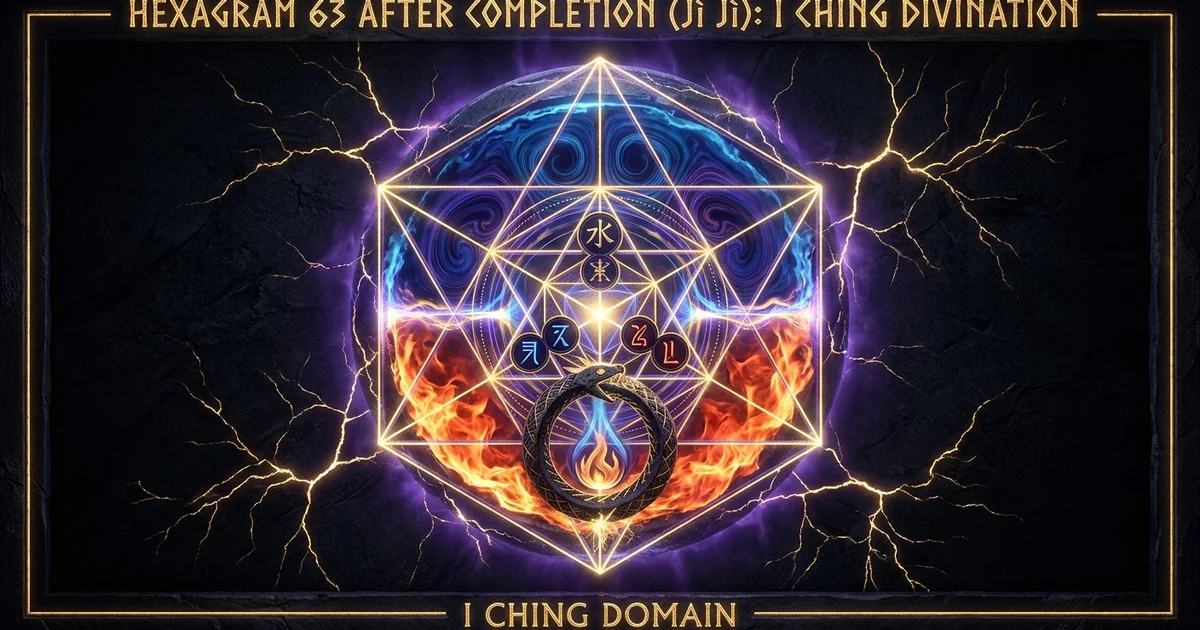
Hexagram 63 After Completion (Jì Jì): I Ching Divination
Archetypal Thesis & Systemic Paradigm: The Paradox of Peak Order
Hexagram 63 (既濟, Jì Jì), universally translated as “After Completion” or “Already Fulfilled,” represents the unique mathematical and structural apex of symmetry within the sixty-four hexagram matrix of the I Ching. Within this psycho-cosmological coordinate framework, Jì Jì is the solitary hexagram wherein every single binary element resides in consummate structural alignment: every odd-numbered station (first, third, fifth) is occupied by a firm, undivided yang line, and every even-numbered station (second, fourth, sixth) is occupied by a yielding, divided yin line. Far from designating an unassailable teleological end-state or an enduring static paradise, this total crystallization of formal order denotes a metastable plateau. In cybernetic and thermodynamic terms, when a complex dynamic system achieves maximum structural order, its internal entropy is reduced to an absolute minimum, thereby exhausting its latent potential energy and rendering the systemic equilibrium extraordinarily vulnerable to perturbation.
--- Line 6: Yin  (Even place: Correct)
--- Line 5: Yang (Odd place: Correct)
--- Line 4: Yin  (Even place: Correct)
--- Line 3: Yang (Odd place: Correct)
--- Line 2: Yin  (Even place: Correct)
--- Line 1: Yang (Odd place: Correct)
In the architecture of the king-wen-sequence, the placement of Jì Jì as the penultimate hexagram—succeeded, rather than concluded, by Hexagram 64: Before Completion (Wèi Jì)—constitutes an intentional ontological critique of absolute closure. The hexagram 63 after completion iching meaning cannot be comprehended through the vernacular lens of triumphant finality or permanent security. Instead, the oracle establishes an epistemological warning: perfect order is an ephemeral, volatile condition. When every component of an organism, state, or psychological apparatus has slotted into its assigned niche, the capacity for further self-organization within that systemic paradigm is reduced to zero. What follows complete integration is not perpetual harmony, but the inexorable drift toward dissolution.
Metastable Equilibrium and Thermodynamic Climax
From a thermodynamic perspective, Jì Jì functions as a dissipative structure that has completed its morphological synthesis. The constituent trigrams—Kǎn (Water) above and Lí (Fire) below—form an engine of immediate, functional interaction. Water naturally descends, while fire naturally ascends. Their encounter produces immediate thermodynamic work: water boils, steam expands, nourishment is processed, and energy is released. Yet, the very efficiency of this arrangement marks its temporal limitation. Once the water is completely boiled, the vessel burns through; once the fuel beneath is consumed, the water turns cold. The high informational fidelity of Jì Jì is therefore characterized by metastability—a state that appears utterly stable to the observer because every local variable is satisfied, yet sits precariously upon the sharpest precipice of systemic phase change.
The divinatory assessment of the jì jì hexagram requires a fundamental shift in consciousness. Diviners who equate “After Completion” with uncomplicated good fortune misread the core mechanics of the Book of Changes. The attainment of complete line correctness (dang wei, 當位) across all six positions generates systemic rigidity. Because no line can advance to a more correct position, any qualitative mutation must represent a fall from perfection into irregularity. The energetic tension of the system cannot be discharged upward or outward; it can only decay. Thus, the thermodynamic climax of Hexagram 63 registers as an existential horizon where vigilance replaces ambition, and conservation supersedes expansion.
The Cybernetic Inevitability of Entropy
Cybernetically, Jì Jì models a closed system that has achieved negative entropy (negentropy) through total constraint. In the lexicon of information theory, maximal order corresponds to minimal uncertainty, which simultaneously implies a catastrophic drop in adaptability. When feedback loops succeed in eliminating all structural error, the system eliminates the very variance required to navigate unanticipated external shifts. As dynamic tension collapses into total coordination, the system loses its internal buffer zones.
This systemic cycle illustrates why the ancient diviners inscribed a catastrophic horizon into the very definition of fulfillment. The trajectory from Jì Jì to Wèi Jì is an operational imperative. The structural rigidity of Hexagram 63 demands an influx of chaotic potential to prevent terminal calcification. When an individual, organizational, or psychic system arrives at the station of Hexagram 63, the diviner’s task is not to engineer further expansion, but to diagnose the subterranean vectors of entropy already beginning to undermine the systemic foundation.
Classical Provenance & Textual Lineage: The Judgment and the Xiangzhuan
The received recension of Hexagram 63 in the Zhouyi preserves a paradoxical balance between pragmatic caution and prophetic dread. The King Wen Judgment (Tuan) provides the essential formula:
既濟:亨小,利貞。初吉,終亂。
Jì Jì: Success in small matters; perseverance furthers. At the beginning good fortune, at the end disorder.
The textual architecture of the Judgment directly confronts the hubris of the triumphant consciousness. The declaration of “success in small matters” (heng xiao) establishes a severe delimitation. Grand, epochal undertakings belong to the ascending phases of creation, such as Hexagram 1 (Qian) or Hexagram 11 (Tai). In Jì Jì, the grand architecture has already been erected; any attempt to launch massive structural revisions will disrupt the delicate equilibrium. The imperative is maintenance, minute calibration, and modest containment. The systemic law codified in the historical Zhou experience dictates that the inception of complete order brings immediate relief (“at the beginning good fortune”), but because human attentiveness naturally slackens once tension is resolved, the culmination inevitably rots from within (“at the end disorder”).
“Water over Fire: the image of the condition in After Completion. Thus the superior man takes thought of misfortune and arms himself against it in advance… When the water in a kettle hangs over fire, the two elements stand in relation and generate energy. But the resulting tension demands caution. If the water boils over, the fire is extinguished and its energy is lost. If the heat is too great, the water evaporates into the air. These elements, very naturally related to each other, generate a situation full of danger.”
Exegesis of the King Wen Judgment and the Fox Metaphor
The imagery of the Judgment incorporates an archaic zoological metaphor that mirrors the final warning of Hexagram 64: the crossing of an icy river by an aged fox. In the cultural memory of the ancient Zhou, the fox was recognized for its hyper-vigilant acoustic awareness, cautiously stepping across frozen rivers while listening for the cracking of ice beneath its paws. In Jì Jì, the crossing has formally occurred; the transit is ostensibly complete. Yet, the textual fragments linked to the line mechanics warn that precisely when the opposite bank is touched, complacency invites catastrophe. The fox gets its tail wet (ru qi wei, 濡其尾), dragging weight into its stride, or worse, submerges its entire head at the terminal line.
This zoomorphic diagnostic demonstrates that book of changes divination never treats physical crossing as absolute psychological security. The moment of stepping onto dry land generates an immediate slackening of sensory acuity. The fox, exhausted by the crossing and relieved by apparent safety, lowers its guard. The jì jì hexagram thus diagnoses the specific vulnerability of the victory lap: the precise interval when survival mechanisms are dismantled because the perceived environment no longer signals immediate mortal danger.
Wang Bi’s Ontological Commentary on Line Rectitude and Arrogance
In his definitive third-century neo-Daoist commentary (Zhouyi Zhu), Wang Bi stripped the Han-era cosmological commentaries of their superstitious omens, substituting a rigorous ontology of structural relations. Translated and analyzed by Richard John Lynn (1994), Wang Bi’s exegesis focuses relentlessly on the concept of dang wei (line correctness) and its intrinsic dialectical reversal. Wang Bi notes that while every line in Jì Jì is positioned correctly, this very perfection breeds an ontological trap:
“When one is in a position of complete success, if one does not govern it with the utmost modesty, it will inevitably become the source of arrogance. If one acts with arrogance, calamity will arise from within.”
Wang Bi demonstrates that line rectitude is not a static moral badge that guarantees immunity from decay. In Jì Jì, the very fact that each line is “correct” means that every line has realized its individual agenda. Because every position has achieved its end, the relational tension that formerly bound the lines into a shared collective effort dissolves. The lines cease to look to one another for completion; mutual interdependence (ying, resonance) curdles into isolated self-satisfaction. Wang Bi perceives that systemic collapse in Jì Jì does not arrive through external invasion or overwhelming force; it emerges as an endogenous, structural rot born of the illusion that structural correctness equals eternal viability.
Structural Mechanics & Symbolic Geometry: Water Over Fire
The architectural stability of Hexagram 63 is generated through a rigorous geometric and energetic configuration. In the spatial distribution of the eight fundamental trigrams (bagua), Jì Jì places Kǎn (Water) as the upper trigram and Lí (Fire) as the lower trigram.
Upper Trigram: Kǎn (Water) = Abysmal, Sinking, Inward, Cold
Lower Trigram: Lí (Fire)   = Clinging, Rising, Outward, Heat
This structural orientation constitutes a functional hydrothermal dynamic. Water, by its innate nature, flows downward; Fire, by its innate nature, flares upward. Because the descending vector of Water sits directly atop the ascending vector of Fire, their trajectories intersect perpendicularly, initiating continuous thermodynamic friction. The heat of the fire transforms the downward weight of the water into steam; the cooling moisture of the water prevents the fire from raging into unconstrained conflagration. This is the archetype of the cauldron, the alchemical athanor, the internal combustion engine, and the human metabolic process.
Hexagram 63: After Completion (Jì Jì)
- Trigram Configuration: Kǎn (Water) over Lí (Fire)
- Vector Mechanics: Convergent; descending water meets ascending fire.
- Thermodynamic Mode: Active kinetic exchange; useful mechanical and chemical work.
- Systemic State: Minimum entropy, maximum structural coherence.
- Latent Risk: Immediate calcification, fuel exhaustion, catastrophic boil-over.
Hexagram 64: Before Completion (Wèi Jì)
- Trigram Configuration: Lí (Fire) over Kǎn (Water)
- Vector Mechanics: Divergent; ascending fire moves away from descending water.
- Thermodynamic Mode: Disconnected polarity; cold sinks, heat dissipates into space.
- Systemic State: Maximum entropy, high unformed potential.
- Latent Risk: Paralysis, failure of elements to cross the threshold of manifestation.
Trigrammatic Polarity: The Hydro-Thermal Engine of Kǎn and Lí
The symbolic physics of water over fire highlights the immense energetic cost required to maintain Jì Jì. The harmony between Kǎn and Lí is not an inert stasis; it is an active, precarious equilibrium maintained by opposing dynamic vectors. In classical Chinese natural philosophy, Fire corresponds to the Heart (Xin) and the spirit (Shen), while Water corresponds to the Kidneys (Shen) and the vital essence (Jing). When the water of the Kidneys ascends to cool the fire of the Heart, and the fire of the Heart descends to warm the water of the Kidneys, the psycho-somatic organism enjoys optimal vitality.
However, this thermodynamic loop operates within an exceptionally narrow band of tolerance. If the fire intensifies ever so slightly, the water is utterly consumed; if the water increases its volume, the fire is permanently extinguished. This dynamic clarifies why the hexagram 63 after completion iching meaning points to continuous, microscopic calibration. The upper trigram Kǎn carries the archetypal qualities of danger, pitfall, and the abyss. That danger sits directly atop clarity and illumination (Lí) indicates that intellectual perception has mapped the entire structural landscape, yet the threat of falling into the abyss remains active precisely because the terrain is so completely known.
Binary Resonance: Exhaustive Correctness and Dual Parity
The mathematical construction of Hexagram 63 reveals an exhaustive symmetry unmatched anywhere else in the sixty-four figures. In the formal system of the I Ching, lines 1, 3, and 5 are designated as naturally yang (active, generative, odd positions), while lines 2, 4, and 6 are naturally yin (receptive, yielding, even positions).
Line 6: Yin (Place 6 = Even) -> Correct (Dang Wei)
Line 5: Yang (Place 5 = Odd)  -> Correct (Dang Wei)
Line 4: Yin (Place 4 = Even) -> Correct (Dang Wei)
Line 3: Yang (Place 3 = Odd)  -> Correct (Dang Wei)
Line 2: Yin (Place 2 = Even) -> Correct (Dang Wei)
Line 1: Yang (Place 1 = Odd)  -> Correct (Dang Wei)
Furthermore, the lines engage in complete structural resonance (ying, 應) across the lower and upper trigrams:
- Line 1 (Yang) corresponds to Line 4 (Yin): An active, initiating lower line finds a receptive, holding response in the outer sphere.
- Line 2 (Yin) corresponds to Line 5 (Yang): The central, balanced, yielded line of the lower trigram serves the sovereign, active, central line of the upper trigram. This is the ideal ruler-minister polarity.
- Line 3 (Yang) corresponds to Line 6 (Yin): The culminating, assertive power of the inner trigram is received by the terminal, yielding line at the apex of the hexagram.
Every single line possesses both absolute correctness of station (dang wei) and a legitimate, polar partner in the complementary trigram (ying). There is zero residual friction, zero unassigned polarity, and zero structural slack. In information science, a system with zero error and total parity has no room for informational transmission; it has become a deterministic crystal. The system has no further problems to solve. Consequently, its evolutionary trajectory is arrested.
Psychological Dynamics & Operational Praxis: The Precipice of Individuation
In the framework of Jungian archetypal psychology, Hexagram 63 captures the dangerous psychological inflation that occurs when the ego believes the process of individuation has reached a terminal conclusion. C.G. Jung, in his celebrated Foreword to the I Ching (1950), emphasized that the hexagrams do not merely represent outer objective situations, but the precise structural disposition of the psychic energy (libido) at the moment of inquiry.
When Jì Jì appears within an analytical consultation, it diagnoses a psychic state wherein all major conscious complexes have been organized, functional adaptations to reality have been secured, and the conflicting demands of persona and shadow appear to have been neatly reconciled. The psyche has erected a pristine, highly functional ego-structure.
“The I Ching does not measure chronological time, but rather qualitative moments in the field of meaningful coincidence. When an individual lands upon Hexagram 63, the unconscious is diagnosing a moment of absolute archetypal crystallization. The danger here is psychological inflation: the ego identifies with the completed work, forgetting that every conscious structure, the moment it achieves total perfection, automatically activates its own unconscious opposite. Completion is never a monument; it is a turning point.”
Enantiodromia and the Jungian Shadow of Perfection
The psychological hazard latent within Jì Jì is the phenomenon of enantiodromia—the Heraclitean law that everything ultimately transforms into its exact opposite. When a conscious attitude becomes totally rigid, absolute, and perfected, it completely severs its connection to the creative, chaotic matrix of the unconscious. The shadow of perfection is catastrophic regression.
In clinical practice, an individual operating under the archetypal field of Jì Jì exhibits an obsessive need to control external variables to maintain the illusion of mastery. Having achieved a hard-won psychological or material baseline, they view any spontaneous emotion, unpredictable intuition, or disruptive somatic symptom as an intolerable threat to their curated equilibrium. The ego becomes an embattled garrison commander defending an immaculate fortress. Yet, the very act of walling out the unconscious builds up subterranean psychic pressure. The chaotic water of Kǎn, held precariously above the conscious fire of Lí, threatens to break through the floorboards and drown the conscious identity.
Operational Line-By-Line Praxis: From Braking the Wheels to Submerging the Head
The six changing lines of Hexagram 63 outline a rigorous operational protocol for managing a system at peak capacity. Each line illustrates the precise behavioral adjustment required to delay structural decay.
Line 6: Getting one's head wet in the water. Peril.
Line 5: The Eastern neighbor's slaughtered ox vs. the Western neighbor's small offering.
Line 4: Fine clothes turn to rags. Caution all day long.
Line 3: Gaozong attacks the Devil's Country. Three years to conquer it.
Line 2: The woman loses her carriage veil. Do not pursue it; after seven days it returns.
Line 1: He brakes his wheels. He gets his tail wet. No blame.
Initial Yang (Line 1): Braking the Wheels
At the inception of completion, the natural human impulse is to accelerate forward, carried by the momentum of previous successes. The text commands: “He brakes his wheels. He gets his tail in the water. No blame.” To drag the brakes when crossing the finish line requires extraordinary discipline. The ego must consciously restrain its desire for further conquest. The wetting of the tail is a minor, corrective inconvenience that reminds the traveler of the surrounding swamp, preventing reckless momentum from carrying the chariot off the cliff.
Second Yin (Line 2): The Lost Carriage Veil
Occupying the central, correct place in the lower trigram, this line represents interior modesty. Yet, when equilibrium is achieved, one’s defensive mechanisms or status symbols may be stripped: “The woman loses her carriage curtain. Do not pursue it; after seven days you will get it.” The veil (fu, 髴) granted status and modesty. When structural shifts strip the ego of its outward protections, the instinctive reaction is panic and frantic repair. The oracle advises radical non-action: do not expend energy chasing lost prestige. In the natural cyclical progression of seven stages, systemic equilibrium will self-correct if left unforced.
Third Yang (Line 3): The Exhausting Imperial Campaign
At the boundary of the inner and outer trigrams, the temptation arises to use consolidated power to wage ideological or territorial warfare: “The Illustrious Ancestor (Gaozong) punishes the Devil’s Country. After three years he conquers it. Inferior people should not be employed.” The historical reference to the Shang emperor Wu Ding conquering the northern nomadic tribes illustrates the massive energetic waste of vanity projects. Even if successful, exhausting the state’s resources to eliminate minor external irritants leaves the core vulnerable. In personal psychology, this warns against obsessive campaigns to eradicate every perceived imperfection in oneself or others.
Fourth Yin (Line 4): Rags in the Fine Garments
Entering the realm of outer manifestation, decay becomes materially visible: “The finest garments turn to rags. Be cautious the whole day long.” No matter how grand the institution or how stable the marriage, structural wear and tear is an objective reality. Silk naturally decomposes; seams fray. The master of changes does not attempt to disguise the decay with cosmetic pretenses. Instead, they operate with constant situational vigilance (jie, 戒), quietly patching structural fissures before they widen into catastrophic leaks.
Fifth Yang (Line 5): The Economy of Spiritual Sincerity
Holding the sovereign station, Line 5 directly contrasts formal, lavish display with internal, minimalist integrity: “The neighbor in the East who slaughters an ox does not attain the true happiness of the neighbor in the West with his small offering.” The eastern kingdom represents ostentatious, decadent ritual—going through the motions of massive religious sacrifice without spiritual presence. The western kingdom (the rising, disciplined Zhou) offers a simple, humble sacrifice (yue) with absolute sincerity. At peak order, grand material displays are signs of internal decadence. The system is preserved only through austere, authentic, and unpretentious alignment with the Dao.
Top Yin (Line 6): Submerging the Head
At the terminal station of the hexagram, symmetry collapses into catastrophe: “He gets his head in the water. Peril.” Line 6 abandons the vigilance of the fox. Carried away by the illusion that the crossing was finalized, the traveler plunges forward blindly into the swollen river, completely submerging the head (ru qi shou, 濡其首). In psychological praxis, this represents the total submersion of the conscious ego by the unconscious shadow—the inevitable consequence of hubris, intellectual arrogance, and the denial of transience.
Philosophical Synthesis & Macrocosmic Correspondence: Chronobiology and Codon Symmetries
The architecture of Hexagram 63 transcends historical divination manuals, offering profound structural isomorphisms with biophysics, chronobiology, and Western esoteric alchemy. In the structural analysis pioneered by Martin Schönberger in The I Ching & The Genetic Code (1973), the sixty-four hexagrams correspond directly to the sixty-four triplet codons of universal DNA/RNA transcription.
In modern psycho-genetic frameworks such as the Human Design System, Hexagram 63 maps precisely to Gate 63: The Gate of Doubt (After Completion), located within the Head Center.
- Biochemical Resonance: Associated with the amino acid Asparagine and systemic cellular stop-mechanisms.
- Circuitry: Collective Logic Circuit (The Channel of Logic, 63-4, linking Doubt to Formulization).
- Cybernetic Function: Gate 63 operates as the cognitive ignition of the logical mental process. It does not look at the past with sentimental satisfaction; it looks at completed patterns with instinctive skepticism, asking: Is this pattern truly viable? Can it survive the next cycle?
- Dynamic Tension: When paired with Gate 4 (Youthful Folly, Hexagram 4), Gate 63 transforms the terror of structural entropy into systematic, scientific inquiry.
Isomorphism with Genetic Codons and Information Theory
Within Schönberger’s genetic matrix, the alternating yin-yang binary pattern of Jì Jì (0-1-0-1-0-1 or 1-0-1-0-1-0 depending on bottom-up reading) directly mirrors the structural properties of genetic punctuation marks. In biological transcription, unbounded growth without punctuation is lethal; it leads to carcinogenic cellular mutation. The organism relies upon precise stop codons (UAA, UAG, UGA) to command the ribosome to cease translation and release the completed polypeptide chain.
Hexagram 63 acts as the macrocosmic and biophysical equivalent of a stop codon. It arrests the forward translational motion of the biological or psychological apparatus. It announces that the protein has folded, the sequence has closed, and the structural unit is complete. Any attempt to force transcription beyond this punctuation point introduces informational noise, producing misshapen, non-functional genetic structures. Information theory confirms this dynamic: maximum entropy allows for infinite possibilities but zero structure, whereas zero entropy (Hexagram 63) locks information into absolute, unmodifiable form.
The Hermetic Coagula and the Dynastic Lifecycle
In the Western Hermetic tradition, the macrocosmic cycle of manifestation is governed by the axiomatic formula Solve et Coagula—dissolve and coagulate. Within this alchemical paradigm, Jì Jì represents the absolute peak of Coagula. The volatile spirit has been fully fixed; the ethereal water has been trapped and shaped by the terrestrial furnace. The Great Work appears complete; the Philosopher’s Stone has crystallized.
Yet, Hermetic philosophy recognizes that an unyielding Coagula produces stony, calcified death. Once the matter has been fixed, it must immediately be prepared for the next cycle of dissolution (Solve), which is precisely what Hexagram 64: Before Completion enacts. If the alchemist clings to the completed stone within the vessel, the vessel cracks under the static pressure, and the work must be restarted from prime matter.
This Hermetic rhythm maps seamlessly onto the dynastic cycle formulated by Chinese historical philosophers and later echoed by contemporary macro-historians. A dynasty is founded through fierce, creative struggle (Hexagrams 1, 2, 3); it organizes its institutions, conquers its rivals, and builds monumental cities (Hexagrams 11, 49, 55). Finally, it reaches the stage of Jì Jì: peace reigns across the realm, every administrative post is staffed by competent scholars, taxes are collected with total algorithmic efficiency, and the borders are secure.
It is precisely at this historical moment that the seeds of collapse take root. The administrative elite, convinced that their systems are permanent, succumb to institutional sclerosis, bureaucratic arrogance, and decadence. They forget the brutal struggles that established the order. Within two generations, the pristine symmetry of Jì Jì disintegrates into systemic rebellion, economic exhaustion, and spiritual rot, throwing the world back into the roiling, unformed waters of Wèi Jì.
Frequently Asked Questions: Advanced Divinatory and Structural Inquiries
Resolution of Apparent Paradoxes in Oracle Consultation
Why does the Book of Changes not terminate at Hexagram 63?
If the sixty-four hexagrams describe the total cosmic and psychological lifecycle, it would seem mathematically and philosophically logical for the book to conclude with Hexagram 63 (After Completion), where every single line is in its correct place and every trigram is in functional harmony. Why, instead, did King Wen and the ancient editors deliberately place Hexagram 64 (Before Completion) as the ultimate figure of the sequence?
This structural decision encapsulates the foundational premise of Chinese metaphysics: the universe is a living, continuous process (dao), not a closed teleological system. If the sequence ended at 63, the I Ching would be endorsing an absolute, dead stasis. The cosmos would be declared “finished,” locking existence into a terminal freeze. By ending with Hexagram 64—wherein every single line is in an incorrect position (all yang lines in even stations, all yin lines in odd stations) and the fire rises away from the sinking water—the oracle guarantees eternal dynamic motion. The end of the book is not a period, but an ellipsis. The structural closure of 63 is deliberately overthrown by the unresolved potential of 64, which immediately rolls back over into Hexagram 1 (Qian) and Hexagram 2 (Kun), sustaining the eternal wheel of existence.
How should a querent interpret a reading of Hexagram 63 unchanging?
When Hexagram 63 is received in a divination without any moving lines (a static hexagram), it indicates that the querent or the system under inquiry has arrived at a state of total, unalterable formal crystallization. There are no immediate internal levers available for modification. Every component of the situation is locked into its respective position.
In operational praxis, an unchanging 63 is a directive for absolute conservatism and vigilant preservation. It tells the querent: Do not innovate. Do not push for expansion. Do not attempt to fix perceived minor flaws. The system is functioning at its absolute ceiling of efficiency, but it is also completely brittle. The psychological posture must shift entirely from that of the creator or conqueror to that of the watchman. One must quietly prepare contingency plans for the systemic breakdown that will inevitably occur when the current environmental conditions shift.
The Mechanics of Changing Lines within Full Symmetry
What is the systemic meaning when multiple lines move in Hexagram 63?
Because Hexagram 63 represents an absolute equilibrium of polarities, the activation of moving lines does not indicate simple gradual change; it signals the structural collapse of systemic symmetry. In the mechanics of book of changes divination, changing lines mark points of energetic exhaustion where yang is turning into yin, or yin into yang.
When multiple lines move in Jì Jì, the querent is witnessing the precise path through which order is unravelling into disorder (chu ji, zhong luan). For example, if Line 1 and Line 2 move simultaneously, the foundational stability of the lower trigram Lí is shattered. The fire is being extinguished from beneath, turning the lower trigram into Gen (Mountain) or Zhen (Thunder), while the upper water crashes downward without thermal resistance.
The interpretation of multiple moving lines in Hexagram 63 requires tracing which lines are destabilizing first:
- Lower Trigram Destabilization (Lines 1, 2, 3): Indicates that internal motivations, core resources, or the primary psychological base are burning out or losing discipline.
- Upper Trigram Destabilization (Lines 4, 5, 6): Indicates that the external environment, leadership structures, or overarching strategic paradigms are collapsing under their own weight.
The resulting hexagram (zhi gua) will reveal the specific landscape into which the broken symmetry is falling. If the structural integrity of Jì Jì cannot be preserved through humility and vigilance, the moving lines provide the exact navigational trajectory required to survive the plunge back into the raw, turbulent waters of the unformed cosmos. :::