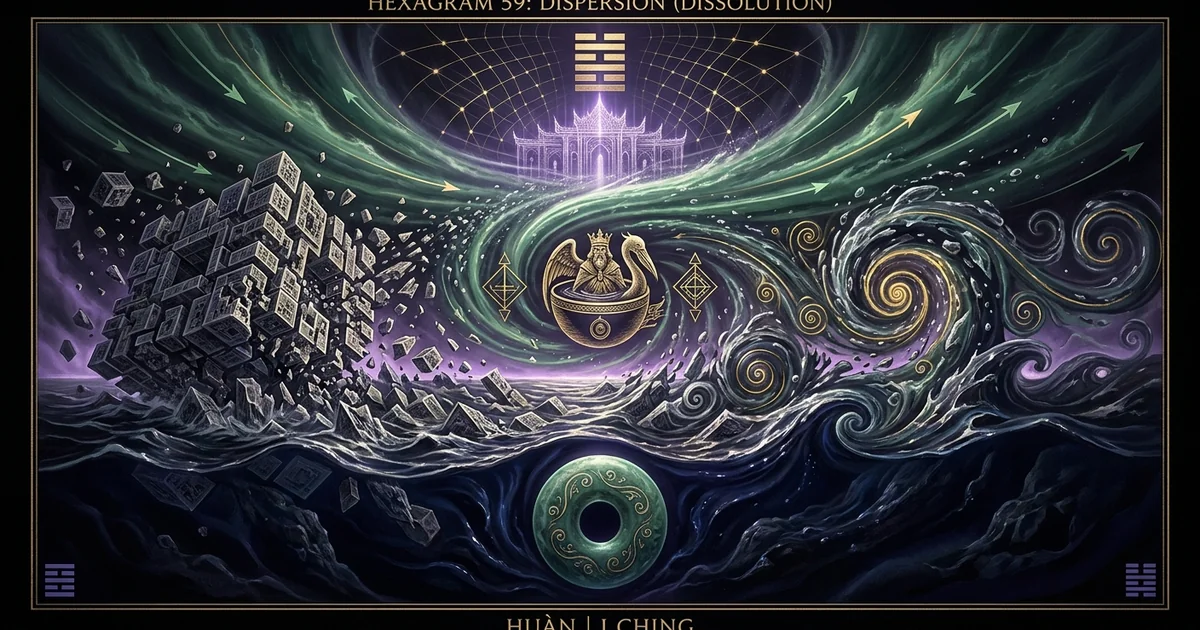
Hexagram 59 Dispersion (Dissolution) (Huàn): I Ching
Archetypal Thesis & Systemic Paradigm: Entropy, Fluidity, and Egoic Dissolution
Thermodynamics of Huàn: The Dissolution of Stagnant Equilibria
Hexagram 59 (渙, Huàn)—variously translated as Dispersion, Dissolution, or Melting—models the deliberate thermodynamic phase transition of a closed psychic or societal system from a state of calcified, low-entropy rigidity into a high-entropy, fluid state-space. In the structural taxonomy of the Book of Changes divination tradition, systems that remain static inevitably succumb to internal necrosis; crystalline structures, while initially protective, become prisons of ossified psychic material. The mechanics of the huàn hexagram formalize the systemic intervention required when an individual ego or a sociopolitical collective isolates itself within impermeable boundaries. Through the thermodynamic action of heat and kinetic motion across an abyss of frozen or stagnant waters, the hexagram delineates how concentrated defensive complexes undergo controlled liquefaction, releasing trapped libido back into macroscopic systemic circulation.
The phenomenology of Huàn does not signify arbitrary structural destruction. Rather, it charts the teleological dismantling of psychic armor. When an open thermodynamic system falls out of exchange with its external environment, it experiences an accumulation of internal entropy that threatens chaotic breakdown. Huàn intervenes precisely at this critical threshold: the hexagram 59 dispersion (dissolution) iching meaning centers on an entropic flush that dissolves crystallizations before they undergo violent cataclysms. By mobilizing the frozen or isolated contents of consciousness, Huàn restores non-equilibrium conditions, allowing metabolic exchange between the micro-cosmic ego and the macro-cosmic field.
The Dialectic of Calcification and Fluidity in Consciousness Systems
Within human consciousness, psychic structures naturally trend toward territorialization. Complexes cohere around emotional trauma, forming defensive bastions designed to insulate the conscious core from the unfathomable depth of the unconscious. This defensive posture corresponds cosmologically to water that has frozen into rigid ice, or a lake whose perimeter has been sealed off from running currents. Trigram Xùn (wind-wood) sweeps across the surface of Trigram Kǎn (the abyssal water), operating as a pervasive, aerodynamic perturbation that breaks surface tension, shatters ice dams, and forces the dormant depths to circulate. The wind does not confront the water through blunt force; rather, it permeates, gently transferring kinetic energy until the coagulated mass dissolves into a moving stream.
This dynamic illustrates the classic polarity between rigidity and fluidity. When the ego calcifies, it loses its adaptive plasticity, viewing all foreign elements as existential threats. The systemic function of the huàn hexagram is to initiate a controlled thaw. It acts as an energetic solvent, dissolving the egotistical fixation on personal survival, private grievance, and ideological dogma. The resulting dispersion is experienced psychologically as vulnerability, yet it constitutes the only viable pathway away from psychological petrification. The wind over water architecture guarantees that the dissolution is guided by a unifying, directional vector rather than descending into formless chaotic floodwaters.
Archetypal Dissolution as a Precondition for Systemic Individuation
In the framework of analytical psychology, Carl Gustav Jung emphasized that structural adaptation must periodically yield to archetype-driven reconfigurations. The hexagram 59 dispersion (dissolution) iching meaning serves as a foundational paradigm for the individuation process. Individuation does not culminate in the expansion or unyielding fortressing of the persona; it requires the systematic, voluntary loosening of the persona-ego axis so that transpersonal and shadow contents can be integrated. Without periodic dispersion, the conscious mind constructs a monolithic facade that severs communication with the Self, provoking severe neurosis or compensatory unconscious eruptions.
Hexagram 59 (Huàn / Dispersion) Structure:
Upper Trigram: ☴ Xùn (Wind, Wood, Gentle Penetration)
Lower Trigram: ☵ Kǎn (Water, The Abyss, Deep Danger)
Huàn therefore facilitates an alchemical lowering of psychological defenses—a controlled permeability. By allowing abyssal affects (Trigram Kǎn) to be aerated by the spirit or intellect (Trigram Xùn), the individual ceases to mistake the personal complex for the absolute horizon of being. Individuation requires this sacrifice of personal insularity. The dissolution of calcified boundaries is not an end in itself, but the operational prerequisite for reconstituting the self within a broader, more authentic collective and cosmic matrix, ensuring that the psyche does not collapse into solipsistic isolation.
Classical Provenance & Textual Lineage: The King Wen Sequence and the Commentary Traditions
The Zhouyi Sequence: Transitioning from Hexagram 58 (Duì) to 59 (Huàn)
The placement of Hexagram 59 within the canonical King Wen sequence provides critical insight into its systemic purpose. Huàn directly follows Hexagram 58, /iching/hexagram-58-the-joyous-dui (The Joyous, Lake). In the Xù Guà Zhuàn (Sequence of the Hexagrams), the transition is formalized: “Joy means pleasure. Pleasure leads to dispersion; hence there follows the hexagram Huàn. Huàn means dispersion.” Hexagram 58 represents intersubjective exchange, collective jubilation, mutual stimulation, and conversational pleasure. However, unmitigated joy and closed-circuit social indulgence harbor an innate systemic hazard: the danger of trivialization, self-satisfied complacency, and decadence. Left unchecked, collective joy coagulates into tribal insularity, where a group or individual becomes consumed by self-soothing feedback loops.
Huàn arrives as the necessary cybernetic corrective. When pleasure becomes an end in itself, it breeds stagnation and clannish selfishness. The societal and psychic fabric separates into self-absorbed cliques. Hexagram 59 shatters this inward-facing complacency. It introduces the penetrative wind of external reality, blowing away the superficial froth of mere amusement. The sequence demonstrates that after pleasure has united individuals, that unity must not be permitted to solidify into an exclusive enclave; it must be dispersed outward into wide-reaching, trans-tribal cultural and spiritual enterprises. This movement naturally prepares the matrix for the subsequent hexagram in the sequence, /iching/hexagram-60-limitation-jie (Jie), which imposes structural boundaries upon the liberated fluid field.
The Royal Temple Archetype: ‘The King Approaches His Temple’ as Axial Center
A foundational motif repeated across the Zhouyi is the phrase: Wang jia you miao (王假有廟)—“The King approaches his temple.” In Hexagram 59, this formulaic pronouncement functions as the absolute structural anchor of the text. When psychic and cultural elements are undergoing rapid dispersion, the danger of total disintegration, centrifugal dissolution, and loss of identity becomes acute. The “Temple” represents the immutable archetypal center: the axis mundi where the human temporal sphere intersects the eternal ancestral order.
The Judgment: Dispersion. Success. The king approaches his temple. It furthers one to cross the great water. Perseverance furthers.
The Image: The wind drives over the water: The image of Dispersion. Thus the kings of old sacrificed to the Lord and built temples. — The I Ching or Book of Changes, Richard Wilhelm & Cary F. Baynes (Bollingen Series XIX, 1950)
As Richard Wilhelm and Hellmut Wilhelm observed in their analytical dialogues, the construction of the ancestral temple and the offering of sacrifices represent the historical institution of a shared, trans-individual ethos. When fear, self-interest, and factionalism disperse a people—or when neurotic defenses scatter an individual’s psychological energies—the remedy is not the application of tyrannical control. It is the voluntary reconstitution of attention around an ancestral, transcendent axis. By approaching the temple, the king (symbolizing the synthesizing ego-function operating under divine mandate) aligns himself with the primordial archetypes. The religious act acts as an unshakeable point of cohesion, ensuring that while transient egoistic forms are dispersed, the essential psychic core remains tethered to transpersonal reality.
Wang Bi’s Ontological Exegesis: Non-Being Resolving Hardened Form
The third-century scholar Wang Bi revolutionized Zhouyi hermeneutics by moving away from literalistic image-number (Xiangshu) divinatory mechanics toward an ontology grounded in Neo-Daoist Xuanxue (Mysterious Learning). In his commentary on Huàn, Wang Bi interprets dispersion not as physical destruction, but as the manifestation of fundamental non-being (wú) resolving the hardened manifestations of being (yǒu). Wang Bi emphasizes that conflicts, blockages, and entropic decay occur precisely because entities fixate upon their particularized, discrete forms, hardening their selfhood against the cosmic Dao.
Wang Bi argues that Trigram Xùn succeeds in dissolving Trigram Kǎn because it embodies non-coercive yielding. Wind has no rigid shape of its own; it permeates cracks, traverses obstacles, and yields completely to the contours of reality. Consequently, when non-being acts through persistent compliance, the “hardened obstructions” within the human heart—resentment, ancestral grievances, and systemic dread—dissolve organically. For Wang Bi, the “Great Water” that must be crossed represents the vast chasm of social alienation and mutual suspicion created by hardened ego-boundaries. By abandoning self-insistence and aligning with the yielding void, one navigates the most dangerous abyssal transitions without catastrophe.
Structural Mechanics & Symbolic Geometry: Trigram Dynamics and Line Progressions
Vector Analysis: Upper Xùn (Wind) over Lower Kǎn (Water)
The primary symbolic geometry of Hexagram 59 is established through the spatial confrontation of its component trigrams:
Upper: ☴ Xùn (Sun) = Wind, Wood, Gentle Infiltration
Lower: ☵ Kǎn (Kan) = Water, Pit, Abyss, Dangerous Depth
Trigram Kǎn occupies the lower, internal position. Kǎn consists of a single solid, yang line enclosed between two broken, yin lines. It represents the subterranean core of vitality trapped within the cold parameters of danger, fear, and instinctual darkness. Left to itself, Kǎn remains a stagnation basin—an inaccessible psychological abyss fraught with existential anxiety.
Trigram Xùn occupies the upper, external position. Composed of two yang lines resting atop a broken yin line, Xùn embodies the dynamic of gentle yet inexorable penetration. It is the wind moving overhead, the roots of wood penetrating rock, the gradual warmth of spring thawing the tundra. In classical Chinese physics, wind moving over water does not simply push the surface; it causes evaporation, transforming liquid mass into gaseous atmospheric vapor. The vector is decisively upward and outward: the cold, enclosed, downward-sinking energy of Kǎn is captured by the circulating, ascending kinetics of Xùn. The stagnant complex is aerated, elevated into the atmosphere of collective conscious life, and transformed from an isolated sinkhole of anxiety into systemic atmospheric precipitation.
| Line Position | Yao Character | Structural Property | Centrality / Correctness | Polar Correlative | Operative Functional Archetype |
|---|---|---|---|---|---|
| Nine at the Top | Yang | Culmination / Dispersion of Blood | Not Central, Incorrect | Resonance with Line 3 | Total expulsion of trauma and ancestral bloodshed |
| Nine at the Fifth | Yang | Sovereign / Royal Proclamation | Central, Correct | Governs the Hexagram | Dissolving royal silos; sweeping collective decrees |
| Six at the Fourth | Yin | Minister / Dissolving the Faction | Not Central, Correct | No direct resonance | Transcending party lines; cosmic communal order |
| Six at the Third | Yin | Individual Complex / Self-Dissolution | Not Central, Incorrect | Resonance with Line 6 | Surrendering private vanity; selflessness in action |
| Nine at the Second | Yang | Inner Support / The Abyssal Anchor | Central, Incorrect | No resonance with Line 5 | Fleeing toward what supports; psychic stabilization |
| Six at the Beginning | Yin | Subordinate / Initial Rescue | Not Central, Correct | Subordinate to Line 2 | Mobilization by horsepower; averting stagnation |
Nuclear Architecture: Trigrams Gen and Zhen Forming Hexagram 27 (Yí)
To unearth the subterranean operational logic of Huàn, one must extract its nuclear hexagram (hù guà). The nuclear trigrams are derived from lines 2, 3, 4 (the lower nuclear) and lines 3, 4, 5 (the upper nuclear):
- Lower Nuclear Trigram (Lines 2, 3, 4): ☳ Zhèn (Thunder, The Arousing)
- Upper Nuclear Trigram (Lines 3, 4, 5): ☶ Gèn (Mountain, Keeping Still)
When synthesized, the lower nuclear Zhèn and upper nuclear Gèn yield Hexagram 27, Yí (頤, Nourishment / Corners of the Mouth):
Nuclear Hexagram: Hexagram 27 (Yí - Nourishment)
Upper Nuclear: ☶ Gèn (Mountain)
Lower Nuclear: ☳ Zhèn (Thunder)
This structural emergence provides an extraordinary metaphysical revelation: the dissolution of forms (Huàn) is entirely governed by the systemic requirement for nourishment (Yí). Why must forms disperse? Because closed structures eventually exhaust their internal nutritional resources and starve the living organism. Hexagram 27 portrays an open mouth—the imperative of taking in external sustenance and eliminating metabolic waste.
The presence of nuclear Zhèn (movement, initialization) beneath nuclear Gèn (containment, stillness) indicates that inside the process of dispersion resides the blueprint for deliberate metabolic ingestion. Rigid identities are dissolved precisely so that the psyche can feed upon the broader cosmic nutrients of life, preventing the auto-intoxication that results from consuming one’s own stale psychological fabric.
The Six Lines (Yao): Trajectories from Immediate Rescue to Absolute Transcendence
Line Progressions of Hexagram 59:
Top Line  : ─── (Yang) [Line 6: Dissolving blood; departure from harm]
Fifth Line: ─── (Yang) [Line 5: Perspiration; grand decrees dispersing silos]
Fourth Line: ─ ─ (Yin)  [Line 4: Dissolving the clique; vast mountain-like vision]
Third Line : ─ ─ (Yin)  [Line 3: Dissolving the self; absolute lack of remorse]
Second Line: ─── (Yang) [Line 2: Rushing to support; structural refuge]
First Line : ─ ─ (Yin)  [Line 1: Assisted by the strength of a horse; early remedy]
Six at the Beginning
“He brings help with the strength of a horse. Good fortune.” At the initiation of dispersion, the disintegrative process is just beginning to manifest within the depths of Trigram Kǎn. The danger of sinking into the emotional morass is high. The broken yin line at the base is weak on its own, yet it immediately yields to the strength of Nine at the Second. The “horse” represents strong, instinctual, pragmatic energy that carries the consciousness out of the swamp before the ground completely liquefies. This is rapid psychic remediation: deploying simple, grounded physiological discipline or external support to halt incipient depressive paralysis.
Nine at the Second
“At the dispersion, he flees toward that which supports him. Remorse disappears.” Nine at the Second is a strong, solid yang line stationed inside the abyssal trigram Kǎn. Surrounded by darkness, it avoids being swallowed by reaching toward a firm foundation—either its internal connection to central balance or a trusted psychological anchor. Rather than attempting a premature, heroic conquest of the abyss, the subject strategically recognizes the prevailing systemic instability and secures a base of psychological equilibrium, neutralizing anxiety.
Six at the Third
“He dissolves his self. No remorse.” Occupying the transitional boundary between the lower water and upper wind trigrams, this yin line faces the threshold of the persona. Here, individual will and narcissistic attachments threaten to sabotage the flow of macrocosmic energy. The line demands the voluntary dissolution of the personal agenda (huàn qí shēn). By choosing to surrender the demand for personal recognition, self-preservation, and egoic entitlement, the subject moves beyond personal remorse; the subjective boundary dissolves into objective purpose.
Six at the Fourth
“He dissolves his clique. Great good fortune. Dispersion leads in turn to accumulation. This is something that ordinary men do not think of.” Stationed at the base of Trigram Xùn, Six at the Fourth represents the minister or social mediator who transcends tribal sectarianism. Parties, political cabals, and exclusive psychological enclaves are dissolved. Wilhelm notes that breaking through clannish insularity allows the collective to re-aggregate around a vastly more inclusive center. By surrendering allegiance to the faction, one paradoxically discovers universal communion—a counter-intuitive systems principle invisible to localized consciousness.
Nine at the Fifth
“His loud cries are as dissolving as sweat. Dispersion! A king abides without blame.” This is the sovereign ruler of the hexagram, central, authoritative, and positioned correctly in the upper trigram. The image is that of fever broken by systemic perspiration (huàn hàn). Just as high fever within an organism is relieved when the skin pores open and perspiration breaks out, carrying toxins away, the sovereign dispenses the locked-up wealth of the central treasury or issues profound, emancipating decrees that break social gridlock. Great ideas and resources are scattered to the winds to nourish the periphery, relieving the societal organism of its lethal systemic fever.
Nine at the Top
“He dissolves his blood. Departing, keeping at a distance, going out is without blame.” At the absolute extreme of Huàn, dispersion reaches the most visceral somatic and ancestral substrate: the blood (huàn qí xuè). Blood symbolizes somatic trauma, deep ancestral wounding, ancient blood-feuds, and biological dread. The top yang line, operating at the highest reaches of Xùn, completely blows away the miasma of historical violence. It indicates a total evacuation from the zone of psychic hazard. One departs from the toxic ancestral theater entirely, stepping outside the lineage of inherited trauma to exist in uncompromised, liberated psychic space.
Psychological Dynamics & Operational Praxis: The Solutio of the Alchemical Ego
The Solutio Operation: Jungian Archetypal Transmutation
Within Western esoteric alchemy, the psychological work is governed by the core aphorism solve et coagula—dissolve and coagulate. Hexagram 59 is the structural and functional equivalent of the alchemical /alchemy/solutio-water-stage-alchemy (solutio). As Edward F. Edinger demonstrated in Anatomy of the Psyche, the solutio operation represents the liquefaction of dry, hyper-rationalized, or fixated mental states within the universal solvent of the unconscious. The prima materia, when hardened into unyielding hubris, must be cast into the water to drown, rot, and dissolve before it can be reconstituted as the incorruptible lapis.
Huàn serves precisely this function in psychological praxis. When an individual presents with high-functioning, obsessive-compulsive defenses or neurotic character-armor, the therapeutic imperative is not to provide more structural reinforcement. The imperative is solutio. The analyst and the patient must allow the wind of archetypal intuition (Xùn) to blow over the abyssal waters of suppressed affective history (Kǎn). Emotional tears, the mourning of ancestral losses, the dissolution of ideological self-righteousness—these are the direct psychological phenomena of Huàn. The ego suffers a temporary loss of rigidity, experiencing the terror of softening, yet discovers that this very dissolution prevents catastrophic psychic petrification.
Hexagram 59: Huàn (Dissolution)
- Thermodynamic Vector: Aerodynamic sublimation, wind moving over deep water.
- Structural Mechanics: Softening of boundaries, controlled phase change from solid to fluid.
- Operational Dynamic: Dissolution of defensive complexes to restore macrocosmic systemic circulation.
- Psychological Manifestation: Emotional catharsis, alchemical solutio, softening of character armor.
- Teleology: Reconstitution of identity around the ancestral temple and cosmic center.
Hexagram 23: Bō (Splitting Apart)
- Thermodynamic Vector: Gravitational structural failure, mountain resting precariously on earth.
- Structural Mechanics: Total collapse of foundational supports due to progressive decay from below.
- Operational Dynamic: Stripping away of obsolete forms; catastrophic erosion of outworn structures.
- Psychological Manifestation: Severe ego-depletion, somatic exhaustion, systemic house-of-cards collapse.
- Teleology: Passive surrender to inexorable decay; waiting until bottom is reached to regenerate.
Oracular Feedback and Differential Diagnosis: Dispersion vs. Fragmentation
When Hexagram 59 emerges in an oracular consultation, the practitioner faces a critical differential diagnosis: Does this dispersion signify an evolutionary, therapeutic solutio, or does it warn of pathological psychological fragmentation? Divination systems, viewed through the lens of cybernetic feedback mechanisms, act as state-space diagnostic engines. Receiving Huàn is an immediate indicator that boundaries are disintegrating. The clinician or diviner must evaluate the integrity of the underlying ego-matrix to determine whether the subject can withstand this dissolution.
If the ego is fundamentally strong but encrusted with rigid, obsessional defenses, Huàn is an auspicious mandate to surrender control, embrace vulnerability, and abandon artificial certainty. The instruction is to yield to the process of dissolution. However, if the ego is fragile, borderline, or pre-psychotic, the dispersion represented by Huàn signals catastrophic ego-splitting—a state where the waters of the abyssal unconscious overwhelm the conscious mind, causing dissociative fugue, psychotic breaks, or severe identity diffusion. In the latter scenario, the emphasis must shift immediately to the anchor points of the hexagram: “The king approaches his temple” and “He flees toward that which supports him” (Line 2). The individual must urgently establish psychic containment, somatic grounding, and archetypal anchors to prevent centrifugal ego-fragmentation.
Crossing the Great Water: Transcending the Paralysis of Existential Dread
The Judgment of Hexagram 59 explicitly proclaims: “It furthers one to cross the great water” (lì shè dà chuān). In traditional Chinese symbology, crossing the great river or the oceanic void represents embarking upon a high-stakes, hazardous enterprise that severs one’s ties to familiar shores. Under ordinary conditions, crossing the great water is an act fraught with lethal peril, demanding absolute caution. Under the dominion of Huàn, however, crossing the water is not merely permitted; it is the vital operational antidote to existential dread.
When an individual’s psychic field is beset by stagnation, fear breeds within the enclosed perimeter. Paralyzed by the dread of the unknown (Trigram Kǎn), the individual remains trapped in a state of anticipatory anxiety. The strategic prescription of Huàn is forward kinetic mobilization. Unbound psychic energy must not be allowed to swirl in self-destructive, ruminative eddies. It must be actively channeled into an externalizing, transpersonal venture. By stepping onto the boat—which is structurally crafted from wood (Trigram Xùn) and rides buoyant upon the dangerous waters (Trigram Kǎn)—the individual transforms the abyss from an executioner into a supportive medium of transit. Action undertaken in service of a transcendent goal mobilizes the frozen libido, transforming static dread into dynamic vector-velocity.
Philosophical Synthesis & Macrocosmic Correspondence: Hermetic Principles and Systems Ecology
The Hermetic Axiom of Rhythm and Polarity: Solve et Coagula
In the Western Hermetic tradition, the universe is governed by immutable rhythmic laws of oscillation, vibration, and polarity. The principle of Solve et Coagula is not a singular historical technique, but the primary pulse of the cosmos: form condenses, solidifies, exhausts its evolutionary trajectory, dissolves into the primordial ocean of unmanifest spirit, and re-coagulates into higher orders of complexity. Hexagram 59 provides an extraordinarily precise cosmological blueprint of the Solve phase of this universal cycle.
Hermetic & Thermodynamic Cycle:
[ Coagula: Solid Structure ]
      │
      ▼  (Systemic Saturation)
[ Solve: Hexagram 59 (Huàn) / Solutio ]
      │
      ▼  (Entropic Dissipation & Reorganization)
[ Coagula Redux: Hexagram 60 (Jié) / Limitation ]
Without the Solve vector, the cosmos would succumb to petrified stasis—an absolute zero of consciousness where no new information could be generated. Huàn is the celestial enzyme that prevents manifestation from choking upon its own debris. It acts as the cosmic solvent, ensuring that every identity, dynasty, theological dogma, and institutional system remains fundamentally permeable to the infinite. The Hermetic magus recognizes that fear of the Solve phase is the root of all spiritual suffering; true mastery consists in conscious, joyous participation in one’s own periodic structural dissolution, trusting entirely in the invariant archetypal laws of subsequent re-coagulation.
Dissipative Systems and Prigoginian Self-Organization
Modern non-equilibrium thermodynamics offers a strikingly congruent vocabulary for understanding Hexagram 59. In the landmark work of Ilya Prigogine and Isabelle Stengers, Order Out of Chaos (1984), physical systems that are driven far from thermodynamic equilibrium are designated as “dissipative structures.” These open systems do not maintain stability through static preservation; rather, they maintain their coherence by continuously dissipating energy, matter, and entropy into their surrounding environments. When an external perturbation pushes such a system beyond its critical threshold, the existing internal equilibrium breaks down completely.
“The more complex a system is, the more numerous are the types of fluctuations that threaten its stability… But under certain conditions, a fluctuation may become amplified, take over the entire system, and drive it to a new state of organization far from equilibrium. Here, dispersion is not mere dissipation of energy; it is the necessary thermodynamic precursor to the spontaneous emergence of order out of chaos.” — Ilya Prigogine & Isabelle Stengers, Order Out of Chaos: Man’s New Dialogue with Nature (Bantam Books, 1984); contextualized with Marie-Louise von Franz, On Divination and Synchronicity (Inner City Books, 1980).
This systems-theory paradigm maps seamlessly onto the dynamics of the huàn hexagram. Huàn represents the deliberate elevation of system fluctuations to disperse an obsolete, low-complexity equilibrium. Within /systems-theory/dissipative-structures-consciousness, an ego or a culture cannot evolve to a higher topological state of organization without passing through an open, far-from-equilibrium zone where its existing parameters are radically dispersed. The dissolution of boundaries is precisely what allows the systemic importation of negative entropy (negentropy) from the macrocosmic environment. Huàn is not a terminal failure of the system, but the self-organizing perturbation required to birth a more sophisticated, resilient, and integrated psychic architecture.
Biochemical and Circuitry Parallels: Gate 59 and Genetic Receptivity
In the synthesis of the Human Design System—which maps the 64 hexagrams of the I Ching to the 64 codons of the human genetic code—/human-design/gate-59-intimacy-sexuality occupies a profound anatomical and physiological node. Designated as the Gate of Sexuality or the Gate of Intimacy, Gate 59 is located within the Sacral Center (the biological motor of vitality, reproduction, and life-force) and directs its energy toward Gate 6 in the Solar Plexus Center (the seat of emotional awareness and boundary regulation), forming the Channel of Mating (59-6).
The Bio-Genetic Circuitry of Gate 59:
[ Sacral Center: Gate 59 (Huàn) ] ──────> [ Solar Plexus: Gate 6 (Sòng) ]
       Vitality / Aura-Breaker                  Emotional Boundary / Friction
The genetic and biochemical mandate of Gate 59 is the dissolution of auric resistance. For sexual reproduction and deep interpersonal intimacy to occur, the protective, defensive fields of two distinct biological organisms must be temporarily dismantled. Gate 59 acts as an auric penetrator: it dissolves the emotional and energetic barriers that separate individuals, creating genetic permeability so that genetic material can cross over and generate new life.
This biochemical parallel mirrors the classical trigram vector of wind sweeping over water: the penetrative, creative life-force (Sacral) shatters the abyssal, defensive emotional barriers (Solar Plexus). Intimacy is fundamentally an act of controlled dispersion; it requires the ego to surrender its absolute sovereignty, permitting another biological and emotional reality to permeate its inner sanctum.
Frequently Asked Questions Regarding Hexagram 59 (Huàn)
Distinguishing Productive Dispersion from Pathological Dissociation
A central challenge in analytical psychology and spiritual guidance is differentiating between evolutionary ego-softening and dangerous psychiatric decompensation. How does one determine whether an experience of Huàn represents healthy archetypal dissolution or pathological dissociation?
The differentiation rests primarily upon the presence of the “Temple”—the structural anchor. In healthy archetypal dispersion, the ego-boundaries soften, and defensive control mechanisms are relaxed, but the subject retains a functioning, observational metacognitive core grounded in somatic and transpersonal reality. The individual experiences emotional release, weeping, profound empathy, and a peaceful surrender of obsessive certitude; this is the classic alchemical solutio. In contrast, pathological dissociation and psychotic fragmentation involve the catastrophic disintegration of the observational center itself.
The individual does not experience fluid release, but rather terrifying depersonalization, derealization, paranoia, and the radical splitting of the psyche into unintegrated, antagonistic fragments. If an oracular consultation yields Hexagram 59 during a period of acute psychological instability, the practitioner must not prescribe further mystical dissolution. Instead, the imperative is to mobilize immediate containment: invoking Line 2 (“fleeing toward that which supports”) to construct rigid somatic routines, external therapeutic containers, and environmental grounding, preventing the abyss from completely overwhelming the fragile conscious seat.
Navigating the Terminal Transition: The Meaning of Nine at the Top
The uppermost line of Hexagram 59 presents one of the most enigmatic and intense images in the entire Zhouyi: “He dissolves his blood. Departing, keeping at a distance, going out is without blame.” What is the deep hermeneutic significance of “dissolving blood”?
In the archaic iconography of the Shang and Zhou dynasties, blood (xuè) was the ultimate currency of sacrificial covenants, kinship lineages, warfare, and generational guilt. It represents the dense, visceral substrate of biological inheritance—the ancestral trauma embedded within the physical body and the family unconscious. To “dissolve one’s blood” signifies the radical, uncompromising purgation of this deepest genetic and emotional conditioning. It points to moments in psychological development where an individual must make a clean break from the ancestral field.
The phrase “departing, keeping at a distance, going out” emphasizes that certain toxic lineages, ancestral feuds, and hereditary behavioral curses cannot be healed through gentle integration; they must be escaped. Nine at the Top has reached the absolute apex of Trigram Xùn (gentle dispersal elevated to its ultimate velocity). It acts as an energetic centrifuge that flings the individual completely out of the blast radius of historical suffering. By evacuating the toxic ancestral matrix, one incurs no blame, achieving true psychic liberation through the total dispersal of historical victimhood.
Harmonizing Hexagram 59 with Western Esoteric Divination Systems
How does the systemic framework of Hexagram 59 interface with the symbolic architectures of Western Hermeticism, specifically the Tarot and astrological coordinate planes?
Within the Tarot’s Minor Arcana, Hexagram 59 shares profound structural resonance with the Suit of Cups, most specifically the developmental trajectory between the Four of Cups and the Eight of Cups. The Four of Cups represents the calcified, stagnant satiety of Hexagram 58 (Joyous Lake turning into self-absorbed apathy). The Eight of Cups represents the decisive moment of Huàn: the voluntary abandonment of the existing emotional fortress to journey into the dark unknown, crossing the great water in search of an authentic spiritual center.
Astrologically, Hexagram 59 is governed by the archetypal synergy of Neptune operating in dynamic aspect to Jupiter. Neptune acts as the universal solvent, ruling the boundless ocean, ego-dissolution, spiritual transcendence, and the liquefaction of hard material structures. Jupiter provides the expansive, religious, and philosophical framework—the archetype of the King approaching his temple. When Neptune dissolves the rigid matrix, Jupiter ensures that the resulting dispersion does not collapse into nihilistic chaos, but instead expands into panoramic transpersonal consciousness, allowing the soul to navigate across the fathomless abyss into profound alignment with the cosmic whole. :::