Hexagram 56 The Wanderer (Lǚ): I Ching Divination - Guide
Archetypal Thesis & Systemic Paradigm: The Metaphysics of Transience
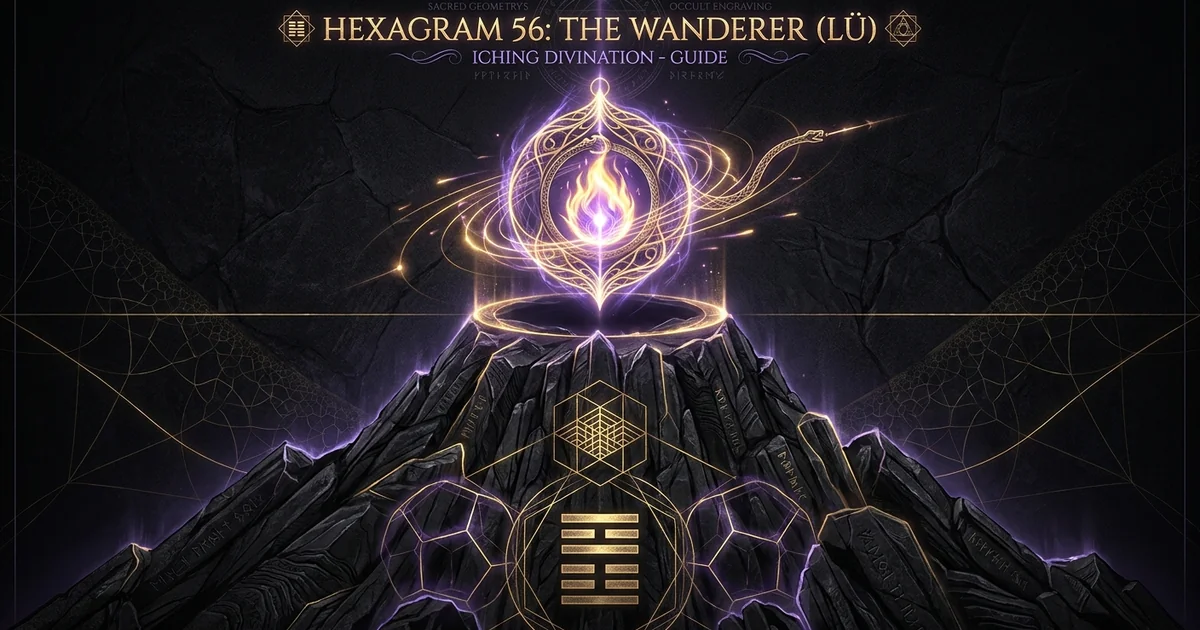
Hexagram 56, designated as Lǚ (The Wanderer), models the thermodynamic, phenomenological, and cybernetic conditions of an open system traversing an unassimilable matrix. Within the psycho-cosmological architecture of the I Ching, this hexagram delineates consciousness severed from its native bio-cultural substrate, compelled to navigate a territory wherein it possesses neither territorial sovereignty nor systemic immunity. The macrocosmic figure of this state is rendered through the elemental juxtaposition of Fire (the trigram trigram-li, ☲) burning upon the immutable exterior of the Mountain (the trigram trigram-gen, ☶). Fire on the Mountain cannot establish permanent dominion; its combustion is an ephemeral event that consumes local fuel before being forced by structural necessity to migrate across the stone ridge. The core archetypal thesis of the lǚ hexagram establishes that survival and operational efficacy in estrangement demand hyper-attunement to environmental vectors, deliberate contraction of the psychic footprint, and absolute submission to the laws of local context.
Thermodynamic Asymmetry of Fire and Earth
The thermodynamic dynamic between upper Li and lower Gen is governed by radical energetic asymmetry. Li is radiant, exergonic, and perpetually dependent upon an external fuel supply (cauda pavonis of combustible material) to maintain its luminous coherence. Gen is endergonic, entropic, immobile, and fundamentally indifferent to the thermal radiation flaring across its surface. In the context of hexagram 56 the wanderer iching meaning, the traveling agent embodies this transient thermal discharge. The wanderer cannot alter the mountain’s topography; any attempt to transfer the mountain’s mass into the flame results in immediate extinction.
Thermodynamically, the wanderer operates as a localized pocket of high negative entropy (negentropy) drifting through a closed macro-environment. Because the traveler cannot extract infinite energy from the host matrix without triggering immune or predatory responses, energy expenditure must be ruthlessly optimized. Dissipation of behavioral energy into unnecessary friction, ideological assertion, or possessive posturing accelerates fuel depletion, precipitating terminal collapse. Survival within this vector requires the agent to function as a steady, self-contained thermodynamic current: casting clear light upon the path while consuming the absolute minimum of environmental biomass.
The Psychology of the Xenite and Uncontained Consciousness
Psychologically, Hexagram 56 marks the complete displacement of the individual ego from the protective containment of the collective unconscious, ancestral lineage, and established sociological architectures. In analytical psychology, this state corresponds to the xenite—the structural foreigner within an alien psychic topology. When the ego detaches from its foundational complexes, it experiences the dizzying autonomy and acute vulnerability of unanchored awareness. Deprived of the default projections and social reinforcements that maintain domestic identity, the ego faces an unmediated encounter with the Objective Psyche.
This psychic condition is frequently shadowed by the unintegrated archetype of the puer-aeternus—the eternal youth whose refusal of earthly limitation manifests as nomadic restlessness and systemic detachment. However, Lǚ does not validate wandering as romanticized liberation; it exposes it as an existential discipline fraught with lethal peril. Consciousness in this state lacks structural insulation. Every sensory input is amplified, and every diplomatic failure carries catastrophic weight. The wanderer cannot rely on institutional leniency or tribal pardon; the host environment judges the stranger strictly by outward behavioral surface and immediate transactional equilibrium.
Cybernetic Feedback in Foreign Contexts
From the perspective of cybernetics and systems theory, Hexagram 56 formalizes the behavioral constraints of an autonomous probe operating within an unfamiliar feedback loop. In native territory, an agent relies on feedforward controls: internalized normative models that accurately predict the environmental response to specific actions. In an alien territory, these predictive models fail. The host system operates on obscure semiotic codes, unspoken cultural parameters, and distinct defensive thresholds. Consequently, the wanderer must pivot from feedforward assertion to rapid, low-amplitude feedback polling.
Direct intervention in foreign systems generates immediate systemic resistance. The cybernetic imperative of Lǚ is therefore non-disruptive observation. The traveler must calibrate its sensory apparatus to detect subtle environmental cues while minimizing its own communicative emissions. The traveler’s presence must not trigger the host system’s homeostatic defense mechanisms. Sovereignty in Hexagram 56 is paradoxical: it is maintained entirely through yielding to local constraints, masking intentionality, and preserving internal clarity (Li) beneath a posture of unshakeable humility and containment (Gen).
Hexagram 55: Feng (Abundance)
- Energetic Vector: Interior expansion, thermodynamic saturation, peak radiance.
- Environmental Posture: Absolute territorial centrality; sovereign domain of the center.
- Structural Architecture: Thunder (
Zhen) beneath Fire (Li); energy bursting outward from an inexhaustible core. - Systemic Risk: Solar eclipse, operational overextension, entropic exhaustion at the zenith.
- Ethical Mandate: To be like the sun at midday; distribute sovereign illumination across the total operational field (see /iching/hexagram-55-feng-abundance).
Hexagram 56: Lǚ (The Wanderer)
- Energetic Vector: Exterior detachment, thermodynamic conservation, peripheral transience.
- Environmental Posture: Complete territorial alienation; peripheral observer at the boundary.
- Structural Architecture: Mountain (
Gen) beneath Fire (Li); luminous combustion drifting along an unyielding surface. - Systemic Risk: Banishment, loss of shelter, violent host retaliation, complete physical ruin.
- Ethical Mandate: To be like a low-intensity brushfire; illuminate local terrain with modesty without attempting permanent settlement.
Classical Provenance & Textual Lineage: Historical Transmission of Lǚ
The historical strata of the book of changes divination tradition trace Hexagram 56 not to abstract metaphysical reflection, but to visceral geopolitical catastrophes of the late Shang and early Zhou transitions. Within the ancestral memory of the Central Plains, the condition of the wanderer was inseparable from displacement, hostage-taking, sacrificial risk, and the total loss of ritual standing. To wander was not to embark upon a pilgrimage; it was to be cast out from the ancestral temple where alone the ancestral spirits could preserve a human life from wandering demons and hostile clans.
King Wen’s Captivity and the King Hai Mythos
The archetypal narrative underlying the imagery of Hexagram 56 preserves the Bronze Age tragedy of King Hai (Wang Hai), the sixth-generation ancestor of the Shang royal lineage. According to the fragmentary accounts in the Tianwen (Questions of Heaven), the Bamboo Annals, and early oracle bone inscriptions, Wang Hai was a master pastoralist who led his extensive herds of cattle and sheep into the northern border territories of the Youyi clan. Stripped of his domestic power base, Wang Hai mistook the fragile hospitality of the Youyi ruler, Mianchen, for permanent security. He indulged in arrogance, conducted an adulterous affair within the foreign court, and flaunted his pastoral wealth.
The consequence of Wang Hai’s failure to recognize his status as a vulnerable guest was immediate and brutal. Mianchen murdered Wang Hai, confiscated his herds, and scattered his entourage. This foundational mythos forms the historical subtext of Hexagram 56: an absolute warning that the traveler who fails to honor the precariousness of foreign soil brings down swift, total destruction. The hexagram’s line progression mirrors this descent, culminating in the terrible imagery of the final line where the traveler’s nest is burned, his cattle are lost through negligence, and his hubristic laughter collapses into terminal lamentation.
The Commentary on the Decision (Tuan Zhuan) and the Great Symbolism (Da Xiang)
The Tuan Zhuan (Commentary on the Decision) grounds the strategic viability of Hexagram 56 in the delicate positioning of its lines: “The Wanderer achieves small success. The flexible gains the middle outside and yields to the strong. Stillness and clinging to clarity: hence small success and perseverance bring good fortune to the wanderer.” The internal structure of the hexagram reveals the six in the fifth place (a yielding, yin line) occupying the central position of the upper trigram Li. By remaining receptive and maintaining balance within the sphere of luminosity, the wanderer navigates the external world without challenging the masculine, structural dominance of the surrounding environment.
“Fire on the mountain: The image of The Wanderer. Thus the superior man is clear-minded and cautious in imposing penalties, and does not protract lawsuits.” — Wilhelm/Baynes (1950), The I Ching or Book of Changes, Bollingen Series XIX.
Tuan Zhuan: “The Wanderer: Small success. The yielding finds the center outside and conforms to the firm. Movement is halted, and clings to clarity; therefore, ‘small success, persistence brings good fortune to the wanderer.’ The meaning of the time of The Wanderer is vast indeed!”
The da-xiang (Great Symbolism) draws an unexpected and penetrating civilizational parallel from the natural image of fire burning swiftly across the mountain: the execution of legal justice and penal administration. The junzi (noble person or superior individual) observes that fire on the mountain does not linger; it illuminates the terrain with absolute clarity, consumes only what is necessary, and passes onward. Therefore, in the governance of human affairs, legal clarity must be executed with swift precision. Punishments must be administered cautiously, and litigation must never be permitted to become a permanent, festering state. Prolonging a lawsuit is the juridical equivalent of attempting to build a permanent fire upon barren rock—it produces nothing but toxic smoke and institutional exhaustion.
Wang Bi’s Ontological Hermeneutics: Politeness as Survival
Writing during the chaotic Three Kingdoms period, the Neo-Daoist philosopher Wang Bi (226–249 CE) stripped the I Ching of the convoluted omenology of the Han dynasty, replacing it with an ontological analysis of positional dynamics and non-being (wu). In his commentary on Lǚ, Wang Bi identified the wanderer’s defining ontological characteristic as the absence of a fixed foundation (wu suo ji). Because the traveler lacks an institutional root, the external world owes the traveler neither support nor mercy.
Wang Bi argues that under such conditions, structural power becomes an impediment rather than an asset. An assertive display of strength by a rootless agent is perceived by the host environment as an existential threat. Therefore, the wanderer’s singular functional shield is the absolute mastery of ritual decorum, situational propriety (Li 禮), and conscious self-effacement. Politeness is not an ornamental social convention in Wang Bi’s hermeneutics; it is an ontological camouflage mechanism. The traveler who remains yielding and respectful defuses the predatory instincts of the host environment, whereas the traveler who attempts to assert dominance within a foreign frame ensures their own physical elimination.
Structural Mechanics & Symbolic Geometry: Anatomy of Li over Gen
Hexagram 56 is composed of two primary trigrams whose elemental vectors point in radically opposing directions, producing an internal tension that characterizes every operational manifestation of the archetype. Below stands trigram-gen (☶, Mountain), the youngest son, whose directional energy is downward, inward, and decisively static. Above stands trigram-li (☲, Fire), the middle daughter, whose energetic trajectory is upward, outward, luminous, and relentlessly mobile.
--- Line 6 (Yang): Top Nine       [Bird burns its nest; weeping follows]
- - Line 5 (Yin):  Six in Fifth    [Shooting a pheasant; arrow lost, fame won]
--- Line 4 (Yang): Nine in Fourth   [Shelter found, ax secured, heart not at rest]
--- Line 3 (Yang): Nine in Third    [Burns down his inn, loses young servant]
- - Line 2 (Yin):  Six in Second   [Finds shelter, keeps property, faithful servant]
- - Line 1 (Yin):  Initial Six     [Trifling with petty concerns; draws calamity]
Nuclear Hexagram Mechanics: The Internal Tension of Dui and Xun
Beneath the outer facade of Fire over Mountain lies a profound structural engine accessible through nuclear hexagram analysis (for foundational principles, see /iching/nuclear-hexagrams-structural-mechanics). The nuclear-hexagram of Hexagram 56 is Hexagram 28, Da Guo (Preponderance of the Great / Critical Mass). This nuclear core is extracted by taking lines 2, 3, and 4 to form the lower nuclear trigram Xun (☴, Wood/Wind), and lines 3, 4, and 5 to form the upper nuclear trigram Dui (☱, Lake/Joy).
The presence of Hexagram 28 at the energetic heart of Hexagram 56 reveals that the condition of the wanderer is intrinsically loaded with structural stress. Da Guo depicts a heavy roof beam sagging to the point of structural failure—a condition where the load exceeds the carrying capacity of the supports. This indicates that beneath the calm, polite movements of the wanderer lies an environment of extreme systemic strain. The traveler possesses no margin for error. A single misstep, an arrogant word, or an administrative delay will snap the structural beam, collapsing the entire enterprise. The internal interplay between nuclear Xun (subtle penetration, adaptation to local winds) and nuclear Dui (affable communication, non-threatening joy) forms the internal software the traveler must run to prevent this catastrophe.
Trigram Vector Dynamics: Upper Li (Clarity/Radiance) vs. Lower Gen (Stillness/Limit)
The macrocosmic interaction between Li and Gen establishes a severe dynamic boundary:
- Upper Li (☲): Fire demands illumination, consciousness, and continuous attachment to an external object. It clings to the mountain, yet it cannot integrate with the mountain. Its movement is volatile and vertical.
- Lower Gen (☶): Mountain embodies the threshold, the barrier, the stopping point. It arrests movement. It represents the indigenous community that stands firm, impenetrable, and closed against the outsider.
The fundamental danger of this geometry is spatial rupture. Fire naturally leaps upward and away from the mountain, leaving the terrestrial ground behind, while the mountain sits in absolute immobility, declining to follow the flame. If the traveler permits their consciousness (Li) to detach completely from the hard reality of local physical limits (Gen), they float into catastrophic illusion. The junzi resolves this tension by holding the fire close to the rock: using luminous awareness to map the boundaries of the mountain without attempting to burn through them.
Six-Line Sequential Vector: From Petty Insolence to Avian Loss
The hexagram moves through an escalating trajectory of social vulnerability, material stabilization, psychological malaise, and final archetypal inflation across its six lines:
Initial Six: The Micro-Vulnerability of Petty Preoccupation
Text: “If the wanderer busies himself with trivial things, he draws down calamity upon himself.” Positioned at the base of the lower trigram Gen, the initial yin line lacks the vision to comprehend the precariousness of foreign transit. Instead of maintaining dignified vigilance, the traveler focuses on petty grievances, bargaining over pennies, or complaining about minor indignities in the host culture. This petty behavioral signature immediately attracts the hostile gaze of predatory forces in the host environment. By signaling low status, narrow consciousness, and isolation, the traveler invites robbery or violence.
Six in the Second Place: The Pragmatic Haven
Text: “The wanderer comes to an inn. He retains his property. He gains the loyalty of a young servant.” Centering the lower trigram, this line achieves correct, yielding balance. The traveler acts with modesty and functional propriety. Consequently, the host environment provides basic shelter (an inn). The traveler secures their personal property through discretion and wins the fidelity of an assistant. This is not a kingdom; it is a stable bivouac. It represents the maximum material success achievable under the laws of transience: safety, logistical equilibrium, and functional human alliance.
Nine in the Third Place: The Hubristic Incineration of Shelter
Text: “The wanderer’s inn burns down. He loses the loyalty of his young servant. Danger.” Standing at the apex of the lower trigram Gen, this strong, overly assertive yang line attempts to project power within an environment that does not belong to it. The traveler treats the temporary inn as a permanent fortress and abuses the hospitality of the host. The energetic friction generates an actual blaze: the traveler burns down his own lodging. Furthermore, through high-handedness, he alienates the local assistant who served as his cultural translator and protector. Isolated, exposed to the elements, and marked as a destructive nuisance, the traveler enters extreme operational peril.
Nine in the Fourth Place: Material Sufficiency with Psychic Estrangement
Text: “The wanderer rests in a shelter. He obtains his property and an ax. My heart is not glad.” Crossing the threshold into the upper trigram Li, the traveler regains material footing. He secures a lodging and finds an ax (fu)—a symbol of practical utility, defensive capability, and the power to make decisive cuts. Yet, despite this security, the text states explicitly: “My heart is not glad” (wo xin bu kuai). The fourth position is an insecure, transitional place. The traveler possesses the physical instruments of survival, but remains acutely aware that he is an outsider. The ax is an instrument of self-defense, reminding him hourly that he lives surrounded by latent violence. Material safety does not resolve ontological homelessness.
Six in the Fifth Place: Sovereign Civility and Cultural Mastery
Text: “He shoots a pheasant. It drops with a single arrow. In the end this brings praise and orders.” Occupying the supreme position of the upper trigram Li, the yielding sixth line demonstrates exceptional cultural grace and tactical precision. The pheasant is the symbol of Li—radiant, colorful, civil, and wild. The wanderer does not slaughter an entire herd through brute force (as King Hai attempted); he brings down a single wild pheasant with supreme economy of motion. He then offers this fine game to the local authorities as an act of diplomatic tribute. By displaying refined skill, modesty, and political respect, the traveler neutralizes suspicion and is awarded honors, diplomatic status, and an official office from the foreign ruler.
Top Nine: The Catastrophe of the Scorched Nest
Text: “The bird’s nest burns up. The wanderer laughs at first, then must weep and wail. Through carelessness he loses his cow. Misfortune.” At the terminal extreme of the hexagram, the fire of Li has risen too high; it has lost all contact with the mountain below. The wanderer experiences radical psychic inflation. Like a bird building its nest in an exposed, fragile treetop, the traveler believes he has achieved permanent elevation above the ground. He laughs arrogantly, forgetting his status as an outsider. The inevitable retribution of natural and social law is total: the nest is consumed by fire. He loses his cow—the symbol of yielding docility, reproductive abundance, and grounded domesticity (the animal of Earth/Kun). His arrogant laughter turns into catastrophic weeping. This line is the direct textual instantiation of the King Hai catastrophe: total dismemberment through carelessness and hubris.
Psychological Dynamics & Operational Praxis: The Archetype of Liminality
When translated into archetypal psychology, Hexagram 56 serves as an operational map for navigating liminal space—the transitional void between dissolved past identities and yet-unformed futures. The human psyche routinely undergoes structural displacement: career terminations, cultural emigration, divorce, psychological crises, or the total collapse of an inherited spiritual paradigm. In such intervals, the individual is stripped of domestic armor and forced onto the road.
Navigating the Puer Aeternus and Compulsive Flight
A primary psychological pitfall governed by the lǚ hexagram is the activation of the ungrounded puer-aeternus. When an individual cannot tolerate the friction, responsibility, and emotional weight of rooted life (the stone of Gen), they frequently romanticize the condition of the wanderer. They construct a persona around transience, pathologically fleeing whenever an environment demands relational commitment or structural accountability.
“When an individual is caught in an archetype, particularly that of the wanderer or the puer aeternus, there is a perpetual evasion of earthly reality. The ego identifies not with the humble traveler who must adapt to the road, but with the divine stranger who is above the local laws. Synchronistic events during such periods cease to be merely guiding signs; they become violently corrective. The unconscious produces an immediate catastrophe—the burning of the nest—to forcefully shatter the illusion of superiority and cast the individual back down onto the indifferent earth.” — Marie-Louise von Franz (1980), On Divination and Synchronicity: The Psychology of Meaningful Chance, Inner City Books.
Hexagram 56 deconstructs this neurosis. The text demonstrates that wandering is not an exalted state of absolute freedom; it is an arduous, high-risk operational vulnerability. The junzi does not wander out of infantile escapism; he wanders because circumstance has mandated transit. While on the road, he does not adopt the chaotic lifestyle of the bohemian; he maintains an even stricter internal discipline, keeping his moral and ethical conduct spotless precisely because he lacks the safety net of home.
The Divinatory Injunction: Small Success Through Correct Restraint
When Hexagram 56 is cast in an authentic consultation within book of changes divination, the Oracle delivers a stark, uncompromising boundary condition: “The Wanderer: small success.” The querent is notified that massive conquests, expansive structural projects, major institutional launches, and aggressive acquisitions are totally off the table. The archetypal climate does not support macro-scale expansion.
The ego must surrender its ambition for imperial dominance. If an entrepreneur receives Hexagram 56, it is not the time to attempt a hostile corporate takeover or deploy massive capital into an untested territory; it is the time to secure modest liquid reserves, build diplomatic alliances through strategic deference, and observe competitor maneuvers from the periphery. If an individual in relational crisis casts 56, it indicates that they are operating as a stranger within the other person’s psychic landscape. Attempting to force emotional intimacy, demand total allegiance, or establish domestic finality will cause the relationship to ignite and collapse, exactly like the inn of the Third Line.
Operational Rules for Consultations and Border Crossings
To navigate an environment governed by Hexagram 56, the practitioner must execute a specific protocol derived from the structural mechanics of the hexagram:
- Strict Decorum and Behavioral Minimalization: Suppress eccentric individualistic expressions. Adopt the formal customs, dress codes, and communication styles of the host environment. Politeness is an operational survival system.
- Suspension of Litigation and Grievance Processing: Abort all legal battles, institutional complaints, and administrative warfare. As the Da Xiang instructs, lawsuits must not be protracted. In a foreign court, the stranger always loses.
- Preservation of Mobile Capital: Convert heavy, immobile investments into liquid, transportable assets. Do not bind psychic or financial energy to real estate that cannot be defended.
- Maintenance of Unbroken Internal Lucidity (Li): Keep the internal perceptual apparatus hyper-alert. Observe without judging; record without intervening. Let awareness remain as sharp as a flame while keeping the bodily presence as tranquil and unyielding as the mountain.
- Readiness to Evacuate: Never mistake a temporary haven for a permanent ancestral home. When the fuel begins to dwindle, or when the host environment exhibits subtle immune rejection, pack the camp and move onward before the inn is set ablaze.
Philosophical Synthesis & Macrocosmic Correspondence: Hermetic Vectors and Cybernetics
The operational mechanics of Hexagram 56 extend beyond the bounds of traditional Sinitic cosmology, intersecting directly with Western esoteric cartography, contemporary human systems design, and the cybernetic physics of information transfer.
- I Ching Coordinate: Hexagram 56 (Lǚ / The Wanderer)
- Trigrammatic Architecture: Fire (
Li, ☲) over Mountain (Gen, ☶) - Nuclear Interior: Hexagram 28 (Da Guo / Preponderance of the Great)
- Human Design Matrix:
gate-56(Gate of Stimulation / The Wanderer), Throat Center (Quarter of Dualism) - Biochemical Genetic Marker: Codon GCC (Alanine / Codon Ring of Seeking)
- Western Astrological Nexus: 00°00’ Leo to 05°37’30" Leo (Solar radiance operating over Fixed Earth/Saturnian thresholds)
- Qabalistic Tree of Life Path: 32nd Path of Tau (Malkuth to Yesod transit: the initial perilous ascent of the traveler out of physical inertia into the astral field)
Human Design Gate 56: The Gate of Stimulation and the Throat Center
In the Rave Mandala of Human Design, Hexagram 56 corresponds directly to gate-56, situated within the Throat Center. Positioned within the Quarter of Dualism, this gate is designated as the Gate of Stimulation: the archetype of the Wanderer and the Storyteller (detailed further in /human-design/throat-center-gates). Mechanically, Gate 56 acts as the throat’s vocalizing conduit for the sensing stream (the 35-36 Channel of Transitoriness and the 11-56 Channel of Curiosity).
The energetic function of Gate 56 is not the preservation of historical dogma, but the verbalization of transient, lived experience. The traveler gathers sensory impressions across the outer world, processes the emotional and perceptual friction of these encounters, and transmutes them into archetypal narratives that stimulate the collective consciousness. Gate 56 does not state: “This is the absolute, unchanging mathematical truth.” Rather, it states: “I walked through the valley, I saw the bird fall, and this is what the journey felt like.” This directly parallels the I Ching hexagram: the wanderer converts the friction between Fire and Mountain into the light of shared wisdom, warning the tribe of external dangers without attempting to drag the whole tribe into the foreign swamp.
Astrological Correspondences: Sagittarius/Scorpio Liminality and Solar-Saturnian Polarities
Astrologically, Hexagram 56 maps conceptually to the severe polarity between Solar radiance (Li) and Saturnian crystallization (Gen). While its seasonal position aligns with the initial degrees of Leo (where the solar fire begins to manifest within the physical plane), its archetypal temperament shares a profound correspondence with the liminal border between late Scorpio and early Sagittarius. It encapsulates the transition from the deep, crisis-driven, structural entrenchment of Scorpio to the nomadic, path-seeking curiosity of Sagittarius.
The Hermetic Principle of Polarity clarifies the functional dynamic of Lǚ:
- The Solar current provides the unyielding light of inner truth, lucidity, self-awareness, and creative expression.
- The Saturnian current establishes the cold reality of the boundary, the mountain wall, the social hierarchy, and the inescapable presence of mortality.
When the traveler operates correctly, they weave these polarities into a functional synthesis: carrying the Solar lamp through the Saturnian labyrinth. When they fail, Saturn crushes the Solar ego for its hubris, leaving nothing behind but the scattered bones of King Hai.
Genetic and Informational Entropy: Transience as Epigenetic Drift
In the context of biogenetics and evolutionary systems biology, Hexagram 56 maps to the codon GCC, coding for the amino acid Alanine within the Codon Ring of Seeking. Alanine is a non-polar, hydrophobic amino acid fundamentally involved in the glucose-alanine cycle, a pathway through which muscle tissue breaks down protein during periods of fasting or extreme exertion, shipping the components to the liver for conversion into usable glucose. This is precisely the biochemical signature of the wanderer: mobilizing internal reserves, operating under caloric conservation, and maintaining metabolic homeostasis while in transit through nutrient-scarce environments.
At the level of informational cybernetics, the wanderer represents an entropy-minimizing probe. When an autonomous software program or biological agent traverses an unfamiliar network, it must avoid altering the system’s global entropy levels. If an agent increases entropy (by generating chaotic noise, rewriting systemic code, or destroying local data structures), the host network’s intrusion detection systems (IDS) immediately flag, quarantine, and eliminate it. The wanderer’s cybernetic imperative is to achieve zero signal impedance. By matching its external frequency to the host system’s carrier wave while processing its own internal data in quiet seclusion, the agent navigates the network without triggering an immunological cascade.
Frequently Asked Questions: Advanced Divinatory and Structural Inquiries
Distinguishing Isolation in Lǚ (56) from Retreat in Tun (33)
A frequent point of structural confusion in deep oracular consultations is the operational distinction between Hexagram 56 (Lǚ, The Wanderer) and Hexagram 33 (Tun, Retreat; see /iching/hexagram-33-tun-retreat). While both hexagrams depict conditions of withdrawal, vulnerability, and non-engagement with dominant hostile forces, their structural mechanics and positional imperatives are fundamentally different.
In Hexagram 33 (Tun), Heaven (Qian) stands over Mountain (Gen). The sovereign agent possesses immense, intrinsic, masculine strength, but observes that the inferior, dark elements are ascending from below (the two yin lines at the base). The noble person executes a deliberate, highly strategic, dignified retreat. They retain their social base, their ancestral lineage, and their interior authority; they withdraw intentionally to preserve their creative power for a future counter-offensive. Retreat is a sovereign tactical choice enacted from a position of latent power.
In Hexagram 56 (Lǚ), by contrast, Fire (Li) stands over Mountain (Gen). The wanderer does not possess intrinsic macro-strength; they are structurally weak and rootless from the very outset. The condition of transience is rarely a strategic option; it is an existential fact imposed by crisis, exile, or structural necessity. In Tun, one retreats back to one’s own fortress; in Lǚ, one has no fortress whatsoever, but must navigate the foreign territory of an alien power. Consequently, Tun permits majestic detachment, whereas Lǚ demands hyper-vigilant etiquette, tactical yielding, and an unceasing awareness of the host’s defensive boundaries.
Handling Top Nine: The Catastrophe of the Burning Nest
The appearance of Top Nine in Hexagram 56 is one of the most severe warnings within the entire sixty-four hexagram corpus. It marks the total psychological or operational collapse of a venture through pride, arrogance, and the loss of situational awareness. When this line changes, it transforms Hexagram 56 into Hexagram 62, Xiao Guo (Preponderance of the Small), indicating that the querent has attempted macro-scale grandiosity precisely when they should have remained strictly within the realm of the small, yielding, and subterranean.
Hexagram 56 (Top Nine Changes)  ----->  Hexagram 62 (Xiao Guo)
  --- (Yang) [Transmutes to Yin]         - - (Yin)  [Upper trigram Zhen]
  - - (Yin)                              - - (Yin)
  --- (Yang)                             --- (Yang)
  --- (Yang)                             --- (Yang)
  - - (Yin)                              - - (Yin)  [Lower trigram Gen]
  - - (Yin)                              - - (Yin)
If Top Nine is received as an active moving line, the following remediations must be executed immediately:
- Radical De-escalation: Abruptly terminate all public displays of success, material wealth, or theoretical superiority. Cancel promotional launches, celebratory announcements, and assertive demands.
- Acceptance of Immediate Losses: If the nest is already burning, do not attempt to salvage the burning twigs; that will result in fatal burns. Abandon the territory, accept the loss of the property or the relationship, and retreat immediately to neutral ground.
- Ego-Dismantling: Engage in rigorous psychological examination to isolate where the puer aeternus or archetypal inflation took control of the personality. The hubristic laughter mentioned in the text must be transmuted into genuine, conscious repentance before the host environment extracts its final penalty.
Strategic Resolution When Hexagram 56 Appears Unchanging
When Hexagram 56 is cast as a static, unchanging hexagram (with no moving lines), the Oracle indicates that the entire field of the inquiry is permanently defined by the archetype of The Wanderer for the duration of the cycle. The situation cannot be transformed into a domestic settlement through effort, persistence, or emotional coercion.
The unchanging nature of Lǚ delivers three structural verdicts:
- The Reality of Non-Belonging: The querent is seeking permanence in an environment where permanence is structurally impossible. If this consultation concerns a career path, the querent will never be fully integrated into the inner core of the company; they will remain an external consultant, an auxiliary agent, or an ideological stranger. The querent must accept this peripheral status and stop exhausting themselves trying to become a permanent member of the local tribe.
- Perpetual Calibration of Conduct: The mandate for modest decorum, quiet observation, and small goals is not a temporary phase—it is the ongoing operational code for the entire situation. Attempting to build an empire or demand ultimate loyalty will immediately shatter the enterprise.
- Cultivation of the Internal Fire: Because external reality refuses to provide a domestic sanctuary, the querent must build the sanctuary entirely within the self. The mountain remains cold stone, but the fire of awareness (Li) can burn with pristine, uncorrupted brilliance, illuminating the journey without requiring the stone to love the flame. The querent must become the centered, self-contained nomad who carries home within their own consciousness, passing through the world with light footfalls, leaving no scars upon the earth, and asking nothing of the road except the clarity to see where it leads. :::