Hexagram 55 Abundance (Fullness) (Fēng): I Ching Divination
Archetypal Thesis & Systemic Paradigm: The Zenithal Paradox of Culmination and Eclipse
Hexagram 55 (Fēng / Abundance) designates the thermodynamic and psycho-cosmological inflection point where energetic culmination inherently triggers entropic descent. Within the structural architecture of the I Ching, this hexagram codifies the paradox of the zenith: that precise threshold where fullness reaches its mathematical maximum and can no longer accumulate without destabilizing the system that generated it. Rather than modeling abundance as a static storehouse, permanent wealth, or an indefinitely sustainable plateau, the internal logic of the Book of Changes formalizes Fēng as a transient, high-velocity condition characterized by the violent convergence of total illumination and sudden obscurity. The hexagram posits that peak systemic throughput is functionally indistinguishable from the onset of crisis, confronting consciousness with the terrifying imperative to act before its operational window collapses.
“The grand plan on which the unconscious life of the psyche is constructed is so totally different from our conscious approach that every peak of psychic attainment carries within it the immediate seed of its opposite. This is the ancient principle of enantiodromia—the inevitable reversal into the opposite—which governs all dynamic systems of energy. When the conscious orientation reaches an absolute zenith without integrating the shadow of its own finitude, the unconscious intervenes to extinguish the light. Abundance, psychologically conceived, is not a resting place; it is a hyper-pressurized state wherein the ego is either tempered through sovereign sacrifice or shattered by inflation.” — Carl Gustav Jung, The Collected Works of C.G. Jung, Vol. 11: Psychology and Religion: West and East (1950).
The Thermodynamics of Peak Energy and Entropic Inevitability
From a non-equilibrium thermodynamic perspective, the systemic paradigm of Hexagram 55 does not represent homeostatic balance, but a dissipative structure operating at maximum capacity. In classical physics, as a system approaches its maximum energetic density, internal friction, heat dissipation, and micro-state turbulence accelerate proportionally. The upper trigram Zhen (Thunder, initiating kinetic force) driving above the lower trigram Li (Fire/Clarity, radiant energy) establishes an explosive conversion of potential luminosity into kinetic manifestation. This thermodynamic surge yields an unsustainable rate of resource expenditure.
In this state, energy cannot be stockpiled; it must be continuously radiated through purposeful action. The illusion that abundance can be preserved as an enduring capital reserve constitutes an ontological failure to comprehend the governing mechanics of Fēng. Energy held at the zenith without a dissipative conduit produces localized systemic overload, manifesting as psychological neurosis, institutional sclerosis, or structural collapse. The thermodynamic vector of Fēng dictates that peak states carry zero latency: the system is compelled to expend its gathered force immediately, accepting that the expenditure itself brings about the close of the epoch of fullness.
The Solar Zenith and the Midday Eclipse Archetype
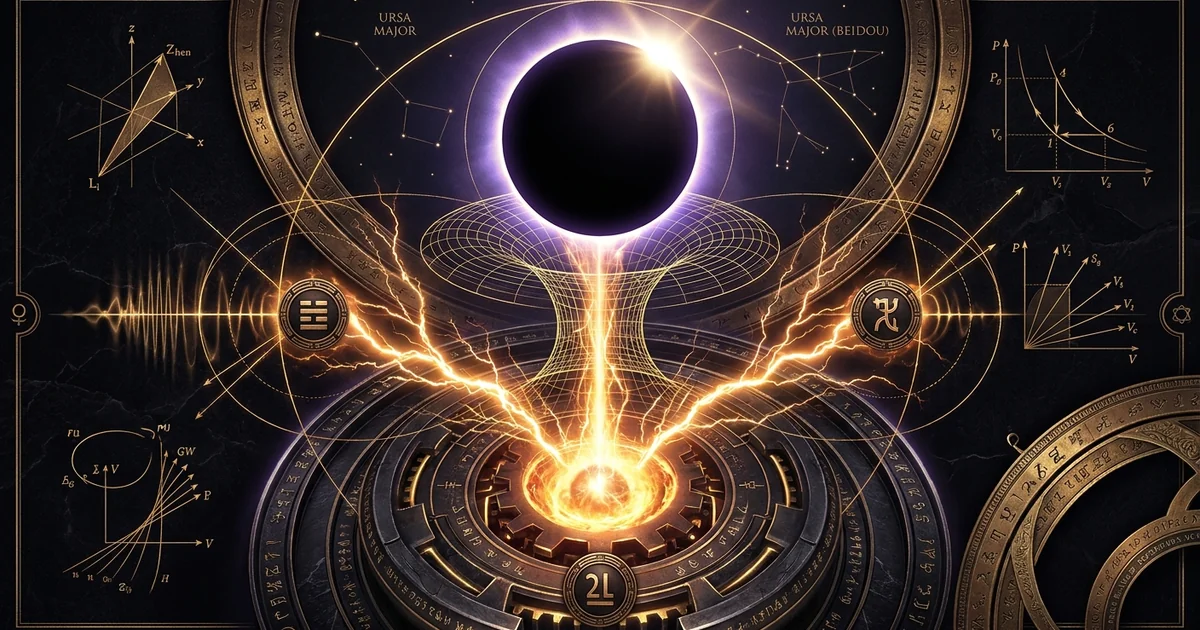
The central astronomical and symbolic motif of Hexagram 55 is the sun at high noon (ri zhong) eclipsed by sudden darkness. At the moment when the solar disc attains its maximum elevation in the sky, shedding unclouded light across the terrestrial plane, a total solar eclipse intervenes, revealing the stars and the Big Dipper in the middle of the day. This astronomical juxtaposition serves as a diagnostic matrix for human consciousness. The midday eclipse demonstrates that supreme clarity and profound blindness are not mutually exclusive conditions, but concurrent realities at the energetic apex.
Under the noon eclipse, the archetype of sovereign omnipotence is severed from naive optimism. The sudden appearance of the northern stellar constellations—traditionally associated with ancestral judgments, the cosmic pivot, and the underworld—within the solar meridian forces the individual to navigate by trans-solar, non-egoic coordinates. The noon sun cannot be preserved; it must decline toward the west. Consequently, the individual situated within the field of Hexagram 55 is forbidden from mourning the dying of the light, but is instructed to enact absolute clarity within the brief interval granted by the alignment.
Cybernetic Feedback: Abundance as Non-Equilibrium Steady State
Within cybernetic theory, Fēng functions as a feedback loop pushed to its outer tolerance margins. The system’s inputs (represented by the internal illumination of Trigram Li) have successfully catalyzed outward executive actions (represented by Trigram Zhen), producing a condition of total informational transparency and organizational potency. Yet, precisely because the feedback loop is running at maximum gain, any attempt to amplify the signal further destabilizes the system through positive feedback runaway.
The systemic lesson of the fēng hexagram is that abundance constitutes a dynamic, non-equilibrium steady state sustained exclusively through movement. The practitioner cannot apply conventional regulatory mechanics designed for scarcity or gradual growth. When the hexagram 55 abundance (fullness) iching meaning is decoded through modern systems analysis, it demonstrates that managing peak states requires radical non-attachment: resources must be distributed, decisions executed, and strategic mandates fulfilled before the inevitable entropic dip. To hesitate at the apex is to invite system-wide obsolescence, transforming the radiant sovereign into the paranoid recluse documented in the hexagram’s ultimate line.
Classical Provenance & Textual Lineage: The Zhou Mobilization and the Eclipse of Feng
The historical architecture embedded within the King Wen sequence of Hexagram 55 is rooted in the pivotal transition from the Shang Dynasty to the Zhou Dynasty in late second-millennium BCE China. Far from presenting a theoretical treatise on metaphysical prosperity, the textual layer of Fēng preserves the emergency field logs and divinatory judgments of King Wu of Zhou as he mobilized his forces at the staging garrison of Feng (丰) immediately prior to the decisive Battle of Muye. The historical Feng was not merely an abstract concept of harvest; it was the fortified geopolitical staging ground constructed by King Wen, where the Zhou state gathered its military alliances, material provisions, and spiritual resolve to challenge the Shang hegemony.
Hexagram Judgment (彖傳 - Tuan Zhuan): 豐:亨,王假之。勿憂,宜日中。 “Abundance means success. The king attains it. Be not sad; be like the sun at midday.” Tuan commentary: 豐,大也。明以動,故豐。「王假之」,由大也。「勿憂,宜日中」,宜照天下也。日中則昃,月盈則食,天地盈虛,與時消息,而況於人乎!況於鬼神乎! “Abundance means greatness. Clarity combined with movement produces abundance. ‘The king attains it’: he makes it great. ‘Be not sad; be like the sun at midday’: it is fitting to shed light on the whole world. When the sun stands at midday, it begins to set; when the moon is full, it begins to wane. The fullness and emptiness of heaven and earth wax and wane according to the seasons—how much more so is this true of man, how much more of the spiritual beings!”
The Great Image (大象傳 - Da Xiang): 雷電皆至,豐;君子以折獄致刑。 “Thunder and lightning both come: the image of Abundance. Thus the superior man decides lawsuits and carries out punishments.” — Translated in Richard Wilhelm and Cary F. Baynes, The I Ching or Book of Changes (1950).
Historical Topography: King Wu, the Capital of Feng, and the Mandate of Heaven
The historical topography of Feng situates the inquirer within a moment of supreme geopolitical peril. Following the death of King Wen, his son King Wu assumed command of a precarious coalition of western tribes. The Zhou military machine had converged on Feng, fully aware that a confrontation with the Shang armies would result either in total dynastic ascendancy or complete annihilation. The Mandate of Heaven (Tianming) was not a static certification of divine favor, but a dynamic, terrifying burden requiring total human alignment.
At this historical junction, the term Fēng denoted the physical fullness of grain, armaments, and conscripts, but it simultaneously designated the overwhelming existential gravity of the enterprise. King Wu stood at the precipice: the reserves of the Zhou state were entirely committed to the field. There was no reserve army, no secondary capital to retreat to, and no surplus margin for strategic error. Fullness, in the context of the Zhou mobilization, meant that the historical arc had reached maximum tension. Every grain of rice, every bronze dagger-axe, and every human life had been channeled into a single, unrepeatable kinetic trajectory.
Exegetical Decipherment: Astronomical Alignment of 1070 BCE at Muye
The cryptic line verses of Hexagram 55—specifically those detailing the canopy of darkness, the sighting of the Big Dipper at midday (ri zhong jian dou), and the snapping of the warrior’s right arm—have been deciphered through archaeoastronomical research. David W. Pankenier’s groundbreaking studies on Shang and Western Zhou chronology demonstrate that the King Wen sequence reflects a literal celestial omen: a total or near-total solar eclipse that coincided with the mobilization of the Zhou forces in the late eleventh century BCE.
Pankenier Celestial Ephemeris (Midday Alignment during Zhou Campaign):
[ Solar Meridian: 12:00 Hours ] -> [ Total Solar Eclipse Occurs ]
                                      ↓
[ Sudden Umbral Obscurity ] ------> [ Asterism Visible: The Northern Dipper (Dou) ]
                                      ↓
[ Terrifying Celestial Omen ] ----> [ King Wu Reinterprets as Cosmic Mandate ]
When the sun was extinguished at noon, the Northern Dipper—the celestial throne of the supreme deity Shangdi—became visible in the darkened sky. To a Bronze Age military host, this was an omen of catastrophic proportions, suggesting that Heaven was withdrawing its light from the terrestrial ruler. Yet King Wu, acting as the quintessential sovereign of Fēng, transfigured the omen.
Rather than succumbing to dread or aborting the military advance, he interpreted the appearance of the Dipper at noon as the direct, unveiled gaze of Heaven overseeing the destruction of Shang tyranny. The broken right arm mentioned in the third line mirrors the physical trauma and command breakdown sustained under the shadow of the eclipse, emphasizing that sovereign action must proceed even when the instrument of execution is fractured and external clarity is veiled.
The Judgment and the Great Image: Sovereign Equanimity in the Noon Sun
The Judgment of Hexagram 55 articulates the psychological stance demanded by this convergence: “Be not sad; be like the sun at midday.” The classical commentary of Wang Bi highlights that sadness (you) is the instinctual reaction of the fragmented ego to the realization that the zenith implies the descent. Ordinary consciousness laments the high-water mark because it recognizes that every step forward leads away from peak luminescence toward the shadows of afternoon.
Wang Bi asserts that the true sovereign models the sun at its zenith precisely by shedding light unconditionally, fully aware that the descent is inevitable. The sovereign acts with radical equanimity, refusing to arrest the cyclic mechanics of time.
The Great Image complements this solar posture through the martial metaphor of jurisprudence: “Thunder and lightning both come: the image of Abundance. Thus the superior man decides lawsuits and carries out punishments.” Lightning (Li) illuminates the underlying truth of legal transgressions with absolute clarity, while thunder (Zhen) executes the sentence with decisive kinetic force.
In classical Chinese statecraft, capital punishments and major judicial verdicts were executed only when the cosmological season was aligned with energetic culmination. Under Fēng, illumination without executive force is weak sentimentality; executive force without illumination is blind brutality. Abundance demands the simultaneous presence of unsparing insight and immediate, irrevocable execution.
Structural Mechanics & Symbolic Geometry: Trigram Vectors, Nuclear Cores, and Line Morphology
The structural geometry of Hexagram 55 consists of the upper trigram Zhen (震, The Arousing / Thunder) situated above the lower trigram Li (離, The Clinging / Fire). This specific topological arrangement establishes a dynamic vector field characterized by kinetic eruption emerging directly out of internal luminosity. The internal fire does not remain contemplative or self-reflective; it charges the atmosphere, building the electrostatic tension that discharges as thunder across the landscape. The polarity between clarity within and movement without defines the functional mechanics of this hexagram in Book of Changes divination.
Trigram Vector Field: Zhen (Thunder) Mobilizing Over Li (Clarity)
In the trigram mechanics of Fēng, the relation of Zhen over Li demonstrates that external motion is legitimate only when guided by inward lucidity. Li is the eye, the flame, the capacity to perceive the subtle filaments of cause and effect. Zhen is the foot, the shockwave, the physical manifestation of political or psychological will. When fire burns beneath thunder, the resultant energy is atmospheric, crackling with explosive potential.
Trigram Field Interaction:
Upper Trigram:  ZHEN  ☳  (Movement, Thunder, Shock, Wood)
Lower Trigram:  LI    ☲  (Clarity, Light, Fire, Consciousness)
Vector Realization: Clarity recognizes the historical threshold;
                   Thunder executes the physical mobilization.
If the trigrams were reversed—yielding Hexagram 21 (Shi He / Biting Through: Thunder below, Fire above)—the motion would be directed inward to crush an obstruction. In Hexagram 55, the clarity is already established at the systemic core, requiring outward, centrifugal expansion. The system does not need to analyze itself further; it must project its realized truth into the material sphere through rapid, definitive strokes.
Nuclear Architecture: Hexagram 28 (Da Guo) as the Hidden Structural Strain
The structural vulnerability of Hexagram 55 is laid bare by its nuclear hexagram. The core lines of Fēng—lines 2, 3, 4, and 5—generate the nuclear trigrams Sun (☴ Wind/Wood) below and Dui (☱ Lake/Metal) above. Interlocking these configurations yields Nuclear Hexagram 28 (Da Guo / Preponderance of the Great).
Hexagram 55: Line Array           Nuclear Extraction:
Line 6:  --- (Yin)
Line 5:  --- (Yin) ------------> Upper Nuclear Trigram: Dui ☱ (Lines 3, 4, 5)
Line 4:  ——— (Yang) ----------->
Line 3:  ——— (Yang) -----------> Lower Nuclear Trigram: Sun ☴ (Lines 2, 3, 4)
Line 2:  --- (Yin) ------------>
Line 1:  ——— (Yang)
Resulting Nuclear Core: Hexagram 28 (Da Guo - The Ridgepole Bends Under Weight)
Hexagram 28 embodies the architectural metaphor of the structural beam bending under excessive load. Its presence at the heart of Fēng proves that the outward glory of abundance masks an acute engineering crisis. The system carries more weight than its internal scaffolding was designed to support indefinitely. The sovereign, institutional, or psychological apparatus operating under Fēng is functioning under immense load-bearing strain. The abundance is so dense that without immediate dissipation, the metaphorical ridgepole will snap. This structural reality reframes the entire hexagram: abundance is not a leisurely paradise, but a high-risk structural emergency where the load must be redistributed before catastrophic fatigue failure occurs.
Morphological Descent: The Six Line Trajectories from Alliance to Paranoia
The six lines of Hexagram 55 map a rigorous narrative trajectory documenting the evolution, crisis, and degradation of peak states. The progression moves from horizontal parity to perceptual eclipse, culminating in an arrogant refusal to engage the cyclic nature of reality.
Line Morphology Spectrum of Hexagram 55:
[Line 6] Yin: Narcissistic Isolation | The Overgrown Mansion | Terminal Paranoia
[Line 5] Yin: Sovereign Attainment  | Gathering Brilliant Counsel | Auspicious
[Line 4] Yang: Twilight Interregnum | Sighting the Dipper | Meeting the Equal Lord
[Line 3] Yang: The Midday Eclipse   | Broken Right Arm | Structural Incapacitation
[Line 2] Yin: The Curtain of Foam   | Stars Seen at Noon | Suspicion and Trust
[Line 1] Yang: Initial Synthesis    | The Equal Ruler | Ten Days of Action
-
Line 1 (Initial Yang): Positioned at the base of clarity, this line encounters its equal partner (the Yang at Line 4). It represents the initial mobilization of resources where parity and mutual recognition enable rapid, unhindered execution: “When one meets his ruler and partner, though they be together for ten days, there is no blame.” Here, abundance is nascent, operational velocity is high, and the structural load has not yet begun to warp the system.
-
Line 2 (Second Yin): Occupying the central position of the lower trigram of clarity, this line is trapped beneath the gathering obscuration: “The screen of foam is so large that the Northern Dipper is seen at midday. Going forward brings doubt and hate.” The light is occluded by the gathering storm clouds of the eclipse. The individual is misunderstood by the upper hierarchy. Rather than forcing outward manifestation, the practitioner must preserve internal truth (zhong xin), relying on character rather than self-justification to dissolve administrative paranoia.
-
Line 3 (Third Yang): Located at the culmination of the lower trigram Li, this line marks the absolute crisis of the eclipse: “The banner of abundance is set up so high that the small stars are seen at midday. His right arm is broken. No blame.” The obscurity is so total that even the minor stars are visible. The breaking of the right arm signifies the loss of the capacity for physical action. This is the zero-point of agency: the system is inundated by circumstances beyond its control, and the only viable course is to endure without generating karmic retaliation.
-
Line 4 (Fourth Yang): Transitioning into the upper trigram of kinetic action, this line emerges from the darkest phase of the eclipse: “The curtain of foam is so large that the Northern Dipper is seen at midday. He meets his equal lord. Good fortune.” While the obscurity lingers, the light begins to return. The Yang energy re-establishes contact with the initial line, mobilizing equivalent forces to overcome the structural deadlock of the crisis. Action becomes possible again, provided it is undertaken with true spiritual equals.
-
Line 5 (Fifth Yin): Occupying the sovereign seat of the hexagram, this Yin line exhibits open, receptive leadership: “Brilliance is brought near. Lines of blessing and fame arrive. Auspicious.” By remaining pliable and recognizing its own systemic limitations, the fifth line gathers wise, capable, and luminous agents into its service. It does not attempt to embody the light through personal ego; instead, it provides the sovereign clearing within which collective brilliance can manifest, successfully steering the state through the high-load threshold of the nuclear core.
-
Line 6 (Top Yin): Situated at the outer terminus of abundance, this line exemplifies the catastrophic inversion of the archetype: “His house is in a state of abundance. He screens off his family. He peers through the gate and sees no one. For three years he sees nobody. Misfortune.” The individual attempts to hoard the abundance that should have been poured out into the collective. The result is total psychological alienation, a self-constructed fortress that becomes a tomb, and absolute perceptual blindness. The peak of abundance, perverted into self-absorbed preservation, curdles into spiritual death.
Psychological Dynamics & Operational Praxis: Navigating Peak States and Mitigating Inflation
In psychological consultations utilizing the Book of Changes, Hexagram 55 serves as an urgent diagnostic indicator of energetic inflation, structural exhaustion, or imminent systemic reversal. The encounter with Fēng marks an ego-Self alignment that is both dangerous and transformative. When an individual or organization reaches the peak of their creative, financial, or political capacity, the archetypal field of Abundance is activated. The critical operational failure in this terrain lies in mistaking the energetic crest for a permanent personal attribute rather than a cosmic transit.
Hexagram 55 (Fēng / Abundance)
Trigram Composition: Zhen (Thunder) over Li (Fire). Dynamic Quality: Kinetic dissipation, acute transience, high-entropy throughput. Phenomenological Reality: The sudden lightning storm at high noon; the solar eclipse. Load Architecture: Nuclear 28 (Da Guo); internal beams bending under extreme pressure. Strategic Imperative: Zero-latency execution; distribute all capital immediately; do not hold. Shadow Risk: Manic hoarding, defensive paranoia, walled-off isolation (Line 6).
Hexagram 14 (Da You / Possession in Great Measure)
Trigram Composition: Li (Fire) over Qian (Heaven). Dynamic Quality: Stable containment, steady-state radiance, solar equilibrium. Phenomenological Reality: The sun shining unobstructed in the boundless vault of the sky. Load Architecture: Nuclear 43 (Kuai); decisive outward breakthrough without structural fatigue. Strategic Imperative: Centralized stewardship; align resources with universal virtue; steady accumulation. Shadow Risk: Pompous complacency, underestimating external entropic decay.
The Enantiodromic Threshold: Differentiating True Abundance from Manic Compensation
Within analytical psychology, the encounter with Hexagram 55 represents the immediate threshold of an enantiodromic reversal. The psyche operates under principles of dynamic compensation. When the conscious ego inflates itself by identifying with the archetype of the cornucopia, the unconscious inevitably activates the shadow: the eclipse, the broken arm, the terrifying isolation of the empty house. True abundance differs from manic compensation by its radical acceptance of limits.
The manic ego attempts to deny the coming night by doubling down on kinetic agitation—multiplying projects, expenditures, and public demonstrations of power. This is the neurotic misinterpretation of Trigram Zhen. The individual generates a hyperactive frenzy of movement to outrun the underlying dread of energetic depletion. True abundance, grounded in the clarity of Trigram Li, recognizes that the peak is already the beginning of the descent. It does not panic; it does not accelerate out of fear. Instead, it utilizes the concentrated power of the zenith to execute whatever decisive act of justice, psychic integration, or material distribution is required to complete the cycle cleanly.
Hermeneutic Diagnosis: Line 6 as Narcissistic Isolation and Psychic Fortress
The tragic culmination of the hexagram in its top line provides an uncompromising portrait of narcissistic decompensation. In clinical application, Line 6 depicts the individual who, having acquired supreme material, intellectual, or psychic capital, turns inward to defend it against an imagined hostile world. The house is opulent, but it is curtained off from human contact. The individual looks out through the cracks of their private fortification, perceiving only enemies, usurpers, and shadows.
The Paranoic Inversion of Peak Capital:
[ Abundance Accumulated ]
         ↓ (Refusal to Distribute / Hoarding Defense)
[ Construction of the Psychological Fortress (Curtaining the House) ]
         ↓ (Perceptual Severance from Objective Feedback Loops)
[ Complete Social and Relational Erasure ("For Three Years He Sees Nobody") ]
         ↓
[ Terminal Misfortune (Psychotic Sclerosis / Spiritual Mummification) ]
This top-line morphology demonstrates that hoarding at the zenith is structurally synonymous with self-annihilation. The walls erected to protect the accumulated fortune inevitably become the walls of an inescapable prison. For three years—symbolizing a complete developmental cycle of time—the reclusive sovereign remains frozen in suspicion. The hermeneutic diagnosis for Line 6 is unambiguous: the refusal to pour out the contents of the vessel causes the contents to rot, poisoning the vessel itself.
Operational Protocol: Strategic Deployment of Resources Under Temporal Compression
When Hexagram 55 is derived in strategic divination, the operational directive is clear: act with extreme velocity, ruthlessly eliminate ambiguity, and disperse resources before the window of opportunity closes. The presence of Fēng confirms that conditions will not improve beyond their current state; the apex has already been achieved.
The practitioner must initiate what military strategists describe as resource dissipation through decisive maneuver. Financial investments must be liquidated or deployed into durable infrastructure; administrative conflicts must be adjudicated through clear, final verdicts; personal projects must be brought to market or manifested in physical form without endlessly revising the conceptual design.
The practitioner must abandon the luxury of contemplative hesitation. The advice to “be not sad; be like the sun at midday” requires the querent to look upon the impending sunset not as a personal tragedy, but as a cosmologically mandated transition. By illuminating the entirety of the current operational field through non-attached, generous, and forceful action, the actor transforms temporal abundance into lasting historical or spiritual reality.
Philosophical Synthesis & Macrocosmic Correspondence: Hermetic Axioms, Codons, and Astrological Decans
The archetypal structure of Hexagram 55 extends far beyond the borders of early Chinese divination, finding direct resonance within Western esoteric cartography, transpersonal genetics, and the Hermetic arts. Across these disparate traditions, the core paradox of Fēng remains invariant: the peak of manifestation represents the fulcrum of its own dissolution, and only those who align their consciousness with the trans-temporal axis can navigate the swing of the cosmic pendulum without being crushed by its momentum.
- Trigram Signature: Zhen (Upper: Thunder) over Li (Lower: Fire) — Atmospheric Discharge over Lucid Ground.
- Nuclear Hexagram: Hexagram 28 (Da Guo / Preponderance of the Great) — Critical Structural Fatigue.
- Astrological Decan: Sagittarius III (approx. 20° to 30° Sagittarius) — Jupiter/Saturn Dialectic of Culminating Expansion confronting Structural Boundary.
- Tarot Arcana: The Ten of Wands (Lord of Oppression) — The Crushing Weight of Consummated Labor.
- Human Design Gate: Gate 55 (Gate of Spirit / The Abundance of Feeling) — Solar Plexus Center.
- Genetic Codon: Histidine (Codons: CAU, CAC) — Biochemical catalyst for cellular repair and proton transfer under metabolic stress.
- Kabbalistic Vector: Path 27 (Peh / The Tower) bridging Netzach to Hod — The shattering of the ego’s fortress under divine lightning.
Hermetic Principle of Rhythm: The Cosmogonic Pendulum of Waxing and Waning
In the Kybalion, the Hermetic Axiom of Rhythm articulates the fundamental law governing Hexagram 55: “Everything flows, out and in; everything has its tides; all things rise and fall; the pendulum-swing manifests in everything; the measure of the swing to the right is the measure of the swing to the left; rhythm compensates.” Fēng represents the precise apex of the pendulum’s swing to the right. The exegesis of the Tuan Zhuan explicitly mirrors this Hermetic truth: “When the sun stands at midday, it begins to set; when the moon is full, it begins to wane. The fullness and emptiness of heaven and earth wax and wane according to the seasons.”
The Hermetic practitioner, however, does not submit blindly to the mechanical swing of the pendulum. Through the art of Mental Transmutation, the initiate achieves the Hermetic Law of Neutralization: by polarizing consciousness upon the higher Mental plane, the practitioner rises above the unconscious swing of the pendulum.
In the operational praxis of Fēng, this translates into sovereign detachment. The actor refuses to identify with the crest of the wave. By maintaining an internal center of gravity within the unmoving Tao (the solar essence) rather than the temporal circumstances of success (the noon hour), the adept observes the waxing and waning of life with total equanimity, transmuting worldly abundance into spiritual continuity.
Biochemical and Genetic Parallelism: Gate 55, Histidine, and the Solar Plexus Mutation
Within the genetic and archetypal cartography of the Human Design System and the Gene Keys, Hexagram 55 corresponds directly to Gate 55 (The Gate of Spirit), located within the Solar Plexus Center. In this system, Gate 55 is designated as the primary site of an evolutionary genetic mutation governing human emotional consciousness. The movement of this gate traces a profound trajectory: from the shadow of victimhood and scarcity, through the gift of emotional freedom, to the siddhi of divine spirit.
Biochemically, Gate 55 maps to the amino acid Histidine, which plays a pivotal role in enzymatic catalytic reactions, cellular repair, and the regulation of metabolic inflammation. Histidine is capable of acting as both a proton donor and a proton acceptor, mirroring the dual nature of Fēng: the capacity to both absorb and discharge immense energetic payloads under acute systemic stress.
The psychological pathology of Gate 55 mirrors the sixth line of the hexagram: an intense emotional melancholy resulting from the mistaken belief that abundance is a material state rather than an internal quality of spirit. The mutation of Gate 55 demands that consciousness cease seeking fulfillment through external material hoarding, discovering instead that true abundance is the unconditioned presence of the human spirit moving effortlessly through both feast and famine.
Astrological Decans and Tarot Parallels: Jupiter in Sagittarius and the Ten of Wands
In Western astrological and hermetic tarot traditions, the thematic core of Hexagram 55 is reflected in the third decan of Sagittarius, governed by Saturn, and represented in the Minor Arcana by the Ten of Wands. Known traditionally as the “Lord of Oppression,” the Ten of Wands depicts a figure bent double under the agonizing weight of carrying ten heavy wooden staffs toward an illustrious city situated in the distance. The harvest has been gathered, the enterprise has succeeded, the accumulation is complete—and the result is almost intolerable physical and psychological strain.
Archetypal Convergence: Fēng and the Ten of Wands:
[ Culmination of Wands / Fire ] ---> [ Maximum Output Achieved ]
                                            ↓
[ Nuclear Hexagram 28 (Da Guo) ] --> [ Structural Fatigue: The Burden of Harvest ]
                                            ↓
[ The Solar Eclipse at Noon ] -----> [ Navigation under Severe Load Constraints ]
                                            ↓
[ Sovereign Resolution ] ----------> [ Final Delivery / Conscious Release of Burden ]
The Ten of Wands encapsulates the paradox of Fēng: the labor of acquisition has transmuted into the burden of transport. The ten wands are not the weapons of warfare, but the harvested timber of past victories. In Sagittarius III, the boundless, expansive vision of Jupiter encounters the rigid, crystallizing boundary of Saturn. The individual cannot sustain this load indefinitely; the threshold of the city gates demands the immediate放下 (fangxia—laying down) of the burden. To carry the wands beyond the gate is to collapse beneath their weight. Hexagram 55 commands the querent to bring the enterprise across the finish line and immediately lay down the load, liberating consciousness from the crushing density of its own worldly success.
Frequently Asked Questions: Resolving Classical Exegetical and Divinatory Paradoxes
Why Does an Omen of Abundance Contain Threatening Imagery of Darkness and Broken Arms?
The presence of catastrophic omens—curtains of foam, the Northern Dipper appearing at noon, and the fracturing of the right arm—within a hexagram titled “Abundance” is one of the most celebrated exegetical problems in the I Ching. The paradox dissolves once it is understood that the Book of Changes does not operate according to simplistic, sentimental models of good and bad fortune. Fēng does not represent safe, comfortable domestic prosperity, but the supreme historical crisis that occurs when human endeavors reach their terminal capacity.
The darkness depicted in lines 2, 3, and 4 is the direct phenomenological consequence of the solar eclipse. Cosmologically, the eclipse reveals that when light reaches its absolute apex, the cosmic framework introduces a counterbalancing obscurity to prevent systemic stagnation. The broken right arm represents the sudden, temporary severance of conventional executive power.
Under the conditions of Fēng, external circumstances are moving with such violent velocity that ordinary ego-driven manipulation is rendered useless. The oracle warns that abundance is an intensely pressurized state: when entering the eye of the historical hurricane, the querent must expect their established methods of control to break, requiring them to navigate by internal alignment with the Mandate of Heaven rather than relying on unhindered brute force.
What Does It Mean Pragmatically to ‘Be Like the Sun at Noon’?
The admonition in the Judgment—“Be not sad; be like the sun at midday”—functions as an operational protocol for psychic hygiene during periods of major success. The human ego, when confronted with the culmination of its desires, instinctually clings to the moment, seeking to arrest time and preserve the harvest forever. This grasping generates profound, debilitating sadness (you), because the ego intuitively perceives that the afternoon shadow is already lengthening.
To be like the sun at noon requires two psychological maneuvers:
- Unconditional Radiance: The sun at midday does not withhold its rays, hoard its heat, or select which objects deserve illumination. It burns at maximum output because that is its essential nature. Pragmatically, the querent is instructed to execute their projects, distribute their resources, and express their vision without calculating personal preservation or attempting to hoard their advantage.
- Radical Acceptance of Transience: The sun does not pause at the meridian out of fear of the western horizon. It reaches the zenith and immediately accepts the journey downward. To be like the noon sun means to inhabit peak capacity without attachment to its permanence. The individual acts decisively in the present hour, fully liberated from the desperate neurosis of trying to freeze an unrepeatable golden moment.
How Should an Unchanging Hexagram 55 Be Interpreted in Modern Strategic Divination?
When Hexagram 55 appears as a static casting without moving lines, it presents a stark diagnostic portrait of a system balanced precariously on the razor’s edge of the peak. An unchanging Fēng indicates that the querent or their organization has attained total structural capacity. Every available resource is deployed, the maximum permissible load is resting upon the organizational scaffolding, and the operational window is opening to its widest extent.
In practical strategy, an unchanging Hexagram 55 issues a severe mandate:
- Zero Growth Mandate: Cease all efforts aimed at further systemic expansion. The system cannot hold more territory, capital, or responsibility without snapping the nuclear ridgepole (Hexagram 28). The objective now is execution and distribution, not acquisition.
- Immediate Dispersion: Capital, authority, and creative output must be released outward immediately. If the casting concerns a legal, intellectual, or business dispute, deliver the final judgment, release the product, or conclude the negotiations without lingering.
- Prepare for Structural Realignment: Recognize that the present level of high-intensity throughput will dissipate swiftly. The unchanging hexagram warns that remaining stationary is impossible: if the querent does not consciously spend the gathered energy through deliberate, sovereign channels, the impending downshift will be enforced catastrophically through system fatigue, market reversal, or psychological collapse. Act now, without hesitation, while the sun occupies the high meridian of your endeavor. :::