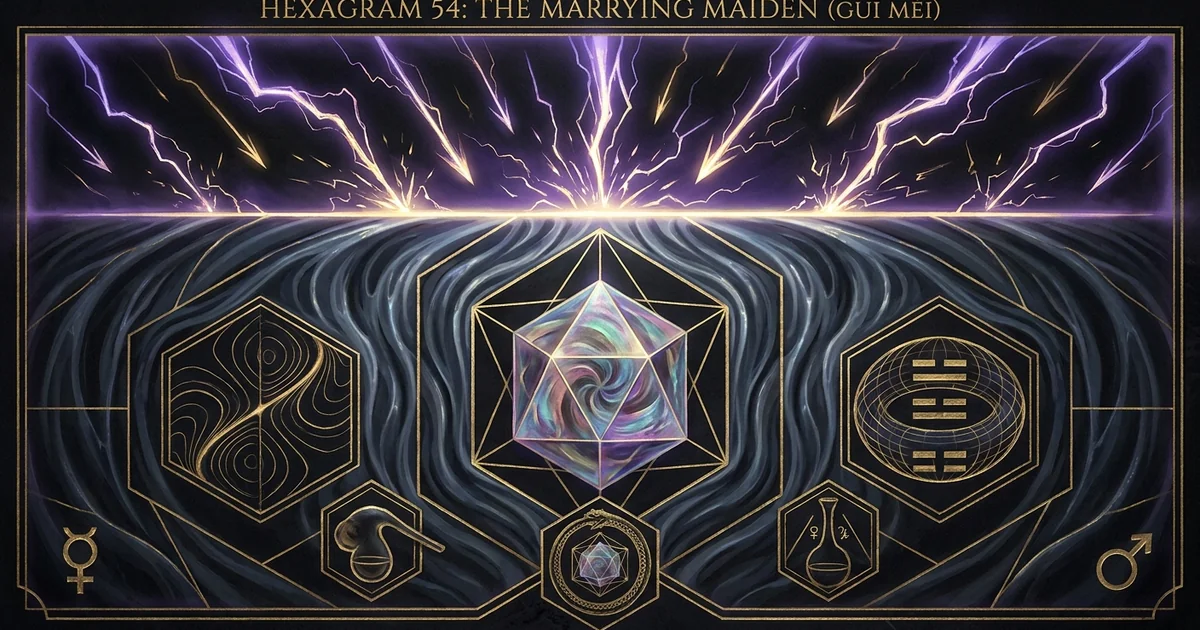
Hexagram 54 The Marrying Maiden (Guī Mèi): I Ching
Archetypal Thesis & Systemic Paradigm: The Mechanics of Asymmetric Agency
Hexagram 54 (Guī Mèi / The Marrying Maiden) delineates an ontological state-space within the Zhouyi where an acting subject enters an operational matrix governed by pre-existing, non-negotiable systemic constraints. Within this structural paradigm, unilateral agency is functionally impotent. Rather than merely reflecting historical sociology or cultural fatalism, the vector of Thunder over Lake (Zhèn over Duì) models the precise thermodynamics of secondary positioning. It formalizes an energetic impasse where the instinctual impulse toward movement is catalyzed by affective resonance or desire, yet lacks the legal, structural, or energetic sovereignty required to dictate terms. The hexagram operates as an initiatory crucible: egoic volition is subordinated to systemic architecture, establishing the exact boundary conditions between autonomous action and structural assimilation.
Vector Mechanics of Thunder Over Lake: The Kinetic Imbalance
The binary architecture of Hexagram 54 generates an immediate kinetic friction through its constituent gua-trigram-polarity. The lower trigram, Duì (Lake / The Joyous / Youngest Daughter), represents open, receptive permeability, affective engagement, and instinctual pleasure. Above it sits Zhèn (Thunder / The Arousing / Eldest Son), the principle of sudden movement, electrical discharge, and forward-surging initiative. When Thunder resides above Lake, kinetic force is aroused directly through affective enticement: movement is stimulated not by deliberate strategic foresight, but by an emotional or relational trigger. This creates a severe vector asymmetry. The elder male follows the impulse initiated by the younger female, inverting the traditional Zhou dynamic of structural precedence.
In systemic terms, the initiation of movement (Zhèn) over an emotionally permeable substrate (Duì) leads to premature systemic mobilization. The energy surges forward before the macrocosmic container is prepared to receive it. In classical mechanics, this is analogous to applying sudden torque to an unanchored drive shaft: the rotational energy cannot be translated into stable forward locomotion and instead threatens to tear the mechanical housing apart. The Zhèn trigram possesses immense momentum, but because its base in Duì lacks sovereign authority, the resulting movement remains erratic, destabilized, and exposed to external friction. The system experiences a critical vector imbalance wherein the velocity of engagement wildly outpaces the agent’s structural standing.
The Paradigm of the Subordinate Operant in Constrained Systems
In stark opposition to the harmonious, sequential protocol modeled in /iching/hexagram-53-jian-gradual-progress, Guī Mèi models the condition of the subordinate operant. The agent finds themselves embedded within an established institutional matrix whose hierarchy, rules of engagement, and distributions of capital were codified long before their arrival. The historical paradigm of the concubine, or secondary bride (mèi), serves as the sociopolitical baseline: she enters the patriarchal household solely to perpetuate the lineage, possessing responsibilities without commensurate legal autonomy. Her standing is entirely contingent upon the favor of the primary wife and the lord of the house.
Transposed into organizational behavior and field theory, this configuration arises whenever an operative, dynamic asset or specialized complex is assimilated into an entrenched apparatus—be it a corporate monopoly, a multi-generational institutional apparatus, or an overarching collective mythos. The subordinate operant cannot appeal to abstract notions of egalitarian fairness; the system’s homeostatic mechanisms are inherently calibrated to preserve established asymmetries. Any unilateral attempt to enforce one’s will, modify operational protocol, or demand primary recognition elicits an immediate immune response from the host architecture. Agency within Hexagram 54 is therefore not extinguished, but radically redefined as the art of operating without sovereign leverage.
Ego-Dissolution as an Adaptational Survival Strategy
The psychic and spiritual challenge presented by Guī Mèi is the mandatory surrender of proprietary egoic teleology. In Western individuated paradigms, agency is classically equated with mastery, territorial acquisition, and self-assertion. Hexagram 54 systematically exposes this conceptualization as an adaptational hazard when applied to asymmetric field states. When encountering the Zhèn-Duì dynamic, attempting to assert the primacy of the individual ego against the systemic baseline triggers an escalated counter-entropic force, resulting in psychic castration or systemic expulsion.
The mandate here is conscious subjugation: an intentional, calculated ego-dissolution. This is distinct from passive resignation or pathological masochism. Instead, it constitutes a deliberate tactical retreat, where the operant disidentifies from the illusion of executive control to preserve essential viability. By consciously accepting a secondary, tertiary, or purely supportive coordinate position, the agent neutralizes the systemic immune response. The operant shifts from a disruptive, foreign body into an indispensable systemic component, mastering the environment from below through flawless adherence to external protocol.
Hexagram 53: Jiàn (Gradual Progress)
- Trigram Geometry: Sun (Wind/Wood) over Gèn (Mountain). Upper gentle penetration rooted in lower impenetrable stillness.
- Teleological Vector: Orderly, ritualized assimilation occurring along an evolutionary temporal gradient; social sanctions fully aligned.
- Agency Metrics: Sovereign, measured progression. The initiate commands absolute legitimacy and ritual validation at every threshold.
- Relational Archetype: The Primary Wife. Formal engagement, legal equality within the hierarchy, institutional protection.
Hexagram 54: Guī Mèi (The Marrying Maiden)
- Trigram Geometry: Zhèn (Thunder/Wood) over Duì (Lake/Metal). Upper sudden kinesis triggered by lower affective resonance.
- Teleological Vector: Precipitous, reactive entry into an immutable pre-existing framework; temporal inversion and displaced sequence.
- Agency Metrics: Severely constrained agency. Unilateral initiatives provoke catastrophic systemic blowback; leverage is entirely indirect.
- Relational Archetype: The Secondary Bride / Concubine. Functional utility without sovereign status; survival depends on adaptive compliance.
Classical Provenance & Textual Lineage: Historical Exegesis of Guī Mèi
The canonical roots of Hexagram 54 anchor its systemic mechanics in the sociopolitical structures of late Shang and early Western Zhou antiquity. To parse the divination manual’s operational directives, the modern investigator must strip away sentimentalized, romantic interpretations of courtship. The Zhou reality was defined by rigorous geopolitical alliances, patrimonial inheritance laws, and the pragmatic economy of concubinage.
The Zhou Dynasty Concubinage Framework and the Marriage of Emperor Yi
The historical setting of Guī Mèi refers to the institutional practice of yīng (sororal polygyny), wherein a primary aristocratic bride was accompanied to her husband’s estate by her younger sisters, cousins, and attendants. These young women entered the new kinship unit collectively as junior wives or concubines. Their primary structural utility was reproductive insurance: should the principal wife prove barren or die prematurely, the lineage was secured through her genetically related consorts without fracturing the inter-clan political contract.
Line 5 of the hexagram explicitly invokes this historical lineage: “Emperor Yi gives his maiden in marriage. The embroidered sleeves of the mistress were not as gorgeous as those of the concubine. The moon that is nearly full brings good fortune.” Emperor Yi (the penultimate Shang ruler, father of the infamous tyrant Di Xin) consolidated his fractured imperial authority by wedding his daughter down into the rising Zhou dynasty. This geopolitical marriage represented an extraordinary inversion of ritual status: an imperial princess handed down to a subordinate, semi-vassal house. Yet, in this calculated systemic sacrifice, the bride’s interior poise and deliberate modesty (plain dress outshone by her maid’s embroidery) preserved the macro-stability of the realm. The text crystallizes the foundational paradox of Hexagram 54: true influence within a constrained system is exerted not through ostentatious claims of superiority, but through deliberate aesthetic, political, and behavioral understatement.
The Judgment (Tuan):
歸妹:征凶,無攸利。 “The Marrying Maiden: Undertakings bring misfortune. Nothing that would further.” — Wilhelm/Baynes, The I Ching or Book of Changes (1950)
Etymological Deconstruction:
- Guī (歸): The character combines fù (婦, woman/wife) with zhuī (𠂤, a military unit or institutional camp) and chǐ (止, foot/halting). It signifies the definitive movement of a woman leaving her ancestral lineage to take up residence permanently in her husband’s clan house; by extension, “to return to one’s ultimate destination” or to submit to an external home.
- Mèi (妹): Composed of the radical nǚ (女, woman) and the phonetic/semantic wèi (未, not yet, incomplete, a branch pointing forward). It designates the younger sister: the maiden who has not yet attained structural maturity or primary status, an operant who is functionally “not yet” sovereign.
The Ten Wings (Shi Yi) Commentary: Tuan Zhuan and Xiang Zhuan
The Tuan Zhuan (Commentary on the Judgment) attributed to Confucius offers a rigorous structural analysis of the hexagram’s internal contradictions. It emphasizes the perilous inversion of fundamental cosmological vectors:
“The Marrying Maiden represents the great meaning of heaven and earth. If heaven and earth do not mate, all things do not prosper. The Marrying Maiden is the end and the beginning of humanity. Joyous and thereby moving: the one who is married is a maiden. ‘Undertakings bring misfortune’: the positions are not appropriate. ‘Nothing that would further’: the flexible rides upon the hard.”
The commentary exposes the structural flaw that generates systemic danger: the positions are inappropriate (wèi bù dāng). In the line geometry of Hexagram 54, the dynamic lines often occupy yin registers, while the receptive lines sit in yang registers. More critically, the text notes that “the flexible rides upon the hard” (róu chéng gāng), referencing lines where yielding yin lines sit directly atop rigid yang lines, an inherently precarious dynamic configuration. The Tuan Zhuan recognizes the biological and cosmological necessity of the union (Thunder and Lake mating mirrors Heaven and Earth fertilizing the biosphere), yet warns that when this union is driven by affective reaction rather than lawful timing, the structural substrate cannot support the kinetic yield.
The Xiang Zhuan (Great Symbolism) reinforces this diagnostic by advising the ruler on temporal limits: “Thunder over the lake: the image of the Marrying Maiden. Thus the superior man understands the transitory in the light of the eternity of the end.” The superior person observes how immediate emotional impulse (Duì) ignites premature action (Zhèn) and compensates by aligning their consciousness with long-range structural cycles. They recognize that immediate gratification must be subordinated to systemic permanence; the current transactional reality must be managed with an unblinking awareness of how the lifecycle will ultimately terminate.
Neoconfucian vs. Daoist Interpretations of Subordinate Adaptation
The historical commentaries on Hexagram 54 reveal a philosophical divergence between Neoconfucian social realpolitik and Daoist operational fluidity. For the Neoconfucian lineage, epitomized by Cheng Yi (1033–1107 CE) and later synthesized by Zhu Xi (1130–1200 CE), Guī Mèi was approached primarily as an ethical treatise against moral impropriety and unbridled desire. To the Confucians, an individual who acts out of personal passion without parental sanction, ritual protocol (lǐ), and institutional verification breaches the cosmic order. Cheng Yi asserts that an alliance initiated through emotional compulsion rather than structural correctness inevitably brings ruin, because when the initial sensory enchantment fades, no binding moral architecture remains to prevent disintegration. The Confucian response to Hexagram 54 is absolute, unbending moral restraint: the suppression of instinctual initiative to protect social cohesion.
Conversely, the classical Daoist exegesis, reflected in the third-century commentaries of Wang Bi (226–249 CE) and later esoteric alchemical lineages, reframes Guī Mèi as a profound lesson in non-contentious integration (wú wéi within constraint). Wang Bi observes that when one is fundamentally out of place and under-resourced, engaging in righteous confrontation is catastrophic folly. In his Zhouyi Zhu, Wang Bi underscores that the kinetic volatility of Thunder can only be neutralized by realizing the absolute fruitlessness of pushing forward (zhēng xiōng). For the Daoist adept, Hexagram 54 does not demand rigid, moralistic self-flagellation; rather, it prescribes water-like adaptation. One willingly assumes the role of the lowest element, navigating the established currents of power without friction. By fully inhabiting the subordinate coordinate without internal resistance, the Daoist escapes the crushing machinery of the macrocosm, preserving the inner light while executing the outward theater of total obedience.
Structural Mechanics & Symbolic Geometry: Binary Architecture of Hexagram 54
The diagnostic precision of the Book of Changes divination relies directly on structural topology. In Hexagram 54, this architecture is defined by an elemental antagonism that operates both across its external trigram polarity and throughout its internal nuclear dynamics.
Hexagram 54: Guī Mèi (The Marrying Maiden)
Line 6: - -  Yin  (Upper Zhèn: Thunder)
Line 5: - -  Yin
Line 4: ---  Yang
Line 3: - -  Yin  (Lower Duì: Lake)
Line 2: ---  Yang
Line 1: ---  Yang
Trigram Decomposition: Upper Zhèn (Wood/Thunder) over Lower Duì (Metal/Lake)
The energetic friction within Guī Mèi is grounded in classical Five-Phase (Wǔ Xíng) elemental physics: Lower Duì is categorized as Metal (as well as Water in its expressive fluid state), while Upper Zhèn is pure, volatile Wood. In the generative and destructive cycles of traditional Chinese cosmology, Metal cuts and restricts Wood; Wood, in its violent upward expansion, fractures and depletes the soil and bedrock holding the Lake.
When Wood sits above Metal/Lake, the relationship is deeply antagonistic. The inner world (Duì) is reflective, seductive, open, and fluid, yet it operates beneath a canopy of eruptive, disruptive electrical discharges (Zhèn). This dynamic ensures that every internal emotional impulse is immediately externalized as an uncontrollable, concussive action. There is no buffering zone. The buoyancy of the Lake constantly provokes the Thunder to clap, and the shockwaves of the Thunder perpetually shatter the placid surface of the Lake. The system is locked in an entropic loop where the affective interior triggers external upheaval, which in turn reinforces internal vulnerability.
Nuclear Trigrams: Hexagram 63 (Jì Jì) as the Latent Determinant
The hidden, interior engine of any hexagram is revealed through its nuclear trigrams (hù gǔa), which expose the latent systemic trajectory that governs the manifest dynamic. The nuclear core of Hexagram 54 is derived by taking lines 2, 3, and 4 to form the lower nuclear trigram, and lines 3, 4, and 5 to form the upper nuclear trigram:
- Lines 2, 3, 4 (Yang, Yin, Yang) constitute the trigram Lí (離, Fire / Clarity).
- Lines 3, 4, 5 (Yin, Yang, Yin) constitute the trigram Kǎn (坎, Water / The Abysmal / Danger).
When Kǎn (Water) is positioned above Lí (Fire), the resulting nuclear hexagram is precisely /iching/hexagram-63-ji-ji-after-completion.
This structural revelation is profound. Jì Jì represents the state of total, absolute systemic completion, where every single line is in its correct place (yang in odd registers, yin in even registers) and all kinetic potential has been exhaustively actualized. The presence of Hexagram 63 as the interior determinant of Hexagram 54 means that the situation the agent has walked into is already completed. The institutional framework is fully crystallized, frozen, and optimized. There are no systemic degrees of freedom available for restructuring. Because the field is already in an “After Completion” state, any attempt by the incoming agent to initiate a new cycle or shift the structural balance is an ontological error. The script has already been written; the operant can only fulfill an existing role within a closed system.
Six-Line Vector Dynamics: Phase State Transitions from Line 1 to Line 6
The six lines of Hexagram 54 trace the evolutionary trajectory of the subordinate operant navigating this rigid matrix, moving from crippled utility up to catastrophic systemic alienation:
- Initial Yang (Line 1): “The marrying maiden as a concubine. A lame man who can walk. Undertakings bring good fortune.” The agent enters at the absolute baseline of the hierarchy. The metaphor of the lame man (bǒ) who nevertheless manages to limp forward models functional impairment: one’s capacity for sovereign locomotion is severely compromised, yet by accepting this baseline limitation and performing humble, supportive functions, movement forward remains structurally viable.
- Second Yang (Line 2): “A one-eyed man who can see. The perseverance of a solitary person furthers.” The sensory apparatus is halved; the agent cannot see the whole field, mirroring the historical concubine whose husband is unavailable, distant, or indifferent. The operational directive is internal rectitude (yōu rén zhī zhēn). Deprived of external confirmation, the agent must cultivate an internal, solitary fidelity to purpose, refusing to descend into bitter reactivity.
- Third Yin (Line 3): “The marrying maiden as a slave. She gives herself in marriage as a concubine.” Occupying the apex of the lower trigram of desire, this line is dynamic yet weak in status. It represents the catastrophe of unbridled desperation. The agent, unwilling to endure the disciplined restraint of secondary status, degrades themselves through inappropriate overtures and self-merchandising, losing both structural dignity and strategic leverage.
- Fourth Yang (Line 4): “The marrying maiden extends the term. A late marriage comes in due time.” A strong yang line in a yin place, held back from premature engagement. Recognizing that current conditions offer only degrading alliances, the operant intentionally postpones integration. This is strategic delay: declining immediate, sub-optimal absorption to wait for the proper macrocosmic window.
- Fifth Yin (Line 5): “Emperor Yi gives his maiden in marriage. The embroidered sleeves of the mistress were not as gorgeous as those of the concubine. The moon that is nearly full brings good fortune.” The sovereign coordinate within the hexagram, yet thoroughly yin. As demonstrated in the historical exegesis, this represents the supreme art of functional modesty. The operant possesses real power, yet consciously cloaks it in deference, avoiding the inflation that attracts institutional sabotage. The near-full moon (jǐ wàng) signals optimal maturity held just short of hubristic fullness.
- Top Yin (Line 6): “The woman holds the basket, but there are no fruits. The young man stabs the sheep, but no blood flows. Nothing that furthers.” The terminal phase boundary of the hexagram is an absolute ritual breakdown. The sacrificial transaction between human and ancestral spirits fails entirely: the basket is empty, the sacrificial beast yields no blood. This represents the total exhaustion of the dynamic. The form of the alliance is simulated, but the systemic life-force has drained away. Operating here is purely performative, producing zero energetic or material yield.
Psychological Dynamics & Operational Praxis: The Archetypal Shadow of Enmeshment
Viewed through the lens of analytical psychology, Hexagram 54 maps with surgical precision to the dynamics of archetypal enmeshment, the puer/puella complex, and the violent psychic shock of confronting the institutional Superego.
“The psychological rule says that when an inner situation is not made conscious, it happens outside, as fate. That is to say, when the individual remains undivided and does not become conscious of his inner opposite, the world must perforce act out the conflict and be torn into opposing halves.” — C.G. Jung, Aion: Researches into the Phenomenology of the Self (Collected Works Vol. 9, Part II), Princeton University Press.
In his structural commentary on divinatory mechanics, Jung underscores that configurations such as Guī Mèi depict the dangerous entrapment of an autonomous ego-complex within a vastly superior, unconscious systemic architecture. When instinctual impulse (Zhèn) is naively projected onto an external container (Duì), the individual is swallowed by the field, mistaking structural subjugation for romantic destiny.
The Puella / Puer Dilemma: Impulsive Desire Against Institutional Will
The underlying psychological tension of Guī Mèi is driven by the dynamic analyzed in /archetypes/the-puer-and-senex-dialectic. The archetype of the Maiden (Mèi) is the feminine correlate of the Puer Aeternus: the youth characterized by boundless potential, radiant vitality, affective volatility, and an allergy to temporal boundaries. The Puer or Puella demands total, unmediated fulfillment of its desires now. It operates on the pleasure principle, intoxicated by the immediate emotional resonance of Lake (Duì).
However, the field into which the Maiden steps is the realm of the Senex: the immutable, ancient, cold institutional framework of ancestral laws and social hierarchies. When the Puella charges blindly into the Senex domain, driven by the thunderous kinesis of Zhèn, an immediate, painful psychic collision ensues. The ego-complex believes it is engaging in a grand, romantic union; in reality, it is being ruthlessly conscripted into an established functional machine. The projection of individual specialness is obliterated by systemic indifference. The complex discovers that it is not the long-awaited bride of the king, but merely an auxiliary instrument of survival, stripped of its sovereign fantasy.
       [ PUER / PUELLA ]
    Affective Resonance (Duì)
    Kinetic Urgency (Zhèn)
           │
           │  (Premature Charge into Institutional Field)
           ▼
    ═══════════════════════════════════════════  ◄── Boundary of Structural Enmeshment
           ▼
       [ SENEX / ARCHETYPE ]
    Pre-existing Patriarchal Matrix
    Total Subordination of Volition
Shadow Integration: Navigating Systemic Impotence Without Cynicism
The primary shadow pathology generated by Hexagram 54 is reactive cynicism and passive-aggressive sabotage. When an agent realizes they possess no sovereign leverage—that they are the “lame man” or the “one-eyed man” within the machine—the wounded ego typically retreats into rancor, bitterness, or covert subversion. It attempts to exact psychological revenge upon the system through quiet defiance, functional incompetence, or toxic compliance.
Shadow integration within this archetype requires the absolute eradication of entitlement. The initiate must confront their systemic impotence cleanly, without ideological distortion or victim narratives. The profound teaching of Guī Mèi is that secondary positioning is an indispensable psychic training ground. Subordination burns away the dross of narcissistic inflation. When an operative can no longer rely on charisma, authority, or force, they are forced to cultivate an exquisite, hyper-vigilant calibration to the dynamics of the objective psyche. They learn to read institutional currents, anticipate the shifts of the primary powers, and execute actions with surgical, understated economy. The shadow is successfully integrated when the agent can occupy an auxiliary, uncredited position with internal poise and zero psychic residue.
Consultation Dynamics: Operational Strategy for Diviners Facing Hexagram 54
When Hexagram 54 appears in a divinatory consultation within the Zhouyi coordinate space, it functions as an uncompromising systemic warning: Halt all unilateral initiatives immediately.
The querent is typically laboring under a massive projection of sovereign agency. They are asking how to win the lawsuit, how to dominate the market with their new startup, how to bend a romantic partner to their timeline, or how to radically transform the organization they have just joined. The emergence of Guī Mèi shatters these assumptions:
- Litigation and Contracts: The querent holds the inferior legal or structural position. Entering legal combat or aggressive contractual negotiation will result in catastrophic failure (zhēng xiōng). Settle on the best terms available, or accept the secondary status.
- Enterprise and Projects: Do not attempt to launch a disruptive, lead-market campaign. The ecosystem is currently dominated by entrenched, monopolistic players. The only viable path is to become an indispensable, auxiliary vendor or white-label supplier, completely subordinating brand identity to the primary host.
- Interpersonal Alignments: The balance of power is thoroughly asymmetrical. One party is entering an established dynamic where the other’s commitments, families, or established patterns hold non-negotiable priority. If the querent insists on demanding primary status, expulsion is guaranteed.
- Operational Protocol: The diviner must prescribe meticulous, scrupulous attention to external etiquette. The querent must become the consummate “junior bride”: speak only when spoken to, dress below their station, deliver flawless operational utility without claiming ownership of results, and wait patiently for the macrocosmic cycle to turn.
Philosophical Synthesis & Macrocosmic Correspondence: Hermetics, Codons, and Cybernetics
To perceive Hexagram 54 only as an ancient sociopolitical relic is to misunderstand the fractal coherence of divinatory cosmology. The pattern encoded in Guī Mèi manifests across genetic regulatory frameworks, Hermetic polarities, and modern cybernetic control systems.
Genetic Codon Mapping: Hexagram 54 and the Molecular Stop/Transition Codes
In the biophysical mapping of the 64 hexagrams to the genetic code, pioneered by Martin Schönberger and rigorously expanded within systems biology frameworks, the structural organization of the Zhouyi correlates directly with the 64 codons of messenger RNA (mRNA) that translate nucleotide sequences into amino acid polypeptide chains.
Hexagram 54 occupies an energetic zone closely linked to cellular transition and termination mechanics, mapped in esoteric human bioenergetics to /human-design/gate-54-marrying-maiden. In this framework, Gate 54 is positioned within the Root Center (the pressure hub of adrenal adrenaline and physical survival), operating as part of the Channel of Transformation (54–32, connecting to the Spleen). This bio-informational vector is designated the Gate of Ambition. It represents the pure adrenal pressure to rise: the primal, cellular drive of the base material to evolve and ascend into higher structural complexity.
Yet, precisely because it is anchored in the Root Center without direct access to the Throat (manifestation) or the Heart/Ego (willpower), its energy is fundamentally subordinate. It represents the molecular pressure of an amino acid awaiting structural folding. In molecular biology, this corresponds to the regulatory pauses, the signaling pathways where translation velocity must be severely modulated to prevent protein misfolding. If the peptide chain elongates too rapidly without the stabilizing chaperones of the host cell, the entire molecular yield aggregates into cytotoxic junk. Cellular viability depends upon the nascent chain yielding entirely to the biochemical constraints of the ribosomal cleft.
- Human Design Framework: Gate 54 (The Marrying Maiden / Ambition) resides within the Root Center (Kinetic Fuel/Adrenal Stress). It forms the Channel of Transformation (54-32) with Gate 32 (Duration / Continuity in the Splenic Center), capturing the metabolic necessity of converting raw physical drive into socially enduring material recognition through subordinate alliance.
- Astrological Coordinates: Aligns with the early degrees of Capricorn, ruled by Saturn (Structure, Boundary, Hierarchy, Temporal Delay), capturing the inexorable weight of institutional reality bearing down on the raw vitality of the incoming soul.
- Biochemical Mapping: Corresponds to the amino acid Serine / specific regulatory transition codons. Serine plays a vital functional role in the catalytic triad of many enzymes; it acts as a secondary nucleophile, executing critical functions precisely because it operates within a tightly locked molecular pocket.
- Cybernetic Metric: Represents an asymmetric negative feedback loop characterized by a high gain penalty for system-boundary transgressions.
Hermetic Principle of Polarity and Gender: The Law of Receptive Assimilation
The Hermetic Axiom of Gender states: “Gender is in everything; everything has its Masculine and its Feminine Principles; Gender manifests on all planes.” Concurrently, the Principle of Polarity dictates that all manifested phenomena exist as dual expressions of a single reality, differing only in degree.
When applied to the physics of field entry, Hexagram 54 illuminates the immutable law of receptive assimilation. When a smaller, localized energetic field (the microcosm / the Maiden) encounters a vastly larger, established macrocosmic vortex (the macrocosm / the Household), the smaller field cannot impose its own polarity upon the larger. If the microcosm attempts to act as a positive, masculine, penetrating polarity (Zhèn), an immediate electromagnetic repulsion occurs. The greater field annihilates the smaller.
To achieve integration without destruction, the incoming operant must deliberately polarize itself as negative, receptive, and feminine (Duì). It must become a void, an empty vessel, a structural tributary. By consciously assuming the receptive pole, the operant allows the voltage of the macrocosmic system to flow through it without short-circuiting its local circuits. Subordination is revealed not as a moral indignity, but as an absolute requirement of Hermetic mechanics: the lesser must yield to the greater to be safely charged by its current.
Complex Systems Theory: Asymmetric Attractors in Dissipative Structures
In complex systems theory and nonlinear dynamics, Hexagram 54 models the behavior of an open system drawn into the basin of an asymmetric strange attractor. When a dissipative structure operates within an environment dominated by an entrenched, high-dimensional attractor, its internal trajectories are inexorably bent toward the attractor’s geometry.
Attempts to establish an independent limit cycle within this basin are mathematically futile. The system’s cybernetic feedback loops act as asymmetric dampeners:
- Positive Feedback (Deviation-Amplifying): Any attempt by the subordinate element to assert independent velocity amplifies turbulent friction. The system experiences violent oscillations, resulting in rapid thermodynamic breakdown and entropy spikes.
- Negative Feedback (Deviation-Counteracting): When the subordinate element aligns its internal states with the boundary conditions imposed by the primary attractor, negative feedback smoothly suppresses turbulence. The energy is successfully dissipated, and the system achieves homeostatic equilibrium.
Hexagram 54 is an algorithmic formula for surviving an asymmetric attractor. The operant sheds its operational noise, dampens its own kinetic volatility, and integrates smoothly into the larger phase space, enduring the current state until the macro-system itself approaches a bifurcation point.
Frequently Asked Questions
Misconceptions of Deterministic Misfortune in Hexagram 54
A pervasive misconception in casual I Ching divination is that Hexagram 54 represents an unmitigated omen of doom, an unavoidable sentence of tragedy, or total personal humiliation. This error stems from a superficial reading of the primary Judgment: “Undertakings bring misfortune. Nothing that would further.”
The text does not pronounce a fatalistic curse upon the querent’s being; it provides a rigorous vector diagnosis of the querent’s current approach. The misfortune (xiōng) is strictly conditional: it is the direct, predictable outcome of pushing forward (zhēng) with sovereign, self-willed momentum within a system that does not accommodate such movement. When the operant ceases to launch unilateral initiatives and instead embraces the discipline of subordinate adaptation, the misfortune is completely deactivated. Hexagram 54 is not an executioner; it is an alarm system indicating that one is attempting to drive an engine with the brakes fully locked. Releasing the drive-impulse eliminates the danger.
Operational Distinction Between Hexagram 53 and Hexagram 54
While both Hexagram 53 (Jiàn / Gradual Progress) and Hexagram 54 (Guī Mèi / The Marrying Maiden) employ the archetype of the maiden’s marriage, their systemic and temporal mechanics are diametrically opposed:
Jiàn (Hexagram 53) depicts an orderly, evolutionary progression. Its trigrams—Wind over Mountain—reflect deep patience and organic cultivation. In Jiàn, the initiate is invited, honored, and ritually integrated along every step of the path. Timing is fully synchronized with institutional authority; the agent possesses full legitimacy and moves forward with structural blessing.
Guī Mèi (Hexagram 54), by contrast, models an abrupt, displaced insertion. Its trigrams—Thunder over Lake—reflect precipitous emotional reactivity and kinetic friction. In Guī Mèi, the agent is not invited as an equal; they are assimilated as an auxiliary resource under pre-existing conditions. There is no evolutionary courtship or structural courtship phase; the initiate is thrust immediately into a high-stakes, heavily constrained environment where they hold zero systemic authority. While Jiàn teaches the patient construction of legitimacy, Guī Mèi teaches the operational survival of structural subordination.
Strategic Navigation of Hexagram 54 Line 6 Changing
When Hexagram 54 mutates via its terminal line—the top Yin line—the divination identifies a state of profound programmatic exhaustion: “The woman holds the basket, but there are no fruits. The young man stabs the sheep, but no blood flows. Nothing that furthers.”
Navigating this line change requires recognizing that the structural arrangement in question has decayed into a completely hollow shell. The ritual form remains, but the living spirit and energetic reciprocity have evaporated:
- In organizational contexts, this indicates a role or partnership where promises of advancement are entirely illusory; the agent is performing endless labor (holding the basket) with zero material or professional harvest.
- In relational contexts, it signifies that the mutual emotional and spiritual exchange has dried up; the parties are going through the motions of commitment, but no authentic vital force (blood) is being generated.
When the Sixth Line changes, it transforms the entire hexagram into Hexagram 38 (Kuí / Opposition or Estrangement). The operational imperative shifts completely: one must no longer attempt to adapt, serve, or subordinate oneself to the framework. The time for secondary adaptation is over, because the container itself is dead. The agent must acknowledge the total vacancy of the situation, cease all performative sacrifices, and prepare for inevitable systemic divergence. :::