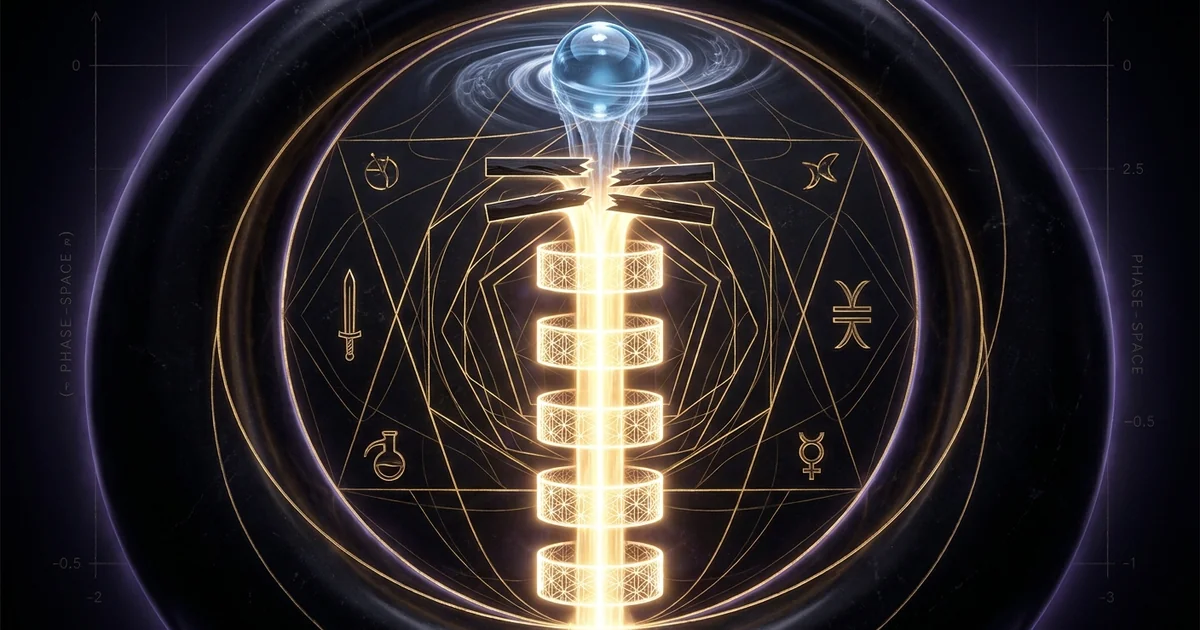
Hexagram 43 Breakthrough (Resoluteness) (Guài): I Ching
Archetypal Thesis & Systemic Paradigm: The Mechanics of Catastrophic Bifurcation
Guài as Non-Linear Phase Transition: The Five-Yang Ascendancy
Hexagram 43, designated in the received King Wen sequence as Guài (夬) and translated variously as Breakthrough, Resoluteness, or Decisiveness, formalizes a critical state-space bifurcation within the dynamic topology of the I Ching cosmogram. In the grammar of the twelve sovereign hexagrams (the shier-xiaoxi-gua, which map the waxing and waning of systemic polarities throughout cyclical time), Guài establishes the penultimate threshold of solar ascendance. The hexagram comprises five unbroken Yang lines surging from the base upward, systematically confronting and displacing a solitary, terminal Yin line at the apex. Rather than describing an incremental evolution, the architecture of the guài hexagram maps a non-linear phase transition: a supercritical state where an accumulated energetic gradient breaches the containing matrix of an obsolete macrocosmic paradigm.
Within complex systems theory, this structural configuration illustrates the mechanics of catastrophic bifurcation. Here, “catastrophe” is utilized in the strictly mathematical sense articulated by René Thom: a dynamical system undergoing an abrupt, qualitative transformation in equilibrium topology in response to continuous, smooth variations in underlying control parameters. The five ascending Yang lines represent the uninterrupted accumulation of systemic coherence, institutional vigor, or psychoid awareness. When these lines occupy positions one through five, the carrying capacity of the existing order reaches its absolute mathematical ceiling. Incremental adaptation is no longer an available systemic vector; the qualitative nature of the system must bifurcate into an entirely reconstituted paradigm.
The psychological and structural stakes of this threshold are uniquely volatile. The terminal Yin line at the sixth rank does not simply occupy space; it acts as the keystone of the antecedent architecture. Because the prevailing structural regime has organized its institutional defenses, semantic codes, and economic flows around the persistence of this final Yin horizon, the pressure exerted by the surging Yang foundation induces an acute hydraulic tension. To misunderstand the hexagram 43 breakthrough (resoluteness) iching meaning as a mandate for violent confrontation is to misread the thermodynamic laws encoded in the system. When five lines of coherent light confront one line of twilight, the transition is mathematically guaranteed, provided the emerging power does not collapse its own structural integrity through reactive oscillation.
                  Hexagram 43 (Guài)

                  ——  ——  Six at the Top (Terminal Yin)
                  ——————  Nine at the Fifth Place
                  ——————  Nine at the Fourth Place
                  ——————  Nine at the Third Place
                  ——————  Nine at the Second Place
                  ——————  Nine at the Beginning
The Paradox of the Solitary Yin: Decisive Cleansing Without Belligerence
The central energetic paradox of Guài resides in the asymmetrical balance of power between the surging collective Yang and the solitary Yin at the sixth position. Because the emerging forces possess overwhelming quantitative and structural superiority, the intuitive temptation of the lower lines is to employ unmitigated force to eradicate the final vestige of decay. The classical commentary tradition, however, warns explicitly against martial aggression. The terminal Yin element is an artifact of systemic exhaustion, an entropic coordinate within consciousness that sustains its survival solely by entangling the ascending forces in an adversarial dynamic.
When an ascending creative force attacks an exhausted structural element through belligerence, it inadvertently grants that decaying element ontological parity. In the dialectics of psychic and sociological conflict, direct violent opposition validates the structural architecture of the opponent, reconstituting the battle lines along the decaying order’s terms of engagement. Systemic resistance cannot be eliminated through reactionary friction; attempting to excise the solitary Yin through brute force induces severe negative feedback loops, producing a catastrophic enantiodromia in which the reforming vanguard adopts the tyrannical behaviors of the order it seeks to supplant.
The mandate of Guài requires a resolute cleansing devoid of malice or combative fixation. The five Yang lines must advance not through localized antagonism against the sixth line, but through the continuous, radiant expansion of their own structural integrity. True resoluteness (guài) is an operational refusal to engage in compromise or shadow projection, paired with an absolute refusal to resort to terror or tactical subterfuge. The removal of the corrupt or entropic constraint occurs as a structural inevitability—a consequence of light occupying all available systemic volume until the shadow possesses no coordinate upon which to project itself.
Cybernetics of the Public Proclamation: The Mechanism of Xuan
To resolve the paradox of non-belligerent displacement, King Wen’s judgment establishes a precise psycho-cybernetic protocol: xuan—the act of open, unadorned public proclamation at the civic center. The text specifies that the breakthrough must be made known at the royal court and announced truthfully, while simultaneously warning that danger persists and that one must first notify one’s own city before deploying executive force. This protocol functions as an information-theoretic intervention within an entropic communication network.
Corruption, cognitive pathology, and systemic decadence thrive within information asymmetry, sequestered backrooms, and unexamined psychological complexes. The mechanism of xuan strips the terminal Yin of its operational camouflage by projecting the emerging paradigm directly into the public commons. By articulating the nature of the systemic transition openly, without deceptive rhetoric or preemptive warfare, the sovereign intellect alters the epistemological boundary conditions of the entire collective. The decree at court is not a declaration of war; it is a structural audit of reality, rendering the obsolete paradigm functionally non-viable by depriving it of the silence and ambiguity it requires to perpetuate itself.
The warning that “it does not avail to resort to arms” directly derives from this cybernetic principle. The application of kinetic violence signals an epistemological failure—an admission that the truth of the breakthrough cannot command systemic coherence on its own energetic merits. Arms represent localized, coercive entropy; the proclamation represents global, transparent information. When the ascending consciousness relies on information transparency rather than force, it neutralizes the defenses of the terminal Yin without triggering the recursive cycles of retributive violence that characterize historical paradigm collapses.
Classical Provenance & Textual Lineage: Historical Transmissions of Guài
King Wen’s Judgment and the Duke of Zhou’s Line Epistles
The received textual core of Hexagram 43 within the Zhouyi reflects the geopolitical and metaphysical crisis attending the transition between the corrupt late Shang dynasty and the ascending Zhou cultural order. King Wen’s Judgment articulates the precarious boundary conditions of systemic renewal:
夬:揚于王庭,孚號,有厲。告自邑,不利即戎,利有攸往。
Guài: The matter must be proclaimed at the royal court. Truthfully it must be announced. Danger. It is necessary to make notification to one’s own city. It is unfavorable to resort to arms. It is favorable to undertake an enterprise.
This judgment provides a template for institutional and psychological state-changes. The injunction to announce the transition truthfully at the court (yang yu wang ting) situates the transformative act within the legitimate center of macrocosmic governance. It rejects conspiratorial coup d’état, requiring the sovereign actor to step into the absolute illumination of the civic center. The caveat “it is necessary to make notification to one’s own city” (gao zi yi) functions as an instruction in recursive self-examination. Before attempting to purge the apex of an external structure, the reforming agent must audit their own foundational base, addressing internal vulnerabilities, ideological dogmas, and cognitive blind spots.
The Duke of Zhou’s line epistles construct an ascending phenomenological ladder of temptation, error, and disciplined mastery. From the overzealous impetuosity of the initial unbroken line (“advancing in the toes”) to the profound vulnerability of the second line (“crying out in alarm; weapons at evening and night”), the text documents the psychological states provoked by proximity to systemic collapse. The apex epistle for Six at the Top—“Without call. In the end, misfortune”—marks the mathematical inevitability of the isolated Yin’s demise. Lacking systemic resonance, cut off from foundational nourishment, and unable to establish reciprocal affinity with the radiant Yang lines below, the solitary summit line collapses under the weight of its own evolutionary obsolescence.
Wang Bi’s Neo-Daoist Commentary: Neutralizing the Decadent Peak
In his definitive third-century commentary Zhouyi Zhu, the Neo-Daoist philosopher Wang Bi radically reframed the textual lineage of Guài by moving away from superstitious prognostication toward an ontological analysis of structural principles (li). Wang Bi recognized that the interaction between the five strong lines and the single weak line at the zenith was fundamentally asymmetric, yet inherently unstable if approached through the lens of moralistic enmity.
Wilhelm / Baynes (1950) Translation of the Judgment:
“Breakthrough. One must resolutely make the matter known at the court of the king. It must be announced truthfully. Danger. It is necessary to notify one’s own city. It does not avail to resort to arms. It is favorable to have a place to go.”
Wang Bi’s Commentary on the Systemic Purge:
“When Yang flourishes and reaches its peak, the base grows firm while the apex becomes solitary. If one uses force against this solitary summit, the summit will resist, and the common people will suffer harm from the friction of weapons. Therefore, the noble person makes the mandate manifest in the court, relying on resonance and sincerity to dissolve the degenerate. When the root is completely established, the branch falls without chopping.”
Wang Bi’s intellectual intervention de-demonizes the terminal Yin. The sixth line is not an ontological evil requiring punitive violence; it is an exhausted temporal coordinate. In Wang Bi’s ontology, the “inferior person” (xiao ren) represented by the top Yin line is merely a reified form whose time has expired. The noble person (junzi) resolves this condition not by descending into personal hatred or martial friction, but by maintaining an absolute, resonant alignment with the Dao. Once the underlying energetic structure is saturated with Yang coherence, the isolated Yin collapses through structural entropy. By viewing the apex line as an energetic void rather than an active adversary, Wang Bi preserves the psycho-spiritual equilibrium of the practitioner of book of changes divination.
Shao Yong’s Binary Calculus and the Waxing Cycle Sequence
In the eleventh century, the Northern Song cosmologist Shao Yong systematically decoded the mathematical foundations of the I Ching within his monumental work Huangji Yingshi Shu (Supreme World Principles Ordering the World). Operating with what would later inspire Gottfried Wilhelm Leibniz’s binary arithmetic, Shao Yong organized the hexagrams into the Xiantian (Early Heaven) circular and square configurations, demonstrating that the sixty-four figures reflect an unbroken binary count.
Within Shao Yong’s binary matrix, Hexagram 43 (expressed in binary notation as 111110, reading bottom-to-top where Yang = 1 and Yin = 0) represents the number 62 in a zero-indexed, left-to-right progression, immediately preceding Hexagram 1, Pure Creative Qian (111111). In the seasonal deployment of the shier-xiaoxi-gua, Guài corresponds to the third lunar month (the month of the Dragon, Chen), situated at the height of spring. During this phase, the vital solar force has nearly achieved absolute hegemony over the terrestrial field, pushing the final vestige of winter’s Yin to the absolute temporal perimeter.
Shao Yong Waxing Progression
Hexagram 11 (Tai)  -->  Hexagram 34 (Dazhuang)  -->  Hexagram 43 (Guài)  -->  Hexagram 1 (Qian)
   [Three Yang]             [Four Yang]              [Five Yang]            [Six Yang]
   Early Spring            Mid Spring                Late Spring             Solstitial Apex</code></pre>
Shao Yong’s structural mapping illuminates why the guài hexagram is structurally fraught. It constitutes the penultimate state of creative emergence. Penultimate states in dynamic systems are inherently hyper-pressurized because they contain the maximum possible kinetic gradient prior to systemic saturation. The transition from Guài to Qian requires crossing an ontological gap: the extinction of the final trace of resistance. Yet, as Shao Yong’s cosmological cycles reveal, the moment Hexagram 1 is actualized in the pure summer solstice, the solitary Yin instantly re-enters from the subterranean depths at the base of the cosmogram in Hexagram 44, Gòu. Thus, Guài represents a fleeting, absolute evolutionary tipping point between near-saturation and cyclical renewal.
Structural Mechanics & Symbolic Geometry: Lake Over Heaven Dynamics
Trigrammatic Architecture: Dui over Qian (Lake over Heaven)
The elemental and energetic architecture of Hexagram 43 is generated by the specific juxtaposition of its constituent trigrams: Dui (☱, the Youngest Daughter, Lake, Swamp, Metal, Joyful Expression) situated above Qian (☰, the Father, Heaven, Sky, Metal, Indomitable Creative Force). This physical configuration—lake over heaven—is intrinsically paradoxical and unstable.
                          Hexagram 43 Architecture

                   ——  ——   Upper Trigram: Dui (☱)
                   ——————   The Joyous / Lake / Reservoir
                   ——————
                   ---------------------------------------
                   ——————   Lower Trigram: Qian (☰)
                   ——————   The Creative / Heaven / Force
                   ——————
A body of water, characterized by fluid mass, resides perched above the celestial vault. Natural law dictates that water seeks the lowest level; when a lake is suspended in the heavens, it represents a colossal reservoir of atmospheric vapor that has climbed to the outer boundary of the troposphere. It has reached its condensation limit. The structural relationship between Dui and Qian structural mechanics demonstrates that this suspended mass cannot remain perpetually aloft. It must inevitably breach its containment and descend as torrential rain. The energetic vector of Qian is relentless upward thrust; the vector of Dui is an open, communicative, permeable aperture. As the indomitable power of Qian presses upward into the reservoir of Dui, the lake waters are driven over the embankment.
The breakthrough is thus characterized by the controlled release of pressurized energy through an open spillway. Dui represents joy, speech, and transparent externalization. This structural dynamic demonstrates that the resolution of systemic pressure does not occur through the brutal shock of an earth-shattering collision, but through the joyful, linguistic, and emotional discharge of stored creative energy. Resoluteness succeeds only when the creative force of Qian expresses itself through the outward grace, communicative clarity, and social accessibility of Dui.
Nuclear Core Dynamics: The Internal Engine of Qian and Qian
An examination of the nuclear trigrams (hu gua) embedded within Hexagram 43 reveals the extraordinary internal engine driving this breakthrough. The lower nuclear trigram (constituted by lines two, three, and four) is Qian (☰). The upper nuclear trigram (constituted by lines three, four, and five) is likewise Qian (☰). Consequently, the interior core of Hexagram 43 is none other than Hexagram 1, the Pure Creative, operating at double strength within the psychological and structural framework of the hexagram.
                   Primary: Hexagram 43 (Guài)          Nuclear: Hexagram 1 (Qian)

                   Line 6: ——  ——
                   Line 5: ——————  ] Upper Nuclear:      —————— Line 5
                   Line 4: ——————  ] Qian (☰)            —————— Line 4
                   Line 3: ——————  ]                     —————— Line 3
                   Line 2: ——————  ] Lower Nuclear:      —————— Line 4
                   Line 1: ——————  ] Qian (☰)            —————— Line 3
                                                         —————— Line 2
This absolute interior condensation of Qian explains the immense structural pressure bearing down upon the lone sixth Yin line. The outward presentation of the hexagram—the communicative, smiling, pleasant demeanor of Dui—encloses an internal furnace of pure, unadulterated creative power. The systemic tension is not superficial; it is powered by an engine of maximum structural coherence pushing outward toward physical manifestation.
The practitioner evaluating this geometry realizes that the breakthrough is driven by the structural reality that the interior of the system has already transformed completely into pure Yang. The single Yin line at the surface level is an ontological ghost, a hollow shell lingering over an interior space that has already achieved systemic integration. The breakthrough does not create new reality; it merely brings the external surface into formal alignment with the reality that has already crystallized within the nuclear engine.
- Upper Primary Trigram: Dui (☱, Metal / Lake / Joyous Expression)
- Lower Primary Trigram: Qian (☰, Metal / Heaven / Indomitable Creative Force)
- Nuclear Core (Lines 2-4 / 3-5): Pure Qian over Pure Qian (Hexagram 1: Absolute Creative Potency)
- Inverse Hexagram (Zong Gua): Hexagram 44 (Gòu / Coming to Meet) — The dialectic inversion where the single Yin enters from beneath.
- Opposite Hexagram (Cuo Gua): Hexagram 23 (Bō / Splitting Apart) — The polarity complement where five Yin lines erode a solitary Yang at the peak.
- Genetic Codon Architecture: In molecular biology correspondence matrices (e.g., Schönberger, Stent), Hexagram 43 maps to the AAA/AAG transcription factor dynamics (Lysine), functioning as a terminal structural activator regulating the unwinding and expression of chromosomal sequences during cellular differentiation.
Vector Analysis of the Six Lines: From Impetuous Toes to the Final Cry
Nine at the Beginning: Advancing with Impetuous Toes
The lowest Yang line rests at the base of the celestial trigram, furthest from the objective at the summit. The text warns: “Mighty in the forward-striding toes. Going and not overcoming becomes a fault.” The energetic pathology here is premature kinetic activation. Experiencing the surging upward momentum of the collective Yang field, the novice consciousness rushes forward without systemic awareness, attempting to settle the final outcome before foundational coherence has been established. This impetuosity dissipates kinetic energy, alerts systemic defense mechanisms prematurely, and results in catastrophic structural failure.
Nine at the Second Place: Hyper-Vigilant Preparedness
Occupying the central position of the lower trigram, this line embodies the ideal defensive posture during a transitional phase: “A cry of alarm. Arms at evening and at night. Fear nothing.” Positioned correctly within the internal core, the second line does not engage in offensive hubris. Instead, it maintains a state of hyper-vigilant readiness. Recognizing that systemic breakthroughs provoke desperation from obsolete power networks, Nine at the Second Place internalizes the tension, transforming reactive anxiety into defensive readiness. Because vigilance is maintained through the darkest hours (“evening and at night”), unexpected external disruptions cannot breach the perimeter.
Nine at the Third Place: The Cheekbones and Solitary Misfortune
“To be resolute in the cheekbones brings misfortune. The noble person is firmly resolved. He walks alone and encounters rain. He is bespattered, and people murmur against him. No fault.” This line occupies the transitional boundary between the lower and upper nuclear trigrams, bearing the brunt of the systemic polarization. The “cheekbones” represent ostentatious, facial righteousness—a performative, moralistic indignation that signals adversarial intent before one can execute systemic transformation. The line warns that visible, theatrical aggression provokes immediate resistance. The advanced practitioner must sever emotional ties with both the vulgar zealots of the Yang vanguard and the defenders of the old regime. By moving forward in solitary, misunderstood quietude, accepting the mud and whispers of social misinterpretation, the line neutralizes the hazard and incurs no ultimate fault.
Nine at the Fourth Place: Thighs Stripped of Skin
Transitioning into the upper trigram of Dui, the fourth line finds itself caught in an agonizing structural bind: “There is no skin on the thighs, and walking comes hard. If one were to let oneself be led like a sheep, remorse would disappear. But if one hears these words, one will not believe them.” The thighs represent the locus of kinetic propulsion; their denudation indicates that the capacity for unilateral autonomous movement has been stripped away. The fourth line is pressured from below by the three surging Yangs and blocked from above by the fifth line. The structural mandate is absolute ego-surrender: allowing oneself to be carried forward by the structural momentum of the collective whole rather than asserting individualistic will. Yet, the ego-bound intellect, fixated on its own agency, habitually rejects this wisdom.
Nine at the Fifth Place: Rooting Out Weeds with Impartial Weight
Holding the sovereign seat of the entire hexagram, the fifth Yang line directly confronts the terminal Yin line immediately above it: “In dealing with weeds, firm resolution is necessary. Walking in the middle remains free of blame.” The metaphor of weeds (lu) captures the essence of the terminal Yin complex. Weeds cannot be permanently eradicated through violent, frenzied chopping of their stalks; such interventions leave the subterranean roots intact, allowing them to regenerate with aggressive vigor. The fifth line, possessing central, balanced authority (zhong), must act with the dispassionate, methodical precision of an agrarian master. The eradication of the obsolete regime must be performed without vindictive hatred, adhering strictly to the balanced path of systemic equilibrium.
Six at the Top: The Final Cry of the Isolated Paradigm
At the extreme zenith sits the solitary Yin: “No call. In the end, misfortune.” Having exhausted every communicative link, relational affinity, and energetic reserve, the apex line finds itself completely isolated from the creative reality surging beneath it. It can emit no genuine call (wu hao) that commands systemic resonance. This line portrays the inevitable, tragic collapse of the reified ego, the corrupt institutional hierarchy, or the obsolete cognitive paradigm that refused voluntary integration with the emerging real. It does not fall because it was brutally crushed; it collapses because the ontological ground upon which it rested has vanished beneath its feet.
Psychological Dynamics & Operational Praxis: Resoluteness in Consciousness
Shadow Confrontation without Shadow Projection: A Jungian Hermeneutic
From the perspective of Jungian archetypal psychology, Hexagram 43 formalizes the climactic phase of the individuation process: the decisive confrontation with and integration of the personal and collective shadow. The terminal Yin line does not represent an absolute external adversary; it represents an autonomous unconscious complex that has dominated the psychic apparatus from behind the scenes, siphoning off libido and enforcing neurotic fixation.
The fundamental clinical danger during this phase is shadow projection. When the conscious ego (reinforced by the newly mobilized libido of the five Yang lines) discovers the locus of its historical neurosis, it reflexively projects moral depravity onto the complex, attempting to eradicate it through intense repression, ascetic self-flagellation, or outward sanctimony. Carl Jung repeatedly observed that an unintegrated complex cannot be conquered through an aggressive crusade:
“The shadow is a moral problem that challenges the whole ego-personality, for no one can become conscious of the shadow without considerable moral effort. To become conscious of it involves recognizing the dark aspects of the personality as present and real. This act is the essential condition for any kind of self-knowledge, and it therefore, as a rule, meets with considerable resistance.” (Jung, Aion, CW 9ii, par. 14)
If the ego attacks the complex with moralistic hatred, it instantly triggers enantiodromia—the psychological law whereby an over-identified, one-sided conscious attitude transforms into its exact opposite. The righteous reformer becomes the fanatic tyrant; the ascetic collapses into compulsive regression. The resoluteness demanded by the guài hexagram is not belligerent confrontation, but radical psychic transparency. The ego brings the contents of the unconscious complex into the clear, non-judgmental light of consciousness (the royal court), acknowledging its presence without succumbing to its energetic gravity. By withdrawing all projections and maintaining a steady, integrated psychic baseline, the practitioner strips the complex of its autonomous charge, allowing its structural shell to fall away naturally.
The Clinical Pathology of Righteous Zealotry in Line Nine at the Third Place
The clinical utility of Hexagram 43 is sharply demonstrated in its analysis of Nine at the Third Place: “Being resolute in the cheekbones brings misfortune.” In the diagnostic framework of modern psychotherapy, the “cheekbones” correspond to the defensive somatic and psychological armor of the righteous zealot. When an individual struggles to separate from a toxic familial, ideological, or behavioral matrix, they often display an inflated, aggressive posture of public denunciation. They wear their hatred of the obsolete complex upon their face as a somatic defense mechanism.
This outward hostility is an unambiguous diagnostic marker of ongoing psychological enmeshment. One does not fight with loud theatricality against something that has lost its power over the psyche; one fights theatrical battles only against that which one still secretly fears, desires, or resembles. The clinical pathology highlighted by the third line reveals that righteous anger re-energizes the complex, tethering the ego to the exact behavioral algorithms it seeks to dismantle.
The prescription of the Duke of Zhou—to “walk alone and encounter rain,” accepting social ostracism and the murmuring of peers—describes the difficult psychological transition from neurotic public activism to quiet, differentiated individuation. The individual must step out of the collective theater of mutual accusation. Walking in the rain signifies total immersion in emotional reality, stripping away the theoretical armoring of the cheekbones. By enduring the humiliation of being misunderstood without counter-attacking, the individual dissolves their emotional attachment to the legacy pattern, completing the internal breakthrough in profound psychological solitude.
Diagnostic Decryption in Book of Changes Divination
When Hexagram 43 is generated within a rigorous consultation of book of changes divination, the structural configuration conveys an unambiguous diagnostic mandate: the matter under consideration has arrived at an irreversible bifurcation point. Whether the inquiry concerns an interpersonal crisis, an institutional deadlock, or a spiritual impasse, the consultation indicates that the window for gradualist compromise has definitively closed.
Hexagram 43 (Guài): Breakthrough
- Direction of Vector: Ascending Yang displacing terminal Yin from below upward.
- Thermodynamic State: Supercritical pressure; expansion of solar light and structural order.
- Primary Psychological Hazard: Moralistic zealotry, over-extension, aggressive confrontation triggering systemic backlash.
- Prescribed Operational Posture: Non-combative transparency, proclamation at the public center, rigorous internal self-audit, structural integrity.
- Elemental Geometry: Lake over Heaven (☱ over ☰): Stored atmospheric mass releasing via an open spillway.
Hexagram 23 (Bō): Splitting Apart
- Direction of Vector: Ascending Yin undermining solitary Yang from below upward.
- Thermodynamic State: Entropic decay; structural erosion and dissipation of coherent form.
- Primary Psychological Hazard: Premature, suicidal action; fighting against an irresistible downward cultural or systemic tide.
- Prescribed Operational Posture: Absolute stillness, patient endurance, nourishing the base, protective retreat into the mountain.
- Elemental Geometry: Mountain over Earth (☶ over ☷): Decaying ridge weathering down into the boundless plain.
In operational praxis, Guài instructs the querent to enact a clean, surgical, and public separation from an entangling pathology. The operational rules are absolute:
- No Conspiratorial Maneuvering: The resolution must be executed in total daylight. Clandestine strategies or passive-aggressive manipulations poison the purity of the breakthrough.
- No Kinetic Retaliation: When attacked by the dying order, the practitioner must not retaliate with retaliatory venom. Resorting to arms instantly brings the practitioner down to the frequency of the terminal Yin.
- Notify One’s Own House: The querent must first address their own complicity in the problem. Where does the obsolete pattern still linger within their daily habits, operational protocols, or unconscious assumptions?
- Resolute Execution: Once the structural path is illuminated, hesitation is fatal. The weeds must be addressed at the root with calm, dispassionate resolve.
Philosophical Synthesis & Macrocosmic Correspondence: Hermetic Axioms & Evolutionary Cybernetics
The Hermetic Axiom of Rhythm and Polarity at the Climax of Yang
In Western esoteric philosophy, particularly within the lineage of Alexandrian Hermeticism crystallized in the Corpus Hermeticum and later formulated in the axiomatic maxims of The Kybalion, the structural mechanics of Hexagram 43 embody the pristine intersection of the Axiom of Polarity and the Axiom of Rhythm. The Axiom of Polarity states that “everything is dual; everything has poles; opposites are identical in nature, but different in degree.” The Axiom of Rhythm dictates that “the measure of the swing to the right is the measure of the swing to the left; rhythm compensates.”
Guài manifests the systemic tension that occurs when the pendulum reaches the absolute apex of its swing toward the Yang pole. The five ascending Yang lines represent the highest concentration of Light, Will, and Solar Form achievable prior to absolute saturation. However, precisely because the Hermetic universe is closed and governed by rhythmic compensation, this peak of Yang contains within its immediate horizon the seed of its opposite.
                  The Wheel of Polar Inversion

                  Hexagram 43 (Guài: 5 Yang, 1 Yin at Apex)
                             │
                             ▼
                  Hexagram 1  (Qian: 6 Yang, Saturation)
                             │
                             ▼
                  Hexagram 44 (Gòu: 5 Yang, 1 Yin at Base)
The moment the breakthrough is consummated and the solitary Yin at the sixth position is displaced, Hexagram 1 (Pure Creative Yang) is actualized. Yet Hexagram 1 is structurally unstable as a temporal process; it cannot remain static within the time-bound realm of the ten thousand things. The instant the sixth line turns Yang, the systemic equilibrium tilts, and Hexagram 44 (Gòu / Coming to Meet) is born, wherein a single Yin line penetrates the foundation from below. The Hermetic master operating with Hexagram 43 is therefore acutely aware that victory is not a permanent, static consolidation of light over darkness. Rather, it is a precise, high-stakes choreography designed to execute a necessary macrocosmic transition without generating excess karmic or systemic momentum that would accelerate the reciprocal swing of the shadow.
Human Design Gate 43: The Epistemological Mechanics of ‘Insight’
In the contemporary synthesis of the Human Design System—which maps the sixty-four hexagrams of the I Ching directly onto the genetic codons and neurological nodes of the human bodygraph—Gate 43 is positioned in the Ajna Center (the center of mental processing, awareness, and conceptualization). Known as the Gate of Insight, its structural keynote is articulated as “Breakthrough.”
Within this analytical architecture, Gate 43 (The Gate of Insight) is an individual, acoustic awareness gate belonging to the Knowing Circuit. Its structural function is to transform pure inner knowing into conceptual form, operating as the precursor to verbal articulation through its harmonic counterpart, Gate 23 (The Gate of Assimilation: “Splitting Apart,” corresponding to Hexagram 23) in the Throat Center. The epistemological mechanics of Gate 43 perfectly reflect the ancient Chinese hexagram geometry. Individual insight is inherently spontaneous, non-linear, and indifferent to social convention; it arises from the subterranean depths of the internal Qian engine, pressing upward toward the communicative gate of Dui.
The fundamental operational pathology of Gate 43 in Human Design mirrors the warnings of the Duke of Zhou: the intense, deafening nature of the acoustic insight creates a profound vulnerability to premature expression. Because the Ajna Center is fundamentally mental and lacks motor capacity, an individual carrying Gate 43 who attempts to force their insight onto an unprepared collective through sheer mental belligerence is labeled an irrational eccentric or a disruptive heretic.
To achieve a true breakthrough, the mental insight must wait for correct timing and an open social invitation (the Dui aperture). The breakthrough occurs only when the unique, individual realization is articulated with structural simplicity and communicative joy, rendering the transformation assimilable by the collective without provoking reactionary resistance.
Catastrophe Theory and the Morphogenesis of Historical Paradigms
On the macrocosmic and socio-historical plane, Hexagram 43 serves as a formal model for the morphogenesis of scientific, cultural, and political paradigms, anticipating the epistemological insights of Thomas Kuhn’s The Structure of Scientific Revolutions and the topological dynamics of René Thom’s Catastrophe Theory.
A paradigm does not collapse simply because it contains anomalies or moral decay. As long as an obsolete framework retains institutional legitimacy—the central palace—it can absorb, marginalize, or suppress systemic feedback. It persists through pure structural inertia. This is the condition of the solitary Yin line clinging to the apex of the hexagram: it controls the interpretive apparatus of the civilization long after its underlying generative vitality has drained away.
“When an archetypal situation reaches its energetic boiling point, the balance of psychic libido can no longer be contained within the old collective categories. Synchronistic events and sudden historical ruptures appear precisely at these tipping points, where the inner unconscious accumulation of meaning shatters the outer rational framework. Hexagram 43 describes this exact thermodynamic state: the old form appears intact on the surface, but the underlying psychological reality has already shifted completely. If the individual or culture attempts to hold on to the dying form through violent defense, catastrophe in its destructive sense ensues. If they can articulate the new meaning openly and without hatred, the breakthrough occurs as a harmonious delivery into a new stage of consciousness.”
— Marie-Louise von Franz, On Divination and Synchronicity: The Psychology of Meaningful Chance (1980), pp. 68–72.
The morphogenesis of the paradigm shifts when the accumulating body of counter-evidence, systemic stress, or creative innovation reaches the supercritical threshold of the five Yang lines. The transition corresponds topologically to Thom’s fold catastrophe: a dynamic surface bending back upon itself until an existing equilibrium state vanishes entirely, forcing the system to execute an instantaneous jump to a higher, more coherent attracter state.
This macro-historical shift corresponds archetypally to the structural rupture depicted in The Tower phase transition, where the lightning of unvarnished truth strikes the calcified citadel of the ego-monarch. The historic proclamation at the court is the moment the alternate paradigm is articulated in the civic commons. When the new model is spoken with undeniable systemic clarity, the obsolete paradigm does not engage in rational debate; its ontological foundation evaporates, and the entire institutional matrix collapses under its own hollow weight.
Frequently Asked Questions: Decoding Hexagram 43 in Praxis
Why does the judgment forbid resorting to arms during a breakthrough?
The explicit injunction within King Wen’s judgment—“it does not avail to resort to arms” (bu li ji rong)—is rooted in fundamental systems cybernetics and the psychological dynamics of conflict. When an ascending creative power deploys kinetic force, military violence, or coercive intimidation against a decaying structure, it instantly validates the adversarial grammar of that structure. Arms are an instrument of local, violent friction; they operate within the same low-entropy paradigm as the corruption they seek to eradicate.
Engaging in kinetic conflict produces three catastrophic systemic side-effects:
- It unifies the decaying elements, providing them with a concrete, external enemy around which they can rally and justify their authoritarian persistence.
- It traumatizes the foundational collective—the “own city” mentioned in the text—siphoning off the creative resources necessary to build the post-transition world.
- It induces a psychic enantiodromia within the reformers themselves, conditioning them to govern through terror, paranoia, and coercion, thereby rebuilding the exact tyranny they intended to destroy.
True breakthrough operates through the gravitational authority of superior coherence, information transparency, and non-negotiable resoluteness. When the new reality is fully established and openly declared, the terminal constraint dissolves naturally. Resorting to arms is an epistemological confession that the breakthrough lacks the internal integrity required to transform the system through structural presence alone.
How does Hexagram 43 fundamentally differ from its complementary pair Hexagram 44 (Gòu)?
Hexagram 43 (Guài / Breakthrough) and Hexagram 44 (Gòu / Coming to Meet) form a complementary pair through total directional and structural inversion:
          Hexagram 43 (Guài)                 Hexagram 44 (Gòu)

          ——  —— Line 6 (Yin at Apex)        —————— Line 6
          —————— Line 5                      —————— Line 5
          —————— Line 4                      —————— Line 4
          —————— Line 3                      —————— Line 3
          —————— Line 2                      —————— Line 2
          —————— Line 1                      ——  —— Line 1 (Yin at Base)
In Hexagram 43, five Yang lines push upward from the base to openly expel a solitary, exhausted Yin line at the summit. The dynamic is public, macroscopic, solar, and expressive. The danger in Guài is over-extension, aggressive sanctimony, and the hubris of the conscious mind attempting to violently purge its own shadow.
In Hexagram 44, the structural dynamic is completely reversed. Five Yang lines stand above, fully exposed, while a single Yin line stealthily enters the system from the absolute base. The dynamic in Gòu is subterranean, microscopic, seductive, and infiltrative. In Gòu, the corrupting or entangling element does not fight openly; it enters unnoticed beneath the threshold of awareness through desire, unexamined appetites, or subtle compromises.
While Guài demands decisive, public expulsion of an obsolete structure through transparent communication, Gòu demands acute micro-discernment and boundary control to prevent an intoxicating, regressive influence from anchoring itself into the foundations of consciousness.
What does it signify when Hexagram 43 transitions into Hexagram 1 versus Hexagram 28?
In the mechanics of I Ching consultation, the specific lines that mutate (bian tong) fundamentally alter the trajectory of the systemic bifurcation:
Transition to Hexagram 1 (Pure Qian):
This mutation occurs exclusively when the solitary Six at the Top changes into a Yang line. This is the optimal structural realization of the breakthrough. The terminal, entropic constraint has been displaced without destabilizing the lower foundation. The entire six-line matrix becomes an uninterrupted column of creative, solar potency. In consciousness, this signifies the complete integration of the shadow complex, the dissolution of the legacy structure, and the dawn of an era of absolute clarity and unencumbered creative vitality.
Hexagram 43 (Guài)                 Hexagram 1 (Qian)
      ——  —— Line 6 [MUTATING]   -->     —————— Line 6
      —————— Line 5                      —————— Line 5
      —————— Line 4                      —————— Line 4
      —————— Line 3                      —————— Line 3
      —————— Line 2                      —————— Line 2
      —————— Line 1                      —————— Line 1</code></pre>
Transition to Hexagram 28 (Preponderance of the Great / Da Guo):
This transition occurs when Nine at the Beginning and Nine at the Fifth Place mutate, or through specific structural line inversions that leave the core overloaded while the extremities are weakened. Hexagram 28 comprises Lake over Wind (☱ over ☴), characterized by thick Yang lines in the interior supported by fragile, vulnerable Yin lines at both the base and the apex.
If the breakthrough in Hexagram 43 is executed with impetuous violence or an unstable foundation, the system does not achieve the balanced radiance of Hexagram 1. Instead, it transitions into the structural catastrophe of Hexagram 28: “The ridgepole sags to the breaking point.” In this scenario, the pressurized waters of the lake, instead of releasing peacefully through the open spillway, shatter the structural load-bearing pillars, plunging the entire enterprise into systemic collapse. The path from Guài to Qian requires absolute alignment; any deviation toward reactive aggression shifts the trajectory toward the structural devastation of Hexagram 28. :::