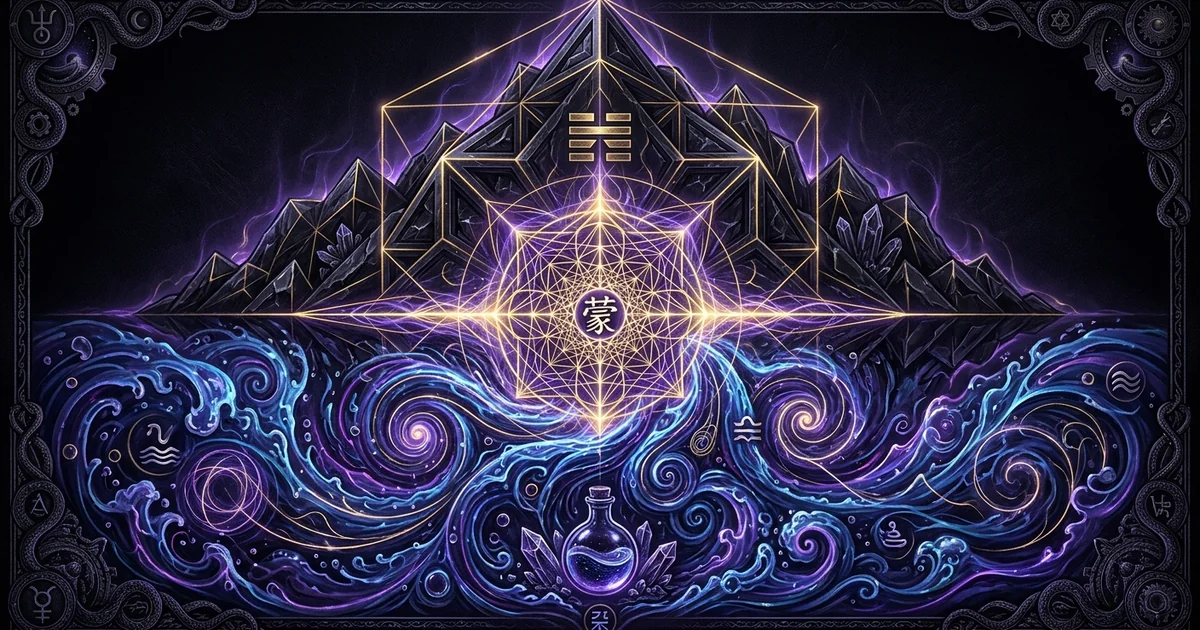
Hexagram 4 Youthful Folly (Méng): I Ching Divination
Archetypal Thesis & Systemic Paradigm: The Epistemology of Méng
Hexagram 4 (Méng / Youthful Folly) establishes a core cybernetic axiom within the Book of Changes: conscious unknowing is not an epistemic deficiency or cognitive absence, but an indispensable, high-entropy initial condition prerequisite for systemic self-organization. Within the sixty-four states of the King Wen sequence, Méng operates as a pedagogical diagnostic apparatus. It models the thermodynamic and cognitive parameters through which raw, undifferentiated psychic energy transitions into structured intelligence.
Where the contemporary intellect treats ignorance as an error state requiring immediate erasure through data ingestion, the I Ching conceptualizes Méng—etymologically rooted in the image of an emergent plant enveloped in mist or a newborn wrapped in caul—as a protected phase space. The hexagram formalizes the conditions under which human consciousness interacts with an unmapped territory, establishing that wisdom cannot be transmitted coercively; it must be precipitated through an organic encounter with structural limitation.
Méng (Hexagram 4)
───   Line 6 (Nine at the top)
─ ─   Line 5 (Six in the fifth place)
─ ─   Line 4 (Six in the fourth place)
─ ─   Line 3 (Six in the third place)
───   Line 2 (Nine in the second place)
─ ─   Line 1 (Initial six)
Upper Trigram: Gen ☶ (Mountain / Keeping Still)
Lower Trigram: Kan ☵ (Water / The Abyssal / Peril)
Primary Entropy and the Neophyte State
In the state-space of the psyche, the condition of the neophyte is defined by an overabundance of microstates without macro-level constraint. This high-entropy condition corresponds archetypally to the initial manifestation of consciousness, an untamed vitality that closely parallels the Fool archetype. In the context of hexagram 4 youthful folly iching meaning, this vitality lacks orientation, threatening to disperse into self-destructive dissipation if left uncontained. Méng does not deprecate this early phase.
The neophyte’s folly represents uncommitted potentiality. The child, the novice researcher, or the querent stands before the objective world in a condition of ontological plasticity. This cognitive plasticity permits lateral leaps and radical pattern recognition that ossified expertise prevents.
However, raw potentiality remains unstable. Without structural demarcation, the undifferentiated psyche succumbs to delusion, mistaking subjective projection for objective reality. Méng designates this precarious juncture: the nascent spark of inquiry suspended over an abyss of peril, demanding containment to prevent cognitive collapse.
The Oracle as a Non-Linear Cybernetic Interrogator
The foundational mechanics of Méng delineate an asymmetry between the seeker and the oracle. The oracle does not solicit the user. It functions as an unyielding structural mirror that yields meaningful information only when perturbed by an authentic, coherent inquiry.
When the hexagram announces, “It is not I who seek the young fool; the young fool seeks me,” it describes a cybernetic attractor. The field of information remains latent and unperturbed until an inquiring consciousness crosses its boundary. The divinatory system maintains ontological neutrality; it does not proselytize, entice, or impose.
Perturbation (Inquirer) ──> [ Boundary Constraint (Gen) ] ──> Coherent Feedback
                                   │
                                   └── Importunity / Repetition ──> Signal Degradation (Noise)
This structural dynamic governs the integrity of synchronicity within the mantic arts. The oracle responds to the initial psychic tension that motivates the consultation. If the inquirer rejects the diagnostic mirror and immediately re-interrogates the matrix—attempting to force a preferred outcome through repetitive casting—the epistemic channel degrades into noise.
The classic formulation, “At the first oracle I inform him; if he asks two or three times, it is importunity. If he importunes, I give him no information,” articulates an operational law of psycho-informational systems: redundant perturbations rooted in doubt or willful evasion destroy systemic coherence, transforming clear signal transmission into entropic static.
The Dialectic of Inquiry: Instruction versus Entreaty
The pedagogic architecture of the méng hexagram hinges on the polarity between instruction (jiao) and entreaty (qiu). Authentic instruction cannot occur through top-down didactic imposition. If the master pursues the student, the student’s receptive capacity closes; the pedagogical intervention is experienced as psychic intrusion, provoking defensive resistance.
True pedagogical initiation requires the student to manifest an internal void—a hunger born from recognizing their own structural limitation. This structural tension pulls the teaching from the instructor.
The seeker’s entreaty acts as a vacuum that draws forth the corrective insight of the sage. In this dialectic, the master maintains absolute stillness, incarnating the unmoving mountain. The neophyte, embodying the restless, seeking dynamism of subterranean water, must ascend toward the mountain’s base.
Should the master compromise this boundary by descending to plead with the student, the master abdicates their structural role as an invariant reference point. The master then enters the unstable, entropic field of the neophyte’s uncontained impulses. The pedagogical dynamic collapses into co-dependency, and the transformational pressure of the encounter evaporates.
The Judgment: Youthful Folly has success. It is not I who seek the young fool; The young fool seeks me. At the first oracle I inform him. If he asks two or three times, it is importunity. If he importunes, I give him no information. Perseverance furthers.
The Image: A spring wells up at the foot of the mountain: The image of Youth. Thus the superior man fosters his character By thoroughness in all that he does. (Wilhelm, Richard & Baynes, Cary F., 1950. The I Ching or Book of Changes)
Classical Provenance & Textual Lineage: From Shamanic Divination to Neo-Confucian Pedagogy
The evolution of Hexagram 4 across three millennia tracks the broader maturation of Chinese intellectual history, reflecting the transition from Bronze Age ancestral divination to Zhou dynasty moral philosophy, Han dynasty cosmological mapping, and Song dynasty metaphysical psychology.
Throughout this textual lineage, Méng preserves its core structural identity while expanding its interpretive scope. Originally understood in the Western Zhou era as an omen addressing marriage contracts, legal disputes, and the tutelage of young princes, the hexagram gradually acquired profound psychological and ontological meaning.
Western Zhou (c. 1046–771 BCE) : Shamanic mantic omens, royal tutelage, ancestral contracts
              │
Han Dynasty (202 BCE–220 CE)    : Xiangshu (Image and Number) correlative cosmology
              │
Wei-Jin Period (220–420 CE)     : Wang Bi's Xuanxue (Neo-Daoist) psychological reduction
              │
Song Dynasty (960–1279 CE)      : Neo-Confucian moral cultivation (Cheng Yi, Zhu Xi)
King Wen and the Duke of Zhou: The Moralization of Méng
In the primitive strata of the Zhouyi, the character Méng (蒙) carried concrete, physical associations: it denoted dodder (a parasitic vine), darkness, mist, blindness, and a state of being covered or sheltered. The early diviners of the court interpreted Méng within the logistics of dynastic succession and clan preservation.
The Duke of Zhou’s line statements reflect an agrarian, aristocratic order grappling with how to integrate unruly heirs into the severe responsibilities of ancestral sacrifice and statecraft. Line 1’s deployment of fetters (fa méng) originated in physical disciplinary restraints applied to insubordinate novices or captives undergoing socialization.
Under the editorial synthesis attributed to King Wen, these primal images underwent an ethical conversion. The foundational condition of youth was no longer treated as a simple vulnerability to be managed through apotropaic ritual, but as a fertile state through which character could be deliberately forged.
Success (heng) is explicitly promised to Youthful Folly, but that success is strictly contingent upon maintaining the proper relationship to authority, timing, and boundary conditions. The primitive terror of the unknown was transformed into an initiatory crucible: the raw human subject must undergo ritual containment to attain functional alignment with the Mandate of Heaven.
Wang Bi’s Metaphysical Reduction: Ken and K’an as Psychological Dynamics
During the Wei-Jin period, the prodigy Wang Bi (226–249 CE) revolutionized I Ching hermeneutics by rejecting the cumbersome, rigid correlative cosmology of the Han Dynasty (Xiangshu or “Image and Number” school). In his commentary on Hexagram 4, Wang Bi executed a radical psychological reduction, returning to the text’s naked systemic architecture.
He dismissed the notion that Méng was merely an external omen concerning rituals or disciplinary beatings, establishing it instead as an internal field of consciousness defined by the interplay between the two constituent trigrams: Mountain and Water.
Wang Bi demonstrated that the tension between the hidden spring (Kan) and the impassable mountain (Gen) mirrors the structural dilemma of human cognition. Water represents the internal movement of desire, peril, and cognitive fluidity; Mountain represents the principle of stillness, limit, and structural resistance.
Wang Bi argued that when the student encounters an external impasse, their internal fluidity must not be permitted to smash blindly against the rock. Instead, it must submit to the stillness of the mountain to attain lucidity. For Wang Bi, the sage’s refusal to answer repetitive inquiries is not an act of cruelty or punitive withdrawal, but a metaphysical necessity designed to force the inquirer’s restless, fluid intellect back upon its own quiet ground of being.
“The unconscious does not simply answer our intellectual curiosities; it reacts to an authentic emotional situation. If one consults the oracle out of frivolous curiosity, or if one repeats the question because the answer was unpalatable, the connection to the archetype is broken. The unconscious then behaves exactly as the I Ching describes in Hexagram 4: it produces nonsense or refuses to speak, because the subjective attitude of the inquirer has introduced fundamental untruthfulness into the psychoid field.” — Marie-Louise von Franz, On Divination and Synchronicity: The Psychology of Meaningful Chance (1980, p. 42)
The Neo-Confucian Hermeneutic: Cheng Yi and Zhu Xi on Moral Cultivation
The Song Dynasty witnessed the full interiorization of Hexagram 4 within the Neo-Confucian project of moral cultivation (xiushen). Commentators Cheng Yi (1033–1107 CE) and Zhu Xi (1130–1200 CE) situated Méng at the heart of epistemology.
In Cheng Yi’s Yichuan Yizhuan, Youthful Folly is read as the universal human condition prior to the illumination of principle (li). Because every individual is born in a state of cognitive cloudiness (méng), the preservation of civilization depends upon the fidelity of the pedagogical relationship.
Cheng Yi laid extraordinary emphasis on the dignity of the teacher. If a scholar actively solicits students, the moral authority of the instruction is compromised; the pedagogical transaction degenerates into commercial exchange or social vanity. Zhu Xi expanded upon this in his Zhouyi Benyi, linking the hexagram directly to the cultivation of the mind.
The spring emerging from the foot of the mountain symbolizes the pristine, original nature (benxing) that remains fundamentally uncontaminated despite the murkiness of physical embodiment. The work of the educator is not to manufacture virtue out of nothingness, but to clear away the debris of base habits and premature certainties, allowing the clear spring water to flow according to its innate, uncorrupted direction.
Structural Mechanics & Symbolic Geometry: Mountain Over Water
The systemic power of Hexagram 4 resides within its precise geometric configuration. Within the binary architecture of the Book of Changes, Méng is the fourth state, formed by the structural inversion of its predecessor, Hexagram 3 (Chun / Sprouting).
Its outer, upper constituent is Trigram Gen (☶), the Mountain, characterized by an invariant, solid Yang line at the apex resting upon two receptive Yin lines. Its inner, lower constituent is Trigram Kan (☵), the Abyssal Water, characterized by a single, potent Yang line trapped between two fractured Yin lines.
Trigrammatic Dyad: Gen (Immobility) Constraining Kan (Abyssal Flux)
The structural dynamic between Gen and Kan constitutes one of the most potent tensions in classical mechanics: kinetic energy confronted by an immovable boundary. Trigram Kan represents the subterranean waters of the unconscious—deeply creative, relentlessly dynamic, inherently dangerous, and fraught with peril. Kan’s energetic vector is downward, seeking the lowest point, yet simultaneously surging upward in the form of a spring pressurized by tectonic forces.
Trigram Gen represents absolute stillness, cessation of motion, and topological containment. It is the boundary that says “thus far and no further.”
When Gen sits atop Kan, the symbolic geometry is that of mountain over water. The perilous, fluid potentiality of Kan is denied uninhibited release. If the mountain were not present, the water would flood the landscape, dissipating its force in swampy diffusion or washing away the surrounding topsoil in an entropic torrent.
The presence of the mountain acts as a natural containment vessel. It checks the reckless flow of the spring, forcing the water to pool, clarify, and accumulate pressure until it carves a structured, sustainable riverbed. Within human cognition, this represents the vital containment of drive-impulses and unstructured ideation by disciplined boundary conditions.
The Energetic Vector of the Spring at the Mountain’s Foot
The classical Image of Hexagram 4 portrays a spring welling up at the mountain’s foot (shan xia chu quan). This image captures an energetic vector characterized by fresh, nascent emergence. A spring emerging from rock is not stagnant water; it possesses an organic, crystalline momentum.
However, because it emerges at the absolute base of the massif, its path forward is entirely blocked by the terrain. It cannot vault the mountain; it must navigate around it.
       ▲  Gen (Mountain)
      / \  - Impassable structural resistance
     /   \ - Enforces patience and redirection
    /     \
~~~~~~~~~~~~~ Kan (Spring/Water)
             - Nascent, unformed vitality
             - Deep subterranean origin
This hydrological metaphor provides the structural blueprint for early education and spiritual initiation. The mountain does not extinguish the spring; it disciplines it. The spring, possessing relentless persistence, does not destroy the mountain; it adapts its trajectory to the structural contours of the stone.
The superior person, observing this landscape, recognizes that character cannot be established through sudden violence or erratic displays of will. It requires thoroughness, rhythmic persistence, and unyielding fidelity to objective boundaries, allowing virtue to accumulate drop by drop until an integrated personality crystallizes.
Hexagram Inversion and Sequence: The Transition from Chun (3) to Méng (4)
The operational logic of the King Wen sequence is governed by systemic pairs formed through spatial inversion (fan zha). Hexagram 3 (Chun / Difficulty at the Beginning) features Kan below Zhen (Thunder under Water). It describes the objective, environmental chaos that accompanies the birth of any new entity into the cosmos. Chun is the cosmos in labor: chaotic, disordered, vegetative, and overwhelmed by macro-level turbulence.
When Chun is rotated 180 degrees, it transforms into Méng.
Hexagram 3 (Chun)                  Hexagram 4 (Méng)
Thunder under Water                 Water under Mountain
Objective, macrocosmic chaos   ──>  Subjective, microcosmic unknowing
External environmental birth        Internal psychological containment
This structural inversion marks a profound systemic shift: the objective chaos of Hexagram 3 is internalized as the subjective incomprehension of Hexagram 4. In Chun, the world itself is disordered; in Méng, the external world has acquired the firm structure of a mountain, but the subject’s internal apparatus remains in a state of immature, watery blindness.
Furthermore, an analysis of the [nuclear-trigrams] (huti) latent within Méng reveals the hidden engine of this state:
- The lower nuclear trigram (lines 2, 3, 4) is Trigram Zhen (☳, Thunder), indicating explosive, upward-surging vitality trapped within the core.
- The upper nuclear trigram (lines 3, 4, 5) is Trigram Kun (☷, Earth), representing absolute receptivity and spatial breadth.
Thus, buried beneath the mountain’s containment and the spring’s peril lies the engine of Thunder stirring deep within the Earth (the configuration of Hexagram 24, Fu / Return). The folly of Méng is not a dead-end stagnation. It is an embryonic incubation chamber holding the seed of thunderous awakening.
Hexagram Line Transitions: Structural Analysis of the Six Yao
The six lines of Hexagram 4 trace the developmental pathway of the neophyte, moving from early socialized discipline, through the traps of psychological projection and isolation, to arrive at child-like receptivity and the necessary implementation of defensive boundaries.
The entire hexagram revolves around the dynamic between the single Yang ruler in the lower trigram (Nine in the second place) and the secondary Yang anchor at the summit (Nine at the top). These two lines carry the responsibility of containing and instructing the four receptive, vulnerable Yin lines.
Line 6: ─── Nine at the Top        -> Structural demarcation; checking the fool
Line 5: ─ ─ Six in the Fifth Place -> Childlike docility; supreme receptivity
Line 4: ─ ─ Six in the Fourth Place-> Entangled in folly; sterile isolation
Line 3: ─ ─ Six in the Third Place -> Eroticized projection; loss of autonomy
Line 2: ─── Nine in the Second Place-> Pedagogical master; magnanimous containment
Line 1: ─ ─ Initial Six            -> Disciplinary correction; shedding illusions
Initial Six and Nine in the Second: Disciplinary Bounds versus Magnanimous Containment
Initial Six: “To make a fool develop, it furthers one to apply discipline. The fetters should be removed. To go on that way brings humiliation.”
Positioned at the very base of the watery abyss, the Initial Six represents raw, unformed impulse completely unacquainted with structural order. It requires an initial shock of boundary awareness—symbolized by disciplinary fetters—to break its unconscious identification with primary narcissism.
However, this discipline must remain strictly provisional. The commentary emphasizes that fetters are applied solely to awaken the subject to the existence of boundaries; if the instructor maintains coercive control past this threshold, the pedagogy curdles into tyrannical humiliation, crippling the student’s initiative.
Nine in the Second Place: “To bear with fools in kindliness brings good fortune. To know how to take women brings good fortune. The son is capable of taking charge of the household.”
Nine in the second place is the functional ruler of the hexagram. As a centered, strong Yang line occupying an inner, receptive Yin position, it represents the fully integrated pedagogical master. Unlike dogmatic instructors who react to ignorance with contempt, this figure possesses the inner strength to tolerate psychic entropy without anxiety.
The phrase “to bear with fools in kindliness” (bao méng) denotes an embrace that contains raw emotion within an unshakable vessel. This line serves as the psychological anchor for all four Yin lines. The master’s maturity allows them to handle both feminine vulnerability and the patriarchal burden of lineage, providing the foundational containment that enables the neophyte to safely mature.
Nine in the Second Place: Pedagogical Mastery
- Structural Position: Centered within the lower trigram (Water); directly immersed in the emotional and cognitive turbulence of the neophyte.
- Modus Operandi: Magnanimous containment (bao méng), inner psychic security, and non-reactive receptivity.
- Thermodynamic Function: Acts as an internal dissipative anchor; absorbs high entropy and converts it through patient resonance into structured order.
- Pedagogical Archetype: The benevolent initiator, the Zen master, or the seasoned analyst who holds the transference without narcissistic retaliation.
Nine at the Top: Structural Discipline
- Structural Position: At the apex of the upper trigram (Mountain); positioned at the external periphery of the hexagram’s state-space.
- Modus Operandi: Structural demarcation (ji méng), energetic resistance, and the application of definitive limits.
- Thermodynamic Function: Imposes an unyielding external boundary wall; prevents the volatile system from leaking outward or succumbing to external predation.
- Pedagogical Archetype: The reality principle, the lawgiver, or the structural boundary condition that rebuffs trespass without punitive malice.
Six in the Third and Six in the Fourth: The Pitfalls of Eroticized Projection and Isolation
Six in the Third Place: “You should not take a maiden who sees a man of bronze and cannot keep possession of herself. Nothing furthers.”
Occupying the apex of the lower trigram, Six in the third place sits directly on the boundary between the inner abyss and the outer mountain. Here, the neophyte’s watery desire seeks an immediate, catastrophic shortcut to completeness.
Encountering the solid, radiant Yang strength of Nine in the second place, the third line surrenders its own integrity, falling into eroticized projection. The “man of bronze” (jin fu) represents the idealized, omnipotent archetype of the master.
The student abandons self-cultivation, projecting their own latent sovereignty entirely onto the external figure. This is the classic dynamic of spiritual seduction and narcissistic inflation: the neophyte desires to consume the master’s authority rather than develop their own. The oracle warns that such uncontained adoration destroys character and invalidates the relationship.
Six in the Third Place (Eroticized Projection):
[ Neophyte ] ── (Projects Idealized Self) ──> [ Man of Bronze ]
   ▲                                                 │
   └──────── (Abdicates Internal Autonomy) ──────────┘
Six in the Fourth Place: “Entangled folly brings humiliation.”
Six in the fourth place represents the most desolate location within the hexagram. Trapped at the base of the Mountain trigram, it is surrounded entirely by other weak Yin lines (lines 3 and 5), completely isolated from the luminous Yang strength of both Nine in the second and Nine at the top.
This line illustrates the tragedy of willful, isolated ignorance. The fourth line lacks both the self-awareness to seek guidance and the organic connection to living truth. It is wrapped in its own dogmatic concepts like a cocoon.
This is the condition of scholastic pedantry and spiritual bypassing: the subject builds elaborate intellectual or mystical defenses around their core blindness. Because it refuses to perturb the oracle or surrender to a teacher, it suffocates within its own subjective delusions, inevitably incurring humiliation when confronted by objective reality.
Six in the Fifth and Nine at the Top: Childlike Docility versus the Punishment of Transgression
Six in the Fifth Place: “Childlike folly brings good fortune.”
Occupying the sovereign seat of the upper trigram, Six in the fifth place represents an extraordinarily auspicious realization of the Méng archetype. Though structurally in a position of authority, this line remains soft, yielding, and fully receptive. It embodies what Daoist metaphysics later formalized as the recovery of the uncarved block (pu) or the mind of the infant (ying’er).
The Fifth Six possesses the humility to recognize its own limitations despite its elevated status. It turns away from the rigid certitudes of the mountain and looks downward toward the wise instructor (Nine in the second place), submitting to guidance with total, unpretentious trust. This docility is not weak passivity; it is an active, radical openness that permits real gnosis to take root, guaranteeing supreme good fortune.
Nine at the Top: “In punishing folly it does not further one to commit transgressions. The only thing that furthers is to ward off transgressions.”
The final line of the hexagram sits at the absolute summit of the mountain. It serves as the external boundary wall of the entire system. When youthful folly degenerates into chronic irresponsibility, anti-social defiance, or persistent boundary violations, magnanimous containment is no longer appropriate; structural pressure must be applied.
However, the line issues a severe ethical warning: the application of discipline must never degenerate into punitive sadism or subjective vengeance (kou). The purpose of the blow is purely defensive and corrective—to ward off destructive trespass, both from the fool and against the fool.
It is the scalpel of the surgeon or the boundary set by the legal code, operating dispassionately to preserve the integrity of the whole.
Psychological Dynamics & Operational Praxis: The Analytic Mirror and Transference
Within the domain of Jungian psychoanalysis and archetypal cartography, Hexagram 4 articulates the structural dynamics of the analytic container. Divination with the I Ching operates within the realm of the objective psyche, relying on the structural bridge of synchronicity to reflect unconscious constellations onto the mirror of conscious awareness.
When Méng appears in an inquiry, it frequently signals that the querent’s ego is currently operating under the influence of an unconscious inflation or epistemic blindness, attempting to use the divination apparatus to validate a neurosis rather than uncover truth.
       Archetypal Dialectic of Méng
┌──────────────────────────────────────────────┐
│           SENEX (Nine at the Top)            │
│       - Boundary, Structure, Reality         │
│       - Resistance to Inflation              │
└──────────────────────▲───────────────────────┘
                       │
             Containment Tension
                       │
┌──────────────────────▼───────────────────────┐
│         PUER AETERNUS (Kan Trigram)          │
│       - Fluidity, Potential, Hubris          │
│       - High Entropy, Flight from Form       │
└──────────────────────────────────────────────┘
The Archetype of the Puer Aeternus and the Senex Anchor
The primary psychological polarity structuring Hexagram 4 is the confrontation between the Eternal Youth and the Senex (Wise Old Man / Chronos). The subterranean spring of Trigram Kan embodies the Puer archetype: brilliant, fluid, non-committal, volatile, terrified of form, and brimming with ungrounded potential.
The Puer wishes to float above the restrictions of time, material limitation, and hard labor. It seeks instantaneous illumination without the friction of the pedagogical path.
The Mountain, Trigram Gen, embodies the Senex anchor. The Senex imposes the reality principle: gravity, historical time, disciplinary boundaries, and silent, heavy resistance.
When the Puer crashes against the Senex without containment, the result is either spiritual disillusionment or psychological fragmentation.
Hexagram 4 orchestrates the precise conditions under which the Puer’s raw vitality is harnessed by the Senex’s form. The Mountain does not destroy the youth; it forces the youth to descend into the work of character formation, trading the hubris of infinite potential for the concrete reality of actualized skill.
Countertransference in the Divinatory Encounter: Avoiding the Guru Complex
For the diviner, analyst, or mentor, the second line of Hexagram 4 provides an indispensable clinical and ethical warning. The phenomenon of the transference inevitably constellates its counterpart: countertransference.
When an inquirer or patient arrives in the grip of Méng, their psychic field is characterized by disorientation, fear, and projection. They desperately seek a savior—a “man of bronze”—upon whom they can project the archetypal image of the Self.
Client/Seeker (State of Méng)
       │  (Transference of Inner Sovereignty)
       ▼
[ Diviner / Mentor / Analyst ]
       │
       ├── Failure: Guru Complex (Inflation, Exploitation, Line 3 Dynamic)
       │
       └── Success: Senex Containment (Magnanimity, Line 2 Dynamic)
The practitioner who lacks self-reflection falls directly into this archetypal trap. Absorbing the querent’s projection, the practitioner succumbs to the guru complex, mistaking the archetypal light passing through them for their own personal radiance. This error is marked by Line 3.
The practitioner begins to enjoy the seeker’s dependence, reinforcing their helplessness to feed a personal narcissistic appetite. True pedagogical and divinatory mastery, incarnated by Line 2, requires the absolute refusal of this projected inflation.
The practitioner must function as an alchemical vessel: receiving the projections, enduring the student’s entropy without retaliation, and calmly redirecting the seeker’s attention back to their own latent structural center.
In the Human Design synthesis, which maps the sixty-four hexagrams to the human bio-energetic architecture, Hexagram 4 corresponds to Gate 4 (The Gate of Formulization), located in the Ajna Center of the Mental Body. Gate 4 operates as the mental vehicle for transforming the raw, chaotic pressure of doubt generated by Gate 63 (After Completion) into structured, logical formulas and potential answers.
Biologically, Gate 4 correlates genetically with the amino acid Valine, an essential branched-chain amino acid vital for cognitive tissue repair and metabolic homeostasis.
The operational mechanics of Gate 4 warn that its logical formulas are purely hypotheses—mental potentials rather than personal truths to be lived. If a person attempts to act out their mental formulas without waiting for their authentic somatic Strategy and Authority, the mental energy degrades into the chaotic, turbulent folly of Hexagram 4: attempting to solve the mystery of life through the premature impositions of the anxious mind.
Operational Protocol: Navigating Consultation Fatigue and Mantic Resistance
When Hexagram 4 appears within an operational divinatory consultation, it functions as a metacognitive intervention. It frequently signals that the consultation has entered the territory of mantic resistance or consultation fatigue.
The practitioner must assess the state of the consultation protocol using an empirical decision matrix:
Consultation Casts Hexagram 4
               │
   ┌───────────┴───────────┐
   ▼                       ▼
Initial Cast          Secondary / Repeated Cast
(Fundamental Blindness) (Importunity / Noise)
   │                       │
   ▼                       ▼
Suspend Speculation   Terminate Consultation
Require Study         Enforce Operational Silence
If Méng is cast in response to an initial query, it alerts the querent that their question is formulated from within a profound cognitive blind spot. The querent is attempting to compute an answer without possessing the necessary foundational data points. The proper operational response is to suspend speculative inquiries and commit to basic operational research.
If Méng appears during a continuous session—where the querent has asked a series of related questions or is probing the same fundamental dilemma from multiple angles—the oracle’s verdict is final: the system has shut down due to importunity (fan). The querent is no longer seeking truth; they are fishing for an answer that flatters their ego or soothes their anxiety.
To continue casting after receiving Hexagram 4 in this context is to flood the divinatory channel with epistemic pollution. The diviner must close the consultation, enforce operational silence, and instruct the querent to contemplate the initial response until its lesson has been integrated into material action.
Philosophical Synthesis & Macrocosmic Correspondence: Hermetic Boundaries and System Dynamics
Hexagram 4 provides an archetypal coordinate system that transcends cultural boundaries. Its mechanics reflect universal laws of complex systems, information theory, and esoteric philosophy.
Whenever a complex system transitions from a disordered state to a higher order of organization, it must submit to an intermediary period of bounded constraint. Order is not the default state of the cosmos; it is a hard-won victory carved out of entropic turbulence through the maintenance of thermodynamic and metaphysical boundaries.
       Alchemical & Information Dynamics of Hexagram 4
┌────────────────────────────────────────────────────────┐
│                   Gen (The Vessel)                     │
│               - Information Constraint                 │
│               - Negative Entropy (Negentropy)          │
│               - Alchemical Vas Hermeticum               │
└───────────────────────────▲────────────────────────────┘
                            │
               Bounded Phase Transitions
                            │
┌───────────────────────────▼────────────────────────────┐
│                    Kan (The Water)                     │
│               - High Entropy Substrate                 │
│               - Raw Unrefined Prima Materia            │
│               - Hydraulic Pressure of Consciousness    │
└────────────────────────────────────────────────────────┘
The Alchemical Vas Hermeticum: Sealing the Unformed Matter
In Western Hermetic philosophy and laboratory alchemy, the transformation of the prima materia into the Philosopher’s Stone cannot take place in an open vessel. If the alchemist’s flask is cracked or improperly sealed, the subtle, volatile vapors (spiritus) escape into the atmosphere, leaving behind only dead, calcified ash (caput mortuum). The vessel must be the vas-hermeticum: a pelican or hermetic egg, hermetically sealed, capable of withstanding severe internal heat and dynamic pressure without rupturing.
The symbolic geometry of Hexagram 4 is the exact structural equivalent of the vas hermeticum. Trigram Kan represents the raw, chaotic, volatile prima materia—the unrefined, instinctual psyche, moist and dark, operating in the nigredo phase. Trigram Gen is the hermetic vessel itself: unyielding, dry, sealed, and resistant to the pressure of the boiling contents.
Méng demonstrates that spiritual transformation requires the containment of the volatile waters within the vessel of discipline, ethical commitment, and esoteric silence (silentium hermeticum). The youth’s folly is cooked within this closed container until its volatile, reactive instincts are transformed into the gold of stable self-sovereignty.
Information Theory: The Necessity of Bounded Constraints for Signal Generation
From the perspective of cybernetics and modern information theory, Hexagram 4 formalizes the relationship between entropy, constraint, and meaningful signal. In Claude Shannon’s formulation, a system possessing maximum entropy contains maximum uncertainty; every potential microstate is equally probable, meaning that no coherent message or structured information can be extracted from it.
To generate a signal—to produce meaning—the system must introduce constraints that drastically reduce the number of available microstates.
Unbounded Water (Kan alone)  ──> Maximum Entropy ──> Complete Noise
Water contained by Mountain ──> Topological Limit ──> Structured Signal (Meaning)
Trigram Kan, left to its own energetic vector, represents high entropy and complete informational noise. Its impulses are omnidirectional and therefore unreadable.
The arrival of Trigram Gen introduces topological constraint. The mountain eliminates infinite lateral possibilities, forcing the system into a restricted channel.
By limiting the freedom of the water, the mountain makes purposeful flow possible. In cognitive science, this models the necessity of cognitive scaffolding: human intelligence does not expand by having all parameters free; it develops by working against the resistance of rigorous constraints, transforming chaotic cognitive noise into an articulate signal.
The Macrocosmic Spring: The Hydrological Cycle of Consciousness
The image of the spring at the mountain’s foot operates as a macrocosmic map of the hydrological cycle of consciousness. Water originates in the celestial heights, falls as rain, infiltrates the subterranean depths of the earth, and bursts forth under pressure as an unmapped spring. It is completely blind to its destination; it knows nothing of the ocean to which it is destined to return.
The mountain serves as the geographic scaffolding that guides the nascent water back toward its macrocosmic source.
This hydrological dynamic demonstrates that ignorance is not an absolute, static state, but an organic phase in the ongoing circulation of consciousness. The spring does not need to feel shame for emerging at the base of the rock; it simply needs to keep flowing along the contours established by the landscape.
The error of human consciousness is the belief that one can achieve the ocean without enduring the journey through the riverbed. Méng stands as an eternal monument to the sacred necessity of the journey: the unformed waters of the soul must submit to the winding, disciplined geometry of the terrestrial river before they can claim the boundless freedom of the sea.
Frequently Asked Questions: Decoding Hexagram 4 in Divination
Interpretation of Hexagram 4 as an Unchanging (Static) Cast
Receiving Hexagram 4 as an unchanging, static cast (without any changing lines) is a definitive statement regarding the querent’s cognitive status in relation to the query. A static cast indicates that the entire operational field is frozen in the archetypal condition of the hexagram: profound inexperience, lack of fundamental parameters, and epistemic occlusion.
The oracle is informing the querent that they do not know what they do not know.
In business, strategic planning, or scientific research, an unchanging Hexagram 4 explicitly warns against making commitments, signing contracts, or launching projects. The analytical models currently deployed by the querent are defective, incomplete, or built upon unverified assumptions.
The proper operational response to a static Méng is to stop formulating strategic actions, cease consultations, and commit to basic research. The querent must seek an external expert, teacher, or auditor—a true Nine in the second place—and assume the receptive posture of a student before taking any operational steps.
The diagnostic meaning of Hexagram 4 alters depending on its location within the divinatory architecture:
When Cast as the Primary Hexagram: Méng defines the immediate, prevailing operational field. The inquiry itself is saturated with inexperience, projection, or a lack of necessary data. The warning against importunity applies directly to the present session: the querent must not re-phrase or repeat the inquiry. The primary directive is containment and self-education.
When Cast as the Relating / Resultant Hexagram (Zhi Gua): Méng indicates the future state-space into which the situation is moving. If the transforming lines of the primary hexagram are acted upon, the querent will find themselves stripped of their illusions and returned to the beginner’s mind. It serves as a warning that the proposed trajectory will lead straight into unmapped, perilous territory where the querent’s current expertise will be completely useless, requiring them to learn an entirely new operational paradigm from scratch.
The Significance of Receiving Line 3 in Inquiries Regarding Relationships
When Hexagram 4, Line 3 changes, it transforms the hexagram into Hexagram 18 (Ku / Work on What Has Been Spoiled / Decay). In inquiries concerning romantic relationships, business partnerships, or spiritual alliances, this is an explicit, severe warning against the loss of personal sovereignty through idealization.
Six in the Third Place Changes:
[ Hexagram 4: Méng ] ── (Line 3 Mutates) ──> [ Hexagram 18: Ku ]
Youthful Folly                              Work on What Has Been Spoiled
Eroticized Projection                       Systemic Decay / Ancestral Corruption
The appearance of Line 3 diagnoses a dynamic where the querent (or their counterpart) is acting out the pathology of the maiden who throws herself at the “man of bronze.” The relationship is not rooted in mutual recognition between two sovereign, integrated adults; it is driven by a desperate, eroticized projection of the Self onto a partner who appears strong, wealthy, charismatic, or spiritually advanced.
The changing line warns that such surrender leads straight to Ku (decay and psychological corruption). The idealized partner will inevitably disappoint, exploit, or dominate the subordinate party, because the dynamic is built upon an abdication of self-respect.
The operational mandate of Line 3 is immediate withdrawal: the querent must break the cycle of projection, reclaim their sovereignty, and refuse to pursue an alliance where they are reduced to a dependent satellite.
Distinguishing Genuine Inexperience from Willful Ignorance
A critical diagnostic challenge in interpreting Hexagram 4 lies in discerning whether the “folly” in question is benign and developmental (innocent inexperience) or malignant and regressive (willful, defensive ignorance). The hexagram provides precise geometric and textual criteria to establish this distinction:
                          Diagnostic Split in Méng
                                    │
           ┌────────────────────────┴────────────────────────┐
           ▼                                                 ▼
Benign / Developmental Folly                      Malignant / Willful Folly
(Six in the Fifth Place)                         (Six in the Fourth Place)
- Modus: Childlike docility                       - Modus: Entangled isolation
- Attitude: Open, yielding, unpretentious         - Attitude: Defensive, pedantic, insular
- Dynamic: Receptive to Nine in the Second       - Dynamic: Disconnected from all Yang anchors
- Trajectory: Leads to Good Fortune (Gnosis)      - Trajectory: Leads to Humiliation (Stagnation)
Benign inexperience is characterized by receptivity, docility, and the absence of defensive pretension. This state is epitomized by Six in the fifth place: the subject recognizes that they do not possess the answers, holds no investment in appearing competent, and eagerly absorbs instruction. Benign folly is completely plastic; when it encounters a structural limit (Gen), it adapts its flow without resentment, viewing the limit as a helpful container.
Malignant, willful ignorance is characterized by entanglement, projection, and isolation. This is epitomized by Six in the fourth place (“entangled folly”) and Six in the third place (“eroticized projection”). In this state, the subject clings stubbornly to their delusions, using spiritual vocabulary, intellectual jargon, or victimhood narratives to shield their core neurosis from corrective feedback.
When confronted by a structural limit or the silence of the sage, the willful fool does not reflect; they react with petulance, entitlement, or repeated, frantic attempts to force the environment into validating their delusion.
For the benign fool, Hexagram 4 prescribes patient, generous instruction (Nine in the second place); for the willful fool, it prescribes the strict enforcement of severe, impenetrable boundaries (Nine at the top).
The Master Arc of Initiation
Hexagram 4 (Méng) ultimately presents an epistemology of initiation. By positioning Mountain over Water, the Book of Changes demonstrates that real learning is an alchemical ordeal where the raw, chaotic impulses of the self are systematically transformed through structural containment.
Conscious unknowing is the prerequisite for the emergence of living wisdom.
The seeker who embraces this state without hubris, respecting the invariant limits of the mountain and the rhythmic persistence of the emerging spring, transforms the hazard of youthful folly into the bedrock of character. The system demands that the fool seek the oracle with singular intent, submit to the structural friction of discipline, and allow the quiet pressure of reality to carve an enduring channel for the spirit.