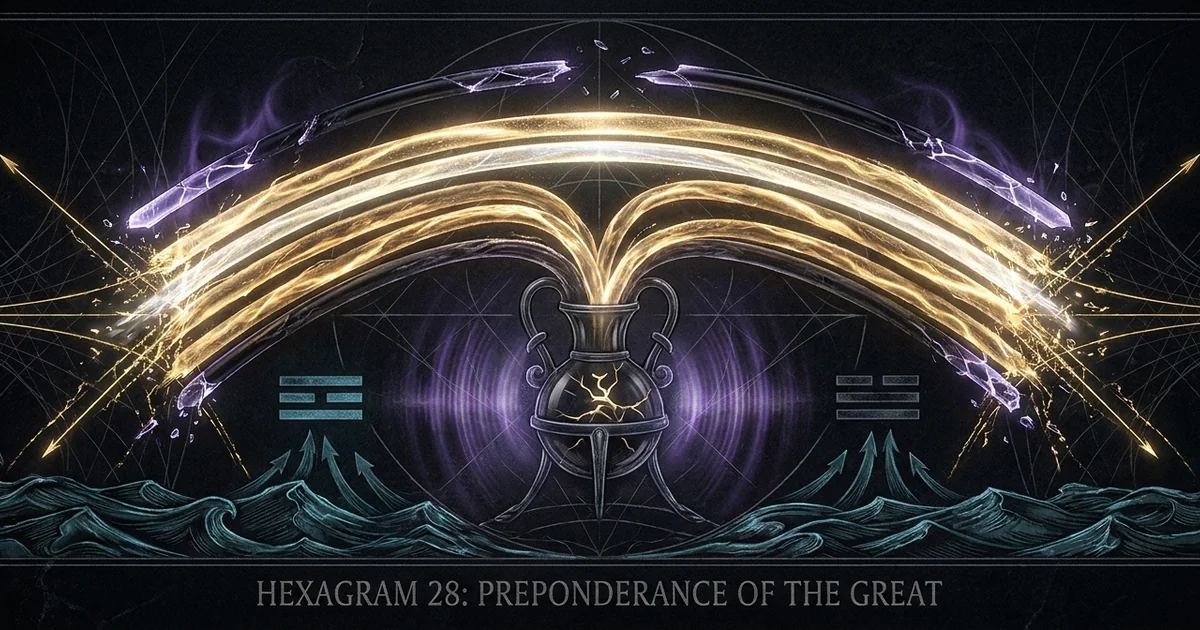
Hexagram 28 Preponderance of the Great (Dà Guò): I Ching
Archetypal Thesis & Systemic Paradigm: The Mechanics of Structural Catastrophe
Hexagram 28 (Dà Guò, 大過), translated as “Preponderance of the Great” or “The Great Exceeding,” models a profound thermodynamic and psycho-structural crisis within the formal architecture of the I Ching. The hexagram depicts a critical state-space transition where an internal concentration of dynamic force fatally overburdens its perimeter containment constraints. In the structural topology of the hexagram, four robust, unbroken yang lines (lines 2, 3, 4, and 5) occupy the interior core, hemmed in at the base and apex by two yielding, broken yin lines (lines 1 and 6). This configuration provides an exact mechanical diagram of structural buckling: a load-bearing column or horizontal beam whose central mass has swollen far beyond the tensile capacity of its foundations and terminal anchors.
In classical Chinese cosmology, this mechanical failure is immortalized in the core judgment phrase: dòng ráo (棟橈), the “sagging ridgepole.” When the central beam of an architectural dwelling bends beneath an unsustainable load, the entire superstructure enters an irreversible threshold state. In the framework of non-equilibrium thermodynamics and complex systems analysis, Dà Guò represents a bifurcation point. Here, a system driven far from equilibrium by an excessive accumulation of latent energy can no longer preserve its current macrostate through standard negative feedback loops. The hexagram signifies neither ordinary error nor mere moral falling; it specifies the physics of an imperative macrocosmic threshold where systemic maintenance has become impossible, leaving radical transition as the sole ontological vector.
Vector Mechanics of the Sagging Ridgepole (Dòng Ráo)
The structural mechanics of the dòng ráo can be understood through the lens of classical beam deflection theory and structural engineering. In an idealized load-bearing assembly, external and internal vectors are distributed symmetrically through rigid supports to solid ground. In Dà Guò, however, the structural core possesses maximum stiffness (the uninterrupted continuity of lines 2 through 5, generating a solid block of pure yang), while the points of support (the bottom Yin at position 1 and the top Yin at position 6) possess zero structural resistance. The yielding nature of Yin signifies softness, elasticity, and void; when placed at the foundational base of an immense, rigid central block, this softness undergoes non-elastic deformation.
Rather than distributing its stress along a stable gradient, the central yang block concentrates shear strain precisely at the interfaces where line 2 meets line 1, and where line 5 meets line 6. As these terminal boundaries compress and tear under tension, the structural centerline bows outward. This bowing generates the classic phenomenon of the sagging ridgepole. The dà guò hexagram mathematically delineates the transition from linear strain to catastrophic non-linear failure. The four yang lines do not merely press; they expand outward, attempting to occupy a geometric volume that the surrounding boundary conditions cannot accommodate. Once the critical threshold of elastic limit is breached, any attempt to maintain the structural status quo accelerates collapse.
The Inversion of Ingestion: Dà Guò versus Hexagram 27 (I)
To grasp the architectural geometry of Hexagram 28, one must analyze it in direct relation to its complementary topological inverse, Hexagram 27 (I / Nourishment). Hexagram 27 is characterized by solid yang lines at the extreme periphery (lines 1 and 6) containing four yielding, broken yin lines within its interior (lines 2, 3, 4, and 5). It forms the graphic ideogram of an open mouth: firm outer jaws enclosing a hollow oral cavity designed for ingestion, assimilation, and metabolic integration. Hexagram 27 models the intake of substance, the maintenance of physical and psychic form through systemic replenishment, and the containment of receptive space by solid skeletal boundaries.
Hexagram 27 (I)                 Hexagram 28 (Dà Guò)
------- Yang (Outer Boundary)   - - - - Yin (Fragile Canopy)
- - - - Yin  (Hollow Interior)  ------- Yang (Hyper-Dense Core)
- - - - Yin  (Hollow Interior)  ------- Yang (Hyper-Dense Core)
- - - - Yin  (Hollow Interior)  ------- Yang (Hyper-Dense Core)
- - - - Yin  (Hollow Interior)  ------- Yang (Hyper-Dense Core)
------- Yang (Solid Foundation) - - - - Yin (Fragile Base)
Hexagram 28 reverses this topological relationship. Where Hexagram 27 is hollow at the core and solid at the perimeter, Hexagram 28 is hyper-dense at the core and depleted at the perimeter. If Hexagram 27 depicts an open mouth taking in nourishment, Hexagram 28 represents an organism whose internal organs have swollen to the point of bursting the skin. In systemic terms, Hexagram 27 is an assimilative system operating within rigid parameters, while Hexagram 28 is an overcharged system whose internal contents can no longer be processed, stored, or metabolically contained. In Dà Guò, ingestion has ceased; what remains is an unsustainable mass that must discharge its built-up potential into kinetic trajectory, or else suffer structural fragmentation.
Dynamic Equilibrium and Irreversible Systemic Rupture
When analyzing the hexagram 28 preponderance of the great iching meaning, one recognizes that dynamic equilibrium within complex systems is fundamentally homeostatic, relying on the constant dissipation of entropy. In Dà Guò, this balance fails because the internal production of entropy and kinetic pressure exceeds the dissipation rate permitted by the perimeter boundaries. This dynamic maps directly to catastrophe theory in consciousness, where continuous shifts in control variables produce sudden, discontinuous shifts in system state. The internal yang forces cannot be dialed down; they have gained an autonomous momentum that drives the system toward a cusp point.
Within the landscape of Jungian analytical psychology, Hexagram 28 delineates an acute psychic crisis: the confrontation between an ego complex of limited containment capacity and an overwhelming influx of numinous archetypal energy from the collective unconscious. Carl Gustav Jung demonstrated that when unconscious contents cross a critical quantitative threshold without adequate ego mediation, the psychic apparatus experiences structural buckling. The ego’s defensive boundaries—represented by the fragile outer Yin lines—are stretched to their absolute yield point. Under these conditions, passive resistance guarantees systemic dissociation or acute neurosis. The only viable path is the bold, conscious externalization of this energy: an intentional, heroic leap across the threshold before the ridgepole breaks and leaves the psyche submerged in archetypal dissolution.
Classical Provenance & Textual Lineage: The Historical Transmission of Dà Guò
The textual transmission of Hexagram 28 across the Zhou, Han, and Song dynasties reveals an unyielding interpretive consensus: Dà Guò is an oracle of catastrophic historical necessity. It does not speak of standard daily praxis or the stable maintenance of civil affairs, but of extreme, liminal moments when customary social forms, ethical systems, and structural alliances reach their absolute breaking point. The character Guò (過) carries a double valence: it denotes both an excess (exceeding, passing beyond) and an error or transgression. Yet the juxtaposition with Dà (大, the Great) elevates this excess beyond petty fault, transforming it into an ontological state where the extraordinary nature of the era mandates an extraordinary breach of conventional conduct.
大過。棟橈。利有攸往。亨。 Preponderance of the Great. The ridgepole sags to the breaking point. It furthers one to have somewhere to go. Success.
King Wen’s Judgment and the Historical Setting of Dynastic Transition
The primary judgment attributed to King Wen anchors Hexagram 28 in the existential crisis that accompanied the twilight of the Shang Dynasty and the nascent rise of the Zhou. King Wen composed or codified these texts under direct existential duress, imprisoned by the Shang tyrant Zhou Xin at Youli. In this sociopolitical crucible, the established cosmological order—symbolized by the ancestral authority and heavenly mandate of the Shang—was bending to its catastrophic collapse. The Shang dynasty was the imperial ridgepole of the known world, yet its inner decay and oppressive mass had hollowed out its structural integrity.
King Wen’s paradoxically hopeful formulation—“The ridgepole sags to the breaking point. It furthers one to have somewhere to go. Success”—derives entirely from this realization. Stasis under a collapsing roof is fatal. The only survival strategy when the structural parameters of an epoch are imploding is decisive directional movement: “It furthers one to have somewhere to go” (Lì yǒu yōu wǎng, 利有攸往). Survival and ultimate triumph demand abandoning the compromised shelter of traditional security. The actor must voluntarily step out into the uncharted wilderness of political revolution, personal reinvention, or spiritual transformation, transforming an impending structural catastrophe into an evolutionary leap.
The Duke of Zhou’s Line Statements: The Paradox of Withering and Rebirth
The line statements formulated by the Duke of Zhou deepen the systemic analysis of Dà Guò by tracking the precise, non-linear unfolding of structural stress from the foundational base to the ultimate apex. The Duke of Zhou deploys a series of paradoxical botanical and sociological metaphors, most notably the recurring motif of the withered willow tree (kū liú, 枯柳) and disproportionate intergenerational unions between the aged and the youthful. These images capture the unnatural, strained dynamics that occur when a system is pushed beyond its normal developmental lifecycle.
In the second line, the image is that of a withered willow putting forth new shoots (kū liú shēng tí, 枯柳生稊), paired with an older man taking a younger wife. In the fifth line, the imagery shifts decisively: a withered willow puts forth flowers (kū liú shēng huá, 枯柳生華), paired with an older woman taking a younger husband. The Duke of Zhou uses these precise pairings to illustrate the fine boundary between generative renewal and sterile, over-ripened expenditure. The shoot (Line 2) contains developmental vitality, demonstrating how raw yang force, when tethered to an embryonic yin ground, can briefly reinvigorate an exhausted structure. The flower (Line 5), by contrast, is a purely decorative, terminal dissipation of energy—a superficial flash of beauty that produces no root, heralds no harvest, and collapses back into exhaustion.
Wang Bi’s Neo-Daoist Commentary: Transcending Forms in Moments of Extremity
In his third-century commentary on the Book of Changes, the Xuanxue (Neo-Daoist) master Wang Bi redefined the understanding of Dà Guò by stripping away the moralistic, omen-based superstitions of the Han Dynasty commentators, replacing them with a metaphysics of structural dynamics and radical situational responsiveness. Wang Bi recognized that the danger inherent in Dà Guò stems from the four central yang lines attempting to resolve crisis by doubling down on their own rigidity. Because yang is inherently active, unyielding, and firm, its natural inclination under pressure is to reinforce its structural form, thereby compounding the weight that is already crushing the yin foundations.
Wang Bi argues that true mastery of Dà Guò requires the realization of ontological emptiness (wú, 無). The four yang lines can avoid breaking the ridgepole only by relinquishing their structural stubbornness and cultivating an internal malleability that accommodates the changing current of the time. When the central core insists on its established privileges and formal permanence, it ensures its own destruction. Wang Bi writes that in extraordinary times, ordinary virtues become fatal vices; fidelity to outdated forms becomes complicity in catastrophe. To navigate the preponderance of the great, the superior person must operate with total detached spontaneity, moving freely through the ruins of collapsing systems without clinging to the rigid geometry of the past.
Structural Mechanics & Symbolic Geometry: Trigram Polarity and Line Topography
The fundamental energetic dynamic of Hexagram 28 is revealed through the direct engagement of its two component trigrams: the lower trigram Xùn (☴, The Gentle / Wood / Wind) and the upper trigram Duì (☱, The Joyous / Marsh / Lake). In the cosmological cartography of the I Ching, this specific stacking produces the potent natural image of Lake over Wind or Water over Wood:
Hexagram 28: Dà Guò (Preponderance of the Great)
Top:    - -  (Yin, Line 6)   \
Middle: ---  (Yang, Line 5)   | Trigram Duì (Lake / Marsh / Joyous)
Base:   ---  (Yang, Line 4)  /
-----------------------------------------------------------------
Top:    ---  (Yang, Line 3)  \
Middle: ---  (Yang, Line 2)   | Trigram Xùn (Wind / Wood / Penetrating)
Base:   - -  (Yin, Line 1)   /
This structural configuration presents an immediate environmental inversion. Trees and wooden structures belong firmly rooted on dry land, their canopies breathing the air of the upper atmosphere. In Hexagram 28, the tranquil marsh or deep lake (Duì) has risen above the forest, drowning the trees (Xùn). The water is not nourishing the wood; it is submerging it beneath an inescapable liquid mass. This spatial displacement represents a catastrophic inundation: the gentle, flexible, vegetative life-force at the base is asphyxiated by the heavy, stagnant waters resting directly above it.
The mechanical interaction between Upper Duì and Lower Xùn constitutes an engineering failure mode:
- Material Interface: Duì represents the fluid mass of the marsh, exerting unrelenting, non-directional hydraulic pressure downward. Xùn represents fibrous, flexible wood whose strength relies on axial tension and vertical transpiration.
- Submersion Paradigm: When the lake rises over the forest, wood loses its cellular rigidity through waterlogging. The load-bearing capacity of the material decays exponentially while the mass of the fluid above it remains constant or increases.
- Metaphysical Polarity: Duì is the joyous, seductive, expressive exterior; Xùn is the penetrating, compliant, subtle interior. The joyous exterior masks a fatal structural compromise, drawing the system deeper into the inundation until its internal flexibility is crushed.
Lake over Wind (Duì over Xùn): The Dynamics of Inundation
The phenomenon of the lake submerging the trees establishes an ecological metaphor of total system saturation. In ordinary environmental cycles, wind moves across the surface of the lake, creating ripples that oxygenate the water and disperse moisture across the land. This balanced relationship is preserved in Hexagram 61 (Zhōng Fú, Inner Truth), where Lake sits below Wind. In Hexagram 28, this natural order is inverted: the lake has climbed atop the wind; the water has swallowed the air. The dynamic vector of Xùn, which is typically upward-reaching and exploratory like vegetative growth, is forced into a state of structural submission.
This inundation radically alters the internal mechanics of the system. Wood immersed in deep water cannot maintain its dry tensile strength; its cellular walls absorb the surrounding fluid until it achieves negative buoyancy. In human and organizational terms, this represents a state of complete psychic or operational overwhelm. The administrative, psychological, or physical frameworks designed to channel daily activity are entirely flooded by circumstantial demands. The lake over wind trigram composition warns that the system is operating within a foreign element: it cannot walk, build, or govern according to terrestrial rules when the ambient medium has become a suffocating deluge.
The Six Line Trajectories: From Platted Rushes to Submersion Beyond the Head
The sequential progression of the six lines in the dà guò hexagram outlines the step-by-step unraveling of a structural crisis, mapping the transition from hyper-prudent prevention to tragic heroic dissolution:
- Initial Six (Line 1, Yin): Placing white rushes beneath an object. No blame. Positioned at the absolute base of the hyper-dense core, this yin line realizes its profound fragility. Recognizing that it cannot support the colossal yang mass above it through sheer strength, it resorts to radical delicacy, humility, and caution. By lining the ground with soft, platted white rushes before setting down heavy sacrificial vessels, it prevents the weight from shattering the base. This is the posture of extreme, hyper-aware circumspection at the onset of systemic instability.
- Nine in the Second Place (Line 2, Yang): A withered willow puts forth new shoots. An older man takes a young wife. Everything furthers. As the first line of the yang core, Line 2 directly interfaces with the yielding yin foundation below. Rather than fighting the base, it merges with it, generating a sudden, anomalous burst of vitality. The dry tree draws up subterranean moisture and produces fresh green twigs. This represents a rejuvenation of an exhausted paradigm through an unconventional, asymmetric partnership. It is productive, viable, and structurally stabilizing, granting the system a temporary reprieve from collapse.
- Nine in the Third Place (Line 3, Yang): The ridgepole sags to the breaking point. Misfortune. Occupying the peak of the lower trigram, Line 3 embodies pure, unyielding, self-righteous rigidity. It refuses to bend; it disdains the softness of the yin boundaries; it attempts to carry the entire cosmic weight through sheer obstinate force. As a direct consequence of this structural arrogance, the beam fractures. Euler’s buckling theory applies here with mathematical certainty: when a column’s internal stiffness refuses to yield to lateral deflection, it shatters catastrophically under axial compression. Line 3 marks the point of unmitigated collapse caused by ideological dogmatism.
- Nine in the Fourth Place (Line 4, Yang): The ridgepole is braced up. Good fortune. If there are ulterior motives, it is humiliating. At the base of the upper trigram, Line 4 achieves structural salvation through external reinforcement and balance. The sagging beam is propped up, the danger is temporarily neutralized, and stability is restored. However, the Duke of Zhou adds a profound psychological warning: if the actor uses this precarious stabilization for selfish maneuvering, covert manipulation, or “ulterior motives” (tā, 它), the provisional scaffolding collapses into deep disgrace.
- Nine in the Fifth Place (Line 5, Yang): A withered willow puts forth blossoms. An older woman takes a young husband. No blame. No praise. Line 5 sits in the ruler’s place, at the summit of the yang mass, adjacent to the fragile Yin line at the apex. Unlike Line 2, which puts forth generative shoots, Line 5 expends its remaining vital reserves in a terminal burst of non-reproductive flowers. The pairing of an older woman and a young husband symbolizes an expenditure of energy that yields no lasting posterity. It is an aesthetic, sterile twilight—blameless because it brings temporary elegance to an exhausted system, but unworthy of praise because it does nothing to prevent the structural implosion looming directly overhead.
- Top Six (Line 6, Yin): One must pass through the water. It goes over the head. Misfortune. No blame. The terminal Yin line represents the ultimate structural rupture. The lake waters break through the final boundary and submerge the subject completely. The individual attempts to ford the raging flood, but the current rises above their head. In conventional worldly terms, this is an unequivocal tragedy (xiōng, 凶, misfortune). Yet the text appends the highest ethical absolution: no blame (wú jiù, 無咎). The actor has not failed through negligence or cowardice; they have willingly embraced the sacrificial threshold demanded by an epochal transition, stepping into the lethal waters to chart a path toward the evolutionary reset of the cosmos.
Nuclear Core and Genetic Codon Correspondences
The structural analysis of Hexagram 28 reaches mathematical completion when examining its internal nuclear engine. When one extracts lines 2, 3, and 4 (the lower nuclear trigram) and lines 3, 4, and 5 (the upper nuclear trigram), an extraordinary geometric phenomenon emerges:
Hexagram 28: Dà Guò
Line 6: - -
Line 5: --- \
Line 4: ---  | Upper Nuclear: Qián (☰, Heaven)
Line 3: --- / \
Line 2: ---    | Lower Nuclear: Qián (☰, Heaven)
Line 1: - -   /
Both the lower nuclear trigram and the upper nuclear trigram are Qián (☰, Heaven / The Creative). Consequently, the nuclear hexagram embedded inside Hexagram 28 is Hexagram 1: Qián (The Creative)—pure, undiluted, hyper-concentrated yang energy. Hexagram 28 is not an ordinary situation that happens to be experiencing stress; it is the physical vehicle of Pure Cosmic Will (Qián) trapped inside an inadequate, brittle matrix. The immense spiritual, creative, and destructive potency of Hexagram 1 is compressed into a structural pressure chamber, generating an explosive potential energy that must inevitably rupture its outward boundaries.
In contemporary systems theory and structural biology, this exact energetic topography mirrors the dynamics of genetic stop codons and catastrophic molecular transcription checkpoints. In molecular genetics, specific nucleotide sequences signal the precise, non-negotiable termination of peptide synthesis. When an amino acid chain accumulates structural weight without encountering regular folding constraints, cellular machinery induces an immediate stop mechanism to prevent the synthesis of deformed, cytotoxic proteins. Hexagram 28 functions as an ontological stop codon within the sixty-four hexagram matrix: it halts the runaway accumulation of linear yang mass, dissolving the compromised form so that the genetic script of the cosmos can reset into the fluid depths of Hexagram 29 (Kǎn / The Abysmal Water).
Psychological Dynamics & Operational Praxis: Archetypal Containment and Deliberate Transgression
In the context of Jungian analytical psychology, the book of changes divination system does not function as an external predictive device, but as an acausal mirror mapping the exact topographic distribution of libido across the conscious and unconscious layers of the psyche. When Hexagram 28 emerges within a divinatory consultation, it delivers an urgent psychological diagnosis: the patient’s conscious ego architecture is undergoing catastrophic strain due to the uncontainable intrusion of transpersonal, archetypal contents.
+-------------------------------------------------------------+
|               COLLECTIVE UNCONSCIOUS (Duì)                  |
|             (The Rising, Inundating Flood)                  |
+-------------------------------------------------------------+
                              |
                              v (Downward Psychoid Force)
+=============================================================+
|             THE SAGGING RIDGEPOLE (Dòng Ráo)                |
|      Four Yang Lines: Massive Archetypal Over-Charge        |
|             (Hyper-Stiff Ego-Complex / Mania)               |
+=============================================================+
                              |
                              v (Basal Shear)
+-------------------------------------------------------------+
|                 SOMATIC GROUNDING (Xùn)                     |
|           (Line 1: Nervous Exhaustion / Rupture)            |
+-------------------------------------------------------------+
Ego Inflation and Archetypal Possession: The Jungian Tension of Opposites
Hexagram 28 provides a classic clinical profile of extreme ego-inflation (Aufgeblasenheit) followed immediately by acute psychic exhaustion. The four central yang lines represent an ego that has identified completely with the heroic, solar, patriarchal principle. It has accumulated power, intellectual certainty, administrative responsibility, and moral rectitude to a pathological degree. The ego believes it can carry the entire burden of its family, its organization, or its cultural epoch through sheer willpower alone. This dynamic is the classical psychic prerequisite for the emergence of the sacrificial hero, whose conscious identity becomes indistinguishable from the tragic, load-bearing cross it refuses to abandon.
Beneath this towering, rigid facade, the somatic and instinctual foundations are collapsing. The lower yin line signifies the vegetative nervous system, the physical body, and the fragile personal unconscious; the upper yin line signifies the permeable psychological boundary that separates individual consciousness from the vast, devouring collective ocean. As the central yang core pushes its demands to the absolute limit, the somatic base gives way to somatic illness, nervous collapse, or panic disorders, while the psychic canopy tears open, admitting irrational, oceanic contents from the archetypal deep. The individual feels as though they are holding up the sky while standing on a floor of cracked glass.
The Diagnostic Protocol for Hexagram 28 in Divinatory Consultation
When a querent receives Hexagram 28 in serious divinatory consultation, standard strategic advice—such as waiting for better conditions, preserving energy, seeking consensus, or exercising patience—is completely contraindicated. The diagnostic protocol for Dà Guò demands immediate, surgical intervention:
- Acknowledge Structural Inoperability: The consultant must disabuse the querent of the illusion that the existing situation can be patched, preserved, or incrementally reformed. The ridgepole is not merely creaking; it has suffered permanent micro-fractures. Any energy invested in keeping the old structure upright is wasted libido that will be crushed in the impending collapse.
- Locate the Asymmetric Outward Vector: The judgment insists: “It furthers one to have somewhere to go.” Passive endurance guarantees total destruction. The querent must identify an outward trajectory—a radical career shift, the termination of a toxic institutional allegiance, an audacious creative leap, or a drastic philosophical departure. The massive internal energy must be converted from static downward load into directional kinetic mobility.
- Deploy Extreme Micro-Prudence (Line 1 Protocol): Even as the macro-decision must be bold and decisive, its tactical execution must be handled with the delicate circumspection of placing white rushes under heavy bronze vessels. The querent must handle legal, financial, and interpersonal details with meticulous care to prevent premature, uncontrolled detonation of the crisis.
Line 2: The Withered Willow Puts Forth Shoots
- Structural Polarity: Solid Yang grounded immediately upon Yielding Yin at the base.
- Biophysical Vector: Upward vegetative regeneration; draws vitality from the moist subterranean root.
- Sociological Dynamic: An older man marries a young wife; fertile, generative asymmetry.
- Thermodynamic Outcome: Systemic renewal; entropy is reversed; energy is captured into structural growth.
Line 5: The Withered Willow Bears Blossoms
- Structural Polarity: Solid Yang dissipating upward into Fragile Yin at the apex.
- Biophysical Vector: Downward terminal exhaustion; expends remaining sugars in superficial aesthetic display.
- Sociological Dynamic: An older woman marries a young husband; sterile, unproductive expenditure.
- Thermodynamic Outcome: Pure entropy dissipation; no root, no seeds; system collapses immediately after the bloom.
Sacrifice as Cathartic Venting: Avoiding Catastrophic Structural Buckling
The essential praxis of Hexagram 28 centers on the art of voluntary structural sacrifice. In engineering, when an enclosed vessel experiences catastrophic internal over-pressure, safety protocols mandate the opening of pressure-relief rupture discs. If the system does not vent its own contents voluntarily, the vessel walls undergo explosive decompression. Similarly, in the human sphere, an individual caught within Dà Guò must consciously sacrifice a major component of their identity, ambitions, or social architecture to save the psychic core.
This sacrificial act requires the deliberate dismantling of the ego’s cherished defensive structures. One must resign the unmanageable executive post, terminate the unsustainable marital contract, walk away from the bankrupt business venture, or renounce the obsessive intellectual ambition. This is not an act of surrender or failure; it is an act of supreme operational intelligence. By voluntarily collapsing the compromised ridgepole in a controlled demolition, the actor preserves their vital core, avoiding the fatal fate of the unyielding actor in Line 3, and positioning themselves to navigate the subsequent deluge with complete spiritual autonomy.
Philosophical Synthesis & Macrocosmic Correspondence: Hermetic Axioms and Systemic Equilibrium
Beyond its operational application in divination and depth psychology, Hexagram 28 serves as a profound metaphysical thesis on the cosmological mechanics of balance, rhythm, and structural collapse. The hexagram embodies the ultimate operational phase of the Hermetic Principle of Polarity and the Principle of Rhythm. In Hermetic cosmology, every state of extreme manifestation inherently generates the gravitational pull of its opposite; the pendulum swing to the right necessitates the pendulum swing to the left. Dà Guò captures the cosmic pendulum at the precise microsecond of its absolute, unsustainable apex—the moment when the forward momentum of Yang has fully exhausted its kinetic license and is dragged by cosmic necessity into the abyssal waters of Yin.
“In a situation represented by Hexagram 28, the inner pressure of the archetypal field becomes so immense that it breaks the ordinary causal nexus of historical events. It is here that synchronicity manifests not merely as an intriguing coincidence, but as an overwhelming, catastrophic intervention of the Self. The conscious structure cannot hold; the individual is forced through a transpersonal initiation where the old world dissolves so that a radically new ordering principle can emerge from the unconscious depths.”
The Hermetic Principle of Polarity and Cosmic Over-Extension
The Hermetic axiom “As above, so below; as within, so without” finds in Hexagram 28 an exacting geometric blueprint. When the internal elements of a macrocosmic empire, a stellar body, or a microscopic cell expand beyond the capacity of their enclosing spheres, the boundary does not hold. In astrophysics, this corresponds to the Chandrasekhar limit: the maximum mass of a stable white dwarf star. Once electron degeneracy pressure can no longer support the gravitational mass of the star’s stellar core, the equilibrium shatters. The star collapses inward, resulting in either a catastrophic supernova explosion or the formation of a black hole.
Hexagram 28 is the metaphysical Chandrasekhar limit of the I Ching. It demonstrates that in the grand economy of the Dao, greatness (Dà) is not an absolute good to be pursued without limit. When greatness exceeds its containment parameters (Guò), it transforms into an existential liability. The universe preserves equilibrium not through the permanent maintenance of static structures, but through the cyclic annihilation of systems that have grown too heavy for their cosmic foundations. The four central yang lines represent the hubris of pure light, pure power, and pure form attempting to construct a permanent monument in a reality governed by impermanence and flux.
Homeostasis, Le Chatelier’s Principle, and Catastrophe Theory
In modern physical chemistry, Le Chatelier’s principle states that if a dynamic equilibrium is disturbed by changing the conditions, the position of equilibrium moves to counteract the change. In nonlinear dynamic systems, however, this homeostatic correction does not always occur smoothly. As developed by the French mathematician René Thom, catastrophe theory mathematically demonstrates how gradual, continuous changes in controlling variables can trigger sudden, discontinuous leaps in a system’s behavioral surface.
Control Space (Yang Mass) --------> Continual Accumulation
                                                  |
                                                  v
    [Smooth Homeostasis] ---> [Bifurcation Cusp] ---> [Discontinuous Catastrophic Jump]
                                (Line 3 Collapse)             (Line 6 Submersion)
Hexagram 28 maps directly to the geometry of the Cusp Catastrophe. As the yang mass accumulates across lines 2, 3, 4, and 5, the system initially adapts through linear elasticity (Line 1’s carefulness, Line 2’s shoots). However, as the energy continues to surge without a proportional expansion of the yin boundaries, the system reaches the fold curve of the catastrophe manifold. At this cusp, the state of the system can no longer change continuously. It must undergo a sudden, vertical, discontinuous drop: the structural snapping of the ridgepole in Line 3, or the total aquatic submersion of Line 6. Dà Guò mathematically models the moment where the rules of gradual adaptation cease, and the laws of catastrophic discontinuity take command.
The Soteriology of Line 6: Faultless Self-Sacrifice for Evolutionary Renewal
The supreme philosophical achievement of the Dà Guò sequence is found in its closing line, the Top Six: “One must pass through the water. It goes over the head. Misfortune. No blame.” Within ordinary utilitarian paradigms of ethics and survival, this outcome appears as unmitigated defeat. The actor has drowned; the mission has failed; the water has triumphed over the human form. Yet the classical text appends wú jiù (無咎)—no blame, no fault.
This judgment introduces an esoteric soteriology that elevates Hexagram 28 into an initiation manual for the sacrificial avatar. In the grand cycles of cosmic evolution, there are moments when an entire civilizational, spiritual, or psychological paradigm has become so hopelessly calcified, corrupted, or structurally burdened that no safe, dry path forward exists. Under these macrocosmic conditions, the individual who insists on personal safety, self-preservation, and the maintenance of their small, private ridgepole acts in direct opposition to cosmic necessity.
The heroic consciousness in Line 6 recognizes that the old world must be baptized in the waters of dissolution. By deliberately wading into the flood—knowing full well that the water will rise above their head—the actor transforms a passive, humiliating collapse into an intentional, consecrated self-offering. They absorb the full destructive brunt of the systemic catastrophe into their own being. In doing so, they exhaust the accumulated entropy of the era, clearing the field of the exhausted ridgepole and paving the way for the emergence of Hexagram 29 (The Abysmal Water), where pure life-force re-seeds itself within the primeval deep.
Frequently Asked Questions: Analytical Clarifications on Hexagram 28
Resolving Divinatory Ambiguities: Calamity versus Evolutionary Breakthrough
A primary ambiguity encountered by practitioners of book of changes divination is whether Hexagram 28 should be interpreted as an omen of unavoidable defeat or as an indicator of revolutionary triumph. The text explicitly promises “Success” (Hēng, 亨) in its primary judgment, yet immediately warns of a sagging ridgepole and ends in Line 6 with water rising over the head.
The resolution of this apparent paradox lies in the radical decoupling of the spiritual mission from the survival of the outer structure. Hexagram 28 guarantees success only if the querent abandons the objective of preserving the existing structural form. If the consultant defines “success” as keeping the bankrupt organization running, saving the hollow marriage, or maintaining an exhausted persona, Hexagram 28 represents pure calamity. The ridgepole will sag, and the roof will collapse. However, if the querent redefines success as liberating their vital energy from an unsustainable container and executing a bold, directional leap into the unknown (“It furthers one to have somewhere to go”), the hexagram promises complete evolutionary triumph. The catastrophe belongs entirely to the architecture; the breakthrough belongs to the liberated spirit.
The Strategic Significance of the Changing Lines in Situational Dynamics
When Hexagram 28 generates changing lines, the operational trajectory of the consultation shifts dramatically depending on where the systemic stress is being actively discharged:
- When Line 1 changes (to Hexagram 43, Guài): The need for extreme, meticulous caution is paramount. The system is entering the catastrophe field, and only radical humility, preparation, and careful placement of foundations can prevent an immediate, catastrophic breach.
- When Line 2 changes (to Hexagram 31, Xián): The excessive yang mass has found an asymmetric, fertile partnership with a soft, receptive base. The querent should actively cultivate unconventional alliances, creative cross-disciplinary ventures, and unexpected sources of youthful vitality to absorb the excess load.
- When Line 3 changes (to Hexagram 47, Kùn): The limit of structural obstinacy has been breached. The querent is clinging to dogmatic certainty and rigid control, which will result in sudden, humiliating failure. All aggressive forward momentum must cease immediately; the querent must yield before the beam snaps.
- When Line 4 changes (to Hexagram 48, Jǐng): Temporary external bracing is successful. The crisis is stabilized, but the querent must operate with total ethical purity and zero hidden agendas. Any attempt to exploit this provisional balance for egoic gain will shatter the scaffolding.
- When Line 5 changes (to Hexagram 32, Héng): The current success or vitality is an aesthetic, temporary bloom rather than a sustainable resurgence. The querent should enjoy the beauty of the moment without mistaking it for a permanent solution or investing long-term resources into its continuity.
- When Line 6 changes (to Hexagram 44, Gòu): The querent has crossed the threshold of personal control and entered the transpersonal deluge. The directive here is complete surrender to the transformational current, accepting the loss of the old identity without self-blame, guilt, or fear.
Differentiating Hexagram 28 (Dà Guò) from Hexagram 27 (I) and Hexagram 43 (Guài)
To attain mastery of the I Ching coordinate system, the practitioner must clearly distinguish Hexagram 28 from the structurally adjacent figures with which it shares morphological features:
Hexagram 27 (I)         Hexagram 28 (Dà Guò)     Hexagram 43 (Guài)
- - - - - - (Yang)      - - - - - - (Yin)        - - - - - - (Yin)
- -   - - - (Yin)       - - - - - - (Yang)       - - - - - - (Yang)
- -   - - - (Yin)       - - - - - - (Yang)       - - - - - - (Yang)
- -   - - - (Yin)       - - - - - - (Yang)       - - - - - - (Yang)
- -   - - - (Yin)       - - - - - - (Yang)       - - - - - - (Yang)
- - - - - - (Yang)      - - - - - - (Yin)        - - - - - - (Yang)
(Hollow Jaws: Ingestion) (Dense Core: Rupture)    (Ascending Yang: Expulsion)
As demonstrated, Hexagram 27 (I / Nourishment) is the exact geometric and operational inversion of Hexagram 28. Hexagram 27 features a hollow, receptive interior bounded by solid outer lines, modeling the sustainable intake, metabolic processing, and assimilation of energy within rigid structural limits. It is a system seeking food, boundaries, and conservation. Hexagram 28, by contrast, is completely overfilled: its core is solid, its boundaries are weak, and its challenge is not ingestion, but emergency dissipation and evacuation.
On the other hand, Hexagram 43 (Guài / Breakthrough) displays a dynamic configuration where five unbroken yang lines surge upward from the base, actively driving toward the elimination of a single remaining yin line at the very top. In Hexagram 43, the yang mass is not trapped or buckling under its own weight; it is a unified, resolute collective force marching forward to decisively expel the final vestige of corruption or darkness.
Hexagram 28 possesses no such directional unity. In Dà Guò, the yang core is trapped between two fragile yin lines, creating an internal pressure chamber that expands omnidirectionally against its ceiling and floor. Hexagram 43 is a revolutionary army scaling the castle wall; Hexagram 28 is a house whose massive timber frame is imploding under the intolerable weight of its own roof. The former requires resolute, public proclamation and decisive forward expulsion; the latter demands radical strategic evacuation, sacrificial catharsis, and immediate directional mobility before the structural coordinates collapse entirely. :::