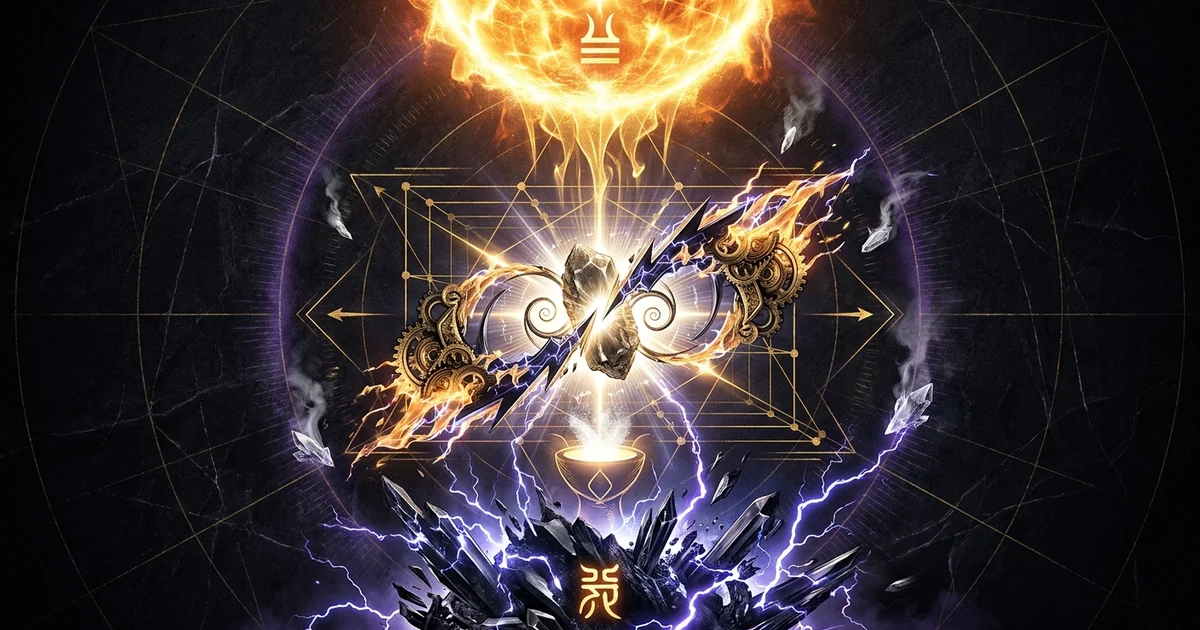
Hexagram 21 Biting Through (Shì Kè): I Ching Divination
Archetypal Thesis & Systemic Paradigm: The Energetics of Rupture and Correction
Hexagram 21 (Shì Kè, 噬嗑) represents an ontological blueprint for systemic correction, defining the exact thermodynamic and cognitive threshold where passive coherence fails and decisive, energetic rupture becomes structurally mandatory. In the taxonomy of the I Ching, this archetypal arrangement captures the phase-space transition of a dynamic system wherein equilibrium can no longer be sustained through assimilation, compromise, or quietude. Configured as Fire over Thunder, the hexagram constructs a kinetic circuit that unites acute intellectual discernment with explosive physical mobilization. In the language of cybernetic state spaces, Hexagram 21 models the execution of a corrective interrupt routine: an intentional, highly localized application of energy designed to shear an exogenous impedance that has hijacked the operational throughput of the macrocosmic or psychic organism. Divinatory mechanics articulate this not as wanton violence, but as the surgical restoration of systemic integrity through the decisive termination of ambiguity.
       HEXAGRAM 21: SHÌ KÈ (BITING THROUGH)

       ─── ───  Line 6 (Nine at the top)    [Upper Trigram: Li / Fire]
       ───   ───  Line 5 (Six in the fifth)
       ─── ───  Line 4 (Nine in the fourth)
       ───   ───  Line 3 (Six in the third)   [Lower Trigram: Zhen / Thunder]
       ───   ───  Line 2 (Six in the second)
       ─── ───  Line 1 (Nine at the base)
The Open Mouth Geometry: Psycho-Somatic Architecture of Shì Kè
The graphic architecture of the shì kè hexagram presents a direct somatic ideogram: an open mouth viewed in cross-section. The bottom line (an unbroken, firm nine) represents the lower jaw, while the top line (an unbroken, firm nine) defines the upper jaw and skull. Between these structural boundaries lie three broken, yielding lines (sixes in the second, third, and fifth positions) representing the soft internal tissues of the oral cavity—the tongue, gums, and palate. This organic cavity, however, is interrupted by a foreign structural density: the firm nine in the fourth place. This single yang line occupies the space between the jaws as an unyielding, foreign obstruction that prevents the mouth from closing. The somatic metaphor operating across the hexagram establishes that until this interstitial mass is severed and pulverized by deliberate mechanical force, no nutritional assimilation, communication, or metabolic rest can occur.
The biomechanics of mastication serve as an archetypal analogue for psycho-spiritual processing. Within Jungian archetypal psychology, an unassimilated psychic datum manifests as a foreign body—an autonomous complex that lodges itself within the conscious field, resisting the ego’s customary mechanisms of emotional digestion. When such an intrusion occurs, the psychic apparatus cannot simply wait for passive dissolution; the intrusive material is too dense, fibrous, or calcified to yield to soft somatic peristalsis. The firm fourth line demands that the jaws clench shut with calibrated violence. The hexagram 21 biting through iching meaning thereby establishes that true synthesis often requires an initial, uncompromising phase of structural rupture. Mastication is fundamentally an act of deconstruction, a biological reduction of complex, alien entities into manageable constituents that the organism can either assimilate or formally excrete.
Cybernetic Feedback Loops: Error Identification and Structural Cleavage
Approached through systems theory and cybernetics, Shì Kè formalizes the protocol for error elimination within closed communication networks. When an error signal persists across multiple systemic iterations, it ceases to be mere ambient noise and solidifies into an active structural blockage—a parasitic subsystem draining energy from the host network. At this juncture, continuing normal operations without addressing the pathology guarantees cascade failure. The configuration of the hexagram demonstrates that the corrective feedback loop requires two coupled variables: an analytical detection mechanism that precisely isolates the locus of error, and an actuator that applies the requisite kinetic load to sever it.
This kinetic sequence illustrates why Hexagram 21 cannot be understood through the lens of ordinary reactive hostility. Reactive hostility is an uncoordinated energetic discharge that lacks diagnostic precision. Conversely, Shì Kè pairs the incisive lucidity of the upper trigram with the subterranean, upward-surging torque of the lower trigram. The diagnostic light reveals the coordinate location of the ninth line in the fourth position, while the motor drive delivers the kinetic strike directly to that coordinate. This cybernetic feedback loop guarantees that the systemic cleavage is executed with minimal collateral damage to the surrounding soft tissue—represented by the yin lines. The obstruction is not negotiated with; it is subjected to immediate mechanical fracture, resetting the thermodynamic parameters of the system and restoring functional throughput.
Classical Provenance & Textual Lineage: From Zhou Bronzes to Song Jurisprudence
The historical development of Hexagram 21 reflects the evolution of ancient Chinese political technology, transforming archaic penal practices into a profound cosmological philosophy of social and spiritual hygiene. The textual lineage, extending from late Shang and early Zhou epigraphy to the Neo-Confucian commentaries of the Song Dynasty, documents a continuous effort to harness the violent reality of punitive action within a transcendent, ethical mandate. In this tradition, divination is not a passive mirror of fate, but a diagnostic tool of governance deployed to identify where the flow of the Dao has been occluded by moral or judicial decay.
Epigraphic Origins: Zhouyuan Oracle Bone and Bronze Inscriptions of ‘Shì’
In archaic oracle bone inscriptions (jiaguwen) and Western Zhou bronze epigraphy (jinwen), the character Shì (噬) appears with the radical for the mouth (kou, 口) adjacent to an ideogram representing the snapping or biting motions of a predatory jaw, closely linked to the archaic character for divination or clearing doubts (shi, 筮). Early linguistic paleography reveals that the term was inextricably bound to legal enforcement, the settling of disputes, and the ritual slaughter of sacrificial victims. In the Bronze Age paradigm, the administration of penal sanctions—collectively known as the wuxing (Five Punishments: tattooing, amputation of the nose, amputation of the feet, castration, and decapitation)—was not viewed as human vengeance, but as a sacred ritual designed to excise spiritual corruption from the body politic.
The archaeological recovery of divination records from the Zhouyuan site reveals that early diviners cast Hexagram 21 when the ancestral state faced internal treason, treaty violations, or severe judicial impasses. The ancient Chinese state operated on the premise that an unpunished crime or an unresolved institutional fracture generated gu (parasitic miasma) that disrupted the seasonal cycles and offended the celestial hierarchy. Consequently, the act of Kè (嗑)—uniting the upper and lower jaws to crush an object—was the literalized performance of cosmic order asserting itself over terrestrial anarchy. Divination using the Yijing functioned as the sovereign diagnostic protocol that determined whether a punitive military expedition or capital execution was cosmically aligned, transforming the judicial axe into an instrument of natural law.
The Tuanzhuan and Daxiang Commentary: Penal Codes as Sacred Realignment
The canonical layers of the Ten Wings formalize this archaic judicial impulse into an enduring philosophical doctrine. The Tuanzhuan (Commentary on the Judgment) clarifies the mechanics of the hexagram by attributing its efficacy to the structural positioning of the trigrams and the distribution of firmness and yielding:
“Biting Through has success. It is favorable to let justice be administered… Thunder and lightning: The image of Biting Through. Thus the kings of former times made firm the laws through clearly defined penalties.” — Richard Wilhelm and Cary F. Baynes, The I Ching or Book of Changes (1950)
The Daxiang (Great Image Commentary) derives its civic imperative from the environmental phenomenology of the trigrams. The combination of lightning (Li) and thunder (Zhen) presents an awe-inspiring sensory assault. Lightning illuminates every obscure recess, exposing the hidden criminal or psychological distortion, while thunder unleashes a terrifying acoustic shock that shatters complacency. The commentary notes that the ancient kings did not invent laws out of tyrannical self-interest; rather, they modeled their penal codes on this meteorologic dynamic. Penalties were designed to be as clear and immutable as lightning, and their execution as immediate and shocking as thunder. The administration of justice was thus understood not as retributive vengeance, but as an act of cosmic hygiene, eradicating the legal and moral occlusions that prevented heaven and earth from communicating their benevolent life-force.
Neo-Confucian Dialectics: Cheng Yi and Zhu Xi on the Balance of Light and Lightning
During the Song Dynasty renaissance, the interpretation of Shì Kè underwent an intellectual shift under the influence of Neo-Confucian scholars Cheng Yi and Zhu Xi. Cheng Yi, in his I Chuan (Commentary on the Yijing), elevated the hexagram beyond the pragmatic machinery of criminal law, conceptualizing it as an internal and external dialectic between wisdom and power. Cheng Yi argued that if lightning appears without thunder, illumination remains purely intellectual—a sterile awareness that sees injustice or mental error but lacks the executive potency to eradicate it. Conversely, if thunder erupts without lightning, the kinetic energy is blind, violent, and erratic, functioning as crude tyranny or unintegrated rage.
+--------------------------------------------------------------------------+
|                      NEO-CONFUCIAN POLARITY MATRIX                       |
+--------------------------------------------------------------------------+
|  Trigram Li (Lightning / Light)      | Trigram Zhen (Thunder / Movement) |
|  - Principle: Clarity (Ming, 明)      | - Principle: Awe/Force (Wei, 威)  |
|  - Function: Structural Diagnosis     | - Function: Kinetic Execution     |
|  - Pathology if isolated:             | - Pathology if isolated:          |
|    Impotent intellectualization       |   Blind tyranny and brutal rage   |
+--------------------------------------------------------------------------+
|  SYNTHESIS IN SHÌ KÈ: Clear vision precedes the strike; awe seals law.   |
+--------------------------------------------------------------------------+
Zhu Xi expanded this formulation by focusing on the ethics of the fourth line. He observed that the firm nine in the fourth place represents the minister or executor of justice who must contend with the most entrenched, recalcitrant elements of the state or the psyche. Zhu Xi posited that in executing structural correction, the agent must embody the moral equanimity of the fifth line (six in the fifth, soft yet sovereign) while wielding the resolute hardness of the fourth line. Song jurisprudence utilized this dialectic to demand that magistrates continuously cross-examine their own interior motives before handing down sentences: the judge must possess the brilliant, unclouded lucidity of the fire trigram to perceive the true nature of the crime, paired with the detached, impassive authority of the thunder trigram to carry out the sentence without emotional contamination.
Structural Mechanics & Symbolic Geometry: Trigram Vectoring and Line Topology
The internal dynamics of Hexagram 21 are determined by the topological tension between its component trigrams, the trajectory of its line vectors, and its nuclear sub-architecture. As an operational system, the hexagram does not present a static condition; it is a pressurized container wherein vector forces collide with an obstacle, build up kinetic energy, and shatter the point of resistance.
The Trigrammatic Engine: Fire (Li) Over Thunder (Zhen)
The primary symbolic engine of Hexagram 21 consists of the upper trigram Li (Fire, Lightning, the Clinging) positioned above the lower trigram Zhen (Thunder, Movement, the Arousing). This spatial orientation generates an intense energetic asymmetry. The intrinsic vector of Fire is to flame upward, radiating light, heat, and visual clarity across the upper horizons of the system. The intrinsic vector of Thunder is to surge violently from the subterranean depths, breaking through stagnation with an upward-directed shockwave. Consequently, the two trigrams do not diverge into entropic distance; rather, Zhen rises directly into the field of Li’s illumination, and Li casts its penetrating brilliance down onto the source of Zhen’s eruption.
       TRIGRAM ARCHITECTURE OF HEXAGRAM 21

       ─── ───  Line 6: Yang   }
       ───   ───  Line 5: Yin    } TRIGRAM LI (Fire / Clarity)
       ─── ───  Line 4: Yang   } Ascends & Illuminates downward
       =========================================================
       ───   ───  Line 3: Yin    }
       ───   ───  Line 2: Yin    } TRIGRAM ZHEN (Thunder / Shock)
       ─── ───  Line 1: Yang   } Surges upward with kinetic force
This structural configuration creates an environment of total accountability. In traditional dynamic systems, motion can be hidden by darkness, or illumination can remain contemplative due to a lack of driving force. In Shì Kè, the two forces amplify each other in an escalating feedback loop: the brighter the lightning shines, the more obvious the systemic impediment becomes; the more violently the thunder shakes the base, the more urgent the necessity for rational, judicial control. The presence of the nuclear hexagram within Shì Kè further illuminates its internal friction. Extracting lines 2, 3, 4 yields the lower nuclear trigram Gen (Mountain), while lines 3, 4, 5 yield the upper nuclear trigram Kan (Water/Abyss). Together, they form the nuclear hexagram 39, Jian (Obstruction/Hardship). The structural core of Shì Kè is an authentic impasse: a subterranean mountain surrounded by dangerous waters. The biting action is not an easy bite through soft fruit; it is a high-stakes, hazardous operation conducted over the precipice of systemic collapse.
Line Vectoring and the Pathology of Resistance (Lines 1 through 6)
The six lines of Hexagram 21 map a granular phenomenology of resistance, charting the escalation of structural resistance and the corresponding increase in force required to eliminate it. Each line position represents a specific tier of the judicial or psychic drama, detailing the exact somatic and ethical consequences of the intervention.
+--------------------------------------------------------------------------+
|                     HEXAGRAM 21 LINE TOPOLOGY TABLE                      |
+--------------------------------------------------------------------------+
| Line | Polarity | Archetypal Image       | Structural & Diagnostic State |
+------+----------+------------------------+-------------------------------+
| 6    | Yang     | Cangue crushes ears    | Total auditory blindness;     |
|      |          |                        | catastrophic incorrigibility  |
| 5    | Yin      | Dried lean meat / Gold | Sovereign balance; calibrated |
|      |          |                        | firmness without cruelty      |
| 4    | Yang     | Dried gristly meat /   | The core impediment; hardest  |
|      |          | Metal arrows           | resistance requiring struggle |
| 3    | Yin      | Dried meat / Poison    | Archaic, toxic residue;       |
|      |          |                        | minor humiliation, no blame   |
| 2    | Yin      | Tender meat / Biting   | Easy penetration; excess      |
|      |          | into the nose          | zeal plunges too deep         |
| 1    | Yang     | Feet in the stocks     | Preventive correction; early  |
|      |          |                        | arrest of errant trajectory   |
+--------------------------------------------------------------------------+- Nine at the Beginning (Initial Line): “His feet are fastened in the stocks, so that his toes disappear. No blame.” Occupying the lowest position, this firm line represents the early stage of a transgressive impulse. The subject has taken the first steps toward error, but has not yet consolidated a pathological complex. The judicial intervention is preventive: the stocks immobilize the feet, temporarily suspending kinetic freedom to protect the individual from committing deeper infractions. The disappearance of the toes indicates an early, non-destructive loss of momentum that prevents catastrophic systemic error.
- Six in the Second Place: “Bites through tender meat, so that his nose disappears. No blame.” The yielding line occupies its correct central place in the lower trigram. The resistance encountered here is soft and easily penetrated (tender meat). However, because line two directly adjoins the hard, disciplinary force of line one, the corrective action is executed with excessive momentum. The nose plunges so deeply into the flesh that it disappears, signifying a minor loss of sensory boundary or an overzealous application of force. Because the intention is balanced and the structural target is authentic, the text accords no blame.
- Six in the Third Place: “Bites on dried meat and strikes on something poisonous. Minor humiliation. No blame.” Here, the yielding line sits at the apex of the lower trigram, transitioning toward the hard obstruction of the fourth line. The meat is no longer fresh; it is aged, tough, and desiccated. In attempting to bite through this calcified matter, the agent strikes an archaic toxic residue—a dormant pocket of systemic poison. The confrontation generates an unpleasant somatic reaction: the psychic or social system experiences the nauseating blowback of confronting long-repressed structural deceit. While the process produces embarrassment and discomfort, the eradication of the historical toxicity remains ethically correct.
- Nine in the Fourth Place: “Bites on dried gristly meat. Receives metal arrows. It is favorable to be mindful of difficulties and to be persevering. Good fortune.” This line is the structural pivot of the entire hexagram: the firm obstacle wedged between the jaws. The substance to be masticated is gristle attached to bone, demanding maximum energetic output. The “metal arrows” signify that the agent must possess both the unyielding hardness of metal and the absolute, linear rectitude of the arrow. The struggle is exhaustive; structural victory is not guaranteed by casual will, but requires sustained, conscious intentionality under extreme duress.
- Six in the Fifth Place: “Bites on dried lean meat. Receives yellow gold. Conscious of danger. No blame.” Occupying the sovereign, central position of the upper trigram, the fifth line represents the ultimate administrator of justice. The meat is tough and dry, requiring firm resolve, but because the line is yielding and occupies the central place, the agent wields power without tyrannical excess. The “yellow gold” symbolizes the enduring, incorruptible virtue of the golden mean. The administrator remains acutely conscious of the razor-thin margin between corrective discipline and sadistic domination, executing the necessary judgment with profound humility.
- Nine at the Top: “His neck is fastened in the wooden cangue, so that his ears disappear. Misfortune.” The hexagram concludes with an archetype of systemic tragedy. The hard line at the absolute extremity represents an incorrigible, obstinate refusal to accept systemic correction. The criminal or the pathologized ego has resisted every prior phase of feedback. In response, the macrocosm imposes the ultimate penal apparatus: the heavy wooden collar (cangue). The cangue is so expansive that it covers the ears, denoting complete sensory blindness to moral and cosmic instruction. The subject has become completely deaf to feedback, rendering systemic destruction inevitable.
Complementary Inversion: Hexagram 21 (Substance/Cleavage) Versus Hexagram 22 (Form/Grace)
The Yijing is arranged in structural dyads, where every odd-numbered hexagram is coupled with its inverse or complementary partner. Hexagram 21 forms an indissoluble metaphysical pairing with Hexagram 22, Bì, Grace. Where Shì Kè features Fire over Thunder, Bì reverses the spatial geometry to place Mountain (Gen) over Fire (Li). This topological inversion alters the primary systemic function from violent deconstruction to aesthetic containment.
Hexagram 21: Shì Kè (Biting Through)
- Trigram Configuration: Fire (Li) over Thunder (Zhen).
- Metaphysical Orientation: Substance, structural cleavage, radical justice.
- Operational Dynamic: Forcible penetration through surface appearance to shatter the real, underlying obstruction.
- Somatic Axis: The masticating jaws crushing bone and sinew.
- Systemic Goal: Total eradication of internal systemic occlusions; raw kinetic truth unmediated by politeness.
Hexagram 22: Bì (Grace / Adornment)
- Trigram Configuration: Mountain (Gen) over Fire (Li).
- Metaphysical Orientation: Form, aesthetic restraint, cultural ornamentation.
- Operational Dynamic: Cultivated containment of primordial fire beneath the still, harmonious exterior of the mountain.
- Somatic Axis: The adorned body, cosmetic beauty, ritual decorum.
- Systemic Goal: Prevention of friction through graceful boundaries; civilizing instinctual reality through surface harmony.
This dyadic relationship reveals that civilization cannot survive on either principle alone. Without Hexagram 21, the aesthetic grace of Hexagram 22 degenerates into empty, hypocritical formalism—a cosmetic facade that conceals systemic corruption beneath polite manners. Without Hexagram 22, the relentless, bone-crushing judicial clarity of Hexagram 21 collapses into perpetual inquisitorial terror, tearing apart the delicate social fabric through endless structural purges. Shì Kè provides the brutal, surgical foundation of unvarnished truth upon which the civilized beauty of Bì can safely rest.
Psychological Dynamics & Operational Praxis: Shadow Integration and the Scalpel of Discernment
When Hexagram 21 appears within a divinatory consultation, its operational presence signals an urgent, non-negotiable psychic imperative. It indicates that the querent has arrived at a cognitive threshold where continued reflection, passive empathy, or spiritual bypassing functions as a dangerous defense mechanism. The psyche is harboring an intractable mass that must be broken by deliberate ego-consciousness.
Jungian Shadow Confrontation: Severing the Autonomous Complex
In the framework of analytical psychology, the obstruction wedged between the jaws of Shì Kè corresponds directly to an autonomous, split-off shadow-complex. Carl Gustav Jung emphasized that complexes behave like independent psychic entities, possessing their own emotional charge, agenda, and defensive architecture. When such a complex lodges itself between the conscious ego and the deeper Self, it acts like the firm fourth line of the hexagram: it impedes the natural circulation of psychic energy (libido), distorting communications, producing somatic symptoms, and generating repetitive, self-sabotaging behavioral loops.
       CONSCIOUS EGO (Upper Jaw / Li: Lucidity)
       ----------------------------------------------------
       [ AUTONOMOUS SHADOW-COMPLEX: Line 4 Impedance ]
       ----------------------------------------------------
       UNCONSCIOUS SELF (Lower Jaw / Zhen: Motor Shock)
The confrontation required by Hexagram 21 is fundamentally an act of ruthless intellectual and ethical discrimination. Passive acceptance or gentle mindfulness is insufficient when dealing with a calcified complex. The complex feeds on ambiguity, flourishing precisely because the conscious mind refuses to formulate clear judgments about its nature. To “bite through” the complex means applying the analytical scalpel of discernment: the individual must explicitly name the pathology, establish its origins, dissect its rationalizations, and decisively strip it of its emotional supply. This is a painful process, captured in the imagery of striking poison and breaking teeth on gristle. It demands that the individual confront humiliating truths regarding their own repressed hostility, narcissism, or moral cowardice. However, this painful psychological mastication is the only method by which the energy trapped within the autonomous complex can be liberated and reintegrated into the wider personality.
The Human Design Synthesis: Gate 21 (The Hunter/Control) in the Ego Circuit
In the synthesis of the Human Design System—which maps the sixty-four hexagrams onto the genetic code and the energetic architecture of the BodyGraph—Hexagram 21 corresponds directly to Gate 21, known as “The Hunter” or the “Gate of Control.” Situated within the Heart/Ego Center, Gate 21 forms half of the Channel of Money (21–45), the material lifeline of the tribal circuitry.
In Human Design mechanics, Gate 21 is structurally linked to the physical heart, the gall bladder, and the metabolic throughput of the thyroid gland. Operating as part of the Codon Ring of Fire/Matter, it governs the distribution of material resources, territory, and boundary defense. When Gate 21 is distorted by not-self conditioning, the individual exhibits pathological control mechanics: either micromanaging others through authoritarian overreach or suffering somatic collapse via heart disease and thyroid exhaustion due to a chronic inability to enforce proper personal boundaries.
The archetype of the Hunter illuminates the biological reality underlying Shì Kè. The Hunter must control the resources of the tribe to guarantee its collective survival. This control requires determining what enters the tribal boundary, how meat is gathered and partitioned, and who is disciplined for endangering the community. Divinatory appearances of this gate point directly to battles over sovereignty. The querent is either failing to take command of their material and psychological territory—allowing external parasites to exploit their resources—or they are executing control through desperate, reactive tyranny. Gate 21 demands the cool, noble authority of the master hunter: one who waits for the correct tactical moment, identifies the target with absolute clarity, and unleashes the arrow without hesitation or emotional malice.
Diagnostic Reading Protocols: Differentiating Necessary Ruthlessness from Reactive Wrath
In applied divinatory praxis, navigating Hexagram 21 requires meticulous diagnostic discernment to distinguish between sacred, necessary ruthlessness and reactive, unintegrated wrath. When an individual receives Shì Kè, their initial emotional response is frequently tainted by fear of conflict or, conversely, a desire to unleash catastrophic aggression against an external adversary. The diviner must calibrate the querent’s understanding through rigorous systemic cross-examination:
- Locus of Obstruction: The diviner must first determine whether the obstruction wedged between the jaws is truly external (a bad contract, an abusive relationship, a toxic employee) or internal (a self-limiting belief, an addictive loop, an unresolved resentment). If the obstruction is internal, external aggression will only exacerbate the psychic fracture.
- The Proportionality of Force: The querent must be directed to examine which line of the hexagram is actively changing. If line one is active, the required intervention is minimal—a simple, preventive boundary. If line four is active, a protracted, exhausting confrontation is unavoidable. If line six is active, the hexagram warns that current punitive measures have crossed into deaf tyranny, signaling impending structural ruin unless aggression ceases immediately.
- Absence of Emotional Contamination: Classical jurisprudence dictates that justice cannot be administered while the magistrate is inflamed by personal vengeance. If the querent acts out of wounded vanity, spite, or panic, they will inevitably ingest the “poison” of line three without achieving the “gold” of line five. True biting through is dispassionate, precise, and executed purely to restore systemic equilibrium.
Philosophical Synthesis & Macrocosmic Correspondence: Hermetic Justice and Systemic Entropy
The operational principles codified in Hexagram 21 transcend the boundaries of East Asian thought, aligning with the core doctrines of Western Hermeticism, esoteric Kabbalah, and non-equilibrium thermodynamics. At this macrocosmic scale, the hexagram expresses a universal cosmic law: that without structural maintenance and the periodic, violent eradication of accumulated decay, all organized systems collapse into thermodynamic chaos.
The Hermetic Scalpel: Geburic Force within the Tree of Life
Within the Hermetic Kabbalah, Hexagram 21 maps directly to the fifth Sephirah of the Tree of Life: Geburah (Strength, Severity, Judgment). Positioned on the Pillar of Severity directly across from Chesed (Mercy, Loving-kindness), Geburah is the divine scalpel that prunes the cosmic tree. While Chesed expands, creates, and forgives without boundary, it risks generating an unmanageable cancer of formless proliferation. Geburah counteracts this expansion through the application of cosmic justice, using the sword to sever that which is degenerate, redundant, or corrupt.
       TREE OF LIFE PILLAR DYNAMICS (SEPHIRAH GEBURAH)

       [ CHESED: Unbounded Mercy ] <--- Dynamic Tension ---> [ GEBURAH: Severity / Justice ]
       (Risk: Unchecked, cancerous proliferation)            (Function: Surgical pruning)
                                    \                       /
                                     \                     /
                                   [ TIPHARETH: Solar Center ]
                                   (Equilibrium / Lucidity)
The synthesis of Shì Kè captures this Geburic dynamic with precision. The lower trigram Zhen provides the martial vigor associated with Geburah’s planetary ruler, Mars—unleashing the kinetic strike that breaks structural resistance. The upper trigram Li provides the brilliant, objective illumination of the solar center, Tiphareth. True Geburic justice is never blind sadism; it is the deliberate application of severity in the service of cosmic equilibrium. It understands that mercy shown to an active parasite is an act of ultimate cruelty toward the host. By breaking the hardened impediment, the sword of Geburah—like the jaws of Shì Kè—restores the pristine architecture of the divine cosmos.
Thermodynamics of Pruning: Dissipative Structures and Necrotic Elimination
From the perspective of contemporary physics and the study of non-equilibrium thermodynamics—pioneered by Ilya Prigogine—living organisms and complex social structures are fundamentally “dissipative structures.” They survive by operating far from equilibrium, constantly importing energy and matter from their environment while exporting the internal entropy generated by their metabolic processes. If a dissipative structure loses the ability to export entropy, that entropy accumulates internally, degrading its organizational fidelity until the system undergoes necrotic death.
+--------------------------------------------------------------------------+
|                     THERMODYNAMICS OF SHÌ KÈ (PRUNING)                   |
+--------------------------------------------------------------------------+
|  Healthy Dissipative System:                                             |
|  [ Free Energy Intake ] --> [ Dynamic Organization ] --> [ Entropy Out ] |
|                                                                          |
|  Pathological Impasse (Obstruction / 9 at 4):                            |
|  [ Free Energy Intake ] --> [ BLOCKED BY COMPLEX ]  --> [ Entropy Stays] |
|                             * Necrotic Decay Builds *                    |
|                                                                          |
|  Thermodynamic Cleavage (Hexagram 21):                                   |
|  [ Targeted Kinetic Shock ] --> [ Cleaves Obstruction ]                  |
|  --> [ Entropy Export Resumes ] --> [ Homeostasis Restored ]             |
+--------------------------------------------------------------------------+
Hexagram 21 is the thermodynamic operator of necrotic elimination. The nine in the fourth place represents an accumulated mass of structural entropy that the system has failed to export. The systemic imperative to “bite through” is the thermodynamic equivalent of cellular apoptosis or the biological pruning of dead tissue. In complex forest ecosystems, periodic fires (Li) ignited by lightning storms clear away the thick, desiccated underbrush that chokes the forest floor. If these clearing fires are suppressed, the fuel builds to such density that the eventual conflagration incinerates the mature trees and destroys the root system entirely. Shì Kè mandates the periodic, controlled burning of psychological and systemic underbrush to preserve the life of the macrocosmic canopy.
Acausal Synchronicity and the Calibration of Will
In his groundbreaking exploration of divinatory phenomena, C.G. Jung posited the concept of acausal-parallelism—meaningful, acausal coincidences wherein internal psychological states correlate with objective outer events. Divining Hexagram 21 marks a critical synchronistic threshold where the internal psychic necessity for structural severance synchronizes with an external crisis demanding decisive action.
“When an archetypal constellation reaches the critical turning point indicated by an oracle, the failure of the individual’s conscious will to execute the required structural rupture causes the energy to fall back into the unconscious. There, it activates the destructive, autonomous aspects of the archetype, manifesting externally as catastrophic fate or psychosomatic illness.” — Marie-Louise von Franz, On Divination and Synchronicity: The Psychology of Meaningful Chance (1980)
The appearance of Shì Kè indicates that the querent can no longer treat their dilemma as an abstract intellectual game. The synchronistic convergence of inner clarity and outer friction proves that the window for peaceful accommodation has definitively closed. In this critical phase-space, deliberate human will must align with cosmic law. The failure to deploy the scalpel does not preserve peace; it merely transfers the judicial execution from the conscious ego to the ruthless machinery of external fate.
Frequently Asked Questions: Advanced Divinatory and Structural Inquiries
Resolving Ambiguity: Hexagram 21 (Biting Through) Versus Hexagram 43 (Deciding/Breakthrough)
A recurring structural question in Yijing scholarship concerns the differentiation between Hexagram 21 (Shì Kè) and Hexagram 43 (Guài, Deciding/Breakthrough). While both hexagrams address the imperative for decisive, uncompromising action, their internal topological mechanics and systemic contexts are fundamentally different.
       HEXAGRAM 21 (SHÌ KÈ)                  HEXAGRAM 43 (GUÀI)

       ─── ───  Line 6 (Yang)                 ───   ───  Line 6 (Yin)
       ───   ───  Line 5 (Yin)                  ─── ───  Line 5 (Yang)
       ─── ───  Line 4 (Yang: Obstacle)       ─── ───  Line 4 (Yang)
       ───   ───  Line 3 (Yin)                  ─── ───  Line 3 (Yang)
       ───   ───  Line 2 (Yin)                  ─── ───  Line 2 (Yang)
       ─── ───  Line 1 (Yang)                 ─── ───  Line 1 (Yang)

       Core: Internal obstruction wedged      Core: Overwhelming flood of yang
       between jaws. Surgical mastication.    surging to expel a single yin outlier.
Hexagram 21 represents an internal obstruction. The problematic element (the firm nine in the fourth place) is lodged deeply within the structural interior of the mouth, encircled by yielding lines. The strategy here is mastication, deconstruction, and assimilation: the foreign body must be crushed between the upper and lower jaws. The danger in Hexagram 21 is striking poison or breaking teeth—collateral damage during the internal digestive process.
In sharp contrast, Hexagram 43 represents an external breakthrough. Here, five solid yang lines have surged upward from the base, massing together to decisively expel a single, precarious yin line that hovers at the absolute threshold (the top). The systemic strategy in Guài is not internal mastication, but public declaration and resolute eviction. The danger in Hexagram 43 is not toxicity during chewing, but emotional retaliation, hubris, or relying on crude physical violence when a legal, transparent proclamation is required. Shì Kè is an act of internal metabolic cleansing; Guài is an act of public political expulsion.
The Esoteric Significance of the Top Nine Cangue Line
The terminal line of Hexagram 21—the nine at the top—presents one of the most stark and chilling warnings within the entire divinatory corpus: “His neck is fastened in the wooden cangue, so that his ears disappear. Misfortune.” The esoteric significance of this line lies in the structural tragedy of an agent who has become completely identified with the machinery of discipline, or a transgressor who has rendered themselves impervious to cosmic feedback.
At the summit of the hexagram of justice, yang energy has reached its absolute extreme. The lightning of Li has turned into a blinding, searing glare; the discipline of the penal code has calcified into an unbending, totalitarian obsession. The cangue is not merely a tool of external punishment; it is an archetypal somatic symbol of terminal cognitive closure. Because the heavy wooden collar covers the auditory apertures, the individual can no longer hear:
- The warnings of their peers or mentors.
- The cries of those who are suffering under their overextended, punitive zeal.
- The subtle, corrective whisper of the Dao.
When the capacity for auditory reception is extinguished, consciousness becomes a closed feedback loop. The individual mistaken for a righteous judge has transformed into a deaf tyrant, and the individual mistaken for a resolute rebel has hardened into an incorrigible criminal. In divinatory consultations, the appearance of this line indicates that the querent has crossed the threshold where further assertion of will is suicidal. The time for corrective biting has passed; the system has frozen into an irreversible catastrophe of its own making.
Navigating Non-Punitive Inquiries: Shì Kè in Creative and Collaborative Contexts
When Hexagram 21 appears in consultations where no literal legal battle, criminal enterprise, or personal enemy exists—such as in artistic production, collaborative business architecture, or scientific inquiry—the archaic language of execution, metal arrows, and severed ears must be translated into operational principles of creative hygiene.
In creative and collaborative domains, Shì Kè signifies the immediate necessity for aggressive editorial pruning. In the evolution of an artistic work (a novel, an architectural blueprint, an orchestral composition), there inevitably arrives a phase where the system becomes clogged with extraneous material. The creator has introduced subplots, ornamental digressions, or conflicting aesthetic styles that act precisely like the gristle of line four: they prevent the work from closing into a unified, impactful whole. To “bite through” in an artistic context means executing ruthless editorial cuts—slashing precious scenes, eliminating redundant characters, and paring the work down to its structural core.
In corporate and collaborative ventures, Hexagram 21 demands the decisive termination of operational ambiguity. It points directly to projects paralyzed by consensus paralysis, where partners avoid addressing an underperforming asset, an ambiguous contractual clause, or an unproductive team member out of fear of interpersonal friction. Shì Kè asserts that polite avoidance is actively poisoning the enterprise. The leadership must display the courage of the fifth line: holding the sovereign center while using the surgical firmness of the fourth line to renegotiate terms, redefine jurisdictional boundaries, or terminate the partnership entirely. True collaboration does not mean avoiding conflict; it requires the continuous, dispassionate capacity to bite through structural impediments to preserve the shared enterprise.