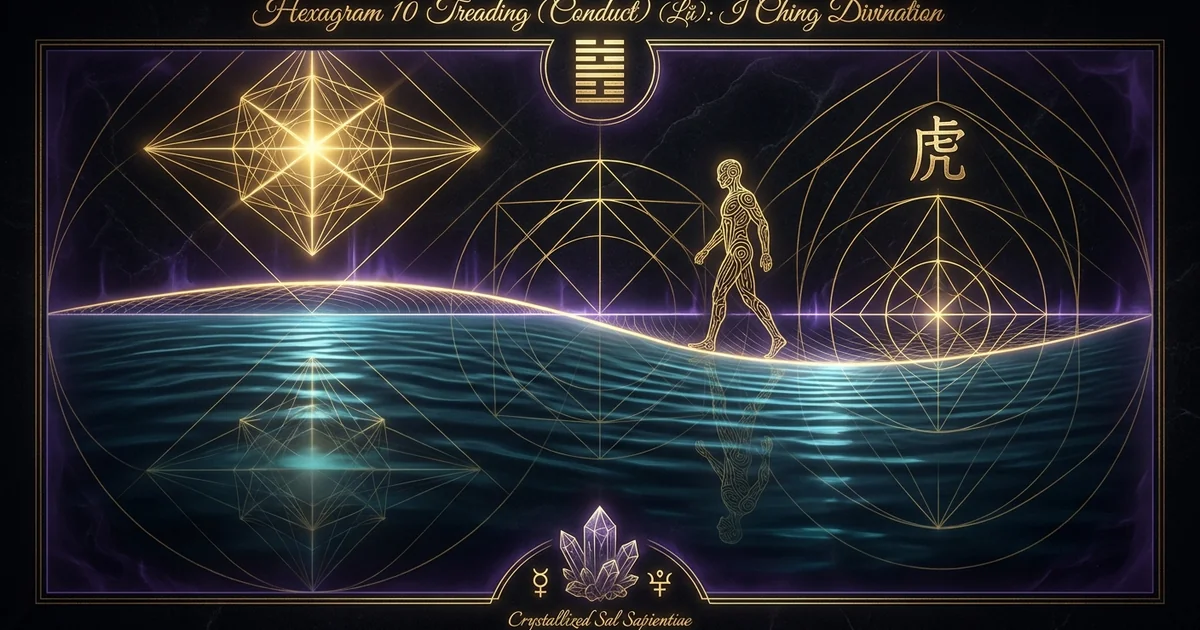
Hexagram 10 Treading (Conduct) (Lǚ): I Ching Divination
Archetypal Thesis & Systemic Paradigm: The Cybernetics of Conduct and High-Entropy Interfacing
Hexagram 10 (Lǚ / 履), conventionally rendered as “Treading” or “Conduct,” delineates the cybernetic protocol for navigating asymmetric power differentials. Within the architecture of the I Ching, this hexagram articulates how a localized, structurally fragile, yet highly sentient agent interfaces with an uncompromising, absolute ontological force without inducing catastrophic systemic collapse. The systemic paradigm embedded in Lǚ does not represent passive appeasement, servile deference, or moralistic fatalism; rather, it establishes an operational calculus of survival within high-entropy environments. By mapping the lower trigram Dui (兑, the Lake / The Joyous) beneath the upper trigram Qian (乾, Heaven / The Creative), the hexagram models a dynamic where receptive, articulate, and non-threatening consciousness directly tracks the trajectory of sovereign authority. The resultant interaction demonstrates how conscious behavior transforms a potentially lethal encounter into a stable trajectory of individuation and strategic continuity.
The Metaphor of the Tiger’s Tail: Engaging Untamed Sovereignty
The core imagistic formula of Hexagram 10—treading upon the tail of the tiger (履虎尾)—constitutes one of the most stark phenomenological representations of radical danger within the Book of Changes. The tiger is an archetypal signifier of primal sovereignty, an autonomous entity possessing overwhelming kinetic and lethal superiority that operates according to its own instinctual imperatives. To step on its tail is to provoke the boundary condition of death itself. Under standard physical and biological dynamics, violating the physical perimeter of an apex predator guarantees violent retaliation.
Hexagram Structure:
Line 6: ——— (Nine at the Top)     Trigram Qian (Heaven / Creative)
Line 5: ——— (Nine in the Fifth)
Line 4: ——— (Nine in the Fourth)
Line 3: —-— (Six in the Third)    Trigram Dui (Lake / Joyous)
Line 2: ——— (Nine in the Second)
Line 1: ——— (Nine at the Beginning)
Yet the primary oracle pronounces: “Treading upon the tail of the tiger. It does not bite the man. Success.” This formulation introduces a profound non-sequitur into linear logic. The predator’s restraint is not attributed to sudden domestication, nor to moral benevolence. It is entirely a function of the operational posture assumed by the agent who treads. The agent enters the sovereign space not with aggressive resistance or paralyzed dread, but through an exact sequence of non-reactive, harmonious, and strategically aligned movements. Conduct (lǚ) is thus defined as an energetic buffer: an operational boundary protocol that prevents the discharge of catastrophic violence by matching the rhythm and trajectory of the sovereign system.
Dui beneath Qian: Cheerful Attunement to Inexorable Cosmic Law
The structural geometry of heaven over lake is foundational to decoding the mechanics of Hexagram 10. Qian, positioned above, embodies pure unconditioned Yang: unyielding, relentless, cosmically programmatic, and devoid of sentimental attachment. Dui, positioned below, represents the youngest daughter, the metal principle rendered permeable, expressive, receptive, and interiorly joyful. The psychological and cybernetic implications of this arrangement are absolute. If the lower element met the unyielding pressure of Qian with equal, rigid opposition (such as another Yang trigram or aggressive counter-assertion), the collision of two uncompromising forces would result in catastrophic structural fracture.
Instead, Dui navigates Qian through joyful compliance and profound relational tact. This is not simulated compliance or deceptive manipulation; it is an authentic internal posture of cheerful attunement to inexorable cosmic law. Dui recognizes the absolute reality of Qian’s power without resentment. By approaching sovereign weight with clarity, lightness, and precise etiquette, Dui disarms the reactive triggers of the upper force. The Lake rests beneath the vaulted canopy of Heaven, reflecting its cosmic movements without attempting to constrain its boundaries. In this relational architecture, the lower trigram maintains its integrity precisely because it offers no resistive surface against which Qian can discharge its crushing force.
Conduct as Vector Field: Navigating Catastrophic State Spaces
When treated as an analytical model for decision theory, Hexagram 10 conceptualizes conduct as a continuous navigation of a dynamic vector field. A human agent navigating complex institutional hierarchies, geopolitical conflicts, or psychic numina moves through a state space saturated with invisible tripwires and lethal power gradients. In such an environment, conduct cannot be reduced to static codes of etiquette or rigid moral dogma. Rather, lǚ functions as real-time feedback processing. Every step taken by the localized observer alters the equilibrium of the entire field.
The systemic problem addressed by Hexagram 10 is the mitigation of systemic reactivity. When interacting with an entity whose energetic throughput dwarfs one’s own, a single micro-gesture of defiance, unconscious entitlement, or clumsy positioning triggers an automatic, devastating response. Impeccable conduct neutralizes this feedback loop. By systematically eliminating unconscious hubris, territorial posturing, and emotional reactivity, the practitioner of lǚ moves through catastrophic state spaces undetected by the predator’s defensive instincts. Survival and subsequent success become mathematically predictable outcomes of precise, self-effacing alignment with the dominant environmental geometry.
Classical Provenance & Textual Lineage: Historical Transmissions of Lǚ
The lineage of Hexagram 10 reveals an evolution from brutal political realities of the Western Zhou dynasty into an advanced metaphysical technology within the Neo-Confucian and Daoist commentaries. The historical progression demonstrates how concrete historical trauma—the precarious existence of ministers serving mercurial, despotic sovereigns—was abstracted into universal cosmological principles governing the relationship between the individual consciousness and macrocosmic necessity.
The Western Zhou Matrix: Courtiers, Kings, and Imperial Peril
In the socio-political crucible of the Western Zhou period (c. 1046–771 BCE), the metaphor of treading on the tiger’s tail was neither poetic abstraction nor psychological archetype. It emerged directly from the existential terror experienced by nobles, retainers, and diviners operating within the immediate orbit of the Zhou King. The early text of the Zhouyi reflects a society wherein royal favor was inherently volatile, and an imperial whim could precipitate the execution of an entire lineage. The King of Zhou, styling himself as the Son of Heaven (Tianzi), wielded the sovereign power of the Upper Trigram Qian, while his courtiers operated in the subordinate, vulnerable position of Dui.
Under these conditions, court etiquette was codified as a matter of immediate physical survival. The rituals of approach, prostration, gaze management, and speech cadences were life-preserving techniques. Archival evidence from bronze inscriptions reveals that ancestral sacrifices and administrative appointments required absolute precision in ritual performance; the slightest procedural error (shi yi) was construed as an ontological disruption capable of invoking ancestral wrath or royal vengeance. Hexagram 10 codified these visceral political survival strategies into the divinatory canon, establishing that impeccable comportment could pacify even the most bloodthirsty and unpredictable sovereign apex.
Wang Bi’s Exegesis: The Metaphysics of Yielding in the Center
During the Three Kingdoms period, the brilliant youth prodigy Wang Bi (226–249 CE) radically restructured the interpretive paradigm of the Classic of Changes. Moving away from the elaborate, often mechanistic Han Dynasty systems of image-and-number (xiangshu), Wang Bi pioneered the meaning-and-principle (yili) school of interpretation, grounding the hexagrams in Daoist metaphysics of Non-Being (wu) and structural resonance. In his analysis of Hexagram 10, Wang Bi identifies the linchpin of the entire hexagram as Six in the Third place—the sole Yin line in the entire hexagram.
“Here, a single Yin treads upon five Yang lines. If the weak attempts to tread upon the strong with arrogance, it will suffer injury; but if it treads with utmost compliance and yields according to principle, even Heaven cannot overpower it, let alone a tiger. Qian is Heaven and Dui is Lake. Lake is that which is tread upon by Heaven, yet it finds joy in submitting. Because it employs compliance to tread upon firmness, the tiger does not bite, and success is found throughout the world.”
Wang Bi’s exegesis focuses on the relational dynamics of the single Yin line. As the lone receptive element situated at the summit of the lower trigram Dui, it carries the entire burden of negotiating the unyielding phalanx of the upper Yang trigram Qian. Wang Bi demonstrates that if this single Yin attempts to mimic Yang force—adopting an aggressive, assertive, or entitled stance—it is immediately crushed by the sheer weight of the surrounding Yang lines. If, however, the agent recognizes its constitutive ontological fragility and uses non-combative intent to navigate the field, it neutralizes the hazard. For Wang Bi, the tiger does not bite because the stepping agent offers no oppositional surface against which the predator’s aggression can crystallize.
Confucian Institutionalization: Lǐ (Propriety) as Ontological Order
With the emergence of the Ten Wings (Shi Yi), particularly the Da Xiang (Great Symbolism commentary), the Confucian school systematically aligned Hexagram 10 with the fundamental virtue of lǐ (禮: ritual propriety, decorum, and structural boundary maintenance). The Da Xiang famously declares:
“Above is Heaven, below is the Lake: the image of Treading. Thus the superior man discriminates between the high and the low, and thereby stabilizes the aspirations of the people.”
This commentary transforms lǚ from an ad-hoc tactical survival maneuver into the cornerstone of socio-cosmic architecture. In the Confucian worldview, societal chaos and psychological fragmentation arise when structural distinctions are obliterated by uncontrolled ego drives. When the lake forgets that it lies beneath heaven, or when the minister presumes the sovereign prerogative of the king, the organic hierarchy collapses into systemic warfare. By “discriminating between high and low” (bian shang xia), the cultivated individual does not endorse oppressive caste rigidities, but rather acknowledges the ontological reality of structural functionalism. Knowing one’s precise coordinates within a hierarchy eliminates ambiguous authority structures, harmonizes personal desire with collective duty, and preserves societal peace through voluntary adherence to boundary conditions.
Structural Mechanics & Symbolic Geometry: Trigram Dynamics and Hexagram Architecture
A rigorous structural analysis of Hexagram 10 demands an examination of its inner and outer trigrams, its internal nuclear core, and the developmental continuum mapped across its six individual lines. The geometry of Lǚ is characterized by extreme mechanical tension, operating on the exact threshold between evaporative combustion and fluid, reflective stabilization.
- Base Hexagram: Hexagram 10 (Lǚ / Treading)
- Trigrammatic Upper Composition: 乾 (Qian / Heaven / Pure Yang / Father / Celestial Dynamic)
- Trigrammatic Lower Composition: 兑 (Dui / Lake / Joyous Yin / Youngest Daughter / Open Receptive)
- Nuclear Core Hexagram: Hexagram 37 (Jia Ren / The Family / Domestic Alignment)
- Nuclear Upper Trigram: 離 (Li / Clarity / Fire) — generated from lines 3, 4, and 5
- Nuclear Lower Trigram: 巽 (Xun / Gentle Penetration / Wind) — generated from lines 2, 3, and 4
- Inverse / Relational Complement: Hexagram 9 (Xiao Chu / Small Taming) — where Wind rests above Heaven
- Line Composition: Five Yang lines (Lines 1, 2, 4, 5, 6) surrounding a single Yin line (Line 3)
Trigram Polarity: The Evaporative Tension of Metal over Metal
In the system of Five Elements (Wuxing), both Qian and Dui belong to the domain of Metal (Jin). However, their structural expressions represent polar extremes of this element. Qian is hard, unyielding, circular, celestial metal—the sword, the cosmic forge, and unbending sovereign decree. Dui is soft, fractured, permeable metal—the reflecting mirror, the ritual vessel, and the opening mouth. When Heaven rests over the Lake, a natural cosmic equilibrium is depicted: the high remains high, and the low remains low.
Yet, thermodynamic tension exists within this pairing. Under standard physical conditions, the heat and continuous cosmic movement of the celestial dome (Qian) cause the waters of the lake (Dui) to evaporate. If Dui is unstable, its waters dry out, leaving a cracked and sterile seabed. Conversely, the open mist of Dui rises to condense within the upper vaults of Qian. For the Lake to survive beneath Heaven without suffering evaporative exhaustion, it must remain continuously fed by internal springs of psychic clarity and structural joy. The lower trigram must preserve its deep coolness, reflecting the dazzling brilliance of the upper trigram without being consumed by its heat.
Nuclear Core Analysis: Trigrammatic Interiority of Hexagram 37 (Jia Ren)
The hidden metaphysical engine of Hexagram 10 resides within its nuclear core (huti). Lines 2, 3, and 4 generate the lower nuclear trigram Xun (Wind/Wood), while lines 3, 4, and 5 generate the upper nuclear trigram Li (Clarity/Fire). Together, these form Hexagram 37, Jia Ren (The Family or Household).
The presence of Jia Ren at the core of Lǚ reveals a vital esoteric principle: external conduct (Treading) can only be successfully sustained if it is anchored in internal household order and moral rectitude (Jia Ren). The wind (Xun) emerging from clarity and warmth (Li) signifies speech that originates from an integrated center and actions that adhere strictly to inner systemic laws.
One cannot tread safely upon the tiger’s tail if one is internally divided, morally fractured, or psychically chaotic. The predatory outer environment will instantly smell the sweat of internal confusion. Only when an individual’s internal psychic household is harmonized—where the inner faculties occupy their rightful places, governed by the illuminating clarity of Li and the adaptable penetration of Xun—can the external personality present an unshakeable, non-reactive front to outer sovereigns.
Line Topography: The Six Regimes of Conduct from Simplicity to Culmination
The developmental journey through Hexagram 10 maps six distinct energetic postures, illustrating how conduct must adapt as an agent advances deeper into dangerous relational terrain.
Line 6: [———] Transcendent Retrospect: Looking back upon conduct; complete supreme good fortune.
Line 5: [———] Resolute Sovereign Decisiveness: Aware of absolute danger; persistent rectitude.
Line 4: [———] The Sovereign Threshold: Stepping upon the tiger's tail with trembling fear; victory.
Line 3: [— —] The Structural Anomaly: The blind who sees, the lame who treads; the tiger bites.
Line 2: [———] The Solitary Wayfarer: The path of the reclusive sage; quiet inner peace.
Line 1: [———] Pristine Simplicity: Plain conduct without social entanglement; walking forward free of blame.
- Nine at the Beginning: “Simple conduct. Progress without blame.” Here, the agent is at the foundational base, uncorrupted by societal vanity, status anxiety, or complex political calculations. By remaining unpretentious, straightforward, and emotionally self-contained, one moves forward without accumulating karmic debris or drawing the predator’s gaze.
- Nine in the Second Place: “Treading a smooth, level path. The quiet persistence of a dark, solitary man brings good fortune.” Situated in the central place of the lower trigram, this line demonstrates the conduct of the detached philosopher or recluse. Free from the gravitational pull of social advancement and court intrigues, the agent treads a quiet, internalized path. By withdrawing the ego from competitive arenas, the tiger ceases to exist as an active threat.
- Six in the Third Place: “A one-eyed man can see; a lame man can tread. He treads upon the tiger’s tail; the tiger bites the man. Misfortune. The warrior acts thus for his great lord.” This represents the focal catastrophe of the hexagram, analyzed extensively below.
- Nine in the Fourth Place: “Treading upon the tail of the tiger. Fear and trembling. Ultimately good fortune.” Positioned at the critical boundary where Dui meets Qian, the agent directly steps into the immediate strike zone of the sovereign predator. Unlike the delusional hubris of Line 3, Line 4 is entirely conscious of the mortal stakes. The internal disposition of “fear and trembling” (suo suo) denotes hyper-vigilant mindfulness and absolute operational precision. This extreme respect for the lethal nature of the environment guarantees safe passage.
- Nine in the Fifth Place: “Resolute conduct. Perseverance with awareness of danger.” Here, the agent occupies the ruling, imperial seat of the upper trigram. Even as the sovereign, one is not exempt from the laws of conduct. Unchecked, tyrannical self-assertion invites violent overthrow; hence, the leader must maintain continuous awareness of the existential precariousness of power (zhen li). Decisive action must be balanced by relentless self-monitoring.
- Nine at the Top: “Look to your conduct and examine the omens. If everything is complete, supreme good fortune ensues.” At the culmination of the hexagram, conduct transcends tactical maneuvering and becomes a comprehensive life assessment. The agent reflects upon the entire cyclical trajectory of their actions. If the path was walked with sustained integrity, modesty, and structural precision, the evolutionary process reaches total completion (yuan ji).
Psychological Dynamics & Operational Praxis: Shadow Confrontation and Line Divination
Interpreted through archetypal psychology, Hexagram 10 ceases to be an external manual of political etiquette and emerges as a sophisticated blueprint for the integration of the Jungian Shadow and the assimilation of the autonomous numinosum. The tiger is not an external tyrant; it is the wild, instinctual, and non-negotiable substrate of the collective unconscious.
The Archetype of the Predator: Jungian Shadow Integration
In Jungian metapsychology, the conscious ego exists as a fragile, specialized surface floating atop an ocean of instinctual, primordial energy. The upper trigram Qian, when confronted directly by the ego without the protective buffering of archetypal literacy, presents itself as the terrifying numinosum—the mysterium tremendum et fascinans. The tiger is the vital, predatory shadow of this numinosum. It embodies raw evolutionary drive, animal rage, the power of systemic violence, and unvarnished vitality.
To attempt to domesticate, suppress, or moralize against the tiger is an act of catastrophic foolishness. The conscious ego cannot defeat the archetypal unconscious through brute will. When a human subject enters profound depth analysis or encounters immense unconscious material—often manifested as deep somatic panics, terrifying dreams, or eruptive instinctual drives—the only psychological protocol that prevents an ego-shattering psychosis is the discipline of Lǚ.
The ego (Dui) must adopt a posture of profound respect, joyous receptivity, and ritual precision toward the autonomous power of the Self (Qian). It must tread behind the instinctual energies, conscious of their lethality, acknowledging their priority, yet refusing to collapse into blind unconscious identification. This requires the cultivation of a psychological boundary system capable of tolerating extreme energetic stress without fragmenting into neurosis or defensive inflation.
The Paradox of Six in the Third: Blind Audacity and Systemic Retribution
Six in the Third place provides the canonical psychological case study of ego inflation (hubris) meeting archetypal reality. The line text presents an architectural pathology: “A one-eyed man can see; a lame man can tread.” The diagnostic insight of this metaphor is striking. The one-eyed man possesses partial vision, yet he operates under the delusion of complete stereoscopic sight. The lame man can move, yet he deludes himself into believing he possesses the agility of an Olympic runner.
          [ THE STRUCTURAL TRAP OF SIX IN THE THIRD ]

                    Line 4: Yang (Heaven) ── Impervious Power
                             ▲
                             │ (Frictional Collision)
                             ▼
Line 3: Yin (Lake) ── Inflated Ego / False Competence (The "One-Eyed" Walker)
                             ▲
                             │ (Entangled Over-Extension)
                             ▼
                    Line 2: Yang (Lake) ── Grounded Reality
This single Yin line sits at the pinnacle of the lower trigram Dui, where the joyous element becomes overly expressive and tips into performative vanity. It believes itself capable of commanding the towering Yang lines of Qian above it. In practical psychological terms, this is the initiate who reads three books on occultism or psychology and declares themselves an enlightened adept. It is the junior executive who mistakes political proximity to the CEO for sovereign authority.
The text warns: “The warrior acts thus for his great lord.” The inflated ego imagines itself a great hero fighting a noble war, but it is merely projecting its unexamined aggression onto a lethal screen. When this delusional, partially blind, partially crippled psychological complex attempts to tread upon the tiger’s tail with unearned arrogance, the systemic feedback is instantaneous and merciless: “The tiger bites the man. Misfortune.” The unconscious devours the inflated ego, resulting in somatic breakdown, catastrophic professional disgrace, or profound psychic fragmentation.
Praxis of Nine in the Fourth and Fifth: Fearful Vigilance versus Resolute Sovereignty
The contrast between Six in the Third and Nine in the Fourth illuminates the precise boundary between psychotic inflation and masterful archetypal navigation.
Six in the Third: The Hubristic Fall
- Somatic / Structural Status: “The one-eyed can see; the lame can tread.” False sense of structural integrity based on partial, distorted perception.
- Internal Stance: Hubristic, performative, combative (“acts as a warrior for his lord”), entirely blind to actual power asymmetry.
- Relational Interface: Imposes itself aggressively onto the superior Yang field, treating sovereign authority as an arena for personal validation.
- Systemic Consequence: Catastrophic bite. Systemic retribution and psychological disintegration through direct predator retaliation.
Nine in the Fourth: Vigilant Circumspection
- Somatic / Structural Status: Fully integrated Yang line occupying a Yin position; acute awareness of structural limits and environmental stakes.
- Internal Stance: Radical humility, hyper-conscious apprehension, internal “fear and trembling” (suo suo).
- Relational Interface: Navigates the proximity of Qian with meticulous, calibrated steps, fully respecting the predator’s sovereign lethal perimeter.
- Systemic Consequence: Total immunity. “The tiger does not bite.” Successful passage through extreme hazard into ultimate good fortune.
Where Nine in the Fourth achieves mastery through radical humility and trembling circumspection, Nine in the Fifth operates within the theater of executive responsibility. The fifth line represents the ego that has been crowned: the individual who holds direct command over structural hierarchies.
Here, the psychological danger shifts from being bitten from above to being overthrown from within. The danger confronting the sovereign is the intoxicating illusion of absolute autonomy. The ruler must execute “resolute conduct” (kui lü), making severe and necessary systemic decisions, but must do so with unrelenting consciousness of structural precarity (zhen li). The moment a leader or integrated individual believes they have permanently tamed the tiger of systemic complexity, their downfall is sealed. The sovereign must live in the perpetual awareness that the throne itself rests upon the back of a living beast.
Philosophical Synthesis & Macrocosmic Correspondence: Hermetic Axioms and Cross-System Mappings
The cosmological mechanics of Hexagram 10 extend far beyond the borders of ancient Chinese thought, demonstrating universal principles that appear consistently across esoteric mapping frameworks, from Hermetic philosophy to modern systems of personal differentiation.
The Principle of Polarity and Rhythm: Harmonizing Asymmetric Planes
In the Hermetic tradition, the Kybalion articulates the Axiom of Polarity (“Everything is dual; everything has poles”) and the Axiom of Rhythm (“The measure of the swing to the right is the measure of the swing to the left”). Hexagram 10 serves as an operational demonstration of these laws when applied to asymmetric planes of existence.
Qian represents the positive, active pole of the celestial Macrocosm; Dui represents the negative, receptive pole of the terrestrial Microcosm. Under standard energetic physics, an interface between two radically unequal energetic potentials results in an arc of destructive discharge (lightning striking the earth, vaporizing the receptor). To prevent this discharge, the Hermetic practitioner employs the Principle of Rhythm. Rather than resisting the downward surge of celestial force, the adept establishes an oscillating rhythm of joyous yielding and structural alignment. By attuning the personal rhythm to the grand rhythm of universal law, the polarized planes achieve dynamic equilibrium.
The practitioner does not attempt to neutralize the tiger’s polarity; rather, they align their operational trajectory precisely parallel to it. The Hermetic axiom “As above, so below” finds its practical mandate here: the below (Dui) must mirror the majesty of the above (Qian) through the flawless beauty of its behavioral geometry.
Human Design Gate 10: Treading and the Behavior of the Self
In the Human Design synthesis, Hexagram 10 is mapped directly to Gate 10, designated as the “Gate of Treading” or the “Behavior of the Self,” situated within the Vessel of Love in the G-Center (the identity and direction hub). Within this system, Gate 10 operates as the primary architectural anchor for how an individual incarnates the love of being alive through authentic, differentiated personal behavior.
Human Design G-Center Architecture:
[ Gate 10: Behavior of the Self / Treading ]
         │
         ├── Channel 10-20 (Awakening) ── Connecting to Throat (Being in the Now)
         ├── Channel 10-34 (Exploration) ── Connecting to Sacral (Empowered Self)
         └── Channel 10-57 (Perfected Form) ── Connecting to Spleen (Intuitive Survival)
Gate 10 encodes the foundational behavioral codes of humanity. When the individual operates from the shadow frequency of Gate 10 (the “Self-Conscious” or socially conditioned false-self), they walk with the clumsy, presumptuous gait of Six in the Third. They alter their behavior to appease, dominate, or manipulate others, thereby constantly triggering systemic retaliation from the environment. They tread on the tiger’s tail with profound psychological incoherence, and life consistently “bites” them through rejection, exhaustion, and failure.
Conversely, when the individual operates from the gift and siddhi frequencies of Gate 10 (Naturalness and Being), conduct ceases to be a calculated performance. It becomes an effortless, autopoietic expression of unique individuality. The individual treads upon the path of their authentic geometry without encroaching upon the energetic territory of others. The “tiger”—the chaotic, predatory nature of the homogenized world—does not bite, because the authentic self emits no frequency of resistance, desperation, or territorial threat. One moves through dense social matrixes completely untouched, preserved entirely by the mathematical perfection of one’s own natural comportment.
Genetic and Astrological Correlates: From Epigenetic Balance to Saturnine Boundaries
The systemic mappings of Hexagram 10 extend into physical genetics and Western astrology, illustrating the somatic and celestial expressions of boundary maintenance.
“The confrontation with the numinosum demands an extraordinary precision of ritual attitude. In ancient divination systems, what is called ‘right conduct’ is nothing less than the psychophysical boundary defense required to keep the ego from being engulfed by archetypal projections. When the individual’s comportment matches the structural rhythm of the archetype, the lethal energy of the unconscious is converted into evolutionary libido. To miss the ritual step is to invite the predator of the deep.”
Genetically, Hexagram 10 correlates to the precise epigenetic mechanisms of cellular boundary control. A cell that cannot accurately interpret the high-entropy chemical gradients of its surrounding environment either suffers membrane rupture or initiates uncontrolled oncological replication. Epigenetic health is a cellular act of “treading”: it is the capacity of the cell to receive hormonal and environmental signals with open receptivity (Dui) while strictly maintaining the integrity of its central genetic script (Qian).
Astrologically, Lǚ represents the complex transitional dynamic between Saturn and Jupiter. Saturn enforces the uncompromising boundaries, hierarchical orders, and existential limits of the cosmic structure—the absolute reality of the upper trigram Qian. The novice views Saturn as a brutal, punitive predator waiting to devour those who transgress its boundaries.
However, when the individual integrates the lessons of Saturn through disciplined conduct, structural humility, and impeccable integrity, Saturnian limitation transforms into the expansive, joyful social elevation of Jupiter. Freedom is not the chaotic absence of boundaries; it is the mastery of constraint. One earns the right to tread freely across vast philosophical and societal landscapes precisely because one has mastered the exact art of not stepping on the tripwires of cosmic law.
Frequently Asked Questions: Technical Clarifications on Hexagram 10
Why Does the Tiger Not Bite: Determinism or Conditional Harmony?
The pronouncement that the tiger does not bite is strictly a conditional outcome, never an absolute deterministic guarantee. In the metaphysical mechanics of the Zhouyi, the hexagram establishes a conditional probability matrix based entirely on behavioral alignment. The predatory nature of the tiger remains structurally intact and eternally dangerous; at no point does the text suggest the animal is sedated, declawed, or transformed into a domestic pet.
The non-biting outcome is generated because the lower trigram Dui matches the dynamic vectors of the upper trigram Qian with complete non-combative harmony. The agent offers zero structural resistance, projects zero hostile intent, and executes movements with such impeccable grace and situational awareness that the predator’s lethal defensive circuitry is never activated. The moment the agent slips into the arrogant posturing of Six in the Third, the condition of harmony is violently severed, and the bite occurs instantaneously. The safety of the practitioner is an autopoietic, real-time accomplishment, preserved breath by breath through active, vigilant conduct.
How Does Hexagram 10 Differ Philosophically from Hexagram 9 (Small Taming)?
Hexagrams 9 and 10 represent an inverted pair (zong gua) within the King Wen sequence, providing complementary perspectives on the management of asymmetric power.
Hexagram 9 (Xiao Chu / Small Taming):   Trigram Xun (Wind) over Trigram Qian (Heaven)
Hexagram 10 (Lǚ / Treading):            Trigram Qian (Heaven) over Trigram Dui (Lake)
In Hexagram 9, the gentle, penetrative force of the single Yin line rests in the fourth position, placed above the raging Yang force of Heaven. Here, the weak attempts to restrain, tame, and accumulate the strong through subtle, indirect maneuvers, soft rhetoric, and continuous micro-adaptations—like the wind modulating the movement of clouds. It is the strategy of the indirect approach, holding back the storm until the conditions for rain are complete.
In Hexagram 10, the relational polarity is dramatically reversed. The raging Yang force of Heaven sits above, exerting direct, downward structural pressure upon the receptive, joyous Yin element below. Here, there is no possibility of “taming” or restraining the sovereign force; any attempt by the Lake to contain or control Heaven would result in immediate destruction. Therefore, Hexagram 10 abandons all ambition of control. It shifts the operational paradigm from taming the power to treading behind it. One does not guide the tiger; one follows it with meticulous steps, ensuring one’s survival through absolute behavioral alignment with an overwhelming cosmic trajectory.
Interpreting Hexagram 10 as an Unchanging Hexagram in Divination
When Hexagram 10 is received in a divination query without changing lines (jing gua), the oracle delivers an unambiguous message regarding systemic structural positioning. The querent is operating within a high-stakes, asymmetric environment dominated by forces vastly superior to their individual ego. These forces may manifest as monolithic corporate institutions, volatile geopolitical environments, severe legal predicaments, or overwhelming unconscious archetypal dynamics.
An unchanging Hexagram 10 commands an immediate moratorium on aggressive self-assertion, ideological crusades, and territorial demands. It indicates that the querent must audit their personal conduct with microscopic scrutiny. Are you demanding privileges you have not structurally earned? Are you speaking out of turn in rooms where words carry lethal political consequences? The unchanging hexagram advises that success is entirely achievable, but solely on the condition that the querent assumes the humble, observant, and joyfully tactful disposition of Dui. One must step lightly, respect the existing hierarchy, preserve inner tranquility, and eliminate every trace of performative entitlement. The path forward is open, but only for those who look down and watch precisely where their feet are falling.
What Does Six in the Third Signify When Encountered in Strategic Inquiries?
When Six in the Third appears as a moving line in a strategic inquiry, it acts as a severe red warning light within the divinatory reading. It denotes that the querent’s plan is compromised by profound self-delusion, premature action, or functional incompetence. The line indicates that the querent is operating as the “one-eyed man” who claims full strategic vision, or the “lame man” attempting to traverse a minefield.
In practical strategy, this line frequently appears when an individual or organization misjudges its leverage. It indicates an agent who believes they are indispensable, confusing proximity to power with the possession of power itself. The text’s declaration that “the warrior acts thus for his great lord” points to a fatal psychological vulnerability: the querent may be rationalizing an aggressive, hubristic move under the guise of loyalty, idealism, or duty. The strategic directive of this line is an absolute, emergency halt. Any forward movement executed from this position will inevitably land directly upon the apex predator’s tail, triggering immediate, devastating retaliation from which recovery will be exceedingly difficult. The agent must acknowledge their partial blindness, step back from the competitive theater, and repair their structural deficits before taking another step. :::