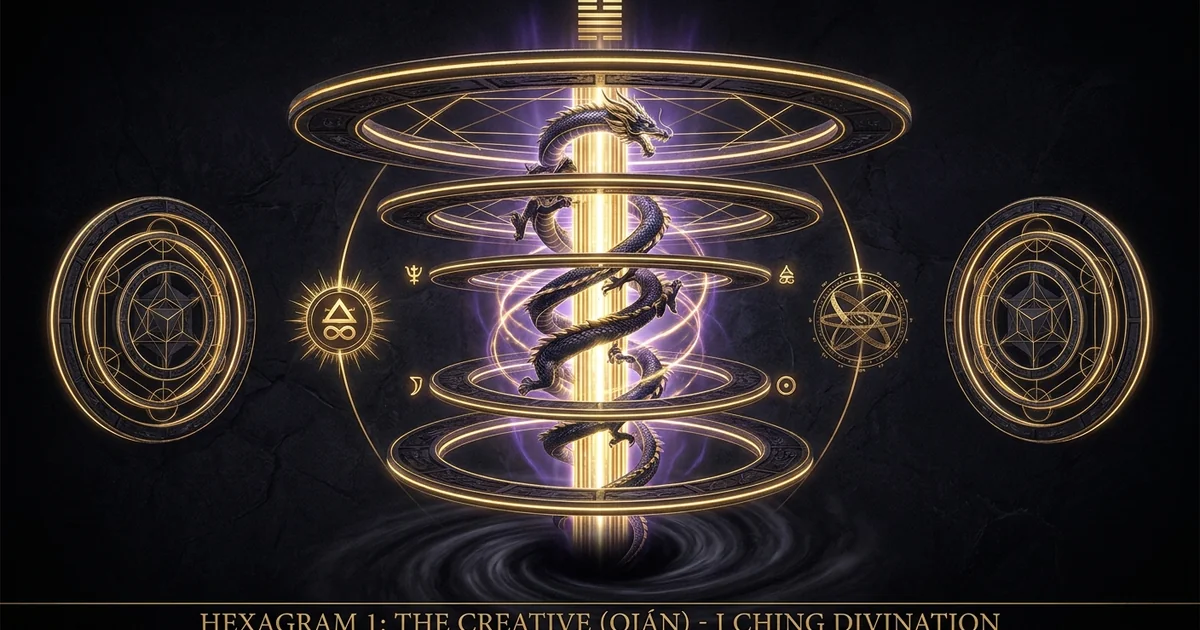
Hexagram 1 The Creative (Qián): I Ching Divination
Archetypal Thesis & Systemic Paradigm: The Primordial Vector of Qián
Pure Yang as Cosmogenic Initiator and Primordial State-Space
Hexagram 1 (Qián, 乾) models pure cosmogenic potentiality and the unconditioned vector of Yang within the formal architecture of the I Ching. Rather than serving as an isolated divinatory pronouncement or a simplistic omen of unbridled success, Qián operates as an ontic engine: the initialization of an energetic continuum prior to its differentiation into discrete spatial entities. Within Chinese cosmology, before the bifurcation into the ten thousand things, resides the non-differentiated field of Taiji (太極). Qián represents the primary polarization within this field—not the static ground of being, but the relentless, unconditioned emergence of active teleology. It is composed of six undivided (solid) lines, mathematically articulating a coherent state of maximal energetic concentration, an informational state-space of pure binary ones (111111).
In the structural taxonomy of the Zhouyi, the qián-trigram doubled upon itself constitutes an unbroken transmission of kinetic impetus. Where classical Western metaphysics posited a Prime Mover that remains unmoved, the systemic logic of Hexagram 1 articulates an initiator that is perpetual motion itself. It is the unconditioned generative capacity that allows form to crystallize out of formlessness. Understanding the hexagram 1 the creative iching meaning requires dismantling contemporary conflations of “creativity” with aesthetic production or subjective novelty; in this structural schema, the creative is the cosmogenic imperative that forces reality into manifestation. It is the absolute radiation of light before an eye exists to perceive it, the fundamental drive of entropy-reversing syntropy that organizes chaotic substrates into coherent, evolving architectures.
The Dynamic Vector: Active Teleology versus Static Omnipotence
Because Qián contains no broken (Yin) lines, its structural topology is devoid of interior receptacles, friction, or passive spatial resistance. Consequently, its operational mode is strictly vector-oriented. It possesses pure trajectory without domesticity. This kinetic dynamic must not be mistaken for theological omnipotence. Omnipotence implies a static, completed state of totalized command, whereas Qián represents continuous, unyielding expenditure. The teleology of the qián hexagram is processual rather than end-state determined; its goal is the infinite perpetuation of its own generative velocity, mediated through time rather than resting in space.
When Divination reveals this configuration, the systemic query does not encounter a benevolent promise of victory, but an immense influx of non-negotiable energetic pressure. In traditional divinatory hermeneutics, encountering pure Yang implies that the querent has accessed, or is being compelled by, an archetype that demands absolute alignment with cosmogenic law. The danger inherent to static interpretations of omnipotence is the illusion that the initiator controls the consequences of the force unleashed. Qián initiates without possessing; it generates without accumulating. Its dynamic vector operates as an uncompromising field condition: any attempt to hoard, crystallize, or statically fixate this energy results in the catastrophic structural failures historically coded in the sequence of the six dragons.
Cybernetics of Unconditioned Potential in Archetypal Psychology
Within analytical psychology and the cybernetics of consciousness, Hexagram 1 embodies the radical initialization of ego-transcendent libido. Carl Gustav Jung recognized in the Zhouyi an operational model of the objective psyche, wherein the hexagrams map dynamic configurations of archetypal energy. Qián corresponds to the archetype of the Solar Phallus, the luminous conscious principle, and the paternal cosmogenic drive that severs the uroboric containment of the unconscious. It is the psychic analogue to the Big Bang—the sudden, non-receptive illumination of awareness that establishes the field of experience.
“The method of the I Ching, like so much else in China, takes the principle of synchronicity as its basis… The hexagram was the exponent of the momentary state of the unconscious, which was in its turn in functional relationship with the physical process… Hexagram 1 represents the pure, unconditioned creative drive—a state wherein subjective intent must achieve rigorous structural resonance with macrocosmic self-organization to avoid catastrophic inflation.” — Carl Gustav Jung, Foreword to The I Ching or Book of Changes (1950)
Divination via the qián hexagram functions not as deterministic prophecy, but as an informational feedback loop assessing whether the conscious mind possesses the structural tensile strength to metabolize pure generative libido. In the context of /divination/jungian-synchronicity-iching, casting Hexagram 1 signals an acausal intersection where the querent’s subjective will is confronted with an objective macrocosmic imperative. If the ego identifies with this primordial vector rather than acting as its vessel, the systemic outcome is profound psychological inflation. The psyche confuses the universal creative principle with subjective agency, mistaking the solar emanation for the personal ego. Archetypal psychology therefore approaches Qián with therapeutic caution: the querent must be assessed for psychological containment, lest the unmediated fire of pure Yang incinerate the cognitive architecture of the personality.
Classical Provenance & Textual Lineage: The Genesis of Heaven over Heaven
The Four Cosmic Virtues: Yuán, Hēng, Lì, and Zhēn
The foundational judgment appended to Hexagram 1 in the King Wen stratum of the text consists of four terse, monumental characters: Yuán (元), Hēng (亨), Lì (利), and Zhēn (貞). In traditional omenological readings, these were frequently treated as programmatic blessings (“Sublime success, furtherance through perseverance”). However, philosophical developments initiated by the Wenyan commentary and deepened through the Neo-Confucian lineage interpret these four terms not as static promises, but as the four sequential, thermodynamic phases of cosmogenic unfolding.
Yuán represents origination, the singular quantum leap from non-being to being, the primordial spring of potentiality. Hēng denotes pervasive access, penetration, and the frictionless proliferation of energy throughout a system—analogous to the expansion phase of thermodynamic processes or the summer canopy of ecological growth. Lì defines beneficial fitness, adaptation, and the harmonious integration of this proliferating energy with existing environments; it is the autumn harvest wherein potential discovers functional utility. Finally, Zhēn signifies structural stabilization, correctness, firm constancy, and the winter contraction that preserves the essential kernel of information for the next macrocosmic cycle.
Together, the formula yuan-heng-li-zhen delineates an autopoietic cycle. Qián is not merely the initial flash of Yuán; it is the entire systemic integrity that sustains the loop through expansion, integration, and crystallization. In the operational arena of book of changes divination, these four cosmic virtues serve as diagnostic checkpoints. A querent receiving Hexagram 1 must interrogate their enterprise: Has it truly accessed its root origin (Yuán)? Can it communicate and penetrate outward without impedance (Hēng)? Does it create systemic harmony and benefit for its ecology (Lì)? And does it possess the moral and formal integrity to endure under structural pressure (Zhēn)?
Judgment: “The Creative works sublime success, furthering through perseverance.” (元亨利貞) The Great Image (Da Xiang): “The movement of heaven is full of power. Thus the superior man makes himself strong and untiring.” (天行健,君子以自強不息。) — Richard Wilhelm and Cary F. Baynes, The I Ching or Book of Changes (Bollingen Series XIX, 1950)
Wang Bi’s Metaphysical Turn: Negating Image to Reveal Pure Function
The textual lineage of the I Ching underwent an ontological revolution during the Third Century CE through the scholarship of Wang Bi (226–249 CE). Resisting the intricate, often convoluted Han Dynasty omenology that mapped every hexagram line to literal omens, physical objects, and astronomical calendars, Wang Bi introduced Xuanxue (Dark Learning), reinterpreting the Zhouyi through ontological Daoism. In his commentary on Hexagram 1, Wang Bi advanced the thesis that Qián possesses no physical image because it is the ground of all images.
Wang Bi argued that the strength of Heaven over Heaven does not reside in its material manifestation—the visible blue dome of the sky—but in its operational absence of physical form (wu). Because it has no fixed morphology, it can accommodate and generate every conceivable morphology. For Wang Bi, Qián’s essence is pure function (yong), an unending kinetic vector that cannot be pinned down as a discrete object. If an interpreter seeks Qián in a specific entity, they miss its ubiquitous agency. This metaphysical pivot transformed Hexagram 1 from an external prognostic tool into an ontological examination of the root of dynamic agency. The strength of the sovereign or the sage, under Wang Bi’s reading, relies precisely on their capacity to remain structurally unconditioned, sustaining perpetual adaptivity and creative vigor without falling into the trap of self-reification.
The Commentary on the Decision (Tuan Zhuan) and the Great Image (Da Xiang)
The Ten Wings (Shi Yi), the canonical commentaries historically attributed to Confucius and his school, systematically contextualized the archaic divinatory texts into a comprehensive moral and metaphysical curriculum. The Tuan Zhuan (Commentary on the Decision) on Hexagram 1 elevates the four cosmic virtues into a universal matrix, declaring that Qián mounts the six dragons at their respective times to drive through the heavens, causing the clouds to pass and the rain to do its work. Here, the temporalization of pure energy becomes paramount: the creative operates through historical time via strategic deployment, never through arbitrary, chaotic discharge.
Complementing this, the Da Xiang (Great Image) articulates the ethical duty extracted from the physical visual of the hexagram: Heaven reduplicated, an uninterrupted sky over sky. Its formulation—Tiān xíng jiàn, jūnzǐ yǐ zìqiáng bùxī (“Heaven’s movement is ever vigorous; the noble person ceaselessly strengthens the self”)—reframes divinatory inquiry into a mandate for moral autopoiesis. The phrase zìqiáng bùxī demands non-ceasing kinetic duty. The cosmos does not rest; entropy never pauses; consequently, the conscious individual must engage in continuous self-overcoming. The divinatory appearance of heaven over heaven fundamentally rejects passivity, moral inertia, or reliance on past accomplishments. It is a severe imperative toward unrelenting developmental discipline.
Structural Mechanics & Symbolic Geometry: The Ontogenetic Dragon Vector
Trigram Reduplication: Heaven Over Heaven as Pure Intensity
The spatial morphology of Hexagram 1 is characterized by the absolute doubling of the qian-trigram (☰). Within the structural syntax of the xiantian-bagua (Earlier Heaven arrangement), the trigram Qián occupies the supreme south, representing pure zenith, pure light, and unconditioned vertical force. In the reduplicated hexagram, this fundamental unit is stacked upon itself: the lower inner trigram represents the internal, subjective, or emerging realm of heaven, while the upper outer trigram represents the external, objective, or structural manifestation of heaven.
This reduplication generates an extraordinary dynamic tension. Because there is no complementary trigram—such as Earth (Kūn, ☷), Water (Kǎn, ☵), or Fire (Lí, ☲)—to absorb, cool, or contextualize the active energy, the hexagram functions as an undampened operational circuit. It is an engine running at absolute capacity without a cooling jacket. In the mechanics of the book of changes divination, such closed-loop intensity creates an ontological challenge: where does pure action locate its ground? The structural mechanics of Hexagram 1 demand that the tension be resolved temporally. Since the hexagram cannot resolve its pressure across spatial polarities, it must distribute its force across an evolutionary timeline, delineated line by line from the bottom to the top.
The Six Lines as a Stratified Evolutionary Gradient
The six lines of Hexagram 1 describe the life cycle, deployment, and systemic hazards of pure potentiality, allegorized through the metamorphosis of the Dragon (Lóng, 龍). In classical Chinese metaphysics, the dragon is not a monster to be slain, but the quintessential emblem of dynamic, shape-shifting Yang energy—capable of dwelling in the subterranean depths, walking the mundane earth, or soaring into the transpersonal celestial vault. The developmental gradient unfurls through six distinct developmental strata:
At the lowest level, Line 1 (Nine at the beginning), we encounter the Hidden Dragon (Qián lóng wù yòng). The energetic vector is fully present, yet it remains submerged beneath the baseline of material readiness. The injunction “do not act” is not a moral prohibition, but a thermodynamic law: to expend unconditioned potential before an adequate systemic infrastructure exists causes energetic dissipation. The power must undergo gestation.
Ascending to Line 2 (Nine in the second place), the dynamic shifts: the Dragon appears in the field (Jiàn lóng zài tián). Here, the creative principle breaches the surface of collective awareness. It achieves visibility, yet it occupies the subordinate, terrestrial realm of the lower trigram. To mature its impact, it must form strategic alliances (“It furthers one to see the great man”), acknowledging that sheer creative genius requires external scaffolding and mentorship to become viable.
Line 3 (Nine in the third place) marks the perilous threshold between the inner and outer trigrams. Here, the actor is creatively active all day, and at twilight still filled with care (Jūnzǐ zhōng rì qián qián, xī xī ruò lì). This is the stage of relentless vigilance. The initial novelty of the project or ego-expression has eroded, replaced by grueling systemic friction. It is the phase of hyper-vigilance wherein the practitioner must balance external output with rigorous internal refinement to remain blameless amidst compounding complexity.
At Line 4 (Nine in the fourth place), the potentiality faces spatial bifurcation: Wavering flight over the depths (Huò yuè zài yuān). The dragon tests its aerodynamic threshold. It stands at the base of the upper trigram, free to retreat back into the internal depths or leap definitively into macrocosmic realization. The hesitation encoded in Huò (perhaps, wavering) indicates an existential crisis of choice; the creative force must risk structural failure over the abyss in order to attain true autonomy.
Line 5 (Nine in the fifth place) represents the classical apex of the entire Zhouyi: the Flying Dragon in the Heavens (Fēi lóng zài tiān). This is the canonical locus of sovereign synthesis. The Yang vector achieves absolute structural resonance with its macrocosmic position. The individual will has fully aligned with objective cosmic law; action is effortless, systemic, and universally transformative. It commands the field not through tyranny, but through undeniable gravitational mastery.
Yet the developmental arc does not conclude at the fifth line. Line 6 (Nine at the top) introduces the tragedy of the terminal stage: the Arrogant Dragon (Kàng lóng yǒu huǐ). Here, the upward kinetic vector has overreached its systemic boundaries. Severed from the grounding reality of the lower trigrams and intoxicated by its own altitude, the dragon passes into hyper-extension. Its altitude turns into absolute isolation; its creative vitality coagulates into brittle hybris.
The Emergence of ‘All Nines’ (Yòng Jiǔ): The Dragon Without a Head
Hexagram 1 possesses a unique systemic property shared only with Hexagram 2: a seventh operational instruction designated as Yòng Jiǔ (用九, “Employing the Nines” or “When all lines are nines”). This state occurs when every single solid line is an “Old Yang” (a nine obtained through yarrow stalk manipulation or coin tosses), indicating that every element of the hexagram is simultaneously at the point of mutation into its Yin counterpart.
The enigmatic text for Yòng Jiǔ reads: “There appears a flight of dragons without heads. Good fortune” (Xiàn qún lóng wú shǒu, jí). This line resolves the central structural danger of pure Yang. If a constellation of dragons operates without a centralized, domineering head, the principle of absolute creative agency has successfully dissolved its own egoic central axis. It has mastered the supreme Hermetic paradox: pure Yang achieves its highest expression when it renounces autocratic dominance and operates as an integrated, non-hierarchical network. By decapitating the monotheistic ego of the dragon, the energy avoids the catastrophe of the sixth line and seamlessly undergoes transformation into the cosmic receptivity of Hexagram 2.
Psychological Dynamics & Operational Praxis: Interpreting Line Mutations
Diagnostic Decoding of Changing Yang (Old Yang, Nine)
In the practice of book of changes divination, receiving a solid line that is dynamic (Old Yang, mathematically designated by the number 9) indicates a sector of experience where the creative impulse has reached maximal tension and is structurally bound to invert into its polar opposite. Changing lines in Hexagram 1 are not merely points of transition; they represent specific areas where the unconditioned vector is threatening to become unstable.
When interpreting changing lines in Qián, the analyst must determine whether the querent is prematurely projecting their intent (Line 1 moving), failing to cultivate requisite alliances (Line 2 moving), buckling under systemic pressure (Line 3 moving), vacillating through fear of commitment (Line 4 moving), or running the severe risk of hubristic over-extension (Line 6 moving). The operational praxis of Hexagram 1 demands radical thermodynamic awareness: changing Yang burns exceptionally hot. It demands immediate somatic grounding, behavioral moderation, and strategic self-containment, lest the intensity of the subjective impulse shatter the institutional, relational, or physical container housing it.
The Catastrophe of Line 6: Kàng Lóng Yǒu Huǐ (Arrogant Dragon Has Regret)
Line 6, Kàng Lóng Yǒu Huǐ, serves as one of the most potent clinical diagnostics within archetypal psychology. The character Kàng signifies an upward stretching that loses its base—a neck distended to the point of structural vulnerability, hyper-extension, or tyranny. In psychological terms, this is ego-monotheism. The conscious ego, having ridden the ascending trajectory of the dragon through lines 2, 4, and 5, forgets its structural dependence on the unconscious ground, somatic vitality, and communal ecology.
When a querent casts Hexagram 1 with Line 6 mutating, the prognosis is universally severe. It marks a moment where a visionary project, a corporate leadership vector, or an ideological drive has crossed the threshold from generative authority into tyrannical isolation. The individual stands at the absolute perimeter of their systemic reality, surrounded by a void, unable to descend gracefully and incapable of ascending further. The inevitable corollary is Huǐ (regret, remorse, structural collapse). The therapeutic mandate in this operational phase is an immediate, deliberate cessation of the upward vector—a conscious, ego-sacrificing descent before the macrocosmic physics of the system forces an involuntary and destructive crash.
Phase Space Transitions: Moving Lines from Hexagram 1 to Hexagram 2
The most profound systemic transition occurs when all six lines of Hexagram 1 are dynamic, precipitating an instantaneous structural inversion into Hexagram 2 (Kūn, 坤), The Receptive. This phase space transition captures the thermodynamic law that extreme Yang inevitably produces Yin. Where Hexagram 1 represents pure electrical potential, light, time, and active agency, Hexagram 2 represents pure gravitational mass, space, somatic density, and absolute receptivity.
Hexagram 1: Qián (The Creative)
- Cosmological Nature: Pure Radiation, Celestial Velocity, Spatial Father
- Information Architecture: Binary
111111(Maximal Intensity) - Metabolic Rhythm: Unceasing Expenditure, Centrifugal Kineticism
- Primary Archetype: The Transcendent Solar Phallus / The Unconditioned Will
- Archetypal Trap: Inflation, Hybris, Isolation, Desiccation
- Psychological Expression: Unbroken Ego-Agency, Autopoiesis, Visionary Teleology
Hexagram 2: Kūn (The Receptive)
- Cosmological Nature: Pure Matrix, Terrestrial Density, Spatial Mother
- Information Architecture: Binary
000000(Maximal Entropy/Capacity) - Metabolic Rhythm: Unconditional Acceptance, Centripetal Gravitation
- Primary Archetype: The Devouring/Nurturing Chthonic Womb
- Archetypal Trap: Stagnation, Inaction, Dissolution into the Collective Unconscious
- Psychological Expression: Somatic Grounding, Deep Receptivity, Relational Matrix
When the transition between these two polar monoliths occurs, the practitioner must execute a radical psychological reversal. The active, forward-thrusting strategies that sustained the initial phase of the operation must be dismantled. The querent is instructed to abandon leadership, relinquish the sovereign vantage of the fifth line, and cultivate the deep, dark, horizontal capacity of the earth. To persist in Yang strategies when the system has entered the phase space of /iching/hexagram-2-the-receptive-kun is to wage an entropic war against the evolving architecture of the cosmos.
Philosophical Synthesis & Macrocosmic Correspondence: Hermetic and Genetic Mappings
Shao Yong’s Binary Calculus and Leibnizian Computational Parallels
During the Song Dynasty, the monumental scholar Shao Yong (1011–1077 CE) revolutionized the structural cartography of the Zhouyi in his magnum opus, the Huangji Yingshi Shu (Book of Supreme World Ordering Principles). Shao Yong rearranged the 64 hexagrams into a strictly rigorous, mathematical sequence known as the Xiantian (Earlier Heaven) Binary Sequence. By assigning the undivided Yang line the value of 1 and the divided Yin line the value of 0, Shao Yong unveiled the computational substructure of Chinese cosmology. Hexagram 1, composed of six solid lines, emerges as the ultimate binary baseline: 111111 (or decimal 63 in a six-bit system, the state of maximal operational saturation).
This binary architecture directly intersected European intellectual history when Jesuit missionaries transmitted Shao Yong’s Xiantian diagrams to Gottfried Wilhelm Leibniz in the late seventeenth century. Leibniz was astounded to discover that his newly developed binary arithmetic—the mathematical foundation of the modern digital computer—had been fully delineated in ancient China two millennia prior. In Leibnizian metaphysics, binary 1 represented God (the creative monadic source) and 0 represented the Void (nothingness). Hexagram 1 was thus identified as the algorithmic inscription of the divine act of creation ex nihilo: the continuous, computational projection of light into the void that generates the manifold computational states of the universe.
Cross-Systemic Geometries: Kether, the Magician/Emperor, and Astrological Cardinal Fire
The systemic geometry of Hexagram 1 reverberates across Western esoteric coordinate frameworks. In Hermetic Qabalah, Qián corresponds with unmistakable precision to Kether (כתר), the supreme Crown of the Tree of Life. Kether is the pristine, non-dimensional point of divine emanation, representing pure, undifferentiated Will (Ratzon) before its polarization into the masculine wisdom of Chokmah and the feminine understanding of Binah. Like Qián, Kether is pure initiation; it contains all that will ever manifest, yet possesses no manifest form within itself.
- I Ching Archetype: Hexagram 1, Qián (乾) — The Creative Engine, Heaven over Heaven (
111111). - Hermetic Qabalah: Kether (The Monad) projecting along the Path of Aleph toward Chokmah; the undifferentiated light of the Ain Soph Aur.
- Tarot Archetype: The synthesis of Archetype I (/tarot/magician-card-archetypal-will, the focalized conduit of transcendental force) and Archetype IV (The Emperor, structural masculine sovereignty).
- Astrological Signature: Pure Cardinal Fire (The dynamic initiation of Aries at 0°, the equinoctial flash of raw self-actualization).
- Human Design Matrix: Gate 1, The Gate of Self-Expression (located in the G Center / Identity Center), which drives the innate mandate to embody unique creative direction without external compromise.
When mapped onto the archetypal lexicon of the Tarot, Hexagram 1 encapsulates the unmediated descent of the wand raised by The Magician, channelled into the structural sovereignty of The Emperor. The Magician acts as the lightning rod drawing down the transcendental fire of the cosmos—a precise visual parallel to the Da Xiang’s image of celestial power. In the astrological realm, this dynamic is expressed through the modality of Cardinal Fire, the raw, unconditioned combustive ignition that shatters winter’s stasis and launches the astrological wheel. It is an unyielding, pioneering impetus that creates its own path by burning through preexisting terrain.
Molecular Parallels: 64 Hexagrams, Genetic Codons, and the Pure UUU Transcription
In the twentieth century, systemic thinkers and molecular biologists—most notably Martin Schönberger and later Marie-Louise von Franz—noted the staggering mathematical congruence between the 64 hexagrams of the I Ching and the 64 triplet codons of the universal genetic code. A hexagram is an informational matrix built upon three binary pairs; a DNA/RNA codon is an informational sequence built upon three pairs of four nitrogenous bases (Adenine, Cytosine, Guanine, and Uracil/Thymine).
Within this biological cartography, Hexagram 1—as pure Yang—corresponds structurally to homopolymeric sequences composed exclusively of the most energetic transcriptional bases, such as the pure poly-U (UUU) codon. In molecular biology, the synthetic poly-U codon was the very first piece of the genetic code cracked by Marshall Nirenberg and Heinrich Matthaei in 1961, directing the synthesis of the amino acid phenylalanine. Phenylalanine is a crucial, aromatic building block essential for the construction of complex organic proteins. Thus, even at the molecular frontier, the structural grammar of Qián holds true: it acts as the pristine, baseline informational transcript that allows the complex syntax of living form to commence its evolutionary journey.
Frequently Asked Questions: Technical Inquiries into the Creative
What does an unchanging Hexagram 1 indicate in an I Ching divination consultation?
An unchanging Hexagram 1 (Qián with no moving lines, resulting from obtaining exclusively young Yang, mathematically represented by sevens) indicates that the query is situated within a field of pure potentiality that has not yet crystallized into specific temporal dynamics. The querent is confronting raw, unconditioned agency. Because there are no changing lines to pinpoint a specific developmental stage of the dragon, the entire archetypal reality of Heaven over Heaven is brought to bear upon the situation simultaneously.
This diagnosis reveals that the situation possesses immense generative momentum, but completely lacks structural containment, receptivity, or grounding. The system is operating in an ideological or energetic vacuum. The counsel of an unchanging Hexagram 1 is not an uncritical green light to act with reckless abandon; rather, it is a demanding warning that the querent must actively supply the missing Yin context. Without the conscious introduction of structural vessels, relational diplomacy, and somatic limits, this pure Yang energy will either dissipate into empty abstraction or burn out the structural capacity of the project before it can achieve functional integration (Zhēn).
How should one interpret the ‘Arrogant Dragon’ (Line 6) when undertaking major leadership decisions?
When Line 6 of Hexagram 1 is triggered in a leadership or strategic inquiry, it operates as an urgent systemic alarm: the enterprise has crossed the zenith of its constructive lifecycle and has entered the hazardous terrain of hyper-extension. In leadership contexts, this typically manifests as visionary isolation. The leader has become entirely captivated by their subjective dogma, dismissing structural warnings from downstream operatives, ignoring financial realities, or severing connections with the institutional base that facilitated their initial rise through lines 2 and 5.
The psychological dynamic of Kàng Lóng Yǒu Huǐ represents a critical systemic threshold. Persisting in an aggressive, expansive, or authoritarian posture when Line 6 is active ensures systemic rupture. The creative vector has become brittle; it can no longer bend, and therefore it must shatter under the inevitable pushback of objective macrocosmic conditions.
To successfully navigate this line mutation, a leader must immediately abandon the expansive vector. Strategic acquisitions must cease; ideological dominance must yield to distributed autonomy; executive power must be intentionally decentralized. The correct behavioral response to the Arrogant Dragon is conscious, intentional abdication—a voluntary retreat from the peripheral perimeter back to a more sustainable, defensible, and grounded operational baseline before the inevitable structural rebound inflicts catastrophic damage.
Why does Hexagram 1 possess a unique seventh line text (Yòng Jiǔ)?
Hexagram 1 (along with Hexagram 2, which features Yòng Liù) possesses an exclusive seventh line commentary known as Yòng Jiǔ because these two primordial hexagrams represent the absolute cosmological extremes of the I Ching matrix. Every other hexagram in the 64-hexagram system contains an internal dialectic of mixed solid and broken lines; they already possess systemic friction, balancing mechanisms, and innate polarities. Hexagrams 1 and 2, however, are pure informational monoliths: absolute active solar energy and absolute passive telluric space.
Yòng Jiǔ (“Employing the Nines”) provides the operational manual for preventing pure energy from consuming itself. It introduces the profound Hermetic doctrine that absolute strength attains perfection only when it abolishes its own centralized hegemony. The image of the “dragons without heads” articulates an egoless, distributed state of supreme power. It instructs the adept that the ultimate mastery of the Yang vector does not culminate in monumental, centralized tyranny, but in the capacity of creative force to disperse itself seamlessly across the entire system, transforming sovereign authority into universal, self-organizing life.