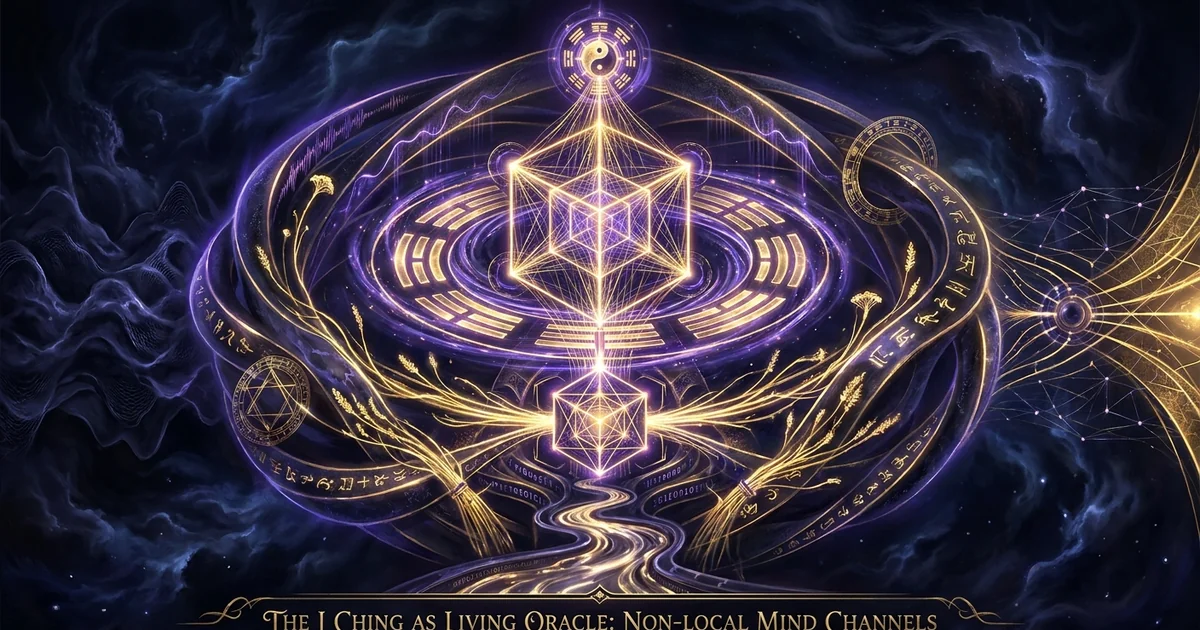
The I Ching as Living Oracle: Non-Local Mind Channels
Archetypal Thesis & Systemic Paradigm: The I Ching as a Non-Local Cybernetic Interface
Transcending Temporal Determinism: The Participatory Oracle
The I Ching, or Zhouyi, cannot be adequately understood through the epistemic lens of classical Newtonian determinism, nor can it be dismissed as an archaic instrument of fatalistic superstition. In standard divinatory critiques, the consultation of an oracle is mischaracterized as an attempt to extract a pre-scripted future from a linear, chronological timeline. Such a perspective presumes a static, clockwork cosmos wherein events unfold along an absolute coordinate axis of past, present, and future. In direct opposition to this mechanistic worldview, the Zhouyi operates as a participatory, non-local psycho-cosmic interface. It models reality not as a sequence of fixed states, but as an open, fluid continuum of energetic vectors and archetypal fields.
When a querent consults the oracle, the procedure does not reveal an immutable destiny. Instead, it captures a qualitative cross-section of the cosmic process at the exact moment of inquiry. This operational dynamic mirrors the participatory universe described by quantum physicist John Archibald Wheeler, wherein the observer is fundamentally implicated in the actualization of physical phenomena.
The casting of the consultation medium—whether through the manipulation of dried yarrow stalks (Achillea millefolium) or the toss of three coins—functions as a macroscopic quantum measurement collapse. The querent does not merely observe a detached scenario; their intentionality, psychological tension, and somatic state become inextricably entangled with the physical apparatus. The oracle acts as a dynamic state-space representation, translating the continuous flux of the Tao into a discrete, legible configuration.
By mapping the fluid topology of the present moment, the I Ching provides an epistemological bridge: it collapses an infinite superposition of possibilities into a specific archetypal diagnostic state, presenting the inquirer with the exact kinetic trajectory of their current psychological and situational matrix.
The Implicate Order and Synchronistic Coupling
To rigorously account for the operational efficacy of the Zhouyi without lapsing into naive supernaturalism, one must synthesize David Bohm’s ontology of the undivided universe with Carl Gustav Jung’s analytical formulation of synchronicity. In Wholeness and the Implicate Order (1980), Bohm postulated that the tangible, empirical world accessible to our senses and instruments constitutes an “explicate order”—an unfolded, localized domain of reality characterized by apparent separation and temporal succession. Beneath this manifest surface lies the “implicate order,” an enfolded, non-local ground wherein all points in space, moments in time, and modalities of consciousness are holonomically interconnected.
UNMANIFEST GROUND
                                  [ Implicate Order ]
                                  (Holomovement / Tao)
                                           │
                        ┌──────────────────┴──────────────────┐
                        ▼                                     ▼
               INTERNAL / PSYCHIC                    EXTERNAL / PHYSICAL
               [ Subjective Mind ]                   [ Material Matrix ]
               (Intentional Query)                   (Kinetic Medium)
                        │                                     │
                        └──────────────────┬──────────────────┘
                                           │
                                  ACASAL CONVERGENCE
                           [ Synchronistic Node: The Cast ]
                                           │
                                           ▼
                                    MANIFEST COGNITION
                                  [ Explicate Order ]
                                (Hexagram Configuration)
Within this ontological architecture, the casting of a hexagram represents the deliberate folding out of the implicate into the explicate. The randomizing kinetic procedure does not cause the symbolic text to correspond with the querent’s inner dilemma through mechanical force; rather, both the mental state of the inquirer and the physical configuration of the stalks or coins are parallel, non-local manifestations of a single underlying holomovement.
This phenomenon is precisely what Jung and theoretical physicist Wolfgang Pauli designated as an “acausal connecting principle.” Synchronistic events are not bound by the law of efficient cause and effect that governs classical mechanics. Instead, they are ordered by meaning. In this framework, meaning functions not as a subjective human projection, but as an active, structural constituent of reality. The non-local consciousness field does not transmit an energetic signal across Euclidean space to alter the fall of the yarrow stalks; rather, it participates in a pre-established, non-causal harmony where physical-psychic complementarity reigns.
Divination, viewed through this quantum mind paradigm, is the deliberate induction of an acausal node. It bridges the observer’s explicit psychic crisis with the implicate structural patterns of the cosmos, allowing the deep semantic layers of the non-local mind channels to articulate themselves through the geometric architecture of the hexagram.
Hexagram States as Phase Space Coordinates of Consciousness
In cybernetic and systems theories, an operational feedback loop requires a sensor, an evaluation metric, and an actuator that adjusts the system’s trajectory relative to environmental fluctuations. The I Ching functions as a 6-bit cybernetic feedback loop designed to calibrate human consciousness against the fluid macrocosmic baseline of the universe. The 64 hexagrams constitute a discrete, comprehensive phase-space coordinate system. Each hexagram, composed of six binary positions (broken yin lines and solid yang lines), represents a specific topological manifold of energetic potential.
When the querent initiates an inquiry, the resulting hexagram provides a precise state-space coordinate that diagnoses the systemic distribution of kinetic energy (yang) and receptive potential (yin) across various structural levels of experience. The six lines delineating the hexagram do not represent static nouns or entities; they symbolize phase transitions, qualitative currents, and dialectical vectors. If a hexagram contains stable lines alone, it characterizes an equilibrium state within that archetypal domain.
When “moving” or mutating lines occur, the oracle registers an entropic instability, pinpointing the exact systemic threshold where an excess of force or receptivity necessitates a phase change. The oracle functions as an epistemic mirror: it reflects the hidden dynamics of the collective unconscious back to the subjective ego, transforming latent psychic contents into explicit symbolic feedback. By engaging with this diagnostic coordinate, the practitioner de-escalates cognitive distortions, aligns with the operational principle of wu-wei (effortless action in resonance with systemic momentum), and consciously navigates the subtle phase transitions of their existential field.
“The cultural development of the Western mind has systematically favored causal thinking to the exclusion of all else… Synchronicity, as I have defined it, postulates a principle in nature that is non-causal, connecting events through their simultaneous occurrence and common meaning. The method of the I Ching does not ask why something happens, but rather, what likes to occur together with what… It takes the fall of the yarrow stalks not as an accident, but as an exponent of the total situation prevailing at the moment of the cast.”
— C.G. Jung and Wolfgang Pauli, The Interpretation of Nature and the Psyche (Pantheon Books, 1955), pp. 31–34; cf. Richard Wilhelm and Cary F. Baynes, The I Ching, or, Book of Changes (Princeton University Press, 1950), Foreword by C.G. Jung.
Classical Provenance & Textual Lineage: The Living Text across Dynastic Epistemologies
From Turtle Plastrons to the Zhouyi: The Shift from Scapulimancy to Mathematical Code
The emergence of the Zhouyi (Changes of Zhou) marks one of the most profound epistemological evolutions in human intellectual history: the transition from visceral, somatic omen-reading to an abstract, combinatorial state-space model of the cosmos. During the Late Shang Dynasty (c. 1200–1046 BCE), divinatory authority rested entirely on pyromancy and scapulimancy. Royal diviners applied intensely heated bronze pokers to specially prepared bovine scapulae and ventral plastrons of turtles (Chinemys reevesii). The intense thermal shock induced irregular, explosive fractures across the bone surface. These cracks (bu) were interpreted by the Shang theocrats as direct, non-mathematical inscriptions from the ancestral spirits and the supreme deity, Shangdi. This archaic paradigm was inherently medium-dependent, volatile, and deeply embedded within blood sacrifice and dynastic monopolization.
With the collapse of the Shang and the rise of the Western Zhou (c. 1046–771 BCE), this somatic, somber methodology underwent a radical technological and metaphysical mutation. The Zhou introduced and formalized the counting of yarrow stalks, a procedure that substituted the stochastic, organic cracking of bone with a rigorous, algorithmic subtraction process based on odd and even numbers. Divination ceased to be an act of inducing physical trauma upon animal bone; it became a mathematical derivation of cosmic principles.
This epistemological shift represented an unprecedented conceptual leap: the cosmos was no longer governed by the arbitrary, appeasable whims of ancestral ghosts, but by an impartial, mathematically structured order governed by the Mandate of Heaven (Tianming). The resulting line groupings, systematically codified into solid (unbroken) and open (broken) linear markers, abstracted the chaos of environmental flux into a coherent symbolic geometry. This shift replaced the passive terror of unpredictable omens with an objective, systemic model that any trained practitioner could navigate through symbolic literacy.
King Wen, the Duke of Zhou, and Confucius: Canonization of the Ten Wings
The classical provenance of the Zhouyi as an integrated literary and philosophical vehicle is traditionally attributed to three critical foundational junctures. According to dynastic historiography, King Wen of Zhou (c. 1152–1056 BCE), while imprisoned at Youli by the tyrannical Shang monarch Zhou Xin, contemplated the permutations of the eight primary trigrams (bagua) and systematically stacked them to derive the sequence of the 64 hexagrams, appending to each a overarching judgment or decision (Gua ci).
Following the triumph of the Zhou Dynasty, King Wen’s son, the Duke of Zhou (Dan), deepened this structural framework by composing the individual line commentaries (Yao ci). These terse, poetic aphorisms mapped the specific socio-political, psychological, and dynamic implications of every individual line position within each of the 64 hexagrammatic configurations, creating a total operational library of 384 distinct temporal vectors.
The second monumental hermeneutic phase occurred during the Eastern Zhou and Warring States periods, culminating in the compilation of the Shi Yi, or the “Ten Wings.” Although traditionally credited to Confucius (551–479 BCE), these philosophical treatises were largely composed by successive generations of Confucian and Daoist scholars between the 5th and 3rd centuries BCE.
Among these texts, the Ta Chuan (The Great Treatise, also known as the Xi Ci) serves as the definitive metaphysical manual of the I Ching. The Ta Chuan transformed what had been an elite administrative and military divination manual into an explicit living intelligence text. It established a comprehensive cosmology wherein the text is understood not as a representation of reality, but as an operational microcosm that pulses in unison with heaven and earth (Qian and Kun). It declared that the oracle possesses Shen—a spiritual, non-localized, autonomous intelligence that, possessing neither spatial confinement nor physical substance, responds instantaneously and organically to human intentionality.
“The Changes have no consciousness, no action; they are quiescent and do not move. But if they are stimulated, they penetrate all situations under heaven. If they were not the most divine thing on earth, how could they do this? The Changes are what enabled the holy sages to reach the depths and to grasp the seeds of all things. Only through what is deep can one penetrate all wills on earth. Only through the seeds can one complete all affairs on earth. Only through the divine (Shen) can one hurry without being fast, and reach the goal without walking.”
— Excerpt from the classical Ta Chuan (Great Treatise of the Zhouyi), standard Neo-Confucian recension.
The Wilhelm-Baynes Transmission: Western Hermeneutics and Archetypal Psychology
The modern reception of the I Ching as a sophisticated psycho-cosmological interface is directly attributable to the masterwork of German sinologist Richard Wilhelm and his English translator, Cary F. Baynes. Wilhelm undertook the monumental task of translating the text during his extended residence in China in the early decades of the twentieth century, working in intimate, daily collaboration with the venerable Confucian scholar Lao Naixuan.
Lao Naixuan initiated Wilhelm into the living oral tradition and the esoteric hermeneutics of the Neo-Confucian Yijing synthesis, particularly the cosmological perspectives of the Song Dynasty master Zhu Xi. Wilhelm’s German translation, published in 1924, went beyond dry philological cataloging: it preserved the vital, dynamic ethos of a living oracle, rendering archaic Chinese imagery into a flexible, philosophically rigorous vocabulary capable of engaging European thought.
When Cary F. Baynes subsequently produced the English translation under the auspices of the Bollingen Foundation in 1950, Carl Gustav Jung was invited to contribute the Foreword. Jung’s essay proved to be a watershed moment for Western hermeneutics and the integration of depth psychology with esoteric cartography. Rather than analyzing the book from an aloof, academic distance, Jung undertook an active, live consultation with the I Ching, asking the text to comment upon its own intention and reception in the Western world. The oracle returned Hexagram 50, Ting (The Caldron), mutating into Hexagram 35, Chin (Progress).
Through this historic dialogue, Jung demonstrated that the Zhouyi functions as a mirror of the collective unconscious. Wilhelm’s translation, enriched by Jungian psychological validation, firmly established that the text could act as a sophisticated diagnostic instrument for uncovering the unconscious complexes, shadow dynamics, and non-local synchronistic currents of modern humanity.
Structural Mechanics & Symbolic Geometry: Binary Permutation and Phase Transitions
Bagua Polarity: The Generative Interplay of Yin (0) and Yang (1)
The architecture of the I Ching is fundamentally binary, anticipating Gottfried Wilhelm Leibniz’s development of the binary number system by multiple millennia. At the absolute foundation of this cosmology is Wuji—the unmanifest, primordial void of absolute, undifferentiated potential. Through the emergence of spontaneous cosmic movement, Wuji polarizes into Taiji (the Supreme Ultimate), which immediately articulates the primary ontological dyad: Yang (the creative, active, light, masculine principle, denoted mathematically as 1 and visually as an unbroken horizontal line: —) and Yin (the receptive, resting, dark, feminine principle, denoted mathematically as 0 and visually as a broken line: -- --).
[ WUJI ] (The Primordial Void: Undifferentiated 0)
                                        │
                                        ▼
                     [ TAIJI ] (The Supreme Ultimate: Genesis of Polarity)
                                        │
                   ┌────────────────────┴────────────────────┐
                   ▼                                         ▼
            [ YANG: 1 ]                                 [ YIN: 0 ]
            (Creative / Solid Line)                     (Receptive / Broken Line)
                   │                                         │
          ┌────────┴────────┐                       ┌────────┴────────┐
          ▼                 ▼                       ▼                 ▼
     [ Old Yang ]    [ Young Yin ]            [ Young Yang ]     [ Old Yin ]
       (9 / ==)         (8 / --)                 (7 / ==)         (6 / --)
          │                 │                       │                 │
     ┌────┴────┐       ┌────┴────┐             ┌────┴────┐       ┌────┴────┐
     ▼         ▼       ▼         ▼             ▼         ▼       ▼         ▼
    Qian      Dui      Li       Zhen          Xun       Kan      Gen      Kun
  (Heaven)  (Lake)   (Fire)  (Thunder)       (Wind)   (Water) (Mountain) (Earth)
Through the generative multiplication of this initial dyad, the two primary polarities pair to produce the Four Bigrams:
- Greater Yang (Old Yang)
- Lesser Yin (Young Yin)
- Lesser Yang (Young Yang)
- Greater Yin (Old Yin)
By adding a third tier to the Four Bigrams, the system generates the Bagua, or the Eight Trigrams. The Bagua represent the fundamental energetic vectors that constitute the manifest universe.
Each trigram models a distinct physical and psychological archetype:
- Qian (Heaven: Pure Creative Force, Unyielding Strength)
- Kun (Earth: Pure Receptive Matrix, Infinite Devotion)
- Zhen (Thunder: Arousing Shock, Incipient Motion)
- Kan (Water: Abyssal Danger, Fluid Adaptability, Depth)
- Gen (Mountain: Keeping Still, Immovability, Introspection)
- Xun (Wind/Wood: Gentle Penetration, Subtlety, Flexibility)
- Li (Fire: Clinging Radiance, Clarity, Cognition)
- Dui (Lake: Joyous Openness, Malleability, Expressive Connection)
These eight trigrams are organized in two classical geometric configurations: the Early Heaven (Xian Tian, attributed to Fu Xi), which maps an idealized, static equilibrium of complementary opposites, and the Later Heaven (Hou Tian, attributed to King Wen), which maps the dynamic, cyclical, temporal unfolding of elemental forces through the terrestrial seasons.
Combinatorial Matrix: The 64 Hexagrams as Dynamic Phase Space
By superimposing one trigram upon another, the combinatorial logic scales exponentially: $2^3 \times 2^3 = 2^6 = 64$. The 64 hexagrams delineate a complete, closed-loop state-space containing every possible permutation of human-cosmic interaction. Within the vertical geometry of the hexagram, the structure is divided into two operational realms: the lower (inner) trigram and the upper (outer) trigram. The lower trigram governs the internal, subjective, psychological domain of the querent—their intrinsic motivation, cognitive orientation, and instinctual undercurrents. The upper trigram governs the external, objective, environmental matrix—the social landscape, macroscopic pressures, and the operational field of the external situation.
Furthermore, the vertical axis of the six lines constructs a fractal topology that scales from the micro to the macrocosm:
- Line 1 (Lowest position): The incipient emergence of an event, the sub-conscious root, the solitary individual entering a situation.
- Line 2: The localized internal center, emotional balance, the loyal official or domestic partner.
- Line 3: The boundary threshold, the point of transition from internal cognition to external manifestation, characterized by high friction, volatility, and danger.
- Line 4: The gateway of the outer court, the institutional threshold, the minister or counselor dealing directly with external reality.
- Line 5: The seat of supreme authority, the apex of leadership, optimal systemic balance and active sovereignty.
- Line 6 (Top position): The point of structural exhaustion, transcendence, or decay; the elder sage who has withdrawn from affairs, or the hubristic collapse of an overextended trajectory.
For a deeper exploration of this mathematical architecture, see /iching/hexagram-structure-mathematics.
The Mechanics of Mutation: Moving Lines, Entropy, and Superposition Collapse
The dynamic brilliance of the Zhouyi lies in its avoidance of fatalistic stasis through the operational mechanics of the moving lines. A reading does not simply deliver an unchanging, monolithic characterization of a situation; it reveals the systemic vectors of transformation. During the divinatory collapse, each line is assigned one of four numerical values derived from the combinatorial reduction:
- 6: Old Yin (mutating, unstable receptive, ready to flip to Yang)
- 7: Young Yang (stable, immutable creative)
- 8: Young Yin (stable, immutable receptive)
- 9: Old Yang (mutating, unstable creative, ready to flip to Yin)
Lines with values of 7 or 8 are stable; they hold their structural tension without immediate systemic collapse. Lines with values of 6 or 9 are volatile, dynamic nodes of high kinetic energy and thermodynamic instability. In the language of non-equilibrium thermodynamics, an Old Yang or an Old Yin represents a dissipative structure driven far from equilibrium, approaching a critical tipping point.
When a moving line is generated, it represents a specific systemic locus where the energetic threshold has been crossed: Yang reaches its extreme and collapses into Yin, or Yin reaches its depth and mutates into Yang. The primary hexagram (Ben Gua) diagnoses the immediate, empirical field of the querent’s present condition.
The mutation of the changing lines systematically converts the original hexagram into a secondary, resultant hexagram (Zhi Gua). The Zhi Gua indicates the downstream phase transition—the systemic attractor toward which the current energetic configuration is inevitably migrating if its present trajectory remains unaltered. This mutation mechanism establishes an interactive, multidimensional temporal map that tracks the transformation of latent possibility into actualization.
Psychological Dynamics & Operational Praxis: Interrogating the Living Intelligence Field
Yarrow vs. Coin Methodologies: Probability Profiles and Ritual Entrainment
The methodology employed to access the I Ching fundamentally conditions the neurological and phenomenological state of the practitioner. The two primary classical consultation techniques—the yarrow stalk procedure and the three-coin method—are often casually treated as functional equivalents, yet their underlying mechanics generate entirely distinct probability distributions and states of cognitive entrainment.
The yarrow stalk method requires fifty stalks of Achillea millefolium, one of which is set aside to represent the absolute unity of the unmanifest Tao. The remaining forty-nine stalks undergo a rigorous, three-fold cycle of division, subtraction, and counting by fours to determine a single line. This intricate manual procedure must be repeated eighteen times to construct a full six-line hexagram. The mathematical probability distribution generated by this method is notably asymmetric:
$$\text{Probability of Old Yin (6)} = \frac{1}{16} \approx 6.25%$$
$$\text{Probability of Young Yang (7)} = \frac{5}{16} \approx 31.25%$$
$$\text{Probability of Young Yin (8)} = \frac{7}{16} \approx 43.75%$$
$$\text{Probability of Old Yang (9)} = \frac{3}{16} \approx 18.75%$$
This mathematical asymmetry is deeply intentional: it demonstrates that in the natural cosmic order, yang lines have a significantly higher tendency to mutate into their opposite ($3/16$ for Old Yang versus $1/16$ for Old Yin), reflecting the volatile, self-expending nature of kinetic energy, whereas receptive yin displays greater structural inertia.
Beyond its pure mathematics, the mechanical duration of the yarrow stalk procedure—typically requiring twenty to thirty minutes of focused manipulation—acts as an explicit contemplative entrainment device. The rhythmic division of stalks induces a down-regulation of high-frequency beta brainwaves into alpha and theta states. This transition softens ego defenses, bypasses the linear analytical intellect, and primes the intuitive centers of the brain for archetypal hermeneutics.
Yarrow Stalk Methodology
- Combinatorial Logic: Complex algorithmic division and modulus counting of 49 physical stems.
- Probability Distribution: Asymmetric:
- Old Yin (6): $1/16$ ($6.25%$)
- Young Yang (7): $5/16$ ($31.25%$)
- Young Yin (8): $7/16$ ($43.75%$)
- Old Yang (9): $3/16$ ($18.75%$)
- Temporal Latency: Extended duration (20–35 minutes of ritual manipulation).
- Neurological Impact: Systematic induction of alpha/theta brainwave states; deep somatic entrainment; high psychophysical engagement.
- Metaphysical Resonance: Aligns precisely with Song Dynasty Neo-Confucian cosmological dynamics; mirrors thermodynamic energy decay.
Three-Coin Methodology
- Combinatorial Logic: Arithmetic sum of three coins tossed simultaneously, where Heads = 3 (Yang) and Tails = 2 (Yin).
- Probability Distribution: Symmetrical (Binomial expansion):
- Old Yin (6 = 2+2+2): $1/8$ ($12.5%$)
- Young Yang (7 = 3+2+2): $3/8$ ($37.5%$)
- Young Yin (8 = 3+3+2): $3/8$ ($37.5%$)
- Old Yang (9 = 3+3+3): $1/8$ ($12.5%$)
- Temporal Latency: Accelerated collapse (2–3 minutes total execution).
- Neurological Impact: Minimal cognitive down-regulation; high beta-wave retention; analytical framework remains dominant.
- Metaphysical Resonance: Symmetrical mathematical distribution lacking the organic asymmetry of classical yarrow dynamics.
Conversely, the three-coin method—assigning values of 2 to tails (Yin) and 3 to heads (Yang)—is an accelerated alternative popularized during the Tang Dynasty. It simplifies the procedure through six rapid tosses of three identical coins. Its probability distribution is strictly symmetrical: Old Yin is $1/8$ ($12.5%$), Young Yang is $3/8$ ($37.5%$), Young Yin is $3/8$ ($37.5%$), and Old Yang is $1/8$ ($12.5%$).
While the coin method offers pragmatic accessibility, it lacks the contemplative latency and neurological down-regulation inherent in the yarrow ritual. Consequently, the querent using coins must exert conscious discipline to avoid superficial, hasty consultations that fail to engage the deeper, non-local layers of consciousness.
Active Imagination and the Hermeneutic Dialogue with the Universe
Once the hexagram and its moving lines are calculated, the consultation shifts from quantitative mechanical collapse to qualitative, archetypal interpretation. Here, the practitioner must not approach the text as an external decree issued by an autocratic intelligence, but as an exercise in analytical hermeneutics and Jungian active imagination. The imagery and judgments embedded in the Zhouyi—running water, dragons battling in the mud, cauldrons of bronze, wells of pristine nourishment—are not archaic curiosities. They are primordial archetypal complexes that capture the structural patterns of human phenomenological reality.
The classical text is deliberately elliptical, polysemous, and multidimensional. It does not employ unambiguous semantic declarations; instead, it utilizes evocative, imagistic tensions that compel the unconscious mind of the querent to supply the missing connective tissue. In this hermeneutic encounter, the practitioner engages in a structured dialogue with the cosmos.
The poetic aphorism functions as a psychological catalyst, breaking through the rigid defenses of the conscious ego and its rationalizing narrative loops. By contemplating the relationship between the inner trigram (the subjective orientation) and the outer trigram (the environmental milieu), the querent reads their inner reality in the exterior structural configuration of the hexagram, realizing that the external impediment they encounter is the physical counterpart of an unresolved intrapsychic complex.
+--------------------------+
                           | Dynamic Existential Knot |
                           |  (Querent's Dilemma)     |
                           +------------+-------------+
                                        |
                                        v
                       +----------------------------------+
                       | Synchronistic Cast: 6-Bit Collapse|
                       | (Calculates Archetypal Address)  |
                       +----------------+-----------------+
                                        |
                                        v
                        +--------------------------------+
                        |  Hermeneutic Mirror (The Text)  |
                        | (Polysemous Classical Imagery)  |
                        +---------------+----------------+
                                        |
                                        v
                       +----------------------------------+
                       | Active Imaginative Integration   |
                       | (Dissolution of Ego Complexes)   |
                       +----------------+-----------------+
                                        |
                                        v
                           +--------------------------+
                           | Realignment with Wu-Wei  |
                           |   (Systemic Harmony)     |
                           +--------------------------+
Archetypal Projection versus Genuine Non-Local Information Retrieval
A critical epistemic question confronts any serious investigation of the Zhouyi: Is the consultation merely a sophisticated Rorschach test—a mechanism of psychological projection wherein the human mind projects meaning onto an arbitrary, ambiguous pattern—or does it constitute an authentic retrieval of non-local information? Mainstream psychological reductionism settles exclusively on the former hypothesis, asserting that apophenia and confirmation bias sufficiently account for the perceived accuracy of the oracle.
However, clinical observations by Marie-Louise von Franz, detailed in On Divination and Synchronicity: The Psychology of Meaningful Chance (1980), demonstrate that this reductionist posture cannot account for the full spectrum of divinatory phenomena. While archetypal projection undoubtedly plays an active role during the initial hermeneutic stage, deep operational praxis reveals anomalous synchronistic correlations that transcend the explanatory limits of internal projection. Von Franz demonstrated that under conditions of intense psychological pressure, where an individual reaches an absolute conscious impasse, the boundary separating the psychic apparatus from the external material world becomes permeable.
At this juncture, the non-local consciousness field manifests an acausal convergence: the hexagram drawn systematically and repeatedly provides objective details concerning external, material situations unknown to the querent’s conscious awareness. The oracle does not rely on subjective projection alone; it operates as an instrument of direct, non-local information retrieval. It interfaces with an enfolded layer of reality where objective physical events and subjective psychological states form a unified, psychophysically neutral reality (unus mundus). To study this relationship between archetypes and synchronistic events, consult /iching/synchronicity-carl-jung.
Philosophical Synthesis & Macrocosmic Correspondence: Hermetic Axioms and Genetic Isomorphisms
‘As Above, So Below’: The Holographic Architecture of Hexagrammatic Space
The fundamental cosmological axiom of Western Hermeticism—Quod est superius est sicut quod est inferius (“That which is above is like that which is below”)—finds its most rigorous, structural manifestation in the architecture of the Zhouyi. The 64 hexagrams do not merely offer advice for daily human behavior; they delineate a fractal, holographic model of reality wherein every localized sub-system mirrors the macrocosmic order.
The internal structure of the hexagram explicitly embodies this isomorphic mapping. The six line positions are traditionally mapped onto the three fundamental realms of existence, known as the San Cai (The Three Powers):
- Lines 1 and 2: The Realm of Earth (governing material stability, foundational geology, the feminine polarity, physical constraints).
- Lines 3 and 4: The Realm of Humanity (governing socio-political structures, psychological tension, conscious choice, ethical discernment).
- Lines 5 and 6: The Realm of Heaven (governing universal cosmic principles, temporal cycles, metaphysical laws, transcendental spirit).
         Line 6: [ Metaphysical Principle / Transcendence ] ┐
                                                           ├─ REALM OF HEAVEN
         Line 5: [ Macrocosmic Law / Sovereign Timing   ] ┘

         Line 4: [ Institutional Dynamics / Transition   ] ┐
                                                           ├─ REALM OF HUMANITY
         Line 3: [ Psychological Tension / Critical Point] ┘

         Line 2: [ Relational Matrix / Structural Ground] ┐
                                                           ├─ REALM OF EARTH
         Line 1: [ Biophysical Emergence / Root Origin   ] ┘
Within this tripartite cosmic schema, each level is further subdivided into its own yin and yang components (e.g., the soft and hard of Earth, the benevolence and righteousness of Humanity, the dark and light of Heaven). Because every individual hexagram contains this holographic distribution, a consultation reveals the exact micro-macrocosmic resonance operative at that specific juncture. The querent discovers that their localized personal crisis is an enfolded reflection of a cosmic phase change, allowing them to adjust their posture from an isolated ego to an active, conscious participant in universal evolution.
The 64 Codon Correspondence: Bio-molecular Syntax of the Living Matrix
The structural resonance between the Zhouyi and the fundamental patterns of reality extends directly into the molecular architecture of organic life. In 1973, German physician and researcher Martin Schönberger published his groundbreaking treatise, The I Ching & the Genetic Code: The Hidden Key to Life, documenting the mathematical and structural isomorphism between the 64 hexagrams and the 64 triplets of the universal genetic code (the mRNA codons).
The biophysical mechanisms governing all living organisms on Earth rely upon an informational syntax composed of four nitrogenous bases: Adenine (A), Uracil (U) [or Thymine (T) in DNA], Cytosine ©, and Guanine (G). These four bases are grouped into three-letter words termed codons ($4^3 = 64$ combinations), which translate genetic instructions into the twenty fundamental amino acids required to synthesize proteins.
This molecular structure mirrors the mathematical derivation of the I Ching. The two primal polarities of Yin (0) and Yang (1) combine to form the Four Bigrams, which precisely correspond to the four nitrogenous bases.
When categorized according to their hydrogen-bonding potentials and molecular families:
- Pyrimidines (Uracil and Cytosine) exhibit structural symmetry with the broken, receptive lines of Yin.
- Purines (Adenine and Guanine) exhibit symmetry with the unbroken, creative lines of Yang.
       [ Primordial Polarity ]
            Yin (0) / Yang (1)
                   │
                   ▼
       [ The 4 Bigrams ]
       ═════════════════════════════════════════════════════════
       Old Yang (==)  <═══>  Uracil (U) / Thymine (T)
       Young Yin (--) <═══>  Cytosine (C)
       Young Yang (==)<═══>  Adenine (A)
       Old Yin (--)   <═══>  Guanine (G)
                   │
                   ▼
       [ 3-Tier Combinatorial Matrix ]
       Hexagram ($2^6 = 64$) <═══> Genetic Codon ($4^3 = 64$)
       (Six Binary Lines)           (Three-Base Codon Triplet)
By stacking these structural components into a three-tiered codon triplet, molecular biology operates upon an identical informational field of 64 permutations. The hexagram, comprised of six binary lines, can be functionally understood as two complementary trigrammatic codons functioning in tandem.
The parity between the Zhouyi and bio-molecular architecture is grounded in information theory:
- Alphabet Size ($N=4$): The four DNA/RNA bases (Adenine, Cytosine, Guanine, Uracil) are structurally isomorphic to the Four Bigrams (Old Yang, Young Yang, Young Yin, Old Yin).
- Word Length ($L=3$): A biological codon requires a triplet sequence ($4^3 = 64$ distinct codons), directly mirroring the generation of the 64 hexagrams via two paired 3-line trigrams.
- Punctuation Dynamics: In molecular biology, three specific codons (UAA, UAG, UGA) function as “Stop Codons” that terminate protein translation, alongside one specific codon (AUG) acting as the universal “Start Codon.” In hexagrammatic dynamics, specific phase states—such as Hexagram 63 (Ji Ji / After Completion) and Hexagram 64 (Wei Ji / Before Completion)—act as structural terminators and initiators within the cyclical loop of the 64-hexagram phase matrix.
This isomorphism demonstrates that the I Ching is not an arbitrary cultural invention. It represents an intuitive discovery of the universal informational syntax that governs both the morphogenesis of biological tissue and the psychic archetypes of human consciousness. To trace this universal symmetry further, see /sacred-geometry/binary-fractals-vector-equilibrium.
The I Ching within the Unified Field of Archetypal Esotericism
Because the I Ching maps the foundational phase space of change itself, it readily interfaces with other symbolic mapping languages, establishing structural intersections across the unified field of archetypal esotericism. Within the Qabalistic tradition, the 64 hexagrams can be systematically projected across the 32 Paths of Wisdom on the Tree of Life (Otz Chiim), wherein the ten Sephiroth and twenty-two connecting channels express the movement of divine light down the Lightning Flash into material consolidation (Malkuth).
Similarly, the hexagrammatic cycle maps onto the 360-degree belt of the tropical Zodiac. In this synthesis, each zodiacal sign spans 30 degrees, accommodating roughly 5.33 hexagrams. This structural overlay integrates the sequential transitions of the Zhouyi with the continuous planetary cycles of astrology, demonstrating how dynamic shifts in celestial vectors parallel the line-by-line mutations of the hexagrams.
This multidimensional integration finds its most explicit modern synthesis in the Human Design System, channeled by Ra Uru Hu in 1987. Human Design directly integrates the 64 hexagrams of the I Ching into the energetic topology of the human bodygraph, designated as the “64 Gates.” These Gates reside within nine major energy centers, functioning as precise electromagnetic focal points that govern the somatic, psychological, and behavioral architecture of the individual.
Every single planetary position at the moment of birth is calculated down to the degree, minute, and second, and then translated into a specific Hexagram, Line, Color, Tone, and Base. This structural linkage confirms the ongoing evolution of the Zhouyi: far from being discarded as an antique relic, it continues to serve as the core binary foundation for advanced contemporary cartographies of consciousness. For an in-depth structural exploration of this specific synthesis, review /human-design/64-gates-iching-origins.
Frequently Asked Questions: Resolving Epistemic Anomalies in Oracle Consultation
Ontological Agency: Sentience vs. Unconscious Mirroring
THE UNUS MUNDUS
                    (Unitary Reality / Primordial Tao)
                                    │
             ┌──────────────────────┴──────────────────────┐
             ▼                                             ▼
  [ Collective Unconscious ]                     [ Non-Local Field ]
  (Transpersonal Psyche)                        (Objective Physical Flux)
             │                                             │
             └──────────────────────┬──────────────────────┘
                                    │
                                    ▼
                         [ The Oracle Interface ]
                    (Autopoietic Archetypal Mirror)
A common source of confusion among both novice practitioners and academic researchers concerns the ontological agency of the oracle itself: Does the I Ching possess an autonomous, discarnate sentience, or is it merely an inert mirror that reflects the personal and collective unconscious of the inquirer?
Approaching this dichotomy through the ontology of the unus mundus (the unitary reality behind psychic and physical phenomena), the question reveals itself to be a false division. The oracle possesses no localized ego; it does not constitute a discrete, personal entity residing in a physical or ethereal location.
However, it is equally inadequate to describe it as a passive, dead tool. The Ta Chuan explicitly states that the Changes possess Shen—a living, spirit-like intelligence that is an autopoietic property of the non-local consciousness field itself.
When the human mind focuses its intent and engages the mechanical randomized procedure, it establishes a temporary, acausal feedback channel. The I Ching acts as a localized node of the transpersonal Self.
It does not supply answers from an external deity, nor does it merely rearrange the querent’s existing ego-knowledge. Instead, it accesses the deep implicate order of nature. The “voice” of the oracle is the living, self-reflective intelligence of the cosmos, speaking through the archetypal architecture of the human psyche and translating cosmic order into a concrete, symbolic dialogue.
Navigating Multi-Line Ambiguity and Dynamic Tension
A frequent operational dilemma emerges when a consultation generates multiple moving lines within a single hexagram, often offering counsel that appears paradoxically contradictory. For example, a reading may present an Old Yang in the second position indicating auspicious advance, while simultaneously producing an Old Yin in the third position warning that any forward movement will invite disaster.
To resolve these dynamic tensions, the practitioner must abandon the binary, either-or logic of classical Western thought and adopt the dialectical, systems-oriented epistemology of the Zhouyi. Multiple moving lines do not represent flat, competing directives; they map the structural and temporal tensions operative across different levels of a complex, evolving system.
To interpret a multi-line reading with precision, practitioners frequently utilize the classical diagnostic rules synthesized by Master Zhu Xi during the Song Dynasty:
- Single Moving Line: Focus interpretation entirely on the text of that moving line; it constitutes the primary operational axis of the moment.
- Two Moving Lines: Read both, but assign primary weight to the upper line, as it represents a more mature, fully manifest stage of the dynamic transition.
- Three Moving Lines: The system is in profound systemic volatility; interpret using the Judgments (Gua ci) of both the primary and resultant hexagrams, balancing the lines as an internal dialectic.
- Four or Five Moving Lines: The resultant hexagram (Zhi Gua) takes operational precedence, as the system has already crossed its critical threshold; consult primarily the non-moving lines of the resultant hexagram to locate the remaining points of stability.
- Six Moving Lines: The system has experienced a total phase inversion. For Hexagram 1 (Qian), refer to the unique “All Nines” text (“A flight of dragons without heads appears. Good fortune”); for Hexagram 2 (Kun), consult the “All Sixes” text (“Perseverance brings advantage”); for all other hexagrams, read the Judgment of the resultant hexagram exclusively.
By viewing multiple moving lines through this systemic, stratified methodology, seemingly contradictory statements are understood as structural polarities within a unified temporal field, mapping both the immediate danger and the emergent path through the crisis.
Query Repetition and the Degradation of Entangled Fields
One of the oldest prohibitions codified in the historical practice of the I Ching warns against the immediate, repetitive consultation of the oracle regarding a single dilemma. This warning is explicitly declared in the Judgment of Hexagram 4 (Meng / Youthful Folly):
“It is not I who seek the young fool; the young fool seeks me. At the first oracle I inform him. If he asks two or three times, it is importunity. If he importunes, I give him no information.”
This classical admonition is not an expression of petulant theological irritability; it is a fundamental law governing the preservation of quantum-like informational entanglement between consciousness and the symbolic matrix.
When a querent casts a hexagram for the first time, the psychophysical field is typically characterized by a high degree of emotional tension, focused intentionality, and genuine epistemic openness. The inquiry functions as a clean measurement collapse, yielding a coherent, high-signal-to-noise ratio that maps the archetypal dynamics of the situation with fidelity.
If the querent dislikes the answer received—often because it confronts an ego-complex, challenges a hidden agenda, or demands an uncomfortable ethical choice—and immediately recasts the medium, the underlying psychological state shifts from open receptivity to defensive manipulation. The querent is no longer seeking an objective diagnostic coordinate; they are attempting to coerce the oracle into validating an ego-desire.
FIRST CAST: HIGH COHERENCE
[ Focused Intent / Open Mind ] ───> [ Clean Quantum Collapse ] ───> [ Clear Archetypal Signal ]

REPEATED CAST: FIELD DECOHERENCE
[ Ego Anxiety / Manipulation ] ───> [ Neurotic Phase Scrambling ] ───> [ Semantic White Noise ]
This neurotic posture introduces massive psychic entropy into the non-local mind channel. The pristine entanglement collapses, the signal dissolves into white noise, and subsequent casts generate chaotic, irrelevant, or mockingly paradoxical hexagrams.
The degradation of the reading is the direct macroscopic analog of quantum decoherence: the act of intrusive, bad-faith measurement destabilizes the delicate non-local coupling between the human unconscious and the living intelligence field of the Zhouyi, leaving the querent stranded in the dry mechanics of their own psychological defense structures. Alignment with the living oracle requires the cultivation of epistemic humility, quiet contemplation, and an enduring respect for the objective, acausal intelligence that animates the Book of Changes. :::