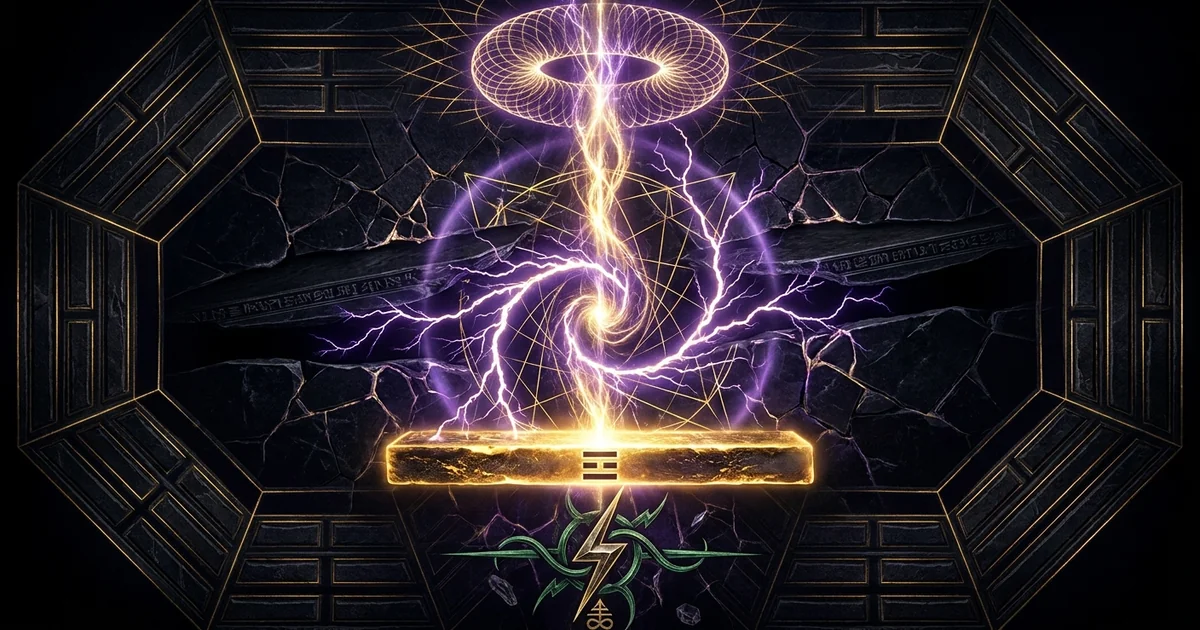
Trigram Zhen: Arousing Thunder & Primal Movement Flow
Archetypal Thesis & Systemic Paradigm: The Mechanics of Catastrophic Awakening
Trigram Zhen (震), translated canonically as “The Arousing” or “Thunder,” designates the precise thermodynamic threshold where quiescent, unmanifest potential undergoes a violent, non-linear phase transition into kinetic manifestation. Within the symbolic topology of the I Ching, Zhen is not an anthropomorphic atmospheric event, nor is it merely an omen of turbulent weather; it is an archetypal operator representing the rupture of equilibrium. It embodies the ignition spark of cosmic and psychic momentum, the sudden emergence of a coherent vector from an isotropic field.
In systemic terms, homeostasis is fundamentally conservative; complex adaptive systems tend to stabilize their internal states, buffering perturbations to preserve structural continuity. However, unbounded equilibrium is synonymous with entropic decay and systemic death. Zhen represents the structural counter-measure to this terminal inertia: an intentional, radical perturbation that forces an open thermodynamic system beyond its linear boundaries, precipitating a sudden re-organization into higher orders of complexity.
       Yin  (Broken)   --  --
       Yin  (Broken)   --  --
       Yang (Solid)    ------
Thermodynamic Non-Equilibrium: The Subterranean Yang Ignition
The architecture of Zhen consists of a single unbroken, luminous yang line positioned beneath two broken, compliant yin lines. In thermodynamic modelling, the foundational yang line functions as a high-density, low-entropy energy injection occurring at the baseline of the system. The yin strata above represent cold, inertial mass—the chthonic substratum or the unindividuated unconscious matrix. Because energy introduced into a stratified system naturally seeks equilibrium, the containment of an active, expanding yang force beneath an unyielding yin ceiling generates a localized pressure gradient. When the internal tension exceeds the structural threshold of the receptive layers above, the containment fails.
The resulting release is not a continuous, adiabatic expansion, but an explosive, non-linear discharge. This is the exact physical and metaphysical morphology of thunder: an electrical dielectric breakdown of the atmosphere provoked by an extreme subterranean and atmospheric differential. Zhen is this dielectric breakdown rendered as a universal psycho-cosmological coordinate. It marks the precise microsecond wherein latency ceases to be latent, rupturing the continuous surface of reality to inaugurate kinetic movement.
The Shock of Awakening as an Ontological Rupture
Within analytical and archetypal psychology, Trigram Zhen maps directly to the disruptive intervention of the Self into an ossified ego-consciousness. The crystallized ego operates via protective feedback loops designed to maintain identity, narrative coherence, and psychic stability. Yet, as Carl Gustav Jung observed, genuine individuation is rarely the outcome of peaceful, linear development; it requires the catastrophic shattering of existing defenses by numinous psychic material erupting from the objective unconscious.
“The breakthrough of the numinous alters the psychic topology instantaneously. It is not an additive process of cognitive accumulation, but an invasive, energetic flash that dissolves the defensive perimeter of the ego-complex. In this moment of terror (tremendum), the prior psychic economy collapses, compelling the system to either suffer psychotic fragmentation or re-crystallize around an expanded, transcendent center of gravity.” — Carl Gustav Jung, Collected Works of C.G. Jung, Vol. 8: The Structure and Dynamics of the Psyche (1952)
The initial subjective phenomenology of Trigram Zhen is invariably terror (kong, 恐). This dread is the predictable autonomic response of an established system confronting its own functional obsolescence. The shock of awakening shatters the illusion of structural permanency, forcing consciousness into an unmediated confrontation with the raw, uncoded dynamism of the real. The terrifying thunderclap represents the auditory and somatic signature of this psychic threshold. It is the violent recalibration of the perceptive apparatus when exposed to an influx of information that exceeds its current processing capacity.
Homeostatic Collapse and Dissipative Self-Organization
From the perspective of non-equilibrium thermodynamics pioneered by Ilya Prigogine, Zhen illustrates the operational mechanism of a “dissipative structure.” When an energetic field is driven far from equilibrium, the linear laws of cause and effect cease to govern the system; microscopic fluctuations amplify exponentially through positive feedback, culminating in a macroscopic bifurcation point.
The baseline yang line of Zhen operates as this initial fluctuation. As it discharges upward through the two yin strata, it disrupts the uniform distribution of psychic and material mass. The old homeostatic baseline is dismantled entirely. The systemic crisis introduced by Zhen is thus fundamentally generative. It dissolves structural rigidity, purges metabolic stagnation, and creates the thermodynamic necessity for novel evolutionary forms. Without the catastrophic punctuation of Zhen, the temporal continuum would calcify into perpetual stasis, preventing the cyclical emergence of life that characterizes the operational ethos of the bagua (eight trigrams).
Classical Provenance & Textual Lineage: The Sovereign Line of the Eldest Son
The historical and textual taxonomy of Zhen reveals a rigorous lineage of mathematical, structural, and philosophical exegesis spanning over two millennia. As an elemental constituent of the canonical Zhouyi, Zhen represents not merely dynamic movement, but the authoritative principle of origination within human kinship and cosmic succession.
                  THE SHUO GUA GENEALOGICAL VECTOR

       Qian (Heaven / Father)       Kun (Earth / Mother)
           [ ————— ]                     [ — — — ]
           [ ————— ]                     [ — — — ]
           [ ————— ]                     [ — — — ]
              │                             │
              └────── Generative Yang ──────┘
                             │
                             ▼
                    Zhen (Eldest Son)
                        [ — — — ]  Line 3 (Yin)
                        [ — — — ]  Line 2 (Yin)
                        [ ————— ]  Line 1 (Yang Transduced)
Exegesis of the Shuo Gua: The Genesis of the Eldest Son Trigram
In the Shuo Gua (說卦傳, Discussion of the Trigrams), which forms part of the Ten Wings (Shi Yi) appended to the core divinatory text, the mechanical generation of the trigrams is meticulously codified through an archetypal genealogy. The primal parents, Qian (Heaven, pure yang) and Kun (Earth, pure yin), engage in an energetic transaction that yields the six subsidiary trigrams. The classical text identifies Zhen as the Eldest Son (zhangnan, 長男).
“In the trigram of the Arousing, the Receptive seeks for the first time the power of the Creative and receives a son. Therefore the Arousing is called the eldest son. […] The Arousing brings about movement. […] It is in the symbol of the Arousing that all things burst forth. It emerges in the East.” — Shuo Gua, translated in Richard Wilhelm and Cary F. Baynes, The I Ching or Book of Changes (1950)
The structural logic here is exact: the Eldest Son does not inherit the uppermost (external) or central (mediating) position from the father. Instead, Zhen receives the initial line (chuxian, 初爻)—the deep foundational stratum. Kun receives Qian’s lower line, meaning that sovereign creative power is anchored at the subterranean base of the receptive matrix. Zhen therefore possesses the pristine, unmediated impulse of the Father, buried deeply within the structural passivity of the Mother. This positioning assigns to Zhen the executive role of historical and cosmological initiator: it is the vanguard of dynamic manifestation.
The King Wen and Fu Xi Vector Spaces: Temporal Succession vs. Polar Equilibrium
The positioning of Zhen shifts markedly between the two primary cosmological arrangements of the bagua: the Fu Xi (Earlier Heaven, Xiantian) and the King Wen (Later Heaven, Houtian) sequences. These dual arrangements reflect two entirely different modalities of systemic mapping: geometric symmetry versus phenomenological-temporal flow.
       EARLIER HEAVEN (Fu Xi)             LATER HEAVEN (King Wen)
       Polar Equilibrium Axis            Diurnal / Vernal Vector Space

                Qian (S)                             Li (S)
                  │                                    │
       Zhen (NE) ─── Xun (SW)                Zhen (E) ──── Dui (W)
                  │                                    │
                Kun (N)                             Kan (N)
In the Earlier Heaven arrangement, attributed to the mythic cultural hero Fu Xi, Zhen is positioned on the Northeast axis, directly opposing Trigram Xun (Wind/Wood, ☴) on the Southwest axis. This structural polarity maps an ontological equilibrium: explosive, localized, upward-thrusting kinetic force (Thunder/Zhen) is perfectly counterbalanced by diffuse, continuous, horizontally penetrating dynamic force (Wind/Xun). In this ideal state-space, the cosmos is balanced in eternal tension; energy does not deplete, nor does it collapse into time.
Conversely, in the Later Heaven arrangement formulated by King Wen, Zhen is relocated decisively to the absolute East. Here, the arrangement reflects the diurnal path of the sun and the circular progression of the terrestrial seasons. The East is the sector of the dawn, the vernal equinox, and the awakening of organic life after the cold stasis of Winter (governed by Kan, Water, in the North). In the Later Heaven sequence, Zhen initiates the entire existential cycle: “God comes forth in the sign of the Arousing.” It transitions from an abstract, polarized potential into an operational temporal vector that drives the cosmic process forward through chronological time.
Han Dynasty Yixiang Lineages: Structural Readings from Wang Bi and Jiao Yanshou
During the Han dynasty, the interpretation of the Zhouyi became heavily encrusted with complex, mechanical systems of omenology and cosmic resonance (Xiangshu Yixue, Image and Number School), developed by scholars such as Jing Fang and Jiao Yanshou. Zhen was frequently decoded as a direct portent of political upheaval, imperial displeasure, seismic events, or destructive meteorological anomalies.
This mechanistic externalization was dismantled in the third century CE by the brilliant neo-Daoist philosopher Wang Bi (ca. 249 CE). In his Zhouyi Zhu (Commentary on the Book of Changes), Wang Bi rejected the literalist reading of physical images, asserting that the physical tokens of thunder and shaking were merely functional vehicles to communicate an underlying metaphysical principle: the necessity of dynamic, spontaneous movement (dong, 動) to break systemic calcification.
Wang Bi demonstrated that the terror associated with Zhen is not an omen of impending geopolitical destruction, but an epistemic prerequisite for authentic inner mastery. Drawing from classical passages, he elucidated that the experience of terror (kong) naturally leads to subsequent self-regulation and composure (xiao, 笑—“laughing words”). The terror awakens consciousness from its narcissistic slumber; once awakened, the sovereign intellect attains a state of dynamic equanimity that can navigate chaotic environments without dropping the sacrificial vessels.
Structural Mechanics & Symbolic Geometry: Binary Architecture and Energetic Vectoring
To fully grasp the systemic operation of Trigram Zhen, one must analyze its binary topology, its assignment within Five-Phase (Wuxing) alchemy, and its specific transformations across macrocosmic hexagram matrices.
                    TRIGRAM ZHEN: TOPOLOGICAL TENSION

         Line 3 (Top):    --  --   Yin: Cold, Compliant Mass
         Line 2 (Middle): --  --   Yin: Structural Inertia
                                   ▲▲▲ Upward Kinetic Thrust
         Line 1 (Bottom): ------   Yang: Dense Ignitive Spark
The Line Topology: Solid Line 1 (Yang) Underlying Broken Lines 2 & 3 (Yin)
The graphic architecture of Zhen (☳) is a masterpiece of dynamic tension. In binary notation (where yin is 0 and yang is 1), reading from bottom to top according to canonical hexagram construction, Zhen is rendered as 1-0-0.
The single yang line at the root is structurally unyielding, dense, and hyper-kinetic. It represents a concentrated packet of informational coherence. Directly above it lie two fractured lines—open spaces characterized by yielding compliance and structural vulnerability. Because yang is inherently buoyant, light, and upwardly mobile, while yin is heavy, dense, and downwardly settling, the binary structure of Zhen creates an unsustainable mechanical contradiction: the heavy mass rests upon an expansive, pressurized base.
The kinetic vector of Zhen is therefore vertical, aggressive, and unidirectional. The solid bottom line does not negotiate with the upper yin strata; it penetrates and shatters them. It provides a foundational propulsion that forces the entire trigram into an upward trajectory. This structural geometry explains why Zhen governs the somatic feet and the lower limbs—it is that which pushes off the earth to initiate biomechanical locomotion.
The Vector of Spring and the Wood Element Bagua Dynamics
Within the Five-Phase (Wuxing, 五行) framework, Trigram Zhen is assigned to the phase of Wood (mu, 木), specifically Lesser Yang (shao yang, 少陽) or Hard, Mature Wood (zhen mu). While its complementary counterpart Xun represents Soft, Pliant Wood (the insinuation of roots, grasses, and flexible vines), Zhen represents the hard, unbending shoot of bamboo piercing frozen winter earth, or the massive trunk of the pine resisting structural inertia.
This aligns Zhen systematically with the vernal equinox. In the cycle of biological systems, the vernal phase requires an extraordinary expenditure of energy to break seed dormancy (vernalization). The seed coat, having protected the embryo through winter’s stasis, now represents a prison that must be violently breached from within. The hepatic (Liver) energy governed by the Wood phase in traditional Chinese medicine reflects this dynamic: it regulates the free flow of qi, stores the dynamic blood, and provides the physiological impulse for directed action and visionary planning (hun). When hepatic energy is blocked, pathology manifests as sudden spasms, convulsions, and uncontrollable affective outbursts—pathological biological simulations of Trigram Zhen.
Structural Permutations: Hexagram 51 (Zhen over Zhen) and Hexagram 24 (Fu)
The energetic behavior of Trigram Zhen becomes starkly apparent when analyzing its macroscopic integration within the 64 hexagrams, most notably in Hexagram 51 (Shock, Zhen, 震為雷) and Hexagram 24 (Return, Fu, 復).
         HEXAGRAM 24: FU (Return)       HEXAGRAM 51: ZHEN (Shock)
             --  -- Line 6 (Yin)            --  -- Line 6 (Yin)
             --  -- Line 5 (Yin)            --  -- Line 5 (Yin)
             --  -- Line 4 (Yin)            ------ Line 4 (Yang)
             --  -- Line 3 (Yin)            --  -- Line 3 (Yin)
             --  -- Line 2 (Yin)            --  -- Line 2 (Yin)
             ------ Line 1 (Yang)           ------ Line 1 (Yang)
In Hexagram 24, Fu (Return / The Turning Point), Trigram Zhen sits beneath Trigram Kun (pure Receptive, pure yin). This represents the winter solstice: five yin lines above, with a single yang line newly generated at the absolute base. Here, Zhen is in its embryonic, subterranean phase. The kinetic power has just sparked in the depths of the earth; it is imperceptible to casual observation, yet it guarantees that the reign of darkness has reached its mathematical limit. The movement is gentle, requiring total non-interference: “The ancient kings closed the passes at the solstice.” Zhen at the base of Kun demonstrates the quiet, deterministic inception of an irreversible evolutionary turn.
In Hexagram 51, Zhen (Shock / The Arousing), Zhen is doubled: Zhen above, Zhen below (1-0-0-1-0-0). Here, the subterranean shockwave of the lower trigram does not dissipate; it encounters a secondary Zhen directly above it, creating a catastrophic resonance cascade. The shockwave is continuous; thunder echoes across the landscape, inducing widespread existential panic. The doubled trigram represents the psycho-social phenomenon of systemic crisis: when external structures collapse in rapid succession, the individual can no longer rely on external reference points for equilibrium, forcing an immediate internal migration to the transcendent, unshakeable center of the Self.
Psychological Dynamics & Operational Praxis: Transmuting Terror into Composure
When consulted within a divinatory, psychological, or state-space framework, the appearance of Trigram Zhen signals an immediate cessation of deliberation. It marks the termination of theoretical planning and demands operational engagement with an erupting reality.
The Somatic Circuitry of Shock: Sympathetic Arousal and Vagal Reset
At the neuro-somatic level, Zhen correlates directly with the sudden, massive activation of the sympathetic branch of the autonomic nervous system. The thunderclap induces an instantaneous acoustic startle reflex: pupils dilate, blood is directed toward the striated musculature via hepatic vasodilation, peripheral circulation drops, and the brainstem initiates an immediate threat appraisal.
                    NEURO-SOMATIC TRAJECTORY OF ZHEN

    Sympathetic Spike               Vagal Inhibition              Equanimity
    (Acoustic Startle)           (Cognitive Decoupling)       ("Laughing Words")
  ┌─────────────────────┐       ┌──────────────────────┐    ┌────────────────────┐
  │ Sudden Adrenaline   │  ──►  │ Preserved Awareness  │ ──►│ Dynamic Balance    │
  │ Visceral Terror     │       │ "Spoon & Chalice"    │    │ Neuro-Somatic Flow │
  └─────────────────────┘       └──────────────────────┘    └────────────────────┘
In modern polyvagal theory, the immediate response to existential shock is either mobilization (sympathetic fight-or-flight) or collapse (dorsal vagal freeze). Zhen contains both: the subterranean yang line represents explosive sympathetic mobilization, while the two yin lines above it can represent the freezing weight of systemic paralysis. The spiritual operational task delineated by the Zhouyi is the preservation of ventral vagal social engagement and internal coherence in the exact midst of extreme sympathetic arousal.
The text advises that the shock terrifies for a hundred li (hundreds of miles), yet the master practitioner does not drop the sacrificial spoon and chalice (bu sang bi chang, 不喪匕鬯). The ritual instruments represent the maintenance of sacred order, axis-mundi awareness, and deliberate non-reactivity while the peripheral neuro-somatic circuits are ablaze with raw survival energy.
- Cardinal Direction: Absolute East (Later Heaven / King Wen)
- Phase Dynamic: Hard Wood (Zhen Mu, 震木) / Lesser Yang (Shao Yang)
- Somatic Topography: The Feet, Liver, Gallbladder, Motor Nervous System
- Biological Organ: Liver (Smooth circulation of qi, visionary tension)
- Meridian Axis: Jueyin (Liver) and Shaoyang (Gallbladder)
- Archetypal Kinship: Eldest Son (Zhangnan, 長男)
- Thermodynamic Mode: Dielectric breakdown, catastrophic non-equilibrium release
- Astrological Analogue: Mars/Jupiter catalytic dynamic (Directed martial force expanding into ideological space)
- Animal Totem: The Dragon (Long, 龍) rising from the subterranean abyss
Interpretive Mechanics of Hexagram 51: ‘Shock Brings Terror, Then Laughing Words’
The foundational judgment of Hexagram 51 contains the celebrated formula: “Shock brings terror, then laughing words” (zhen lai xi xi, xiao yan ya ya, 震來虩虩, 笑言啞啞). This is an extraordinary mapping of cognitive-affective integration.
       Existential Threat (Terror: Xi Xi) ──► System Reorganization
                                                    │
                                                    ▼
       Equanimous Composure (Laughter: Ya Ya) ◄─────┘
The term xi xi describes the trembling apprehension of an organism confronted with an overwhelming display of cosmic force. The subsequent xiao yan ya ya (laughing words) does not denote cynical mockery, manic denial, or superficial levity. It represents the profound, somatic relief of an ego that has survived its own anticipated demise. Laughter is the biological discharge of surplus psychic tension when an insurmountable threat has been metabolized without destroying the system.
The sequence reveals that terror is not an obstacle to be avoided, but an indispensable psychological crucible. The individual who flees from the terror remains trapped in neurosis; the individual who fully undergoes the ontological shock discovers an internal sovereignty that transcends circumstantial vulnerability.
Meditative Decoupling: Navigating Abrupt Epistemological Shifts
In Daoist internal alchemy (Neidan), Trigram Zhen is mobilized as the dynamic engine of transformation. In the lower dantian (the physical lower abdomen), the practitioner gathers the passive, quiescent jing (vital essence, corresponding to Kun, pure yin). Through specialized breathing vectors and mental concentration, the practitioner ignites the fundamental yang fire at the base of this essence.
This ignition corresponds to the generation of Zhen. The energetic substance can no longer remain dormant in the pelvic floor; the subterranean yang line forces the awakened energy upward through the spinal pathway of the Du Mai (Governor Vessel). This phenomenon is often accompanied by spontaneous tremors, sensations of intense heat, and an internal sound described as rolling thunder within the skull. The alchemist must navigate this violent ascendance without egoic panic. If the practitioner contracts in terror, the ascending fire stagnates, causing profound psychological disequilibrium or physical distress. The operational imperative is total meditative decoupling: allowing the primal movement flow to burn through blockages along the energetic spine while resting unconditionally in unattached awareness.
Philosophical Synthesis & Macrocosmic Correspondence: Hermetic Polarities and Genetic Codons
The operational dynamics of Zhen are not bounded by classical Chinese texts; they reflect universal structural dynamics that reappear across disparate scientific, Hermetic, and informational paradigms.
                    HERMETIC POLARITY OF THE WOOD AXIS

       ZHEN (Thunder) ☳                 XUN (Wind) ☴
       [ — — — ] Top (Yin)              [ ————— ] Top (Yang)
       [ — — — ] Middle (Yin)           [ ————— ] Middle (Yang)
       [ ————— ] Bottom (Yang)          [ — — — ] Bottom (Yin)
       Kinetic / Explosive Vector       Dispersive / Penetrative Vector
Hermetic Polarity: The Dialectic of Zhen (Shock) and Xun (Penetration)
Within the Hermetic philosophy formalized in the Corpus Hermeticum and later esoteric tracts, the universe is governed by the principles of Polarity, Vibration, and Rhythm. Everything exists along a continuum of paired opposites. As established in the Earlier Heaven bagua, Zhen finds its operational counter-weight in Trigram Xun (The Gentle / Wind).
Trigram Zhen: The Kinetic Spark
- Symbol: Thunder (☳)
- Binary Archetype:
1-0-0(Base Yang, Upper Yin) - Operational Vector: Vertical, explosive, breakthrough
- Kinetic Velocity: Discontinuous, high-amplitude, immediate
- Psychological Mode: Ontological shock, catastrophic insight, panic transmuted into sovereign presence
- Five-Phase Expression: Hard Wood (Zhen Mu), the sprouting seed, the lightning strike
- Somatic Locus: Lower limbs, rapid physical propulsion, acute sympathetic discharge
Trigram Xun: The Insinuating Vector
- Symbol: Wind / Wood (☴)
- Binary Archetype:
0-1-1(Base Yin, Upper Yang) - Operational Vector: Horizontal, diffusive, penetrating
- Kinetic Velocity: Continuous, low-amplitude, ubiquitous
- Psychological Mode: Subconscious insinuation, gentle persuasion, sustained integration
- Five-Phase Expression: Soft Wood (Xun Mu), the creeping ivy, the ambient breeze
- Somatic Locus: The thighs, breath, nervous system distribution
Zhen is the lightning strike that instantly ionizes the atmosphere; Xun is the planetary wind system that gradually distributes those ionized molecules across continents. Zhen represents revolutionary, qualitative disruption; Xun represents evolutionary, quantitative adaptation. Mastery of the I Ching requires recognizing that these two trigrams are not antagonistic, but constitute the systolic and diastolic phases of the cosmic Wood element. Zhen initiates the trajectory through catastrophic rupture; Xun completes the trajectory through patient, inexorable infiltration.
Chronobiological and Genetic Parallels: Start Codons and Circadian Rhythms
In the late 20th century, researchers including Martin Schönberger and Katya Walter recognized the mathematical isomorphism between the 64 hexagrams of the I Ching and the 64 triplet codons of the universal genetic code (mRNA). Within this mapping, the four bigrams correspond to the four nucleotide bases (Adenine, Cytosine, Guanine, and Uracil), and the hexagrams describe the complete state-space of amino acid transcription.
       TRANSCRIPTION INITIATION: THE GENETIC ZHEN

       [ Kun Stratum: Inactive DNA Matrix ]
                      │
                      ▼
       [ AUG / Methionine: The Start Codon ]  <─── Structural Zhen (☳)
                      │
                      ▼
       [ Polypeptide Synthesis Commences ]
Within this genetic cartography, Trigram Zhen correlates structurally with the universal Start Codon (AUG), which codes for Methionine. In molecular biology, translation of messenger RNA into a polypeptide chain cannot occur arbitrarily; the cellular ribosome requires an unambiguous informational ignition signal to commence synthesis. The start codon functions precisely as an informational Zhen: it awakens the passive transcriptional machinery, breaks the linear stasis of the genetic strand, and inaugurates the forward construction of living protein architectures.
Similarly, in chronobiology, Zhen maps to the rapid cortisol spike that occurs approximately 30 minutes prior to waking (the cortisol awakening response). The organism is jolted from the delta-wave stasis of deep sleep (Kan/Kun) into the beta-wave engagement of the diurnal sphere through a calculated endocrine shockwave.
Systemic Cybernetics: The Arousal Signal as Negentropy
In the cybernetics of Norbert Wiener and Gregory Bateson, information is defined as “a difference that makes a difference.” A message containing zero surprise possesses maximum entropy and communicates nothing; it reinforces pre-existing systemic assumptions without altering the system’s internal state.
Trigram Zhen is the supreme negentropic operator. By delivering an input that cannot be predicted from the system’s prior historical trajectories, it injects high-density information directly into the systemic core. Far from being a chaotic force of destruction, the shock of Zhen rescues complex systems—whether psychological egos, cultural institutions, or biological ecosystems—from the terminal decay of hyper-specialization and bureaucratic stagnation. It forces the system to learn, adapt, and reorganize at an accelerated pace, ensuring its long-term viability across an unpredictable cosmic environment.
Frequently Asked Questions
Structural and Hermeneutic Inquiries on Trigram Zhen
Why is Zhen classified as the Eldest Son if it contains only one yang line and two yin lines?
In the structural hermeneutics of the Zhouyi, the ruler or primary determinant of a trigram’s dynamic quality is determined by the minority line, not the majority. A trigram dominated by two yin lines is structurally governed by its single, distinctive yang line, which stands out as the active energetic focus.
Furthermore, according to the genealogical transmission formalized in the Shuo Gua, Qian (Heaven) transfers its first, foundational line (chuxian) to Kun (Earth). Because it is the first (lowest) line that is received, this child represents the primordial, earliest generation of the yang principle within the receptive matrix—hence, the Eldest Son (zhangnan). Trigram Kan (Water) receives the second (middle) line, making it the Middle Son, while Gen (Mountain) receives the third (top) line, making it the Youngest Son.
What is the precise mechanical difference between Hexagram 51 (Shock) and Hexagram 24 (Return)?
The difference lies in systemic scale, latency, and kinetic velocity:
- Hexagram 24 (Fu) represents Zhen operating beneath pure Kun (
1-0-0-0-0-0). The kinetic yang impulse has just emerged at the absolute subterranean baseline. Its momentum is imperceptible on the macroscopic surface; it demands absolute rest, preservation, and non-action to nurture the fragile spark of returning light. - Hexagram 51 (Shock) features Zhen doubled (
1-0-0-1-0-0). Here, the yang energy is not a fragile seed; it is a fully actualized macroscopic chain reaction. The movement is violent, audible, and systemically disruptive. Hexagram 24 requires the preservation of internal stillness; Hexagram 51 requires the sovereign maintenance of liturgical and psychological presence during a chaotic peripheral storm.
       HEXAGRAM 24 (Fu)                     HEXAGRAM 51 (Zhen)
       Latent Seed Under Earth              Resonant Macroscopic Chain Reaction
       Internal Stillness Required         Unshakable Equilibrium Demanded
Resolving Divinatory Misconceptions of Disaster vs. Transformation
Does receiving Trigram Zhen or Hexagram 51 indicate an inevitable catastrophe?
No. This interpretation stems from a superficial reading popularized by debased fortune-telling lineages that equate disturbance with moral evil or pragmatic failure. In the rigorous psycho-cosmology of the I Ching, Zhen denotes an ontological rupture: the breaking of a crystallized frame of reference.
While this frequently manifests as an unexpected external shock—such as the abrupt termination of an enterprise, an ideological crisis, or a somatic symptom—the event itself is structurally neutral. It is an evolutionary corrective designed to dissolve terminal homeostasis. The disaster occurs only when the ego attempts to stubbornly cling to its obsolete defensive structures rather than yielding to the systemic reorganization demanded by the shock.
How does one differentiate between the shock of Zhen and the conflict of Hexagram 6 (Song)?
Trigram Zhen represents an ontological shock arising naturally from the thermodynamic laws of cyclical reality; it is an organic, evolutionary threshold where latent energy breaks into the open. It has no personal enemy; it is the impersonal thunderclap of awakening.
Hexagram 6 (Song, Conflict), on the other hand, represents an ideological deadlock between two incompatible vectors: Heaven (Qian) pushing upward above, and Water (Kan) descending downward below. Conflict in Hexagram 6 is communicative, contractual, and relational; it arises from misaligned interests and communicative distortion. Zhen is non-discursive: it does not argue; it shatters the ground upon which the argument was taking place.
Somatic and Cross-Disciplinary Attributions
How does Trigram Zhen operate within somatic therapy and somatic experiencing?
In somatic psychology, Zhen maps to the release of trapped procedural survival energy following a trauma freeze. When an organism is threatened, it mobilizes enormous sympathetic energy to fight or flee. If that response is blocked, the energy is frozen into the somatic matrix via dorsal vagal shut-down (the upper yin lines of Zhen).
Therapeutic resolution often involves an involuntary, somatic tremor—a localized “earthquake” or “thunder” within the client’s musculature. This physical shaking is the precise manifestation of the foundational yang line breaking through the frozen muscular armor. The somatic practitioner encourages this tremor, recognizing it as the nervous system’s natural mechanism for discharging accumulated survival charge and restoring autonomic flexibility.
Where does Trigram Zhen fit in the architectural progression of the 64 Hexagrams?
Within the King Wen Sequence, Zhen appears as a critical dynamic pivot. Following the developmental stability and structural crystallization of Hexagram 49 (Ge, Revolution) and Hexagram 50 (Ding, The Caldron)—which establish new institutional and spiritual vessels—Hexagram 51 (Zhen, Shock) violently tests the structural integrity of those vessels.
It ensures that the newly established sacred order does not freeze into dogmatic idolatry. Zhen immediately tests the priest: does he drop the sacrificial chalice when the earth roars, or does his realization of the Tao hold fast in the presence of the arousing thunder? Zhen is the ultimate diagnostic of authentic metaphysical integration.