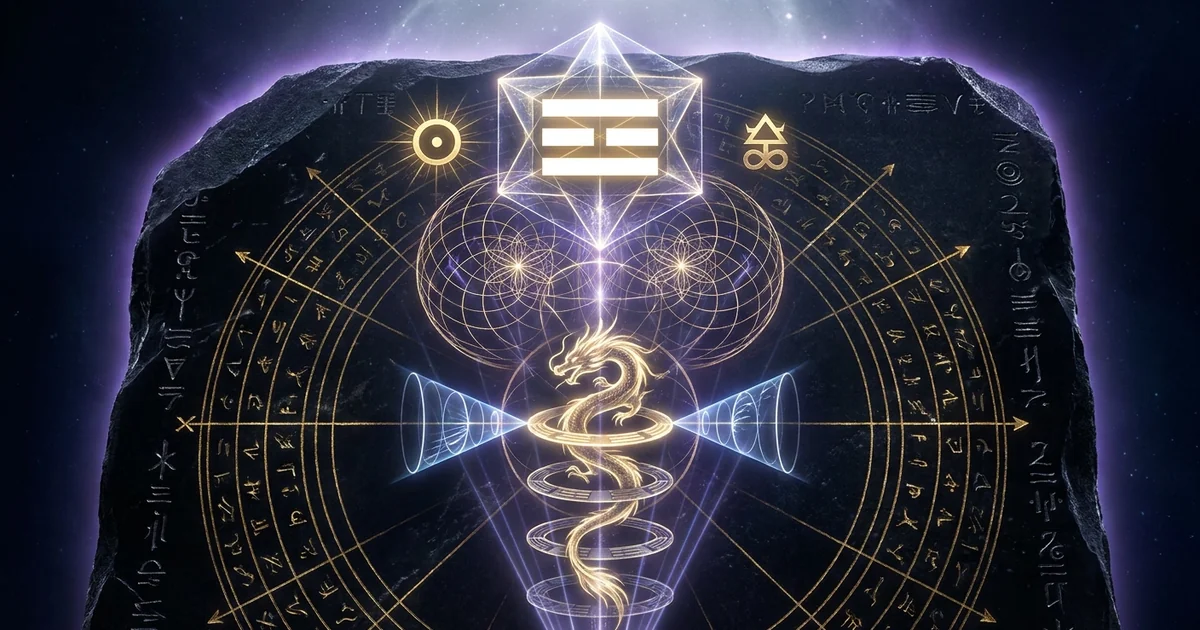
Trigram Qian: Pure Creative Force of Celestial Heaven
Archetypal Thesis & Systemic Paradigm: Qian as the Vector of Pure Yang
The Ontological Status of Tian (Celestial Heaven)
Trigram Qian (☰) occupies the primary structural coordinate within the psycho-cosmological topology of the I Ching. Identified ontologically with Tian (Celestial Heaven), Qian does not represent a distant metaphysical anthropomorphism, nor does it function as a simple patriarchal emblem within an ancient hierarchy. Instead, it constitutes the unconditioned, unbroken vector of pure creative volition—the primordial initiating force that compels potentiality into actuality. Within the foundational Chinese metaphysics that informs the bagua, Qian represents the totalization of yang energy, operating without the dampening resistance or receptive matrix of trigram-kun. It is continuous, unsegmented, and relentlessly dynamic.
In classical thought, Tian signifies the visible dome of the cosmos, the cyclical precision of astronomical movements, and the invisible moral-ontological engine driving all natural phenomena. As an archetypal reality, Tian designates an ontological horizon that precedes material condensation. It is the realm of pure form-generation, where the blueprints of manifestation reside as luminous dynamic patterns before they intersect the physical realm of Earth (Di). When the early cosmologists observed the diurnal and seasonal revolutions of the stars, they mapped this uninterrupted kinetic continuity directly onto Trigram Qian. Consequently, Qian is characterized fundamentally as Jian (strength, persistent motion, unyielding vitality), manifesting a mode of existence that never suspends its generative impulse.
To comprehend the trigram qian heaven creative energy iching dynamic is to recognize it as the self-subsistent origin of all kinetic systems. Qian does not rely on an external prime mover; it is the prime mover. It serves as the primary engine within the taiji dialectic, supplying the radical, uncurbed propulsion that drives the emergence of the cosmos out of unmanifest stillness. It is the unconditioned breath (Qi) elevated to its highest mathematical coherence, establishing the structural horizon against which all subsequent transformations are measured and calibrated.
Pure Actuality, Negative Entropy, and the Kinetic Principle
Interpreted through contemporary non-equilibrium thermodynamics and complex systems theory, Trigram Qian manifests as a systemic state of pure negentropy (negative entropy). While material systems naturally drift toward thermodynamic equilibrium, thermal dispersion, and informational decay, Qian operates as the localized, concentrated injection of coherent work and order. As a yang trigram composed of three solid lines, its informational structure represents maximum redundancy of pure signal, entirely devoid of the entropy or indeterminate variance introduced by broken (yin) lines. It is the absolute state of pure actuality (actus purus in Scholastic terminology), completely exhausting its capacity for inertia in favor of kinetic teleology.
The kinetic principle governing Qian is continuous rather than oscillating. In the broader mechanics of the Zhouyi, individual lines fluctuate between extremes of tension and release. Qian, however, embodies the idealization of an uninterrupted forward vector. It is the cosmic ignition spark, the mathematical vector that points decisively away from the chaotic null-state toward ordered instantiation. Its dynamic drive does not negotiate with entropy; it overrides it through persistent systemic re-ordering. When systems fall into structural stagnation, the entry of Qian introduces a systemic phase shift, forcing recalibration and catalytic renewal across all constituent nodes.
This negentropic property explains why Qian is traditionally associated with the celestial spheres, the movements of light, and the relentless generation of life. In thermodynamic terms, the Sun provides the negentropic energy flow that permits planetary biology to organize against entropic dissipation; Qian is the psycho-cosmological prototype of that solar influx. It represents the structural mandate that form shall prevail over formlessness, that coherent code shall supersede ambient white noise, and that evolutionary self-organization shall violently resist the gravitational pull of universal dissolution.
The Creative Celestial Father in Archetypal Psychocosmology
Within the domain of analytical psychology formulated by Carl Gustav Jung and elaborated by Marie-Louise von Franz, Trigram Qian corresponds directly to the archetype of the creative celestial father—the supraordinate archetype-logos that organizes, clarifies, and teleologically propels human consciousness. Qian is not the personal biological father, nor is it the cultural archetype of the tyrannical king (the ossified Senex). Rather, it functions as the transcendent principle of spiritual paternity: the luminous, discriminating consciousness that divides the primordial waters of the unconscious matrix and establishes the sovereign ego-Self axis.
“The archetype as an autonomous energy charge does not merely represent a psychological image; it behaves as an ontological dynamic that seizes consciousness and compels manifestation. In the architecture of divination, the appearance of the pure creative principle signifies a breakthrough of absolute meaning into temporal chaos—the supreme masculine Logos ordering the pre-verbal matrix.” — Carl Gustav Jung, Foreword to the I Ching (1950) & Marie-Louise von Franz, On Divination and Synchronicity (1980)
The archetype of Qian represents the teleological impetus of the psyche. It provides the internal imperative toward individuation, operating as an autonomous energetic demand that consciousness actualize its latent potentials into tangible, coherent works. Where the unintegrated unconscious remains undifferentiated, dark, and reactive, the intervention of Qian introduces crystalline clarity, rational delineation, and conscious purpose. It is the internal authority that commands an individual to author their existence rather than passively drift within ancestral complexes.
Psychologically, Qian is the source of generative inspiration, sudden creative illumination, and moral resolve. When the ego successfully aligns with this vector, it experiences an accession of transpersonal power characterized by visionary lucidity and decisive will. However, this celestial current carries radical systemic liability. Because Qian is pure kinetic energy devoid of receptive inertia, human consciousness cannot sustain its direct, unmediated charge indefinitely without adequate grounding. Left unmitigated by the receptive containment of Earth, the creative force of Qian breaches the vessel of the human psyche, precipitating ideological fanaticism, executive exhaustion, and devastating archetypal inflation.
Classical Provenance & Textual Lineage: The Genesis of Qian in the Zhouyi
The Primordial Stemma of the Shuogua Zhuan
The historical and metaphysical articulation of Trigram Qian finds its primary textual foundation within the Ten Wings (Shi Yi), the authoritative canonical commentaries appended to the foundational divinatory layers of the Zhouyi. Among these, the Shuogua Zhuan (The Discussion of the Trigrams) functions as an archaic structural encyclopedia, detailing the operational behaviors, symbolic correlations, and natural manifestations of each trigram. The Shuogua Zhuan does not approach Qian through sentimental moralism; instead, it establishes an exhaustive semiotic catalog defining how the celestial dynamic operates across various categorical dimensions of reality.
In the eighth chapter of the Shuogua Zhuan, the baseline definition is forged with pristine economy: “Qian is strength” (Qian, jian ye). The commentary immediately ties this dynamic property to concrete macrocosmic and microcosmic phenomena:
“Qian is heaven. It is round, it is the sovereign, it is the father, it is jade, it is metal, it is cold, it is ice, it is deep red, it is a good horse, an old horse, a lean horse, a wild horse, it is tree fruit.”
These attributions represent an intricate web of vibrational and functional equivalences. Jade and metal represent indestructible structural integrity, dense purity, and the refined crystallization of mineral matter under immense celestial pressure. Cold and ice refer to the radical purity of the upper atmosphere, untouched by the humid, thermal turbulences of earthly decay. The designations of the horse—ranging from the prime steed to the old and wild horse—emphasize relentless mobility, stamina, untamed generative vigor, and enduring loyalty to the celestial course.
The Shuogua Zhuan systematically positions Qian as the operational anchor of the cosmos. It notes that “Qian rules by yielding nothing,” meaning that its sovereignty is maintained through absolute structural fidelity to its own internal nature. It does not bargain, waver, or dilute its essence to accommodate circumstance. In cataloging these attributes, the Shuogua Zhuan constructs a multi-layered template wherein any phenomenon manifesting absolute continuity, structural hardness, sovereign intentionality, or generative propulsion is understood as an operational node of Qian.
The Wenyan Commentary and the Four Cardinal Cosmic Attributes (Yuan, Heng, Li, Zhen)
While the Shuogua Zhuan maps the external correspondences of Qian, the Wenyan Zhuan (Commentary on the Words of the Text)—traditionally focused exclusively on Hexagram 1 (Hexagram 1: Pure Yang Qian) and Hexagram 2—provides the ethical, cosmic, and metaphysical interiority of this pure celestial force. The Wenyan elevates the foundational divinatory formula attached to Qian—Yuan, Heng, Li, Zhen—from simplistic prognostic indicators into the four cardinal cosmic virtues (Si De), mapping the cyclic pulsation of celestial virtue through time.
“Great indeed is the generating power of the Creative; all beings owe their beginning to it. It permeates all heaven… ‘Yuan’ (origination) is the first and chief quality of goodness. ‘Heng’ (facilitation) is the assembly of beauties. ‘Li’ (beneficence) is the harmony of all that is right. ‘Zhen’ (perseverance) is the foundation of all actions. Because the noble person embodies humaneness, he can preside over others. Because he brings about the assembly of beauties, he can harmonize them through the rites. Because he benefits all things, he can unite them through justice. Because he is steadfast and solid, he can manage all affairs.” — Zhouyi, Wenyan Zhuan, Bollingen Series XIX
Under the analytical scrutiny of the Wenyan, these four terms trace the developmental trajectory of creative actualization:
- Yuan (Origination / Primordial Genesis): The primordial seed-state of pure intentionality. It is the unconditioned spark of cosmic benevolence (Ren), the sudden emergence of structural novelty from the void.
- Heng (Facilitation / Pervasive Flow): The frictionless expansion and communication of this creative impulse across the field of reality. It is the aesthetic coordination of all emerging parts, ensuring the initial impulse moves toward complexity without internal contradiction.
- Li (Beneficence / Harmonious Advantage): The tangible nourishment and order that the creative vector bestows upon the manifest world. It brings justice and fittingness (Yi) into physical expression, sustaining created life through righteous utility.
- Zhen (Perseverance / Unwavering Realization): The structural crystallization, firm moral rectitude, and self-contained closure of the cycle. It is the capacity of the creative act to maintain its structural truth against temporal erosion, becoming the immutable foundation for the next generative leap.
The Wenyan demonstrates that Qian’s celestial force is inherently cyclical and moral. Pure creative power that does not cycle into steadfast perseverance (Zhen) degrades into chaotic violence. Thus, Qian contains within its own semantic code the imperative for structural discipline and moral responsibility.
Wang Bi’s Ontological Revolution: Trigrams as Metaphysical Dynamic Images
During the Three Kingdoms period, the brilliant Neo-Daoist (Xuanxue) philosopher Wang Bi (226–249 CE) radically restructured the interpretive paradigm of the Zhouyi, liberating it from the burdensome, mechanical omenology (Xiangshu) of the Han dynasty. Prior to Wang Bi, Han commentators had encrusted Trigram Qian with exhaustive lists of literal omens, physical portents, and rigid astrological computations. Wang Bi enacted an ontological revolution by asserting the priority of Meaning (Yi) over Image (Xiang), and Image over Word (Yan).
In his seminal Zhouyi Zhu (Commentary on the Zhou Changes), Wang Bi posited that Qian is not a collection of physical objects—it is not merely the literal sky, a physical horse, or a sovereign emperor. Rather, Qian is an intelligible metaphysical dynamic: the pure operation of non-being (Wu) mobilizing itself through continuous, unified Yang activity. Wang Bi argued that the three solid lines of Qian represent an indivisible principle (Li) of coherent integration. To fixate on the physical manifestations listed in the early appendices is to forget the fundamental principle that animates them.
Wang Bi demonstrated that Qian operates through absolute spontaneity (Ziran). Because it contains no internal divisions or conflicting broken lines, it moves without friction, initiating all worldly transformations while remaining untouched by temporal corruption. By framing Qian as an immaterial, metaphysical dynamic rather than a catalog of Han portents, Wang Bi provided the philosophical foundation for all subsequent internal, contemplative, and archetypal readings of the trigram, establishing it as an ontological coordinate of conscious, generative will.
Structural Mechanics & Symbolic Geometry: Anatomy of the Three Solid Lines
Binary Topology and the 111 Register
In the structural mechanics of the bagua mathematics, Trigram Qian is composed of three solid lines (San Lian ☰). When transcribed into binary notation—as recognized by Gottfried Wilhelm Leibniz upon his receipt of Joachim Bouvet’s I Ching charts—Qian corresponds uniquely to the register [1, 1, 1]. This designation reveals its fundamental information-theoretic reality: Qian represents total systemic activation across all three qualitative registers of existence.
Heaven:  —————  (Bit 2 = 1)
Man:     —————  (Bit 1 = 1)
Earth:   —————  (Bit 0 = 1)
In binary topology, a solid line signifies continuity, activation, and structural charge, whereas a broken line (0) signifies permeability, spatial opening, and grounding potential. A system characterized by [1, 1, 1] operates at maximum systemic tension. There are no systemic dampers, no intervals of rest, and no receptive interruptions to absorb or buffer the energetic charge.
This topology dictates that Qian can never be reactive; it is perpetually and structurally proactive. In informational architectures, Qian functions as an uncorrupted, continuous clock-rate, the steady transmission of fundamental frequency that synchronizes all dependent systemic modules. Without the presence of an open zero (0), Qian possesses zero spatial capacity to receive input from external entities; its operational role is exclusively communicative, distributive, and imperative.
Spatial Vectoring: Xiantian (South) versus Houtian (Northwest) Orientations
The psycho-cosmological function of Trigram Qian shifts profoundly depending on its placement within the two primary spatial matrices of Chinese metaphysics: the Xiantian Bagua (Early Heaven Sequence, attributed to the legendary culture hero Fu Xi) and the Houtian Bagua (Later Heaven Sequence, attributed to King Wen).
In the Xiantian Bagua, Qian resides at the apex: the South. In classical Chinese cartography, South corresponds to the top of the map, the zenith of the sun, maximum illumination, and the peak of summer warmth. Here, Qian stands in direct, unmediated polar opposition to Trigram Kun (Earth, [0, 0, 0]), which anchors the North. This Early Heaven arrangement is an energetic, ideal blueprint of the cosmos prior to its temporal descent. Qian in the South signifies primordial energetic alignment, pristine balance, and the uninhibited radiation of celestial light down into the receptive field of the Earth. It is the static, eternal perfection of metaphysical law.
In the Houtian Bagua, which maps the dynamic, fallen, or operational world of temporal succession and seasonal transitions, Qian descends from the radiant South to the Northwest. This spatial relocation represents an essential ontological transition. The Northwest is the sector of late autumn, the liminal zone between the golden harvest and the freezing dark of winter. Here, Qian no longer represents effortless, summer-like radiance; instead, it represents the arduous, disciplined consolidation of energy.
In the Northwest, celestial energy crystallizes into worldly authority, structural endurance, and the rigorous preservation of life-force against approaching cold. It is the quadrant where the sovereign must govern with absolute moral steel, where the father-principle must enforce boundaries to survive the underworld journey of winter, and where spiritual aspiration must transform from ephemeral visionary inspiration into hardened structural resilience.
The Microcosmic-Macrocosmic Triad: Earth, Man, and Heaven in Trigram Geometry
The tripartite anatomy of Trigram Qian maps precisely onto the classical triad of Chinese ontology: the Three Realms (San Cai). Each of the three unbroken lines commands a distinct dimensional register within this cosmic hierarchy:
- The Initial Line (Bottom): The Earth Layer (Di): The foundational drive. This line represents the creative impulse anchored in the subterranean, instinctual layers of being. It is the raw, volcanic power of the core, the foundational physical strength required to support any high-level structure. In the psycho-energetic anatomy of the human being, this corresponds to the lower centers of survival, instinctual vitality, and biological drive.
- The Second Line (Middle): The Realm of Man (Ren): Conscious integration. This line occupies the pivotal mediator coordinate between unconscious instinct and transpersonal vision. It is the seat of the conscious human heart-mind (Xin), the locus of rational agency, ethical choice, and sovereign intentionality. It determines whether the creative drive rising from the bottom line is sublimated into constructive social and psychological forms or allowed to violently burn through the individual’s life.
- The Third Line (Top): The Heaven Layer (Tian): The transpersonal boundary and zenith tension. This line signifies the ultimate developmental edge of the creative impulse, where it borders the infinite void. It is the faculty of spiritual intuition, abstract ideation, and transpersonal aspiration. Because it borders non-being, it carries the structural hazard of over-reach, representing the boundary where pure yang risks decoupling entirely from material reality, drifting into disembodied abstraction and manic hubris.
Because all three lines in Qian are solid, there is an absolute structural alignment running from the foundational instinctual baseline through the human heart directly into the celestial zenith. This creates an unhindered vertical axis of transmission, turning the individual who embodies Qian into a direct conductor of transpersonal will.
Psychological Dynamics & Operational Praxis: Navigating Creative Volition and Hubris
The Pathology of Inflation: The Arrogant Dragon (Kang Long You Hui)
While Trigram Qian represents the apex of generative nobility, its operational manifestation in human psychology requires extreme defensive discipline. In analytical psychology, the encounter with pure, unmitigated Yang inevitably induces the hazard of archetypal inflation. When an individual’s ego identifies directly with the transpersonal energy of Qian, it ceases to be a human container and instead imagines itself to be the divine prime mover.
This psychological catastrophe is prefigured with exceptional clinical precision in the sixth line text of Hexagram 1 (the doubled Qian): “Arrogant dragon will have cause to repent” (Kang long you hui). The dragon—the classical zoomorphic emblem of Qian, representing the fluid, atmospheric, and terrestrial mobility of pure energy—climbs so high into the rarefied upper atmosphere that it severs connection with the sustaining moisture and gravity of the receptive Earth (Trigram Kun).
Unintegrated Yang Inundation
- Ego Inflation: The conscious mind identifies with the transcendent prime mover, generating messianic delusions and intellectual grandiosity.
- Manic Exhaustion: Systemic failure to respect biological and systemic limits, precipitating catastrophic nervous exhaustion and systemic burnout.
- Dogmatic Tyranny: The unyielding application of abstract principles without relational empathy, crushing the vulnerability of emerging forms.
- Severed Grounding: Complete rupture from the material container (Trigram Kun), leading to the inevitable fall of the “Arrogant Dragon.”
Integrated Qian Sovereign Will
- Ethical Initiation: The ego functions as an aligned, humble vessel for transpersonal volition without claiming personal ownership of the spark.
- Disciplined Teleology: Relentless generative focus paced by conscious temporal awareness and rhythmic intervals of structural consolidation.
- Transformational Law: The formulation of clear, transparent, and liberating structures that provide safety and orientation for the collective.
- Dynamic Polarization: Conscious dependence on and respect for the receptive Earth, preserving the vital circuit of manifestation.
The pathology of the “Arrogant Dragon” manifests in contemporary executive and creative life as manic over-extension, clinical workaholism, ideological rigidity, and an authoritarian refusal to accommodate structural dissent. When an individual or an institution operates exclusively out of unintegrated Qian, they view any demand for rest, reflection, or emotional processing as a weakness. The result is structural catastrophe: the hyper-extended system fractures under its own unyielding tension, crashing down into a severe, paralyzing depressive collapse.
Directing the Initiator Impulse: Active Imagination and Sovereign Focus
To effectively integrate the initiator impulse of Qian without succumbing to inflational ruin, analytical and operational praxis requires the conscious development of sovereign focus. In the process of Jungian active imagination, encountering the imagery of Qian—manifesting as radiant solar discs, golden monarchs, pristine white horses, or towering mountain peaks bathed in noon light—demands that the ego maintain an attitude of profound ethical reverence.
The practitioner must understand that the volcanic flow of generative insight surging into consciousness does not belong to the ego. It is a transpersonal loan from the collective unconscious. The correct psychological orientation consists of establishing an internal crystalline matrix capable of translating these abstract celestial insights into practical, earthly structures. This is precisely what the classical texts describe as the Noble Person (Junzi) who “strengthens himself tirelessly” while remaining anchored in absolute self-correction (Zhen).
Sovereign focus requires the ruthless elimination of systemic distractions. Because Qian represents pure vectoring, its efficacy depends entirely on its directional convergence. If this massive charge of creative voltage is dispersed across dozens of half-formed projects or fragmented desires, it degenerates into ambient anxiety and erratic hyperactivity. The initiate of Qian must wield the sword of conscious discrimination, cutting away non-essential commitments to channel the entire force of the celestial impulse into a single, cohesive developmental vector.
Operational Consultation: Reading Qian as a Vector of Radical Emergence
In the operational praxis of the Zhouyi, receiving Trigram Qian in a consultation—whether as an isolated trigram dynamic within an inner hexagram structure (nuclear trigram) or as the ruling orientation of an inquiry—signals an imperative for radical, decisive emergence. Qian never counsels passive contemplation, defensive retreat, or indeterminate hesitation.
When Qian dominates a reading, the following operational mandates govern the strategic field:
- Radical Agency: The querent is instructed to assume immediate, uncompromising sovereignty over their field of action. All reliance on external validation, parental permission, or institutional safety must be stripped away.
- Structural Purity: The strategy must adhere to absolute, unbending moral principles. Any compromise with corrupt procedures or chaotic shortcuts will corrupt the pristine frequency of the Qian vector, provoking an immediate systemic collapse.
- Persevering Endurance: The querent must prepare for an extended period of unyielding effort. Qian succeeds not by instantaneous magic, but through the continuous, inexorable pressure of sovereign will exerted upon temporal reality.
- Proactive Initiation: It is not the time to adapt to existing environmental conditions; it is the time to redefine the environment itself. The querent must cast the die and act as the prime cause within their domain.
Philosophical Synthesis & Macrocosmic Correspondence: Hermetic, Genetic, and Cybernetic Symmetry
Hermetic Parallels: Kether, the Demiurgic Logos, and Solar Emanation
The macrocosmic mechanics of Trigram Qian reveal a breathtaking structural isomorphism when mapped against the Western esoteric tradition, particularly within Hermeticism and the Qabalistic Tree of Life. In the Qabalistic schema, Qian corresponds directly to the primordial emanations at the summit of the Tree: the intersection between Kether (The Crown, the point of pure unconditioned unity) and Chokmah (Wisdom, the primary masculine, dynamic surge of creative force known as the Great Father).
Just as Qian is pure yang without internal division, Kether is the absolute Monad—the prime point emerging from the Ain Soph (the unmanifest void) that contains all subsequent archetypal geometries in potential. When Kether vibrates and projects its initial kinetic burst into manifest direction, it becomes the creative, generative flash of Chokmah. This lightning flash (Metatron) is precisely the dynamic captured by the three solid lines of Qian: an unmitigated shaft of divine light descending into the abyss to illuminate and organize the dark waters of primordial substance.
In Hermetic cosmogony, Qian is the operational signature of the Demiurgic Logos—the fiery, solar intelligence described in the Corpus Hermeticum that speaks the universe into structural coherence. It is the solar principle (Sol) operating at its highest spiritual frequency: not merely the physical star, but the invisible metaphysical sun that sustains the spiritual intelligence of the cosmos. This solar emanation provides the ontological guarantee that reality is rational, purposeful, and navigable by the human intellect.
Cybernetic Feedback: Qian as the High-Signal / Zero-Noise Informational Command
From the perspective of cybernetics and information theory as formulated by Norbert Wiener and Claude Shannon, Trigram Qian represents an idealized extreme of communication architecture: the maximum signal-to-noise ratio. In an informational transmission system, noise is introduced through indeterminate, shifting pathways that dissipate the integrity of the original transmission. Trigram Kun ([0, 0, 0]) represents maximum receptivity, an open channel capable of absorbing all potential inputs, while Trigram Qian ([1, 1, 1]) is the unambiguous, high-amplitude broadcast that tolerates zero informational entropy.
The table below illustrates the mathematical, informational, and esoteric correspondences across the primary triadic registers of Qian:
| Systemic Coordinate | Structural Mapping | Operational Dynamic |
|---|---|---|
| I Ching Matrix | Trigram Qian ☰ / Hexagram 1 | Pure Yang; Persistent Cosmic Initiator (Jian) |
| Binary Information | Byte [1, 1, 1] |
Maximum continuous activation; Zero-noise baseline |
| Genomic Code | Homotrimeric Codon Analogs (e.g., UUU / AAA) | Unbroken reading frame; absolute biochemical polarity |
| Qabalistic Tree | Kether / Chokmah Axis | Divine Will vibrating into Primordial Dynamic Emanation |
| Human Design | Gate 1 (The Creative / G-Center) | Primary vector of raw individual self-expression |
In cybernetic governance, Qian operates as the sovereign command-signal: an uncorrupted algorithmic instruction that resets corrupted sub-routines and establishes the system’s operational baseline. Without the cyclical intervention of this pure, coherent code, open systems naturally degenerate into chaotic informational entropy. Qian acts as the recursive error-correction mechanism of the cosmos, reinscribing the primordial laws of organization upon an otherwise decaying systemic substrate.
Genomic Codon Parallels: Trigram Combinatorics and the Triplet Base Code
The mathematical elegance of the bagua finds its most startling physical validation in molecular biology, specifically in the structural isomorphism between the 64 hexagrams of the I Ching and the 64 triplet codons of universal messenger RNA (mRNA). As established by pioneering researchers exploring the genetic-divinatory nexus, the 4 nitrogenous bases of DNA/RNA (Adenine, Cytosine, Guanine, and Uracil/Thymine) combine in triplet sequences to code for the 20 fundamental amino acids, exactly mirroring the combinatoric expansion of the 2 polarities (Yin and Yang) into the 8 trigrams and the 64 hexagrams.
Within this biological framework, Trigram Qian operates as the functional equivalent of the continuous, unbending reading frame. Its binary composition [1, 1, 1] serves as the molecular analog to continuous purine or pyrimidine activation—the structural guarantee of unbroken genetic transcription. Qian represents the uncorrupted transcription factor: the mechanical enzyme that locks onto the chromatin architecture, splits the resting double-helix, and forces the unmanifest genetic library to actively synthesize life-sustaining proteins.
In trans-systemic architectures like the Human Design System—which maps the 64 hexagrams directly onto the human somatic-energetic framework—Qian’s double appearance in Hexagram 1 corresponds to Gate 1: The Creative located within the G-Center (the identity and directional hub). Gate 1 is defined as the gate of self-expression: the raw, acoustic, direction-giving vector of identity that must express its unique creative mutation regardless of external social validation. This biological and somatic grounding confirms that Qian is not a poetic fiction of the ancient Chinese mind, but an accurate symbolic capture of the generative mathematical code that structures all living matter.
Frequently Asked Questions: Analytical Inquiries into Trigram Qian
Trigram Qian versus Hexagram 1: Differentiating Component from Whole
A critical categorical error often made by introductory students of the Zhouyi is the conflation of Trigram Qian with Hexagram 1 (The Creative / Qian).
Trigram Qian is an elementary, three-line archetypal component ([1, 1, 1]). It is an atomic metaphysical vector—an idealized energetic state of pure unbroken yang. It does not describe a sequence of temporal development; it defines an elemental frequency of reality: celestial force, roundness, strength, sovereignty, and kinetic initiation. It exists as one of the eight fundamental building blocks of the cosmic state-space.
Hexagram 1, conversely, is a complex, six-line systemic organism formed by the doubling of Trigram Qian upon itself (Qian over Qian). Hexagram 1 maps the operational journey of this celestial force through six distinct developmental phases across time:
- Line 1 (Hidden Dragon): The pure creative force is latent, submerged in the depths, and must not be recklessly deployed.
- Line 2 (Dragon in the Field): The force begins to emerge, making contact with worldly reality and seeking aligned mentorship.
- Line 3 (Tireless Labor): The creative force encounters the friction of human society, requiring intense vigilance and constant ethical labor.
- Line 4 (Leaping in the Abyss): The liminal test, where the creative vector must risk everything to transcend historical limitations.
- Line 5 (Flying Dragon in the Heavens): The structural apex of the hexagram, where the creative will is fully realized, ruling the macrocosm with effortless authority.
- Line 6 (Arrogant Dragon): The structural catastrophe of over-extension, where the force severs its grounding and collapses.
While Trigram Qian is the pure essence of the celestial fire, Hexagram 1 is the exhaustive master-manual explaining how human beings and cosmic institutions must manage, pace, and consummate that fire across the crucible of linear time.
Corrective Praxis for Overactive Yang Diagnosed in Divination
When a divinatory consultation or psychological diagnostic reveals a pathology of over-concentrated, chaotic, or tyrannical Yang, the immediate operational task is not to suppress Qian through violence, but to consciously construct its complementary receptacle: Trigram Kun (The Receptive Earth).
The corrective praxis consists of three deliberate strategic adaptations:
- Somatic Grounding: Overactive Yang manifests as extreme heat and ideological pressure in the upper centers of the mind. The individual must redirect conscious attention down into the lower centers—the belly (Dantian), the physical legs, and direct contact with the earth. Rhythmic, slow physical labor and sensory re-sensitization break the manic loop of celestial abstraction.
- Cultivating Strategic Yielding (Wu Wei): The individual must consciously practice the discipline of receiving rather than initiating. This demands refraining from offering unsolicited solutions, abandoning administrative micro-management, and allowing emerging situations to reveal their inherent contours before imposing top-down order upon them.
- Constructing the Vessel: Creative ideas fail when they lack structural containers. The overactive Yang must be directed not toward further visionary expansion, but toward the tedious, meticulous work of administrative, financial, and organizational boundary-setting. By building the dark, quiet, moisture-rich vessel of the Earth, the blazing light of the Celestial Father can be safely concentrated into tangible physical manifestations rather than burning out the psyche.
The Philosophical Shift between Early and Later Heaven Positions
The migration of Trigram Qian from the South in the Xiantian Bagua to the Northwest in the Houtian Bagua represents one of the most profound metaphysical transitions mapped in Chinese psycho-cosmology.
In the Early Heaven arrangement (Xiantian), the cosmos is viewed from the vantage point of primordial, unmanifest perfection. South is the pole of pure solar radiance, summer, noon, and unobstructed light. Qian occupies this position because it is the supreme generator of the cosmic design. Here, the creative principle exists as pure divine thought: frictionless, all-powerful, and eternally sustained in absolute transcendent balance with its polar twin, Earth (Kun in the North). This is the world of archetypal blueprints—the universe as conceived in the mind of the Logos before the beginning of time.
In the Later Heaven arrangement (Houtian), the perspective shifts radically to the phenomenal, incarnated world: the cyclical reality of physical seasons, human historical suffering, and material manifestation. Here, the South is occupied by Trigram Li (Fire/Clarity), because in the physical world, the sun’s illumination is dependent on fuel and visible fire.
Qian descends to the Northwest—the sector of transition between late autumn and early winter. This spatial relocation signifies that within the arena of physical existence, celestial authority does not remain an effortless, sunny ideal. It must enter the cold, darkening world of matter. In the Northwest, Qian manifests as the hardened warrior-king, the uncompromising architect of survival, and the profound moral authority required to hold the cosmic order together through the freezing trial of the underworld. It is no longer merely the spark of life; it is the spiritual resolve that preserves the primordial seed through the dark of winter until the next spring awakens the world. :::