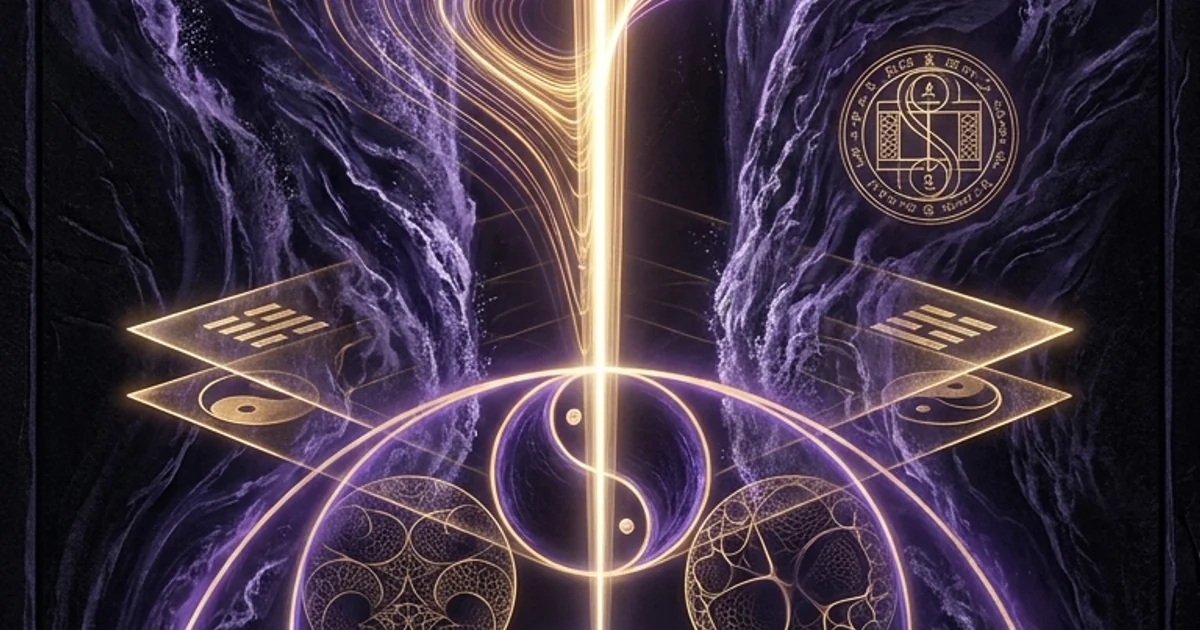
Trigram Kan: Dangerous Abyssal Water and Deep Wisdom
Archetypal Thesis & Systemic Paradigm: The Abyssal Threshold of Consciousness
The Mechanics of Enclosed Yang: Entropic Collapse as Catalytic Pressure
Within the formal semiotics of the Bagua, Trigram Kan (☵, 坎) manifests as a supreme topological paradox: an indivisible, luminous, solid Yang line held captive between two divided, yielding Yin lines. In binary computational notation, this configuration operates as 0-1-0, an ontological sandwich wherein pure spiritual potency is structurally hemmed in by entropic receptivity. This structural architecture directly models the systemic state wherein conscious agency, the central spark of intentionality, becomes enveloped by unconscious inertia, structural friction, and high-hazard externalities. The dynamic tension of this trigram does not arise from static balance, but from dynamic compression. The outer yielding lines do not merely surround the central firm line; they exert a centripetal, compressive force that concentrates the Yang line’s radiative energy into an acute, dense point of survival.
In the lexicon of cybernetics and dynamic systems, Kan represents an irreversible descent into a high-entropy basin. When an organized system encounters a threshold where prior behavioral modalities fail, the surrounding environment ceases to be a supportive medium and turns into a perilous constraint matrix. The central Yang line signifies the system’s core algorithmic integrity, the irreducible kernel of self-organization that must preserve its structural coherence while the peripheral boundaries undergo complete liquefaction. The trigram kan water danger abyssal wisdom iching archetype establishes that true coherence is not verified when the surrounding field is clear and stable, but rather when the periphery is volatile, ungrounded, and treacherous.
                  Top:     - -  (Divided / Yin / Outer Surface Turbulence)
                  Center:  ———  (Solid / Yang / Indestructible Core Intent)
                  Bottom:  - -  (Divided / Yin / Subterranean Instability)
The compression of the central Yang line by the adjacent Yin polarities generates an internal hydrostatic pressure. This energetic condition prevents the Yang line from expanding outward in the style of Trigram Li (☲). Denied centrifugal radiation, the Yang energy inside Kan turns inward, transforming radiant kinetic power into deep, concentrated potential energy. It is this thermodynamic containment that transmutes raw survival instinct into existential consciousness. The consciousness trapped in Kan cannot navigate the surrounding hazard by brute-force expansion; doing so would shatter its brittle ego boundaries against the yielding, bottomless medium. It can survive only by stabilizing its core while letting its outer layers adapt fluidly to the surrounding matrix.
Gravitational Vectoring: The Inherent Downward Trajectory of Water
Unlike all other elemental manifestations in the I Ching cosmogram, the phenomenological motion of Kan is strictly asymmetrical, governed by an absolute gravitational vector. While Fire ascends toward the ethereal canopy of heaven, Water seeks the lowest, most discarded, and subterranean reaches of the earth. It is intrinsically downward-seeking, flowing into crevices, abysses, fissures, and sinkholes. In archaic natural philosophy, this downward vector represents systemic entropy and the inevitable gravitation of all differentiated phenomena toward an undifferentiated ground state. Kan embodies the absolute downward pull of reality, the existential weight that pulls conscious systems into contact with their unintegrated material foundations.
This downward trajectory exposes conscious systems to the phenomenon of the sheer drop: the plunge into the ravine, the fall from established structural status, and the loss of conscious equilibrium. When human agency encounters the gravitational vector of Kan, the habitual scaffolding of social posturing and cognitive presumption is stripped away by sheer momentum. Water does not pause to negotiate with obstacles; it accelerates down gradients of least resistance until it reaches the lowest possible point of rest. Consequently, Kan functions as the ultimate leveler within systemic cartography. It dissolves hierarchy, breaks down calcified institutions, and forces consciousness to confront the lowermost floor of psychic reality.
By constantly seeking the lowest ground, Kan models an epistemological stance rooted in extreme humility and radical realism. In flowing to the bottom of the ravine, water fills every hollow before advancing. It does not bypass the trauma, the error, or the structural debt of an operational system; it floods the subterranean basements of being until the void itself is saturated. Water’s relentless descent models the systemic necessity of total immersion: a complex organism cannot transcend a stage of breakdown by superficial circumvention. It must sink directly to the bed of the crisis, aligning with gravity rather than futilely opposing it, to locate the solid tectonic bedrock that can support a genuine re-emergence.
The Paradox of Peril: Danger as an Initiatory Psycho-Cosmic Crucible
The diagnostic designation of Kan across traditional commentaries is Xian (險): danger, hazard, pitfall, or perilous precipice. Yet, the classical philosophy of the I Ching repudiates any simplistic conflation of danger with moral evil or absolute catastrophe. Within the systemic mechanics of the text, Xian constitutes an evolutionary selection pressure and an initiatory threshold. Hazard is the existential crucible through which structural self-delusion is eliminated. The peril of Kan exposes fragility. Systems, psychologies, and strategies that rely on rigid assumptions fracture instantly when submerged within Kan’s unstable waters. Only structural flexibility anchored around an unshakeable core can navigate these perilous depths.
                           [ Rigid Systematic Ego ]
                                      │
                                      ▼  (Descent into Kan)
                     [ High-Entropy Dissolution / The Pit ]
                                      │
                                      ▼  (Surrender of Rigid Forms)
                     [ Preservation of Central Yang Core ]
                                      │
                                      ▼  (Emergence)
                     [ Non-Linear Wisdom / Zhi Realization ]
The paradox of the abyss lies in its indispensability for producing higher-order cognitive coherence, codified in the classical tradition as Zhi (智, systemic wisdom). Intellectual knowledge can be acquired through abstract contemplation, but abyssal wisdom requires direct contact with mortality, failure, and radical vulnerability. When an agent enters the field of Kan, their navigational apparatus must shed preconceived frameworks. Every step taken along a ravine requires total situational presence, somatic acuity, and continuous adaptation. In this trial, the danger itself becomes the organizing teacher.
The crucible of Kan transforms the terror of the abyss into an engine of psychological resilience. The hazard forces the conscious subject to confront what depth psychology terms the terrifying autonomy of the unconscious. Under the pressure of external catastrophe or interior collapse, the illusory omnipotence of the ego is extinguished. The surviving remnant is precisely the luminous solid Yang core: the indestructible, transpersonal Self that endures when all circumstantial supports have washed away. Thus, the peril of Kan is fundamentally soteriological: it shatters our superficial identifications to release the genuine interior locus of authority.
Classical Provenance & Textual Lineage: From Bronze Age Mantic Pit to Neo-Confucian Cosmology
Etymological Archaism: Kan (坎) as the Subterranean Pit and Snare
Paleographic and epigraphic investigations into the Western Zhou bronze inscriptions and early oracle bone records reveal that the ideogram Kan (坎) is intrinsically bound to physical excavations, sacrificial trenches, and earthen pitfalls designed to trap animals or human enemies. The character incorporates the earth radical (土, tu) coupled with qian (欠), an archaic pictograph depicting a kneeling human figure with an open mouth, gasping for breath or lamenting in distress. Together, the ideogram presents a vivid portrait of catastrophic enclosure: a human being trapped inside an earthen cavity, cut off from the terrestrial horizon, crying out from the darkness of a subterranean trench.
In the archaic milieu of the early Zhou dynasty, the pit was not merely an agricultural or military fixture; it served as a primary site of religious sacrifice and judicial interrogation. To cast a captive or an animal into the kan was to deliver them into the subterranean womb of the earth deities, subjecting them to an absolute test of divine favor and survival. The pit was the direct physical boundary between the illuminated upper realm of the living and the moist, cold underworld of ancestral ghosts (gui) and chthonic powers. The mantic diagnosis of encountering a pit (kan) signaled an abrupt halt to forward momentum. It demanded the immediate cessation of conventional locomotion and compelled an involuntary descent into the bowels of the earth, where survival was determined by factors beyond conscious mastery.
       Archaic Morphology of Kan:
       [ 土 : Earth / Trench Walls ]  +  [ 欠 : Kneeling Figure Gasping in Lament ]
       = An existential pitfall wherein upward mobility is mechanically arrested.
As the Western Zhou mantic traditions evolved into the philosophical system of the Warring States period, this primitive terror of the physical trench was systematically interiorized. In his seminal translation and commentary, Richard Wilhelm, working in close collaboration with Cary F. Baynes (The I Ching or Book of Changes, 1950), observed that Kan shifts from denoting an external earthen hazard to representing a profound metaphysical state: the condition of having fallen into an emotional, social, or spiritual abyss. The physical snare of the Bronze Age hunter became the conceptual snare of the Daoist and early Confucian philosophers: an unavoidable zone of existential confinement where a person’s inner resolve is tested to its absolute limit.
The Shuo Gua Codices: Phenomenological Attributions of the Water Element
The Shuo Gua (說卦傳, Discussion of the Trigrams), the essential Wing of the Ten Wings devoted to trigram phenomenological taxonomies, dramatically expands the semiotic range of Kan far beyond simple liquid. Chapter 7 states concisely: “Kan represents that which is sinking down; it constitutes pits and ravines.” In Chapter 11, the text unfurls an exhaustive, startling inventory of systemic correspondences that reveal the ancient psycho-physical associations of the water element bagua archetype:
“Kan is water, it is ditches, it is ambushes, it is that which bends and straightens, it is the bow and the wheel. Among men, it is the increase of anxiety, it is melancholy, it is the sick heart, it is earache. It is the blood sign, it is red. Among horses, it is the horse with a beautiful back, the horse of wild mettle, the horse with hanging head, the horse with thin hooves, the horse that stumbles. Among carriages, it is that which meets with many defects. It is penetrative. It is the moon. It is the thief. Among wood, it is that which is firm and has much pith.” — Richard Wilhelm & Cary F. Baynes (1950), The I Ching or Book of Changes, Princeton University Press.
These classical attributions are unified by an underlying functional logic. Kan is the “thief” because it approaches soundlessly, operates in subterranean concealment, and robs an entity of its superficial certainty. It represents “that which bends and straightens” (the bow and the wheel) because survival within fluid mechanics requires perpetual elastic deformation—bending without fracturing under pressure, then snapping straight when kinetic alignment is recovered. It is the “sick heart” and the “increase of anxiety” because emotional dread is the subjective, psychological experience of being cast into the abyss without an external handhold.
The attribution of “wood that has much pith” highlights the structural signature of the trigram: an outer shell that is soft, spongy, and yielding (the outer Yin lines), safeguarding a dense, concentrated structural interior (the central Yang line). The phenomenological attributions of the Shuo Gua demonstrate that the Zhou diviners and subsequent commentators did not view water merely as a passive chemical compound. They understood it as a comprehensive systemic condition characterized by stealth, internal tension, cardiovascular stress, mechanical friction, and the relentless requirement for elastic adaptation under duress.
Early Heaven (Xiantian) vs. Later Heaven (Houtian): Spatial Re-anchoring from West to North
The systemic function of Trigram Kan undergoes a profound cosmological recontextualization in the transition between the two primary Bagua sequences: the Early Heaven (Xiantian, 先天) arrangement attributed to the mythological culture-hero Fu Xi, and the Later Heaven (Houtian, 後天) sequence formulated by King Wen. In the Xiantian cosmogram, Kan is positioned in the spatial West, standing in direct dynamic opposition to Trigram Li (Fire) in the East. This horizontal alignment depicts an ideal, primordial equilibrium: the thermodynamic axis of cosmic respiration, where Water and Fire perpetually balance each other across the cosmic field without destructive cataclysm, representing the uncorrupted, pre-temporal balance of universal archetypes.
       EARLY HEAVEN (Fu Xi)                   LATER HEAVEN (King Wen)
              South: Qian (Heaven)                   South: Li (Fire)
                        │                                      │
   West: Kan (Water) ───┼─── East: Li (Fire)     West: Dui ────┼─── East: Zhen
                        │                                      │
              North: Kun (Earth)                     North: Kan (Water)
In the Houtian arrangement, which maps the phenomenological unfolding of space, time, and cyclical mutation in the manifest world, Kan is decisively relocated to the absolute North. This spatial shift anchors Kan to the winter solstice, the temporal midnight, and the dead point of the seasonal cycle. As Neo-Confucian cosmologist Shao Yong (c. 1060) articulated in his seminal treatise Huangji Jingshi (皇極經世, Supreme Principles Governed by the Cosmos), this re-anchoring places Kan at the absolute nadir of manifest reality. It becomes the energetic winter where the outward vitality of the universe is extinguished, forcing all biological and spiritual energy down into dormant storage.
This Northern placement transforms Kan into the cosmological reservoir of unmanifest potential. The North is the direction of cold, darkness, and subterranean stillness, the sector where life appears completely absent, yet where the seed of the next cycle is silently gestating under heavy ice. By moving from the West to the North, Kan ceases to be merely a balancing counterweight to eastern fire; it becomes the ontological origin and termination point of the entire Houtian cycle. Manifestation emerges from the cold depths of the Northern waters (Kan), rises through the vegetative thunder of the East (Zhen), reaches solar zenith in the South (Li), contracts through the harvest of the West (Dui), and inevitably dissolves back into the Northern abyss of Kan to undergo essential winter regeneration.
Structural Mechanics & Symbolic Geometry: Binary Architecture of the Middle Son
Binary Topography: Yin-Yang Configuration (0-1-0) and Energetic Vectors
The architectural matrix of Trigram Kan is defined by its binary topography: a broken line (0), followed by an unbroken line (1), crowned by a broken line (0). This 0-1-0 configuration establishes an inward-drawing, centripetal vector field. In the mechanics of yin-yang-polarity, Yin lines naturally diverge, yield, and recede, whereas Yang lines concentrate, project, and sustain structural integrity. Because the Yin lines form both the physical base and the upper surface, the trigram lacks external structural defense. It yields completely to external pressure, creating an operational vacuum that pulls surrounding forces inward toward its center.
       LINE 3 (Upper):  - -   Yin   (Surface tension, yielding, vortex opening)
       LINE 2 (Center): ———   Yang  (Hydrostatic core, indomitable will, real pivot)
       LINE 1 (Lower):  - -   Yin   (Groundless bed, subterranean depths, absence of base)
This structural configuration generates the kinetic signature of a vortex. Anything encountering the upper Yin line finds no firm purchase and slides precipitously toward the center. Similarly, an agent standing upon the lower Yin line finds no solid terra firma; the ground gives way beneath their feet, plunging them into the deep. The only reality within Kan is its center: the solitary Yang line at the second position. The second position in classical hexagram analysis is the locus of interior balance and emotional centering. In Kan, this locus is occupied by pure, focused Yang.
The energetic vector of Kan is therefore simultaneously descending and converging. It pulls reality inward and downward, creating an intense test of structural mechanics. If the core Yang line wavers or fractures into a Yin line (converting the trigram into pure Kun, ☷), the system undergoes catastrophic entropic death: it becomes an undifferentiated, stagnant marshland. If the core remains firm, the system leverages the fluid adaptability of its outer Yin layers to navigate jagged obstacles without losing its foundational identity. The internal Yang line acts as an internal keel, providing balance within turbulent conditions.
The Middle Son (Zhong Nan): Filial Archetype and the Acquisition of Will
Within the genealogical taxonomy of the Bagua, known as the family of the trigrams, Kan is designated as the Middle Son (Zhong Nan, 中男). The generative mechanics of the trigrams dictate that the three sons are produced when the receptive cosmic mother, Trigram Kun (☷), receives the fertilizing masculine creative impulse of Trigram Qian (☰) across its three distinct positions:
- Eldest Son (Zhen, ☳): Qian’s Yang line enters the first (lowest) position of Kun, sparking the eruptive, kinetic burst of thunder and upward initiative.
- Middle Son (Kan, ☵): Qian’s Yang line penetrates into the second (central) position of Kun, embedding the masculine spirit into the interior depths of matter.
- Youngest Son (Gen, ☶): Qian’s Yang line rests in the third (uppermost) position of Kun, halting all ascent in the calm immobility of the mountain.
As the Middle Son, Kan embodies a psychological archetype distinct from the impulsive initiative of the Eldest Son or the quiet composure of the Youngest Son. The Middle Son carries the sacred creative spark of the father directly within his core, but this spark is completely insulated and hemmed in by maternal darkness. Consequently, the Middle Son is the archetype of existential struggle, testing, and the hard-won acquisition of internal will (Zhi). He cannot rely on the Eldest Son’s external momentum, nor does he enjoy the Youngest Son’s contemplative peace. He must fight his way through the hazardous, dark currents of the maternal unconscious to claim his masculine autonomy.
In archetypal analysis, the Middle Son represents the stage of development where an individual encounters the raw resistance of the material world. Here, infantile omnipotence is shattered by real-world consequence. The Middle Son must learn endurance, resilience, and emotional autonomy while traversing prolonged isolation. His destiny is forged through struggle; he discovers his real identity only through testing. His core will is not inherited; it is hammered out upon the anvil of external hazard, turning simple survival instincts into a refined, tempered consciousness.
The Tonal Axis of Inversion: Hexagram 29 (The Abyssal) and the Polarity with Li (Fire)
When Trigram Kan is doubled upon itself, it forms Hexagram 29 of the I Ching: Xi Kan (習坎), variously translated as “The Abyssal,” “Repeated Danger,” or “The Sinking.” The character Xi (習) depicts young birds exercising their wings over a nest, implying repetitive exposure, training, and habituation. Xi Kan does not indicate an isolated hazard, but an entire environment of persistent, recurring danger. In this doubled realm, one abyss opens directly into another; no sooner has the traveler climbed out of one ravine than they plunge into the next.
Trigram Kan (☵) - Water
- Structural Architecture: Internal Yang (1) enclosed by External Yin (0-1-0).
- Energetic Vector: Centripetal, descending, gravitational, inward-drawing.
- Thermodynamic Mode: Cold, moist, high-density potential energy, entropy-absorbing.
- Psychological Dimension: Deep Unconscious, the Archetypal Shadow, somatic instinct, trauma storage.
- Cognitive Modality: Non-linear situational intuition, instinctual vigilance, Zhi (Abyssal Wisdom).
Trigram Li (☲) - Fire
- Structural Architecture: Internal Yin (0) enclosed by External Yang (1-0-1).
- Energetic Vector: Centrifugal, ascending, radiative, outward-expanding.
- Thermodynamic Mode: Hot, dry, low-density radiant energy, entropy-generating.
- Psychological Dimension: Lucidity, conscious perception, intellect, visual clarity, cultural form.
- Cognitive Modality: Linear rational analysis, illumination, Ming (Apparent Brilliance).
The structural polarity between Kan (☵) and Li (☲) constitutes the central thermodynamic axis of the entire sixty-four hexagram matrix. As Richard John Lynn emphasizes in his translation of Wang Bi’s fourth-century commentary (The Classic of Changes, 1994), Kan and Li are absolute inversions of each other:
                      Kan (☵):  - -      Li (☲): ———
                                ———              - -
                                - -              ———
Kan is water, which has a firm core wrapped in an adaptive exterior; Li is fire, which burns brightly on its outer surface while remaining hollow, vulnerable, and dependent on fuel at its center. Kan is the depths of the ocean; Li is the radiance of the noon sun. Kan is the visceral seed of instinct (Jing); Li is the illuminated blossom of spirit (Shen). When these two trigrams lose their relational tension, systemic equilibrium collapses: fire rises unchecked into arid abstraction, while water sinks into cold, stagnant decay. Only through their deliberate alchemical confrontation is life sustained.
Psychological Dynamics & Operational Praxis: Navigating the Jungian Shadow and Abyss
Nekyia and Dissolution: Kan as the Archetypal Descent into the Unconscious
In the conceptual framework of Jungian depth psychology, Trigram Kan serves as the precise cosmological analogue of the Nekyia—the classical descent into the dark underworld, the terrifying night sea journey of the hero. When the conscious ego becomes inflated, one-sided, or alienated from its instinctual roots, the psyche compensates by drawing it into the field of Kan. This involuntary descent represents the shattering of established conscious adaptations and a direct confrontation with the archetypal shadow. The abyss is not populated merely by external hazards, but by discarded parts of the self, repressed traumas, and unintegrated instinctual drives that the ego has disowned.
[ Inflated Conscious Ego ]
                  │
                  ▼  (Psychic Inundation / Crisis)
       [ The Waters of Kan (The Nekyia) ]
                  │
                  ├── Dissolution of Persona and Rigid Defenses
                  ├── Confrontation with the Archetypal Shadow
                  └── Assimilation of Raw Instinctual Affects
                  │
                  ▼  (Integration of the Abyss)
       [ Emergence of the Central Self (The Yang Seed) ]
During the Nekyia, the rational intellect finds its defenses undermined by primitive emotional currents. Water drowns the persona. In his Foreword to the I Ching (1950), Carl Gustav Jung emphasized that the mantic power of the hexagrams rests on their capacity to reveal unconscious dynamics through synchronicity. The sudden appearance of Kan in a consultation confirms an objective psychic threshold: the ego is entering a state of emotional dissolution where its reliance on logic and conscious planning fails, requiring the subject to abandon superficial intellectual postures.
“The water is the darkest and most unapproachable region. The encounter with the shadow is often experienced as a dark and dangerous passage, a plunging into the cold water of the unconscious… It is the gateway through which we must pass if we are to reach the luminous core of the Self.” — Carl Gustav Jung (1950), Foreword to the Wilhelm/Baynes Edition of the I Ching, Routledge & Kegan Paul.
The terror evoked by the abyss is precisely the ego’s dread of non-existence, its fear of being engulfed by unconscious material. Yet, as depth psychology affirms, this psychological descent is the indispensable prerequisite for genuine individuation. Without the dissolution operated by Kan, the personality remains an artificial construct, a brittle shell unsupported by instinctual vitality. The Nekyia dissolves this fragile shell, allowing the hidden Yang line—the transpersonal Self—to emerge from the personal wreckage as the true organizing center of the psyche.
Strategic Non-Contention: Wu Wei as Kinetic Adaptation to Ravines
The operational praxis demanded by Kan is codified in the core Daoist doctrine of Wu Wei (無為, effortless action or strategic non-contention). When a person is trapped in a raging torrent, thrashing against the current guarantees exhaustion and drowning. The only viable path to survival is to yield completely to the momentum of the water, matching its currents while preserving breath and somatic awareness until a natural eddy offers escape. The commentary on Hexagram 29 in the Wilhelm/Baynes translation states this directly:
       "Water flows on and on, and merely fills up all the places
        through which it flows; it does not shrink from any dangerous spot,
        nor from any fall, and nothing can make it lose its own essential nature."
This represents the height of strategic adaptation. Water navigates a fractured landscape not through aggressive force, but through compliant responsiveness. If it meets a mountain, it does not attempt to shatter the rock; it flows around its base. If it falls into a crevasse, it does not struggle against the descent; it drops into the darkness, pools, fills the void, and continues forward once the threshold is reached. It never abandons its essential nature—its fluidity, its wetness, its relentless downward search for unity—regardless of its container’s shape.
       Obstacle Encountered  ──>  Non-Contention (Bypassing / Wrapping)
       Chasm Encountered     ──>  Complete Immersion (Filling the Void)
       Sustained Turbulence  ──>  Maintenance of Core Nature (Yang Keel)
       = Dynamic, unyielding survival through total external flexibility.
To apply the operational praxis of Kan in situations of extreme peril means adopting absolute tactical flexibility. The practitioner abandons fixed agendas, pride, and the reflexive demand for immediate control. They accept the reality of the hazard, flow into the contours of the crisis without panic, and maintain absolute internal focus. Through non-contention, water overcomes what is hardest and most rigid; through yielding adaptation, the practitioner outlasts the crushing weight of the abyss.
Divinatory Remediation: Engaging Hexagrams Containing Kan as Upper or Lower Gua
In the practical hermeneutics of I Ching interpretation, the specific location of Trigram Kan within a hexagram radically alters its strategic meaning. It functions either as the lower inner trigram (Nei Gua, 內卦) or as the upper outer trigram (Wai Gua, 外卦), signaling whether the danger is interior and psychological or exterior and environmental:
          OUTER TRIGRAM (Kan Above)        INNER TRIGRAM (Kan Below)
          Hazard in the environment;        Hazard in the psyche;
          external barrier requiring        unconscious complexes requiring
          patience, stillness, and pause.   courage, rooting, and integration.
When Kan appears as the lower inner trigram, danger lurks within the subjective core of the enquirer. It points to unintegrated anxiety, a hidden emotional trap, a reservoir of grief, or an instinctual complex sabotaging conscious intentions. For instance, in Hexagram 36 (Ming Yi, ☲ over ☵, Darkening of the Light), the inner water swallows the descending solar light, requiring the querent to conceal their wisdom, retreat into inner quietude, and endure exterior oppression without revealing their true nature. The remediation here is rigorous psychological introspection and somatic grounding.
Conversely, when Kan serves as the upper outer trigram, the hazard is located in the external social, economic, or physical environment. The world outside is flooded, treacherous, and unpredictable. This is seen in Hexagram 39 (Jian, ☵ over ☶, Obstruction), where the abyssal water of Kan sits atop the immovable mountain of Gen. Forward movement leads directly into an impassable chasm, while remaining in place offers steady containment. The remediation in such hexagrams demands strategic pause: halting forward advance, regrouping with trusted allies, and waiting for the floodwaters to recede before taking action.
Philosophical Synthesis & Macrocosmic Correspondence: Hermetic Solutio and Alchemical Jing
Daoist Internal Alchemy (Neidan): Extracting the True Lead from Kan
Within the esoteric tradition of Daoist Internal Alchemy (Neidan, 內丹), Trigram Kan occupies a central, sacred position. It is the vessel containing the pre-natal Jing (精, vital somatic essence) and the esoteric substance known as “True Lead” (Zhen Qian, 真鉛). In the post-natal human body, the natural thermodynamic vector causes the water of Kan (seated in the kidneys, reproductive system, and lower abdomen) to flow continuously downward and leak out into generative dissipation, illness, and death. Simultaneously, the fire of Trigram Li (seated in the heart and rational consciousness) perpetually flares upward into emotional distraction and intellectual strain.
       POST-NATAL DEVOLUTION               ALCHEMICAL NEIDAN INVERSION
       (Natural Thermodynamic Loss)          (The Great Kan-Li Reversal)

        Li (Fire / Heart)   ▲ [Flares Up]      Li (Fire / Heart)   ▼ [Directed Down]
                            │                                      │
       ─────────────────────┼────────────     ─────────────────────┼────────────
                            │                                      │
        Kan (Water / Kidneys) ▼ [Leaks Down]   Kan (Water / Kidneys) ▲ [Boiled Up]
       Result: Dissipation and Death         Result: Steam (Qi) & Golden Elixir
The fundamental goal of Neidan is to reverse this natural thermodynamic loss through the practice of Kan-Li inversion (Dian Dao Kan Li, 顛倒坎離). The alchemist uses concentrated breathwork, somatic focus, and meditation to pull the cold water of Kan upward while directing the hot flame of Li downward beneath it. By placing fire beneath water, an internal cauldron is formed. The intense heat of the heart-fire boils the cold, dark kidney-waters of Kan, vaporizing the heavy, subterranean Jing into refined spiritual breath (Qi).
This process extracts the central Yang line—the “True Lead”—from within the dark, watery depths of Kan and uses it to replace the hollow, divided Yin center of Trigram Li. When the pure Yang center of Kan is restored to Li, Li returns to the pristine state of pure Qian (☰, Heaven). Simultaneously, when the empty Yin line of Li fills the center of Kan, Kan returns to pure Kun (☷, Earth). Through this alchemical exchange, the post-natal human structure returns to the immortal, unified harmony of the pre-natal cosmos.
The Alchemical Solutio: Liquefaction of Rigid Egoic Constructs
This Daoist somatic technology corresponds directly with the Western Hermetic tradition of alchemy, specifically the phase known as the Solutio or the entry into the Nigredo (the blackening). In Western Hermeticism, the foundational operational axiom is Solve et Coagula—dissolve and coagulate. Before any base metal can be transmuted into the incorruptible Philosophers’ Stone, its current rigid, crystalline structure must be dissolved back into the primordial fluid medium: the Prima Materia.
   [ Calcified Base Metal / Rigid Ego ]
                  │
                  ▼  (Application of Solutio / Trigram Kan)
   [ Dissolution into the Prima Materia / The Dark Waters ]
                  │
                  ▼  (Separatio & Sublimatio)
   [ Recovery of the Indestructible Stone / The Central Yang Core ]
The Solutio is precisely the psychic and metaphysical operation of Trigram Kan. It is the liquefaction of calcified dogma, brittle ego boundaries, and static systems of belief. When an alchemist immerses a substance in the abyssal solvent, the external form dissolves, releasing the latent spiritual seed trapped inside. The Solutio feels like a terrifying death to the ego because it strips away all external anchors and conceptual certainties.
Yet, Hermetic philosophers universally affirmed that the ultimate stone can be discovered only in the deepest mire. Paracelsus and the later alchemical treatises insist that the secret treasure rests at the bottom of the unapproachable, putrid chasm. One must descend into the black, moisture-laden waters of the underworld to locate the incorruptible, divine seed. In this Hermetic light, Kan is not a tragedy to be avoided, but the necessary alchemical bath without which no genuine spiritual gold can ever coalesce.
Cybernetic Feedback: Kan as Error-Correction and Homeostasis under Stress
Transposed into contemporary systems theory, cybernetics, and non-linear dynamics, Trigram Kan serves as an elegant model of negative feedback loops, homeostatic correction, and phase transitions under critical stress. A system that optimizes only for continuous expansion, positive feedback, and frictionless output will drive itself into catastrophic fragility. It accumulates hidden systemic debt, ignores peripheral anomalies, and builds up internal instability until its structural boundaries fail.
- Cardinal Direction: Absolute North (Later Heaven / Houtian)
- Temporal Alignment: Winter Solstice, Midnight (23:00–01:00), Month of the Rat (Zi)
- Biological Correlate: Kidneys, Urinary Bladder, Adrenal Glands, Skeletal Bone Marrow, Hearing
- Planetary Governor: The Water Star (Chenxing / Mercury)
- Hermetic Phase: Solutio / Nigredo (The Blackening, Dissolution of the Prima Materia)
- Elemental Phase (Wuxing): Water (Shui), representing latent potential and sinking energy
- Systemic Archetype: The Homeostatic Governor, Error-Correction Threshold, High-Entropy Basin
Kan represents the inevitable, restorative plunge into the error-correction basin. It is the sudden confrontation with real-world constraints that shocks the system out of its self-reinforcing, runaway cycle. When an enterprise, a government, or an individual personality crashes into the abyss, the disaster is a systemic corrective. The descent into the ravine forces the immediate elimination of inefficient subroutines, cuts away parasitical growth, and demands a radical consolidation of core energy.
       [ Runaway System Expansion (Unstable Li/Yang) ]
                             │
                             ▼  (Encounter with Reality Constraints)
       [ The Kan Event: Crashing into the Basin of Friction ]
                             │
                             ├── Liquidation of Systemic Inefficiencies
                             ├── Re-calibration of Basic Feedback Loops
                             └── Consolidation of Core Viability (Central Yang)
                             │
                             ▼  (Adaptive Recovery)
       [ Resilient, Re-stabilized Complex Homeostasis ]
In cybernetic terms, abyssal wisdom (Zhi) is not a static store of data; it is refined systemic resilience. It is an organism’s acquired ability to maintain its identity across erratic, non-linear environments. The system learns to survive hazardous fluctuations not by building rigid, brittle walls, but by developing fluid responses that process friction, adapt to shocks, and use gravitational constraints to steady its own performance.
Frequently Asked Questions on Trigram Kan
Why is Kan frequently associated with both profound catastrophe and ultimate sagacity?
The co-presence of catastrophe and ultimate sagacity within Kan is an intentional structural feature of I Ching cosmology, not an accidental contradiction. True sagacity (Zhi, 智) is fundamentally distinguished from superficial intellectual knowledge (Shi, 識). Intellectual knowledge functions comfortably within ordered, predictable conditions where abstract logic remains uncompromised by material reality. Sagacity, by contrast, is forged exclusively through direct exposure to existential hazard, non-linear collapse, and the surrender of cognitive pride.
Water does not navigate the world through abstract maps; it explores the landscape through immediate physical contact with every depression, fissure, and sheer drop. It discovers the true shape of reality by fearlessly descending into its lowest depths. When human consciousness is plunged into the abyss of Kan, all theoretical illusions are stripped away by survival pressures. The surviving consciousness develops deep situational awareness, somatic clarity, and radical adaptability. The catastrophe is the exact crucible that burns away delusion, producing a refined, practical wisdom that can navigate chaos without panic.
What is the functional difference when Kan appears as the Inner versus Outer Trigram in a Hexagram?
The structural position of Kan within a six-line hexagram dictates the spatial and psychological orientation of the hazard:
          [ UPPER TRIGRAM: Kan as Outer World ]  ──>  Environmental Danger
          ─────────────────────────────────────
          [ LOWER TRIGRAM: Kan as Inner Self  ]  ──>  Psychic Turbulence
When Kan is the lower, inner trigram (Nei Gua), the abyss is situated in the querent’s interior psychic landscape. The peril manifests as emotional vulnerability, anxiety, traumatic memories, unintegrated shadow impulses, or quiet panic. Navigating this inner abyss requires introspection, psychological courage, and emotional honesty. The individual must descend into their own depths to integrate these turbulent feelings, rather than projecting them onto external scapegoats.
When Kan is the upper, outer trigram (Wai Gua), the hazard is located in the external environment. The enquirer faces treacherous social terrain, bad financial markets, deceptive associates, or impossible logistical blockades. In this case, the inner psyche may be entirely composed and balanced, but the road ahead is washed out. The strategic remediation for an outer Kan is patience, quiet withdrawal, non-contention, and waiting for the environmental torrent to run its course before committing resources to forward travel.
How does the singular Yang line of Kan avoid total extinguishment within the surrounding Yin waters?
In both binary mechanics and Daoist metaphysics, the central Yang line within Kan cannot be extinguished because it represents an irreducible, indivisible packet of cosmic spirit. In the generation of the trigrams, this central line is the pure, undivided light of Trigram Qian (☰) embedded directly within the heart of darkness. Spirit does not rely on spatial size for its power; it operates as an intense, unyielding seed of order within surrounding entropy.
Furthermore, the surrounding Yin lines do not act as an aggressive, attacking fire, but as yielding, cold, receptive matter. They enclose the Yang line, but they cannot occupy its central seat. In the mechanics of the Yijing, the central second position is a place of natural balance and internal authority. By remaining centered, calm, and aligned with its own core nature, the Yang line holds its identity securely. It does not waste its strength fighting the surrounding dark; it simply rests in its own balance, acting as a luminous guide that outlasts the deepest night.