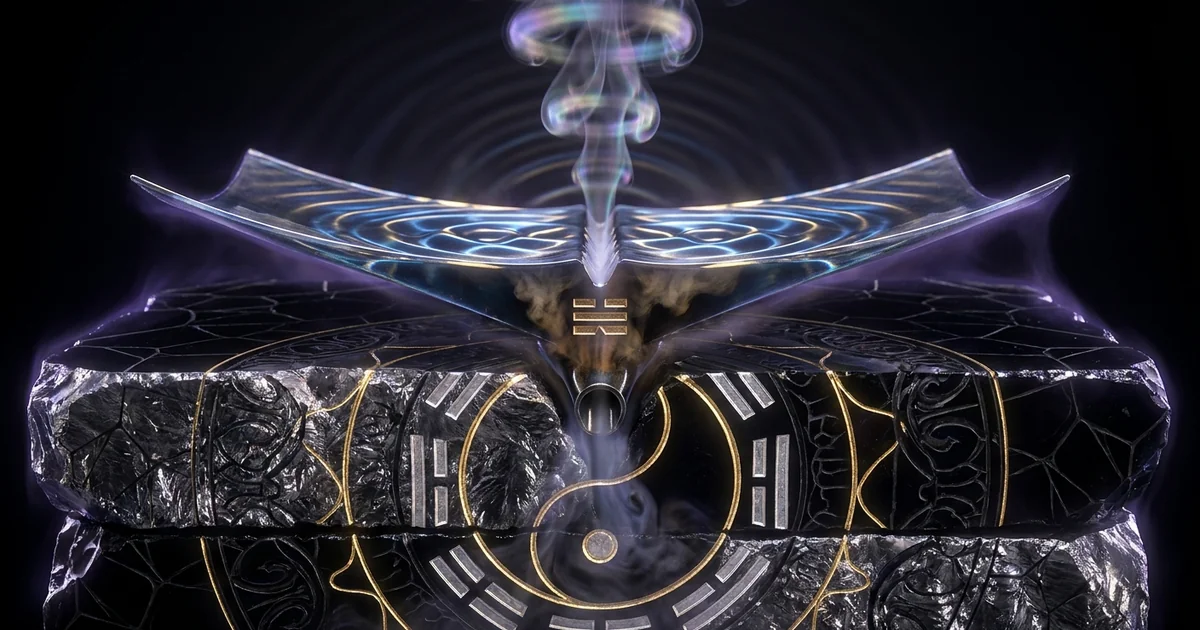
Trigram Dui: Joyful Depths of Open Lakes and Concord
Archetypal Thesis & Systemic Paradigm: The Thermodynamics of Joy and Porous Boundaries
The Lake as an Open Dissipative System
In the structural topology of the I Ching, Trigram Dui (☱, The Lake) models the boundary mechanics through which internal pressure transitions into externalized expression. Far from representing an inert hydrological basin, Dui functions as an open dissipative system. Within non-equilibrium thermodynamics, an open system maintains its organization not through static equilibrium, but through continuous energetic and material exchange with its surrounding environment. Dui maps this phenomenon onto the psycho-cosmic interface: an interior reserve of dense, compact yang energy capped by a receptive, porous yin threshold. Through this open boundary, internal mass breathes, evaporating into the atmosphere as vapor and receiving downward precipitation in return.
The cosmological archetype of the lake expresses the dynamic equilibrium achieved when an enclosed fluid body resists both absolute containment and chaotic dispersion. Without its broken upper line, the structure would harden into the unyielding, self-enclosed monolith of Qian (☰, Pure Yang); without its two solid lower lines, the fluid mass would collapse into the sheer, boundaryless entropy of Kun (☷, Pure Yin). Dui therefore formalizes the principle of communicative permeability. Joy, in this cosmological grammar, does not denote ungrounded ecstasy or manic dissipation, but the structural relief that occurs when interior potency finds an articulate, unconstricted exit channel. The lake smiles upon the landscape because its surface is neither a wall nor a void, but a liminal threshold calibrated for reciprocal exchange.
Semantic Topology of Dui (兌): Transmutation from Ingestion to Utterance
The etymological architecture of the ideogram Dui (兌) reveals an explicit somatic and linguistic ontology. Archaic paleographic inscriptions trace the character to an image of a human figure with an open mouth, crowned by vapor or vocal emissions escaping upward. In classical philology, the glyph shares an immediate ancestral root with shuo (說, to speak, expound, or persuade) and yue (悅, inward delight and satisfaction). This tripartite semantic cluster links oral ingestion, respiratory ventilation, and discursive articulation into a unified metaphysical operation.
To experience Dui is to open an aperture. In the early texts, this opening represents the stripping away of opacity through deliberate articulation. Where internal contemplation risks calcifying into psychic fixation, speech releases the trapped energetic charge, transforming raw pressure into intelligible resonance. Dui operates as both the receptive mouth that ingests physical and intellectual nourishment and the expressive vocal apparatus that redistributes digested wisdom back into the collective sphere. Through this mechanism, raw experience transmutes into linguistic syntax. The joy generated by Dui is the cognitive and physiological relief of being understood—an ontological communion where the isolation of the sovereign subject dissolves through the act of shared speech.
The Energetics of Two Solid Strata Under a Permeable Canopy
The energetic profile of Trigram Dui is governed by its specific binary architecture: a divided line (yin, - -) situated above two undivided lines (yang, —). In terms of field dynamics, this arrangement produces a rising pressure gradient. The foundational solid line establishes an unshakeable ontological footing; the medial solid line concentrates energetic momentum, generating structural coherence and directional will. Left unmoderated, this concentrated yang force would produce an aggressive, unyielding thrust. However, the presence of the broken top line acts as a permeable canopy or soft valve, venting the subterranean power into the atmosphere.
This structural composition explains the unique nature of Dui’s joy within the systemic paradigm of trigram dui lake joyful open expression iching. Where Trigram Li (☲, Clinging Fire) radiates light outward through high-entropy combustion, Dui radiates warmth through low-entropy cohesion, generating sustainable pleasure and communion. The two solid lines represent deep reserves of integrity, competence, and accumulated resource; the broken line ensures these assets remain accessible to others. Dui does not hoover energy inward like an abyss, nor does it scorch its environment. It establishes an inviting shore where consciousness meets consciousness without the defensive posturing characteristic of impermeable psychological boundaries.
Classical Provenance & Textual Lineage: The Tenth Wing and Early Exegesis
The Shuogua Zhuan Exegesis: Mouth, Sorceress, and Autumn Harvest
The classical source text for trigram taxonomy, the Shuogua Zhuan (說卦傳, Discussion of the Trigrams), canonical within the Ten Wings, situates Dui within a precise network of physical, social, and seasonal correspondences. In Chapter 2, the text asserts that the sacred sages assigned the trigrams their functions based on observed earthly movements: “Dui pleases and rejoices all things.” Chapter 8 refines this cosmetic mapping, explicitly identifying Dui with the mouth, the tongue, the sorceress or shamaness (wu, 巫), the concubine, smashing and breaking apart, and drop-and-fall decay.
“Dui is the Joyous… It is the mouth and the tongue. It is the sorceress; it is smash and break; it is the concubine. Among soils, it is hard and salt. In the body, it is the mouth.” — Shuogua Zhuan, Section 8 (Wilhelm/Baynes translation, 1950).
The association with the mouth and the tongue establishes Dui’s identity as the somatic organ of both nourishment and linguistic mediation. The attribution of the wu (the shamaness or medium) contextualizes Dui’s linguistic function within the realm of sacred speech: the medium does not generate the divine message from herself, but opens her vocal tract as an empty, porous reed through which invisible forces articulate their will. Similarly, the paradoxical designation of “smashing and breaking” (hui zhe, 毀折) exposes the trigram’s severing capacity. Articulation requires division; speech cannot exist without the phonemic separation of vowels and consonants, just as harvest cannot occur without cutting the stalk from the root.
Han Dynasty Xiangshu (Image-Number) Metaphysics and the Metal Resonance
During the Han Dynasty (202 BCE – 220 CE), the formalization of Xiangshu (Image-Number) metaphysics under scholars such as Jing Fang and Zheng Xuan integrated the trigrams into the Wuxing (Five Operational Phases) system. Within this matrix, Dui was designated as Soft Metal or Yin Metal (辛, Xin), directly contrasting with the Hard, Unyielding Yang Metal (庚, Geng) of Trigram Qian. This taxonomic placement offers profound insight into the mechanics of the metal element lake.
In Han cosmological physics, Metal governs the mechanics of condensation, discrimination, and formal containment. While Qian Metal manifests as the forged sword, structural armor, and the unbending decree of Heaven, Dui Metal corresponds to the jeweler’s engraving tool, the delicate acoustic properties of struck bronze bells, and the mineralized bedrock that holds standing bodies of water. The youngest daughter trigram carries the density of the metal phase, but expresses it with pliancy and aesthetic grace. It represents the phase transition where raw, mined ore undergoes artistic smelting and chiseling, transforming functional brute matter into an instrument of music or cultural refinement.
Later Heaven Placement: King Wen’s Cardinal West and Temporal Culmination
In the Later Heaven (Hou Tian) Bagua arrangement attributed to King Wen, Dui occupies the cardinal West. This spatial orientation carries specific temporal, meteorological, and developmental implications. The West corresponds to the setting sun, twilight, and the mid-autumn season (roughly equivalent to the eighth lunar month). In agricultural and psychological cycles, this represents the moment when arduous productive labor ceases, and the fruits of that labor are collected, processed, and enjoyed in collective celebration.
Wang Bi (c. 240 CE), in his commentary on the Zhouyi, emphasizes that Dui represents the stage where beings find mutual delight because the struggles of vegetative growth (associated with the East and Zhen) and thermodynamic expansion (associated with the South and Li) have achieved their designated form. The West marks the transition from exertion to harvest communion. Labor without Dui collapses into meaningless drudgery; Dui introduces the feast that validates the agricultural cycle. It is the twilight space where the sun’s scorching glare softens into reflective amber hues upon the water’s surface, inaugurating an era of cultural assembly and shared banquet.
Structural Mechanics & Symbolic Geometry: Binary Topology and Elemental Kinship
Binary Codification: The Open Yin Line over Two Yang Strata (☱)
In binary arithmetic terms—systematized within the Song Dynasty reconstructive ontology of Shao Yong (1011–1077 CE) and later analyzed by Gottfried Wilhelm Leibniz—the eight trigrams constitute a complete 3-bit binary progression. Reading the lines from bottom to top as solid (1) and broken (0), Trigram Dui possesses the numerical coordinate 110 (or 6 in standard decimal notation when counted bottom-up: $2^0 \times 1 + 2^1 \times 1 + 2^2 \times 0 = 3$, or top-down depending on directional convention). In Shao Yong’s Huangji Jingshi (Supreme Principles Governing the World), Dui occupies the threshold of emergent matter.
The lower solid stratum represents deep terrestrial mass, while the middle solid stratum represents buoyant hydro-thermal pressure. The upper broken stratum creates the basin that prevents the yang potency from vaporizing entirely while offering no ceiling to inhibit light. This geometry yields an intrinsic balance between depth and surface:
$$\text{Structural Modulus of Dui} = \frac{\text{Internal Stability (Two Solid Lines)}}{\text{Surface Receptivity (One Broken Line)}} = \frac{2\text{ Yang}}{1\text{ Yin}}$$
This mathematical configuration ensures that Dui’s outward presentation remains fundamentally stable. The joy it generates is structurally underpinned by interior fortitude; it is not a volatile euphoria that collapses under crisis, but an articulate grace sustained by accumulated reserves.
Dui and Gen: The Transversal Axis of Lake and Mountain
In the Early Heaven (Xian Tian) Bagua of Fu Xi, Trigram Dui sits in the Southeast, positioned directly across from /iching/trigram-gen-mountain (☶, Mountain) situated in the Northwest. This pairing establishes one of the four cardinal axes of cosmological equilibrium: the Transversal Axis of Lake and Mountain (Shan Ze Tong Qi, 山澤通氣, “Mountain and Lake permeate each other’s breath”).
Trigram Dui (☱, The Lake)
- Structural Anatomy: Broken yin line over two solid yang lines; open at the summit, anchored at the base.
- Elemental & Spatial Vector: Yin Metal; low-lying basin, descending catchment, open communicative aperture.
- Directional Movement: Centrifugal radiation; speech, externalization, dissipation of pressure through verbal concord.
- Psychological Function: Extraverted relationality, expressive catharsis, social communion, linguistic translatability.
- Pathological Extreme: Gossip, rhetorical vanity, hyper-receptive vulnerability, superficial hedonism.
column [Trigram Gen (☶, The Mountain)]
- Structural Anatomy: Solid yang line over two broken yin lines; closed at the summit, receptive at the base.
- Elemental & Spatial Vector: Yang Earth; high-altitude promontory, upward thrust, impenetrable boundary.
- Directional Movement: Centripetal containment; stillness, interiorization, concentration of energy through silence.
- Psychological Function: Introverted self-regulation, boundary preservation, meditative stopping, structural containment.
- Pathological Extreme: Rigidity, somatic calcification, profound isolationism, communicative paralysis.
:::
This opposition provides profound insight into environmental and psychological homeostasis. Mountain (Gen) gathers clouds, concentrates moisture, and channels water downward; Lake (Dui) receives these waters, evaporates moisture upward, and feeds the atmospheric moisture that re-blankets the mountain peaks. Mountain represents the act of boundary preservation and meditative internal containment; Lake represents boundary dissolution through shared communicative exchange. If Gen is the contemplative anchor of the psyche, Dui is its expressive release valve.
       [ Gen: Mountain (☶) ]
         Solid Summit / Silence
            ▲           │
Containment │           │ Downward Runoff
    Energy  │           │   (Nourishment)
            │           ▼
     Evaporative Moisture / Shared Breath
            │           ▲
     Mutual │           │ Permeability
   Exchange │           │   & Speech
            ▼           │
        [ Dui: Lake (☱) ]
         Broken Summit / Concord
Metal Element Dynamics: Soft Metallurgical Shaping vs. Rigid Coercion
The classification of Dui as the metal element lake within Han systemic theory highlights a paradox: how does a body of water correlate to metal? The resolution lies in recognizing that Dui is not the water itself—which belongs to the abyssal, kinetic domain of /iching/trigram-kan-water (☵)—but the mineralized, reflective basin and the metallurgical instrument of refinement. Metal, in Chinese alchemy, is defined by its ability to yield to the mold (Cong Ge, 從革) and take on refined shape without losing its foundational density.
Dui is the application of the goldsmith’s hammer, transforming unshaped ore into an intricate, resonant chalice. Within social dynamics, this corresponds to diplomacy, etiquette, and dialectical rhetoric. Where raw force (Qian) crushes opposition through sheer kinetic violence, Dui achieves compliance through persuasion, charm, and the aesthetic framing of ideas. It cuts, but it cuts with surgical finesse, separating truth from error through precise lexical boundaries rather than ideological tyranny. The joy of Dui is inseparable from this cutting precision: it is the delight experienced when messy, ambiguous psychic states are finally granted clean, elegant verbal definitions.
Psychological Dynamics & Operational Praxis: The Relational Self and Communicative Shadow
The Youngest Daughter Archetype: Play, Seduction, and Spontaneity
In the family matrix of the eight trigrams, Dui is designated as the youngest daughter trigram (Shao Nü, 少女). In archetypal psychology, she embodies the principle of the Puella Aeterna: spontaneous, perceptive, playful, aesthetically oriented, and deeply invested in the relational field. Unlike the Eldest Daughter (Sun, ☴, The Wind), who penetrates slowly through humble, persistent labor, or the Middle Daughter (Li, ☲, Fire), who illuminates through conscious insight and intellectual clarity, the Youngest Daughter seduces through sheer delight, charismatic presence, and expressive warmth.
Carl Gustav Jung, in his 1950 Foreword to the Wilhelm/Baynes translation of the I Ching, observed that the Chinese mind does not grasp the world through causal mechanics, but through acausal synchronicity and the qualitative evaluation of relational states. Dui exemplifies this relational self. It corresponds directly to Jung’s extraverted feeling function: an intentional adaptation to external circumstances through the accurate, sensitive evaluation of communal values. The Youngest Daughter does not impose her will through dogmatic decrees; she shifts the emotional atmosphere of the room by inviting play, uncoerced dialogue, and collective relaxation. She democratizes psychic energy, drawing repressed, brooding complexes out of their defensive isolation into the cleansing air of mutual recognition.
Pathological Deviations: Gossip, Rhetorical Manipulation, and Shallow Hedonism
When the structural equilibrium of Dui deteriorates, its communicative porosity metastasizes into acute psychological pathology. Because the trigram’s defining feature is an open, divided line at the top, a severance between this surface aperture and the supporting yang strata below causes the lake to lose its depth. The open mouth remains, but it is no longer sustained by foundational substance.
In its degraded state, the archetype descends into compulsive verbosity, destructive gossip, rhetorical manipulation, and shallow hedonistic distraction. The mouth, designed for communion, becomes an instrument of interpersonal destabilization. Speech degenerates into sophistry: words are utilized not to reveal reality, but to fabricate an artificial veneer that masks internal emptiness. Furthermore, because Dui governs oral ingestion, its shadow frequently manifests in somatic addictions—compulsive eating, alcoholism, and the perpetual hunger for novel sensory stimulation. The individual becomes an open, leaking vessel, incapable of containing psychic tension, reflexively expelling every internal impulse into the collective sphere before it has undergone the meditative gestation of Gen.
“In Hexagram 58, the doubling of Dui creates an image of two lakes joined together. This is the archetype of the seminar, of genuine academic discourse and intellectual friendship. But when the feeling function is contaminated by unconscious power drives, Dui’s open lake becomes a swamp of gossip and shallow sociability, draining the psyche of its creative introversion.” — Marie-Louise von Franz, Archetypal Patterns in Divination and Synchronicity (1980).
Hexagrammatic Doubling: Hexagram 58 (Dui upon Dui) and Academic Discourse
The intrinsic potential of the trigram finds its zenith when doubled upon itself to form /iching/hexagram-58-the-joyous (Dui, The Joyous, Lake over Lake). The Image commentary in the Zhouyi captures the precise mechanics of this configuration: “Lakes resting one upon the other: The image of The Joyous. Thus the superior man joins with his friends for discussion and practice.”
    --- ---  Line 6 (Yin)  \
    -------  Line 5 (Yang)   Upper Trigram Dui (Lake)
    -------  Line 4 (Yang)  /
    --- ---  Line 3 (Yin)  \
    -------  Line 2 (Yang)   Lower Trigram Dui (Lake)
    -------  Line 1 (Yang)  /
When two lakes are joined, an ecological safeguard is established: their shared waters prevent either basin from drying up through evaporation or stagnating through isolation. In human cultural dynamics, Hexagram 58 models dialectical inquiry and scholarly fellowship. An isolated intellectual lake inevitably becomes exhausted; its waters diminish as it attempts to irrigate the surrounding soil. When placed in open, reciprocal communication with another scholar-lake, ideas are continuously cross-ventilated, refreshed, and clarified. The “discussion and practice” (peng you jiang xi, 朋友講習) described by the sages is not competitive debate designed to establish intellectual dominance, but mutual calibration. One lake tests its boundaries against the other, refining concepts until ambiguity dissolves into pure, shimmering clarity.
Philosophical Synthesis & Macrocosmic Correspondence: Hermetic Axioms and Cross-System Mappings
Hermetic Correspondence: Netzach, Venus, and Alchemical Liquefaction
In cross-cultural psycho-cosmology, Dui maps cleanly onto the Western Hermetic and Qabalistic matrices. Structurally and phenomenologically, Dui corresponds to the seventh Sephirah on the Tree of Life: Netzach (Victory, Endurance, the Emotional-Desire Matrix), governed by the /astrology/venus-archetype. Netzach represents the polarization of primary astral force into dynamic emotional currents, aesthetic beauty, and the instinct toward relational harmony.
In Western alchemy, Dui represents the operation of Solutio or liquefaction: the softening and dissolving of rigid, calcified coagulations so they can recombine in refined structural matrices. Where Qian corresponds to the solar, fixed Sulphur and Kun to the dark, receptive Salt, Dui operates as the philosophical Mercury in its glistening, liquid-metal phase. It is the solvent that breaks down ideological dogma through charm and laughter. The astrological Venus in Libra—signifying balance, diplomatic mediation, legal contracts, and aesthetic symmetry—mirrors Dui’s ability to weave divergent perspectives into a balanced tapestry of shared meaning.
- I Ching Coordinate: Trigram ☱ (110 Binary); Autumn, West, Soft Metal (辛), Mouth/Tongue.
- Western Hermetic Kabbalah: Sephirah Netzach (Victory); Path of Peh (The Mouth / Tower) & Path of Nun (Scorpio/Dissolution).
- Astrological Matrix: Venus in Libra / Taurus; Cardinal West; The Twilight Horizon; House VII (Descent/Other).
- Human Design: Root Center, Gate 58 (The Joy of Life / The Vital Pressure to Correct); Spleen linkage via Channel 18-58.
- Biochemical Resonance: Glutamic Acid / Codon mappings for Hexagram 58; cellular membrane permeability.
Human Design and Genomic Architecture: Gate 58 (The Joy of Life)
Within the Human Design system—which synthesizes the I Ching hexagram matrix with somatic and astrological coordinates—Hexagram 58 anchors /human-design/gate-58-joy-of-life, located within the Root Center. Designated as the “Gate of Vital Joy,” Gate 58 operates not as a mental or emotional center, but as a motor-driven pressure fuel. It provides the somatic vitality that drives the Channel of Judgment (18–58, The Channel of Openness/Correction), linking the pressure of the Root to the intuitive awareness of the Splenic Center.
This biological allocation confirms the thesis that Dui’s joy is non-sentimental. Gate 58 provides the energetic pressure required to challenge dysfunctional structures, identify collective errors, and demand perfection in living forms. It represents the profound joy derived from improving the collective quality of life. Without the pressure of Gate 58, society lacks the vitality to correct its toxic patterns; with it, humanity possesses the persistent, joyful resilience to refine its cultural, artistic, and hygienic boundaries. It is the evolutionary insistence that existence must not merely be endured, but relished and harmonized.
Cybernetic Feedback Loops: The Lake as Relational Attractor
From the perspective of modern cybernetics and dynamical systems theory, Trigram Dui constitutes an attractor state characterized by high communicative transparency. In any networked architecture—whether biological, sociological, or computational—friction accumulates when signals are garbled, suppressed, or retained within closed nodes. Stagnant information generates systemic entropy, resulting in system failures or erratic fluctuations.
Dui acts as a noise-reduction mechanism. By operating as a permeable interface, it decreases the resistance of the communication channels, allowing feedback to cycle unimpeded through the network. When two nodes interact within a Dui dynamic, their mutual openness generates an informational resonance chamber: errors are flagged without defensive blowback, systemic updates are processed rapidly, and the network dynamically self-regulates toward homeostatic equilibrium. Concord (He, 和) in the classical Chinese worldview is not homogenization, but the rich, polyphonic harmony achieved when distinct voices ring out cleanly without masking one another.
Frequently Asked Questions: Structural and Interpretive Nuances of Trigram Dui
Clarifying Structural Ambiguities and Interpretive Dilemmas
How does the hydrology of Dui (☱) fundamentally differ from the water nature of Kan (☵)?
A frequent point of confusion among students of the Zhouyi is the operational distinction between the two water-associated trigrams: Kan (☵, The Abyssal Water) and Dui (☱, The Lake). The distinction is ontological:
- Trigram Kan is kinetic, abyssal, untamed water. It corresponds to raging rivers, ocean trenches, torrential rain, subterranean aquifers, and existential danger. Structurally, Kan is a single solid yang line trapped between two broken yin lines; it represents cosmic life force encased in somatic jeopardy, governing the kidneys, blood circulation, and deep unconscious instinct.
- Trigram Dui, conversely, is gathered, contained, tranquil, and reflective standing water. It does not rage; it rests within its mineral basin, interacting peacefully with the sky. Kan is the water you drown in; Dui is the water you drink from, bathe beside, and gather around for communal assembly. Kan is water in motion; Dui is water at rest, reflecting the light of the heavens upon its calm, articulate surface.
[ Kan (☵) Water ]: Kinetic, Dangerous, Abyssal, Interior Yang Trapped in Outer Yin
[ Dui (☱) Lake ]:  Gathered, Reflective, Mineralized, Exterior Yin Opening Interior Yang
Why is Dui classified under the Metal phase (Wuxing) rather than the Water phase?
Despite manifesting physically as a lake, Dui is classified in Han Xiangshu metaphysics under the Metal phase (Yin Metal). This categorization reflects the structural mechanics of containment and boundary formation:
- The Basin Precedes the Water: A lake cannot exist without a geological depression—a mineralized, compressed basin that arrests the downward seepage of water. The metal phase constitutes the hard bottom that holds the fluid.
- Condensation and Autumnal Harvesting: Metal governs the descending, cooling motion of late autumn, the season when vapor condenses on cold surfaces as dew. Metal pulls the invisible into tangible drops. Dui represents this exact condensation of raw energetic steam into articulate dew drops of speech and artistic form.
- Acoustic and Articulatory Qualities: The mouth contains the teeth—the hard, enamel-coated “metal” instruments that physically strike together to slice food and bite off syllables. The tongue acts as the soft pliant striker within the oral bell, producing the modulated music of civilized discourse.
How should a practitioner interpret Dui when it mutates into Gen or Qian during divination?
When Trigram Dui undergoes nuclear or operational mutation within a hexagram cast, its communicative dynamic pivots dramatically based on which lines transform:
- Dui Mutating to Gen (☱ $\rightarrow$ ☶): This mutation occurs when the lower solid lines fracture and the top broken line solidifies (a structural inversion of polarity). In operational praxis, this indicates a necessary movement from extraverted speech to introverted silence. The lake dries up or freezes solid into a mountain peak. The time for communal negotiation, external charm, and verbal persuasion has ended; the querent must withdraw from the collective assembly, erect firm psychological boundaries, halt all outward expansion, and cultivate solitary meditative stillness.
- Dui Mutating to Qian (☱ $\rightarrow$ ☰): This mutation occurs when the top line (Line 3) transitions from broken yin to solid yang. Here, the permeable, receptive aperture closes, transforming the pliant Youngest Daughter into the unyielding Sovereign. Rhetoric and diplomacy are supplanted by decisive executive decree. The lake ceases to be an inviting shore for social communion; it hardens into celestial authority, demanding absolute alignment, non-negotiable integrity, and the enforcement of transcendent principles without sentimental compromise. Joy transcends interpersonal pleasure and elevates into the sublime, austere majesty of cosmic law. :::