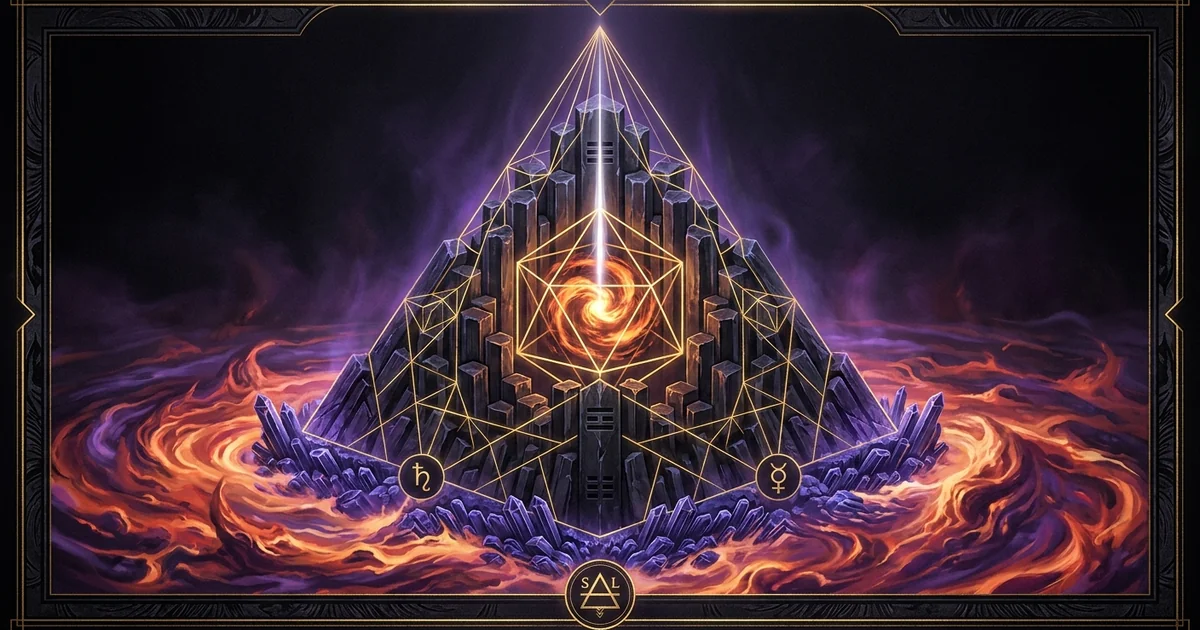
Human Design Gate 52 (Keeping Still (Mountain)): Archetypal
Archetypal Thesis & Systemic Paradigm: The Mechanics of Somatic Stillness
Thermodynamic Quenching in the Root Center
Within the topological architecture of the Human Design BodyGraph, the root-center operates as a primary pressure motor, transforming physiological drive into metabolic and kinetic trajectories. As one of the dual pressure-centers, its primordial function is adrenal: the synthesis and distribution of physical stress, fight-or-flight mobilization, and systemic propulsion. Gate 52—canonically designated as Keeping Still (Mountain) and correlated with hexagram-52 of the I Ching—occupies an anomalous position within this combustion chamber. Rather than transducing adrenal pressure into immediate kinetic motor output or emotional wave dynamics, Gate 52 acts as a thermodynamic brake, a quenching rod inserted into a nuclear pile. It arrests raw survival propulsion, dampening chaotic motor discharge through a specialized mechanism of somatic stillness.
This quenching operation is not a state of entropic decay or flaccid cessation. It is an active, metabolically demanding containment strategy. In the physics of nonequilibrium thermodynamics, maintaining an organized system in a non-discharging state against an ascending pressure gradient requires continuous free energy expenditure. Gate 52 performs precisely this work: it captures the ascending adrenal surge of the Root Center and holds it in somatic latency. Through this energetic containment, the raw physical urgency to act, flee, or discharge tension is neutralized, establishing the stable platform required for higher-order cognitive processing.
The Tension of Kinetic Inaction: Gate 52 Energetics
The specific mechanics of gate 52 energetics cannot be understood through the lens of passive rest or leisure. Passive rest belongs to the restorative quiescence of an unpressured system; Gate 52, conversely, is characterized by intense internal tension held under complete kinetic arrest. It represents the structural poise of an archer at full draw, or the physiological bracing of a predatory cat frozen in mid-stalk. Adrenal hormones—specifically cortisol and noradrenaline—are synthesized within the adrenal medulla, yet their systemic release into immediate muscular discharge is systematically suspended.
+------------------------------------------------------------------------+
|                          BIOENERGETIC HOLD                             |
|                                                                        |
|  [Adrenal Ignition] ---> [Gate 52 Gating Matrix] ---> [Zero Discharge]  |
|                                 |                                      |
|                                 v                                      |
|                    [Somatic Potential Energy]                          |
+------------------------------------------------------------------------+
By halting this somatic release, Gate 52 converts kinetic momentum into potential energy. Within the broader somatic ecosystem, this manifests as an acute physical stillness where the spine, musculature, and breath synchronize to minimize exterior motion. The subjective experience of this gate is frequently fraught with tension: an agonizing demand from the base of the physiology to do something to relieve the pressure, countermanded by an equally absolute mechanical mandate to remain rooted to the earth until structural clarity emerges.
Topological Teleology within the BodyGraph
The systemic teleology of Gate 52 becomes visible when its placement within the collective-understanding-circuit—frequently designated as the Logic Circuit—is rigorously evaluated. The logical stream cannot operate under the influence of volatile, intermittent bursts of kinetic velocity. Logic demands pattern recognition, empirical observation, hypothesis testing, and the patient assembly of repeatable formulas. Every empirical endeavor requires that the observer remain motionless long enough to record the phenomena under investigation.
If the adrenal pressure of the Root Center were to vent uncontrollably through the visual or motor systems, pattern recognition would collapse into perceptual distortion. Hyper-kinetic observers mistake noise for signal because their own instruments—sensory, neural, and muscular—are trembling with unmanaged discharge. Gate 52 therefore serves as the infrastructural foundation for the entire Collective Understanding stream. It supplies the spatial stability, muscular immobility, and temporal patience necessary for consciousness to zoom in on structural details, allowing the logical matrix to fulfill its evolutionary imperative of mastering the material world.
In molecular biology, the genetic translation of mRNA transcripts into functional peptide chains relies upon specific termination codons (UAA, UAG, and UGA). These “stop codons” do not code for any amino acid; instead, they signal the release factor to hydrolyze the bond between the nascent polypeptide and the tRNA, halting elongation and finalizing the macro-structural integrity of the synthesized protein.
Hexagram 52 corresponds biophysically to the genetic termination sequence. Just as a stop codon halts cellular assembly to prevent aberrant polypeptide elongation, Gate 52 halts kinetic motor elongation within the organism. It serves as an endocrine and somatic stop codon, arresting continuous, indiscriminate behavioral loops so that the broader physiological pattern can achieve structural stability. This genetic termination mirrors the down-regulation of catecholamines within the sympathetic nervous system, permitting an parasympathetic coherence that sustains visual and analytical concentration.
Classical Provenance & Textual Lineage: The Double Mountain of Ken
Hexagram 52 in the Zhouyi and Wilhelm-Baynes Tradition
In the foundational architecture of the Zhouyi, Hexagram 52 is named Ken (艮), constructed via the doubling of the trigram-ken—Mountain over Mountain. The mountain represents the absolute threshold of earth elevated toward heaven: immovable, massive, opaque, and self-contained. When the trigram of the Mountain is superimposed upon itself, the image denotes an intensification of this quality: stillness resting upon stillness. In the seminal translation by Richard Wilhelm and Cary F. Baynes (1950), the structural implication of this doubling is addressed through the somatic metaphor of the human back.
The spinal column functions as the structural conduit of the central nervous system, housing the descending motor tracts that translate neural impulses into muscular action. The Wilhelm-Baynes translation of the Judgment notes: “KEEPING STILL keeps his back still so that he no longer feels his body. He goes into his courtyard and does not see his people. No blame.” This paradoxical formulation identifies the precise mechanism of sensory decoupling: when the back—the postural axis—is brought to complete, unyielding vertical equilibrium, the restless somatic feedback loops that populate the ego’s self-awareness are temporarily severed. The subjective sense of an anxious, embodied agent dissolves into objective structural presence.
"The Judgment: KEEPING STILL. Keeping his back still / So that he no longer feels his body. / He goes into his courtyard / And does not see his people. / No blame.
The Image: Mountains standing close together: / The image of KEEPING STILL. / Thus the superior man / Does not permit his thoughts / To go beyond his situation." — Richard Wilhelm & Cary F. Baynes, The I Ching or Book of Changes (1950)
The Great Symbol commentary reinforces this somatic discipline: “Mountains standing close together: The image of KEEPING STILL. Thus the superior man does not permit his thoughts to go beyond his situation.” The cognitive boundary is explicitly tethered to spatial and temporal immediacy. The mountain does not project its mass into adjacent valleys; it simply occupies its precise geographic coordinate. To not permit thoughts to wander beyond the immediate situation is the classical Chinese framing of attentional focus: the elimination of peripheral anxiety, speculative projections, and cognitive distortions.
The Neidan Meditation of Resting the Back
Within the internal alchemy (Neidan) traditions of classical Taoism, the imagery of Hexagram 52 is inextricably linked with sitting in forgetfulness (zuowang) and the stabilization of the micro-cosmic orbit. The instruction to keep the back still is an explicit technical directive for seated meditation. In early Taoist treatises, the spine is viewed as a conduit of primordial energy (qi) that must not be bent or twisted by the erratic demands of the worldly senses.
                    THE NEIDAN AXIS
               [ Ken: Mountain / Above ]
                         ▲
                         │ (Stillness of the Spine)
                         ▼
               [ Ken: Mountain / Below ]
When the adept sits with the spine erect and immobile, the sensory faculties (traditionally correlated with the forward-facing sensory gates: eyes, nose, mouth) cease to reach outward toward the external realm of the “ten thousand things.” This deliberate withdrawal of perceptual grasping stops the scattering of vital essence (jing). The courtyard mentioned in the Zhouyi text represents the inner chamber of the mind. Entering the courtyard and seeing no one implies that the psychological landscape has been scrubbed clean of projected forms, social debts, familial complexes, and identity scripts. The double mountain creates an energetic watershed where the internal winds (feng) settle into stillness, transforming erratic turbulence into crystalized awareness.
Transmission from Classical Taoist Cosmogony to Human Design
When Ra Uru Hu synthesized the Human Design System in 1987, the classical cosmological architecture of the I Ching was stripped of its devotional and didactic moralism, yet its mechanical foundations were preserved. In The Definitive Book of Human Design (2001), Gate 52 is designated as the gate of Keeping Still, maintaining its explicit identity as the energetic anchor of the Collective Understanding Circuit.
Ra Uru Hu stripped Ken of the Confucian admonition toward “gentlemanly conduct” (junzi), replacing it with the bioenergetic language of mechanistic differentiation. In Human Design, human beings do not sit quietly because it is virtuous or morally noble; they are brought to stillness because the underlying circuitry dictates that the logical stream requires stabilization to prevent catastrophic strategic errors. The ancient Taoist spine becomes the somatic anchor of the adrenalized Root Center, holding the entire vehicle in space-time so that the empirical gaze can function unperturbed by the panic of survival.
Structural Mechanics & Symbolic Geometry: Circuitry, Anatomy, and Lines
The Channel of Concentration (52–9) and Collective Logical Circuitry
Topologically, Gate 52 sits on the upper boundary of the Root Center, pointing directly northward across the infrastructural gap toward Gate 9 in the sacral-center. Together, they form the channel-of-concentration (52–9), an electromagnetic bridge entitled The Design of Being Focused. Within this configuration, Gate 52 provides the foundational somatic stillness and adrenal pressure, while Gate 9—The Taming Power of the Small—supplies the microscopic, detail-oriented cognitive magnification.
                      SACRAL CENTER
                            ▲
                            │ Gate 9 (Magnification of the Small)
                     [CHANNEL 52-9]
                            │ Gate 52 (Stillness of the Mountain)
                            ▼
                       ROOT CENTER
The functional dynamics of this channel depend on the division of labor between its dual poles. Without Gate 52, Gate 9 possesses an infinite appetite for details, yet lacks the somatic anchor to sit in place long enough to parse them; it becomes hyper-distractible, hopping erratically from one micro-element to another. Conversely, Gate 52 without Gate 9 produces an immense somatic pressure to remain motionless, but lacks a specific analytical target toward which to direct its concentrated gaze, creating a pressurized somatic holding pattern.
When unified into a defined channel, the 52–9 configuration stabilizes the entire logical stream. It anchors the collective process of identifying reliable, repeatable patterns that ensure the future survival of humanity. Whether applied to laboratory research, engineering, algorithmic programming, or social policy, the Channel of Concentration demands the suspension of immediate, short-term kinetic implementation in service of rigorous, long-range validation.
Sub-Structural Line Mechanics (Lines 1 through 6)
The hexagram unfolds through six distinct lines of development, moving from the foundational, somatic baseline of Line 1 to the transcendent systemic detachment of Line 6. Each line illustrates a specific stage in the management of kinetic containment:
- Line 1: Think Before Acting. At the base of the hexagram, stillness begins at the periphery. Wilhelm-Baynes correlates this line with keeping the toes still. In the Human Design lexicon, this represents the foundational awareness that initiating physical action under premature adrenal pressure leads to structural failure. The line carries the archetype of self-restraint at the inception of movement.
- Line 2: Concern for the Whole (The Pausing of the Calf). Here, stillness is challenged by the impulse of the collective or surrounding elements to move forward. The lower leg wants to follow the foot; however, if the overarching pattern is unready, the individual must maintain somatic stillness despite the social momentum sweeping around them, enduring the tension of non-compliance.
- Line 3: Controls (Keeping the Hips Still). This line marks the threshold between the lower and upper trigrams, a locus of intense somatic friction. Wilhelm-Baynes warns of the danger of stiffening the spine or arresting movement at the waist, which suffocates the breath and cracks the heart. Mechanically, Line 3 represents forced, neurotic, artificial stillness: suppressing the motor system through sheer punitive control, resulting in internal somatic crisis.
- Line 4: Self-Discipline (Keeping the Trunk Still). The transition into the upper trigram brings an internalization of the mountain’s architecture. The torso, housing the respiratory and cardiovascular apparatus, is brought into deliberate harmony. Kinetic stillness is no longer a clumsy external restraint; it has matured into natural systemic self-discipline that effortlessly absorbs pressure without internal fracturing.
- Line 5: Explanation (Keeping the Jaws Still). Moving upward toward the communicative center, Line 5 governs the stillness of the mouth. In the collective logical domain, verbal diarrhea is a frequent outlet for unmanaged adrenal anxiety. This line represents deliberate silence, the refusal to speak prematurely, and the restriction of vocalization to structured, lucid, and rigorously tested formulations.
- Line 6: Peacefulness (Noble Stillness). At the apex of the hexagram, stillness ceases to be a disciplinary constraint and becomes an absolute structural condition. This is the mountain fully unified with the earth, completely unmoved by transient environmental fluctuations. The pressure of the Root Center is completely harmonized; the individual embodies an unwavering objective presence that grounds the surrounding collective field.
Circuit Disconnections: Contrast with Individual Circuitry and the Heart Center
To maintain diagnostic precision in Human Design analysis, Gate 52 must be cleanly demarcated from parallel structural mechanics. First, it must not be conflated with the willpower generated within the heart-center (Ego). The Heart Center operates through egoic resolve, self-worth, and contractual commitment—a tribal, manifestative energy that forces outcomes through emotional or material drive. Gate 52, conversely, is an impersonal, adrenal pressure mechanism residing in the Root. It possesses zero egoic investment. It does not “will” itself to sit still; rather, the mechanical pressure itself enforces kinetic cessation.
+------------------------------------------------------------------------+
|                      MECHANICAL DIFFERENTIATION                        |
|                                                                        |
|  Heart Center (Ego)          ---> Willpower, Egoic Drive, Promises     |
|  Individual Circuitry        ---> Melancholy, Acoustic Pulse, Mutation |
|  Gate 52 (Collective Logic)  ---> Adrenal Pressure, Somatic Immobility |
+------------------------------------------------------------------------+
Second, Gate 52 must be rigorously distinguished from the mechanics of individual-circuitry. The Individual stream operates via an acoustic, unpredictable pulse driven by mutation and existential melancholy. When an Individual gate in the Root Center (such as Gate 60 or Gate 38) experiences pressure, it manifests as existential tension, frustration, or a sudden, explosive breakthrough. Gate 52, embedded within the Collective Understanding Circuit, possesses no acoustic pulse and zero interest in individual mutation. Its pressure is spatial, visual, and empirical. It demands immobility not to catalyze a novel mutation, but to allow the collective intellect to observe whether an existing, repeatable pattern remains structurally sound over time.
Psychological Dynamics & Operational Praxis: The Pathology and Mastery of Restraint
Neuropsychological Substrates of Attentional Gating
In the classical neuropsychology established by Aleksandr R. Luria in The Working Brain (1973), the human brain is conceptualized as an integrated tripartite architecture: the first functional unit regulates cortical tone and arousal (brainstem and reticular activating system); the second unit receives, processes, and stores information (posterior cortical regions); and the third unit programs, regulates, and verifies mental activity (prefrontal cortex). Gate 52 functions as an archetypal analogue to the inhibitory regulatory networks connecting Luria’s first and third functional units.
For sustained visual and analytical attention to operate, the prefrontal cortex must exert top-down inhibitory control over subcortical motor programs. When sensory stimuli enter the brainstem, they generate an arousal response that seeks expression via motor output. If prefrontal executive inhibition fails, attentional fragmentation and hyper-kinetic behaviors inevitably follow.
               NEUROPSYCHOLOGICAL GATING
              [ Prefrontal Cortex: Inhibition ]
                             ▲
                             │ (Gating Control)
                             ▼
             [ Subcortical Arousal: Adrenal ]
Gate 52 provides the symbolic and bioenergetic blueprint for this prefrontal attentional gate. It arrests reflexive motor execution, allowing sensory information to be held in working memory rather than immediately converted into physical action.
The Shadow of Restlessness: Hyperactivity vs. Somatosensory Paralysis
When Gate 52 operates within the distorted framework of the Not-Self—particularly in individuals possessing an undefined Root Center, or those with an activated Gate 52 lacking connection to Gate 9—it swings between pathological polarity states:
- Kinetic Hyperactivity and Agitation: The subject experiences the unchanneled adrenal pressure of Gate 52 as an unbearable somatic vibration. Lacking the mechanical focus of Gate 9, the individual misinterprets this intense internal pressure as a mandate to run, initiate projects, clean spaces, pace rooms, or fidget uncontrollably. This is the dynamic architecture of modern Attention Deficit Hyperactivity Disorder (ADHD), wherein the organism attempts to discharge central nervous system tension through frantic, fragmented motor movements that fail to resolve the underlying pressure.
- Somatosensory Paralysis and Catatonic Stagnation: The inverse distortion manifests as an inability to mobilize any movement whatsoever. The individual becomes crushed beneath the mass of the mountain. Somatic stillness degrades into chronic procrastination, depressive inertia, and systemic paralysis. The organism feels so heavy, so physically anchored into the earth, that even necessary survival actions are indefinitely suspended, fostering profound despair and physical lethargy.
Not-Self Shadow: Reactive Turbulence
- Premature physical discharge to escape adrenal tension
- Erratic motor agitation, hyper-fidgeting, pacing, fragmented focus
- Severe systemic anxiety generated by incomplete logical loops
- Adrenal burnout through constant, unfocused physical mobilization
- Paralyzing somatic inertia and depressive catatonic collapse
- Speaking, executing, and finalizing details out of structural sequence
Differentiated Mastery: Still Mountain
- Absolute somatic containment of physiological pressure gradients
- Deliberate, grounded stillness serving as a platform for visual observation
- Tactical patience: holding position until the complete pattern crystallizes
- Parasympathetic equilibrium maintained despite external chaos
- Seamless integration with Gate 9 for microscopic cognitive focus
- Strategic, high-impact action executed only when timing matures
Deconditioning the Not-Self Root Pressure
Deconditioning the mechanics of Gate 52 requires a rigorous operational protocol. The primary distortion of the Not-Self Root Center is the persistent, irrational belief that if one does not act immediately to discharge the pressure, catastrophe will ensue. Individuals conditioned by this dynamic live in a state of perpetual panic, racing through life in an attempt to be “free of the pressure.”
Operational mastery demands the complete decoupling of the somatic experience of pressure from the mandate to act. The practitioner must cultivate the capacity to sit inside the adrenal furnace of the Root Center without allowing that heat to reach the throat, the motor systems, or the hands. The physical body must become comfortable with the sensation of pressure itself, recognizing it as pure, neutral fuel rather than a crisis. By allowing Gate 52 to do its quenching work, the individual anchors into their environment, observing the surrounding turbulence with the immovable gravity of the mountain.
Philosophical Synthesis & Macrocosmic Correspondence: Hermetic Stillness and Morphogenetic Fields
The Principle of Polarity and Kybalion Mechanics
In Hermetic philosophy, the Principle of Polarity states that “Everything is Dual; everything has poles; everything has its pair of opposites; opposites are identical in nature, but different in degree.” Simultaneously, the Principle of Vibration asserts that “Nothing rests; everything moves; everything vibrates.” At first glance, the immovable stillness of Hexagram 52 appears to contradict the Hermetic law of universal vibration. However, upon deeper occult investigation, absolute stillness is revealed to be the polar apex of infinite vibration.
Consider a wheel rotating at such an astronomical frequency that its spokes become invisible and its structural form appears entirely static. Stillness and absolute kinetic frequency converge at the zero-point of the energetic continuum. Gate 52 represents this metaphysical convergence: it is not the absence of energy, but the harmonization of opposing vectors into a state of structural equilibrium. By anchoring the organism to this zero-point, Gate 52 prevents the entropic dissipation of force, allowing consciousness to manipulate vibration from a stable, non-vibrating fulcrum.
Jungian Active Imagination as Deliberate Bodily Suspension
In Synchronicity: An Acausal Connecting Principle (1960), Carl Gustav Jung demonstrated that acausal correspondences and deep psychic crystallizations can only be perceived when the conscious mind drops its frantic causal grasping. In the praxis of Active Imagination, Jung required patients to enter a state of complete somatic containment. The subject was instructed to suppress the instinct to physicalize psychic contents, holding the physical body in strict repose so that the autonomous archetypal complexes of the unconscious could emerge into the field of inner vision.
JUNGIAN CONTAINMENT VESSEL
           +-----------------------------+
           | Physical Body: Suspended    |
           | Rational Gaps: Arrested     |
           |                             |
           | Archetypal Crystallization  |
           |             ▼               |
           |    Acausal Synchronicity    |
           +-----------------------------+
This psychological methodology is an operational mirror of Gate 52. If the patient twitches, moves, writes, or acts out the psychic fantasy prematurely, the alchemical vessel is shattered, and the unconscious contents are dispersed back into chaotic neurotic symptoms. Marie-Louise von Franz, in Number and Time (1980), elaborated upon this dynamic by examining how the deliberate suspension of spatial movement catalyzes temporal synchronization. Spatial stillness creates the psycho-energetic vessel within which temporal patterns can align, precipitating meaningful coincidences and structural psychological breakthroughs.
“The suspension of immediate physical reaction to the promptings of an archetype is the primary condition for the crystallization of consciousness. Where stillness is absent, the instinctual archetype is lived out compulsively as mere physical fate; where the somatic container remains unbroken, the psychic aspect of the archetype detaches from its material compulsion and transforms into luminous understanding.” — Marie-Louise von Franz, Number and Time (1980)
The Morphogenetic Matrix of the Collective Logical Stream
On a macrocosmic scale, Gate 52 serves as the archetypal anchor for civilizational infrastructure. Societies advance not merely through expansion, exploration, and warfare, but through structural pauses—periods of containment where legal, scientific, linguistic, and geometric models are codified.
Consider the construction of stone monuments, cathedrals, astronomical observatories, or planetary particle colliders: each requires decades of physical immobility, architectural precision, and the systemic suppression of instantaneous gratification. Gate 52 supplies the morphogenetic field of humanity with this capacity for monumental patience. It is the civilizational monastery, the laboratory bench, the library reading room, and the observation deck: spaces where the chaotic kinetic noise of the human collective is filtered out, leaving only the crystalized silence of the Mountain.
Frequently Asked Questions: Analytical Clarifications on Gate 52
What occurs when Gate 52 operates without Gate 9 in a chart?
When Gate 52 is defined in a chart without its electromagnetic counterpart, Gate 9 (the 52–9 channel remaining open), the individual experiences what is known as the “unfocused pressure cooker” syndrome. The Root Center constantly generates massive adrenal pressure to remain still, ground down, and concentrate. However, because there is no defined Gate 9 in the Sacral Center to channel that energy into granular details, the individual possesses the pressure to concentrate without an automatic target for their focus.
This dynamic frequently produces profound subjective frustration. The individual sits down with the full intention of working, reading, or researching, anchored firmly to their chair. Yet, because the detail-magnification filter is absent, their awareness drifts, unable to lock onto a single data point. The somatic pressure builds up in the body, manifesting as restlessness in the joints, leg-bouncing, and internal irritability.
The strategy for this configuration is to recognize that the focus itself must be directed by outer environmental mechanics or the defined sacral details of others. Individuals with an isolated Gate 52 must not force their minds to focus; they must simply allow their physical body to remain still and let the appropriate focal point arrive naturally within their perceptual field.
                      ELECTROMAGNETIC SPLIT
         Undefined Sacral (No Gate 9) = No Detail Target
                                 ▲
                                 │ (Frustrated Energy Loop)
                                 ▼
         Defined Root (Gate 52 Defined) = Massive Pressure to Sit Still
How is Gate 52 distinct from the willpower of the Heart Center and the melancholy of Individual Circuitry?
The distinction between Gate 52, the Heart Center, and Individual Circuitry is absolute and structural:
- Gate 52 vs. Heart Center: The Heart Center (Ego) operates via willpower, pride, and personal commitment. When the Heart Center says “I will sit here and finish this,” it is an exertion of moral or egoic force designed to prove value or fulfill an agreement. Gate 52 has nothing to do with will, ego, or moral resolve; it is a cold, mechanical, pressure-driven adrenal dampening. The body sits still because the root mechanics suppress the motor system, not because the ego decided to be strong.
- Gate 52 vs. Individual Melancholy: Individual Circuitry operates through an acoustic pulse that is either ON or OFF, deeply intertwined with moods, chemistry, and existential melancholy. When an Individual gate in the Root Center (such as Gate 60 or 38) feels pressure, it feels like an existential pulse that must express itself or implode. Gate 52, as a Collective Logical gate, possesses no moods, no melancholy, and no pulse. Its pressure is steady, dry, structural, and collective, designed exclusively to support empirical verification.
How should planetary transits of Gate 52 be navigated in personal praxis and workspace architecture?
When transiting planetary bodies—particularly major conditioning forces like Saturn, Jupiter, or the Nodes of the Moon—enter Gate 52, a collective dampening wave sweeps through the human morphogenetic field. During these transit windows, societies and individuals experience an abrupt slowdown in kinetic velocity. Projects that were racing forward suddenly encounter bureaucratic delays, material bottlenecks, or a collective loss of immediate momentum.
To navigate this transit effectively, the following operational protocols must be integrated:
- Eliminate Artificial Urgency: Understand that the transit is applying a systemic thermodynamic brake. Fighting the brake by pushing harder against logistical delays only results in severe adrenal exhaustion and structural errors.
- Optimize Workspace Architecture: Align the physical work environment with the mechanics of the Mountain. Ensure the physical spine is supported (ergonomic seating that stabilizes the back, as indicated in the Zhouyi), eliminate peripheral visual distractions that provoke erratic motor reactions, and reduce kinetic multitasking.
- Prioritize Review over Initiation: Utilize the transit window to audit, evaluate, and stabilize existing systems rather than launching novel, untested trajectories. The Mountain does not march; it anchors the earth so that the horizon can be accurately surveyed.