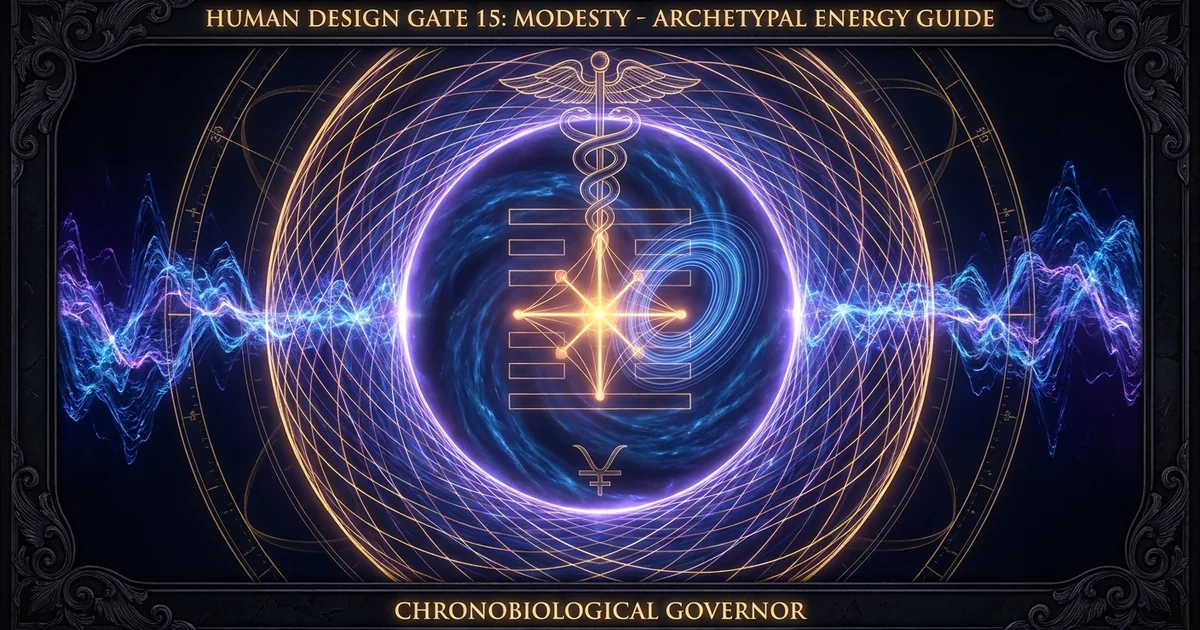
Human Design Gate 15 (Modesty): Archetypal Energy - Guide
Archetypal Thesis & Systemic Paradigm: The Geometry of Modesty and Extremes
The Dynamic Paradox: Modesty as Equilibrium of Polar Extremes
Within the analytical framework of human design, Gate 15 occupies an anomalous position that consistently defies colloquial definitions of its traditional nomenclature. Far from denoting submissive self-erasure, passive meekness, or moral asceticism, human design gate 15 modesty operates as an omnidirectional, high-capacitance biological governor. In the architecture of the Rave Mandala, Hexagram 15 represents the capacity to contain, calibrate, and synthesize the outer limits of behavioral, environmental, and temporal variance. It does not repress polarities; it mediates them. Where normative cultural frameworks demand behavioral stabilization through the suppression of deviation, Gate 15 achieves equilibrium through systemic inclusion. It absorbs the complete continuum of human variance—from hyper-kinetic acceleration to catatonic dormancy, from ascetic discipline to profligate indulgence—and integrates these states into a unified evolutionary current.
This dynamic paradox is rooted in the structural mechanics of the hexagram itself. Modesty, in its authentic systemic and metaphysical context, is the absence of ideological identification with any single fixed state. When the biological organism or collective body does not grasp at a static definition of the self, it maintains the structural elasticity necessary to accommodate profound shifts in frequency, environmental pressure, and collective pacing. Gate 15 is therefore the fulcrum of behavioral elasticity. It provides a homeostatic counterweight to mechanical rigidity, allowing human social frameworks to deform under catastrophic pressures without fracturing. The archetype demonstrates that true balance is neither static nor symmetrical; it is a fluid, hyper-adaptive process of continuous re-centering across shifting operational planes.
The G-Center as a Transpersonal Rhythmic Transducer
Positioned within the structural geometry of the G-Center, Gate 15 acts as a transpersonal rhythmic transducer. The G-Center governs identity, higher love, and spatial-temporal trajectory—the geometric course steered by the Magnetic Monopole. Within this center, Gate 15 does not generate mechanical energy of its own; rather, it directs and conditions the vital flow supplied to it, serving as the collective logic’s oceanic threshold. The gate 15 energetics function by intercepting the fixed, repetitive daily cadence of the Sacral Center and transmuting it into an expansive, trans-species synchronization with terrestrial and cosmic patterns.
By anchoring identity to macrocosmic temporal cadences rather than subjective mental agendas, Gate 15 liberates identity from static narrative scripts. The individual with Gate 15 configured within their design functions as a tuning fork for the collective aura. They do not merely live their own tempo; they project an energetic envelope that accommodates the diverse rhythms of others. This makes the gate an indispensable anchor for social aggregation. Without the presence of this G-Center aperture, humanity’s divergent biological clocks would precipitate continuous social and evolutionary dissonance, fracturing collective endeavors into mutually hostile tempos.
Systemic Resistance: The Rejection of Mechanical Homogenization
The ultimate societal function of Hexagram 15 is its systemic resistance to mechanical homogenization. Industrial and post-industrial governance structures rely upon strict, entrained synchronization—standardized work hours, uniform circadian regimens, and behavioral predictability. Such mechanical homogenization suppresses biological uniqueness in service of industrial throughput. Gate 15 disrupts this synthetic entrainment. It represents the inherent evolutionary requirement for biological and cultural variance, asserting that systemic health directly correlates with the range of acceptable anomalies within an ecology.
In the logic of evolution, a species reduced to a singular, uniform behavioral tempo is exceptionally vulnerable to systemic collapse when environmental conditions shift. Gate 15 preserves humanity’s genetic and phenotypic insurance policy by maintaining fluctuating infradian rhythms, eccentric social drives, and asymmetric operational modalities. It acts as an open ecological corridor through which the collective logic circuit tests atypical adaptations. Far from being a pathology or an operational inefficiency, the erratic behavioral swing native to this gate is the exact mechanism by which collective consciousness escapes the entropic trap of systemic stasis.
“The temporal organization of living matter involves an architecture of rhythms with frequencies spanning over ten orders of magnitude. Homeostasis is not an invariant baseline, but a continuous orchestration of multidimensional infradian, circadian, and ultradian oscillations. Systemic stability relies entirely upon dynamic temporal variance rather than static physiological immobility.” — Franz Halberg, Chronobiology: Circadian and Infradian Rhythms in Biological Equilibrium (1969)
Classical Provenance & Textual Lineage: From King Wen to the Genetic Matrix
Mountain Beneath the Earth: Structural Dynamics of Ken over K’un
In the classical sequence of the I Ching, Hexagram 15, known as Ch’ien, is structurally constituted by the trigram Ken (Mountain, the Keeping Still) situated beneath the trigram K’un (Earth, the Receptive). This spatial configuration constitutes a striking cosmological inversion. The Mountain, characterized by towering verticality, immense mass, and unyielding terrestrial weight, is traditionally positioned above the landscape. Yet, in Ch’ien, this monumental subterranean formation lowers itself beneath the yielding, flat surface of the Earth.
Hexagram 15: Ch’ien / Modesty
The Judgement: Modesty creates success. The superior man carries things through.
The Image: Within the earth, a mountain: The image of Modesty. Thus the superior man reduces that which is too much, And augments that which is too little. He weighs things and makes them equal.
This spatial syntax reveals the profound mechanical definition of modesty established by King Wen and the Duke of Zhou. The mountain does not proclaim its elevation; it hides its immense density within the womb of the soil. This symbolizes inner substance that requires no external ostentation to maintain structural integrity. The stillness and solidity of Ken provides an unshakeable, interior bedrock, while the absolute receptivity of K’un forms an open, non-combative exterior. The hexagram asserts that authentic authority and systemic stability occur when high power deliberately submerges itself beneath the common ground, avoiding the friction and inevitable collapse that attend visible arrogance and structural top-heaviness.
       --  --  Upper Trigram: K'un (The Receptive Earth)
       --  --
       --  --
       ------  Lower Trigram: Ken (The Keeping Still / Mountain)
       --  --
       --  --
Wilhelm’s Translation of Ch’ien: Leveling the Full and Augmenting the Empty
Richard Wilhelm’s translation of the Image of Hexagram 15 isolates the homeostatic feedback mechanism intrinsic to the archetypal dynamic: “The superior man reduces that which is too much, and augments that which is too little. He weighs things and makes them equal.” This statement serves as an ancient formulation of cybernetic homeostasis and entropy management. The superior man, acting as the conscious expression of cosmic law, identifies structural asymmetry within the sociopolitical and energetic ecology, intervening not to impose arbitrary moral limits, but to restore equilibrium.
In the natural order, celestial and terrestrial forces operate under this exact law of self-correction. Mountains are eroded by wind and water; oceanic chasms are filled with alluvial silt. The proud and excessive invite their own catastrophic diminishment through the accumulation of systemic friction, while the modest, the low, and the receptive attract resources through natural gravitational mechanics. Within this context, modesty is an applied science of energetic conservation. By preemptively divesting oneself of excess and elevating what is depressed, the individual or civilization circumvents the violent, compensatory swings of compensatory karmic and physical mechanics.
The Rave Mandala Translation: Codon Serine and Temporal Polyphony
In the modern synthesis of the Human Design System formulated by Ra Uru Hu, Hexagram 15 (Qian) maps directly to the genetic matrix through the biochemistry of the Serine codon ring. Serine is a polar, non-essential amino acid central to the catalytic mechanisms of numerous enzymatic reactions, notably playing an irreplaceable role in phosphorylation—the universal biological switch that governs cellular metabolic regulation, signaling, and temporal cellular cycles.
Genetic Codon Association:
Codon Group: Serine Ring (AGU, AGC, UCU, UCC, UCA, UCG)
Biochemical Interface: Gate 15 (UCU / UCC / UCA / UCG variants within the Rave Mandala)
Physiological Correlate: Dynamic metabolic equilibrium, enzymatic rate modulation, and autonomic pacing.
Through this genetic translation, the ancient concept of Ch’ien shifts from moral philosophy to a biological reality. Serine’s biochemical role as a molecular switchboard parallels Gate 15’s operational mandate in the collective aura: the regulation of systemic tempo and rate-of-exchange. Gate 15 manifests as temporal polyphony. It ensures that the biological vessel is not locked into an invariant metabolic rate, but retains the enzymatic and energetic versatility to operate across highly divergent tempos. The integration of the Serine ring across the collective circuitry establishes that human diversity is not an ideological virtue, but a hardwired genetic mechanism without which biological adaptability and evolutionary evolution would stall.
Structural Mechanics & Symbolic Geometry: Circuitry, Centers, and Line Progression
The Channel of Rhythm (15-5): Coupling G-Center Direction to Sacral Vitality
To comprehend the operational mechanics of Gate 15, it must be analyzed within its circuit context. Gate 15 forms one half of the Channel of Rhythm (15-5), located within the Collective Logic Circuitry (Understanding Circuit). This channel is the macrocosmic clock of the human species. It connects the Sacral Center—the motor of vital, generative lifeforce—via Gate 5 (Waiting / Fixed Patterns) directly to Gate 15 in the G-Center.
Gate 5 represents the immutable, cellular rhythm of life itself: the fixed, universal frequency that governs circadian synchronization, planetary orbits, cellular mitosis, and seasonal succession. It is the metronome. Gate 15, on the opposite pole, represents the fluid behavioral adaptation to those rhythms—the extremes through which that universal tempo must express itself in a chaotic, fluctuating world.
Without Gate 15, Gate 5’s rhythm would be brittle, mechanical, and incapable of enduring environmental shifts; it would shatter upon contact with anomalous conditions. Conversely, without Gate 5, Gate 15’s capacity for extremes would devolve into erratic, groundless turbulence, devoid of temporal anchors. When coupled in the Channel of Rhythm (15-5), these gates establish the dynamic equilibrium of existence: an unshakeable, universal pulse (Gate 5) that accommodates an infinitely diverse, polymorphic spectrum of biological and social movement (Gate 15).
+-------------------------------------------------------+
   |                THE CHANNEL OF RHYTHM                  |
   |                                                       |
   |   [ SACRAL CENTER ]             [ G-CENTER ]          |
   |     Gate 5 (Fixed)  <--------->   Gate 15 (Extremes)  |
   |     - Universal Cadence           - Polymorphic Flow  |
   |     - Cellular Mitosis            - Social Adaptation |
   |     - The Invariant Metronome     - The Oceanic Tide  |
   +-------------------------------------------------------+
Line Progression Analysis: From Subterranean Modesty (Line 1) to Global Inclusivity (Line 6)
The hexagram’s six lines outline the developmental journey of modulating extremes, progressing from somatic grounding to transpersonal orchestration:
- Line 1: Duty / Self-Effacement (Subterranean Modesty). The foundation of the hexagram is rooted in quiet, somatic recognition. Here, modesty is an intrinsic survival adaptation: the instinct to remain low, inconspicuous, and energetically contained until action is necessitated by the environment. It acts without expectation of social recognition, insulating the individual from the distorting pressures of premature visibility.
- Line 2: Influence (Quiet Balance). The internal equilibrium of the lower trigram begins to radiate outward without deliberate contrivance. Line 2 represents the natural, effortless embodiment of modesty. It moves naturally between extremes without attaching to either pole. Its modest demeanor exerts an involuntary magnetic draw, attracting others into its rhythmic orbit purely through its coherent physiological poise.
- Line 3: Ego Inflation / Deflation (The Peril of Assessment). As the line of transition from personal awareness to interpersonal friction, Line 3 encounters the destabilizing influence of the ego. The challenge here is the constant temptation to exploit one’s capacity for extremes, or alternatively, to perform modesty as an aesthetic posture. Balance is easily lost here through self-conscious evaluation, demanding an ongoing, vigilant shedding of pretense.
- Line 4: Restraint (Disciplined Calibration). Crossing into the transpersonal upper trigram, Line 4 applies deliberate, conscious discipline to behavioral swings. It understands the political and social consequences of unregulated variance. Here, the extremes are harnessed pragmatically for collective leadership, demonstrating how divergent pacing can be synchronized to organize and direct social groups.
- Line 5: Sensitivity (Universal Magnetism). The line of collective projection. Gate 15.5 stands as the classic social integrator, capable of attuning to the most disparate psychological archetypes and lifestyle extremes. Because it contains no internal resistance to strange or radical tempos, the collective projects upon it the role of the ultimate arbiter, diplomat, and harmonizer of social conflict.
- Line 6: Self-Defense / Global Inclusivity (The Transpersonal Watchman). The zenith of the hexagram balances wide-open inclusion with discerning boundary maintenance. Having mastered the entire spectrum of behavioral extremes, Line 6 cannot be conditioned by tribal or personal dogma. It embodies the ultimate evolutionary realization of the gate: an unconditional acceptance of the polymorphic nature of the human species, paired with the structural authority to defend that variance against reactionary, homogenizing factions.
Systemic Contrasts: Collective Understanding versus Tribal Circuitry and the Ajna Center
To precisely calibrate gate 15 energetics, this configuration must be differentiated from the mechanics of tribal circuitry and the dogmatic pressures generated within the mental plane of the ajna center. The collective logic circuit, to which Gate 15 belongs, is intrinsically transpersonal, objective, and dedicated to the long-term survival patterns of humanity as an integrated biological totality. It does not operate on personal sentimentality, moral righteousness, or the transactional bonds characteristic of tribal dynamics.
Collective Logic (Gate 15)
Operates unconditionally across all human variations; completely impersonal; integrates divergence to safeguard macro-evolutionary adaptability; temporal pacing is somatic, oceanic, and non-linear.
Tribal Circuitry (Defense/Ego)
Demands ideological, genetic, and behavioral conformity; strictly conditions support based on mutual sacrifice; rejects deviations from tribal law to preserve group coherence; highly localized.
Ajna Center (Mental Logic)
Constructs brittle, conceptual frameworks concerning ‘how things ought to be’; attempts to enforce rigid schedules, moralistic baselines, and standardized, mechanical daily routines.
Tribal circuitry regulates energy through exclusive, transactional contracts—loyalty, resource division, and genetic preservation. It treats non-conforming, erratic behavioral cadences as threats to communal survival. Gate 15 dismantles this tribal insularity. It demands that the collective incorporate the outsider, the deviant, and the anomalous rhythm, identifying these outliers as critical phenotypic variations necessary for the vitality of the genetic pool.
Furthermore, an acute friction consistently manifests between Gate 15 and the Ajna Center. The Ajna seeks mental certainty, semantic consistency, and predictable, linear operational metrics. When the Ajna Center attempts to mentally govern the somatic rhythms of Gate 15, it inevitably diagnoses natural energetic variance as operational dysfunction. Mental logic insists that an individual wake, work, and create under uniform daily schedules. Gate 15, anchored in the deeper intelligence of the G-Center, rejects this linear tyranny; its bio-rhythms fluctuate in accordance with macrocosmic currents that the mental apparatus is entirely unequipped to map or control.
Psychological Dynamics & Operational Praxis: Navigating Extremes in Consultation
The Shadow of Dullness and Compulsive Homogenization
In the psychological analysis of Gate 15, the primary pathology emerges not from the presence of extremes, but from the terror of them. The shadow frequency of this archetype manifests as Dullness—a state of catatonic energetic suppression born from the desperate need to appear ‘normal’. When an individual carrying an activated Gate 15 is subjected to heavy childhood, educational, or professional conditioning, they quickly recognize that their natural cadences are disruptive to the homogenized collective. In response, they unconsciously suppress their natural oscillations, forcing their biology into artificial, repetitive patterns.
+-----------------------------------------------------------------+
|                  THE SPECTRUM OF CONSCIOUSNESS                  |
|                                                                 |
|   SHADOW        -->        GIFT           -->      SIDDHI       |
|  Dullness               Diversity                Florescence    |
|  Forced conformity,     Integration of           Cosmic unity,  |
|  fear of variance,      rhythmic extremes,       unconditional  |
|  depleted vitality.     auric magnetism.         transpersonal  |
|                                                  love.          |
+-----------------------------------------------------------------+
This compulsive homogenization extracts a severe physiological toll. To suppress an intrinsic infradian or ultradian rhythm requires constant, exhausting autonomic intervention. The sympathetic nervous system remains chronically activated, leading to adrenal exhaustion, chronic fatigue, depressive flatness, and a profound loss of direction.
Alternatively, the shadow manifests in its reactive polarity: compulsive, chaotic rebellion. In this state, the individual becomes addicted to behavioral volatility for its own sake, ricocheting violently between lifestyle extremes, destructive habit loops, and erratic relationships, mistakenly believing that self-generated chaos is synonymous with authentic freedom. Both poles of the shadow are reactive stances dictated by an underlying terror of simply allowing natural, organic tempos to emerge without ego intervention.
Clinical Praxis: Somatic Calibration of Fluctuating Rhythms
In clinical human design analysis and somatic transpersonal consultation, a client presenting with an activated Gate 15 requires specific diagnostic and therapeutic calibration. The fundamental objective is the depathologization of temporal variance. Analysts must actively deconstruct the client’s internalized shame regarding their inability to sustain linear, repetitive routines.
A practitioner must guide the Gate 15 client through somatic inventory mapping:
- Sleep Cycle De-standardization: Establishing permission to sleep in non-circadian patterns when somatic pressure dictates (e.g., biphasic sleep, rotating bedtimes, dynamic periods of deep rest followed by high-output cycles).
- Nutritional Polyphony: Decoupling eating patterns from clock time; accepting shifting caloric and nutritional demands that align with metabolic ebbs and flows rather than social mealtimes.
- Aura Management: Recognizing that an activated Gate 15 carries an expansive aura that naturally pulls others into its current rhythm. Clients must learn to respect this auric impact, developing conscious boundary hygiene to avoid overwhelming more fragile energetic types.
- Decoupling Self-Worth from Consistency: Eradicating the capitalist metric of daily, repetitive productivity as a measure of integrity or professional value.
When the practitioner anchors the client in this awareness, the somatic holding patterns dissolve. The client stops fighting their inherent pacing, allowing their biological systems to restore the vitality that was previously drained by the futile attempt to emulate static predictability.
Analytical Differentiation: Overriding the Ajna Center’s Mental Pressures
A pervasive clinical dilemma arises when an activated Gate 15 resides in a chart alongside an undefined or highly conditioned defined ajna center. In this common configuration, the mental apparatus acts as an internal warden, weaponizing cultural norms to assault the body’s fluctuating states. The Ajna identifies the down-cycle of a rhythm as ‘laziness’ and the hyper-kinetic up-cycle as ‘hypomania’, constantly generating clinical labels to justify its anxiety.
[ Ajna Center: Mental Anxiety / Categorization ]
                 |
        (Attempts to Regulate)
                 v
[ G-Center: Gate 15 Dynamic Somatic Extremes ]
                 |
          (Natural State)
                 v
   [ Fluctuating Cellular Energy ]
Effective consultation requires severing the Ajna Center’s jurisdiction over the body’s temporal mechanics. The mental plane must be re-educated: it is an observer of the tide, not its master. Practitioners should assign concrete cognitive tracking protocols—such as empirical rhythm journaling without prescriptive corrective action.
When the client systematically charts their fluctuations over months, the Ajna is presented with structural evidence that every period of withdrawal is followed by a natural surge of creative, collective contribution, and that every extreme state has a precise, self-limiting biological half-life. By rendering the rhythm empirical, mental panic subsides, and somatic authority is restored to the G-Center and Sacral axis.
Philosophical Synthesis & Macrocosmic Correspondence: Hermetic Balance and Natural Law
The Hermetic Principle of Polarity and Rhythmic Neutralization
Viewed through the lens of esoteric philosophy, Gate 15 serves as a direct embodiment of the Hermetic Principle of Rhythm, as articulated in classical Hermetic texts: “Everything flows, out and in; everything has its tides; all things rise and fall; the pendulum-swing manifests in everything; the measure of the swing to the right is the measure of the swing to the left; rhythm compensates.”
       (+) Extreme A: Hyper-Kinetic Acceleration
               \             /
                \     o     /  <-- Gate 15 Neutral Fulcrum
                 \   / \   /      (The Hermetic Observer)
                  \ /   \ /
       (-) Extreme B: Absolute Rest / Dormancy
In the Hermetic praxis, the master does not attempt to annihilate the pendulum or suppress the polar oscillation. Instead, they apply the Art of Neutralization. By ascending consciousness to a transpersonal coordinate, the practitioner allows the swing of the pendulum to pass beneath them on the mental and physical planes without sweeping their identity into the polarized current.
Gate 15 exemplifies this exact mechanism within the Rave BodyGraph. By hosting the absolute extremes of experience within its expansive awareness, it ceases to be owned by either pole. It achieves the ultimate Hermetic virtue: the absolute stillness at the center of the wheel. The modesty of Gate 15 is, at its root, this Hermetic neutralization—an ego-transcendent awareness that recognizes all human conditions as temporary operational frequencies of a single, unified cosmic lifeforce.
Chronobiological Synchronization and the Vessel of Universal Love
Gate 15 occupies an essential coordinate within the esoteric geometry of the Vessels of Love—a cross-incarnational quartet of G-Center gates comprising:
- Gate 10 (Love of Self / Treading)
- Gate 15 (Love of Humanity / Modesty)
- Gate 25 (Universal Love / Innocence)
- Gate 46 (Love of the Body / Pushing Upward)
- Amino Acid: Serine (Codon Ring of Seeking / Pacing)
- Physiological Association: Cellular metabolic rate, enzymatic temporal triggers, autonomic pacing.
- Astrological Coordinates: Late Gemini to Early Cancer (Tropical Zodiac), mediating the critical transition from mutable air (intellectual diffusion) to cardinal water (matriarchal cohesion and somatic containment).
- Macrocosmic Quartet: The Vessel of Love (Representing the transpersonal, unconditional Love of Humanity and its collective phenotypic diversity).
Within this holy quartet, Gate 15 anchors the love of the collective human form in all its bizarre, beautiful, and radical expressions. While Gate 10 preserves the integrity of individual differentiation and Gate 46 honors the somatic temple, Gate 15 looks upon the immense sea of humanity—with its saints, tyrants, outcasts, and visionaries—and accepts the full human pattern without moral revulsion. It represents the profound, somatic recognition that the species cannot evolve toward spiritual maturity if it suppresses its phenotypic and temporal diversity.
This love is not an emotional sentiment or an intellectual posture; it is an auric field effect. It is the chronobiological synchronization of human consciousness with the cosmic heartbeat. By accepting and loving the erratic, chaotic nature of the human animal, Gate 15 functions as the collective womb through which humanity’s divergent trajectories are sheltered, held, and drawn along the evolutionary path charted by the Magnetic Monopole.
The Transpersonal Vessel: Modesty as Evolutionary Imperative
Ultimately, Hexagram 15 demonstrates that true modesty is an evolutionary imperative. In the wider cosmos, nature ruthlessly eradicates arrogance. That which becomes brittle, self-important, and inflexible invites its own destruction from higher environmental pressures. The mountain that lifts itself too aggressively into the sky is shattered by tectonic violence and sheared away by frost; the mountain that accepts its subterranean seat beneath the soft, accommodating earth endures throughout cosmic epochs.
Modesty is structural transparency. It is the absolute voiding of self-importance that allows the macrocosmic current to pass through the individual instrument without resistance. In this high operational state, Gate 15 becomes the open conduit for collective transformation. The individual possessing this gate becomes a vessel of evolutionary currents—a conscious node through which the universe experiences the boundless, polymorphic beauty of its own temporal forms, reminding humanity that the journey toward awakening is not a march toward sterile uniformity, but a dance through the full spectrum of existence.
Frequently Asked Questions: Analytical Inquiries on Gate 15 Mechanics
How Does Gate 15 Modesty Differ Mechanically from Tribal Circuitry Commitments?
The primary mechanical difference lies in the programmatic architecture of the circuitry. Tribal circuitry (such as the 19-49 or the 54-44) is closed, highly conditional, and focused entirely on the genetic continuity, emotional security, and material maintenance of the localized group. Within the tribal domain, “belonging” is predicated on behavioral and temporal compliance: an individual must observe the rituals, uphold the marriage contracts, defend the borders, and align with the tribal schedule. Deviation from these tribal cadences is interpreted as treason, defectiveness, or an existential threat to community security.
Conversely, Gate 15 resides within the Collective Logic Circuitry, which is unconditionally transpersonal and globally oriented. Gate 15 does not possess mechanisms for interpersonal contracts, emotional bargaining, or tribal boundary enforcement. It relates to humanity as an integrated biological matrix rather than an exclusive kinship network. Where the tribe enforces conformity to protect its resources, Gate 15 actively welcomes the aberrant, the stranger, and the atypical cadence, recognizing that macro-systemic resilience requires phenotypic variance.
Tribal care is intensely personal, exclusive, and contractual; Gate 15 modesty is completely impersonal, all-inclusive, and structurally non-judgmental. It makes space for the king and the beggar, the hyper-productive and the dormant, holding them as equally valid operational dynamics within the species’ wider ecology.
What Dynamics Arise When an Undefined Ajna Center Challenges Gate 15 Bio-Rhythms?
When an undefined ajna center operates in tandem with an activated Gate 15, the individual is highly susceptible to profound psychological and somatic conditioning. An undefined Ajna has no fixed way of mentally conceptualizing reality; its natural state is an open, flexible processing node for diverse concepts. However, when operating under Not-Self conditioning, the undefined Ajna becomes obsessed with presenting itself as certain, consistent, and mentally reliable to a culture that values intellectual and operational predictability.
+--------------------------------------------------------------+
|            THE UNDEFINED AJNA / GATE 15 CONFLICT             |
|                                                              |
|   Undefined Ajna (Not-Self): "I must prove I am consistent,  |
|   predictable, and mentally certain."                        |
|                              vs.                             |
|   Gate 15 (Somatic Design): "My biological rhythms, sleep,   |
|   and social engagement naturally swing between extremes."   |
|                              =                               |
|   RESULT: Internalized guilt, artificial standardization,   |
|   sympathetic nervous exhaustion, and chronic burnout.       |
+--------------------------------------------------------------+
When this conditioned mental state collides with Gate 15’s dynamic swings, the undefined Ajna weaponizes the intellect against its own somatic mechanics. If the Gate 15 body enters a low-energy, introspective ebb, the undefined Ajna panics, concluding that this natural deceleration indicates depression, a lack of discipline, or vocational incompetence. It then attempts to force the body into rigid regimens using stimulants, artificial schedules, and punitive mental narratives.
Conversely, when Gate 15 swings into hyper-kinetic engagement, the Ajna constructs elaborate, unsustainable life commitments based on the assumption that this temporary output is the new baseline. This psychological battle disrupts the body’s natural balance. Healing this dynamic requires the client to stop turning their mental energy inward as an internal regulator, instead allowing the mind to step back and neutrally observe the shifting somatic tides dictated by the G-Center.
How Does an Electromagnetic Connection between Gate 15 and Gate 5 Function in Synastry?
In synastry, the electromagnetic connection between Gate 15 and Gate 5 completes the Channel of Rhythm (15-5), establishing a potent, deeply somatic mechanical dynamic between two charts. This partnership joins two distinct, complementary temporal architectures: Gate 5 provides the rhythmic metronome rooted in the Sacral Center’s regenerative life force, while Gate 15 provides the open, behavioral capacity for extremes rooted in the G-Center’s transpersonal direction.
Partner A: Gate 5 (Sacral)               Partner B: Gate 15 (G-Center)
[ Cellular Mitosis / Daily Metronome ] <---> [ Oceanic Extremes / Adaptive Flow ]
                           \                   /
                            \                 /
                        ELECTROMAGNETIC COMPLETION:
                         The Channel of Rhythm (15-5)
In functional partnerships, this connection establishes an evolutionary cadence. Partner A (Gate 5) brings consistent daily rituals—predictable waking times, reliable operational cadences, and cellular stability—which serve as a grounding anchor for the relationship. Partner B (Gate 15) is drawn to this stabilizing presence, using it as an anchor that prevents their fluctuating rhythms from dissolving into unstructured chaos.
Simultaneously, Partner B (Gate 15) challenges the rigidity of Partner A (Gate 5), offering the expansive behavioral range necessary to prevent their routines from hardening into mechanical stagnation. Gate 15 helps Gate 5 adapt its rhythms to changes in the outer environment.
However, if lived unconsciously, this electromagnetic connection can generate significant friction. Gate 5 may judge Gate 15’s natural shifts as unpredictable, untrustworthy, or chaotic, attempting to force them into a strict Sacral routine. Concurrently, Gate 15 may feel trapped, claustrophobic, and exhausted by Gate 5’s unyielding habits, feeling that their natural dynamism is being compressed into a rigid routine.
For the Channel of Rhythm to operate correctly in partnership, both individuals must recognize that Gate 5 is the bank of the river, while Gate 15 is the rushing water itself. Without the riverbank, the water dissipates into a formless swamp; without the moving water, the riverbank is merely an empty, dry trench carved into the earth. The relationship thrives when structural stability and rhythmic variance are honored as complementary halves of a unified evolutionary design.