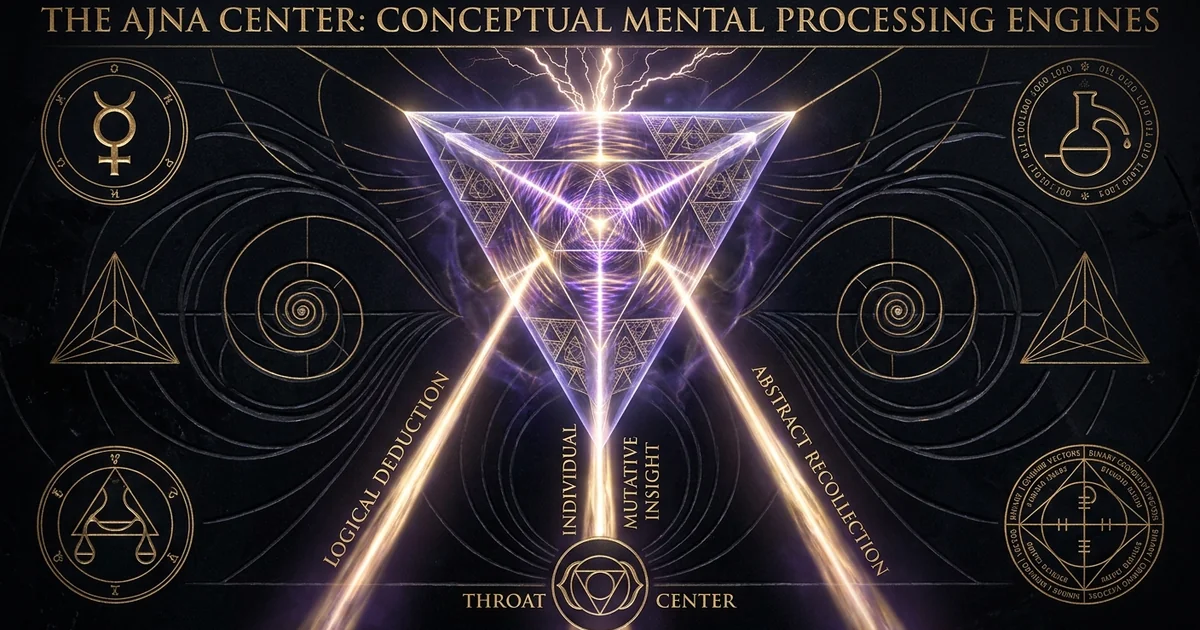
The Ajna Center: Conceptual Mental Processing Engines
Archetypal Thesis & Systemic Paradigm: The Conceptual Engine of Consciousness
The Epistemological Decoupling of Awareness from Motor Authority
In the structural taxonomy of the Bodygraph, the Ajna Center occupies an operational position that subverts classical assumptions regarding human volition. Conventional Western intellectual traditions, rooted in Cartesian dualism and Enlightenment rationalism, have historically elevated the cognitive apparatus to the role of sovereign executive. The mind has long been misattributed with somatic governance, perceived as the primary engine through which an individual deliberates, decides, and executes biological trajectory. Within the structural architecture of the nine-centered transitional human form, however, cognitive awareness is epistemologically decoupled from motor authority. The Ajna functions exclusively as an awareness center and conceptual processing engine; it possesses zero native biological motor capacity.
The conceptual processing engine of the Ajna Center does not produce kinetic action, nor does it command biological metabolic resources for environmental movement. Its mechanics are dedicated to the synthesis, categorization, comparison, and structural modeling of phenomena. When the mind attempts to function as an inner-authority, it oversteps its bio-energetic mandate, imposing linear cognitive projections onto an organic vehicle whose kinetic intelligence operates through completely non-intellectual somatic centers. The Ajna’s true evolutionary mandate is that of an internal measurement engine: an architectonic instrument designed to observe, measure, construct hypotheses, and map informational dualities. It serves the evolutionary arc of consciousness by bearing witness to existence rather than steering the biological vessel through the space-time continuum.
The Tripartite Awareness Topology in Nine-Centered Architecture
The Bodygraph maps three discrete awareness centers across the human biological form, each operating through a distinctive temporal domain and existential imperative. The Splenic Center operates as primal awareness: somatic, instinctual, and fixed entirely in the existential present moment. Its intelligence addresses immediate physiological survival and immune integrity, functioning through rapid, non-repetitive sensory alerts that vanish once processed. At the opposite end of the temporal spectrum lies the Solar Plexus Center, an awareness center undergoing a protracted evolutionary mutation. Operating across an undulating wave, the emotional awareness of the Solar Plexus requires the passage of temporal cycles to distill clarity from the turbulent polarities of desire, mood, and sensitivity.
Between these instinctual and emotional poles lies the Ajna Center, which governs mental awareness. The temporal spectrum of the Ajna is characterized by its capacity to manipulate time through memory and projection. It draws the past forward through abstract narrative synthesis and casts the future outward through logical pattern projection. The energetic signature of the Ajna is not the visceral fear of the Spleen nor the nervous emotional volatility of the Solar Plexus; rather, its awareness operates under the distinct cybernetic pressure of mental anxiety. This anxiety is the evolutionary friction generated by the need to resolve cognitive dissonance. Positioned immediately below the incoming inspiration documented in head center pressure dynamics, the Ajna absorbs thermodynamic mental pressure and translates it into formal language, numeric structures, and conceptual geometries intended for eventual articulation via throat center manifestation mechanics.
Classical Provenance & Textual Lineage: The Third Eye, Ajna Chakra, and Post-1781 Mutation
Vedic Lineage of the Ajna Mandala and Pineal-Pituitary Bifurcation
The historical lineage of the Ajna traces directly to the classical Vedic and Tantric yogic traditions, wherein the Ajñā chakra—traditionally visualized as a luminous, two-petaled lotus located between the eyebrows (bhrūmadhya)—served as the command center of internal vision. In the Ṣaṭ-Cakra-Nirūpaṇa, the Ajna is characterized as the seat of the subtle mind (manas), the portal through which the practitioner transcends the elemental constraints of the lower five chakras (earth, water, fire, air, and ether) to touch the transpersonal light of the guru or internal master. The two petals of the classical mandala, inscribed with the Sanskrit syllables Haṁ and Kṣaṁ, archetypally symbolize the terminal reconciliation of solar (piṅgalā) and lunar (iḍā) currents, resolving dualistic cognitive friction into an integrated state of transcendent intuition.
Modern Human Design mechanics systematically bifurcate this classical cranial territory. The traditional seventh and sixth chakras of the seven-centered Hindu-Brahmin model were structurally disrupted during the global macrocosmic transition of 1781, coinciding with the celestial discovery of the planet Uranus by William Herschel. In this mutation, the monolithic cranial lotus was split into two functionally distinct yet deeply coordinated computational hubs: the Head Center, correlating endocrinologically to the pineal gland, and the Ajna Center, corresponding to the anterior and posterior lobes of the pituitary gland. This neuro-endocrinological bifurcation separated raw, entropic informational pressure from structured cognitive awareness, formalizing the modern Ajna as a conceptual processor rather than an ultimate spiritual summit.
The 1781 Mutation: Ra Uru Hu and the Emergence of the Dhyana-Mind Complex
The post-1781 nine-centered architecture transformed the human cognitive apparatus from an authoritarian command hub into an enactive perceptual organ. In the seven-centered human form, the mind operated as a tactical instrument of survival. Bound directly to systemic survival instincts, the mind was relied upon to strategize life preservation, enforce dogmatic social frameworks, and construct defensive material barricades. It was designed to direct physical force, using reason to conquer environmental threats.
With the evolutionary shift toward the nine-centered homo sapiens in transitu, the Ajna was structurally insulated from motor control. Ra Uru Hu delineated this transformation as the birth of the dhyana-mind complex: a cognitive apparatus explicitly engineered to function as an objective observational lens.
“The moment you try to use the mind to make a decision, you are living in the seven-centered past. The seven-centered being was a mental being who used the mind to govern its life, to rule the world, to strategize its survival. But the nine-centered form is an awareness form. Its mind is an instrument for measuring the world for others, an Outer Authority, but completely useless as an internal guide for the life of the form itself. The mind can only observe; it cannot know what to do.”
Under this operational dispensation, the Ajna Center ceased to be a sovereign driver of somatic fate. It assumed its true role: a refined computational node within human bodygraph-circuitry, translating raw energetic phenomena into communicative archetypes while entirely relinquishing its role as the biological arbiter of survival.
Structural Mechanics & Symbolic Geometry: Circuitry, Gates, and Cognitive Streams
[ HEAD CENTER ]
                          /      |      \
                         /       |       \
                    Gate 64   Gate 61   Gate 63
                       |         |         |
                       v         v         v
                    Gate 47   Gate 24   Gate 4
                    [------------------------]
                    [      AJNA CENTER       ]
                    [   Gates: 47, 24, 4     ]
                    [   Gates: 11, 43, 17    ]
                    [------------------------]
                       |         |         |
                    Gate 11   Gate 43   Gate 17
                       \         |         /
                        \        |        /
                         v       v       v
                    Gate 56   Gate 23   Gate 62
                          [ THROAT CENTER ]
The Triadic Streams of Mental Cognition: Logical, Abstract, and Individual
The computational architecture of the Ajna Center is organized around three discrete streams of cognitive circuitry, each governed by its own systemic axioms, evolutionary imperatives, and internal metrics of validation. These streams process informational inputs through unique heuristics, ensuring that human consciousness can simultaneously execute logical predictions, retain experiential history, and integrate sudden mutative revelations.
The Collective Logic Circuit routes cognitive awareness through an empirical verification matrix. It demands visual, demonstrable, and repeatable data patterns. Its core cognitive drive is to identify systemic inconsistencies, project future possibilities, and secure collective predictability. Conversely, the Collective Abstract Circuit operates along a cyclic, narrative timeline. Rather than evaluating future projections through objective formulas, the abstract mind continuously reviews the past, assembling fragmented memories into cohesive experiential frameworks, holistic philosophies, and cultural myths. Bridging these collective streams is the Individual Knowing Circuit, which operates outside of logical proof or historical consensus. The individual stream processes cognitive data acoustically and mutatively, generating spontaneous personal epiphanies that transform standard patterns without requiring collective validation.
The Six-Gate Infrastructure: Binary Architecture of the Mental Nodes
The Ajna Center coordinates six specific gates of the 64-hexagram matrix, divided symmetrically into three upper gates receiving energetic pressure from the Head Center, and three lower gates seeking communicative expression through the Throat Center. Each gate is an operational node mapped to a corresponding hexagram from the I Ching (Wilhelm & Baynes, 1950), defining a unique cognitive frequency.
| Gate & Archetype | Circuitry Stream | Hexagram Geometry | Codon Family | Cognitive Frequency & Dynamic |
|---|---|---|---|---|
| Gate 4: Formulae (Youthful Folly) | Collective Logic | Mountain over Water | Methionine (Initiator) | Mental Solution: Generates theoretical answers and logical hypotheses; lacks inherent somatic authority to enact them. |
| Gate 17: Opinions (Following) | Collective Logic | Lake over Thunder | Urasil / Guanine / Adenine | Mental Organization: Assembles discrete logical patterns into visual concepts, systemic structures, and organizational opinions. |
| Gate 24: Rationalization (Return) | Individual Knowing | Earth over Thunder | Phenylalanine | Mental Rationalization: Cycles obsessively through sudden spontaneous mutations to render them coherent to collective language. |
| Gate 43: Insight (Breakthrough) | Individual Knowing | Lake over Heaven | Lysine | Mental Epiphany: Transforms acoustic mutation into unique, spontaneous insight; permanently risks social deafness until correctly articulated. |
| Gate 47: Realization (Oppression) | Collective Abstract | Lake over Water | Proline | Mental Epiphany from Memory: Processes chaotic historical data and sensory fragments until a spontaneous conceptual revelation occurs. |
| Gate 11: Ideas (Peace) | Collective Abstract | Earth over Heaven | Tryptophan | Mental Conceptualization: Stores abstract conceptual imagery and archetypal narratives; operates as a catalog of ideas rather than a practical agenda. |
The structural tension between the upper receptive gates (47, 24, 4) and the lower expressive gates (11, 43, 17) demonstrates how cognitive pressure is converted into conceptual form. Gates 47, 24, and 4 receive informational tension from the pineal-driven Head Center (Gates 64, 61, and 63, respectively). These upper Ajna gates serve as internal filtration engines: they process raw questions, past turmoil, and systemic doubts. The lower Ajna gates—11, 43, and 17—restructure those filtered dynamics into deployable cognitive artifacts: ideas ready to stimulate (Gate 11), insights ready to be translated (Gate 43), and structured opinions ready to establish collective systems (Gate 17).
Visual and Acoustic Cognition: The Mechanics of the 43-23 and 4-63 Channels
The phenomenological operations of these gates crystallize fully within their respective channel architectures. The Channel of Logic (63-4), linking the Head Center’s pressure of doubt directly to the Ajna’s capacity for formulation, operates as an exquisitely visual computational engine. Through this channel, cognitive awareness scans the external horizon for flaws, discrepancies, and disruptions in geometric patterns. The logical mind processes information through optical metaphors—focus, clarity, perspective, illumination. Yet, Gate 4’s internal mandate is not to deliver immutable truth, but merely to generate a plausible formula. When the personality mistakes an intellectual formula for a compulsory imperative for action, the vehicle experiences immediate somatic drag, attempting to force the body into ideological compliance.
In sharp contrast to this visual empiricism, the Channel of Structuring (43-23), known archetypally as the channel of the “Genius to Freak,” processes information along an acoustic spectrum. Gate 43 does not look outward; it listens inward to an idiosyncratic, solitary frequency. This channel operates within the Individual Knowing Circuit, insulated from collective debate and empirical verification. The acoustic insight of Gate 43 arises instantaneously—a sudden acoustic mutation within the anterior pituitary plexus.
The dilemma of the 43-23 dynamic is one of translation: transforming a non-linear, acoustic epiphany into the linear syntax of Gate 23 in the Throat Center. If expressed prematurely or forced into incompatible collective frameworks, this mutative knowing sounds incoherent to the collective, earning the individual the archetype of the “Freak.” When articulated in correct alignment with timing, however, it successfully alters human awareness, manifesting the archetype of the “Genius.”
Psychological Dynamics & Operational Praxis: Defined vs. Open Ajna Mechanics
The Defined Ajna (Fixed Cognitive Topology)
- Neurological Mechanics: Consistent, automated neurological pathways; constant hormonal homeostasis maintained via predictable anterior/posterior pituitary signaling.
- Cognitive Nature: Fixed, predictable intellectual heuristics; reliable internal reference frames for structuring logic, memory, and conceptual architecture.
- Mental Anxiety Dynamic: Anxiety rooted in the structural defense of its concepts; dread of intellectual invalidation, cognitive chaos, or systemic inconsistency.
- Not-Self Pathology: Dogmatic crystallization; mistakes internal structural coherence for objective universal truth; seeks to force the somatic vessel into executing its mental frameworks.
- Transcendent State: Impartial measurement engine; pure Outer Authority; provides architectural clarity, structural guidance, and analytical insights to others.
The Undefined / Open Ajna (Fluid Epistemic Receptor)
- Neurological Mechanics: Neuroplastic cognitive fluidity; dynamic, unbound receptor pathways continuously entrained by ambient electromagnetic and auric inputs.
- Cognitive Nature: Multi-perspectival intelligence; deep epistemic agility; capacity to inhabit and deconstruct contradictory ideological models without clinging to form.
- Mental Anxiety Dynamic: Chronic existential anxiety surrounding cognitive emptiness; compulsive terror of intellectual inadequacy or looking foolish.
- Not-Self Pathology: Rigidly simulates epistemic certainty; aggressively clings to dogmatic systems, synthetic opinions, and borrowed intellectual certainties to alleviate anxiety.
- Transcendent State: Epistemological wisdom; detached witness of human conceptual structures; discerns cognitive bias without structural attachment.
The Defined Ajna: Rigid Heuristics, Structural Defense, and Fixated Certainty
The Defined Ajna—comprising approximately fifty percent of the human population—operates via consistent, hardwired neurological circuitry. Its cognitive pathways function predictably, processing informational streams through reliable conceptual frameworks. The defined mind does not alter its operational heuristics based on environmental conditioning; rather, it actively projects its internal structural logic outward upon the world. This gives the Defined Ajna an innate cognitive stability, affording it an extraordinary capacity for sustained mental focus, rigorous categorical architecture, and deep theoretical continuity.
The inherent shadow of this mechanical definition is intellectual dogmatism. Because its cognitive mechanisms operate with perpetual internal consistency, the Defined Ajna easily conflates internal structural coherence with absolute ontological reality. It falls into the solipsistic trap of believing its fixed perspective represents the only valid organization of truth. Under the sway of not-self-conditioning, the Defined Ajna experiences profound mental anxiety whenever its foundational conceptual frameworks are destabilized. This anxiety triggers aggressive intellectual defensiveness, ideological entrenchment, and desperate attempts to force bodily behavior to conform to mental models, blinding the individual to the organic reality of somatic life.
The Open and Undefined Ajna: Multiperspectival Fluidity and the Conditioning Trap of Certainty
The Undefined or completely Open Ajna Center possesses no fixed internal channels or gates to regulate conceptual processing. Neurologically, it represents a state of neuroplastic fluidity, operating not as an emitter of mental structure, but as a sensitive receiver of the cognitive frequencies permeating the collective auric environment. The open mind possesses the capacity to understand multiple, contradictory philosophies simultaneously without needing them to achieve artificial synthesis. In its unconditioned state, it represents the ultimate epistemological receptor, capable of discerning the underlying conditioning, logical fallacies, and cognitive structures of those within its immediate environment.
Conditioning Vector:
Ambient Defined Mental Aura ===> Open Ajna Infiltration ===> Synthetic Need for Certainty ===> Dogmatic Rigidity
In the unawakened state, however, this very absence of fixed cognitive architecture becomes the source of severe psychological distortion. The Open Ajna experiences its lack of a fixed operational track as an existential defect, interpreting cognitive openness as intellectual inadequacy, vacuity, or mental weakness. Terrified of appearing unstable or foolish, the Open Ajna adopts a defensive Not-Self compensatory strategy: it attempts to perform and project absolute certainty. It compulsively clings to dogmatic belief systems, adopts rigid moral codes, and stubbornly defends borrowed opinions that do not belong to it. The Not-Self Open Ajna becomes an aggressive evangelist of borrowed orthodoxies, desperately attempting to reassure itself of its intellectual validity.
Deconstructing Mental Anxiety: The Fear of Intellectual Oblivion
Across all mechanical configurations, the primary currency of the Ajna Center is mental anxiety. This anxiety must not be confused with the nervous system’s fight-or-flight survival responses (Splenic fear) or somatic emotional volatility (Solar Plexus nervousness). Ajna anxiety is the acute existential friction of cognitive insufficiency. It is the dread that the mind cannot make sense of reality, that its questions will remain unresolved, that its memories will slip into meaninglessness, or that its insights will be rejected by the collective.
For this anxiety to be metabolized cleanly, the cognitive apparatus must be definitively stripped of somatic agency. When the mind is decoupled from decision-making, its anxiety ceases to be a crisis of survival. It is demoted from an existential catastrophe to an operational metric: simple computational heat generated by an engine processing complex data. In this detached orientation, the individual does not act upon the anxiety, nor do they seek to silence it through the premature adoption of synthetic certainties. The anxiety is witnessed impartially by the passenger-consciousness, allowing the Ajna to spin its theoretical models without derailing the physical life of the organism.
Philosophical Synthesis & Macrocosmic Correspondence: Hermetic Epistemology and Cybernetic Cognition
The Hermetic Axiom of Mentalism: Transmutation of the Noosphere
The structural operation of the Ajna Center serves as a precise somatic crystallization of the first Hermetic axiom articulated in the Kybalion: the Principle of Mentalism. This classical doctrine states: “THE ALL is MIND; The Universe is Mental.” In this Hermetic cosmology, the material realm represents a localized coagulation of universal mental substance, a dense articulation of underlying archetypal templates. The Ajna Center functions as the human biological engine of this alchemical transmutation, mediating between the unmanifest potential of the Head Center’s pressure and the tangible, material manifestation of the Throat Center.
Operating within the human noosphere, the Ajna takes raw, unformatted cosmic inspiration—the undifferentiated “All”—and fragments it into dualistic linguistic matrices. Through hexagram-geometry, it imposes coordinates upon infinity. The Ajna operates as a micro-demiurge within the individual form: it cannot create original physical matter, but it obsessively crafts the conceptual scaffolding through which matter is experienced, organized, and inhabited. It translates divine fire into operational syntax, ensuring that cosmic mystery is rendered legible to human awareness.
Varela’s Radical Constructivism and the Ajna as an Enactive Horizon
This classical Hermetic understanding converges directly with contemporary paradigms of cybernetics and enactive cognitive science. In the seminal epistemological work The Embodied Mind (Varela, Thompson, & Rosch, 1991), cognitive systems are shown to be fundamentally self-referential, organizational networks that do not recover an independent, pre-given external world, but rather enact a domain of significance through structural coupling.
“Cognition is not the representation of a pre-given world by a pre-given mind but is rather the enactment of a world and a mind on the basis of a history of the variety of actions that a being in the world performs… The world is not something that is given to us; it is something we bring forth through the very process of living.”
Viewed through this radical constructivist lens, the Ajna Center’s insistence on “certainty” is recognized as an internal homeostatic regulatory equilibrium rather than an accurate snapshot of objective reality. The Ajna does not look out upon an objective universe; it computes internal sensory perturbations to stave off cognitive entropy. Its logical hypotheses (Gate 4), perceptual opinions (Gate 17), and cyclic rationalizations (Gate 24) are heuristic models designed to maintain cognitive stability. When an individual assumes that mental certainty equates to an ontological fact, they fall victim to an enactive illusion. True cognitive maturity entails understanding that every construct generated by the Ajna is a self-referential model, an enactive horizon that maps relations without ever capturing the ultimate nature of the territory.
The Passenger Consciousness: Disidentification from the Mental Engine
The structural resolution of mental mechanics lies in the establishment of the Passenger Consciousness. Drawing deeply upon Jung’s analytical framework of individuation (Jung, 1921), wherein the ego relinquishes its inflated identity as the master of the psyche to become an observer of the transcendent Self, Human Design demands the absolute disidentification of the personality from the operations of the Ajna Center.
The human personality typically operates under the catastrophic misapprehension that it is the thoughts generated within the cranium. When an individual identifies with the pituitary-plexus operations of the Ajna, they become trapped in a recursive loop of cognitive defense, frantically chasing intellectual certainty to justify their existence. In the awakened state of awareness, the personality retreats into the back seat of the somatic vehicle, occupying the stance of the pure Passenger. From this vantage point, the Ajna Center is experienced not as an identity, but as a conceptual engine mounted to the vehicle’s dashboard.
The Passenger watches the Ajna generate opinions, obsess over puzzles, and formulate hypotheses, without ever intervening in its computational movement. The Passenger does not attempt to silence the mind, control its frequency, or force it to be positive; it merely watches the engine work. Through this clean disidentification, the mind transitions from an unstable, tyrannical internal authority into an exquisite instrument of Outer Authority—a lens capable of examining reality and serving the collective consciousness of the other.
Frequently Asked Questions: Resolution of Core Dilemmas in Ajna Mechanics
Can an Open or Undefined Ajna Achieve Epistemic Certainty?
From a mechanical perspective, an Open or Undefined Ajna Center can never hold absolute, stable, or permanent biological certainty—nor is it structurally engineered to do so. The design of an Open Ajna is one of neuroplastic receptivity, meaning its cognitive processing is consistently shaped by the transient auric fields, planetary transits, and collective currents passing through its environment.
When an individual with an Open Ajna seeks fixed certainty, they inevitably induce severe psychological strain and intellectual rigidity. This not-self-conditioning arises from the false belief that certainty equals safety or competence. For the Open Ajna, true functional wisdom lies in embracing intellectual indeterminacy: developing the capacity to hold multiple competing hypotheses, paradoxical frameworks, and theoretical systems without requiring ontological closure. Its gift is deep epistemic agility—the ability to act as a clear, non-judgmental mirror of human thought, assessing the validity of another’s logic without becoming permanently defined by the concepts it holds.
Why Can the Ajna Center Never Function as an Inner Authority?
The Ajna Center is structurally disqualified from functioning as an inner-authority due to the absence of direct, native motor connectivity. In the nine-centered topology, the initiation of somatic movement requires access to energetic and metabolic resources governed exclusively by the Bodygraph’s four motors: the Sacral Center (generative life-force), the Heart/Ego Center (willpower and material endurance), the Solar Plexus Center (emotional wave mechanics), or the Root Center (adrenal, kinetic pressure).
The Ajna possesses no intrinsic connection to any of these metabolic engines. When human decisions are directed through the mind, the Ajna is forced to employ synthetic, coercive strategies: it uses guilt, fear, theoretical obligation, and dogmatic narratives to commandeer biological resources. This intervention causes widespread energetic friction, somatic resistance, immune exhaustion, and deep psychological frustration or bitterness. The Ajna’s cognitive calculations can evaluate pros and cons indefinitely, but because it operates in dualities, it can never resolve a choice into a single, correct somatic action. The choice must emerge from the body’s designated somatic authority—such as the Sacral response or Splenic instinct—leaving the Ajna to serve purely as an analytical observer of the path taken.
How Does Ajna Mental Anxiety Translate into Neurological Dysregulation?
When the Ajna Center’s conceptual anxiety is converted into the sovereign driver of an individual’s life, it generates severe neuro-endocrinological friction. Because the Ajna Center corresponds to the anterior and posterior lobes of the pituitary gland—the master gland of the human endocrine architecture—chronic mental anxiety translates into continuous, dysregulated signaling along the hypothalamic-pituitary-adrenal (HPA) axis.
Existential Mental Anxiety (Not-Self Ajna Certainty Seeking)
                 │
                 ▼
Hypothalamic Activation & CRH Release
                 │
                 ▼
Pituitary Gland Hyper-Signaling (ACTH)
                 │
                 ▼
Adrenal Cortisol & Catecholamine Flooding
                 │
                 ▼
Chronic Allostatic Load, Neuroplastic Atrophy, & Physiological Exhaustion
When an individual forces their mind to strategize survival, obsessively manufacturing artificial certainty to resolve cognitive tension, the pituitary hyper-activates the release of adrenocorticotropic hormone (ACTH). This triggers chronic cortisol and catecholamine flooding from the adrenal glands. Over prolonged durations, this sustained allostatic load produces profound biological dysregulation: sympathetic nervous system overdrive, altered blood glucose homeostasis, suppressed immune surveillance via splenic depletion, and cognitive exhaustion.
The psychological demand for mental certainty becomes a physiological toxin. By returning the Ajna to its correct function—a non-decisive conceptual processing engine observed by detached passenger-consciousness—the HPA axis naturally recalibrates, restoring somatic equilibrium to the entire living form.