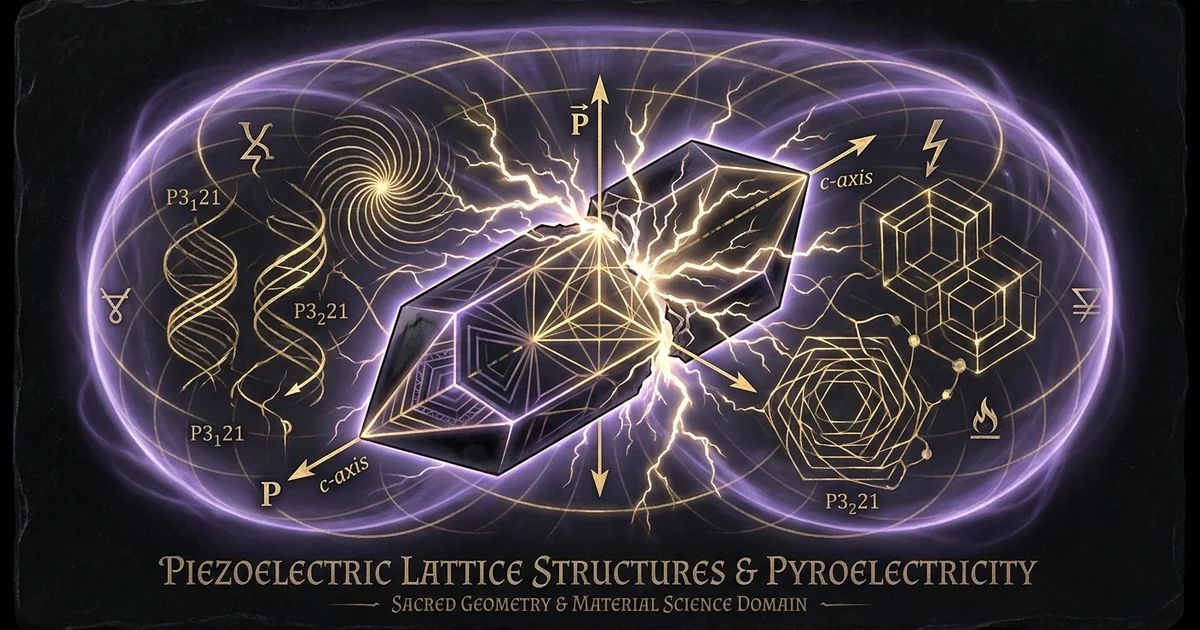
Piezoelectric Lattice Structures and Pyroelectricity
Mineral Classification & Crystallographic Thesis: Symmetry-Breaking and Dipole Emergence
Inversion Symmetry and the 21 Non-Centrosymmetric Point Groups
The foundational premise governing electromechanical coupling in solid-state systems resides in the spatial symmetry of the underlying crystallographic space group. Of the thirty-two discrete crystallographic point groups derived from Neumann’s Principle, precisely twenty-one lack a center of inversion. This non-centrosymmetric morphology represents a departure from isometric spatial equilibrium: within these specific geometries, an applied mechanical stress does not produce equal and opposite internal ionic displacements across an invariant inversion center. With the singular exception of cubic point group 432—which, despite lacking inversion symmetry, possesses octahedral symmetries that mathematically nullify first-rank tensor development through isotropic internal cancellation—the remaining twenty non-centrosymmetric point groups exhibit linear electromechanical transduction, historically classified as piezoelectricity.
In centrosymmetric lattices, any homogeneous elastic strain merely translates the internal center of positive ionic charge in lockstep with the center of negative ionic charge, maintaining an electric dipole moment of absolute zero across macroscopic boundaries. Conversely, in non-centrosymmetric crystals, anisotropic deformation disrupts the internal barycenter of electric charge. The positive cations and negative anions displace along crystallographically determined vector paths governed by the absence of an inversion operator $\bar{1}$. This physical condition guarantees that mechanical stress directly establishes a net dielectric polarization vector. Ten of these twenty non-centrosymmetric piezoelectric classes are inherently polar, possessing a unique, singular polar axis whose crystallographic symmetry operations leave the direction of the vector invariant. These ten point groups ($1, 2, m, mm2, 4, 4mm, 3, 3m, 6,$ and $6mm$) exhibit spontaneous dielectric polarization even in the complete absence of applied mechanical stress, forming the domain of pyroelectricity.
α-Quartz (SiO₂) and Tourmaline (Schorl/Elbaite) Structural Baselines
Low-temperature quartz ($\alpha$-quartz) and the tourmaline supergroup serve as archetypal systems for analyzing non-centrosymmetric lattice dynamics. Alpha-quartz crystallizes within the trigonal enantiomorphic space groups $P3_121$ (right-handed screw axis) or $P3_221$ (left-handed screw axis), belonging to the non-polar enantiomorphous point group 32. In this geometry, corner-sharing silicon dioxide tetrahedra ($\text{SiO}_4$) are linked into continuous, rigid open frameworks. Because the point group 32 features a threefold rotation axis intersected by three polar twofold axes perpendicular to it, the crystal lacks a center of inversion, enabling robust piezoelectric behavior. However, because these twofold axes are mutually oriented at $120^\circ$ angles in the basal plane, the net spontaneous vector sum across the equilibrium unit cell sums exactly to zero, precluding equilibrium spontaneous polarization or true primary pyroelectricity along the optic $c$-axis.
Tourmaline, conversely, crystallizes in the trigonal rhombohedral system under space group $R3m$ (point group $3m$). The mineral architecture consists of six-membered rings of corner-sharing silicon dioxide tetrahedra linked to planar borate groups ($\text{BO}_3$), brucite-like octahedral clusters of transition metal cations, and lithium-aluminum octahedra, all terminated by variable alkali cations in the peripheral cages. Crucially, the $3m$ point group possesses a singular threefold polar axis parallel to the crystallographic $c$-axis, without orthogonal twofold axes or horizontal mirror planes to cancel internal charge separation. The terminal apical vertices of the triangular borate and silicate polyhedra point uniformly toward the analogous pole of the crystal, creating an uncompensated, intrinsic internal dipole moment. This structural baseline endows tourmaline with simultaneous linear electromechanical transduction and spontaneous, thermally driven vector polarization.
Piezoelectric Transduction (Point Group 32)
- Operational Symmetry: Non-centrosymmetric, non-polar ($P3_121 / P3_221$).
- Tensor Rank: Third-rank piezoelectric tensor $d_{ijk}$ linking second-rank mechanical stress ($\sigma_{jk}$) to first-rank dielectric displacement ($D_i$).
- Driving Mechanism: External shear or compressive strain deforming silicon-oxygen bond angles; dipole moments cancel to zero in thermodynamic rest state.
- Polarization Nature: Transient vector displacement induced proportional to mechanical strain; zero net dipole when applied force returns to equilibrium.
Pyroelectric Polarization (Point Group 3m)
- Operational Symmetry: Non-centrosymmetric, permanently polar ($R3m$).
- Tensor Rank: First-rank pyroelectric vector $p_i$ linking scalar temperature differential ($\Delta T$) directly to first-rank dielectric displacement ($D_i$).
- Driving Mechanism: Spontaneous shift in internal ionic barycenters along the polar $c$-axis driven by intrinsic structural asymmetry and uncompensated polyhedral alignment.
- Polarization Nature: Permanent spontaneous polarization ($P_s$); thermal excitation dynamically unmasks bound surface charges by expanding the lattice.
The Unified Physical-Esoteric Resonance Proposition
The formal convergence of solid-state tensor physics and traditional metaphysical lapidary lore crystallizes within the understanding of these asymmetric lattices. Historically, esoteric mineralogy has asserted that specific crystalline materials act as living energetic transducers, functioning as conduits capable of anchoring and rectifying intangible environmental or conscious forces. Within the exactitude of non-centrosymmetric crystallography, this metaphysical stone activation is systematically demystified and confirmed: it is physically grounded in the dynamic equilibrium shifts of structural dipoles undergoing subtle environmental pressures, ambient acoustic resonance, and thermodynamic cycling.
When mechanical vibrations or atmospheric thermal fluctuations strike an oriented, non-centrosymmetric crystalline plate, the physical deformation of the underlying polyhedra generates real, measurable surface charge potentials. Rather than being passive, inert masses of consolidated silicate earth, these minerals function as non-linear transducers that translate isotropic ambient fluctuations into directed, coherent dielectric potentials. The directional polarization paths generated by helically stacked silicon dioxide tetrahedra correspond to classical descriptions of channeled subtle conduits. When sustained within precise geometrical boundary conditions, the physical dielectric polarization of the crystal establishes a deterministic interface where macroscopic biofield oscillations and microscopic crystalline lattices mutually phase-lock into coherent states of energetic exchange.
Lattice Geometry & Solid-State Physics: Tensor Formalism and Dielectric Polarization
Trigonal Unit Cell Topologies: P3₁21 versus P3₂21 Chirality
The crystallographic structure of $\alpha$-quartz represents an enantiomorphic realization of spatial symmetry-breaking. The basic building blocks—silicon dioxide tetrahedra—are interconnected such that each silicon atom coordinates tetrahedrally with four oxygen atoms, while each oxygen atom bridges between two silicons. The arrangement traces a continuous, open threefold helix climbing parallel to the crystallographic $c$-axis $[0001]$. In the right-handed enantiomorph, defined by space group $P3_121$, the helical rotation advances clockwise along the upward screw axis; in the left-handed enantiomorph, space group $P3_221$, it advances counterclockwise. This chiral topology directly underpins macroscopic optical activity, producing optical rotatory dispersion and gyrotropic circular dichroism, where left- and right-circularly polarized electromagnetic waves propagate at differing phase velocities.
P3₁21 (Right-Handed Helix)          P3₂21 (Left-Handed Helix)
      [Si]                                [Si]
        \                                   /
         (O)                             (O)
           \                             /
           [Si]                         [Si]
          /                               \
        (O)                               (O)
        /                                   \
      [Si]                                [Si]
  (Clockwise c-axis progression)    (Counterclockwise c-axis progression)
This structural chirality has direct implications for spatial dielectric response. The lack of horizontal mirror planes or inversion centers guarantees that an electric field applied along an $a$-axis ($[11\bar{2}0]$) induces an asymmetrical deformation of the helical spring formed by the interconnected tetrahedra. As the silicon atoms carry an effective dynamic charge of approximately $+4e$ and the bridging oxygen ions carry approximately $-2e$, the mechanical compression of these chiral helices forces differential displacement vectors between adjacent sublattices. This phenomenon, which can be further investigated via /sacred-geometry/trigonal-lattice-symmetry-and-chiral-fields, establishes that the sign and magnitude of the resultant electromechanical displacement are intrinsically chiral, fundamentally determining the direction of the macroscopic dielectric potential.
Electromechanical Coupling Factors and Piezoelectric Tensor d_ij
The classical mathematical treatment of linear electromechanical interactions, formalized by J. F. Nye (1985) and W. G. Cady (1946), expresses the direct piezoelectric effect through the third-rank tensor $d_{ijk}$, which linearly maps the second-rank mechanical stress tensor $\sigma_{jk}$ to the first-rank dielectric displacement vector $D_i$:
$$D_i = d_{ijk} \sigma_{jk}$$
Employing standard Voigt matrix notation, the third-rank tensor indices condense from $ijk$ ($i = 1, 2, 3$; $j, k = 1, 2, 3$) into matrix indices $il$ ($i = 1, 2, 3$; $l = 1, \dots, 6$), where $1 \to 11$, $2 \to 22$, $3 \to 33$, $4 \to 23$, $5 \to 13$, and $6 \to 12$. For crystal point group 32 (exhibiting the symmetry operations of a single threefold axis parallel to $x_3$ and three twofold axes parallel to $x_1$), crystal symmetry imposes rigorous Neumann constraints on the matrix, reducing the eighteen potential independent coefficients to merely two non-zero independent variables:
$$d = \begin{pmatrix} d_{11} & -d_{11} & 0 & d_{14} & 0 & 0 \ 0 & 0 & 0 & 0 & -d_{14} & -2d_{11} \ 0 & 0 & 0 & 0 & 0 & 0 \end{pmatrix}$$
The $d_{11}$ modulus represents the direct longitudinal piezoelectric coefficient, where mechanical tension applied along the digonal $a$-axis induces an identical sign and magnitude of dielectric polarization along that same axis. Simultaneously, transverse stress along the $y$-axis ($x_2$) produces an equal and opposite charge displacement along $x_1$, as dictated by the $-d_{11}$ parameter.
- Space Group: $P3_121$ (enantiomorph $P3_221$).
- Unit Cell Parameters: $a = 4.913 \text{ \AA}$, $c = 5.405 \text{ \AA}$ ($Z = 3$).
- Mohs Hardness: 7.0; Density: $2.648 \text{ g/cm}^3$.
- Dielectric Permittivity Tensor: $\varepsilon_{11} = 4.52$, $\varepsilon_{33} = 4.64$.
- Piezoelectric Strain Modulus: $d_{11} = 2.31 \times 10^{-12} \text{ C/N}$ ($2.31 \text{ pC/N}$), $d_{14} = -0.727 \times 10^{-12} \text{ C/N}$.
- Source: Nye, J. F. (1985). Physical Properties of Crystals. Oxford University Press.
The electromechanical coupling factor $k$, a dimensionless index characterizing the efficiency of energy conversion between mechanical and electrostatic domains, is defined by:
$$k^2 = \frac{d^2}{\varepsilon^{\sigma} s^E}$$
where $\varepsilon^{\sigma}$ is the dielectric permittivity measured at constant stress and $s^E$ is the elastic compliance tensor evaluated under an invariant electric field. In oriented crystalline quartz cuts, $k$ ranges from 0.09 to 0.14 depending on vibrational shear modes (e.g., AT-cut, BT-cut), demonstrating high mechanical quality factors ($Q > 10^5$) that minimize internal acoustic damping and maximize the temporal coherence of the macroscopic resonant oscillation.
Thermal Gradients, Secondary Pyroelectricity, and Dielectric Susceptibility
Pyroelectric dynamics operate through changes in temperature rather than mechanical stress, as comprehensively compiled by S. B. Lang (1974). In non-centrosymmetric crystals possessing a unique polar axis, such as tourmaline (point group $3m$), the total pyroelectric coefficient $p_i$ maps the rate of change of the spontaneous polarization vector $P_s$ to the scalar temperature differential $\Delta T$:
$$p_i = \frac{\partial P_{s,i}}{\partial T}$$
Solid-state physics distinguishes between primary and secondary pyroelectricity. Primary pyroelectricity represents the intrinsic change in the spontaneous dipole moment that occurs when the unit cell temperature is varied while the crystal is mechanically clamped to prevent all macroscopic thermal expansion or strain ($\varepsilon_{jk} = 0$):
$$p_i^{\text{primary}} = \left( \frac{\partial P_{s,i}}{\partial T} \right)_{\varepsilon}$$
Secondary pyroelectricity occurs in a mechanically free crystal. As temperature fluctuates, anisotropic thermal expansion induces internal mechanical strains ($\alpha_{jk} \Delta T$), which subsequently act upon the piezoelectric tensor $d_{ijk}$ to generate an auxiliary electric displacement:
$$p_i^{\text{secondary}} = d_{ijk} c_{jklm}^E \alpha_{lm}$$
where $c_{jklm}^E$ is the elastic stiffness tensor at constant electric field and $\alpha_{lm}$ is the thermal expansion coefficient tensor. In tourmaline, secondary pyroelectricity constitutes a substantial fraction of the total experimentally measured pyroelectric current along the $c$-axis ($p_3 \approx 4 \times 10^{-6} \text{ C}\cdot\text{m}^{-2}\cdot\text{K}^{-1}$ at $298 \text{ K}$).
The microscopic origins of this thermal sensitivity reside in the anharmonicity of the lattice potential. As the crystal absorbs thermal energy, asymmetric phonon modes expand the polyhedral bonds unequally along the polar axis, modifying the separation between the cationic sublattices and the borosilicate ring scaffolds. This dynamic modulation alters the localized dielectric polarization, directly linking ambient thermodynamic fluctuations to coherent macroscopic electric fields. Detailed mechanics of the borosilicate scaffolding can be referenced in /crystals-materials/tourmaline-complex-borosilicate-dynamics.
Subtle Energetic Dynamics & Resonance Mechanics: Biofield Interfacing and Coherent States
Acoustic Phonon Coupling with Biofield Ultra-Weak Photon Emission (UPE)
The bridge between solid-state tensor physics and esoteric biological interactions is established through the continuous transduction of mechanical, electromagnetic, and acoustic fields. Living biological systems continuously emit ultra-weak photon emissions (UPE)—a coherent, low-intensity biophotonic flux originating from mitochondrial metabolic reactions, lipid peroxidation, and DNA conformational transitions. Concurrently, metabolic and cardiopulmonary activities generate endogenous micro-acoustic vibrations that oscillate throughout the cellular matrix.
When a non-centrosymmetric crystalline resonator, such as $\alpha$-quartz, resides within the near-field zone of a biological organism, these mechanical and electromagnetic emissions do not encounter an inert boundary. Instead, the high-frequency acoustic waves of the biological system couple directly into the crystal’s acoustic phonon modes through classical acoustic impedance matching. The incoming acoustic stress deforms the chiral $\text{SiO}4$ helices, activating the $d{11}$ and $d_{14}$ piezoelectric coefficients to convert cellular acoustic waves into proportional surface charge oscillations. These fluctuating surface charges emit dielectric potentials in the radiofrequency, microwave, and far-infrared spectra. This bidirectional phase-conjugation allows mineral lattices to act as biological matching networks, transmuting stochastic biofield noise into coherent, phase-locked electromagnetic fields.
[ Biological UPE & Acoustic Vibrations ]
                 │
                 ▼
[ Piezoelectric Strain Induction ]
                 │
                 ▼
[ Coherent Phonon-Polariton Generation ]
                 │
                 ▼
[ Stabilized Near-Field Biofield Feedback ]
Endogenous Piezoelectric Matrices: Bone Collagen and Fascial Liquid Crystals
The biophysical viability of this coupling becomes evident when examining endogenous biological ultrastructure. Human physiology is structurally grounded in non-centrosymmetric, piezoelectric materials. Dense connective tissues—most prominently the type-I collagen fibers of the deep fascial layers, tendons, and osteon lamellae in cortical bone—crystallize into polar, non-centrosymmetric space groups conforming structurally to point group 6 ($C_6$) or point group 2 ($C_2$). Cady (1946) and subsequent investigators confirmed that dry and hydrated bone, along with aligned collagen macromolecules, exhibit longitudinal and shear piezoelectric coefficients ($d_{14} \approx 0.1 \text{ to } 0.7 \text{ pC/N}$).
The endogenous collagen fibrils function as a living liquid-crystalline semi-conduction matrix. Mechanical locomotion, postural strain, and pulmonary oscillations induce sustained, low-amplitude piezoelectric potentials across these fascial highways. These potentials govern osteoblast and osteoclast activity via Wolff’s Law of bone remodeling while simultaneously guiding the spatial transit of endogenous subtle current along traditional meridian lines.
When an external mineral resonator exhibiting superior mechanical quality factors ($Q$) and matching trigonal symmetry is introduced into the human biofield, an energetic bridging occurs. The external crystal acts as an organizing template, pulling the noisier, dampened oscillations of the biological tissue into stable harmonic entrainment. The endogenous liquid crystals of the human fascia match the vibrational modes of the inorganic mineral lattice, reducing internal structural dissipative losses and amplifying systemic coherence.
Vector Polarization Grids as Subtle Coherence Amplifiers
Pyroelectric crystals introduce an additional layer of energetic coupling through the sustained vector field of their spontaneous polarization ($P_s$). A pyroelectric lattice such as tourmaline maintains an uncompensated internal electrostatic potential that extends beyond its physical boundaries into the ambient vacuum. On the sub-micron scale, this static dielectric gradient alters the polarizability of local air molecules and impacts the boundary conditions of the local electromagnetic quantum vacuum, a concept formalized in /physics-electromagnetism/dielectric-permittivity-and-vacuum-polarization.
The continuous presence of this spatial vector field polarizes ambient moisture, air ions, and dielectric interfaces, transforming random environmental thermal noise into coherent energetic gradients. In structured energetic grids, the deliberate alignment of polar axes establishes macroscopic subtle-energy-vortices: toroidal dielectric fields that accelerate ion movement and stabilize local entropy. The spontaneous polarization vector acts as a subtle coherence amplifier, filtering phase deviations and establishing an energetic standing wave that can stabilize localized biological fields against external electromagnetic pollution.
Historical Lapidary Lore & Traditional Lineage: Pyroelectric Observations in Antiquity
The Lychnis of Pliny and Theophrastus’s Lingurion: Ancient Ash-Pullers
The empirical identification of electromechanical and pyroelectric phenomena precedes modern solid-state physics by more than two millennia. The earliest recorded historical account of pyroelectricity appears in the classical Greek lapidary treatise Peri Lithon (On Stones), composed circa 315 BCE by Theophrastus, the successor to Aristotle at the Peripatetic Lyceum. Theophrastus documented the properties of a mineral he designated as lingurion ($\lambda\upsilon\gamma\gamma\omicron\acute{\upsilon}\rho\iota\omicron\nu$), traditionally identified by modern mineralogists as an uncolored or brownish-yellow variety of tourmaline or zircon.
“It is also found by digging, like the other kinds; but it is very scarce, and the animal from which it comes is hard to capture… It has the power of attracting, just as amber has; and some say that it attracts not only straw and dry leaves, but also thin pieces of copper and iron, as Diocles also observed. It is exceptionally cold and clear.” — Peri Lithon, translated by E. R. Caley & J. F. C. Richards (1956).
Theophrastus’s observation represents an empirical verification of pyroelectricity: heating the crystal—either through solar exposure or via friction generated by manual handling—induces a spontaneous polarization vector along its polar axis, unmasking electrostatic surface charges that attract light particulates such as straw, ash, and desiccated vegetation. Centuriess later, Pliny the Elder reaffirmed these observations in Naturalis Historia (c. 77 CE), describing a stone termed lychnis (often correlated with red tourmaline or almandine garnet):
“Lychnis, stimulated by the heat of the sun or by friction with the fingers, attracts straw and scraps of paper to itself.”
These historical monikers—culminating in the 18th-century Dutch vernacular aschentrekker (“ash-puller”) applied to Ceylonese tourmaline crystals introduced to Amsterdam—prove that the macroscopic manifestation of non-centrosymmetric charge displacement was systematically exploited long before the mathematical codification of the piezoelectric tensor.
Antiquity (315 BCE)       18th Century (1707)       19th Century (1880)       Modern Solid-State
  Theophrastus:             Dutch Lapidaries:          Curie Brothers:           Tensor Physics:
   "Lingurion"               "Aschentrekker"            Experimental              $D_i = d_{ijk}\sigma_{jk}$
 attracts ash via          extracts ash from         Piezoelectricity in         $P_i = p_i \Delta T$
  solar thermal             pipe embers via           low-quartz and              Coupled subtle-field
     heating                  pyroelectricity           tourmaline                  transduction
Ayurvedic Rasashastra: Gem Calcination (Bhasma) and Latent Charge Induction
In the classical Eastern traditions, particularly the Rasashastra (the iatrochemical and alchemical branch of traditional Ayurvedic medicine), minerals exhibiting asymmetric morphology were processed to liberate their subtle vibrational virtues. The preparation of Ratna Bhasma (calcined mineral ash derived from tourmaline, quartz, and precious stones) required protracted cycles of marana (incineration) and bhavana (trituration with herbal juices).
Central to this metallurgical practice was the controlled thermal cycling of the raw crystal stock. The mineral was subjected to repeated rounds of heating in sealed cow-dung-fired earthen kilns (putas), followed by quenching in cooling plant extracts. Within the context of solid-state physics, this severe, cyclic thermal shocking operates directly upon the secondary and tertiary pyroelectric properties of polar mineral lattices. The rapid expansion and contraction generate violent internal stress waves that traverse the non-centrosymmetric lattice. The resulting internal dielectric breakdown and surface charge generation mechanically and chemically open the crystallite cleavages.
This process was designed to eliminate gross heavy-metal toxicity while structurally realigning the crystal into micro- and nano-crystalline particulates. These particles retained their non-centrosymmetric properties, designed to interact directly with the cellular bioelectric potentials of the human physiology.
Renaissance Hermetic Mineralogy: The Chladni Figures of Paracelsian Thought
During the Western Renaissance, the Hermetic-Paracelsian medical lineage postulated that all crystalline bodies represent materialized dynamic nodes of the Archeus—the internal animating spirit that imprints astral geometries onto inorganic matter. Paracelsus and later Renaissance natural philosophers, such as Giambattista della Porta, advanced the Doctrine of Signatures, arguing that the macroscopic geometry, terminations, and cleavage habits of crystals reveal their hidden functions within the subtle micro-macrocosmic continuum.
Centuries before Ernst Chladni mathematically visualized nodal acoustic resonance patterns, Renaissance lapidaries recognized that certain stones possessed anisotropic directional conduits that could focus subtle astral influences. By orienting a faceted quartz crystal to face planetary aspects or solar culminations, the hermetic magician was actively manipulating the stone’s piezoelectric and pyroelectric interfaces. The crystalline terminations, triangular striations along prism faces, and polar variations in hardness were treated as macroscopic manifestations of internal force networks. This foundational Hermetic philosophy anticipated the core tenet of modern crystallography: macro-physical properties are deterministic projections of unit-cell symmetry-breaking.
Practical Applications, Calibration & Safety Protocols: Handling, Grids, and Operational Constraints
Orientation Mechanics: Aligning the Trigonal c-Axis with Terrestrial Fields
To optimize a non-centrosymmetric crystal for subtle field stabilization or laboratory vibrational transduction, the spatial orientation of its structural axes must be precisely controlled. Isotropic placement of piezoelectric materials ignores the directional constraints formalized within the piezoelectric tensor $d_{ijk}$. For $\alpha$-quartz, the optic $c$-axis $[0001]$ exhibits zero longitudinal piezoelectric response ($d_{33} = 0$), yet longitudinal dielectric displacement reaches its maximum along the three perpendicular twofold $a$-axes ($[11\bar{2}0]$). In contrast, tourmaline exhibits its maximal spontaneous pyroelectric polarization directly along the singular $c$-axis.
When constructing energetic grids or lab-grade subtle transducers, the primary polar axis of tourmaline or the secondary electromechanical channels of quartz should be aligned in parallel with the local vector of the planetary geomagnetic field. At temperate latitudes, this involves calculating both the magnetic declination and inclination (dip angle). Aligning the crystal’s polar axis along the geomagnetic vector minimizes transverse dielectric dissipation and optimizes phase coherence, reducing internal electro-acoustic reflection losses at the mineral boundaries. This precise directional coupling maximizes the conversion of ambient electromagnetic noise into a stabilized dielectric field.
       North Dip Vector (Geomagnetic Field)
                     ^
                    /  [+] Spontaneous Analogous Pole
                   /   /
                  /   /  Tourmaline Crystallographic c-axis
                 /   /   (Aligned along local inclination)
                /   /
               /   /
              /   /
             /   [-] Spontaneous Antilogous Pole
            /
Thermal-Acoustic Tuning: Calibration Protocols Using Sound and Temperature Cycling
To establish an active, coherent dielectric field, the practitioner must transition the crystal from a static rest state to an energized, dynamic state. This is achieved through calibrated acoustic-thermal perturbation, keeping the mineral well within its elastic deformation regime while driving its internal dipole mechanics.
- Geometric Positioning: Mount an optical-quality single crystal of $\alpha$-quartz or tourmaline in a non-conductive, dielectric chuck (such as PTFE or virgin beeswax). Orient the crystallographic $c$-axis parallel to local geomagnetic north, compensating for regional inclination via an adjustable goniometer head.
- Thermal Stabilization: Stabilize the specimen within an operational thermal window between $290 \text{ K}$ and $340 \text{ K}$ ($17^\circ\text{C}$ to $67^\circ\text{C}$). Thermal variations must not exceed a ramp rate of $1.5 \text{ K/min}$ to prevent non-uniform internal thermal shock and localized lattice microfracturing.
- Acoustic Interfacing: Position an acoustic transducer or calibrated physical diapason (e.g., $432 \text{ Hz}$ or $528 \text{ Hz}$) precisely $50 \text{ mm}$ orthogonal to the crystal’s prism face along an $a$-axis ($x_1$). Drive the acoustic source at $85 \text{ dB}$ SPL to introduce mechanical shear stress across the $d_{11}$ matrix planes.
- Dielectric Verification: Monitor the resulting surface potential using a non-contact electrostatic voltmeter. An aligned crystal will register micro-volt charge fluctuations phase-locked to the acoustic driving frequency, indicating successful activation of the electromechanical transduction interface.
Operational handling must respect the thermal limits of the mineral species. While tourmaline remains thermally stable up to approximately $1073 \text{ K}$, low-quartz ($\alpha$-quartz) transitions rapidly into high-quartz ($\beta$-quartz) at $846 \text{ K}$ ($573^\circ\text{C}$). Near this critical point, lattice fluctuations destabilize, and the loss of its asymmetric trigonal structure permanently erases its initial dielectric programming.
Energetic Saturation, Mechanical Cleavage Risks, and Toxin Mitigation
The physical resilience of non-centrosymmetric crystals varies widely across species. Alpha-quartz lacks cleavage planes, fracturing along smooth conchoidal paths, which endows it with high mechanical resilience under hydrostatic pressures. However, tourmaline features distinct rhombohedral and prismatic parting tendencies. Subjecting a tourmaline crystal to severe thermal gradients—such as rapid quenching from boiling water to room temperature—creates sharp internal shear stresses. If these stresses exceed the mechanical yield point, the crystal experiences mechanical fracture, discharging stored electrostatic strain energy in violent micro-triboluminescent bursts that shatter the specimen.
Furthermore, dynamic dielectric systems can experience what lapidaries classify as energetic saturation. From a condensed matter perspective, this corresponds to space-charge accumulation, where free surface ions from the atmosphere neutralize the uncompensated spontaneous polarization of the mineral. When fully neutralized, the crystal loses its capacity to project an active field. To clear this space-charge accumulation without physical damage, the mineral must be grounded on a conductive copper substrate or submerged in an electrolyte bath of high-purity, weakly saline deionized water. This allows bound surface charges to equilibrate, restoring the crystal’s responsiveness to ambient thermal and acoustic gradients.
Safety and Material Stability: Toxicity, Degradation, and Energetic Contraindications
Heavy Metal Inclusions in Non-Centrosymmetric Silicates and Borosilicates
While pure $\alpha$-quartz ($\text{SiO}_2$) presents minimal chemical toxicity under ambient macroscopic conditions, other non-centrosymmetric, pyroelectric minerals contain hazardous chemical elements within their complex crystal structures. The tourmaline supergroup is notorious for its chemical substitution complexity, described by the general structural formula:
$$X Y_3 Z_6 (\text{T}6 \text{O}{18}) (\text{BO}_3)_3 \text{V}_3 \text{W}$$
In schorl, the $Y$-site is saturated with ferrous and ferric iron ($\text{Fe}^{2+}, \text{Fe}^{3+}$); in dravite, magnesium dominates; but in more exotic species, toxic heavy metals fill these positions. Elbaite and liddicoatite frequently contain significant concentrations of manganese ($\text{Mn}^{2+}$), chromium ($\text{Cr}^{3+}$), and vanadium ($\text{V}^{3+}$). Synthetic ferroelectric perovskites that parallel natural non-centrosymmetric behaviors—such as lead zirconate titanate ($\text{PZT}$) or barium titanate ($\text{BaTiO}_3$)—contain toxic lead and barium cations that are easily released if handled improperly.
       Tourmaline Lattice Topology: Heavy Metal Sequestration Sites
                          ┌────────────────────────┐
                          │   X-Site: Na, Ca, Vac   │
                          └───────────┬────────────┘
                                      │
              ┌───────────────────────┴───────────────────────┐
              ▼                                               ▼
  ┌───────────────────────┐                       ┌───────────────────────┐
  │ Y-Site: Fe, Mn, Cr, V │ ◄── Cationic Leaching ──│ Z-Site: Al, Fe³⁺, Mg │
  └───────────────────────┘          Hazard       └───────────────────────┘
              │                                               │
              └───────────────────────┬───────────────────────┘
                                      │
                          ┌───────────▼────────────┐
                          │ T-Site: Si₆O₁₈ Rings   │
                          └────────────────────────┘
The bio-accumulation risks associated with these metals become pronounced when crystals are pulverized or exposed to acidic solutions. Aqueous environments, particularly those containing organic acids, promote incongruent dissolution along microscopic crystal fractures. Toxic cations leach into the liquid, posing systemic health hazards if ingested.
Triboelectric Shock Hazards and Dielectric Breakdown during Rapid Cleavage
The electromechanical and pyroelectric dynamics of non-centrosymmetric lattices can also present acute electrostatic hazards. During rapid mechanical cleavage or violent diamond-wheel cutting performed without continuous wet cooling, the stress-gradient-induced polarization—governed by the flexoelectric effect and linear piezoelectric response—can generate local field strengths exceeding the dielectric breakdown strength of air ($3 \text{ MV/m}$).
These high-voltage discharges can create substantial electrostatic shocks. More critically, high electrical gradients across micro-fissures generate rapid localized heating, causing explosive micro-spallation. This ejects respirable silica and borosilicate particulates with aerodynamic diameters below $2.5 \text{ \mu m}$ ($\text{PM}_{2.5}$). Inhalation of these crystalline silica particulates causes permanent pulmonary damage, leading to silicosis and chronic respiratory inflammation. All physical cutting, grinding, or polishing of piezoelectric silicates must therefore be performed under continuous aqueous lubrication with specialized personal protective equipment.
- Direct Aquatic Leaching Hazard: Never introduce unsealed, heavy-metal-bearing polar minerals (including schorl, dravite, manganese-rich elbaite, or synthetic ferroelectrics) into direct contact with water intended for internal consumption. Acidic or neutral aqueous extraction leaches toxic transition-metal ions ($\text{Mn}^{2+}, \text{Cr}^{3+}, \text{Fe}^{2+}$) through micro-fracture channels. Employ strictly indirect methods, sealing the crystal inside an inert borosilicate glass vessel before fluid immersion.
- Pulverization Toxicity: Dry pulverization or grinding of non-centrosymmetric crystals releases fine, respirable crystalline particles that can cause silicosis. The accompanying triboelectric and piezoelectric surface charges cause these micro-particulates to adhere tenaciously to mucous membranes, exacerbating tissue inflammation.
- Electrostatic Field Breakdown: Subjecting polar crystals to high-temperature gradients (exceeding $5 \text{ K/s}$) can produce electric fields that exceed the dielectric breakdown threshold of air, presenting a static discharge hazard to sensitive bioelectronic hardware and cellular systems.
Contraindications for Unshielded Elixir Infusions and High-Amplitude Rife Fields
The use of high-amplitude electromagnetic field generators—such as plasma-tube Rife systems, pulsed electromagnetic field (PEMF) devices, or high-voltage Tesla coils—in close proximity to non-centrosymmetric crystals presents distinct physical and energetic contraindications. When high-intensity pulsed fields resonate with the electromechanical frequencies of an unconstrained crystal, the mineral absorbs significant energy via the inverse piezoelectric effect:
$$\varepsilon_{jk} = d_{ijk} E_i$$
This applied field induces rapid physical contractions and expansions of the lattice. If the applied radio-frequency field matches an internal acoustic resonance mode of the crystal, high mechanical stresses develop along internal twin boundaries and inclusion interfaces.
This acoustic ringing can crack or shatter fragile crystals. Energetically, this uncalibrated transduction emits uncontrolled, high-frequency dielectric spikes that disrupt the sensitive, liquid-crystalline collagen matrix of the human nervous system. Biofield collapse, characterized by acute autonomic dysregulation, vertigo, and cephalalgia, can occur when an unshielded, high-coupling crystal is driven into non-linear over-resonance within the biofield.
Frequently Asked Questions: Crystallographic and Energetic Dynamics
Differentiating Authentic Piezoelectric Resonators from Amorphous Glass
A common problem in lapidary practice and vibrational physics involves differentiating authentic crystalline quartz resonators from amorphous imitation glass. At the atomic scale, fused silica and manufactured glass consist of silicon dioxide tetrahedra, but they completely lack long-range periodic order. Because glass cools isotropically into a disordered, vitreous solid state, it belongs to no crystallographic point group and possesses macroscopic inversion symmetry throughout its bulk volume.
$$\text{Glass (Amorphous): } \langle d_{ijk} \rangle = 0 \quad \longleftrightarrow \quad \alpha\text{-Quartz (Point Group 32): } d_{11} = 2.31 \text{ pC/N}$$
Because amorphous glass is centrosymmetric on the macro-scale, it cannot generate piezoelectric or pyroelectric potentials. Applied mechanical strain produces no differential internal charge separation, rendering glass inert for intentional electromechanical transduction.
Laboratory differentiation is performed using cross-polarized optical microscopy: authentic $\alpha$-quartz exhibits distinct optical birefringence and first-order interference colors when rotated between crossed polarizers, whereas glass exhibits complete optical extinction (isotropism), disrupted only by irregular stress patterns. Furthermore, thermal conductivity tests reveal that genuine quartz dissipates heat rapidly compared to the thermal insulation properties of amorphous glass.
       Cross-Polarized Optical Microscopy Profile
------------------------------------------------------------
Amorphous Glass:         Alpha-Quartz Resonator:
[ Polarizer: 0° ]        [ Polarizer: 0° ]
       │                        │
       ▼                        ▼
[ Isotropic Media ]      [ Anisotropic Trigonal Lattice ]
       │                        │
       ▼                        ▼
[ Complete Extinction ]  [ Birefringent Interference Colors ]
  (Zero Transduction)      (Chiral Enantiomorphism / Active)
The Threshold of Inversion: Understanding the α-to-β Quartz Transition
The temperature boundary known as the $\alpha$-to-$\beta$ quartz transition takes place at $846 \text{ K}$ ($573^\circ\text{C}$) under standard atmospheric pressure ($101.3 \text{ kPa}$). This transformation represents a reversible, displacive phase transition between low-temperature $\alpha$-quartz and high-temperature $\beta$-quartz. Crucially, the transition involves no breaking of covalent $\text{Si}-\text{O}$ bonds; rather, the interconnected silicon dioxide tetrahedra tilt and rotate relative to one another, straightening their bond angles from approximately $144^\circ$ toward an idealized $153^\circ$.
Low-Temperature α-Quartz (T < 846 K)
- Crystallographic System: Trigonal.
- Space Group: $P3_121$ or $P3_221$ (Point Group 32).
- Inversion Center: Absent ($\bar{1}$ absent).
- Piezoelectric Tensor: Two independent non-zero coefficients ($d_{11}, d_{14}$).
- Metaphysical State: Grounded electromechanical transduction; phase-locks with endogenous biofields.
High-Temperature β-Quartz (T > 846 K)
- Crystallographic System: Hexagonal.
- Space Group: $P6_222$ or $P6_422$ (Point Group 622).
- Inversion Center: Absent, but exhibits higher hexagonal symmetry constraints.
- Piezoelectric Tensor: Strictly nullifies $d_{11}$ ($d_{11} = 0$); only shear $d_{14}$ remains.
- Metaphysical State: Primary longitudinal transduction erased; subtle energetic programming collapses.
This displacive transition alters the piezoelectric matrix. In point group 622, the longitudinal coefficient $d_{11}$ drops to zero. If an $\alpha$-quartz crystal is heated past this threshold, it expands along its $a$-axes and contracts along its $c$-axis, commonly triggering mechanical failure. Even when cooled slowly back below $573^\circ\text{C}$, the crystal frequently undergoes secondary Dauphiné twinning, nucleating domains of opposite polar orientation that mutually cancel macroscopic piezoelectric potentials and permanently erase any prior subtle coherence programming. Detailed acoustic models can be referenced in /crystals-materials/silicon-dioxide-alpha-quartz-acoustics.
Polarity Reversal and Cleansing Mechanics under Extreme Thermal Loads
In true ferroelectric and pyroelectric systems, thermal excursions near or past critical phase boundaries modify the underlying domain structure. True ferroelectric materials possess a spontaneous polarization vector that can be reversed by an external electric field or disrupted by heating past the Curie temperature ($T_C$). At the Curie point, thermal kinetic energy overcomes the double-well potential of the asymmetric unit cell, restoring a centrosymmetric or non-polar phase and reducing spontaneous polarization to zero.
$$\text{For } T \ge T_C: \quad P_s \to 0, \quad p_i \to 0$$
Tourmaline behaves as a non-ferroelectric pyroelectric material: its spontaneous polarization cannot be easily flipped by an opposing laboratory electric field prior to dielectric breakdown, and it maintains its $R3m$ space group up to its structural thermal decomposition point above $1073 \text{ K}$. However, heating tourmaline to moderate operational temperatures ($373 \text{ K} \text{ to } 473 \text{ K}$) accelerates the migration of localized mobile charge carriers, rapidly neutralizing bound space-charge layers.
This solid-state mechanism clarifies the traditional lapidary concept of “energetic clearing” via heat or sunlight. Ambient thermal cycling accelerates the discharge of accumulated, trapped surface charges that screen the crystal’s intrinsic dipole fields. By thermally mobilizing these surface electrons, the underlying non-centrosymmetric lattice purges its accumulated entropy, returning the mineral to its baseline state of clean, unshielded electromechanical receptivity.