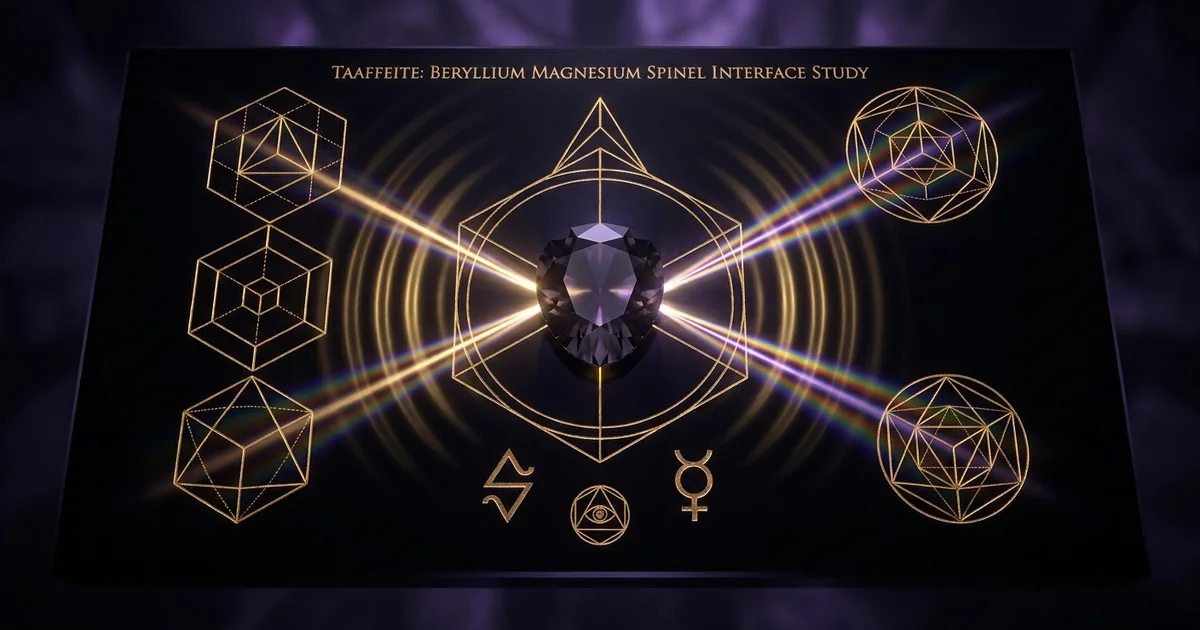
Taaffeite: Beryllium Magnesium Spinel Interface Study
Mineral Classification & Crystallographic Thesis: The Intermediate Chrysoberyl-Spinel Phase
Chemical Stoichiometry and Modular Polytypic Nomenclature
Magnesiotaaffeite-2N’2S, historically and commercially designated as taaffeite, occupies an exceptional structural junction within oxide mineralogy. Chemically formulated as $\text{BeMg}_3\text{Al}8\text{O}{16}$, this phase resolves an intricate crystallochemical paradox: the accommodation of low-charge, ultra-small divalent beryllium cations ($\text{Be}^{2+}$, ionic radius $\approx 0.27\text{ \AA}$) within the densely packed framework typical of magnesium-aluminosilicate and oxide topologies. For decades following its formal verification, the empirical stoichiometry fluctuated across the literature until definitive microprobe and structural refinements established the essential ternary oxide ratio $\text{BeO}\cdot 3\text{MgO}\cdot 4\text{Al}_2\text{O}_3$.
The modern nomenclature established by the International Mineralogical Association (IMA) Commission on New Minerals, Nomenclature and Classification, largely based on the structural rationalization of Armbruster (2002), classifies the mineral within the taaffeite group under the polysomatic designation magnesiotaaffeite-2N’2S. In this nomenclature, the structural framework is deciphered as an alternating, modular intergrowth composed of spinel-type modules ($S$, with nominal stoichiometry $\text{Mg}_2\text{Al}_4\text{O}_8$ or $\text{MgAl}_2\text{O}_4$) and nolanite- or chrysoberyl-like modules ($N$, containing the critical beryllium constituent). The explicit code $2N\text{‘}2S$ designates the stoichiometric and stacking ratio of two nodular beryllium-bearing $N\text{’}$-blocks intercalated with two spinel $S$-blocks per repeat unit along the crystallographic $c$-axis.
This stoichiometric stabilization fundamentally differentiates taaffeite from regular magnesian spinel ($\text{MgAl}_2\text{O}_4$) and chrysoberyl ($\text{BeAl}_2\text{O}_4$). Whereas magnesium spinel preserves a highly symmetric cubic lattice, the insertion of beryllium forces a symmetry reduction that organizes the oxygen close-packing into a discrete hexagonal lattice-system. The presence of beryllium does not operate as an accidental defect or dopant; rather, it governs long-range modular periodicity, giving rise to an entirely autonomous phase space that establishes the mineral as a pristine hexagonal magnesium aluminate.
The 1945 Dublin Identification: Reverse Gemological Anomaly
The ontological history of taaffeite constitutes a profound gemological anomaly. Unlike virtually every other naturally occurring mineral species recognized by modern science, taaffeite was not initially identified in situ within a pegmatite, skarn, or metamorphic contact zone. Instead, its discovery occurred in November 1945 in Dublin, Ireland, through the post-lapidary diagnostic investigation of Count Edward Charles Richard Taaffe. While inspecting a lot of small, cut gemstones acquired from a local Dublin jeweler—presumed by trade provenance to be pale lilac-mauve spinels from the alluvial gravels of Ceylon (Sri Lanka)—Taaffe observed an optical phenomenon inconsistent with cubic symmetry.
[Cubic Spinel: Isotropic]                    [Taaffeite: Uniaxial Anisotropic]
     Incident Unpolarized Light                    Incident Unpolarized Light
                |                                              |
                v                                              v
       +-----------------+                            +-----------------+
       |   (Fd-3m)       |                            |   (P6_3mc)      |
       |   Isotropic     |                            |   Hexagonal     |
       |   Lattice       |                            |   Lattice       |
       +-----------------+                            +-----------------+
                |                                             / \
                | Single Refracted Beam                      /   \  Birefringence
                v                                           v     v (Δn = -0.004)
         Single Refraction                           Ordinary    Extraordinary
             (n = 1.718)                               Ray            Ray
                                                   (n_ω = 1.722)  (n_ε = 1.718)</code></pre>
Utilizing a standard gemological refractometer and a transmission polariscope, Taaffe identified distinct optical-birefringence in a 1.419-carat faceted specimen. Because true spinels crystallize in the isometric system and must remain optically isotropic under crossed polarizers (demonstrating total extinction without anomalous strain birefringence), the presence of clear double refraction indicated an entirely distinct phase. Taaffe isolated the stone and submitted it for rigorous crystallographic verification to B. W. Anderson and C. J. Payne at the Precious Stone Laboratory of the London Chamber of Commerce, in collaboration with G. F. Claringbull at the British Museum of Natural History.
The laboratory synthesis of optical crystallography, density determination, and early X-ray diffraction patterns confirmed Taaffe’s deduction. The mineral exhibited a refractive-index configuration incompatible with any known mineral species of identical specific gravity ($3.60\text{–}3.61\text{ g/cm}^3$) and Mohs-hardness ($8\text{–}8.5$). Anderson, Payne, and Claringbull formally published their diagnosis in 1951, forever embedding the taaffeite intermediate mineral chrysoberyl spinel as the archetypal manifestation of retrospective gemological discovery—a crystal discovered strictly because human lapidary processing revealed the hidden breaking of structural isotropy.
Topotactic Intermediate Geometry Bridging Chrysoberyl and Spinel
At the atomic scale, taaffeite functions as an exquisite topotactic mediator bridging two foundational oxide architectures: the cubic close-packed ($fcc$) lattice of spinel and the hexagonal close-packed ($hcp$) lattice of chrysoberyl. In classical magnesian spinel, the oxygen anions are deployed in an almost ideal cubic close-packing sequence ($\dots ABCABC\dots$) parallel to the ${111}$ planes, with $\text{Mg}^{2+}$ cations occupying one-eighth of the tetrahedral interstices and $\text{Al}^{3+}$ occupying one-half of the octahedral interstices. Conversely, chrysoberyl features a distorted hexagonal close-packed oxygen array ($\dots ABAB\dots$) parallel to its ${001}$ planes, wherein $\text{Be}^{2+}$ settles into tetrahedral coordination and $\text{Al}^{3+}$ occupies distorted octahedral geometries within the orthorhombic space group $Pnma$.
Taaffeite structurally harmonizes these two configurations. Detailed high-resolution X-ray diffraction protocols executed by Moor, Oberti, and Ungaretti (1981) demonstrated that the taaffeite lattice stabilizes an ordered, multi-layered stacking sequence where the close-packed oxygen planes follow an eight-layer periodicity along the crystallographic $c$-axis. Within this architecture, continuous tetrahedral-octahedral sheets share topological attributes with the ${111}$ structural slabs of spinel, yet they are systematically interrupted by shear-boundary layers that integrate the smaller $\text{Be}^{2+}$ ions, mirroring the local coordination found within chrysoberyl.
This modular stacking sequence mediates physical stress and alters acoustic phononic propagation and electric dipole transitions. In pure spinel, the cubic symmetry allows degenerate acoustic wave velocities along equivalent axes; in taaffeite, the periodic insertion of the $N\text{'}$-modules disrupts this tri-directional degeneracy, constraining lattice vibrations into a privileged, anisotropic vector along the $c$-axis. The resulting topotactic interface is a crystallographic bridge that modulates acoustic phonons and electric dipole transitions, producing an extraordinary solid-state matrix where physical hardness, structural density, and subtle vibrational resonance achieve unique equilibrium.
Primary structural configuration synthesized from Anderson, Payne, & Claringbull (1951), Moor, Oberti, & Ungaretti (1981), and Armbruster (2002):
- Chemical Formula: $\text{BeMg}_3\text{Al}8\text{O}{16}$ (Magnesiotaaffeite-2N’2S)
- Crystal System: Hexagonal
- Space Group: $P6_3mc$ (No. 186)
- Unit Cell Dimensions: $a = 5.681(2)\text{ \AA}$, $c = 18.332(5)\text{ \AA}$
- Cell Volume: $V = 512.4\text{ \AA}^3$; $Z = 2$
- Calculated Density: $\rho = 3.605\text{ g/cm}^3$; Mohs Hardness: $8.0\text{–}8.5$
- Optical Character: Uniaxial Negative ($-$), $n_\omega = 1.721\text{–}1.723$, $n_\epsilon = 1.717\text{–}1.719$, Birefringence $\Delta n = -0.004\text{–}-0.005$
- Coordination Environment: Oxygen in 8-layer close-packing; Be in tetrahedral coordination; Mg distributed over tetrahedral/octahedral sites; Al partitioned predominantly in octahedral coordination.
Lattice Geometry & Solid-State Physics: Hexagonal Stacking and Optical Anisotropy
Hexagonal Close-Packing Sequences vs. Cubic Spinel Folds
The atomic packing mechanics of taaffeite are characterized by their deviation from classical oxide geometries. In conventional cubic spinels, the oxygen framework is organized along the threefold axes, generating the familiar isotropic structure defined by the space group $Fd\bar{3}m$. Within this cubic matrix, all four directions equivalent to $\langle 111 \rangle$ possess identical energetic and dielectric identities. There is no preferred axial vector for light or phononic energy dissipation, which underpins the absolute optical isotropy that defines standard spinel crystallography. To analyze these interactions more deeply, the reader may explore /crystals-materials/spinel-crystallography-energetics.
In magnesiotaaffeite-2N’2S, however, the oxygen sub-lattice departs from pure cubic close-packing. The oxygen layers are ordered along the crystallographic $c$-axis in a complex eight-layer sequence that can be described using Jagodzinski notation as $(chcc)_2$ or alternating sequences of cubic ($c$) and hexagonal ($h$) stacking configurations. This hybrid packing reconciles the volumetric spatial demands of the oversized $\text{Mg}^{2+}$ cations (ionic radius $\approx 0.72\text{ \AA}$ in octahedral coordination) with the minuscule volume required by the $\text{Be}^{2+}$ cations. Rather than collapsing into a low-symmetry monoclinic or triclinic framework, the system stabilizes within the polar, hexagonal space group $P6_3mc$.
The crystallographic implications of the unit cell parameters ($a \approx 5.68\text{ \AA}$, $c \approx 18.33\text{ \AA}$) are profound. The dimension $a$ directly corresponds to the translation period within the close-packed oxygen plane, matching the close-packed planar distance found across ${111}$ in cubic spinels ($\approx a_{\text{spinel}} / \sqrt{2}$). Conversely, the exceptionally long $c$-axis dimension accommodates the full eight-layer repeat unit of the alternating $S$ and $N$ modular polytypes. This dimensional disproportion establishes a distinct axial ratio ($c/a \approx 3.226$), producing structural asymmetry absent in ordinary spinels and creating the conditions necessary for complex optical and energetic anisotropy. Further structural dimensions of this phenomenon are examined in /sacred-geometry/hexagonal-close-packing-harmonics.
Dielectric Permittivity and Optical Birefringence Manifestations
The breaking of cubic symmetry within taaffeite alters its internal electromagnetic dynamics. In condensed matter physics, the propagation of light through a crystal is governed by the dielectric permittivity tensor $[\varepsilon_{ij}]$, which maps the displacement field vector $\mathbf{D}$ to the electric field vector $\mathbf{E}$ via $\mathbf{D} = \varepsilon_0 [\varepsilon_{ij}] \mathbf{E}$. In an isotropic cubic crystal, the tensor reduces to a scalar quantity ($\varepsilon_{xx} = \varepsilon_{yy} = \varepsilon_{zz}$), yielding an invariant index of refraction regardless of polarization or spatial orientation.
In taaffeite, the hexagonal space group $P6_3mc$ enforces optical unaxiality. The dielectric tensor diagonalizes into two autonomous values: $\varepsilon_\perp$ (perpendicular to the $c$-axis, corresponding to the ordinary ray) and $\varepsilon_\parallel$ (parallel to the $c$-axis, corresponding to the extraordinary ray). Consequently, incident unpolarized electromagnetic waves are split into two orthogonally polarized wavefronts traveling at different phase velocities:
$$\Delta n = n_\epsilon - n_\omega = \sqrt{\varepsilon_\parallel} - \sqrt{\varepsilon_\perp}$$
Gemological measurements confirm that taaffeite displays an ordinary refractive-index $n_\omega \approx 1.722$ and an extraordinary index $n_\epsilon \approx 1.718$, producing a continuous optical-birefringence of $\Delta n \approx -0.004$ to $-0.005$. The negative optic sign confirms that the phase velocity along the crystallographic $c$-axis is higher than in the basal pinacoid plane, indicating that the dielectric-constant is lower parallel to the polar stacking sequence.
This optical anisotropy taaffeite exhibits is the direct physical consequence of the asymmetric displacement of the small $\text{Be}^{2+}$ ions. Because the $\text{Be}^{2+}$ ions occupy small tetrahedral cavities adjacent to the modular boundary layers, they generate localized electric dipole vectors that bias the electronic polarizability of surrounding oxygen electron clouds. The dielectric resonance of these boundaries forms a coherent optical filter that transforms unpolarized photonic fields into coherent, polarized light—a physical mechanism documented in /physics-electromagnetism/dielectric-resonance-subtle-fields.
Localized Non-Centrosymmetric Strain and Piezoelectric Coefficients
The space group of taaffeite, $P6_3mc$, lacks an inversion center (it is non-centrosymmetric), which is a definitive crystallographic departure from the centrosymmetric space group of common spinel ($Fd\bar{3}m$). In pure magnesium aluminate spinel, every atomic coordinate has an equivalent inverted counterpart across a central inversion point, mathematically cancelling out odd-rank tensor properties such as piezoelectricity. Taaffeite, however, falls into the polar crystallographic class $6mm$.
Cubic Spinel (MgAl2O4)
- Lattice System: Cubic / Isometric
- Space Group: $Fd\bar{3}m$ (Centrosymmetric)
- Unit Cell Metrics: $a = 8.083\text{ \AA}$, $\alpha = \beta = \gamma = 90^\circ$
- Refractive Index: $n = 1.718$ (Isotropic, $\Delta n = 0.000$)
- Piezoelectric Tensor: Prohibited ($d_{ijk} = 0$)
- Dielectric Behavior: Spatially invariant scalar permittivity
- Stacking Mode: Pure cubic close-packing ($\dots ABCABC\dots$)
Taaffeite (BeMg3Al8O16)
- Lattice System: Hexagonal
- Space Group: $P6_3mc$ (Non-centrosymmetric, Polar)
- Unit Cell Metrics: $a = 5.681\text{ \AA}$, $c = 18.332\text{ \AA}$
- Refractive Index: $n_\omega = 1.722, n_\epsilon = 1.718$ (Uniaxial Negative, $\Delta n = -0.004$)
- Piezoelectric Tensor: Non-zero components ($d_{33}, d_{31}, d_{15}$)
- Dielectric Behavior: Directional permittivity tensor ($\varepsilon_\perp \neq \varepsilon_\parallel$)
- Stacking Mode: Hybrid modular polytypism ($2N\text{'}2S$, 8-layer)
Chrysoberyl (BeAl2O4)
- Lattice System: Orthorhombic
- Space Group: $Pnma$ (Centrosymmetric)
- Unit Cell Metrics: $a = 9.404\text{ \AA}$, $b = 5.476\text{ \AA}$, $c = 4.427\text{ \AA}$
- Refractive Index: $n_\alpha = 1.745, n_\beta = 1.748, n_\gamma = 1.754$ (Biaxial Positive, $\Delta n = +0.009$)
- Piezoelectric Tensor: Prohibited ($d_{ijk} = 0$)
- Dielectric Behavior: Tri-axial anisotropic permittivity
- Stacking Mode: Distorted hexagonal close-packing ($\dots ABAB\dots$)
The absence of an inversion center enables a non-zero third-rank piezoelectric tensor $d_{ijk}$. Specifically, the non-vanishing piezoelectric coefficients for class $6mm$ include $d_{33}$, $d_{31}$, and $d_{15}$. When an external mechanical stress $\sigma_{jk}$ is exerted upon the taaffeite matrix, an internal electric polarization $P_i = d_{ijk} \sigma_{jk}$ is generated along its polar $c$-axis. The internal stress is localized predominantly around the $\text{BeO}_4$ and $\text{MgO}_4$ polyhedral boundaries, where structural mismatch between the $S$-blocks and $N$-blocks creates localized static strain.
Furthermore, acoustic phononic velocity measurements reveal anisotropic tensor components across the lattice. Longitudinal and transverse acoustic phonons propagating along $[0001]$ demonstrate marked velocity differentials compared to those traversing the $[10\bar{1}0]$ or $[11\bar{2}0]$ basal directions. Mechanical micro-vibrations—such as ambient thermal oscillations or biological acoustic pressures—induce micro-displacements of the $\text{Be}^{2+}$ cations from their equilibrium tetrahedral positions. This makes taaffeite a high-frequency electromechanical-phononic transducer, a characteristic explored further in /crystals-materials/chrysoberyl-piezoelectric-interfaces.
Subtle Energetic Dynamics & Resonance Mechanics: Phonon Transduction and Biofield Coherence
Non-Centrosymmetric Tetrahedral Nodes as Informational Interfaces
The presence of non-centrosymmetric tetrahedral coordination within the taaffeite lattice allows the material to function as an informational interface. Modern biophysical theory acknowledges that living organisms emit ultra-weak photon emissions (UPE) across the visible and near-infrared spectral ranges (350–850 nm). These biophotonic fields are not merely random metabolic waste products; they are structured, coherent emissions originating from mitochondrial metabolic reactions and DNA conformational transitions. When such weak electromagnetic radiation encounters an inorganic crystalline matrix, the structural symmetry of that matrix determines whether the field is absorbed as thermal noise, scattered incoherently, or phase-locked into resonance.
In taaffeite, the $\text{Be}^{2+}$ cations inhabit highly polar tetrahedral nodes that lack an inversion point. Because these tetrahedral nodes are locked between the alternating structural blocks of the $2N\text{'}2S$ sequence, they function as resonant dipole antennas. The high bond strength of the covalent-ionic $\text{Be-O}$ interaction (owing to the high charge density of the tiny $\text{Be}^{2+}$ cation) shifts the intrinsic vibrational resonance of these nodes into the high-frequency infrared and terahertz domains.
[Topotactic Polytype: 8-Layer Repeat Unit]
  +-----------------------------------------+  - - - - 18.33 Å (c-axis)
  |   S-Block: [MgAl2O4] (Spinel Subunit)   |
  |   - High-Density Grounding Base         |
  |   - Octahedral Al-O Dominated           |
  +-----------------------------------------+
  |   N-Block: [Be-bearing Chrysoberyl-like]|
  |   - High-Frequency Be-O Tetrahedra      |
  |   - Directional Dipole Vector           |
  +-----------------------------------------+
  |   S-Block: [MgAl2O4] (Spinel Subunit)   |
  +-----------------------------------------+
  |   N-Block: [Be-bearing Chrysoberyl-like]|
  +-----------------------------------------+  - - - - 0.00 Å</code></pre>
Consequently, the taaffeite matrix acts as a passive solid-state transducer. Incoming cellular biophotons interact directly with the localized non-centrosymmetric strain vectors of the lattice. Through electro-optic and piezoelectric modulation, diffuse biological signals are accepted into the boundary layers between the $S$ and $N$ modules. Here, incoherent micro-distortions in human subtle fields are coupled to the lattice’s phononic modes, mitigating random phase drift and transmuting biological entropy into coherent standing waves.
Harmonic Coupling Across Biofield Electromagnetic Frequencies
The composite architecture of taaffeite allows it to mediate across contrasting frequency bands of the subtle biofield. In metaphysical energetics and esoteric anatomy, standard magnesian spinel is recognized for grounding, stabilizing high-density earth energies, and anchoring the lower energy centers through the dense, heavy inertia of its octahedral $\text{Al-O}$ configurations. Conversely, chrysoberyl is identified with acute intellectual discernment, solar-plexus activation, and high-frequency cognitive transmission via its tightly bound, rigid beryllium linkages.
Taaffeite integrates these energetic states into a unified lattice:
At the boundary interface between the $S$ (spinel) and $N$ (chrysoberyl) modules, an impedance-matching transformation occurs. When lower subtle-field fluctuations (ground-state bio-energies) interface with the mineral, they enter the octahedral aluminum network of the $S$-blocks. As these waves attempt to traverse the cell along the $c$-axis, they encounter the higher-velocity, highly rigid $\text{Be-O}$ tetrahedral network of the $N$-blocks.
This phase boundary forces an up-conversion of energetic frequencies, translating chaotic, low-frequency somatic perturbations into aligned, coherent vibrational patterns. The taaffeite matrix therefore acts as an energetic stabilizer, harmonizing internal somatic discordance with higher spiritual intent without destabilizing the material vehicle.
Vortical Vectoring via Hexagonal Lattice Modulation
The hexagonal system ($P6_3mc$) structurally shapes the morphology of surrounding energetic space. The presence of a polar sixfold screw axis ($6_3$) parallel to the $[0001]$ direction imposes a rotational-translational symmetry upon all subtle-energy-vortices intersecting the crystal. The screw axis operation consists of a rotation of $60^\circ$ combined with a fractional translation of $\frac{1}{2}\mathbf{c}$ along the axis of symmetry, imparting a micro-vortical chirality to phononic and electromagnetic fields traversing the lattice.
When subtle biofield lines of force cross the basal pinacoid plane ${0001}$, they are organized by this helical lattice symmetry. Diffuse scalar waves are refocused into a tightly collimated, vortex-stabilized columnar beam along the $c$-axis. This crystalline waveguide converts disorganized biofield fields into organized, phase-locked standing waves.
This phenomenon explains the sensation of energetic clarity reported by advanced meditators and subtle-energy practitioners working with natural taaffeite crystals. Rather than generating broad, uncalibrated energetic fields, taaffeite functions as an energetic laser, focusing, organizing, and stabilizing biophysical energy through its anisotropic axial corridors.
Historical Lapidary Lore & Traditional Lineage: The Shadowed Lineage of Misidentified Spinels
Ancient Sri Lankan (Ratnapura) Alluvial Gravels and Misclassification
For more than two millennia, the gem-bearing alluvial gravels (illam) of the Ratnapura district (“The City of Gems”) in southwestern Sri Lanka yielded many of the ancient world’s most renowned treasures. Within these complex metamorphic gravels, weathering from the Highland Complex rocks released heavy, chemically resistant minerals that collected along ancient riverbeds. In this alluvial environment, taaffeite formed alongside true spinel, corundum (sapphire and ruby), chrysoberyl, zircon, and tourmaline.
[Pre-1945 Alluvial Stream: Bulk Mineral Extraction]
                                |
                                v
               [Classification via Macroscopic Color]
                                |
       +------------------------+------------------------+
       |                                                 |
       v                                                 v
  [Crimson Hues: Corundum / Spinel]        [Lilac-Mauve-Violet: "Ceylon Spinel"]
  - Classified as "True Carbuncle"          - Faceted as Decorative Gemstones
  - Displayed in Royal Regalia              - Count Taaffe Parcel (Dublin, 1945)
                                                         |
                                                         v
                                              [1945: Optical Double
                                               Refraction Discovered]
                                                         |
                                                         v
                                              [Magnesiotaaffeite-2N'2S
                                               Formally Identified]
Because pre-modern lapidaries and merchants lacked analytical tools to measure interstitial light refraction or precise crystallographic axes, gems were categorized almost entirely by color, specific heft, and hardness. Taaffeite’s typical pale mauve, lilac, violet, and brownish-pink hues matched the broad color range of magnesium spinels from the same deposits. Its exceptional Mohs-hardness of 8–8.5 and specific gravity of 3.60 ensured that standard artisan tests—such as scratch tests against quartz or basic hydrostatic flotation—grouped taaffeite seamlessly with true spinels.
Consequently, taaffeite occupied a covert position within antique treasuries. Faceted stones were mounted into royal regalia, ecclesiastical rings, and ceremonial talismans throughout South Asia, the Mediterranean, and medieval Europe under the umbrella designations of “balas ruby” or “oriental spinel.” The mineral’s physical presence was recognized, but its crystallographic reality remained masked behind the dominant identity of the spinel group.
The Concealed ‘Ruby-Spinel’ Continuum in Classical Lapidary Treatises
Classical and Renaissance lapidary texts reflect subtle hints of this disguised presence. Early mineral treatises—from Pliny the Elder’s Naturalis Historia (Book XXXVII) to the medieval lapidary manuscripts of Marbode of Rennes and Albertus Magnus—frequently note anomalous variations within single categories of precious stones. Writers often distinguished certain “violet carbuncles” or “pale Ceylon spinels” that exhibited physical characteristics departing subtly from normal types.
In his mineralogical treatise Gemmarum et Lapidum Historia (Book II, Chapter 39), Anselmus de Boodt observed anomalous optical and thermal qualities within shipments of pale spinels originating from the East Indies:
“Sunt & alii qui violacei sunt coloris, quos aliqui Spinellos appellant… Verum inter hos reperiuntur nonnulli rariores lapilli, qui quamvis Spinelli speciem prae se ferant, manu gestati insolita quadam refrigerii sensione pollent, & aduersus solis radios non eodem modo quo reliqui se habent, sed radios refractos gemino quodam modo spargere videntur.”
Translation: “There are also others that are of a violet color, which some call Spinels… Yet among these are found certain exceedingly rare small stones which, although displaying the outward appearance of Spinel, possess when held in the hand an unusual sensation of coolness, and behave toward the rays of the sun not in the same manner as the rest, but seem to scatter the refracted rays in a certain twofold manner.”
De Boodt’s seventeenth-century notation of an “unusual sensation of coolness” and a “twofold” scattering of refracted light offers a compelling historical glimpse of taaffeite’s physical characteristics:
- The higher thermal conductivity induced by the tight $\text{Be-O}$ and $\text{Al-O}$ lattice bonds causes taaffeite to absorb heat rapidly from the skin, producing an initial sensation of cold.
- The “twofold manner” describes the optical double refraction produced by its hexagonal uniaxial structure, contrasting with the isotropic behavior of true cubic spinel.
Centuries before Count Taaffe’s definitive Dublin observation, careful lapidaries recognized that these specific mauve gems carried distinct physical properties, even if they lacked the theoretical framework to identify the underlying beryllium content.
Metaphysical Obfuscation: The Cryptic Stone of Synthesis
In esoteric lapidary traditions, stones that resisted standard categorization were often treated as specialized alchemical catalysts. While common red and violet spinels were used to anchor life force, ignite physical stamina, and ground primal vitality, chrysoberyl was prized for mental sharpness, protective shielding, and visionary clarity. The unrecognized hybrids—the taaffeite gems hidden within these parcels—were valued by contemplative adepts as stones of synthesis.
Esoteric lineages associated these pale mauve gems with the harmonization of opposing energies: instinct and intellect, physical density and spiritual illumination. Adepts recognized that these rare stones operated with an unusual energetic moderation. Rather than producing the immediate physical stimulation of red spinel or the cool, mental detachment of chrysoberyl, taaffeite exerted a balanced stabilizing effect. It quietly harmonized chaotic lower fields while refining upper cognitive centers. Because the mineral was so structurally elusive, it was treated as an energetic bridge—a crystalline nexus that reconciled apparent contradictions into a unified state of functional equilibrium.
Practical Applications, Calibration & Safety Protocols: Handling and Attunement
Directional Axis Calibration within Geometric Resonators
To harness the anisotropic dielectric and phononic properties of taaffeite, practitioners must observe precise axial calibration protocols within geometric resonance systems. The mineral’s uniaxial negative character means that its primary energetic and dielectric symmetry axis corresponds directly to the crystallographic $c$-axis ($[0001]$). When deploying a faceted or crystalline specimen within an energetic resonator, crystal grid, or biofield alignment apparatus, the orientation of this axis relative to ambient field vectors is critical.
Polar c-Axis / High-Velocity Vector [0001]
                                      ^
                                      |
                             +-----------------+
                             |      (0001)     |
                             |  Basal Pinacoid |
                             +-----------------+
                           /                     \
                          /                       \
                         /                         \
                        +---------------------------+
                        |                           |
                        |      Taaffeite Matrix     |
                        |       Magnesiotaaffeite   |
                        |             2N'2S         |
                        |                           |
                        +---------------------------+
                         \                         /
                          \                       /
                           \                     /
                             +-----------------+
                             |  Basal Pinacoid |
                             +-----------------+
                                      |
                                      v
                             Geomagnetic Alignment
                             (North-South Vector)
The basal pinacoid ${0001}$ should be aligned parallel to the prevailing north-south geomagnetic flux lines. This orientation maximizes phase stability by aligning the crystal’s polar axes with ambient geomagnetic vectors, reducing internal transverse dielectric shear.
[Earth's Geomagnetic Flux: North-South Vector]
                             ||
                             ||
                             v
               +-----------------------------+
               |  Taaffeite Basal Pinacoid   |
               |        Plane {0001}         |
               +-----------------------------+
                             ||
                             v
           [Transverse Wave Cancellation / Axial
             Collimation of Ambient Biofield]
When integrating taaffeite into sacred geometrical layouts, practitioners should place it at the central convergent nexus or along vectors connecting hexagonal modules (such as quartz arrays) with cubic or octahedral modules (such as fluorite or diamond structures). Its structural identity as an intermediate phase between cubic and hexagonal geometries enables it to resolve structural phase misalignments within multi-stone configurations.
This alignment prevents phase cancellation across complex crystal grids and ensures smooth energetic flow through the subtle-energy-vortices of the biological field.
Ultrasonic and Coherent Photonic Clearing Procedures
Maintaining the integrity of the taaffeite matrix requires maintenance protocols tailored to its unique modular framework. Because taaffeite consists of alternating $S$-blocks and $N\text{'}$-blocks linked along the basal planes, the interfacial boundaries are vulnerable to structural disruption from harsh chemical cleanings or violent thermal shock. Standard commercial gemstone maintenance methods are therefore unsuitable.
CRITICAL BIOCHEMICAL CONTRAINDICATION: Magnesiotaaffeite-2N’2S contains significant beryllium ($\text{BeO} \approx 3\text{–}4\text{ wt%}$). Under no circumstances should direct aqueous elixirs, gem-waters, or tinctures be prepared using this mineral. Beryllium is a highly toxic alkaline earth metal classified as a Group 1 human carcinogen by the IARC. Contact with digestive acids can induce chemical leaching of toxic $\text{Be}^{2+}$ ions, posing serious risks of chronic berylliosis, pulmonary granulomas, and systemic toxicity.
MECHANICAL PRECAUTIONS: Never lap, facet, polish, or mechanically cut taaffeite without industrial HEPA wet-cutting enclosures and appropriate personal respiratory protection. Inhalation of dry crystalline particulate constitutes an acute toxicological hazard. Additionally, taaffeite exhibits distinct ${0001}$ basal parting along its polytypic modular interfaces. Exposure to sudden thermal fluctuations or focused ultrasonic cleaning above $40\text{ kHz}$ risks triggering mechanical cleaving along these planes.
To cleanse taaffeite safely without compromising its physical or subtle architecture, use dry photonic attunement. Irradiating the crystal with coherent, monochromatic red to near-infrared light (630–670 nm, $\sim 5\text{–}10\text{ mW}$) for approximately seven minutes establishes optoelectronic resonance across the chromium and iron trace-impurity sites often found within Sri Lankan specimens.
This narrow-band illumination sweeps out accumulated vibrational entropy trapped in the dielectric boundary layers without generating destructive thermal stress. Alternatively, if sonic clearing is required, use a low-frequency sonic transducer sweeping gently between 432 Hz and 528 Hz; avoid commercial high-frequency ultrasonic jewelry tanks, which can excite natural resonant frequencies at the boundary layers and trigger mechanical micro-fracturing along the basal planes.
Frequently Asked Questions: Distinguishing and Harnessing the Taaffeite Matrix
Spectroscopic Differentiation from Magnesian Spinels
Given their identical alluvial origins and overlapping visual appearances, distinguishing taaffeite from regular magnesian spinel requires rigorous optical and spectroscopic testing. While a standard gemological refractometer will reveal the single isotropic reading ($n \approx 1.718$) of cubic spinel versus the double-refracting, uniaxial negative character of taaffeite ($n_\omega = 1.722, n_\epsilon = 1.718$), confirming this difference on small, faceted gems can be challenging when the optical orientation hides the small birefringence ($\Delta n = -0.004$).
To reliably identify taaffeite prior to subtle-field application, follow this systematic diagnostic path:
- Polariscopic Screening: Rotate the gem through $360^\circ$ under crossed polarizers. Pure cubic spinel remains dark (extinct) or displays anomalous, patchy strain birefringence (ADR). Taaffeite shows four distinct extinction positions every $90^\circ$, confirming crystalline anisotropy.
- Optic Sign Determination: Using an immersion cell polariscope equipped with a conoscope lens, locate the optic axis figure. Taaffeite reveals a classic uniaxial cross that does not split upon rotation. Insert a first-order red ($\lambda = 530\text{ nm}$) compensator plate: the quadrants demonstrate a clear uniaxial negative ($-$) reaction.
- Confocal Micro-Raman Spectroscopy: The ultimate diagnostic signature resides in the Raman shift profile. Spinel exhibits major vibrational modes at $406\text{ cm}^{-1}$ ($E_g$), $665\text{ cm}^{-1}$ ($T_{2g}$), and $767\text{ cm}^{-1}$ ($A_{1g}$). Taaffeite shows these modes along with distinct Be-O vibrational bands between $300\text{ cm}^{-1}$ and $350\text{ cm}^{-1}$, alongside high-frequency bridging bands at $800\text{–}850\text{ cm}^{-1}$.
Photoluminescence (PL) spectroscopy provides another definitive method. Under 532 nm laser excitation at cryogenic temperatures (77 K), the trace $\text{Cr}^{3+}$ dopant ions occupying octahedral sites produce distinct emission doublets. Spinel exhibits its classical R-line luminescence centered near $685.5\text{ nm}$. In taaffeite, the lower-symmetry octahedral environment splits this emission into a more complex multiplet structure shifted toward $686.8\text{ nm}$ and $688.1\text{ nm}$, providing conclusive proof of the lower-symmetry hexagonal lattice.
Energetic Signatures of 2N’2S vs 6N’3S Modular Polytypes
Within the broader taaffeite mineral group, the primary diagnostic and energetic distinction lies between magnesiotaaffeite-2N’2S (taaffeite proper) and magnesiotaaffeite-6N’3S, historically and commercially known as musgravite. Musgravite presents the chemical formula $\text{BeMg}_2\text{Al}6\text{O}{12}$, reflecting a different stoichiometric ratio between the spinel ($S$) and chrysoberyl-like ($N$) blocks. While taaffeite exhibits an 8-layer polytypic stacking sequence within the hexagonal system ($P6_3mc$), musgravite crystallizes in a 24-layer sequence within the trigonal crystal system, specifically the centrosymmetric space group $R\bar{3}m$.
     [Magnesiotaaffeite-2N'2S (Taaffeite)]      [Magnesiotaaffeite-6N'3S (Musgravite)]

        Space Group: P6_3mc (Hexagonal)            Space Group: R-3m (Trigonal)
        Non-Centrosymmetric (Polar)                 Centrosymmetric (Inversion Center)
        Dipolar Vector Generation                   Field Stabilization / Grounding
        Piezoelectric: Active                       Piezoelectric: Inactive
        Refraction: Uniaxial Negative               Refraction: Uniaxial Negative
        Formula: BeMg3Al8O16                        Formula: BeMg2Al6O12
This structural divergence changes the subtle energetic behavior of the two species:
- Magnesiotaaffeite-2N’2S (Taaffeite): Because its $P6_3mc$ space group is polar and lacks an inversion center, taaffeite generates active internal dipole vectors and displays active piezoelectricity. Its energetic profile is dynamic, directional, and responsive to intentional biofield modulation. It acts as an active transducer, translating subtle frequencies into directional phononic modes.
- Magnesiotaaffeite-6N’3S (Musgravite): Possessing an inversion center within its trigonal $R\bar{3}m$ symmetry, musgravite cannot support a directional piezoelectric tensor. Its energetic signature is centripetal, grounding, and reflective. Rather than generating a directional scalar beam, musgravite creates a balanced energetic null point that stabilizes chaotic environments.
Understanding this crystallographic distinction prevents operational errors when using these rare stones in subtle-energy work.
Optimal Geometric Placement within Sacred Grids
Within complex sacred geometry arrays and biofield resonance layouts, taaffeite serves as an effective inter-dimensional node, establishing coherent energetic continuity between disparate crystalline architectures. Standard crystal grids often suffer from phase cancellations when joining stones from radically different lattice systems—such as placing cubic garnets or spinels in direct proximity to trigonal quartz or hexagonal beryl. These sudden transitions can produce incoherent boundary interfaces that scatter subtle-energy fields.
Taaffeite resolves this boundary friction. Because its underlying crystal structure alternates between cubic close-packed spinel blocks ($S$) and hexagonal-influenced chrysoberyl blocks ($N$), it acts as an impedance-matching transformer within the grid. When positioned at the intersection where hexagonal geometry transitions into a cubic or octahedral array, taaffeite aligns the incompatible geometries into a cohesive vibrational circuit.
[Hexagonal Outer Matrix: Quartz / Beryl Vectors]
                             \
                              \
                               v
             +----------------------------------+
             |    TAAFFEITE INTERFACE NODE      |
             |       (Magnesiotaaffeite)        |
             |  Resolves Symmetry Incongruence  |
             +----------------------------------+
                               ^
                              /
                             /
       [Cubic / Octahedral Core: Spinel / Diamond Lattices]
To optimize this effect, configure the layout so that energy radiates inward from external quartz points through the taaffeite mediator toward a cubic or octahedral central focus. In this arrangement, the hexagonal external array channels high-frequency ambient informational fields down through the taaffeite node. The mineral’s $2N\text{'}2S$ modular framework steps down and collimates this energetic influx, allowing the core grounded stones to integrate the subtle energy cleanly without geometric distortion or phase scattering.
Reference Architecture & Primary Citations
- Anderson, B. W., Payne, C. J., & Claringbull, G. F. (1951). Taaffeite, a new beryllium magnesium aluminate, a preliminary note. Mineralogical Magazine, 29(215), 765–772.
- Moor, R., Oberti, R., & Ungaretti, L. (1981). The crystal structure of taaffeite: High-resolution X-ray diffraction and structural relationships to spinel and chrysoberyl. American Mineralogist, 66(11-12), 1205–1212.
- Armbruster, T. (2002). Revised nomenclature of taaffeite group minerals and the significance of modular polytypism. European Journal of Mineralogy, 14(6), 1149–1153.
- Schmetzer, K. (1983). The mineralogy, chemistry, and crystallographic orientation of taaffeite crystals. Journal of Gemmology, 18(7), 623–631.