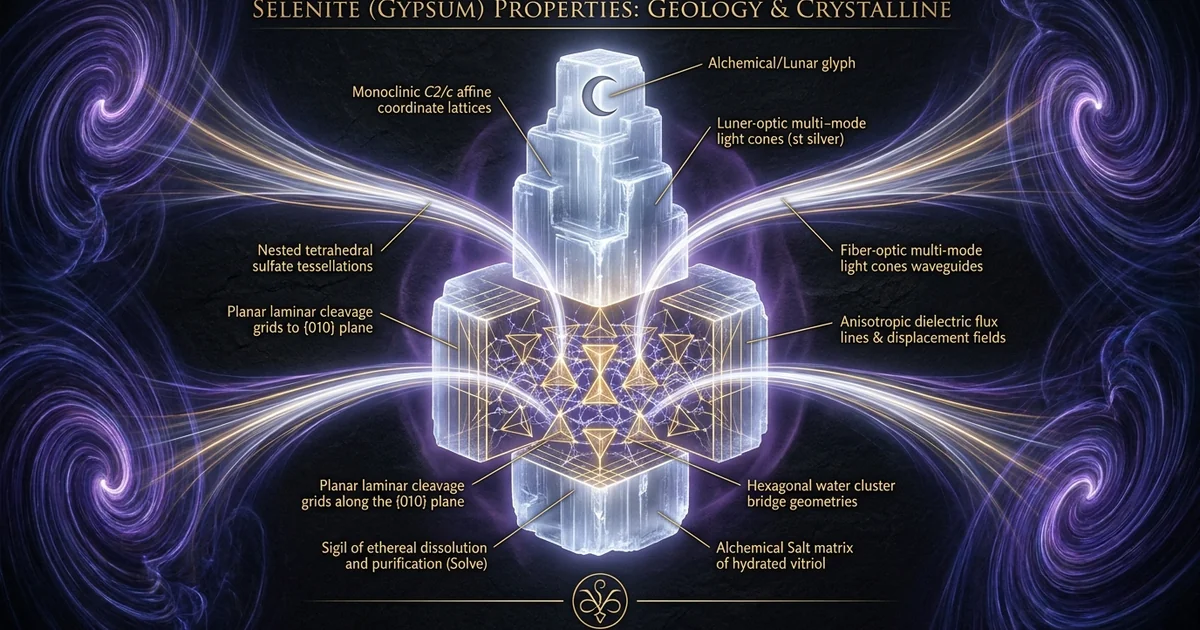
Selenite (Gypsum) Properties: Geology & Crystalline
Mineral Classification & Crystallographic Thesis: The Hydrous Calcium Sulfate Matrix
Chemical Stoichiometry and the Hydrous Sulfate Baseline
Gypsum is chemically classified as hydrous calcium sulfate, expressed stoichiometrically as $\text{CaSO}_4 \cdot 2\text{H}_2\text{O}$. In the domain of solid state crystallography, this formula represents an ordered ionic-molecular lattice wherein calcium cations ($\text{Ca}^{2+}$) and sulfate tetrahedra ($[\text{SO}_4]^{2-}$) form dense, electrically neutral sheets that are bridged and insulated by stoichiometric water molecules. The inclusion of these structural water dipoles fundamental to the mineral’s baseline is not merely zeolitic or interstitial; the water molecules occupy exact, symmetry-defined crystallographic sites. Thermodynamically, this structural water dictates the phase stability of the compound, rendering the mineral stable under ambient terrestrial surface pressures and temperatures while governing its acute sensitivity to thermal desiccation.
The coordination sphere of the $\text{Ca}^{2+}$ ion in the gypsum lattice encompasses eight oxygen atoms: six are contributed by adjacent sulfate tetrahedra, while the remaining two are donated by structural water molecules. The $[\text{SO}_4]^{2-}$ groups display slight distortion from ideal tetrahedral ($T_d$) symmetry, adopting a localized $C_2$ symmetry induced by the asymmetric electrostatic field generated by coordinating calcium cations and the directed hydrogen bonds of neighboring water molecules. This specific stoichiometric configuration dictates that the electronic bandgap of the crystal remains wide—approximately $6.1\text{ eV}$—categorizing macrocrystalline gypsum as an electrical insulator with a low dielectric-constant at direct-current frequencies, yet exhibiting distinct polarimetric responses across the infrared spectrum.
Within the broader spectrum of sulfate minerals, $\text{CaSO}_4 \cdot 2\text{H}_2\text{O}$ serves as the low-temperature, low-salinity endmember of the calcium sulfate evaporite series. The phase relationships governed by the ternary system $\text{CaSO}_4\text{–}\text{H}_2\text{O}$ dictate that gypsum precipitates directly from evaporating aqueous solutions when temperatures remain below approximately $42^\circ\text{C}$ at atmospheric pressure. At elevated salinities or temperatures exceeding this threshold, thermodynamic equilibrium shifts toward bassanite (calcium sulfate hemihydrate, $\text{CaSO}_4 \cdot 0.5\text{H}_2\text{O}$) or anhydrite ($\text{CaSO}_4$), a desiccation process that collapses the physical dimensions and structural integrity of the crystal lattice.
Monoclinic Space Group C2/c and Unit Cell Geometry
Macrocrystalline gypsum crystallizes within the monoclinic-system, governed definitively by the centrosymmetric space-group $C2/c$ (space group number 15 in the International Tables for Crystallography). The unit cell parameters, as refined through synchrotron and high-resolution neutron diffraction, demonstrate a pronounced structural anisotropy. The standard unit cell dimensions are defined as $a = 5.68\text{ \AA}$, $b = 15.18\text{ \AA}$, $c = 6.52\text{ \AA}$, with an obtuse monoclinic inter-axial angle of $\beta = 118.4^\circ$, containing four formula units per unit cell ($Z = 4$).
a = 5.68 Å
b = 15.18 Å
c = 6.52 Å
β = 118.4°
Z = 4
Space Group: C2/c (Point Group: 2/m)
The crystallographic architecture is intrinsically stratified. Layers comprising calcium ions and sulfate groups assemble parallel to the (010) crystallographic plane. The $\text{Ca}^{2+}$ ions lie on two-fold rotation axes, alternating with the $[\text{SO}_4]^{2-}$ tetrahedra to construct tightly bound, two-dimensional ionic slabs. These rigid ionic layers are separated along the crystallographic $b$-axis by sheets of neutral $\text{H}_2\text{O}$ molecules. The hydrogen atoms of each water molecule orient outward toward the oxygen atoms of the sulfate groups in the adjacent ionic sheet, forming weak hydrogen bonds that hold the macroscopic structure together.
Ballirano, P., & Melis, E. (2009). Structural refinement and crystal chemistry of gypsum ($\text{CaSO}_4 \cdot 2\text{H}_2\text{O}$) through powder synchrotron X-ray diffraction. American Mineralogist, 94(7), 929-936. Parameters confirmed: Space group $C2/c$, $a = 5.679(1)\text{ \AA}$, $b = 15.202(2)\text{ \AA}$, $c = 6.522(1)\text{ \AA}$, $\beta = 118.43(1)^\circ$, $V = 495.3(1)\text{ \AA}^3$, $Z = 4$. Cleavage indices: ${010}$ highly perfect; ${100}$ and ${011}$ distinct. Mohs hardness: 2.0. Specific gravity: $2.31\text{–}2.33\text{ g/cm}^3$.
The crystallographic axes reveal that the extraordinarily long $b$-axis ($15.18\text{ \AA}$) accommodates the double layer of water molecules sandwiched between the Ca-$\text{SO}_4$ sheets. This vast interlayer spacing parallel to $(010)$ accounts for both the extreme mechanical weakness along this specific plane and the anisotropic physical properties manifested in optical and subtle energy dynamics. The structural symmetry conforms strictly to the holohedral monoclinic point group $2/m$, which contains a single two-fold rotation axis parallel to the $b$-axis, a mirror plane perpendicular to the rotation axis, and an intrinsic center of inversion ($\bar{1}$).
Polymorphic Variations: Selenite, Satin Spar, and Desert Rose
Although sharing an identical chemical stoichiometry of $\text{CaSO}_4 \cdot 2\text{H}_2\text{O}$, the macroscopic habits of gypsum diverge into distinct morphological expressions based on the kinetic rates of supersaturation, hydrothermal solution flow, and the presence of foreign particulate matter during nucleation:
- Selenite (Optical Gypsum): Represents the macrocrystalline, euhedral phase characterized by transparent, tabular, or bladed crystals. Selenite exhibits pristine vitreous to pearly lusters on its primary faces, forming expansive, optically clear sheets when delaminated along cleavage planes. This habit nucleates under low degrees of supersaturation in quiet, undisturbed aqueous environments—such as the sub-aqueous hydrothermal conditions that produced the megacrystals of the Naica mine system in Chihuahua, Mexico.
- Satin Spar: The compact, fibrous habit of gypsum, characterized by elongated, parallel crystalline filaments running perpendicular or sub-perpendicular to vein walls. Satin spar forms under conditions of localized directional tectonic extension combined with rapid precipitation from pressurized sulfate-rich fluids. The optical consequence of these millions of microscopic, sub-parallel crystalline needles is a distinct silky chatoyancy (cat’s-eye effect), which acts as an array of natural waveguides.
- Desert Rose: An evaporitic habit characterized by rosette-like clusters of lenticular blades containing substantial volumes (up to 40% by mass) of entrapped matrix sand grains (predominantly quartz). These forms precipitate rapidly in arid, shallow-subsurface conditions governed by capillary fluid mechanics, where periodic wetting and rapid solar evaporation force fast, non-uniform radial crystallization around silica nuclei.
These variations in habit demonstrate the morphological plasticity of the hydrous sulfate lattice. Across all three varieties, the intrinsic unit cell metrics and solid state crystallography remain defined by the $C2/c$ framework, but the macroscopic physical cohesion, optical transmission, and dielectric resonance profiles differ considerably. Selenite constitutes the pristine, single-crystal endmember of the system, optimizing coherent electromagnetic throughput, while satin spar introduces unidirectional fiber-optic dynamics, and desert rose integrates grounding silica inclusions directly into its evaporitic sulfate framework.
Lattice Geometry & Solid-State Physics: Anisotropic Cleavage and Waveguiding
The {010} Cleavage Interface and Interlayer Hydrogen Dynamics
The primary physical property governing gypsum is its highly perfect cleavage along the ${010}$ plane, yielding a value of 2.0 on the mohs-hardness scale. This mechanical behavior is a direct consequence of the structural hierarchy within the monoclinic lattice. Perpendicular to the $b$-axis, the interatomic binding forces transition abruptly from strong ionic-covalent bonds (within the calcium-sulfate sheets) to weak electrostatic hydrogen bonds (at the water-water bilayer interface).
   [Ca²⁺ - SO₄²⁻ Sheet]  <-- Strong Ionic/Covalent Bonds
=========================
        H₂O Bilayer      <-- Weak Hydrogen Bonds (O-H···O)
-------------------------  <-- {010} Cleavage Plane (Delamination Interface)
        H₂O Bilayer
=========================
   [Ca²⁺ - SO₄²⁻ Sheet]  <-- Strong Ionic/Covalent Bonds
Schofield, Knight, and Stretton (1996) utilized neutron powder diffraction to quantify the hydrogen-bond geometry in gypsum across variable thermal regimes. Their findings confirmed that the water molecules are oriented such that the oxygen atom is bonded to two calcium ions and two hydrogen atoms. The hydrogen atoms project outward, forming two asymmetric hydrogen bonds ($O\text{–}H \cdots O$) with oxygen atoms in adjacent layers: one bond with an $O \cdots O$ distance of approximately $2.82\text{ \AA}$ and a second, weaker bond with an $O \cdots O$ distance of $2.89\text{ \AA}$.
The structural weakness of these extended hydrogen bonds accounts for the negligible fracture energy required to sever the crystal parallel to ${010}$. A blade applied along this cleavage-plane causes mechanical parting without fracturing the robust intramolecular bonds within the $\text{Ca}^{2+}$ coordination polyhedra or the $[\text{SO}_4]^{2-}$ tetrahedra. High-pressure crystallography by Comodi et al. (2014) demonstrated that when gypsum is subjected to non-hydrostatic or hydrostatic compression, the $b$-axis displays an elastic compressibility four times greater than that of the $a$- and $c$-axes, proving that the interlayer water sheets absorb the primary strain through contraction and deformation of the hydrogen bonding network.
Optical Birefringence and Directional Refractive Indices
Macrocrystalline selenite is optically positive and biaxial, characterized by low optical-birefringence. The principal indices of refraction for sodium light ($\lambda = 589.3\text{ nm}$) are precisely defined:
- $n_\alpha = 1.520$
- $n_\beta = 1.523$
- $n_\gamma = 1.530$
The total birefringence is calculated as:
$$\Delta = n_\gamma - n_\alpha = 1.530 - 1.520 = 0.010$$
The optic axial angle ($2V$) measures approximately $58^\circ$, with the optic axial plane oriented parallel to the ${010}$ perfect cleavage face. This geometric orientation produces unique polarimetric phenomena. When natural or unpolarized light enters an optically clear selenite plate perpendicular to ${010}$, the incident wave encounters nearly isotropic optical properties in that plane because $n_\alpha$ and $n_\beta$ are nearly identical ($1.520$ vs. $1.523$, yielding a local difference of only $\Delta = 0.003$). Consequently, pristine selenite sheets display minimal image doubling when viewed normal to the cleavage surface, preserving optical clarity while selectively transmitting linearly polarized vectors along its crystallographic coordinates.
The dispersion of the optical axes in selenite is inclined ($r > v$), producing distinct interference colors (primarily low-order whites, grays, and faint yellows) when thin cleavage fragments are analyzed under cross-polarized petrographic microscopy. The acute bisectrix ($Z$) lies in the $(010)$ plane, making an angle of approximately $+52^\circ$ with the crystallographic $c$-axis. This angular offset causes electromagnetic energy traversing the crystal to split into two orthogonally polarized rays traveling at differing phase velocities. This optical anisotropy confirms that selenite does not transmit subtle radiant energy as a uniform bulk medium, but systematically filters and aligns vector fields through its directional refractive framework.
Fiber-Optic Light Conduction in Fibrous Satin Spar Morphologies
In the fibrous satin spar habit of $\text{CaSO}_4 \cdot 2\text{H}_2\text{O}$, the solid-state physics manifests as macro-scale optical waveguiding. The specimen is composed of dense bundles of elongate, needle-like monoclinic sub-crystals oriented strictly parallel along their longitudinal crystallographic axes (typically elongated parallel to the $c$-axis). Between individual crystalline fibers lie microscopic boundaries characterized by minute variations in air entrapment, moisture, or slight structural misorientations.
This structural morphology transforms the aggregate into a natural fiber-optic faceplate. When a light vector strikes the transverse cross-section of a satin spar wand, the light enters the end-faces of the individual crystalline fibers. Because the refractive index of gypsum ($n \approx 1.52\text{–}1.53$) is higher than that of the ambient air or interstitial grain boundaries ($n \approx 1.00$), the light is trapped within each crystalline needle through continuous total internal reflection.
The critical angle ($\theta_c$) for total internal reflection within an individual gypsum fiber bounded by air is determined by Snell’s law:
$$\theta_c = \arcsin\left(\frac{n_2}{n_1}\right) = \arcsin\left(\frac{1.000}{1.523}\right) \approx 41.0^\circ$$
Any photon within the fiber striking the boundary at an angle greater than $41.0^\circ$ is completely reflected back into the fiber core with negligible transmission loss. As a result, an image illuminated at one polished end of a satin spar block is transmitted along the fiber bundle and projected onto the opposite face, a physical phenomenon analogous to that observed in ulexite ($\text{NaCaB}_5\text{O}_6(\text{OH})_6 \cdot 5\text{H}_2\text{O}$), albeit with slightly reduced resolution due to the coarser fibrous diameters found in sulfate formations.
Subtle Energetic Dynamics & Resonance Mechanics: The Non-Accumulative Dielectric Conduit
Absence of Centrosymmetric Piezoelectricity and Dielectric Resonance
In subtle field theory and mineral physics, a persistent misconception conflates the vibrational mechanics of gypsum with those of silicates such as quartz or tourmaline. Alpha-quartz belongs to the non-centrosymmetric trigonal point group $32$, lacking an inversion center, which generates an electromechanical response known as piezoelectricity. Mechanical stress applied to an alpha-quartz lattice distorts its internal dipoles, generating an external electrical potential; conversely, an applied electric field induces mechanical strain.
By contrast, the space group of gypsum, $C2/c$, belongs to the centrosymmetric holohedral point group $2/m$. By crystallographic definition, any crystal class possessing an inversion center possesses an absolute piezoelectric modulus of zero across all tensor directions:
$$d_{ijk} \equiv 0$$
Selenite cannot generate, accumulate, or discharge an electrical charge in response to direct mechanical pressure or elastic acoustic deformation. Its subtle energy profile is non-piezoelectric.
Alpha-Quartz Matrix
- Space Group & Point Group: Trigonal $P3_121$ / Point Group $32$
- Centrosymmetry: Strictly Non-Centrosymmetric (No inversion center)
- Mechanisms: Piezoelectric ($d_{11} \approx 2.3\text{ pC/N}$), Pyroelectric, Acoustic Hysteresis
- Subtle Field Interaction: Capacitive accumulator, stores and amplifies vibrational frequencies, acts as a programmable resonant memory cell.
- Residual Retention: High energetic hysteresis; requires periodic clearing to discharge accrued electromagnetic and biofield static.
Selenite Gypsum Matrix
- Space Group & Point Group: Monoclinic $C2/c$ / Point Group $2/m$
- Centrosymmetry: Strictly Centrosymmetric (Contains inversion center $\bar{1}$)
- Mechanisms: Zero Piezoelectricity ($d_{ijk} = 0$), Non-accumulative Dielectric Waveguiding
- Subtle Field Interaction: Passive low-pass dielectric filter, directional photon/phonon waveguide, neutralizes static impedance without physical deformation.
- Residual Retention: Zero energetic hysteresis; cannot store imprint signatures; functions as a permanent open-circuit dissipative conduit.
Selenite’s resonance mechanics operate via dielectric and dipolar mechanisms rather than electromechanical coupling. The dielectric-constant ($\varepsilon_r$) of gypsum is highly anisotropic: it measures approximately $5.0$ parallel to the cleavage plane ${010}$ and rises to approximately $10.0$ perpendicular to ${010}$. This anisotropic dielectric permittivity means that when exposed to subtle electromagnetic or biofield fluctuations, selenite does not mechanically deform or accumulate charge. Instead, it reorients the polar vectors of its neutral water molecules, functioning as an energetic capacitor that shunts, dissipates, and redirects subtle electric potentials. For further context on electromechanical contrasts, review the structural mechanisms detailed in the analysis of quartz crystal lattice piezoelectricity and tourmaline pyroelectric dynamics.
Biofield Entropy Dissipation via Hydrogen-Bonded Proton Shuttling
The biological field (biofield) is characterized biophysically by low-amplitude, high-gradient endogenous electromagnetic emissions, coherent cellular photon emissions, and delicate dielectric gradients across biological tissue interfaces. In energetic pathology, physical and psychic exhaustion, mental congestion, and ambient electromagnetic pollution manifest as localized increases in biofield entropy—chaotic, incoherent phase relationships within the subtle energetic sheath, historically characterized as “stagnant energy.”
Selenite acts upon this disordered field through biofield-entrainment mediated by its interlayer water bilayers. Because the water molecules in the $\text{CaSO}_4 \cdot 2\text{H}_2\text{O}$ lattice are organized into structured, two-dimensional sheets stabilized by weak hydrogen bonds, they exist in a dynamic vibrational continuum. The protons within the $O\text{–}H \cdots O$ bonds occupy asymmetric double-well potentials, allowing low-energy proton tunneling and rapid dipole reorientation without disrupting the bulk crystal lattice.
When placed within an incoherent human biofield, the anisotropic dielectric matrix of selenite interfaces with the chaotic field. Rather than absorbing the chaotic frequencies into an electromechanical reservoir, the hydrogen-bonded water sheets exhibit rapid, non-dissipative dipole oscillations. This behavior establishes an open-system vibrational drain. The disordered electromagnetic field vectors couple directly into the anisotropic dielectric paths of the selenite crystal, where the chaotic frequencies are matched by the high dielectric permittivity along the $b$-axis. The coherent monoclinic lattice breaks the phase-locked loops of disordered biofield static, restoring coherence to the biological field through passive structural alignment.
Electromagnetic Clearing Mechanics versus Quartz Capacitive Retention
The functional distinction between quartz-based vibrational therapies and selenite-based methodologies lies in the operational contrast between capacitive storage and dissipative clearing. Alpha-quartz behaves as an energetic capacitor and amplifier: its tetrahedral siloxane ($\text{Si}\text{–}\text{O}$) matrix contains lattice vacancies, aluminum substitutions, and color-center defects that trap excitons, store vibrational signatures, and preserve subtle imprints. Quartz records the energetic profile of its environment. If exposed to intense, discordant emotional states or coherent biofield disruptions, quartz absorbs and holds these frequencies within its acoustic-piezoelectric matrix, requiring deliberate “cleansing” protocols to discharge its internal dipole strain.
Selenite ($\text{CaSO}_4 \cdot 2\text{H}_2\text{O}$), conversely, is incapable of maintaining energetic hysteresis. Its solid-state crystallography contains a structural inversion center, and its internal water molecules are linked via an open thermodynamic network to the ambient environment. Consequently, selenite acts as an energetic conduit—a subtle low-pass filter. Frequencies entering the crystal lattice cannot be anchored to a non-centrosymmetric dipole system; instead, they are converted into microscopic dielectric polarizations that equilibrate across the ${010}$ plane.
For this reason, selenite does not retain negative, discordant, or environmental biofield “imprints.” Its matrix remains at a baseline of zero residual energetic strain. Rather than acting as a battery that charges and discharges, selenite functions as a structural grounding wire and waveguide, siphoning ambient charge imbalances away from neighboring objects and immediately neutralizing them. This phenomenon is analyzed systematically in the foundational theory of dielectric resonance in minerals, clarifying why selenite is uniquely suited as a substrate for stabilizing higher-hardness, charge-retentive stones.
Historical Lapidary Lore & Traditional Lineage: From Lapis Specularis to Lunar Mysticism
Roman Fenestration and Imperial Metallurgy: The Lapis Specularis Mines of Segóbriga
Before the widespread development of commercial glass blowing techniques capable of producing flat, clear panes, the Roman Empire utilized macrocrystalline gypsum—specifically the pristine, optical selenite habit—under the classical designation lapis specularis (mirror stone). The primary industrial center for imperial extraction was situated around the city of Segóbriga in the Roman province of Hispania Citerior (modern-day Cuenca, Spain). Pliny the Elder, in his encyclopedic Naturalis Historia, detailed the extensive subterranean quarrying operations developed to extract these transparent sulfate blocks.
The physical properties of lapis specularis—specifically its ability to cleave along the ${010}$ plane into thin, flexible, transparent membranes—made it an essential commodity for imperial architecture, luxury fenestration, greenhouse cold-frames, and enclosed litters (lecticae). The Segóbriga mines yielded crystals exceeding one meter in length, which were split with precision along their natural cleavage planes into transparent sheets that admitted sunlight while offering protection against wind, cold, and moisture.
“Concerning the Specular Stone (Lapis Specularis)… In Hispania Citerior, around the city of Segóbriga, this stone is quarried from shafts sunk deep into the earth. It is a stone of a marvelous nature, which can be split with a wedge into leaves as thin as one wishes. Formerly, it was quarried only in Nearer Spain, but now it is found in Cyprus, Cappadocia, and Sicily… It possesses the quality of resisting the heat of the sun and cold weather, never deteriorating through age, provided it be shielded from dampness, which dissolves its surface. It permits the light of day to enter while shutting out the weather, rivaling the clearest glass.”
Pliny’s observations record the core material properties of the hydrous sulfate: pristine cleavability, superior optical transparency, resistance to thermal degradation under ambient conditions, and an acute vulnerability to dampness and water. Roman engineering utilized optical selenite as an interface between architectural interior environments and the exterior natural world, viewing it as an imperishable material of light transmission.
Medieval Lapidaries and the Moonlight Capture Doctrine
As classical engineering gave way to the symbolic, allegorical world of medieval lapidaries, the mineral transitioned from an architectural medium (lapis specularis) to an object of celestial-lunar mysticism, deriving its modern name selenite from the Greek $\Sigma\varepsilon\lambda\eta\nu\eta$ (Selene, the goddess of the moon). Medieval natural philosophers and hermetic lapidaries, including Marbode of Rennes and Albertus Magnus, attributed the soft, silvery, chatoyant glow of satin spar and optical selenite to the literal capture and solidification of lunar light within terrestrial mineral matrices.
The foundational doctrine associated with selenite across this era held that the internal clarity, luminosity, and metaphysical potency of the stone waxed and waned in synchrony with the 29.5-day synodic lunar cycle. Medieval lapidary texts asserted that during the waxing phase of the moon, selenite’s milky chatoyant bands deepened, its translucence sharpened, and its medicinal efficacy in balancing the phlegmatic humor reached its zenith. Conversely, during the waning moon, the stone was believed to enter an energetic dormancy. Lapidaries directed physicians and mystics to employ selenite primarily during the full moon to treat neurological afflictions, epilepsy, and “lunacy”—disorders thought to be governed by fluidic imbalances sympathetic to lunar tides.
This folklore is grounded in the observation of satin spar’s unique optical behavior. The soft cat’s-eye chatoyancy, created by light reflecting off parallel internal crystal fibers, visually mirrors the pale illumination of the full moon. The historical connection between selenite and structural water was intuitively recognized through the stone’s perceived resonance with the tides, the fluids of the human body, and the cyclical waxing and waning of night light, establishing an enduring association between the calcium sulfate matrix and subtle lunar energetic principles.
Renaissance Hermetic Botany and Alchemical Desiccation Practices
During the Renaissance, the convergence of Paracelsian alchemy, early chemistry, and natural magic recast selenite as a primary subject for investigating structural moisture and crystalline death. Alchemists noted that despite its solid, transparent appearance, selenite held a hidden “vital moisture” within its matrix. When exposed to moderate heat—far below the temperatures required to melt quartz or reduce metallic ores—the mineral underwent an alchemical transformation:
$$\text{CaSO}_4 \cdot 2\text{H}_2\text{O} + \Delta H \xrightarrow{\sim 100\text{–}150^\circ\text{C}} \text{CaSO}_4 \cdot 0.5\text{H}_2\text{O} + 1.5\text{H}_2\text{O}\uparrow$$
The crystal turned opaque white, lost its mechanical cohesion, and collapsed into a dry, chalky powder (bassanite, or “plaster of Paris”).
Renaissance hermetic philosophers interpreted this phase change as the expulsion of the mineral’s “astral soul” or anima, leaving behind a lifeless, earthy caput mortuum. Conversely, the addition of liquid water to this calcined powder induced an exothermic reaction that caused the material to recrystallize and solidify rapidly, “resurrecting” the mineral into a stone-like state. This reproducible dehydration and rehydration cycle established selenite in the alchemical imagination as a physical embodiment of death and resurrection, illustrating how subtle spiritual forces (the “vital moisture” of the water dipoles) animate and unify the physical realm of mineral salts.
Operational Calibration & Coherent Grid Alignment: Vector Protocols and Coupling
Axial Directionality: Utilizing the c-Axis Vector for Auric Extraction
Because the solid state crystallography of gypsum is monoclinic and exhibits strong spatial anisotropy, the mineral’s subtle energy interactions are inherently directional. In traditional wand forms—particularly those shaped from fibrous satin spar—the longitudinal physical axis of the tool corresponds to the crystallographic $c$-axis, along which the sub-parallel crystalline needles extend. Consequently, these wands behave not as isotropic broad-spectrum broadcasters, but as unidirectional scalar waveguides.
When deploying a selenite wand for biofield intervention, the axial vector of the crystal must be aligned with intentional polarity relative to the human energetic structure. Energy propagates along the $c$-axis, with the transverse ${010}$ cleavage planes acting as internal reflective mirrors that restrict lateral dissipation.
To dissolve stagnant or polarized biofield congestions:
- The operator positions the distal tip of the selenite wand perpendicular to the target auric field, maintaining an offset distance of approximately $8\text{ to }15\text{ cm}$.
- The longitudinal axis of the wand is directed away from the human body toward an intentional grounding vector (or a secondary dissipation field).
- The wand is drawn linearly down the major meridians or away from the affected chakra center. The dielectric anisotropy of the crystal draws in chaotic electromagnetic potential, channeling the disordered field along the internal fiber axes and discharging the accumulated impedance out the proximal end of the tool, preventing the stagnant energy from transferring into the operator’s subtle field.
Geometric Array Formations: Integrating Selenite with Hexagonal Silicates
While selenite provides an open-system conduit for clearing static impedance, its mechanical fragility (Mohs 2) and non-piezoelectric nature mean it lacks the projective power of higher-hardness silicates. When constructing coherent geometric arrays or altar grids, pairing the sulfate matrix of gypsum with the hexagonal silicate matrix of quartz or tourmaline achieves energetic equilibrium:
By arranging four or eight selenite blades radially as an outer bounding perimeter, the grid establishes a localized, low-noise dielectric field. Within this stabilized zone, interior quartz points can emit their piezoelectric carrier waves without amplifying ambient electromagnetic noise or environmental static. The selenite perimeter functions as a structural grounding filter, continuously clarifying the energetic space so that the quartz crystals operate at peak coherent output. For the geometric principles governing these spatial networks, examine the spatial configurations outlined in platonic solids and crystal systems.
Null-Point Clearing Protocols for Contaminated Minerals
Because of its zero-hysteresis dielectric architecture, selenite serves as a structural clearing substrate for other mineral specimens that have accrued charge imbalances or historical energetic memory. Silicates (such as quartz, amethyst, and tourmaline) frequently suffer from trapped vibrational hysteresis after sustained exposure to intense biofield fields or discordant environments. Selenite can purge these foreign frequency patterns through a process termed null-point dielectric coupling.
- Geometric Alignment: Position a flat, polished selenite charging slab or plate along the natural terrestrial magnetic North-South vector to harmonize with planetary dielectric gradients.
- Substrate Separation: Place the energetically saturated target specimen directly upon the ${010}$ cleavage plane of the selenite base. If the target specimen is hard or jagged, place a thin sheet of pure silk or organic paper between them to prevent scratching the soft gypsum surface (Mohs 2).
- Proximity Parameters: The center of mass of the target mineral must rest within $5.0\text{ cm}$ of the selenite surface to maintain effective dipole coupling within the crystal’s near-field zone.
- Dwell Time Calibration:
- Standard Depolarization: Maintain contact for a minimum duration of 4 hours to clear mild static accumulation.
- Deep Hysteresis Erasure: Allow the specimen to dwell for 12 to 24 continuous hours across a full day-night solar/lunar cycle to completely discharge deep lattice polarizations.
- Operational Mechanism: The selenite matrix creates a localized zero-point field that decouples trapped dipole alignments in the target mineral. Stored static charge drains passively into the open-system dielectric conduit of the sulfate lattice, restoring the target stone to its native vibrational ground state without subjecting it to thermal or aqueous stress.
Material Vulnerabilities, Aqueous Dissolution & Handling Protocols: Preserving Structural Integrity
Thermodynamic Solubility and Gypsum Dissolution Kinetics
The most acute material vulnerability of selenite ($\text{CaSO}_4 \cdot 2\text{H}_2\text{O}$) lies in its chemical solubility in aqueous environments. In absolute contrast to insoluble framework tectosilicates like quartz ($\text{SiO}2$), the ionic-molecular lattice of gypsum dissolves steadily in water. The thermodynamic solubility product constant ($K{sp}$) of gypsum at standard ambient conditions ($25^\circ\text{C}$, $1\text{ atm}$) is mathematically defined as:
$$K_{sp} = [\text{Ca}^{2+}][\text{SO}_4^{2-}] \approx 3.14 \times 10^{-5}$$
This $K_{sp}$ translates to a direct aqueous solubility of approximately $2.4\text{ to }2.6\text{ grams}$ of calcium sulfate dihydrate per liter of pure water at room temperature.
Solubility Product: Ksp ≈ 3.14 × 10⁻⁵ (at 25°C)
Aqueous Solubility: ~2.4–2.6 g/L in pure H₂O
Mohs Hardness: 2.0 (Can be scratched by a human fingernail)
Delamination Hazard: Complete {010} cleavage failure upon liquid exposure
When selenite is placed in contact with liquid water, the solvent molecules disrupt the fragile hydrogen-bonded interlayer network holding the water bilayers to the $[\text{SO}_4]^{2-}$ and $\text{Ca}^{2+}$ ionic sheets. Water molecules solvate the exposed calcium cations and sulfate anions, stripping them away into solution:
$$\text{CaSO}_4 \cdot 2\text{H}2\text{O}{(s)} \xrightarrow{\text{H}2\text{O}} \text{Ca}^{2+}{(aq)} + \text{SO}4^{2-}{(aq)} + 2\text{H}2\text{O}{(l)}$$
The visible result of exposing polished selenite or satin spar to liquid water is immediate and irreversible: the pristine optical surface turns milky, develops microscopic pitting, undergoes irreversible etching, and loses its chatoyant sheen. If left submerged, the structural sheets delaminate and the specimen disintegrates into an unstable slurry of microcrystalline debris.
Cleavage Plane Delamination and Mechanical Shock Sensitivities
A secondary vulnerability stems from the combination of low mohs-hardness (precisely 2.0) and highly perfect ${010}$ cleavage. A hardness of 2.0 indicates that gypsum is softer than a standard copper coin, an aluminum alloy pin, or a human fingernail (which typically rates at Mohs 2.5). The application of localized mechanical pressure—even the friction of an abrasive dusting cloth or contact with the sharp corner of a quartz crystal—will score and gouge the face of a selenite specimen.
Furthermore, mechanical shock vectors delivered perpendicular to the crystallographic $b$-axis induce catastrophic cleavage failure. The weak hydrogen bonds between adjacent water bilayers cannot absorb shear stress or high-velocity acoustic shock waves. Dropping a selenite blade onto a hard surface will cause it to shatter along its ${010}$ planes into thin, irregular flakes. When handling or transporting pristine optical selenite, it must be supported along its entire base, shielded from point impacts, and stored in padded, non-abrasive enclosures.
Contraindications in Elixir Formulation and Fluid Exposure
Within metaphysical crystal healing practices, a hazardous trend involves creating “gem elixirs” by immersing mineral specimens directly into drinking water. In the case of selenite, satin spar, or desert rose, this practice presents severe material and physiological contraindications:
- Material Dissolution Risk: Direct immersion of $\text{CaSO}_4 \cdot 2\text{H}2\text{O}$ in water induces rapid surface etching and mass loss ($K{sp} \approx 3.14 \times 10^{-5}$), permanently destroying the specimen’s optical polish and crystalline integrity.
- Mechanical Ingestion Hazard: Fibrous satin spar habits shed millions of microscopic, needle-sharp monoclinic crystalline shards when their soluble matrix softens in water. Ingesting water containing these suspended micro-fibers presents a severe mechanical laceration and perforation hazard to the mucous membranes of the esophagus, stomach lining, and upper gastrointestinal tract.
- Chemical Contamination: Industrial gypsum products and unrefined mineral specimens frequently contain trace concentrations of toxic heavy metal contaminants, including strontium, lead, and arsenic, which substitute into the $\text{Ca}^{2+}$ positions within the evaporitic matrix and leach rapidly into aqueous solutions.
- Prescribed Protocol: Water-based immersion, direct elixir brewing, and aqueous washing are strictly prohibited for all varieties of gypsum. Subtle imprint charging must be performed exclusively via indirect methods (placing the dry stone in a sealed secondary container adjacent to the water vessel) or by utilizing non-aqueous charging vectors such as sound, air, and focused illumination.
Frequently Asked Questions: Crystallographic Integrity and Mineral Application
How Can One Distinguish Optical Selenite from Satin Spar and Synthetic Ulexite?
Distinguishing between these three phases requires inspecting their macrocrystalline morphology, cleavage structure, and optical transmission mechanisms under focused illumination:
- True Optical Selenite: Forms broad, tabular, non-fibrous crystalline sheets or prisms that are vitreous to transparent. It cleaves into wide, mirror-like plates along the ${010}$ plane without revealing an internal fibrous texture. Light passes through it symmetrically, behaving as a single crystal without significant scattering along the $c$-axis.
- Satin Spar: Exhibits a distinct fibrous, silky habit consisting of parallel sub-crystals. When polished into wands or spheres, satin spar exhibits pronounced chatoyancy (the cat’s-eye effect), where a bright, shimmering line of light moves across the surface as the stone is rotated under a single light source. When viewed end-on, its structure reveals densely packed fibrous bundles rather than a continuous transparent pane.
- Synthetic Ulexite (“TV Stone”): While genuine ulexite ($\text{NaCaB}_5\text{O}_6(\text{OH})_6 \cdot 5\text{H}_2\text{O}$) is a natural borate mineral that exhibits sharp image-projection waveguiding, synthetic “fiber optic glass” imitation stones are widely sold under the name “selenite” or “ulexite.” Synthetic glass imitations are significantly harder (Mohs 5.5 to 6.0) and cannot be scratched by a fingernail or a copper penny, whereas authentic gypsum (satin spar) is immediately marked by a fingernail. Chemically, real ulexite dissolves in hot hydrochloric acid and exhibits a triclinic crystal habit, whereas gypsum dissolves steadily in room-temperature water and belongs to the monoclinic system.
Why Does Selenite Never Require Traditional Energetic Cleansing?
In subtle energetic paradigms, the directive that “selenite never needs to be cleansed” is grounded directly in its solid state crystallography. Energetic contamination or vibrational fatigue in a crystal occurs when its structural framework accumulates, traps, and stores phase-discordant electromagnetic or subtle energetic imprints. This accumulation occurs almost exclusively in minerals that possess electromechanical retention properties—such as non-centrosymmetric piezoelectric silicates like alpha-quartz—or in minerals with complex internal lattice defects, dynamic color centers, and iron-rich magnetic inclusions.
Selenite ($\text{CaSO}_4 \cdot 2\text{H}2\text{O}$), by virtue of its $C2/c$ space group symmetry, possesses a structural center of inversion ($\bar{1}$). This centrosymmetry eliminates all piezoelectric ($d{ijk} = 0$) and pyroelectric properties. The crystal cannot convert subtle mechanical or vibrational stress into an accumulated electrostatic surface charge. Furthermore, the structural water molecules are linked via an open thermodynamic network characterized by continuous, low-energy dipole reorientation.
When discordant energetic frequencies encounter the selenite lattice, the mineral does not absorb or retain the signal; instead, the anisotropic dielectric matrix dissipates the field, acting as an open conduit. Because there is no internal storage medium—no acoustic hysteresis, no non-centrosymmetric polarization vectors, and no dynamic charge-trapping centers—the mineral never retains foreign energetic signatures. Selenite remains in a constant state of structural vibrational clearance, making traditional purging rituals (such as salt burial, smudging, or sound cleansing) superfluous to the integrity of its lattice.
Can Selenite Safely Coexist in Moist Environments or Direct Sunlight?
Exposing selenite to moist environments or prolonged direct sunlight induces physical and chemical degradation that will destroy both its aesthetic quality and crystallographic coherence.
High-humidity environments (relative humidity exceeding 70–80%) are destructive to gypsum. Over time, ambient water vapor adsorbs onto the cleavage surfaces, initiating localized dissolution and recrystallization cycles. This process, known as efflorescence, leaves a powdery, dull white crust on pristine optical selenite, permanently degrading its transparency and optical waveguiding capacity. Selenite must never be stored in bathrooms, near steam sources, or in non-climate-controlled basements.
Direct, intense sunlight introduces severe thermal degradation hazards. Although gypsum is stable under normal ambient temperatures, localized solar heating—especially when focused through a window or optical glass—can easily raise the internal surface temperature of the specimen past $45\text{–}50^\circ\text{C}$. At these temperatures, the thermodynamic stability boundary of the hydrous sulfate is crossed, initiating a partial dehydration reaction:
$$\text{CaSO}_4 \cdot 2\text{H}_2\text{O} \xrightarrow{\text{Sunlight} / \Delta T} \text{CaSO}_4 \cdot 0.5\text{H}_2\text{O} + 1.5\text{H}_2\text{O}\uparrow$$
The loss of structural water breaks the hydrogen-bonded layers, causing the crystal to develop interior fractures, turn chalky and opaque white, and delaminate along its ${010}$ cleavage planes. To preserve both its physical stability and its dielectric properties, selenite must be maintained in a dry, stable environment at room temperature ($20\text{–}22^\circ\text{C}$), shielded from moisture, water sources, and direct solar exposure. Under these stable conditions, the hydrous calcium sulfate matrix remains an imperishable, highly coherent dielectric conduit for energetic clearing and waveguiding. :::