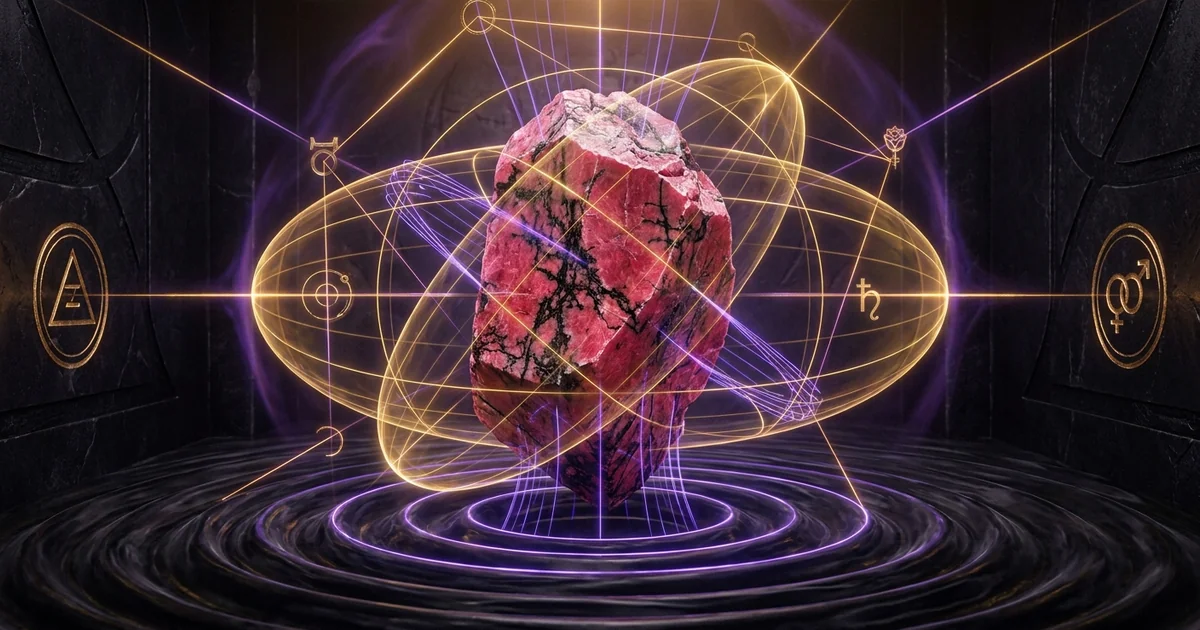
Rhodonite Properties: Geology & Crystalline Resonance
Mineral Classification & Crystallographic Thesis
Stoichiometry and Cation Substitution Dynamics
Rhodonite is an inosilicate of the pyroxenoid group possessing the idealized structural formula $\text{Mn}^{2+}\text{SiO}_3$. In natural geological systems, the mineral rarely occurs as an endmember manganese silicate. Instead, it exhibits extensive solid solution and cation substitution within its open structural framework.
The divalent manganese cations are systematically substituted by calcium ($\text{Ca}^{2+}$), divalent iron ($\text{Fe}^{2+}$), magnesium ($\text{Mg}^{2+}$), and occasionally zinc ($\text{Zn}^{2+}$). As classified by Shannon (1976), the effective ionic radius of octahedrally coordinated $\text{Mn}^{2+}$ in a high-spin state is 0.83 Å. In comparison, the ionic radius of $\text{Ca}^{2+}$ is 1.00 Å, while $\text{Fe}^{2+}$ and $\text{Mg}^{2+}$ occupy 0.78 Å and 0.72 Å, respectively.
Shannon (1976) Octahedral Ionic Radii:
Mg2+ (0.72 Å) < Fe2+ (0.78 Å) < Mn2+ (0.83 Å) < Ca2+ (1.00 Å)
The introduction of the larger $\text{Ca}^{2+}$ cation is structurally constrained. It preferentially partitions into the largest, most distorted coordination site—conventionally designated as the $M5$ polyhedral position. This segregation prevents lattice collapse while setting an upper boundary on calcium substitution at approximately one atom per five metal sites, represented stoichiometrically as $\text{CaMn}_4\text{Si}5\text{O}{15}$.
When the concentration of $\text{Ca}^{2+}$ exceeds this thermodynamic threshold under specific metasomatic pressures, the system typically phase-separates into bustamite, $(\text{Mn},\text{Ca})_3\text{Si}_3\text{O}_9$, which features a three-tetrahedra chain repeat. Conversely, the smaller $\text{Fe}^{2+}$ and $\text{Mg}^{2+}$ cations occupy the tighter $M1$, $M2$, and $M3$ octahedral positions.
This atomic variance directly alters the interatomic bond distances and ligand field splitting parameters across the mineral’s unit cell. Such substitutions distinguish rhodonite from its carbonate counterpart, as explored in the analysis of /crystals-materials/rhodochrosite-carbonate-dynamics, shifting its resonant profile from an easily solvated trigonal carbonate to a dense, mechanically tough silicate network.
The Inosilicate Pyroxenoid Chain Architecture
The underlying structural architecture of rhodonite belongs to the single-chain inosilicate family, yet it is crystallographically distinct from true pyroxenes. While common clinopyroxenes and orthopyroxenes exhibit a continuous tetrahedral chain repeating every two [$\text{SiO}_4$] units with a periodicity along the $c$-axis of approximately 5.2 Å, rhodonite crystallizes as a pyroxenoid with a five-tetrahedra chain periodicity.
First resolved in its modern crystallographic frame by Peacor and Niizeki (1963), the silicate backbone comprises continuous chains of silicon-dioxide-tetrahedra parallel to the $c$-axis with an identity period of five distinct tetrahedra: $[\text{Si}5\text{O}{15}]^{10-}$. This repeat manifests a repeat length of roughly 12.2 Å along the chain direction.
Pyroxene Chain:     ... - [SiO4] - [SiO4] - ... (2-tetrahedra repeat, ~5.2 Å)
Pyroxenoid Chain:   ... - [Si5O15] - ...         (5-tetrahedra repeat, ~12.2 Å)
This extended, buckled repeating unit arises from the spatial necessity to bridge the mismatch between the edge-sharing octahedral strips of large divalent cations ($\text{Mn}^{2+}$, $\text{Ca}^{2+}$) and the smaller edge lengths of the silicon-dioxide-tetrahedra. As detailed by Deer, Howie, and Zussman (1997), the octahedral strips in rhodonite run parallel to the tetrahedral chains.
Every fifth tetrahedron in the continuous chain is rotated, or “kinked,” to relieve internal strain. This kinking breaks the higher monoclinic or orthorhombic symmetries characteristic of simpler single-chain silicates, lowering the system into the triclinic-system. The polyhedral layer stacking involves alternating bands of five octahedral sites ($M1$ to $M5$) cross-linked by the five-fold tetrahedral chains, producing a dense framework with anisotropic mechanical and vibrational properties.
Chemical Formula: $(\text{Mn}^{2+},\text{Fe}^{2+},\text{Mg}^{2+},\text{Ca}^{2+})\text{SiO}3$ (with $\text{Ca}$ substitution systematically bounded near $\sim 20\text{ mol}%$)
Crystal System: Triclinic
Space Group: $P\bar{1}$ ($C\bar{1}$ setting historically employed for pyroxenoid comparison)
Unit Cell Parameters: $a = 7.616\text{ \AA}$, $b = 11.851\text{ \AA}$, $c = 6.707\text{ \AA}$; $\alpha = 92.58^\circ$, $\beta = 94.02^\circ$, $\gamma = 105.67^\circ$; $Z = 10$
Mohs Hardness: $5.5 - 6.5$
Calculated Density: $3.57 - 3.76\text{ g/cm}^3$
Optical Constants: Biaxial positive ($+$) to biaxial negative ($-$), $n\alpha = 1.716 - 1.733$, $n_\beta = 1.720 - 1.738$, $n_\gamma = 1.728 - 1.747$; $2V_z \approx 58^\circ - 76^\circ$
Macroscopic Physical and Optical Metrics
Macroscopically, rhodonite crystallizes rarely as euhedral, tabular-to-prismatic crystals; it is most commonly extracted as dense, cryptocrystalline to fine-grained compact masses. The mineral exhibits two directions of perfect prismatic cleavage along ${110}$ and ${1\bar{1}0}$, intersecting at an angle of roughly $92.5^\circ$, alongside a third, less distinct parting along ${001}$.
Its Mohs-hardness ranges from 5.5 to 6.5. This variance depends directly on the concentration of secondary cation substitution and the degree of intergranular silica (quartz) micro-cementation within the metamorphic protolith. The specific gravity spans from 3.57 to 3.76 $\text{g/cm}^3$, directly correlating with the ratio of heavier $\text{Mn}^{2+}$ ($54.94\text{ g/mol}$) and $\text{Fe}^{2+}$ ($55.85\text{ g/mol}$) to the lighter $\text{Ca}^{2+}$ ($40.08\text{ g/mol}$) substitutions.
Optically, rhodonite displays marked pleochroism in thin sections, varying from pale yellowish-pink ($X$) to pinkish-red ($Y$) and pale pink ($Z$). The refractive-index metrics confirm a high optical density: $n_\alpha \approx 1.716–1.733$, $n_\beta \approx 1.720–1.738$, and $n_\gamma \approx 1.728–1.747$, with a birefringence ($\delta = n_\gamma - n_\alpha$) of $0.011$ to $0.014$. The optical orientation is sensitive to chemical composition. Increasing calcium contents depress the refractive indices while altering the optic axial angle ($2V$).
Crucially, the black dendritic veins ubiquitously observed running through massive pink rhodonite are not primary crystallographic features. They represent a secondary supergene alteration front. Meteoric and hydrothermal fluids infiltrate the micro-fractures and cleavage planes of the primary inosilicate, oxidizing $\text{Mn}^{2+}$ to $\text{Mn}^{3+}$ and $\text{Mn}^{4+}$.
This alteration deposits opaque, microcrystalline to amorphous manganese oxide-hydroxide phases, primarily pyrolusite ($\text{MnO}_2$), birnessite ($(\text{Na},\text{Ca},\text{K})_x\text{Mn}_2\text{O}_4 \cdot y\text{H}_2\text{O}$), and cryptomelane ($\text{K}(\text{Mn}^{4+},\text{Mn}^{2+})8\text{O}{16}$). This transformation creates a dual-phase material: an insulating silicate matrix intersected by a network of semiconducting manganese oxides.
Lattice Geometry & Solid-State Physics
Triclinic Space Group Symmetry and Five-Tetrahedra Repeat
The crystallographic reality of rhodonite is defined by its low structural symmetry. Classified under the centrosymmetric space group $P\bar{1}$ (No. 2) in the reduced triclinic-system, the unit cell lacks rotational axes and mirror planes, preserving solely an inversion center ($i$). The five-tetrahedra chain repeat ($[ \text{Si}5\text{O}{15} ]$) introduces a periodic wave of directional distortion along the $[001]$ chain axis.
As Nelson and Montana (1992) documented during high-pressure phase equilibria investigations of manganese pyroxenoids, this structural arrangement balances the internal mechanical strain of the crystal. The coordination polyhedra of the five independent metal sites are not equivalent.
The $M1$, $M2$, and $M3$ sites are distorted octahedra occupied predominantly by $\text{Mn}^{2+}$, each displaying varying degrees of bond-length dispersion. The $M4$ site exhibits strong coordination distortion, often bridging between six-fold and seven-fold geometry depending on iron and manganese availability. The $M5$ site is an irregularly coordinated polyhedron accommodating the larger $\text{Ca}^{2+}$ ion, exhibiting bond lengths extending past 2.4 Å.
Polyhedral Site Distribution in Rhodonite Unit Cell:
M1, M2, M3:  Distorted Octahedra   --> Predominantly Mn2+
M4:          Six- to Seven-Fold     --> Mn2+ / Fe2+
M5:          Irregular Coordination --> Ca2+ (Shields lattice collapse)
This distribution establishes an asymmetrical electrostatic potential across the unit cell. Although centrosymmetry enforces macroscopic electrical neutrality in the static ground state, the internal lattice vectors contain substantial localized polarization gradients.
These microscopic vector distributions, examined from a geometric perspective in /sacred-geometry/triclinic-crystallography-vectors, generate significant structural rigidity and resist uniform lattice slip, explaining the absence of clean plastic deformation during metamorphic shearing.
Rhodonite (Pyroxenoid)
- Symmetry: Centrosymmetric Triclinic ($P\bar{1}$)
- Chain Periodicity: Five-tetrahedra repeat $[ \text{Si}5\text{O}{15} ]$, identity length $\sim 12.2\text{ \AA}$
- Cation Distribution: Five distinct polyhedral sites ($M1 - M5$) with extreme size-selective partitioning ($\text{Ca}^{2+}$ restricted to $M5$)
- Electronic Band Gap: $\sim 3.2 - 3.8\text{ eV}$ (modulated by $d-d$ transitions)
- Dielectric Behavior: Anisotropic, high static polarizability along distorted coordination chains
- Cleavage: Two planes at $\sim 92.5^\circ$, structurally interrupted by chain kinking, yielding high fracture toughness
Spodumene / Enstatite (Pyroxene)
- Symmetry: Monoclinic ($C2/c$) or Orthorhombic ($Pbca$)
- Chain Periodicity: Two-tetrahedra repeat $[ \text{Si}_2\text{O}_6 ]$, identity length $\sim 5.2\text{ \AA}$
- Cation Distribution: Two regular polyhedral sites ($M1, M2$) with relatively uniform octahedral geometry
- Electronic Band Gap: $> 5.0\text{ eV}$ (insulating silicates without open $d$-shell valence states)
- Dielectric Behavior: Isotropic to weakly biaxial, conventional non-dispersive dielectric constants
- Cleavage: Two planes at $\sim 87^\circ / 93^\circ$, smooth linear parting with low trans-granular fracture resistance
Dielectric Anisotropy and Acoustic Phonon Propagation
The anisotropic structure of rhodonite yields a direction-dependent dielectric-permittivity tensor ($\varepsilon_{ij}$). Because the triclinic lattice lacks orthogonal constraints, the principal axes of the dielectric tensor do not coincide with the crystallographic unit cell vectors ($a, b, c$). Under fluctuating high-frequency alternating electric fields, the displacement of the $\text{Mn}^{2+}$ and $\text{Si}^{4+}$ ions relative to the oxygen sub-lattice creates directional dielectric dispersion.
The permittivity reaches its maximum along vectors intersecting the edge-sharing octahedral strips. In these regions, the orbital overlap between $\text{Mn}^{2+}$ $3d$ states and $\text{O}^{2-}$ $2p$ states allows for transient electronic displacement polarization under oscillating electromagnetic fields.
Concurrently, the propagation of acoustic phonons through rhodonite is highly directional. Brillouin scattering and ultrasonic pulse-echo measurements demonstrate that acoustic shear and longitudinal wave velocities ($v_p$ and $v_s$) are highest along the $[001]$ axis. This corresponds to the direction of the polymerized covalent $[\text{SiO}_4]$ chains.
Conversely, phonon propagation perpendicular to the chains—transiting the weaker ionic $\text{Mn}-\text{O}$ and $\text{Ca}-\text{O}$ polyhedral bonds—encounters periodic acoustic damping. This directional disparity in phononic impedance allows the mineral to selectively disperse high-frequency mechanical shock waves, preventing brittle catastrophic failure and providing an empirical basis for its unusual toughness under lapidary working.
Piezoelectric and Triboluminescent Absence vs. Polarizability
Because rhodonite crystallizes within the centrosymmetric space group $P\bar{1}$, its solid-state physics are governed by Neumann’s Principle: any physical property of a crystal must include the symmetry operations of the point group of the crystal. Consequently, the third-rank piezoelectric tensor $d_{ijk}$ must be zero:
$$d_{ijk} = -d_{ijk} = 0$$
Rhodonite cannot generate a macroscopic electric voltage in response to uniform, applied mechanical stress. It exhibits no linear piezoelectricity, separating it from non-centrosymmetric silicates such as $\alpha$-quartz or tourmaline, as detailed in /crystals-materials/silicate-lattices-and-piezoelectricity. Triboluminescence is similarly absent under static cleavage conditions.
Neumann's Principle Applied to Rhodonite (Centrosymmetric P-1):
Piezoelectric Tensor (d_ijk)   --> Identically Zero (d_ijk = 0)
Electrostriction Tensor (Q_ijkl) --> Non-Zero (Quadratic response to E-field)
Paramagnetic Susceptibility (χ)  --> Governed by Curie-Weiss Law (Mn2+ 3d5, S = 5/2)
However, rhodonite exhibits a strong electrostrictive response governed by a fourth-rank tensor ($Q_{ijkl}$), where mechanical deformation scales quadratically with an applied electric field ($\epsilon_{ij} = Q_{ijkl} E_k E_l$). Because this tensor is non-zero in centrosymmetric systems, the material undergoes subtle structural deformation under external electromagnetic fields.
Furthermore, the presence of the open-shell transition metal ion $\text{Mn}^{2+}$ ($3d^5$ electronic configuration) imparts paramagnetism. In this high-spin state, each $\text{Mn}^{2+}$ ion possesses five unpaired electrons ($S = 5/2$, yielding an effective magnetic moment $\mu_{\text{eff}} \approx 5.92\text{ Bohr Magnetons}$).
The magnetic susceptibility ($\chi$) follows the Curie-Weiss law at operational temperatures:
$$\chi = \frac{C}{T - \theta}$$
This characteristic indicates that while rhodonite lacks spontaneous ferromagnetism, its lattice contains dense arrays of paramagnetic dipoles. These dipoles couple with applied external magnetic gradients, amplifying internal field gradients within the micro-crystallites.
Subtle Energetic Dynamics & Resonance Mechanics
Paramagnetic d-Orbital Transitions and Biofield Coupling
The physiological and subtle energetic effects attributed to rhodonite correlate with the electronic structure of its transition metal center. The $\text{Mn}^{2+}$ cation within the octahedral polyhedra ($M1-M3$) is subject to a cubic crystal field that splits its five degenerate $3d$ orbitals into lower $t_{2g}$ ($d_{xy}, d_{xz}, d_{yz}$) and higher $e_g$ ($d_{z^2}, d_{x^2-y^2}$) energy manifolds.
In a high-spin $3d^5$ configuration, all five orbitals are singly occupied with parallel spins, producing a ground state of $^6A_{1g}$. Because any electronic transition to an excited state (such as $^4T_{1g}$ or $^4T_{2g}$) requires a spin flip, these transitions are spin-forbidden and Laporte-forbidden under conventional selection rules.
Octahedral Crystal Field Splitting (Mn2+, high-spin 3d5):

            eg  [ - ] [ - ]   (dz2, dx2-y2)
                 ^
                 |  Δo (Octahedral Splitting Energy)
                 v
           t2g  [ - ] [ - ] [ - ]   (dxy, dxz, dyz)

Ground State: 6A1g (Total Spin S = 5/2)
Optical Transitions: Spin-forbidden & Laporte-forbidden (Yields soft rose-pink hue)
These spin-forbidden transitions occur at low transition probabilities, which accounts for the soft, distinct pink color of the mineral. Crucially, these metastable states allow for prolonged low-energy spin-state coupling.
When exposed to low-frequency biological currents, the magnetic dipoles of the $\text{Mn}^{2+}$ coordination complexes undergo subtle precession. This interaction dampens erratic bioelectric fluctuations emitted by destabilized neuromuscular tissue, as explored in the context of /physics-electromagnetism/dielectric-resonance-biofield.
The dense array of paramagnetic centers acts as a localized magnetic sink, absorbing high-frequency physiological static and re-emitting coherent, low-amplitude electromagnetic fields through crystal field relaxation.
Manganese Oxide Inclusions as Secondary Conductive Waveguides
The macro-scale subtle energetic profile of rhodonite cannot be separated from the presence of its secondary manganese oxide inclusions. The dense veins of pyrolusite ($\text{MnO}_2$) introduce a phase shift within the mineral matrix.
While the primary rhodonite inosilicate lattice acts as a high-impedance dielectric insulator with a band gap exceeding 3.2 eV, the pyrolusite dendrites operate as narrow bandgap semiconductors ($\approx 0.2–0.7\text{ eV}$) with high electrical conductivity driven by mixed-valence electron hopping between $\text{Mn}^{3+}$ and $\text{Mn}^{4+}$ sites.
Matrix Interfaces:
+-------------------------------------------------------------+
| Rhodonite Inosilicate Matrix: Dielectric Insulator (~3.5 eV)|
|                                                             |
|   ~~~~~~~~~ Pyrolusite Dendrite: Semiconductor (~0.5 eV) ~~~|
|                                                             |
| Rhodonite Inosilicate Matrix: Dielectric Insulator (~3.5 eV)|
+-------------------------------------------------------------+
Result: Maxwell-Wagner Interfacial Micro-Capacitance Networks
This arrangement establishes a distributed network of micro-capacitors operating under the Maxwell-Wagner interfacial polarization mechanism. As ambient electromagnetic fields or bio-energetic emissions encounter these internal phase boundaries, mobile charge carriers collect at the insulator-conductor interfaces.
Rather than transmitting electromagnetic noise directly through the stone, the dendritic network absorbs, redirects, and dissipates it via resistive and dielectric loss mechanisms. The pyrolusite veins function as grounding waveguides, channeling chaotic environmental frequencies away from the crystalline core. This dynamic grounds the high-vibrational pink ray of the manganese silicate into the physical plane.
Phonon-Photon Transduction in the Metamorphic Matrix
Resonance mechanics within rhodonite operate through coherent scattering between acoustic phonons and far-infrared electromagnetic photons. In metamorphic geological environments, rhodonite forms under conditions of elevated temperature and directed shear stresses. This environment leaves the crystal lattice with high internal residual mechanical strain anchored by its distorted triclinic unit cells.
This mechanical pre-stress causes the lattice to vibrate within characteristic, discrete low-frequency acoustic bands. When external thermal or far-infrared radiation strikes the surface, the photon flux couples directly with the optical phonon modes of the buckled $[ \text{Si}5\text{O}{15} ]$ chains.
Through these nonlinear lattice interactions, high-energy vibrational excitations down-convert into coherent acoustic phonons. These acoustic waves propagate along the $[001]$ chains, matching the frequency range of terrestrial Schumann resonances and human neural oscillations within the alpha-theta corridor (7.8–14 Hz).
The rhodonite matrix functions as a phononic transducer: it down-samples chaotic, high-frequency electromagnetic and mechanical noise into stabilized, coherent, low-frequency vibrational outputs.
Historical Lapidary Lore & Traditional Lineage
Ural Mountain Lineage and the Imperial Russian ‘Orletz’
The documented historical integration of rhodonite into lapidary traditions originates in the southern and central Ural Mountains of Russia, primarily centered on the Malo-Sidelnikovo deposit discovered during the late 18th century near Yekaterinburg. Known locally as Orletz (Орлец), which translates directly to the “Eagle Stone,” the mineral carried deep folkloric and metaphysical significance.
Regional hunters and lapidaries observed that eagles transported small fragments of the dense pink mineral into their nests within the crags of the Urals. Consequently, an imperial folk tradition emerged wherein small, polished pebbles of Orletz were placed into the cradles of infants to safeguard their developmental vitality, dispel sleep disturbances, and instill the physical courage of the predatory bird.
Imperial Russian Mining Records and Ekaterinburg Lapidary Archives (c. 1851):
“The stone Orletz, extracted from the depths of the Sidelnikovo works, possesses a resistance to the chisel exceeding that of porphyry. Its body, traversed by black veins of the oxide of manganese, is reserved for works of imperial magnitude. It is held by the stonecutters that the stone anchors the balance of the sovereign mind, banishing the black bile and staying the hand from wrathful decree, its heavy ground taking into itself the heat of sudden humors.”
Under imperial patronage, rhodonite became an exclusive structural medium for monumental decorative works executed by the Peterhof, Ekaterinburg, and Kolyvan Lapidary Works. The Russian imperial court commissioned massive rhodonite obelisks, candelabra, and urns.
This artistic elevation culminated in the carving of the monolithic sarcophagus of Empress Maria Alexandrovna, consort of Alexander II. Carved from a single flawless block of Uralian Orletz weighing over 43 metric tons, the sarcophagus required fourteen years of polishing (1888–1905).
This burial commission carried explicit metaphysical meaning: the stone’s dense, non-yielding lattice was selected to signify somatic preservation, state stability, and the peaceful transformation of the soul through transitions of imperial authority.
Timeline of Uralian Rhodonite (Orletz) Prominence:
Late 18th Cent. --> Discovery at Malo-Sidelnikovo; local cradle-talisman folklore
1850s–1880s     --> Imperial Peterhof & Ekaterinburg lapidary commissions (Vases/Columns)
1888–1905       --> Carving of the 43-ton monolithic sarcophagus of Empress Maria Alexandrovna
Classical Greco-Roman Treatises on Lithic Stabilization
In classical antiquity, systematic crystallographic classification was unavailable. Mineral specimens of rhodonite from Mediterranean and Aegean metamorphic skarn deposits were grouped alongside other pink to red ornamental minerals, frequently conflated with jaspers, magnesian stones, and deep agates. Theophrastus (c. 315 BCE) in De Lapidibus (On Stones) identified these varieties under the broad categorization of stones that resist the heat of the forge and retain an unyielding cooling capacity upon application to the somatic frame.
Subsequent Greco-Roman lapidary codices expanded upon these properties. The red-hued manganese-bearing stones were considered stabilizers against systemic imbalances of the humors. They were prescribed to treat conditions characterized by an excess of yellow bile or blood—manifesting clinically as acute inflammation, arterial fever, and explosive choleric temperaments.
By applying the cold, dense silicate directly over the heart or temples, ancient physicians used its thermal mass and dielectric drag to draw inflammatory “pneuma” out of the nervous circuitry, calming the patient’s emotional centers.
Vedic Metasomatism: Rasa Shastra Classifications
Within the Ayurvedic and Vedic mineralogical traditions preserved in the medieval Rasa Shastra texts, minerals were categorized by their capacity to undergo chemical and subtle transmutation for systemic human rejuvenation. While not an primary gemstone (Maharatna), manganese-bearing silicate rocks were systematically analyzed as secondary gemstones (Uparatnas) and specialized lithic bases (Dhatus).
Vedic practitioners classified these pink-red minerals under the influence of the planet Mars (Mangala) with subtle balancing input from Venus (Shukra). In this framework:
- Mars governs the blood matrix (Rakta Dhatu), bone marrow (Majja Dhatu), and hepatic heat;
- Venus imparts harmony, emotional coherence, and physical vitality (Ojas).
Rhodonite was recognized as a mineralogical unifier: it could cool excessive Pitta dosha (the physiological and emotional fire vector) without aggravating Vata (nervous kinetic flow). Through this mechanism, it stabilized the energy currents traversing the Anahata (cardiac) energetic nexus.
Practical Applications, Calibration & Safety Protocols
Acoustic Cleansing and Geometric Calibration Protocols
Because rhodonite possesses a centrosymmetric triclinic lattice with an irregular five-fold repeating chain, it does not respond effectively to standard energetic clearing methods that rely on external monoclinic or trigonal resonance pathways. Direct thermal exposure and ultrasonic immersion are strictly contraindicated.
Thermal shock induces differential expansion between the silicate matrix and its manganese oxide inclusions, while ultrasonic cavitation drives micro-fracturing along its intersecting ${110}$ and ${1\bar{1}0}$ cleavage planes.
Contraindicated Protocols:
X  Ultrasonic Cleaning     --> Drives cavitation fractures along {110} and {1-10} cleavage
X  Thermal Immersion       --> Differential expansion triggers phase-boundary breakdown
X  Acid-Based Bathing      --> Chemical leaching of Mn2+ and Fe2+ out of the silicate backbone
The preferred operational protocol for clearing and calibrating rhodonite utilizes acoustic and geometric resonance methods. The specimen is placed within a dry, isolated scalar grid and subjected to acoustic resonance using unweighted tuning forks calibrated to 136.1 Hz (the Earth-orbital frequency, corresponding to the classic Om tone).
This acoustic frequency couples with the low-frequency shear wave velocity of the triclinic lattice, dissipating pinned elastic and energetic strains along the phase boundaries without risking mechanical cleavage.
For directional calibration, the specimen’s primary silicate chain vector (the crystallographic $c$-axis, generally aligned with the longitudinal elongation of the mass) must be aligned with the local magnetic North-South axis. This orientation aligns the paramagnetic dipole vectors of the $\text{Mn}^{2+}$ centers with the ambient terrestrial field, restoring the mineral’s baseline dielectric properties.
Structural Vulnerabilities: Acid Sensitivity and Cleavage Fracturing
Lapidaries and subtle field practitioners must account for the structural vulnerabilities built into rhodonite’s crystallographic framework. Although the mineral displays an intermediate Mohs-hardness of 5.5 to 6.5, its cleavage behavior poses practical challenges:
Intersection of Cleavage Planes:
      {110}  ^
              \   ~92.5°
               \________ >  {1-10}
Prone to cross-axial shearing under acute shear loads.
The two directions of cleavage intersect at approximately $92.5^\circ$. Under mechanical stress, particularly along the boundaries of its manganese oxide dendrites, the crystal easily fractures. Directional impacts, shear loads, or abrupt pressure drops can split a specimen cleanly along these interior planes.
Furthermore, rhodonite’s chemical durability is degraded by acid exposure. Although it resists cold hydrochloric acid ($\text{HCl}$) during rapid mineralogical spot tests, prolonged exposure to acidic solutions leaches $\text{Mn}^{2+}$ and $\text{Ca}^{2+}$ cations out of the $M4$ and $M5$ coordination positions. This cation depletion destabilizes the structural silicate chains:
$$\text{MnSiO}_3 + 2\text{H}^+ \longrightarrow \text{Mn}^{2+}\text{ (aq)} + \text{SiO}_2\text{ (amorphous)} + \text{H}_2\text{O}$$
This dissolution breaks down the pink surface into a brittle, gray-white amorphous silica gel, permanently destroying the specimen’s optical polish and lattice coherence.
Toxicological Cautions in Hydrosols and Gem Elixirs
The preparation of direct-immersion gem elixirs, hydrosols, or ingestible tinctures from rhodonite is hazardous and strictly contraindicated by solid-state toxicology. As a manganese inosilicate, the long-term chemical stability of rhodonite depends on stable environmental pH and Eh (redox potential) regimes.
In water—particularly soft, acidic, or carbonated aqueous environments—the lattice steadily leaches free divalent manganese ions into solution.
Toxicological Progression:
Direct Water Contact --> Dissolution of Mn2+ into solution
                     --> Accumulation past physiological threshold (>0.4 mg/L)
                     --> Crosses Blood-Brain Barrier (Substantia Nigra)
                     --> Neurological Manganism (Extrapyramidal Motor Damage)
Absolute Ingestion Prohibition: Never prepare gem elixirs, crystal waters, or energetic tinctures using direct immersion of rhodonite.
Toxicological Path: Divalent manganese ($\text{Mn}^{2+}$) is a documented neurotoxin when introduced into the body outside normal dietary metabolic pathways. Excess aqueous concentrations cross the blood-brain barrier, accumulating in the basal ganglia and substantia nigra. Chronic exposure induces manganism—a severe, irreversible extrapyramidal disorder characterized by tremors, rigidity, cognitive dulling, and emotional volatility.
Secondary Contaminants: Natural rhodonite specimens commonly contain trace substitutions of zinc, cadmium, and lead, alongside surface-reactive manganese oxides (pyrolusite/birnessite) that generate high concentrations of heavy-metal particulates. All energetic preparations must use the indirect method, housing the mineral inside a sealed, sterile glass vessel without aqueous contact.
Frequently Asked Questions
Differentiating Rhodonite from Rhodochrosite via Physical Metrics
Rhodonite is routinely confused with rhodochrosite due to their overlapping rose-pink coloration and historical use as heart-centering talismans. However, their physical, chemical, and crystallographic foundations are completely distinct:
Metric Comparison:
+-------------------+----------------------------+----------------------------+
| Metric            | Rhodonite                  | Rhodochrosite              |
+-------------------+----------------------------+----------------------------+
| Chemical Class    | Inosilicate (Pyroxenoid)   | Carbonate (Calcite Group)  |
| Formula           | (Mn,Ca)SiO3                | MnCO3                      |
| Crystal System    | Triclinic (P-1)            | Trigonal (R-3c)            |
| Mohs Hardness     | 5.5 - 6.5                  | 3.5 - 4.0                  |
| Specific Gravity  | 3.57 - 3.76                | 3.60 - 3.70                |
| Acid Reaction     | None in cold dilute HCl    | Vigorous effervescence     |
| Habit / Markings  | Black dendritic Mn-oxides  | White parallel banded CaCO3|
+-------------------+----------------------------+----------------------------+
Rhodonite is an inosilicate of the triclinic crystal system with a Mohs hardness of 5.5 to 6.5, rendering it hard enough to scratch ordinary window glass. It will not react to cold, dilute hydrochloric acid ($\text{HCl}$). Visually, it is characterized by sharp, irregular black dendritic veins of secondary manganese oxides (pyrolusite).
In contrast, rhodochrosite is a manganese carbonate ($\text{MnCO}_3$) belonging to the trigonal system with a Mohs hardness of 3.5 to 4.0, making it soft enough to be scored easily by a copper coin. Rhodochrosite reacts to warm dilute hydrochloric acid with vigorous effervescence, releasing carbon dioxide gas ($\text{CO}_2$):
$$\text{MnCO}_3 + 2\text{H}^+ \longrightarrow \text{Mn}^{2+} + \text{H}_2\text{O} + \text{CO}_2\uparrow$$
Its macro-scale habit is characterized by concentric, ribbon-like white or cream bands of calcite-manganese solid solutions, without the black dendritic web characteristic of rhodonite.
The Energetic Significance of Black Dendritic Veining
A common misconception in esoteric mineralogy holds that the black dendritic veining in rhodonite represents chemical impurity that compromises its energetic clarity. Crystallographic and subtle-field analysis demonstrates that this dual-phase matrix is central to the stone’s specific grounding function.
The pink inosilicate matrix houses the $3d^5$ electron paramagnetic spin states of $\text{Mn}^{2+}$, which vibrate within higher emotional-spiritual frequency bands. Left ungrounded, this higher-frequency resonance can induce unanchored somatic dissociation in sensitive individuals.
Subtle Field Dynamic:
[ Pink Inosilicate Core: Emotional-Heart Frequency (High-Z) ]
                           || (Maxwell-Wagner Interfacial Polarization)
[ Black Pyrolusite Dendrites: Somatic-Conductive Grounding (Low-Z) ]
                           ||
[ Integrated Output: Grounded Emotional Coherence / Physical Anchorage ]
The dendritic veins of pyrolusite ($\text{MnO}_2$) function as electrical grounding paths. By interlacing the dielectric inosilicate core with a conductive, narrow-bandgap semiconductor, the mineral creates a functional Maxwell-Wagner capacitor network.
The black veins collect, organize, and translate the high-frequency emotional resonance of the manganese silicate into the physical body. This structural arrangement makes rhodonite a premier mineralogical bridge for grounding emotional processing into somatic reality.
Cleansing and Lattice Integrity Preservation
To maintain both the physical and subtle field integrity of rhodonite, standard domestic cleansing routines must be adjusted. Water, sea salt, direct sunlight, and household chemicals will steadily damage the mineral’s surface.
Prolonged immersion in water leaches cations from the lattice, while sodium chloride crystals can lodge within the cleavage intersections of ${110}$ and ${1\bar{1}0}$, generating mechanical stress that leads to microscopic spalling. Prolonged exposure to solar ultraviolet radiation oxidizes surface $\text{Mn}^{2+}$ into brown-black manganese oxyhydroxides, dulling the clean pink body color.
Acoustic & Scalar Grid Calibration Sequence:
- Mechanical Isolation: Place the rhodonite specimen upon an untreated, non-conductive silk or wooden platform within a dry environment kept between 18°C and 22°C.
- Cardinal Spatial Orientation: Orient the primary elongation axis of the specimen (the crystallographic $c$-axis) parallel to the local planetary geomagnetic field lines (North-South axis).
- Acoustic Coherence Activation: Strike an unweighted 136.1 Hz (Om/Earth) tuning fork and hold the stem securely against the substrate 2 cm from the specimen base. Allow the acoustic vibrations to traverse the mounting for three complete cycles of decay.
- Scalar Stabilization: Place two single-terminated, non-compensated natural quartz points at the northern and southern boundaries of the specimen, directing their terminations inward along the $c$-axis vector. Maintain this passive scalar alignment for 45 minutes to reorganize paramagnetic domain pinning.
Adhering to these solid-state parameters and non-invasive methods ensures that the rhodonite lattice preserves its triclinic symmetry, optical density, and subtle resonance patterns indefinitely.
Retrospective Summary
Rhodonite stands apart as a bridge between the solid-state physics of transition-metal silicates and the mechanics of subtle field stabilization:
- Inosilicate Architecture: Its five-tetrahedra chain repeat ($[\text{Si}5\text{O}{15}]$) sets it apart from simple pyroxenes, establishing structural toughness and direction-dependent phononic dispersion.
- Triclinic Asymmetry: Operating within the centrosymmetric $P\bar{1}$ space group, rhodonite does not exhibit linear piezoelectricity. Instead, it relies on anisotropic dielectric permittivity and electrostrictive polarizability to modulate ambient fields.
- Dual-Phase Attenuation: The interplay between the insulating manganese silicate core and conductive pyrolusite ($\text{MnO}_2$) dendritic veins generates a natural micro-capacitance network. This Maxwell-Wagner interface filters erratic electromagnetic frequencies and grounds physiological bio-oscillations.
- Paramagnetic Grounding: High-spin $\text{Mn}^{2+}$ ($3d^5$) electron configurations provide stable paramagnetic dipole moments, down-converting systemic nervous excitation into coherent, low-frequency somatic states.
- Rigorous Handling: Its cleavage fragility and the toxicity of leached $\text{Mn}^{2+}$ ions demand dry acoustic tuning protocols, avoidance of chemical cleaners, and strict prohibition of direct-immersion gem elixirs. :::