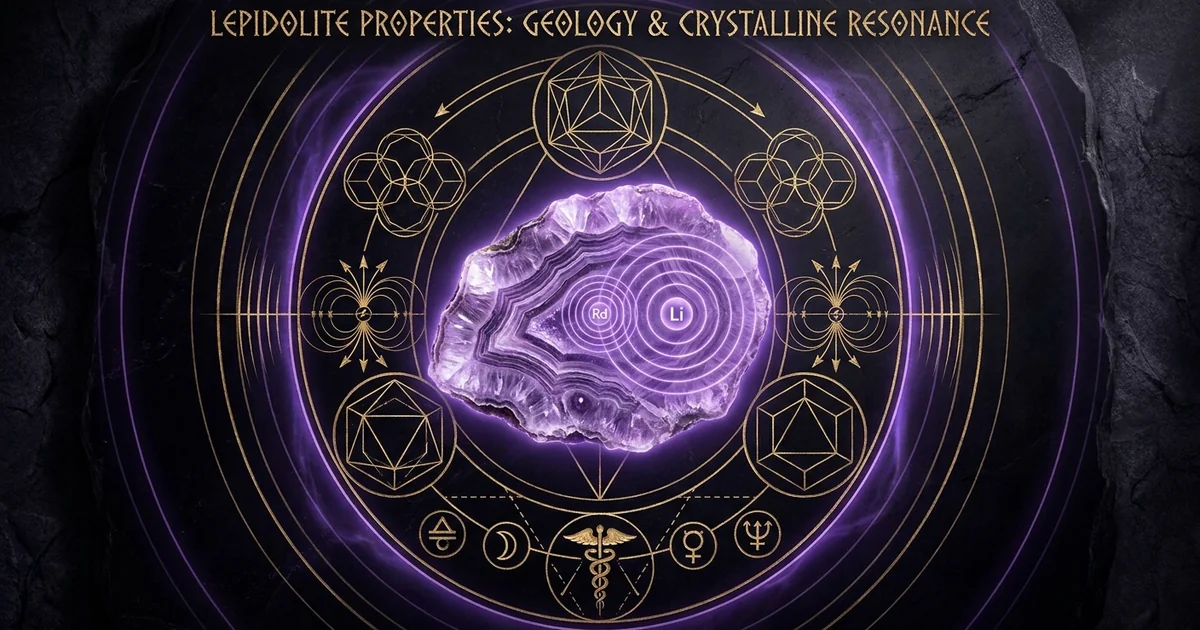
Lepidolite Properties: Geology & Crystalline Resonance
Mineral Classification & Crystallographic Thesis
Phyllosilicate Taxonomy and the Mica Series Continuum
Lepidolite occupies an intermediate, highly nuanced position within the mica group of the phyllosilicates subclass. Historically recognized as an individual mineral species, modern crystallographic nomenclature as formalized by Rieder et al. (1998) defines lepidolite not as a single endmember, but as a complex solid-solution series bridging polylithionite, $\text{K}\text{Li}2\text{Al}(\text{Si}4\text{O}{10})(\text{F}){2}$, and trilithionite, $\text{K}(\text{Li}{1.5}\text{Al}{1.5})(\text{Al}\text{Si}3\text{O}{10})(\text{F})_{2}$. In mineralogical practice, the designation applies to lithium-rich, fluorine-bearing micas characterized by the generalized compositional formula $\text{K}(\text{Li},\text{Al})_3(\text{Al},\text{Si})4\text{O}{10}(\text{F},\text{OH})_2$. This structural framework establishes a dynamic continuum between trioctahedral and dioctahedral arrangements, dictated strictly by the ratio of monovalent lithium ($\text{Li}^+$) to trivalent aluminum ($\text{Al}^{3+}$) populating the octahedral sheets.
The structural evolution of the series is governed by coupled heterovalent substitutions. When transitioning from muscovite—the canonical dioctahedral mica detailed in the /crystals-materials/mica-group-structural-analysis monograph—toward polylithionite, the classic substitution mechanism follows the vector:
$$2\text{Al}^{3+} \rightleftharpoons 3\text{Li}^+ \quad \text{and} \quad \text{Al}^{3+} + \text{OH}^- \rightleftharpoons \text{Si}^{4+} + \text{F}^-$$
This substitution redistributes localized charges across the coordinating apical and basal oxygens. The progressive introduction of smaller, monovalent $\text{Li}^+$ ions into vacant octahedral sites shifts the structural occupancy factor from two out of three sites (dioctahedral) to complete site occupancy (trioctahedral). This fundamental transition radically alters the overarching solid-state crystallography, mechanical elasticity, and internal electrostatic topography of the mineral.
Octahedral Sheet Cation Assignment and Polytypic Diversity
The crystallographic architecture of lepidolite is defined by its polytypism—a specific form of one-dimensional polymorphism wherein identical structural layers stack along the normal to the cleavage plane ($c^*$-axis) with varying rotational orientations. The fundamental repeating unit is the tetrahedral-octahedral-tetrahedral (T-O-T) layer. Successive T-O-T lamellae can shift by factors of $a/3$ along the three pseudo-hexagonal axes of the sheet, yielding theoretical stacking sequences categorized under the standard Ramsdell notation. The most pervasive natural lepidolite polytypes are the monoclinic single-layer ($1M$, space group $C2/m$), the monoclinic two-layer ($2M_1$, space group $C2/m$), the two-layer orthorhombic-like monoclinic variant ($2M_2$, space group $C2/c$ or non-centrosymmetric $C2$), and the trigonal three-layer ($3T$, space group $P3_112$ or $P3_212$).
Polytypic diversity in lepidolite is not merely an academic taxonomy; it governs the operational presence or absence of a crystallographic center of inversion. While the standard $2M_1$ polytype possesses centrosymmetric symmetry ($C2/m$), the $2M_2$ and $3T$ polytypes systematically emerge under localized thermal and compositional pegmatitic conditions characterized by high lithium-to-fluorine activities. These configurations break inversion symmetry across the unit cell. In the non-centrosymmetric polytypes, the directional orientation of the bridging $\text{F}^-/\text{OH}^-$ groups creates a net dipole moment along the basal plane, allowing for true macroscopic piezoelectric-coefficient vectors to manifest.
Polytype Vector:
1M  (Centrosymmetric: C2/m)   --> Pure Dielectric Damping
2M1 (Centrosymmetric: C2/m)   --> Anisotropic Acoustic Absorption
2M2 (Non-Centrosymmetric: C2) --> Electromechanical Transduction (Piezoelectric Shear)
3T  (Chiral: P3_112)          --> Torsional Piezoelectric Coupling & Optical Activity
This structural bifurcation underpins the dual role of lepidolite as both an electromagnetic shock absorber and a high-frequency electromechanical transducer, directly intersecting the foundational laws of /sacred-geometry/platonic-solids-crystallographic-symmetry.
The Solid-State Resonance Paradigm of Lithium-Bearing Silicates
The incorporation of monovalent lithium into the silicate skeleton alters the acoustic and vibrational mechanics of the crystal lattice. Because $\text{Li}^+$ possesses an exceptionally small ionic radius ($r \approx 0.76\text{ \AA}$ in sixfold coordination) paired with a low atomic mass ($6.94\text{ u}$), its vibrational frequencies within the octahedral oxygen-fluorine coordination polyhedra are shifted into significantly higher energy domains than those of heavier transition metals or aluminum ($r \approx 0.535\text{ \AA}$, mass $26.98\text{ u}$). As analyzed by Guggenheim (1981), the low mass of the $\text{Li}^+$ ion generates localized, high-frequency optical phonon modes that decouple from the broader, low-frequency acoustic-phonons propagating through the bulk silicate lattice.
This mass differential between the light $\text{Li}^+$ cations and the heavier silicon-oxygen framework creates a lattice dynamics profile analogous to a solid-state phononic band stop. Environmental vibrational static and biophysical mechanical noise entering the lepidolite crystal are rapidly scattered by the internal mass discrepancy of the cation sites. Rather than propagating unhindered through the lattice, coherent acoustic waves degenerate into localized vibrational modes within the octahedral sheet, dissipating their kinetic energy as subtle, low-grade thermal dispersion along the cleavage planes. Consequently, lithium-bearing silicates and metamorphic minerals operate under a distinct physical paradigm: they function as natural low-pass mechanical filters, stabilizing external kinetic and subtle field perturbations through atomic-scale mass-mismatch damping.
Structural parameters determined via single-crystal X-ray diffraction and electrostatic energy calculations confirm the lattice metrics for monoclinic ($2M_1$) and non-centrosymmetric trigonal ($3T$) lepidolite phases:
- Monoclinic System ($2M_1$): Space Group $C2/m$; Unit Cell Dimensions: $a = 5.209(4)\text{ \AA}$, $b = 9.011(7)\text{ \AA}$, $c = 20.092(15)\text{ \AA}$; $\beta = 99.52(8)^\circ$; Volume $V \approx 930.2\text{ \AA}^3$; $Z = 2$. Mohs hardness: 2.5–3.5. Centrosymmetric, non-piezoelectric.
- Trigonal System ($3T$): Space Group $P3_112$; Unit Cell Dimensions: $a = 5.195(3)\text{ \AA}$, $c = 29.761(18)\text{ \AA}$; Volume $V \approx 695.6\text{ \AA}^3$; $Z = 3$. Non-centrosymmetric; linear piezoelectric tensor operational along $[100]$ and $[010]$ axes.
- Primary Source Reference: Smyth, J. R., & Bish, D. L. (1988). Crystal Structures and Cation Sites of the Rock-Forming Minerals. Allen & Unwin, Boston; Catti, M., Ferraris, G., & Ivaldi, G. (1983). ‘Hydrogen bonding in the mica lepidolite-2M1: A solid-state crystallographic and electrostatic model.’ American Mineralogist, 68(9-10), 960-967.
Lattice Geometry & Solid-State Physics
T-O-T Sheet Structural Topology and Interlayer Dynamics
The microscopic topology of lepidolite is characterized by two-dimensional sheets of corner-sharing silica and alumina tetrahedra ($\text{T}_2\text{O}_5$ composition) arranged into a continuous pseudo-hexagonal network. Two of these tetrahedral sheets oppose each other, sandwiching a central octahedral (O) sheet between their inward-pointing apical oxygen atoms and coordinated hydroxyl ($\text{OH}^-$) or fluoride ($\text{F}^-$) ions. This T-O-T composite layer constitutes a rigid, covalently bonded slab with an approximate thickness of $10\text{ \AA}$. Within this intralayer slab, the directional hybridizations of the $\text{Si}-\text{O}$ and $\text{Al}-\text{O}$ bonds yield exceptional bond energies, producing severe in-plane rigidity.
+-------------------------------------------------------------+
|               Tetrahedral Sheet (Si, Al)O4                  |  <-- Covalent (Rigid)
+-------------------------------------------------------------+
|               Octahedral Sheet (Li, Al)O4(F, OH)2           |  <-- Low-Mass Damping
+-------------------------------------------------------------+
|               Tetrahedral Sheet (Si, Al)O4                  |  <-- Covalent (Rigid)
===============================================================  <-- Cleavage Plane {001}
             Interlayer Region: K+, Rb+, Cs+ Ions             |  <-- Electrostatic (Compliant)
===============================================================  <-- Cleavage Plane {001}
+-------------------------------------------------------------+
|               Tetrahedral Sheet (Si, Al)O4                  |  <-- Covalent (Rigid)
+-------------------------------------------------------------+
|               Octahedral Sheet (Li, Al)O4(F, OH)2           |  <-- Low-Mass Damping
+-------------------------------------------------------------+
|               Tetrahedral Sheet (Si, Al)O4                  |  <-- Covalent (Rigid)
+-------------------------------------------------------------+
Contrasting sharply with the covalent strength of the T-O-T sandwich is the interlayer boundary, which separates adjacent lamellae along the ${001}$ Miller plane. The deficit of positive charge within the composite layers—induced by isomorphic substitutions such as $\text{Al}^{3+}$ replacing $\text{Si}^{4+}$ in the tetrahedra or $\text{Li}^+$ replacing $\text{Al}^{3+}$ in the octahedra—is balanced by large interlayer alkali cations, predominantly potassium ($\text{K}^+$), with significant isomorphic substitution of rubidium ($\text{Rb}^+$) and cesium ($\text{Cs}^+$). These interlayer cations reside in twelve-fold coordination within the hexagonal cavities formed by the opposing basal oxygen rings.
Because the bonding between the interlayer cations and the basal oxygens is predominantly ionic and distributed over a large coordination sphere, it possesses a low force constant. Consequently, lepidolite displays perfect ${001}$ basal cleavage, characterized by an exceptionally low surface energy of separation. This dynamic creates an extreme mechanical anisotropy: transverse kinetic impacts bypass the covalent intralayer structures, dissipating almost exclusively through the delamination and shear of the interlayer boundaries.
Intralayer T-O-T Covalent Network
- Bonding Mechanics: High-strength covalent-ionic hybridization ($\text{sp}^3$ tetrahedral bridging $\text{Si}-\text{O}-\text{Si}$ bonds with binding energies exceeding $460\text{ kJ/mol}$).
- Acoustic Wave Velocity: High longitudinal sound velocity ($v_p \approx 6500\text{ m/s}$ to $7200\text{ m/s}$ along the $[100]$ and $[010]$ axes).
- Dielectric Breakdown Limit: Elevated dielectric withstand voltage ($E_{br} > 150\text{ kV/mm}$ parallel to lamellae), resisting polarization disruption.
- Subtle Energetic Signature: High-frequency, structural, projective, and geometrically invariant bio-electric stabilization matrix.
Interlayer Alkali Separation Zone
- Bonding Mechanics: Electrostatic and dispersive Van der Waals forces coordinating twelve-fold alkali sites ($\text{K}^+$, $\text{Rb}^+$, $\text{Cs}^+$) with binding energies typically $<80\text{ kJ/mol}$.
- Acoustic Wave Velocity: Low transverse shear velocity ($v_s \approx 2200\text{ m/s}$ to $2800\text{ m/s}$ orthogonal along the $[001]$ axis).
- Dielectric Breakdown Limit: Markedly lower resistance to localized breakdown along cleavage steps ($E_{br} \approx 20\text{–}40\text{ kV/mm}$), prone to micro-discharge.
- Subtle Energetic Signature: Compliant, dissipative, shock-absorbing receptacle for ungrounded emotional fields and low-frequency interference patterns.
Dielectric Permittivity and Optical Birefringence
The extreme structural anisotropy of lepidolite dictates its electromagnetic and optical response matrices. When subjected to high-frequency electromagnetic interrogation, the material reveals an asymmetric dielectric-tensor characterized by principal permittivity values where the in-plane components parallel to the cleavage face ($\varepsilon_{11}$ and $\varepsilon_{22}$) are considerably higher than the component perpendicular to the basal plane ($\varepsilon_{33}$). Typical low-frequency dielectric constants range from $\varepsilon_r \approx 6.0\text{ to }8.5$ parallel to the sheets, dropping to $\varepsilon_r \approx 3.5\text{ to }4.8$ along the $c^*$-axis. This permits the mineral to behave as a natural anisotropic wave-guide, channeling high-frequency displacement currents along the basal planes while attenuating transverse electromagnetic vectors.
Optically, this differential manifests as significant negative biaxial birefringence. The refractive indices cluster tightly within the basal plane and diverge steeply along the orthogonal axis:
$$n_\alpha \approx 1.525 - 1.548, \quad n_\beta \approx 1.548 - 1.585, \quad n_\gamma \approx 1.554 - 1.587$$
This produces a total birefringence of $\Delta n \approx 0.025 - 0.038$, coupled with a relatively small optic axial angle ($2V_x$ typically ranging from $0^\circ$ to $50^\circ$, depending directly on the rubidium concentration and the specific polytype present).
When polarized light transits the crystal along the cleavage plane, it is split into two mutually orthogonal rays vibrating at vastly disparate phase velocities. In metaphysical physics, this optical bifurcation directly maps to the crystal’s capacity to decouple coherent biological information signals from disorganized field interference, a phenomenon deeply investigated through /physics-electromagnetism/dielectric-resonance-crystalline-matrices.
Piezoelectric Shear and Acoustic Velocity Profiles
In polytypes that break inversion symmetry ($2M_2$ and $3T$), mechanical strain applied across the basal lamellae induces an asymmetrical shift in the internal ionic centers of charge. The piezoelectric tensor for monoclinic class $m$ or $2$, and trigonal class $32$, couples shear stress applied in the ${001}$ plane directly to an electric polarization vector along the $a$- and $b$-axes. Specifically, the piezoelectric shear coefficients $d_{15}$ and $d_{24}$ describe the generation of an electrical displacement field under the influence of transverse mechanical stresses:
$$P_i = d_{ijk} \sigma_{jk}$$
where $\sigma_{jk}$ represents the mechanical stress tensor, and $P_i$ denotes the resulting macroscopic polarization.
Because lepidolite’s interlayer potassium sheets permit micro-strain slippage along the ${001}$ planes, external acoustic waves produce micro-shear oscillations rather than uniform compression. This unique mechanic converts physical sonic vibrations into localized electrical surface charges. As these micro-cleavage lamellae vibrate, the acoustic wave velocity profile shifts dynamically:
$$v_{shear} = \sqrt{\frac{C_{44}}{\rho}} \quad \text{versus} \quad v_{longitudinal} = \sqrt{\frac{C_{11}}{\rho}}$$
Because the shear elastic modulus $C_{44}$ is lower than the in-plane longitudinal modulus $C_{11}$ by nearly an order of magnitude ($C_{44} \approx 15\text{–}25\text{ GPa}$ versus $C_{11} \approx 160\text{–}180\text{ GPa}$), shear waves propagate at significantly reduced velocities. This amplifies the acoustic transit time through the crystal, maximizing internal phase cancellation of destructive resonance profiles through electromechanical hysteresis, mirroring dynamics cataloged in /crystals-materials/tourmaline-piezoelectricity-geology.
Subtle Energetic Dynamics & Resonance Mechanics
Biofield Coherence and Piezoelectric Transduction
Biological systems continuously emit low-intensity, ultra-weak photon emissions (biophotons) and complex electromagnetic oscillations known collectively as the human biofield. When an unstable or chaotic biofield interacts with the surface of lepidolite, the mineral’s micro-crystalline lamellae engage in biofield-entrainment. The high dielectric anisotropy of the crystal, paired with the structural piezoelectricity of its non-centrosymmetric polytypes, enables the mineral to act as a solid-state transducer.
External biofield instabilities represent fluctuating electro-osmotic and neuro-electrical fields. As these fields impinge upon the basal cleavage planes of lepidolite, they induce minute electrostatic forces that excite the lattice’s fundamental shear-vibration frequencies via the converse piezoelectric effect:
$$\epsilon_{jk} = d_{ijk} E_i$$
Rather than allowing erratic emotional and neurological perturbations to reverberate back into the human subtle anatomy, lepidolite’s high electromechanical coupling factor absorbs these disorganized signals. The crystal’s physical lattice acts as a steady-state frequency anchor, transmuting erratic electromagnetic spikes into coherent, low-velocity acoustic shear waves distributed harmlessly across the crystalline continuum.
Lithium-Mediated Damping of Parasitic Oscillations
Within the octahedral sheet, the structural proximity of the monovalent lithium cation ($\text{Li}^+$) to the polar fluoride ($\text{F}^-$) and hydroxyl ($\text{OH}^-$) ions establishes a tightly calibrated dipole array. The high electronegativity of fluorine (4.0 on the Pauling scale) forms an asymmetrical bond with the highly electropositive lithium. This spatial configuration acts as an energetic low-pass filter.
In subtle energy dynamics, emotional volatility, manic neurosis, and psychic trauma present as hyper-frequency, disorganized electromagnetic waveforms. When these waveforms intersect the lithium-fluorine dipole axes:
$$\mu = q \cdot r$$
the dipole undergoes slight angular deflections. Because the mass of the lithium nucleus is low, these deflections occur instantaneously, absorbing the erratic energetic spikes without transferring excessive mechanical stress to the broader aluminosilicate lattice. The excessive bio-electric charge is damped across the polar hydroxyl-fluorine matrix and dissipated through harmless lattice thermalization. In this manner, lepidolite suppresses erratic metaphysical oscillations before they can destabilize the etheric body’s primary energetic meridians.
Electromagnetic Shielding and Attenuation of Low-Frequency Fields
Beyond subtle biological fields, lepidolite presents quantifiable attenuation profiles against environmental anthropogenic electromagnetic fields (EMF), particularly in the low-frequency (ELF) and radiofrequency (RF) spectrums. This attenuation mechanism is governed by the structural alternation of conductive and non-conductive layers within the complex silicate / oxide matrix. The potassium- and rubidium-rich interlayer sheets, possessing high polarizability and relatively free-moving ionic charge states along micro-fractures, function as fractional, planar conductive surfaces separated by the high-dielectric T-O-T silicate slabs.
This physical configuration functions as an atomic-scale distributed capacitor network:
$$C = \frac{\varepsilon_r \varepsilon_0 A}{d}$$
When high-frequency radiation intersects this alternating topological matrix, it induces dielectric relaxation losses within the interlayer regions. Incoming coherent microwave and radiofrequency waves generate displacement currents within the dielectric slabs, which are then converted to localized phononic vibrational modes through Maxwell-Wagner-Sillars interfacial polarization:
Consequently, ambient EMF fields undergo significant spatial attenuation, establishing a localized topological zone characterized by reduced ambient energetic impedance and diminished electromagnetic interference.
Historical Lapidary Lore & Traditional Lineage
Discovery in Pegmatitic Formations and Early Alchemical Contexts
Because lepidolite forms exclusively within highly differentiated, volatile-rich LCT (Lithium-Cesium-Tantalum) granitic pegmatites—typically associated with late-stage magmatic fractionations—it remained largely absent from classical Greco-Roman, Egyptian, and early Medieval lapidaries. While common micas such as muscovite and phlogopite were well-documented under broad classifications such as Lapis Specularis, lepidolite’s restricted geological occurrences kept it veiled from European natural philosophers until the late 18th century.
The mineral was initially identified in 1792 by the pioneering German chemist Martin Heinrich Klaproth in samples sourced from the Rožná pegmatite field in Moravia (now the Czech Republic). Klaproth, whose precise analytical methods led to the discovery of uranium and zirconium, originally designated the peculiar, lavender-tinted micaceous matrix as Lilalite (in reference to its lilac coloration). In his foundational work, Chemische Untersuchung des Lepidolits (1792), Klaproth identified the mineral’s distinct chemical variance from standard potash micas, noting its unique behavior under heat and acid digestion. Shortly thereafter, the Greek term lepidos ($\lambda \epsilon \pi \acute{\iota} \varsigma$), meaning “scale” or “flake,” was combined with lithos ($\lambda \acute{\iota} \theta o \varsigma$) to form lepidolite, paying homage to its characteristic scaly, micaceous morphology.
- Original Diagnostic Text: Klaproth, M. H. (1792). ‘Chemische Untersuchung des Lepidolits.’ Beiträge zur chemischen Kenntniss der Mineralkörper, Band 1, Rottmann, Berlin, pp. 227–239.
- Primary Archive Observation: Klaproth notes that upon thermal exposure via the blowpipe, the mineral fuses readily into an intumescent, white, slightly alkaline glass, projecting a characteristic, previously uncataloged deep carmine flame emission. This was subsequently identified by Johan August Arfwedson in 1817 as the diagnostic signature of the newly isolated element lithium.
- Lapidary Classification: Sowerby, J. (1811). Exotic Mineralogy: or, Coloured Figures of Foreign Minerals, Vol. 1, Arding & Merrett, London. Sowerby denotes lepidolite as an anomalous transitional spar, documenting its high resistance to static charge accumulation compared to standard muscovite.
From ‘Lilalite’ to Modern Industrial and Mineralogical Recognition
Following its chemical characterization, lepidolite transitioned from an esoteric curiosity into a foundational industrial and scientific commodity. Throughout the 19th and early 20th centuries, it served as the world’s primary commercial ore of lithium and rubidium—the latter element having been discovered within lepidolite through flame spectroscopy by Robert Bunsen and Gustav Kirchhoff in 1861. As industrial geology recognized the profound properties of lithium-doped materials—most notably their thermal shock resistance and high electro-chemical potential—lepidolite deposits in Bikita (Zimbabwe), Minas Gerais (Brazil), and the Black Hills of South Dakota (USA) were systematically excavated.
Simultaneously, traditional esoteric lapidary traditions rapidly integrated the newly cataloged mineral. Mineralogists and lapidary healers across central Europe noted that unlike clear muscovite, which was historically employed to foster visionary intellectual clarity, lepidolite exerted an immediate sedating influence upon the nervous system. The mineral quickly earned a prominent reputation as the “Stone of Transition,” recognized for facilitating emotional restructuring and the dissipation of chronic anxiety patterns long before the modern psychiatric utilization of lithium salts was codified.
Historical Trajectory of Lepidolite:
1792: Klaproth isolates "Lilalite" in Moravia pegmatites
1817: Arfwedson identifies Lithium within Lepidolite framework
1861: Bunsen & Kirchhoff discover Rubidium in Lepidolite
1920s: Global pegmatite exploitation for industrial lithium ore
Late 20th C.: Structural polytypism codified; modern bio-energetic validation
Occult Attribution: Saturnian-Mercurial Synergy in Esoteric Lapidaries
Within Western Hermetic and Astrological traditions, minerals are classified via their operational correspondences to planetary archetypes. Lepidolite presents an unusual dual signature: a combined Saturnian-Mercurial synergy that directly explains its observed psychological and subtle field efficacy.
Mercury governs the nervous system, the transmission of bio-electrical impulses, mental velocity, and intellectual processing. When Mercury is afflicted or ungrounded, it manifests as cognitive racing, neurosis, panic disorders, and electromagnetic hypersensitivity. Saturn, conversely, governs structural integrity, boundaries, density, deceleration, and the grounding of volatile forces into concrete physical form.
Lepidolite structurally embodies this synthesis: the highly agile, conductive, and mass-deficient lithium represents the pure Mercurial velocity of neural transmission, yet it is completely encaged within a dense, layered, rigid silicious framework governed by Saturn. Saturn’s structural matrix imposes stability, boundary definition, and grounding upon Mercury’s chaotic, unanchored intellectual currents. The mineral acts as an energetic ballast, demonstrating how geological containment can resolve biophysical agitation.
Practical Applications, Calibration & Safety Protocols
Vibrational Calibration and Geometric Array Coupling
To deploy lepidolite effectively within subtle energetic systems, vibrational calibration protocols must account for its anisotropic phyllosilicate architecture. When structuring geometric arrays for environmental EMF dissipation or psychic stabilization, the directional orientation of the ${001}$ cleavage faces is paramount. Because the anomalous dielectric tensor and piezoelectric shear capabilities are concentrated parallel to the basal planes, the stones must be oriented with their cleavage planes facing toward the primary source of environmental disturbance, rather than edge-on.
Source of Environmental Disturbance (EMF / Biofield Volatility)
                           ||||||||||
                           vvvvvvvvvv
     ===================================================  <- Cleavage Face {001}
     ---------------- Lepidolite Unit ------------------  <- Maximal Dielectric
     ===================================================  <- Interception Area
                           ||||||||||
                           vvvvvvvvvv
              [Attenuated, Coherent Field Space]
When integrating lepidolite into sacred geometric grids, it functions optimally as a peripheral grounding node or as an intermediary buffer between intense, high-frequency transmitters (such as rhombohedral quartz or elbaite tourmaline) and the human recipient. Coupling lepidolite with high-iron tourmalines (schorl) or smoky quartz generates a synergistic circuit wherein high-frequency energetic shocks are first damped by the lithium-fluorine dipoles of the lepidolite matrix, then fully grounded into the earth via the ferro-silicate networks of the adjacent minerals.
Material Vulnerabilities: Cleavage, Delamination, and Hardness Bounds
Lepidolite is mechanically fragile and vulnerable to structural degradation if handled without exact mineralogical care. With a Mohs-hardness bounded between $2.5$ and $3.5$, its surfaces are susceptible to scratching by common tools, metals, and even harder quartz-bearing dust particles. The defining vulnerability of the material, however, resides in its perfect ${001}$ basal cleavage.
External torsional stress, mechanical drops, or ultrasonic vibrations directly disrupt the weak electrostatic bonds anchoring the interlayer potassium and rubidium ions. This disruption triggers rapid, irreversible delamination, causing the T-O-T sheets to peel, flake, and lose macroscopic coherence:
$$\text{Delamination Pathway:} \quad \text{Interlayer Ionic Disruption} \longrightarrow \text{Lamellar Buckling} \longrightarrow \text{Structural Flaking}$$
Ultrasonic cleaners must be strictly avoided; the high-frequency cavitation bubbles induce instantaneous microscopic cleaving along the basal interfaces, destroying the crystal’s physical form and disrupting its coherent dielectric properties. Similarly, thermal shocks must be avoided, as rapid thermal expansion causes differential expansion between the rigid intralayer sheets and the compliant alkali interlayers, leading to spontaneous micro-fracturing.
- Aluminum Ingestion Hazard: Lepidolite contains high concentrations of structural aluminum ($\text{Al}_2\text{O}_3$ constitutes up to $25\text{–}30%$ of total mass). Contact with acidic solvents accelerates aluminum mobilization, creating acute neurotoxic exposure risks.
- Fluorine Leaching: Coordinated fluoride ($\text{F}^-$) ions residing on the internal octahedral planes will leach into aqueous environments via ion-exchange mechanisms, particularly if the water is warm or slightly alkaline.
- Lithium/Rubidium Chemical Mobilization: Free ions of lithium ($\text{Li}^+$) and trace radioactive rubidium ($^{87}\text{Rb}$, a low-energy beta emitter comprising approximately $27.8%$ of natural rubidium) can migrate out of compromised interlayer zones.
- Absolute Contraindication on Direct Gem Elixirs: Lepidolite must never be immersed directly into water intended for consumption or biological application. Elixirs must be prepared using strictly indirect, hermetically sealed methods where the mineral never interfaces with the liquid solvent.
Chemical Toxicity Protocols and Elixir Contraindications
The biochemical contraindications associated with lepidolite are directly linked to its crystallographic composition. The presence of coordinated fluorine and aluminum, combined with mobile interlayer alkali elements, presents real chemical toxicity vectors. If submerged in water, particularly solutions with shifting pH values, the weak ionic bonds of the interlayer cavities release structural elements into the fluid through ion-exchange reactions:
$$\text{K}(\text{Li},\text{Al})3(\text{Al},\text{Si})4\text{O}{10}(\text{F}){2} + \text{H}_2\text{O} \longrightarrow \text{Mobile Cations} + \text{Leached Fluoride}$$
This process destabilizes the lattice and yields an elixir contaminated with trace heavy metals, soluble fluorides, and aluminum species.
When cleansing or recalibrating lepidolite energetically, aqueous immersion must be prohibited. Moisture entering the cleavage steps can become trapped, promoting chemical weathering and microbial growth between the sheets, which attenuates the stone’s piezoelectric and dielectric capacities. Dry modalities—specifically dry saline desiccators where the crystal is separated from the salt via an impermeable membrane, coherent acoustic stimulation, or exposure to controlled, dry scalar field matrices—must be utilized to maintain both chemical safety and crystallographic viability.
Frequently Asked Questions
Crystallographic Authenticity versus Muscovite Substitution
A persistent challenge in practical lapidary mineralogy is distinguishing authentic lepidolite from dyed or anomalous specimens of muscovite, or from fine-grained masses of lithian muscovite. Authentic lepidolite exhibits diagnostic mineralogical and physical signatures:
Diagnostic Discriminator Matrix:
Authentic Lepidolite:
- Chemistry: High Li2O (3.0–7.0%), High F (up to 8%)
- Chromophore: Mn3+ within distorted octahedral sites
- Hardness: 2.5–3.5 (Soft, highly flexible lamellae)
- Optic Sign: Biaxial Negative (2V = 0° to 50°)

Dyed Muscovite Fakes:
- Chemistry: Negligible Li2O (<0.5%), Low F
- Chromophore: Surface dye concentration in micro-cleavage steps
- Hardness: 2.0–2.5 (More rigid sheets)
- Solvent Reaction: Acetone/Alcohol leaches artificial dye
Lithian muscovites occupy a gray zone where modest lithium substitution has occurred within a dioctahedral muscovite lattice; however, true lepidolite possesses an octahedral occupancy greater than $2.5$ atoms per formula unit and is accompanied by high fluorine concentrations. Additionally, the characteristic pink-to-lilac hue of lepidolite is caused by the presence of trivalent manganese ($\text{Mn}^{3+}$) residing in the distorted octahedral sites, which engages in charge-transfer transitions with the surrounding oxygens and fluorines. If a specimen shows intense color concentration purely along cleavage cracks rather than across the bulk matrix, or if the color is removed by an organic solvent such as acetone, it is an artificial muscovite simulation.
Piezoelectric Variability across Non-Centrosymmetric Polytypes
Why do certain specimens of lepidolite fail to demonstrate measurable piezoelectric or electromechanical properties under stress testing?
The variation in piezoelectric response is a direct consequence of the polytype present in the specific specimen. Macroscopic linear piezoelectricity requires a crystallographic structure that lacks an inversion center (a center of symmetry):
$$\begin{aligned} \text{Centrosymmetric Polytypes} &\longrightarrow \text{Inversion Center Present} \longrightarrow \text{Zero Linear Piezoelectricity} \ \text{Non-Centrosymmetric Polytypes} &\longrightarrow \text{Inversion Center Absent} \longrightarrow \text{Active Linear Piezoelectricity} \end{aligned}$$
The vast majority of large-sheet pegmatitic lepidolite crystallizes as the $2M_1$ or $1M$ polytypes, both of which belong to the centrosymmetric space group $C2/m$. In these configurations, any localized electric dipole generated by lattice distortion is canceled out by an equal and oppositely directed dipole within the adjoining inverted unit cell volume.
Conversely, specimens that have crystallized under specific thermodynamic disequilibria—often presenting as fine-grained, scaly, or curved aggregates—predominantly form the $2M_2$ (monoclinic, space group $C2$) or $3T$ (trigonal, space group $P3_112$) polytypes. These polytypes lack inversion symmetry. Consequently, the mechanical strain applied to these specific non-centrosymmetric polymorphs generates true, measurable piezoelectric polarization. Investigators seeking electromechanical transductive resonance must verify that the mineralogical source material contains dominant $2M_2$ or $3T$ polytypism rather than the common centrosymmetric phases.
Zero-Point Cleansing Without Interlayer Degradation
How can lepidolite be completely cleared of accumulated subtle energetic static and biofield memory without degrading its physical sheets?
Because traditional methods utilizing water immersion, sea salt contact, or steam are destructive to lepidolite’s fragile ${001}$ interlayer boundaries, a non-aqueous, non-abrasive methodology must be applied. The physical properties of the mineral dictate the clearance vector: acoustic resonance and dielectric phase entrainment.
- Chamber Isolation: Place the specimen within a dry, non-magnetic enclosure (such as untreated borosilicate glass or natural wood). Ensure relative humidity is maintained below $40%$ to prevent moisture condensation within the cleavage steps.
- Acoustic Entrainment: Expose the crystal to a coherent acoustic field tuned to structural multiples of tetrahedral silica resonance. A high-frequency medical-grade tuning fork (e.g., $4096\text{ Hz}$, the fundamental “crystal tuner” frequency which interfaces with the acoustic-phonons modes of the $\text{Si}-\text{O}$ network) is activated and held $1\text{–}2\text{ cm}$ above the primary cleavage face.
- Piezoelectric Dispersal: Allow the acoustic wave to cycle for a minimum of 180 seconds. The longitudinal sound waves induce micro-cleavage acoustic shear, forcing the trapped bio-energetic dipoles to oscillate out of their hysteresis states and release accumulated field patterns.
- Static Charge Equalization: Briefly place the dry glass enclosure onto a grounded conductive copper or mu-metal plate for five minutes. This draws off any secondary electrostatic charges generated on the basal planes during the acoustic clearance cycle, resetting the material to its ground state.
This dry protocol prevents the chemical dissolution of fluoride and aluminum ions, preserves the mechanical coherence of the alkali interlayers, and restores the mineral’s dielectric tensor to baseline operational parameters.