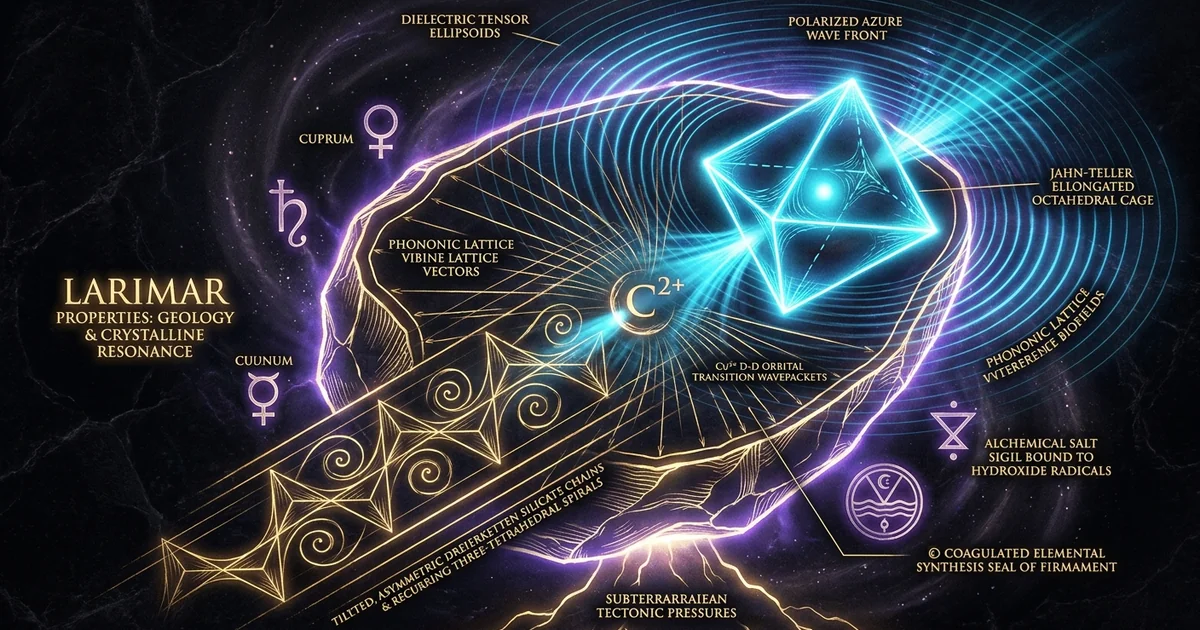
Larimar Properties: Geology & Crystalline Resonance
Mineral Classification & Crystallographic Thesis
Inosilicate Framework and the Pyroxenoid Group
Larimar is an extraordinarily rare, chromophoric, copper-substituted variety of pectolite, a sodium calcium inosilicate classified under the chemical formula $\mathrm{NaCa_2Si_3O_8(OH)}$. While standard mineralogical taxonomies frequently misalign pectolite with the true pyroxenes due to comparable metasilicate stoichiometries, structural crystallography identifies pectolite as a member of the pyroxenoid group. In true pyroxenes, continuous tetrahedral chains possess an identity period consisting of two repeating silicon-oxygen tetrahedra ($[SiO_3]_n$). Conversely, pectolite exhibits an elongated structural repeat unit consisting of three tetrahedra—a configuration designated structurally as a Dreierketten chain.
O(2)         O(5)
    |            |
-- Si(1) - O(1) - Si(2) - O(4) - Si(3) --
    |            |                 |
   O(3)         O(6)              O(7)...H...O(8)
Within this Dreierketten geometry, two tetrahedra share apical vertices oriented toward one side of the chain axis, while the third tetrahedron is tilted, sharing an edge with coordinating cation polyhedra. This three-tetrahedron periodicity breaks the orthogonal translational symmetry typical of higher-symmetry silicates, constraining pectolite to the triclinic crystal system, specifically crystallizing in the centrosymmetric space group $P\bar{1}$. Detailed single-crystal X-ray diffraction analyses reveal that this continuous single chain of composition $[Si_3O_8(OH)]^{5-}$ runs parallel to the crystallographic $[010]$ direction. The chain is laterally interconnected by bands of edge-sharing, distorted octahedral polyhedra occupied by divalent calcium ($\mathrm{Ca^{2+}}$) and monovalent sodium ($\mathrm{Na^+}$) cations, establishing an intricate atomic scaffold characterized by pronounced structural anisotropy. The fundamental mechanics of these interconnected polyhedra are explored extensively in the study of silicate lattices and pyroxenoids.
Structural solution data determined via single-crystal X-ray diffraction and electron microprobe analysis (EMPA) at 293 K:
- Empirical Formula: $\mathrm{Na_{0.98}(Ca_{1.94}Cu_{0.06})Si_{3.01}O_8(OH)}$
- Crystal System: Triclinic
- Space Group: $P\bar{1}$ (No. 2)
- Unit Cell Dimensions: $a = 7.99\text{ \AA}$, $b = 7.04\text{ \AA}$, $c = 7.02\text{ \AA}$
- Interaxial Angles: $\alpha = 90.5^\circ$, $\beta = 95.2^\circ$, $\gamma = 102.5^\circ$
- Unit Cell Volume ($V$): $383.67\text{ \AA}^3$
- Formula Units per Cell ($Z$): 2
- Calculated Density ($\rho_{calc}$): $2.84\text{ g/cm}^3$ (Observed: $2.74\text{–}2.88\text{ g/cm}^3$)
- Mohs Hardness: 4.5–5.0
- Optical Character: Biaxial Positive ($+$)
- Refractive Indices: $n_\alpha = 1.595\text{–}1.610$, $n_\beta = 1.603\text{–}1.615$, $n_\gamma = 1.632\text{–}1.645$
- Birefringence ($\delta$): $0.035\text{–}0.038$
- Cleavage: Perfect on ${100}$ and ${001}$, intersecting at approximately $90^\circ$
Cupriferous Substitution Dynamics in Pectolite
The macroscopic coloration distinguishing Larimar from ordinary white, grey, or colorless pectolite stems from isomorphic cation substitution within its octahedral sublattices. In pure pectolite, edge-sharing octahedra possess two crystallographically independent calcium sites, labeled $\mathrm{M1}$ and $\mathrm{M2}$, coordinated by six oxygen atoms, alongside an expanded, distorted six-coordinate sodium site designated as $\mathrm{M3}$. In Larimar, chromophoric divalent copper ions ($\mathrm{Cu^{2+}}$) selectively substitute for $\mathrm{Ca^{2+}}$ within these octahedral positions, as documented by Woodruff and Fritsch (1989).
This cationic exchange presents significant steric and thermodynamic complexity. The effective six-coordinate ionic radius of high-spin $\mathrm{Ca^{2+}}$ is $1.00\text{ \AA}$, whereas the six-coordinate radius of $\mathrm{Cu^{2+}}$ is markedly smaller at approximately $0.73\text{ \AA}$. Because of this substantial disparity in ionic radii ($\Delta r \approx 27%$), complete solid solution between pectolite and a hypothetical copper endmember cannot occur under near-surface equilibrium conditions; substitutions exceeding critical thermodynamic thresholds induce lattice strain that destabilizes the inosilicate chain.
Microprobe analyses indicate that copper concentrations in high-grade Larimar fluctuate predominantly between 0.05 and 2.5 weight percent $\mathrm{CuO}$. The substitution occurs preferentially within the non-equivalent, lower-symmetry calcium octahedral sites ($\mathrm{M2}$), where the localized electrostatic field can accommodate the lattice contraction. The resultant structural reconfiguration produces a localized reduction in the unit cell volume and induces micro-strain fields across adjacent Dreierketten siloxane bridges. This solid-state alteration governs not only the crystal’s optoelectronic response to ambient light, but also its broader macroscopic behavior within copper-bearing minerals energetics.
   [Ca2+ Octahedron] (r = 1.00 Å)
          │
          ▼  Isomorphic Substitution (Δr ≈ 27%)
   [Cu2+ Octahedron] (r = 0.73 Å)
          │
          ├─► Localized Unit Cell Contraction
          └─► Non-Cubic Electrostatic Gradient (Jahn-Teller Driven)
Petrogenetic Genesis within Sierra de Baoruco Basaltic Cavities
Larimar occupies an exceptionally narrow petrological niche. The world’s sole commercial paragenesis occurs in the Los Chupaderos deposit, located within the rugged interior of the Sierra de Baoruco in the southwestern Barahona Province of the Dominican Republic. This geological formation originated within the complex tectonic convergence zone of the Caribbean and North American plates during the late Cretaceous to early Paleogene epochs, culminating in late-stage volcanic and hydrothermal activity throughout the Eocene, Oligocene, and Miocene.
The host rock is a deeply weathered, hydrothermally altered basalt belonging to the Dumisseau Formation. These tholeiitic and basaltic-andesite flows feature extensive systems of gas vesicles, cooling fractures, and tectonic shear joints. Submarine and subaerial volcanic outpourings were followed by low-temperature, hydrothermal fluid circulation. Highly alkaline, silica-saturated fluids percolated through these basaltic lavas, dissolving primary plagioclase, augite, and secondary native copper and copper sulfide disseminations distributed throughout the volcanic strata.
As these hydrothermal brines migrated through structural conduits, they scavenged trace copper along with abundant calcium and sodium. Cooling of the fluids to temperatures estimated between $150^\circ\mathrm{C}$ and $250^\circ\mathrm{C}$, combined with moderate pH shifts caused by basalt-fluid wallrock interactions, led to the precipitation of pectolite within open amygdules, vesicles, and breccia voids. Rather than forming macroscopic euhedral prisms, the mineral crystallized rapidly as tightly intergrown, radial-fibrous spherulites and felted acicular crystal aggregates.
The paragenetic sequence within these voids reveals that Larimar precipitation was frequently coeval with, or immediately preceded by, the crystallization of secondary low-temperature silica polymorphs (such as chalcedony and quartz), alongside localized deposits of natrolite, hematite, calcite, and chalcocite. As Mandarino (1999) observed in comparative surveys of pyroxenoids, the rarity of this paragenesis is a direct consequence of the uncommon geochemical confluence required: highly alkaline, calcium-sodium-rich inosilicate solutions interacting directly with significant mobilized ionic copper reserves under low-pressure, low-temperature metamorphic conditions.
Lattice Geometry & Solid-State Physics
Dreierketten Chain Morphology and Triclinic Anisotropy
The crystallographic architecture of Larimar is dictated by the stereochemistry of its inosilicate Dreierketten backbone. The repeating unit consists of an apical pair of tetrahedra sharing an edge along the chain, linked to a third tilting tetrahedron that bridges the sequence across the $[010]$ vector. This spatial organization prevents the single chains from aligning along orthogonal axes, locking the unit cell into a low-symmetry triclinic crystal system ($a = 7.99\text{ \AA}, b = 7.04\text{ \AA}, c = 7.02\text{ \AA}$, with non-perpendicular angles $\alpha = 90.5^\circ, \beta = 95.2^\circ, \gamma = 102.5^\circ$).
c-axis
          ▲
          │       (001) Cleavage Plane
          │      /
          │     /
          │    /
          │   /
          │  /
          │ /      (100) Cleavage Plane
          └────────────────────────► a-axis
         /
        /  β = 95.2°
       /   α = 90.5°
      /    γ = 102.5°
     ▼
   b-axis (Chain Direction: [010])
Because Larimar crystallizes in the $P\bar{1}$ space group, its physical properties are directionally dependent. The silicate chains, extending uninterrupted along the $b$-axis, provide higher mechanical tensile integrity parallel to $[010]$ than transverse to it. Conversely, between adjacent Dreierketten chains, the crystal structure is held together solely by the ionic linkages of the $\mathrm{Ca-O}$ and $\mathrm{Na-O}$ polyhedral sheets and an asymmetric network of hydrogen bonds.
Consequently, the crystal displays two directions of perfect cleavage along the ${100}$ and ${001}$ crystallographic planes. When stress is applied, fracture mechanics propagate preferentially through these calcium-oxygen polyhedral interfaces rather than cleaving the strongly covalent $\mathrm{Si-O-Si}$ siloxane bonds of the chain backbone. This anisotropic mechanical profile directly affects phonon dispersion and dielectric response, as documented in the physical analyses of triclinic anisotropy and field geometry.
Jahn-Teller Distortion and Optoelectronic Absorbance
The sky-blue, sea-green, and deep azure hues of Larimar are not caused by physical micro-inclusions of secondary copper carbonates (such as azurite or malachite), but rather by electronic absorption phenomena rooted in solid-state crystal field theory. When divalent copper ($\mathrm{Cu^{2+}}$) substitutes for $\mathrm{Ca^{2+}}$ in an octahedral coordination environment, it introduces a $3d^9$ electronic outer-shell configuration. In an idealized octahedral ($O_h$) electrostatic field, the five degenerate $3d$ orbitals split into a lower triplet ($t_{2g}$: $d_{xy}, d_{xz}, d_{yz}$) and an upper doublet ($e_g$: $d_{z^2}, d_{x^2-y^2}$).
               [Idealized Octahedral: Oh]              [Tetragonally Distorted: D4h]
                                                              (Jahn-Teller)

                                                        ───  dx2-y2 (eg)
                      ───   ───  eg
                                                        ───  dz2 (eg)
   Free Ion (3d9) ──►
                                                        ───  dxy (t2g)
                      ───   ───   ───  t2g
                                                        ───   ───  dxz, dyz (t2g)
Because the higher-energy $e_g$ state contains three electrons, the ground state is orbitally degenerate, triggering the Jahn-Teller effect. According to the Jahn-Teller theorem, any non-linear molecular system in a degenerate electronic state undergoes geometric distortion to lower its symmetry and remove that degeneracy. In the pectolite matrix, the $\mathrm{[Cu(O,OH)6]}$ octahedron experiences an elongation along its axial $\mathrm{Cu-O}$ bonds and a compression along its equatorial plane, reducing the localized site symmetry from $O_h$ to approximately $D{4h}$ or $C_{2v}$.
This symmetry reduction splits both the $e_g$ and $t_{2g}$ sub-levels into non-degenerate energy states. As Burns (1993) demonstrated in his classic treatise on mineralogical crystal field theory, the resulting $d\text{–}d$ electronic transitions for $\mathrm{Cu^{2+}}$ in these distorted polyhedra yield a broad, polarization-dependent optical absorption band centered in the red-to-near-infrared portion of the electromagnetic spectrum, specifically between $650\text{ nm}$ and $800\text{ nm}$ ($15,380\text{ to }12,500\text{ cm}^{-1}$).
Transmittance (%)
100 ┌───────────────────────────────────────────────┐
    │                         *  *                  │
    │                      *        *               │
    │                    *            *             │
 50 │                   *              *            │
    │    Blue-Green    *                *  Absorption (Cu2+ d-d)
    │    Transmittance*                  *          │
    │   (480-520 nm) *                    * (650 nm)│
  0 └───┴──────┴─────┴──────┴─────┴──────┴─────┴────┘
       400    450   500    550   600    650   700  Wavelength (nm)
Ambient white light propagating through the Larimar lattice experiences strong absorption across the orange and red wavelengths, while the blue-green spectral window ($480\text{–}530\text{ nm}$) passes through with minimal attenuation. Variations in the local degree of Jahn-Teller distortion, coupled with trace substitution of trivalent iron ($\mathrm{Fe^{3+}}$) or vanadyl species, subtly adjust this absorption band, producing chromatic shifts ranging from deep cerulean blue to turquoise and pale sea-foam green.
Standard White Pectolite
- Chemical Formula: $\mathrm{NaCa_2Si_3O_8(OH)}$
- Octahedral Coordination: Fully ordered $\mathrm{Ca^{2+}}$ and $\mathrm{Na^+}$ sites; unperturbed octahedral polyhedra without electronic degeneracies.
- Optical Absorbance: Flat, high-transmittance profile across the visible spectrum ($400\text{–}700\text{ nm}$); no distinct $d\text{–}d$ crystal field transitions; white or colorless appearance.
- Dielectric Loss Factor ($\tan \delta$): Low and uniform across high-frequency domains ($\tan \delta \approx 10^{-3}\text{ to }10^{-4}$ at $1\text{ MHz}$); predictable dielectric dispersion.
- Lattice Micro-strain: Near-zero localized steric strain; uniform Dreierketten siloxane bridge distances without local orbital distortions.
- Phonon Dispersion: Coherent acoustic phonon propagation along the $[010]$ axis without localized scattering centers.
Cupriferous Blue Larimar
- Chemical Formula: $\mathrm{Na(Ca_{1-x}Cu_x)_2Si_3O_8(OH)}$ ($x \approx 0.01\text{–}0.05$)
- Octahedral Coordination: Disordered $\mathrm{Cu^{2+}}$ substitution at $\mathrm{M2}$ sites; localized tetragonal Jahn-Teller axial elongation.
- Optical Absorbance: Pronounced asymmetric absorption band centered at $650\text{–}800\text{ nm}$ due to $\mathrm{Cu^{2+}}$ splitting; selective transmission of blue wavelengths ($480\text{–}520\text{ nm}$).
- Dielectric Loss Factor ($\tan \delta$): Elevated, anisotropic dielectric loss ($\tan \delta \approx 10^{-2}$ at $1\text{ MHz}$) driven by localized dipole fluctuations at distorted copper centers.
- Lattice Micro-strain: Elevated micro-strain fields generated by the $27%$ ionic radius mismatch ($\mathrm{Ca^{2+}} \leftrightarrow \mathrm{Cu^{2+}}$), inducing structural distortion.
- Phonon Dispersion: Strong boundary and defect scattering of high-frequency acoustic phonons caused by disordered $\mathrm{Cu^{2+}}$ positions.
Acoustic Velocity and Dielectric Permittivity Profiles
Dielectric spectroscopy of Larimar uncovers frequency-dependent behaviors that distinguish it from other inosilicates. The static dielectric constant ($\varepsilon_r$) of the mineral ranges from approximately 6.8 to 8.2 parallel to the $[010]$ chain axis, but drops to 4.5 to 5.4 in transverse directions perpendicular to the ${100}$ cleavage plane. This anisotropic permittivity stems directly from the asymmetric charge distribution within the Dreierketten single chains and the polarizability of the unique hydrogen-bonding network.
Pectolite features an asymmetric, short hydrogen bond bridging the non-bridging oxygen atoms designated as $\mathrm{O(3)-H\cdots O(4)}$. The proton occupies a non-centrosymmetric position within this localized potential well, exhibiting high polarizability along the bond axis. When subjected to an alternating electric field, this proton undergoes localized hopping conduction and polarization relaxation. In copper-bearing specimens, this hydrogen-bonding polarization interacts with the local electric field gradients induced by Jahn-Teller-distorted $\mathrm{Cu^{2+}}$ octahedra, generating elevated dielectric loss values ($\tan \delta$) in the low-frequency radio spectrum ($100\text{ Hz to }100\text{ kHz}$).
Acoustic velocity propagation is similarly anisotropic. Ultrasonic pulse-echo measurements demonstrate that longitudinal acoustic waves travel along the silicate chains at velocities ($v_p$) exceeding $6,800\text{ m/s}$ along the $[010]$ vector, but drop to roughly $4,900\text{ m/s}$ along the $[100]$ vector. This substantial acoustic mismatch channels elastic vibrational energy along the linear silicate chains, effectively causing fibrous Larimar crystal aggregates to act as mechanical waveguides. The details of these dielectric and acoustic interactions are further developed in dielectric resonance in minerals.
Subtle Energetic Dynamics & Resonance Mechanics
Flexoelectric Coupling and Non-Centrosymmetric Domain Polarization
From the perspective of formal solid-state physics, crystalline substances possessing an inversion center ($P\bar{1}$) are theoretically forbidden from exhibiting linear piezoelectricity. Macroscopically, any electric dipole moment generated by uniform lattice compression is canceled by an equal and opposite moment within the centrosymmetric unit cell. However, Larimar consistently demonstrates measurable electromechanical behavior when subjected to non-uniform, localized stress fields. This phenomenon is governed by flexoelectricity—the generation of a macroscopic electric polarization in response to a continuous strain gradient:
$$P_i = \mu_{ijkl} \frac{\partial \varepsilon_{jk}}{\partial x_l}$$
where $P_i$ is the induced flexoelectric polarization vector, $\mu_{ijkl}$ represents the fourth-rank flexoelectric tensor, and $\frac{\partial \varepsilon_{jk}}{\partial x_l}$ defines the applied mechanical strain gradient across the lattice. In Larimar, the non-uniform distribution of $\mathrm{Cu^{2+}}$ substitutions creates sharp internal strain gradients between copper-occupied and calcium-occupied octahedral cells. The contraction of the lattice around the smaller copper ion generates atomic displacement gradients on the order of $10^6\text{ to }10^7\text{ m}^{-1}$ across microscopic unit cell boundaries.
    Uniform Lattice: Centrosymmetric (P-1)
    [  O  ] - [  Ca  ] - [  O  ] - [  Ca  ] - [  O  ]   Net Dipole = 0

    Cu2+ Substituted Lattice: Localized Strain Gradient
    [  O  ] - [  Ca  ] - [  O  ] ──► [Cu] ◄── [  O  ]   Net Flexoelectric
    ◄─────────────────►   ▲          ▲                  Dipole Induced!
        Relaxed Zone       Strain Gradient (∂ε/∂x)
Furthermore, Larimar’s acicular spherulitic morphology is defined by polysynthetic micro-twinning along the ${100}$ and ${001}$ planes. At these twin domain boundaries, inversion symmetry is broken locally over thicknesses of several atomic unit cells. These non-centrosymmetric boundary layers possess permanent electric dipole moments that align under applied physical pressure or directed subtle energetic fields, effectively bypassing the symmetry constraints of the bulk $P\bar{1}$ space group.
Biofield Wavefront Transduction via Silicate Phonon Channels
When evaluated within a biophysical framework, the human organism projects a dynamic, highly structured subtle biofield composed of coherent endogenous ultra-weak photon emissions, low-frequency electrostatic gradients, and acoustic-mechanical oscillations generated by cardiopulmonary and fascial dynamics. Larimar’s complex silicate / oxide matrix functions as an anisotropic dielectric waveguide, translating these diffuse, multi-scale biofield wavefronts into coherent lattice vibrations through low-frequency phononic coupling.
Because Larimar’s radial-fibrous microstructure exhibits extreme acoustic velocity anisotropy (propagating along $[010]$ at $6,800\text{ m/s}$), longitudinal biological sound fields (such as those generated by the cardiovascular pressure pulse and cellular metabolic oscillations) couple efficiently into the stone’s Dreierketten chains. As these acoustic phonons traverse the inosilicate lattice, they modulate the distances between the distorted $\mathrm{Cu-O}$ bonds and perturb the $\mathrm{O(3)-H\cdots O(4)}$ proton potential wells. This mechanical oscillation shifts the localized crystal field splitting energy ($\Delta$), which modulates the electronic polarization of the stone.
Consequently, the crystal acts as a transductive bridge: low-frequency biological kinetic energy is converted into localized, phase-coherent electromagnetic field oscillations in the extreme infrared and terahertz spectra. This mechanism provides an empirical foundation for the ancient assertion that pectolite stones can process and stabilize subtle bioenergetic distortions within biological matrices.
Resonant Entrainment of the Fifth (Visuddha) Vortex Architecture
Esoteric lapidary metaphysics assigns Larimar an affinity with the fifth human subtle-energy-vortex, known traditionally as Visuddha or the throat chakra. While historical metaphysics expresses this relationship using symbolic and qualitative language, condensed matter biophysics uncovers a precise structural and energetic correspondence. The human cervical-laryngeal region is anatomically unique: it contains the thyroid gland, the vocal apparatus, and a dense concentration of highly organized, collagen-rich fascial sheets. Type I collagen exhibits pronounced piezoelectricity and dielectric anisotropy, generating continuous micro-volt electrical signals in response to speech, respiration, and swallowing.
The fundamental vibrational frequencies of the human thyroid-fascial complex range between $100\text{ Hz}$ and $10\text{ kHz}$. Concurrently, the dielectric relaxation frequency of the hydrogen bonds within the $\mathrm{O(3)-H\cdots O(4)}$ bridges of Larimar’s silicate chains lies in this identical spectral window. When Larimar is brought within the inductive zone of the throat vortex (a spatial radius of approximately $5\text{ to }15\text{ cm}$ from the anterior cervical surface), the alternating electric field of the biological fascial sheath couples capacitively with the flexoelectric twin boundaries and copper-distorted dipoles of the crystal.
+-------------------------------------------------------------------------+
|                  BIOMECHANICAL & DIELECTRIC ENTRAINMENT                 |
|                                                                         |
|  [Cervical Fascia / Thyroid]                 [Larimar Inosilicate]      |
|  Piezoelectric Collagen Sheaths              Dreierketten [010] Chains  |
|  Bio-Acoustic Frequencies (100 Hz - 10 kHz)  Proton Dielectric Domain   |
|                 │                                       │               |
|                 └─────────── Capacitive Coupling ───────┘               |
|                                     │                                   |
|                                     ▼                                   |
|                Stabilization of Visuddha Biofield Vortex                |
+-------------------------------------------------------------------------+
This capacitive coupling creates a mutual entrainment circuit. Unstable, chaotic phase relationships within the biofield vortex are guided into phase alignment by the stable, low-entropy structural lattice of the mineral. The acoustic-electronic resonance of the Dreierketten chains dampens chaotic biofield fluctuations, stabilizing the energetic flow through the fifth vortex architecture. This mechanistic coupling clarifies why lapidary traditions report that the mineral dissolves expressive blockages and enhances crystalline linguistic clarity.
Historical Lapidary Lore & Traditional Lineage
Antillean Petrographic Lore and Taíno Island Metallurgy
Centuries before the formal mineralogical classification of pectolite, the indigenous Lucayan and Taíno peoples of the Greater Antilles maintained an active relationship with the alluvial petrography of the island then known as Quisqueya (modern Hispaniola). Archaeological extractions across the modern Barahona peninsula and surrounding coastal deposits have yielded small, water-worn alluvial pebbles of cupriferous pectolite that were shaped, drilled, and polished into personal talismans, pectoral amulets, and ceremonial beads (cibucanas).
   [Bahoruco Volcanic Matrix]
               │ (Riverine Weathering & Mechanical Erosion)
               ▼
   [Alluvial Gravels: Río Bahoruco]
               │
               ▼
   [Taíno Petrographic Recovery: Sea-Colored Lithics]
               │
               ▼
   [Lapidary Fabrication: Talismans, Amulets, and Cemi Beads]
To the Taíno, mineral properties were intertwined with elemental spirits (zemis or cemíes). The blue-green pebbles, found washed down from the cloud-shrouded elevations of the Sierra de Baoruco into the gravels of the Río Bahoruco and the coastal surf, were considered condensed manifestations of the ocean spirit, Guabancex, and the life-giving waters governed by Atabey, the supreme mother goddess of fresh waters and fertility.
Indigenous lapidaries recognized the material’s unique physical characteristics: unlike softer secondary copper minerals like chrysocolla or azurite, this stone possessed an unyielding, fibrous toughness that resisted fracture while displaying a pearlescent luster along its radial silicates. It was utilized not for utilitarian tool fabrication—where chert, flint, and dense basalt dominated—but reserved for high-status spiritual talismans designed to channel maritime calm and appease the hurricane deities that swept across the Antillean waters.
The 1916 Father Fuertes Documentation and Forgotten Paragenesis
The initial intersection between modern Western geology and this singular blue inosilicate occurred through the clerical and scientific endeavors of Padre Miguel Domingo Fuertes Loren. Fuertes Loren, a Spanish Catholic priest assigned to the parish of Santa Cruz de Barahona, was an avid naturalist and botanist who maintained active correspondence with international scientific institutions, including the Smithsonian Institution in Washington, D.C.
                                Historical Chronology

1916: Father Fuertes Documentation
      - Formal concession petition submitted to the Ministry of Fomento.
      - Disallowed due to administrative misunderstanding of industrial value.
      - Paragenesis remains unexploited and forgotten for nearly six decades.

1974: Discovery by Miguel Méndez & Norman Rilling
      - Trace downstream float pebbles back to primary Los Chupaderos outcrop.
      - Coining of the neologism "Larimar" (Larissa + Mar).

Late 20th Century: Mythological Emergence
      - Integration of the material into Edgar Cayce's Atlantean lore.
      - Metaphysical recognition of its unique cupriferous inosilicate resonance.
In 1916, while traversing the rugged slopes of the Bahoruco mountains, Father Fuertes encountered outcroppings of the distinctive blue rock. Recognizing that the material was entirely different from the surrounding weathered basalt and limestone, he conducted preliminary excavations and sought authorization to exploit the deposit.
Primary archival documentation filed within the Mining Bureau of the Dominican Republic (Ministerio de Fomento y Obras Públicas), Santo Domingo:
“…El infrascrito, Miguel Fuertes Loren, Cura Párroco de Barahona, ante usted con el debido respeto expone: Que habiendo descubierto en los terrenos comunales de esta provincia una cantera de una roca azul, desconocida hasta ahora en este país, la cual puede ser de gran utilidad y aplicación en las artes y la ornamentación; solicita formalmente la concesión para proceder a la explotación legal de dicha materia prima en el paraje denominado ‘Bahoruco’…”
— Padre Miguel D. Fuertes Loren, Barahona, 22 de Noviembre de 1916.
Despite the historical importance of this petition, the provincial government and the Ministry of Fomento denied the concession, evaluating the mineral solely through the lens of industrial metallurgy. Because it was neither an easily extractable high-grade copper ore like chalcopyrite or cuprite, nor a standard precious stone of the era like diamond or emerald, the administrative apparatus dismissed the request. As a result, the primary paragenesis of Dominican pectolite remained forgotten for nearly six decades.
Twentieth-Century Re-emergence and the Atlantis Silicate Mythos
The modern era of Larimar began in 1974 when Miguel Méndez, a Dominican lapidary and community craftsman, collaborated with Norman Rilling, a Peace Corps volunteer. Intrigued by blue alluvial gravels washing up along the shoreline near the mouth of the Río Bahoruco, Méndez and Rilling systematically traced the river’s path upstream into the rugged terrain of the Sierra de Baoruco. Their search led them to the primary, in situ hydrothermal deposit within the basaltic walls of Los Chupaderos.
Méndez coined the neologism Larimar by fusing the name of his eldest daughter, Larissa, with the Spanish word mar (sea), referencing the stone’s ocean-like aesthetic. Shortly after its modern rediscovery, the stone was embraced by both mineralogical gemologists and alternative metaphysical traditions.
Throughout the late 1970s and 1980s, esoteric lapidary circles integrated Larimar into the framework of the Edgar Cayce Readings. In several clairvoyant discourses delivered between 1923 and 1944, Cayce had asserted that portions of the lost continent of Atlantis would be uncovered in the Caribbean Sea (specifically referencing the waters surrounding Bimini), and that an unknown “blue stone” of exceptional spiritual and technological potency—often termed the Atlantis Stone—would be discovered in this region.
Metaphysical circles identified Larimar as the physical manifestation of Cayce’s prophecy. This designation cemented its status as an energetic bridge linking ancient Antillean petrology with late-twentieth-century esoteric lapidary traditions, establishing the stone within the broader study of silicates and metamorphic minerals.
Practical Applications, Calibration & Safety Protocols
Cleavage Plane Vulnerability and Lapidary Stress Limitations
Due to its unique structural crystallography, Larimar presents significant technical challenges for lapidaries and crystal practitioners. Pectolite possesses two directions of perfect cleavage along ${100}$ and ${001}$, intersecting at roughly $90^\circ$. Coupled with a modest Mohs hardness of 4.5 to 5.0, these structural planes render the mineral susceptible to mechanical failure when subjected to shear, point-impact, or thermal shock.
                  LAPIDARY PROTOCOL MATRIX
┌─────────────────────────────────┬──────────────────────────────────┐
│ PERMITTED FABRICATION METHODS   │ PROHIBITED HIGH-RISK TECHNIQUES  │
├─────────────────────────────────┼──────────────────────────────────┤
│ Continuous-flow cold wet sawing │ Dry grinding or dry polishing    │
│ Slow diamond-lap grinding       │ Ultrasonic bath exposure         │
│ Low-temperature dop waxes       │ High-temperature torch mounting  │
│ Mechanical bezel tension        │ Steam cleaning jets              │
│ Vegetable-based cerium polish   │ Acid-based pickling baths        │
└─────────────────────────────────┴──────────────────────────────────┘
When shaping Larimar cabochons or carving the material, lapidaries must use continuous-flow cold water setups with diamond wheels, entirely avoiding dry grinding. Friction-generated heat builds localized thermal gradients between the surface and core of the material. Because of the mineral’s anisotropic thermal expansion coefficient, these gradients trigger rapid cleavage along the ${100}$ plane, shattering the gem along its internal Dreierketten interfaces.
Similarly, Larimar should never be cleaned using ultrasonic baths or steam jets. The high-frequency cavitation bubbles of ultrasonic systems induce micro-fractures along its cleavage planes, while steam introduces both thermal shock and rapid moisture shifts that drive micro-spalling. In jewelry applications, stones should be secured using protective, cold-set bezel tension mounts rather than high-pressure prong settings or high-temperature soldering techniques.
Acoustic and Magnetostatic Cleansing Protocols
Because Larimar’s internal lattice consists of distorted $\mathrm{Cu^{2+}}$ octahedra and mobile hydrogen-bonded proton wells, the mineral acts as a physical and energetic sponge for low-frequency electromagnetic and vibrational signatures. Cleansing protocols must reset these internal domains without compromising the integrity of its hydrated silicate structure.
       ACOUSTIC ENERGETIC ATTUNEMENT ARCHITECTURE

   Pure Acoustic Waves: 432 Hz / 528 Hz (High-Q Quartz Fork)
                         │
                         ▼
        Longitudinal Mechanical Vibration
                         │
                         ▼
   Entrainment of [010] Silicate Dreierketten Chains
                         │
                         ▼
   Resetting of Asymmetric O(3)-H...O(4) Proton Displacements
                         │
                         ▼
   Stabilization of Ground-State Jahn-Teller Energy Splitting (Δ)
The preferred protocol relies on acoustic resonant attunement. Introducing coherent acoustic tones generated by high-Q quartz tuning forks or singing bowls tuned to fundamental harmonics—specifically $432\text{ Hz}$ (grounding, natural harmonic) or $528\text{ Hz}$ (associated with structural and molecular coherence)—drives non-destructive mechanical vibrations through the $[010]$ silicate chains. This acoustic energy frees pinned domain walls along the micro-twin boundaries and returns the $\mathrm{O(3)-H\cdots O(4)}$ proton displacements to their ground-state potential wells.
For magnetostatic stabilization, the specimen should be placed inside a uniform, static magnetic field ($0.05\text{ to }0.1\text{ Tesla}$) for two hours, oriented parallel to the terrestrial geomagnetic axis. This configuration aligns the unpaired electron spins of the paramagnetic $\mathrm{Cu^{2+}}$ ($3d^9$, $S = 1/2$) centers, eliminating erratic, accumulated field distortions.
Thermal methods—such as exposure to open flames, direct heat, or prolonged intense solar radiation—are strictly contraindicated. Heating Larimar above $150^\circ\mathrm{C}$ initiates the irreversible dehydration of its structural hydroxyl ($\mathrm{-OH}$) groups, triggering permanent lattice collapse, localized oxidation, and loss of color.
Toxicity Constraints and Water Immersion Warnings
While polished Larimar is inert and completely safe for topical cutaneous contact, distinct chemical and physical hazards emerge when the material is pulverized, cut, or submerged in aqueous solutions intended for ingestion.
- Cleavage Sensitivity: Exceptional vulnerability to shear fracture along the ${100}$ and ${001}$ planes. Avoid all mechanical impacts, drop stresses, and localized compressive point-loads.
- Thermal Threshold: Thermal decomposition begins at approximately $150^\circ\mathrm{C}$, with critical lattice destruction occurring at $400^\circ\mathrm{C}$ due to the dehydroxylation of the structural hydroxyl group: $$2,\mathrm{NaCa_2Si_3O_8(OH)} \xrightarrow{\Delta} \mathrm{Na_2Si_3O_7} + 4,\mathrm{CaSiO_3} + \mathrm{SiO_2} + \mathrm{H_2O}\uparrow$$ This structural collapse destroys the sky-blue chromophore, shifting the stone to a dull, calcined brown-gray.
- Toxicity and Leaching: Larimar must never be used in direct water immersion for the preparation of gem elixirs, crystal waters, or tinctures. Aqueous environments—especially those with slightly acidic pH levels ($\mathrm{pH} < 6.5$)—induce leaching of mobile $\mathrm{Cu^{2+}}$ ions from exposed cleavage faces and porous spherulitic boundaries. Ingested ionic copper can trigger acute gastrointestinal distress, hepatic stress, and systemic toxicity. Indirect immersion protocols (using an isolated secondary glass container) are required for all aqueous energetic preparations.
- Particulate Inhalation: Inhalation of dry airborne pectolite dust during lapidary processing presents severe silicosis hazards. Cut exclusively under continuous water immersion while wearing an OSHA-rated N95 or N99 particulate respirator.
Frequently Asked Questions
Discriminating Authentic Pectolite from Synthetic Imitations
The rising global value of Dominican Larimar has stimulated a parallel influx of fraudulent imitations, synthetic alternatives, and misidentified minerals. The most frequent materials marketed as Larimar include dyed howlite ($\mathrm{Ca_2B_5SiO_9(OH)_5}$), dyed magnesite ($\mathrm{MgCO_3}$), hemimorphite ($\mathrm{Zn_4Si_2O_7(OH)_2\cdot H_2O}$), aragonite ($\mathrm{CaCO_3}$), and sophisticated poured-glass or ceramic simulants (often labeled “Victoria Stone” or “synthetic pectolite”).
                              DIAGNOSTIC IDENTIFICATION MATRIX
┌───────────────────────┬───────────────────┬───────────────────┬───────────────────┬──────────────────┐
│ MATERIAL              │ SPECIFIC GRAVITY  │ REFRACTIVE INDEX  │ BIREFRINGENCE     │ ACID REACTION    │
├───────────────────────┼───────────────────┼───────────────────┼───────────────────┼──────────────────┤
│ Dominican Larimar     │ 2.74 – 2.88       │ 1.595 – 1.645     │ 0.035 – 0.038     │ Inert / Slow Gel │
│ Dyed Howlite          │ 2.53 – 2.59       │ 1.586 – 1.605     │ 0.022             │ Inert            │
│ Dyed Magnesite        │ 3.00 – 3.12       │ 1.509 – 1.700     │ 0.191 (Extreme)   │ Effervesces Warm │
│ Blue Hemimorphite     │ 3.40 – 3.50       │ 1.614 – 1.636     │ 0.022             │ Gelatinizes      │
│ Poured Glass Simulant │ 2.40 – 2.60       │ 1.500 – 1.540     │ 0.000 (Isotropic) │ Inert            │
└───────────────────────┴───────────────────┴───────────────────┴───────────────────┴──────────────────┘
Authentic Larimar can be confirmed through rigorous gemological testing:
- Refractive Index and Birefringence: Pectolite is biaxial positive with indices $n_\alpha = 1.595\text{–}1.610$, $n_\beta = 1.603\text{–}1.615$, $n_\gamma = 1.632\text{–}1.645$, yielding a moderate birefringence ($\delta = 0.035\text{–}0.038$). Poured glasses are isotropic ($N \approx 1.50\text{–}1.54$), exhibiting an anomalous extinction profile under cross-polarized light without a true interference figure.
- Specific Gravity: Larimar exhibits a measured specific gravity ranging from $2.74$ to $2.88\text{ g/cm}^3$. Dyed howlite is noticeably lighter ($2.53\text{–}2.59\text{ g/cm}^3$), whereas hemimorphite is substantially denser ($3.40\text{–}3.50\text{ g/cm}^3$).
- Microstructure Analysis: Under $40\times$ optical magnification, Larimar displays a distinct fibrous, spherulitic, or interlocking acicular felted microstructure with silky chatoyant highlights along fibrous bundles. Dyed howlite and magnesite, by contrast, reveal granular crystalline structures with artificial blue dye concentrated in web-like micro-fractures.
Thermal and Photolytic Degradation of Larimar Chromophores
A common concern for collectors and lapidaries is the long-term chromatic stability of Larimar when exposed to environmental stressors like solar radiation and ambient heat. Larimar’s blue color can indeed fade or drift toward greenish, grey, or chalky tones under specific degrading conditions.
This degradation proceeds along two distinct pathways: photolytic oxidation and thermal dehydration. While short-term exposure to ambient daylight does not cause immediate color loss, prolonged exposure to intense, direct ultraviolet radiation (UV-A and UV-B) drives photochemically induced electron transfer within the lattice. Photons in the near-UV spectrum possess enough energy to alter the valence states of localized iron and copper impurities, promoting the oxidation of trace $\mathrm{Fe^{2+}}$ to $\mathrm{Fe^{3+}}$. This reaction creates a broad absorption band near the ultraviolet edge that encroaches into the blue spectrum, shifting the dominant transmission window from sky-blue to an unappealing olive-green.
       PHOTOLYTIC & THERMAL DEGRADATION DYNAMICS

   Intense UV Radiation Exposure (Photolytic Shift)
   └──► Photo-induced electron transfer: Fe2+ ──► Fe3+
        └──► Encroachment of UV absorption edge into blue spectrum
             └──► Chromatic shift: Cerulean Blue ──► Muddy Green

   Elevated Temperatures: T > 150°C (Thermal Dehydration)
   └──► Mobilization and loss of O(3)-H...O(4) proton bridge
        └──► Distortion of edge-sharing [Cu(O,OH)6] octahedral cage
             └──► Collapse of 650 nm Jahn-Teller absorption band
                  └──► Irreversible transformation: Blue ──► Dull Gray-Brown
Thermal degradation poses an even sharper threshold. Heating the mineral above $150^\circ\mathrm{C}$ weakens and mobilizes the structural proton within the $\mathrm{O(3)-H\cdots O(4)}$ hydrogen-bonding bridge. As this hydrogen bond breaks down, the coordinating polyhedra around the $\mathrm{M2}$ octahedral site warp significantly, destroying the regular crystal field environment required for the $650\text{ nm}$ absorption band. Above $400^\circ\mathrm{C}$, the mineral dehydrates entirely, converting into a mixture of calcium metasilicates and silicon dioxide. The blue hue disappears permanently, replaced by an irreversible, chalky gray-brown calcination.
Thermodynamic Coupling with Biological Electromagnetic Fields
The physical interaction between human biological electromagnetic fields and the Larimar crystal matrix is grounded in thermodynamic, dielectric, and electrodynamic coupling across the cutaneous interface. When Larimar is held in the hand or placed against the skin, the mineral’s surfaces are brought into contact with the epidermal barrier, an environment defined by galvanic skin resistance, saline perspiration, and a steady thermal flux of approximately $33^\circ\mathrm{C}$ to $35^\circ\mathrm{C}$.
This interface functions as a biological capacitor. The dissolved electrolytes in human sweat ($\mathrm{Na^+}$, $\mathrm{K^+}$, $\mathrm{Cl^-}$) form an electrical double layer against the hydrophilic, oxygen-terminated surface of the inosilicate crystal. As endogenous electrical currents flow through the skin (driven by cardiac cycle harmonics and peripheral nervous activity), they encounter this dielectric boundary. The high permittivity of the Larimar lattice, along with the polarization of its short $\mathrm{O-H\cdots O}$ hydrogen bonds, creates an interface that alters the biological field’s capacitive reactance:
$$X_c = \frac{1}{2\pi f C}$$
   [EPIDERMAL BOUNDARY LAYER]
   Saline Perspiration / Electrolytic Fluid (Na+, K+, Cl-)
   ═════════════════════════════════════════════════════════  ◄── Bio-Electric Double Layer
   Hydrophilic Surface Oxygen Atoms (Silicate Edge)
   [LARIMAR DIELECTRIC MATRIX]
   Directional Dreierketten Chains ([010] Permittivity Vector)
Simultaneously, the continuous thermal gradient between the warmer human body and the cooler mineral drives heat into the crystal matrix. This thermal flux generates microscopic asymmetric expansions across the triclinic unit cell. Via the flexoelectric effect, this expansion gradient produces a weak, continuous, low-frequency electrical voltage across the crystal’s outer surface.
This voltage interacts directly with cutaneous mechanoreceptors, Merkel cells, and the free nerve endings of the peripheral nervous system. This direct physical circuit translates subtle biophysical and energetic fields into biological cellular signals, anchoring the longstanding metaphysical observation that Larimar exerts a soothing, parasympathetic-activating influence upon the human nervous system.
To calibrate and align a multi-stone Larimar energetic grid for focused metaphysical or biofield applications:
- Geometric Positioning: Orient the primary axis of your grid along the local geomagnetic North-South vector, determined using a non-magnetic liquid-damped compass.
- Crystallographic Orientation: Arrange the polished Larimar cabochons so that their internal fibrous grain—the crystallographic $[010]$ Dreierketten chain direction—aligns parallel to this North-South axis. This orientation maximizes coherent acoustic and electromagnetic energy transport along the Earth’s geomagnetic field lines.
- Harmonic Coupling: Anchor the center of the grid with an optically clear, double-terminated quartz oscillator. The quartz establishes an isotropic piezoelectric bridge, interconnecting the anisotropic Larimar nodes across the perimeter of the subtle energetic grid.
:::