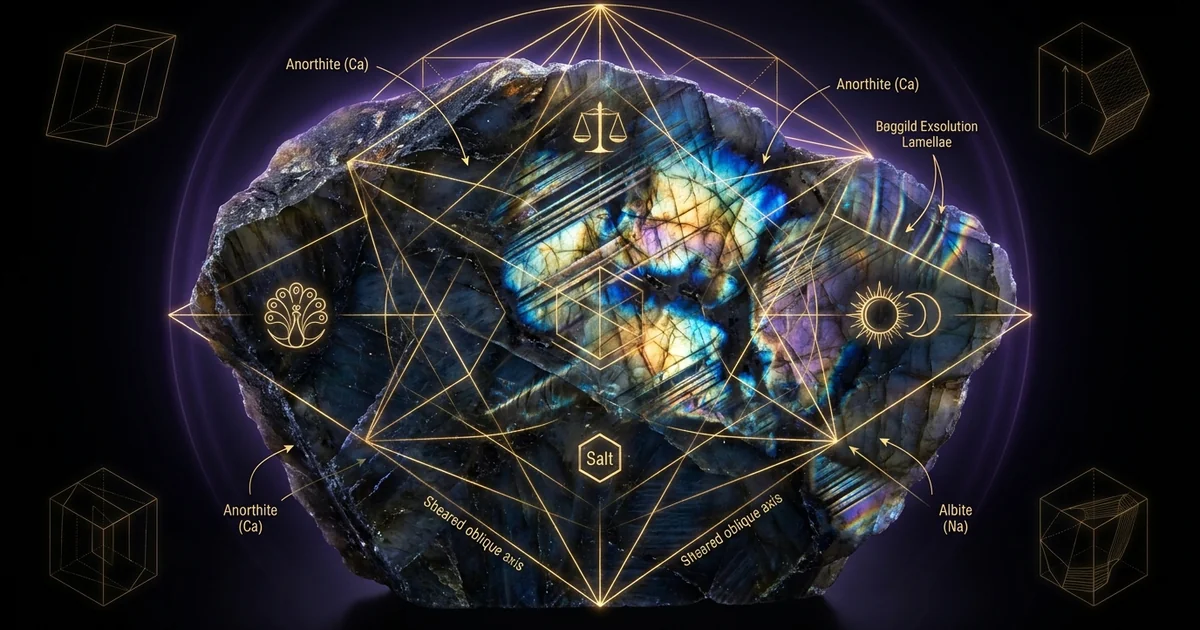
Labradorite Properties: Geology & Crystalline Resonance
Mineral Classification & Crystallographic Thesis
Plagioclase Solid Solution Series and Stoichiometric Range
Labradorite occupies an intermediate-to-calcic position within the continuous plagioclase feldspar group, an isomorphic solid-solution series defined by the endmembers albite ($\text{NaAlSi}_3\text{O}_8$) and anorthite ($\text{CaAl}_2\text{Si}2\text{O}8$). Classified precisely as an intermediate member containing between 50 and 70 mol% anorthite ($\text{An}{50}\text{–}\text{An}{70}$), its general stoichiometry is formulated as $(\text{Ca},\text{Na})(\text{Al},\text{Si})_4\text{O}_8$. The thermodynamic stability of this mineral matrix is dictated by the coupled, charge-compensating substitution mechanism:
$$\text{Na}^{+} + \text{Si}^{4+} \longleftrightarrow \text{Ca}^{2+} + \text{Al}^{3+}$$
This substitution maintains strict electrostatic neutrality across the three-dimensional framework while radically altering the local charge densities and coordination environments of the interstitial cation sites. Within the $\text{An}{50}\text{–}\text{An}{70}$ composition window, the balance between monovalent sodium and divalent calcium creates an intrinsically strained crystalline medium.
As synthesized in the foundational mineralogical compilations by Ribbe (1983) and Smith and Brown (1988), the high-temperature disordered plagioclase structure transitions during protracted subsolidus cooling toward an ordered, low-temperature configuration. In this regime, the system cannot sustain a homogeneous single-phase state across the entire composition curve.
Instead of a smooth, uniform dispersion of $\text{Ca}^{2+}$ and $\text{Na}^{+}$ throughout the framework, the silicate network undergoes internal segregation. This chemical instability is not an epiphenomenon; it forms the definitive structural baseline for the mineral’s subtle energetic behavior. The distribution of divalent calcium ions exerts an intense electrostatic field within the structural cavities, while the monovalent sodium zones maintain lower local potential gradients. This alternating potential acts as a microscopic spatial template for directional charge stabilization.
Data synthesized from solid-state crystallographic characterizations (Ribbe, 1983; Smith & Brown, 1988):
- Chemical Formula: $(\text{Ca},\text{Na})[\text{Al}(\text{Al},\text{Si})\text{Si}2\text{O}8]$ with $\text{An}{50}\text{–}\text{An}{70}$
- Crystal System: Triclinic; Pinacoidal class ($1\bar{1}$)
- Space Group: $C\bar{1}$ (high-temperature disordered) transitioning to complex $e$-plagioclase incommensurate superstructures ($I\bar{1}$) at low temperatures
- Unit Cell Dimensions: $a \approx 8.15\text{ \AA}$, $b \approx 12.80\text{ \AA}$, $c \approx 14.20\text{ \AA}$; $\alpha \approx 93.5^\circ$, $\beta \approx 116.2^\circ$, $\gamma \approx 89.7^\circ$
- Molar Mass: $\approx 274.5\text{ g/mol}$ (calculated for $\text{An}_{60}$)
- Mohs Hardness: $6.0\text{–}6.5$
- Specific Gravity: $2.68\text{–}2.72\text{ g/cm}^3$
- Mean Refractive Indices: $n_\alpha = 1.554\text{–}1.562$, $n_\beta = 1.559\text{–}1.567$, $n_\gamma = 1.562\text{–}1.573$
- Birefringence: $\delta = 0.008\text{–}0.011$; Biaxial positive or negative
- Cleavage: Perfect on ${001}$, good on ${010}$, imperfect on ${110}$, intersecting at roughly $86^\circ\text{–}93^\circ$
Triclinic Symmetry and Space Group Variations
The crystallographic architecture of labradorite belongs to the triclinic crystal system, specifically the pinacoidal crystal class ($C_i$ or $\bar{1}$ in Hermann-Mauguin notation). It exhibits the lowest degree of geometric symmetry permissible in centrosymmetric minerals, characterized entirely by an inversion center ($\bar{1}$) devoid of mirror planes, glide planes, or rotation axes.
The structural unit cell dimensions ($a \approx 8.15\text{ \AA}$, $b \approx 12.8\text{ \AA}$, $c \approx 14.2\text{ \AA}$) and mutually inclined inter-axial angles ($\alpha \approx 93.5^\circ$, $\beta \approx 116.2^\circ$, $\gamma \approx 89.7^\circ$) reflect this profound internal asymmetry. The low-symmetry environment produces a highly anisotropic spatial and dielectric field, a property explored extensively in triclinic lattice energetics.
At elevated temperatures exceeding $800^\circ\text{C}$, the disordered tetrahedra assume a spatial average governed by the $C\bar{1}$ space group. However, as documented by Wenk and Nakajima (1980), intermediate compositions subjected to geologic cooling schedules develop long-range modulating superstructures designated as the $e$-plagioclase phase, featuring reflections characteristic of an $I\bar{1}$ or incommensurate lattice.
In this state, the ordering of silicon and aluminum across the tetrahedral ($T$) sites becomes coupled to periodic antiphase domain boundaries (APBs). The alternating displacement of interstitial $\text{Ca}^{2+}$ and $\text{Na}^{+}$ cations generates a spatially modulated polarization field across the unit cells. This triclinic asymmetry ensures that incoming energetic vectors do not degenerate into isotropic diffusion; instead, they are channeled along discrete, low-resistance crystallographic vectors governed by the skew of the primary axes.
The Core Physical-Esoteric Resonance Proposition
The foundational thesis of labradorite resonance asserts that the material operates as an open, solid-state dielectric waveguide and biofield transducer. This capacity stems directly from the sub-micron structural segregation within its triclinic framework. Standard condensed matter physics recognizes that variations in ionic concentration across a crystal lattice alter its local polarizability, dielectric breakdown thresholds, and dielectric resonance crystal properties. In labradorite, this physical phenomenon interfaces with subtle field dynamics.
The corner-sharing $[(\text{Al},\text{Si})\text{O}_4]$ tetrahedral network forms kinked chains commonly described as “crankshaft” frameworks running parallel to the $a$-axis. Because aluminum carries an effective negative charge relative to silicon when tetrahedrally coordinated with oxygen, the segregation of $\text{Al}^{3+}$ into specific sub-domains produces alternating zones of localized negative framework charge. These zones are compensated by the spatial distribution of $\text{Ca}^{2+}$ and $\text{Na}^{+}$ ions.
This configuration establishes an intrinsically anchored, multi-polar solid-state array. Environmental electromagnetic oscillations, ambient biofield signals, and radiant fields do not merely traverse an undifferentiated dielectric matrix. They encounter a periodic, sub-micron cascade of refractive and energetic boundaries that polarize, filter, and organize chaotic fields into coherent, phase-aligned waveforms.
Lattice Geometry & Solid-State Physics: Exsolution Lamellae and Labradorescence
                 =================================================
                 [010] COMPOSITIONAL EXSOLUTION (BØGGILD INTERGROWTH)
                 =================================================

                 Phase 1: Ca-Rich Lamellae (An60-65) | n ≈ 1.568 | High ε_r
                 ------------------------------------------------- [Phase Boundary]
                 Phase 2: Na-Rich Lamellae (An35-40) | n ≈ 1.554 | Low ε_r
                 ------------------------------------------------- [Phase Boundary]
                 Phase 1: Ca-Rich Lamellae (An60-65) | n ≈ 1.568 | High ε_r
                 ------------------------------------------------- [Phase Boundary]
                 Phase 2: Na-Rich Lamellae (An35-40) | n ≈ 1.554 | Low ε_r

                 =================================================
                 CONSTRUCTIVE INTERFERENCE: mλ = 2d √(n² - sin²θ)
                 =================================================
The Bøggild Miscibility Gap and Sub-Micron Lamellar Exsolution
The hallmark optical and energetic signature of labradorite is directly tied to the thermodynamics of the Bøggild miscibility gap. As anorthosite plutons or deep-seated gabbroic intrusions cool over millenary timescales, homogeneous solid solutions within the $\text{An}{48}\text{–}\text{An}{58}$ range cross a critical solvus temperature (roughly $600^\circ\text{C}\text{–}800^\circ\text{C}$). Here, an unmixing reaction becomes thermodynamically mandatory. This subsolidus phase separation does not progress to complete macroscopic phase segregation; instead, it is arrested kinematically at the sub-micron scale via spinodal decomposition or slow nucleation and growth.
The result is the classic Bøggild intergrowth, originally evaluated in crystallographic detail by O. B. Bøggild in his 1924 monograph On the Labradorization of the Feldspars. This structural phenomenon consists of alternating, planar exsolution lamellae oriented subparallel to the $(010)$ or $(\bar{2}01)$ crystallographic planes.
These lamellae bifurcate into two discrete compositions: an anorthite-rich phase resembling bytownite ($\text{An}{60}\text{–}\text{An}{65}$) and an albite-rich phase resembling andesine ($\text{An}{35}\text{–}\text{An}{40}$). Transmission electron microscopy by Wenk and Nakajima (1980) demonstrated that individual lamellae vary between 100 nm and 300 nm in thickness. The absolute regularity, spacing, and geometric flatness of these lamellae dictate the physical and subtle behavior of the stone.
Dielectric Alternation and Multilayer Thin-Film Interference
The optical manifestation of this lamellar intergrowth—known in mineralogy as labradorescence or the Schiller effect—is an interference phenomenon rather than a trace-element pigmentary absorption. Because the refractive index of plagioclase scales linearly with anorthite content, the $\text{An}{60}\text{–}\text{An}{65}$ lamellae possess a higher mean refractive index ($n \approx 1.565\text{–}1.570$) than the alternating $\text{An}{35}\text{–}\text{An}{40}$ lamellae ($n \approx 1.550\text{–}1.555$). The interface between each lamellar boundary represents a spatial discontinuity in both refractive index ($n$) and the dielectric constant:
$$\varepsilon_r \approx n^2$$
When polychromatic light enters the labradorite lattice, partial reflection and transmission occur at every lamellar boundary. The reflected wavefronts emerge with phase relationships determined by the lamellar thickness ($d$) and the angle of incidence ($\theta$), in accordance with Bragg’s formulation for periodic stratified media:
$$m\lambda = 2d \sqrt{n^2 - \sin^2 \theta}$$
Where $m$ is the integer order of reflection, $\lambda$ is the reflected wavelength, $d$ is the lamellar period, and $n$ is the average refractive index of the intergrowth.
When the structural period $d$ falls between 120 and 150 nm, destructive interference cancels out the majority of the visible spectrum, while constructive interference selectively amplifies a narrow band of wavelengths. This produces vivid, metallic reflections ranging from deep indigo and royal blue to green, gold, and copper-orange. The precise dielectric alternation across these thousands of internal boundaries converts the macroscopic crystal into a natural multilayer dielectric mirror and photonic crystal.
Acoustic Velocity and Elastic Wave Propagation
Beyond its optical manifestations, the periodic intergrowth within labradorite modulates acoustic and phononic propagation through its crystal volume. The elastic stiffness tensor ($C_{ijkl}$) in triclinic feldspars reflects low spatial symmetry, generating directional variations in acoustic velocity ($v_p$ for compressional waves, $v_s$ for shear waves). The alternating lamellar sheets possess contrasting elastic moduli: the calcic, anorthite-rich lamellae exhibit higher density and structural stiffness relative to the lighter, more compressible sodic lamellae.
This alternation produces mechanical and phononic impedance boundaries at the nanoscale. As ambient acoustic vibrations and thermal phononic waves propagate along vectors perpendicular to the lamellar planes, they encounter periodic impedance mismatches:
$$Z = \rho \cdot v$$
These mismatches generate phononic bandgaps. These periodic interfaces inhibit the propagation of specific high-frequency vibrational modes, scattering incoherent thermal and mechanical noise while facilitating the transmission of coherent, low-frequency, long-wavelength elastic oscillations parallel to the lamellar planes. The crystal functions as an internal vibrational stabilizer, filtering disordered mechanical inputs into coherent directional vectors.
Subtle Energetic Dynamics & Resonance Mechanics
Physical Optical Interference
- Mechanism: Multilayer thin-film dielectric reflection governed by Maxwell’s equations and Bragg’s Law.
- Structural Substrate: Bøggild exsolution lamellae (100–300 nm thickness) with alternating indices $\Delta n \approx 0.014$.
- Primary Manifestation: Directional polychromatic labradorescence (Schiller effect) across visible optical wavelengths ($380\text{–}750\text{ nm}$).
- Dynamic Behavior: Passive elastic scattering and specular coherent reflection of electromagnetic photons.
Subtle Energy Resonance
- Mechanism: Phase-locked dielectric bandgap filtration and coherent toroidal field alignment.
- Structural Substrate: Asymmetric triclinic cation channels producing interfacial Maxwell-Wagner-Sillars polarization fields.
- Primary Manifestation: Biophotonic coherence stabilization, biofield boundary definition, and high-frequency entropic shielding.
- Dynamic Behavior: Active scalar transduction, dampening ambient environmental static, and organizing chaotic bioplasmic emissions.
Sub-Micron Lamellae as Subtle Dielectric Resonators
The periodic lamellar framework that produces optical labradorescence functions analogously across the non-physical, subtle spectrum. In subtle energy mechanics, interfaces between domains of divergent dielectric permittivity serve as planar capacitors and charge accumulation zones.
The nanoscale alternating sheets of high-calcium and high-sodium plagioclase establish a permanent array of internal Maxwell-Wagner-Sillars (MWS) interfacial polarizations. When exposed to external ambient biofield disturbances, this structured lattice acts as a high-density subtle dielectric resonator.
Environmental subtle static, which generally propagates as incoherent, low-frequency, non-polarized scalar drift, is attenuated when it enters this stratified lattice. The periodic discontinuities in the mineral’s subtle dielectric constant ($\varepsilon^* = \varepsilon’ - i\varepsilon’'$) form a subtle-bandgap filter. Frequencies that do not match the geometric spacing of the Bøggild intergrowth undergo destructive phase cancellation along the lamellar interfaces.
Conversely, frequencies whose subtle phase vectors align with the sub-micron lamellar periodicity are collected and focused along the plane of labradorescence. This mechanism explains why labradorite is traditionally experienced as a stone of focused energetic shielding: it does not passively absorb low-vibrational static, but dismantles it through destructive interference.
Biophotonic Coherence and Biofield Shielding Mechanics
The interface between the human biofield and the crystalline lattice of labradorite is primarily mediated through biophotonic emission. Biological systems continuously emit ultra-weak biophotons within the 200–800 nm optical band. These emissions are not random metabolic noise; as established in biophysical field theory, they exhibit coherence signatures that reflect the physiological and bioenergetic state of cellular systems.
When the human energy field extends into proximity with a polished labradorite matrix, these coherent biophotons interact directly with the stone’s photonic bandgap. The mineral’s internal multilayer mirror reflects these emissions constructively, folding the biophotonic envelope back onto the operator’s field rather than permitting its dissipation into the surrounding environment.
       [ Human Biofield / Biophotonic Emission (Coherent ~200-800 nm) ]
                                    │
                                    ▼
       ┌─────────────────────────────────────────────────────────────┐
       │   Labradorite Matrix: Dielectric Multilayer Photonic Mirror │
       │   - Incoherent Ambient Static: Phase-Cancelled via Lamellae  │
       │   - Coherent Biophotons: Constructively Reflected / Folded  │
       └─────────────────────────────────────────────────────────────┘
                                    │
                                    ▼
       [ Stabilized Auric Perimeter: Toroidal Boundary Reformation ]
This interaction provides an objective physical basis for the traditional designation of labradorite as an auric shield. The biofield loses integrity when coherent cellular radiation leaks outward and becomes disorganized by ambient electromagnetic static (EMF) and discordant environmental emissions.
By positioning labradorite within the immediate field space, its periodic exsolution layers reflect the organism’s biophotons while dispersing external, incoherent ambient waves. This establishes a stabilized, non-permeable biofield boundary, preserving energetic homeostasis and preventing vital depletion during prolonged exposure to dense or chaotic environments.
Electromagnetic Waveguide Dynamics and Phase Boundary Coupling
At the structural junction where the anorthite-rich and albite-rich lamellae meet, the continuous silicate framework undergoes localized lattice strain. This localized elastic strain generates subtle piezoelectric and flexoelectric polarization fields concentrated entirely within the phase boundaries. Because these boundaries extend continuously across macroscopic domains, they act as solid-state waveguides.
Under the principles of classical and subtle waveguide theory, energy propagation is constrained along the longitudinal plane of the boundary, perpendicular to the axis of maximum lattice distortion.
The consequence of this geometry is the conversion of incoming omnidirectional subtle field pressures into organized, linear field vectors. As chaotic energy impacts the outer boundary of the crystal, it couples to the strain fields of the Bøggild interfaces.
The energy is guided along these channels, exiting the crystal as an aligned, coherent field. This structural channeling converts erratic environmental static into phase-aligned emissions, transforming the crystal from a passive barrier into an active, stabilizing energy filter.
Historical Lapidary Lore & Traditional Lineage
Inuit Oral Tradition: The Aurora Trapped in Stone
Centuries before European mineralogists cataloged the plagioclase solid solution series, the indigenous Inuit populations of the coastal tundra of northern Labrador maintained an oral tradition that linked the stone’s optical flash to atmospheric electrical phenomena. According to ancestral lore, the Northern Lights (Aurora Borealis) were once trapped within the rocky mass of the shoreline. A revered Inuit warrior, seeking to liberate the celestial luminescences, approached the coastal formations and drove his spear into the stone.
The blow fractured the rock, releasing the bulk of the trapped lights into the polar heavens to guide the souls of the departed and dance across the magnetosphere. However, a portion of the celestial energy remained locked within the mineral matrix, preserved forever as the iridescent fire of labradorite.
Far from being a childish fable, this narrative demonstrates an intuitive recognition that the stone’s optical resonance mirrors the ionization states and field transitions of the upper atmosphere. The shimmering greens, auroral indigos, and golds of the Schiller flash served as a permanent terrestrial link to the ionosphere. Indigenous shamans treated the mineral as a protective stone that preserved the soul’s vertical axis of connection during journeys beyond the corporeal plane.
Excerpts from the missionary journals and correspondences of the Unitas Fratrum (Moravian Church), documenting the acquisition and testing of the Labrador-Stein on Paul’s Island:
“The coast here presents a rock of extraordinary hardness, dark and unremarkable upon its broken face, yet when placed against the sun or dipped in clear water, it blazes forth with a wondrous light resembling the wings of foreign beetles or the Northern streamers themselves… The heathen natives hold these locations in great quietude, saying the light rests within the rock and turns away dark spirits that wander the shore at winter. We have gathered substantial parcels to send unto London and Herrnhut, where the lapidaries and professors of natural history marvel at its strange, metallic play of colors, distinct from all spats and gems previously catalogued.” — Extracts from the Mission Archive at Nain, Labrador District, 1774
Eighteenth-Century Classification at Paul’s Island
The formal introduction of labradorite to Western science began on Paul’s Island, near the community of Nain, along the barren coast of Labrador, Canada. In 1770, Moravian missionaries who had established stations to evangelize the native Inuit populations discovered abundant occurrences of coarse-grained anorthosite cut by glacial erosion and coastal wave action. The missionaries, notably Father Adolf, recognized the commercial and scientific value of the chatoyant feldspar, collecting high-grade specimens that were forwarded to mineral dealers and academies in England, Germany, and Denmark.
The stone rapidly captivated European natural philosophers. Abraham Gottlob Werner, the preeminent geologist at the Freiberg Mining Academy, integrated the material into systematic mineralogy under the designation Labrador-stein (Labrador stone). Lapidaries quickly discovered that fashioning the material required strict adherence to its cleavage geometry to display the optical phenomena, elevating it to an elite status in lapidary arts.
Simultaneously, esoteric fraternities in Central Europe recognized labradorite’s practical resonance. Rather than viewing it as a simple ornamental variety of feldspar, they classified it as an operative stone of spiritual boundary definition, using it to demarcate ritual thresholds and ground psychic interactions against external energetic intrusion.
       =========================================================
       HISTORICAL & ENERGETIC DIVERGENCE IN CHATOYANT FELDSPARS
       =========================================================

       LABRADORITE [(Ca,Na)(Al,Si)₄O₈]
       - Series: Plagioclase Feldspar (Triclinic, Bøggild Gap)
       - Mechanism: Sub-micron exsolution lamellae (100-300 nm)
       - Polarity: Dynamic, masculine/projective, boundary demarcation
       - Subtle Field Action: Auric shielding, scalar beam collimation,
         deflection of discordant environmental static

       vs.

       CLASSICAL MOONSTONE [KAlSi₃O₈ + NaAlSi₃O₈]
       - Series: Alkali Feldspar (Monoclinic/Triclinic, Cryptoperthite)
       - Mechanism: Cryptoperthitic albite-orthoclase lamellar diffusion
       - Polarity: Receptive, feminine/somatic, emotional fluidics
       - Subtle Field Action: Parasympathetic activation, astral body
         cooling, emotional stabilization, lunar phase attunement
       =========================================================
Comparative Trans-Cultural Mineralogy: Labradorite vs Classical Moonstone
In comparative mineralogy and traditional metaphysics, it is critical to distinguish plagioclase labradorite from alkali feldspar moonstone. While both stones owe their optical luster to sub-micron exsolution processes, their chemical engines and resulting subtle polarities diverge sharply:
Moonstone is typically an alkali feldspar solid solution composed of orthoclase ($\text{KAlSi}_3\text{O}_8$) and albite ($\text{NaAlSi}_3\text{O}_8$). Its unmixing generates cryptoperthitic intergrowths that scatter light diffusely, yielding a soft, floating, billowy reflection termed adularescence. Esoterically, the potassium-sodium alkali framework exhibits a receptive, cool, lunar polarity. It directly interfaces with the emotional astral vehicle, soothing parasympathetic tension and balancing internal physiological fluids.
Conversely, labradorite’s calcium-sodium calcic engine and planar Bøggild lamellae produce sharp, mirror-like, spectral reflections (labradorescence). Its energetic polarity is fundamentally projective, structural, and defensive.
Where moonstone softens and opens the psychic perimeter to receive subtle intuitive impressions, labradorite seals and armors the boundary, reflecting foreign entanglements and organizing the field against external intrusion. Moonstone cools internal heat; labradorite reinforces the energetic perimeter, establishing an active, impenetrable boundary around the subtle anatomy.
Practical Applications, Calibration & Safety Protocols
- Mechanical Friability: Labradorite exhibits perfect, macroscopic cleavage on ${001}$ and ${010}$ intersecting at nearly $90^\circ$. Striking the crystal along or near these axes will induce structural shearing, spalling, and permanent loss of the coherent lamellar Schiller interfaces. Never expose labradorite to ultrasonic cleaning or steam treatments; the cavitation energy causes microscopic delamination of the Bøggild exsolution sheets, extinguishing both the optical flash and the dielectric boundary coherence.
- Chemical Toxicity & Leaching: Labradorite contains high concentrations of structural aluminum and calcium silicates ($(\text{Ca},\text{Na})(\text{Al},\text{Si})_4\text{O}_8$). In acidic or hydro-chemically aggressive solutions, structural aluminum ions readily leach from the tetrahedral framework. NEVER utilize labradorite in direct, unjacketed gem elixirs, drinking infusions, or ingestible preparations. All resonant aqueous attunements must strictly employ indirect, sealed-glass containment to eliminate toxic metal exposure.
Mechanical Vulnerability: Perfect Cleavage on {001} and {010}
The primary physical vulnerability of labradorite lies in its crystallographic cleavage. As a plagioclase feldspar, it possesses two cleavage directions of exceptional ease: perfect cleavage parallel to the basal pinacoid ${001}$ and good-to-perfect cleavage parallel to the side pinacoid ${010}$. These planes intersect at an angle of roughly $86^\circ$ to $93^\circ$. Because the sub-micron Bøggild lamellae are oriented subparallel to these planes, mechanical impact delivered along these cleavage axes readily triggers structural failures.
                    {001} Basal Cleavage Plane
                           ┌───────────────────────────┐
                           │                           │
                           │   Intergrowth Interface   │
                           │                           │
                           └───────────────────────────┘
                                     ▲       ▲
                                     │   ~86° to 93°
                                     ▼       ▼
                           ┌───────────────────────────┐
                           │                           │
                           │                           │
                           │                           │
                           └───────────────────────────┘
                    {010} Side Pinacoidal Cleavage Plane
When mounting, handling, or gridding labradorite specimens, you must avoid applying point-source mechanical shear or compressive clamping perpendicular to the ${001}$ and ${010}$ interfaces.
A sharp impact can cause the delicate, sub-micron exsolution sheets to shear apart along internal slip-planes. This cataclastic failure manifests visually as cloudy, internal fractures and white, powdery surface bruising, permanently extinguishing the constructive Bragg interference. In subtle applications, this physical shattering disrupts the continuity of the dielectric waveguide, turning a coherent energy filter into a source of erratic, disordered scatter.
Chemical Toxicity & Hydrothermal Degradation
From an aqueous geochemical standpoint, labradorite is unstable when exposed to prolonged dampness, environmental acids, or caustic cleaning agents. The framework substitution of $\text{Al}^{3+}$ into up to 50% of the tetrahedral sites significantly increases the susceptibility of the aluminosilicate framework to proton attack compared to pure silica minerals like quartz.
When exposed to low-pH solutions (including unbuffered water saturated with atmospheric carbon dioxide, $\text{pH} \le 5.5$), the interstitial calcium and sodium cations leach into solution. This extraction destabilizes adjacent $[(\text{Al},\text{Si})\text{O}_4]$ tetrahedra, releasing potentially toxic monomeric and polymeric aluminum species ($[\text{Al}(\text{H}_2\text{O})_6]^{3+}$):
$$\text{CaAl}_2\text{Si}_2\text{O}_8 + 2\text{H}^+ + \text{H}_2\text{O} \longrightarrow \text{Ca}^{2+} + \text{Al}_2\text{Si}_2\text{O}_5(\text{OH})_4 \text{ (clay phase)}$$
Consequently, direct-immersion gem elixirs made with labradorite pose a serious chemical hazard. Ingesting aluminum ions bypasses the body’s protective barriers, presenting neurotoxic and physiological risks.
Furthermore, exposing labradorite to steam cleaners or high-temperature aqueous cleansing degrades the outermost Bøggild lamellae via localized hydrothermal alteration, forming microcrystalline clay and zeolite crusts. This completely ruins the specimen’s optical properties and degrades its dielectric capacity to organize subtle biofield frequencies.
Vibrational Orientation and Directional Attunement
To maximize labradorite’s energetic shielding capabilities, calibrate the physical orientation of its Schiller plane relative to the operator’s subtle anatomy. The Bøggild lamellae are not isotropic; their dielectric filtering functions exclusively when incoming energy fields encounter the intergrowth layers at specific angles.
To create an active biofield shield, identify the primary labradorescent flash face and orient it directly outward, facing away from the operator’s physical body toward the external environment.
       [ External Chaos / Discordant EMF Static ]
                          │
                          ▼ (Incoming Vectors)
       ┌────────────────────────────────────────────────────────┐
       │   Schiller Flash Face Oriented Directly OUTWARD         │
       │   (Bøggild Dielectric Planes Transverse to Incident)   │
       │                                                        │
       │                  LABRADORITE MATRIX                    │
       │                                                        │
       │   Non-Reflective, Grounding Base Oriented INWARD       │
       └────────────────────────────────────────────────────────┘
                          │
                          ▼ (Organized, Filtered Waves)
       [ Human Energy Field / Biofield Boundary Interface ]
When worn as a personal talisman or positioned in an operational workspace, the crystal should be set so that its reflective flash remains unobscured by heavy, opaque metal backings that introduce chaotic eddy currents. Setting the specimen in sterling silver (a metal with high electrical and subtle conductivity) provides an effective impedance-matching interface for grounding filtered static.
Aligning the crystal’s $a$-axis crankshaft chains vertically—parallel to the central pranic spine or Sushumna channel—helps direct coherent biophotonic energy along the body’s primary meridian pathways.
Geometric Grid Placement & Biofield Attunement
To construct an active auric boundary array that neutralizes hostile environmental fields and repairs biofield ruptures, execute the following geometric sequence:
- Material Selection: Select twelve (12) polished labradorite cabochons exhibiting uniform, high-intensity blue-green labradorescence ($d \approx 130\text{–}150\text{ nm}$). Ensure each specimen has clean pinacoidal planes free from open, structurally unsealed surface cracks.
- Spatial Topology: Lay out an expanded dodecagonal perimeter centered upon the operator’s working or resting location, establishing an energetic perimeter of at least 2.5 meters in diameter.
- Orientation Calibration: Using a magnetic compass, place the primary anchor stone at true Magnetic North. Position the remaining eleven stones at exact $30^\circ$ radial increments around the perimeter.
- Schiller Plane Alignment: Rotate each labradorite specimen so that its primary plane of labradorescence faces directly outward along the radial axis, perpendicular to the perimeter boundary line.
- Coupling Transducers: Position twelve natural, single-terminated trigonal quartz points directly behind each labradorite stone. Orient the quartz terminations radially outward, aiming directly through the center of the labradorite cabochons.
- Harmonic Activation: Strike a 432 Hz calibrated acoustic tuning fork and introduce its stem to the base of each quartz crystal, moving clockwise from North to entrain the piezo-electric lattices into a coherent, phase-locked boundary network.
Triclinic Alignment in Polyhedral Layouts
Because labradorite crystallizes in the low-symmetry triclinic system, its subtle field interactions are inherently anisotropic. This structural property makes it unsuitable for placement at the center of symmetric geometric grids, such as isometric or cubic arrays, where balanced, omnidirectional field dispersion is required. Placing a triclinic stone at the nucleus of an isotropic grid introduces directional skew and phase distortion into the central vortex.
Instead, labradorite functions with maximum efficiency along the outer perimeter of polyhedral grid layouts. In sacred geometric configurations (such as the Flower of Life, Metatron’s Cube, or Platonic solids), the perimeter acts as the boundary interface between the coherent geometric core and the chaotic ambient environment.
Positioned at these perimeter vertices, labradorite acts as an impedance-matching boundary layer. Its low internal symmetry dissolves incoming isotropic standing waves, while its alternating lamellae filter, organize, and polarize environmental energy before it can penetrate the inner sanctum of the grid.
Coupling Labradorite with Quartz Amplification Systems
While labradorite excels at filtering and organizing subtle energy, its intrinsic energetic flow rate is limited by its complex, kinked aluminosilicate crankshaft structure. To bypass this mechanical throughput bottleneck, lapidary energy practitioners couple the mineral directly with trigonal quartz ($\text{SiO}_2$).
Quartz possesses high symmetry (trigonal class 32), exceptional mechanical and subtle elasticity, and a high, direct piezoelectric coefficient ($d_{11} \approx 2.3 \times 10^{-12}\text{ C/N}$).
       ┌────────────────────────┐         ┌────────────────────────┐
       │     TRIGONAL QUARTZ    │         │  TRICLINIC LABRADORITE │
       │  (High Symmetry Engine)│ ======= │  (Subtle Bandgap Filter│
       │  - Accelerates Flux    │ Energy  │  - Low Symmetry        │
       │  - Direct Piezo Vector │ Flow    │  - Bøggild Exsolution  │
       │  - Amplifies Amplitude │         │  - Filters Static      │
       └────────────────────────┘         └────────────────────────┘
                    │                                  │
                    └─────────────────┬────────────────┘
                                      │
                                      ▼
             [ Stabilized, High-Throughput Coherent Vector ]
When a natural quartz point is positioned with its base in contact with the non-reflective boundary of a labradorite specimen and its termination directed outward, it forms an energetic transducer pair:
- The labradorite matrix filters ambient static, removing chaotic phase variations through its Bøggild exsolution boundaries.
- This purified, polarized subtle energy enters the quartz lattice through structural interfacial contact.
- The quartz crystal accelerates this organized charge along its polar $c$-axis, projecting a coherent, amplified subtle beam outward into the environment.
This directional coupling functions as an active field projector, clearing environmental stagnancy and projecting a coherent boundary around the perimeter of an assigned space.
Acoustic and Frequency-Based Lattice Clearing
Due to the extreme mechanical fragility of labradorite’s ${001}$ and ${010}$ cleavage planes and its susceptibility to water-induced framework dissolution, conventional clearing methods (such as saltwater immersion, sun baking, or rough tumbling) cause structural damage. Thermal shocks induce uneven expansion between the anorthite-rich ($An_{60}$) and albite-rich ($An_{35}$) lamellae due to their differing thermal expansion coefficients, causing microscopic delamination and permanently ruining the stone’s optical flash.
The safest, most scientifically sound method for clearing and re-calibrating the labradorite matrix is acoustic entrainment via pure tone frequencies:
        Acoustic Emission: 432 Hz / 528 Hz Pure Sine Sound Waves
                                   │
                                   ▼
        ┌────────────────────────────────────────────────────────┐
        │ Mechanical Acoustic Waves Impinge upon Cleavage Planes  │
        │ - No Thermal Shock (Protects Differential Exsolution)  │
        │ - No Chemical Dissolution (Prevents Aluminum Leaching) │
        └────────────────────────────────────────────────────────┘
                                   │
                                   ▼
        ┌────────────────────────────────────────────────────────┐
        │ MWS Interfacial Polarizations Driven to Neutral State   │
        │ Static Surface Charges Dissipated via Edge Dislocations│
        └────────────────────────────────────────────────────────┘
                                   │
                                   ▼
        [ Restored Dielectric Clarity & Resonant Waveguide Coherence ]
Exposing the crystal to pure, stable sound waves—specifically 432 Hz (associated with mathematical acoustic harmonic grounding) or 528 Hz (associated with structural biophotonic repair)—induces non-destructive elastic oscillations throughout the plagioclase lattice.
These acoustic waves travel through the material, purging accumulated electromagnetic static from the internal MWS dielectric interfaces through micro-mechanical motion. This resets the internal phase boundaries to a neutral, responsive state without risking mechanical fractures or chemical degradation.
Frequently Asked Questions
Distinguishing True Labradorescence from Spectrolite and Moonstone
True labradorescence is an optical interference phenomenon restricted to intermediate plagioclase feldspars ($\text{An}{50}\text{–}\text{An}{70}$) displaying Bøggild lamellar exsolution. Spectrolite is a gemologically distinct, premium trade variety of labradorite sourced exclusively from anorthosite and gabbro intrusions in the Ylämaa region of South Karelia, Finland.
Geologically, spectrolite crystallized within exceptionally stable, high-pressure plutonic environments that cooled extremely slowly. This allowed the Bøggild exsolution lamellae to develop with absolute geometric regularity and uniform thickness across broad continuous fields.
       =========================================================
       SPECTRAL COMPARISON: LABRADORITE vs. SPECTROLITE
       =========================================================

       STANDARD LABRADORITE (Madagascar, Canada)
       - Dominant Wavelengths: 450–520 nm (Selective narrow band)
       - Reflected Spectral Signature: Deep Blues, Aquas, Cool Greens
       - Matrix Quality: Translucent grey to smoky brown

       SPECTROLITE (Ylämaa, Finland)
       - Dominant Wavelengths: 380–750 nm (Full visible spectrum)
       - Reflected Spectral Signature: Vivid Violet, Royal Blue, Green,
         Canary Yellow, Orange, and Metallic Carmine Red
       - Matrix Quality: Dense, opaque, near-black anorthosite base
       =========================================================
Consequently, standard labradorite typically displays a narrow, selective color spectrum dominated by blue, cyan, and occasional green interference bands.
Spectrolite, by contrast, exhibits full-spectrum iridescence: brilliant crimson, orange, yellow, vivid green, deep blue, and violet can all manifest across a single specimen.
Moonstone, as previously noted, is an alkali feldspar (cryptoperthite) exhibiting diffuse adularescent scattering, completely lacking the sharp, metallic interference fringes and diverse spectral range produced by the Bøggild plagioclase gap.
Preserving Optical Resonance Against Structural Degradation
Preserving both the optical labradorescence and the subtle energetic resonance of labradorite requires careful handling of its physical surface. The constructive interference that produces its optical flash occurs within the outermost few microns to millimeters of the stone’s crystalline face.
If this surface is scratched, abraded, or worn down through rough contact, incoming light is scattered diffusely by surface defects before it can reach the internal Bøggild lamellae. This entirely suppresses constructive interference, leaving the stone looking dull and lifeless.
To maintain maximum optical and energetic resonance:
- Avoid wearing labradorite jewelry during heavy manual labor, and store specimens individually in soft, unbleached cotton or velvet wraps to prevent contact with harder minerals (such as quartz, beryl, or corundum).
- Clean the surface exclusively with an ultra-soft, microfiber cloth dampened with neutral distilled water ($\text{pH} \approx 7.0$).
- Never expose the stone to household chemical agents, perfumed oils, cosmetics, or ultrasonic cleaners.
- Periodically examine the cleavage planes under oblique light; if micro-fracturing begins along the ${001}$ edge, coat the perimeter with a natural, inert microcrystalline wax to seal the lamellar interfaces against air, moisture, and chemical contaminants.
Mitigating Subtle Saturation and Static Overload
A common misconception in modern crystal literature is that labradorite acts as an infinite sponge, passively absorbing and trapping negative energy within its bulk framework until it becomes “energetically clogged.”
Condensed matter physics and subtle energetic dynamics reveal a different process. Labradorite does not store chaotic static within its primary unit cells; its triclinic framework simply does not have the capacity to hold unstructured interstitial charge for extended periods.
Instead, subtle saturation manifests as a surface phenomena: an accumulation of parasitic, electrostatic, and subtle charges along ungrounded boundary dislocations and open cleavage cracks on the mineral’s exterior. This surface-level charge accumulation creates an electrostatic shielding layer that deflects incoming biofield emissions, preventing them from interacting with the underlying Bøggild dielectric interfaces and muting the crystal’s filtering capabilities.
To clear this static buildup, you do not need to bury the stone in salt (which can corrode the silicate framework via halogen ion interaction). Simply place the specimen on a clean, grounded conductive surface—such as an unlacquered copper or brass grounding plate connected to an Earth ground—or expose it to pure acoustic vibration (432 Hz sound waves) for five minutes. This dissipates surface static to ground, immediately restoring the crystal’s internal phase boundaries and returning its dielectric waveguide to peak operational efficiency.