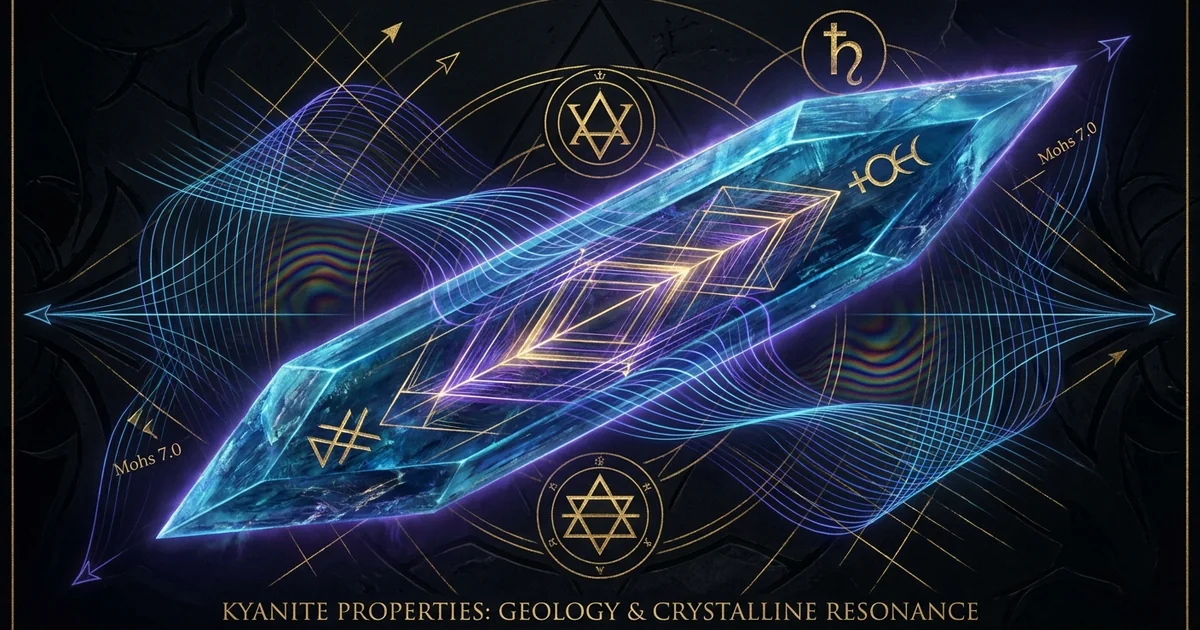
Kyanite Properties: Geology & Crystalline Resonance
Mineral Classification & Crystallographic Thesis
The Aluminosilicate Polymorph Triad: Kyanite, Andalusite, and Sillimanite
Kyanite occupies an exceptional position within solid-state mineralogy and metamorphic petrogenesis as the high-pressure endmember of the trimorphic anhydrous aluminosilicate system ($\text{Al}_2\text{SiO}_5$). Alongside its polymorphs, andalusite and sillimanite, kyanite forms an indispensable thermodynamic foundation for geothermobarometry, chronicling the tectonic evolution of regional metamorphic belts. The phase equilibrium governing these three minerals was established rigorously by Holdaway (1971), whose landmark determination of the aluminosilicate triple point (~3.76 kbar and 501 °C) confirmed kyanite as the stable phase under regimes characterized by elevated lithostatic pressure and low-to-moderate thermal gradients. As detailed by Winter (2010) in petrologic frameworks of metapelitic sequences, kyanite emerges predominantly during medium- to high-pressure Barrovian-type regional metamorphism, typically within the amphibolite and granulite facies, where pelitic protoliths rich in kaolinite, pyrophyllite, and chlorite undergo progressive devolatilization.
The transition dynamics between these phases, detailed in /crystals-materials/aluminosilicate-polymorph-phase-transitions, reveal that while sillimanite, andalusite, and kyanite share an identical chemical stoichiometry ($\text{Al}_2\text{O}_3 \cdot \text{SiO}_2$), their spatial architectures diverge fundamentally. In all three polymorphs, half of the aluminum cations ($\text{Al}^{3+}$) are sequestered in continuous edge-sharing chains of $[ \text{AlO}_6 ]$ octahedra oriented parallel to the crystallographic $c$-axis. The differentiating structural signature resides exclusively in the coordination number of the remaining aluminum cations within the interstitial polyhedral networks: sillimanite cross-links its octahedral spines with four-coordinate $[ \text{AlO}_4 ]$ tetrahedra; andalusite integrates five-coordinate $[ \text{AlO}_5 ]$ trigonal bipyramids; and kyanite demands that all remaining aluminum ions occupy six-coordinate octahedral geometry.
Because every aluminum atom in kyanite resides in sixfold coordination ($^{[6]}\text{Al}\ ^{[6]}\text{Al}\ \text{Si}\ \text{O}_5$), the lattice achieves the densest packing configuration possible for an uncollapsed aluminosilicate framework. This high coordination number forces the oxygen anions into a distorted cubic close-packed arrangement, yielding a structural density of 3.53 to 3.67 $\text{g/cm}^3$, substantially outstripping andalusite (~3.15 $\text{g/cm}^3$) and sillimanite (~3.25 $\text{g/cm}^3$). The geological stabilization of kyanite over its triad counterparts is thus driven entirely by pressure: under compressive crustal forces, the molar volume ($\bar{V}$) of the system is forced into its minimum energetic state ($44.09\ \text{cm}^3/\text{mol}$, compared to $51.53\ \text{cm}^3/\text{mol}$ for andalusite and $49.90\ \text{cm}^3/\text{mol}$ for sillimanite), satisfying the thermodynamic relation $(\partial G/\partial P)_T = V$.
Kyanite
- Crystal System: Triclinic
- Space Group: $P\bar{1}$
- Coordination Number: $^{[6]}\text{Al}\ ^{[6]}\text{Al}\ \text{Si}\ \text{O}_5$ (All Al in Octahedra)
- Density Range: 3.53 – 3.67 $\text{g/cm}^3$
- Molar Volume: $44.09\ \text{cm}^3/\text{mol}$
- Thermodynamic Domain: High pressure, low-to-moderate temperature (Barrovian facies)
- Hardness Profile: Directional: 4.5–5.0 along [001]; 6.5–7.0 across [100]
Andalusite
- Crystal System: Orthorhombic
- Space Group: Pnnm
- Coordination Number: $^{[6]}\text{Al}\ ^{[5]}\text{Al}\ \text{Si}\ \text{O}_5$ (Octahedral + Trigonal Bipyramidal)
- Density Range: 3.13 – 3.16 $\text{g/cm}^3$
- Molar Volume: $51.53\ \text{cm}^3/\text{mol}$
- Thermodynamic Domain: Low pressure, low-to-medium temperature (Buchan/Contact aureoles)
- Hardness Profile: Uniform: 6.5 – 7.5 across crystallographic axes
Sillimanite
- Crystal System: Orthorhombic
- Space Group: Pbnm
- Coordination Number: $^{[6]}\text{Al}\ ^{[4]}\text{Al}\ \text{Si}\ \text{O}_5$ (Octahedral + Tetrahedral)
- Density Range: 3.23 – 3.27 $\text{g/cm}^3$
- Molar Volume: $49.90\ \text{cm}^3/\text{mol}$
- Thermodynamic Domain: High temperature, moderate-to-high pressure (Anatectic migmatites)
- Hardness Profile: Relatively uniform: 6.5 – 7.5 parallel to fibrous elongation
Triclinic Space Group P1 and Crystalline Asymmetry
Unlike the orthorhombic symmetries governing andalusite and sillimanite, kyanite crystallizes in the centrosymmetric triclinic space group $P\bar{1}$ (No. 2). The triclinic system is defined mathematically by the total absence of rotational or mirror symmetries, retaining only a center of inversion. The unit cell parameters, precisely refined through synchrotron X-ray diffraction, demonstrate an asymmetrical distortion: $a = 7.126\ \text{Å}$, $b = 7.852\ \text{Å}$, $c = 5.572\ \text{Å}$, with interaxial angles $\alpha = 89.99^\circ$, $\beta = 101.11^\circ$, and $\gamma = 106.03^\circ$. With $Z = 4$ formula units of $\text{Al}_2\text{SiO}_5$ per unit cell, the internal lattice comprises twenty distinct atomic sites, forcing extreme geometrical constraints upon every metal-oxygen polyhedral bond.
The fundamental structural motif consists of unbranched, infinite chains of $[ \text{Al}(1)\text{O}_6 ]$ and $[ \text{Al}(2)\text{O}_6 ]$ octahedra sharing trans-edges, marching strictly parallel to the crystallographic $c$-axis $[001]$. These continuous octahedral pillars are cross-linked across the $a$- and $b$-directions by isolated $[ \text{SiO}_4 ]^{4-}$ orthosilicate tetrahedra and an additional array of cross-connecting $[ \text{Al}(3)\text{O}_6 ]$ and $[ \text{Al}(4)\text{O}_6 ]$ octahedra. This configuration constitutes an extreme case of crystalline asymmetry. The lack of orthogonal axes causes bond lengths and inter-polyhedral angles to vary continuously along non-parallel trajectories, establishing a lattice environment where internal strain fields cannot be distributed isotropically.
This severe spatial polarization is detailed in /sacred-geometry/triclinic-lattice-symmetry-breaking, which frames the triclinic space group as the ultimate mechanical symmetry-breaker among metamorphic minerals. The edge-sharing octahedral chains run as rigid, unyielding structural columns, while the lateral cross-linkages involve flexible Si–O–Al bridge angles that tilt off-axis due to the obtuse $\beta$ and $\gamma$ angles. The result is a pronounced structural disparity: along the $c$-axis, bond densities are dominated by short, highly covalent Al–O shared octahedral edges, whereas the trans-axial directions ($a$ and $b$) feature interstitial spaces and weaker ionic bridges between the silicate tetrahedra and peripheral aluminum polyhedra.
The Anisotropic Resonance Postulate
The structural asymmetry of the $P\bar{1}$ space group establishes kyanite as a profound solid-state physical archetype: its mechanical, optical, and electromagnetic characteristics are entirely non-isotropic. In standard condensed matter systems, high structural symmetry generates isotropic or uniaxial behavior wherein vibrational and electronic perturbations disperse outward spherically or rotationally. Kyanite, conversely, acts as a directional filter. Because the dense, edge-sharing $[ \text{AlO}_6 ]$ octahedral chains create an uninterrupted, low-impedance channel parallel to $[001]$, lattice vibrations (phonons), electrostatic polarization, and subtle electromagnetic fluxes propagate along this specific vector with minimal scattering loss.
This crystallographic architecture gives rise to the Anisotropic Resonance Postulate. Within the domains of advanced mineral physics and subtle energy mechanics, mineral lattices are modeled not merely as static arrays of atoms, but as dynamic dielectric cavities that intercept, transduce, and broadcast ambient electromagnetic and biofield fluctuations. Most mineral systems act as omnidirectional or isotropic energetic sponges: their multi-axial symmetry traps vibrational resonance within polyhedral clusters, accumulating electrostatic boundary charges, local lattice strains, and subtle energetic dross.
Kyanite diverges entirely from this entrapment paradigm. By pairing an unyielding, high-density conduction channel along the $c$-axis with wide, easily sheared cleavage planes across the transverse dimensions, the kyanite lattice behaves as an open, linear acoustic-vibrational waveguide. Perturbations applied to the crystal—whether kinetic, thermal, electromagnetic, or biophysical—cannot establish standing, static resonant loops within the unit cell. Instead, they are instantaneously polarized, accelerated along the octahedral highway, and dissipated across the terminal terminations or delaminated cleavage boundaries. Kyanite refuses energetic accumulation because its structural geometry lacks the internal closed-loop symmetries required to sustain trapped vibrational entropy.
Lattice Geometry & Solid-State Physics
Anisotropic Cleavage and the Haüy Hardness Disparity
The primary diagnostic hallmark of kyanite is its extreme directional mechanical anisotropy—a phenomenon so structurally radical that French crystallographer René-Just Haüy (1801) named the mineral Disthene (from the Greek dis, twice, and sthenos, force) to denote its dual hardness profile. On the Mohs scale, kyanite displays a hardness of 4.5 to 5.0 when scratched parallel to the elongation of the bladed crystal along the crystallographic $c$-axis $[001]$. Conversely, when tested transverse to the elongation, parallel to the $a$-axis $[100]$ or along the $[010]$ vector, the hardness spikes to 6.5 to 7.0. A standard steel needle easily furrows the surface parallel to the blade, yet skates harmlessly across the identical face when dragged orthogonally.
Mohs Hardness Vectorization in Kyanite:
Direction parallel to [001] (c-axis):       |====> (4.5 - 5.0 Mohs) [Weak atomic cross-bonds]
Direction transverse to [001] (along a-axis): |========> (6.5 - 7.0 Mohs) [Dense polyhedral packing]
This mechanical divergence is rooted in kyanite’s cleavage systems and polyhedral bond distributions. Kyanite possesses perfect cleavage on ${100}$ and distinct, less developed cleavage on ${010}$, frequently augmented by a structural parting along ${001}$. The ${100}$ cleavage planes represent expansive planar sheets where the connectivity between the infinite $[ \text{AlO}_6 ]$ chains and the $[ \text{SiO}_4 ]$ tetrahedra is at its lowest spatial density. When mechanical shear is applied parallel to $[001]$, the scratch tip merely slides along the continuous glide planes of the ${100}$ face, easily rupturing the relatively weak, extended Al–O bonds between adjacent polyhedral columns.
When mechanical abrasion is applied perpendicular to the $c$-axis, the scratch vector directly confronts the high-density edge-sharing $[ \text{AlO}_6 ]$ octahedral chains. To furrow the crystal across this orientation requires the simultaneous rupture of the most covalent, tightly bound Al–O octahedra and Si–O tetrahedra within the unit cell. The Haüy hardness disparity is thus a macroscopic translation of the lattice’s microscopic anisotropy: the crystal is mechanically compliant along its structural rails, but exceptionally resistant when assaulted across its load-bearing columns.
Dielectric Tensors and Optical Polarity
The triclinic asymmetry of the kyanite matrix governs its interaction with electromagnetic radiation, producing extreme optical and dielectric anisotropy. Optically, kyanite is biaxial negative, characterized by uncommonly high refractive indices for a non-framework silicate: $n_\alpha = 1.710–1.718$, $n_\beta = 1.719–1.725$, and $n_\gamma = 1.724–1.734$, yielding a moderate-to-high birefringence ($\delta = 0.012–0.016$) and a large optic axial angle ($2V_x \approx 82^\circ–84^\circ$). The optical indicatrix is severely inclined relative to the crystallographic axes; the extinction angle of $\alpha$ against the $c$-axis on the ${100}$ plane ranges between $27^\circ$ and $32^\circ$, a direct consequence of the triclinic shear angle $\beta = 101.11^\circ$.
The dielectric response of kyanite under applied high-frequency oscillating fields further underscores this non-equivalence. Shannon et al. (1991), utilizing high-precision capacitance bridge measurements, systematically determined the dielectric constants of the aluminosilicate polymorphs. In kyanite, the real components of the dielectric permittivity tensor ($\kappa_{ij}$) demonstrate significant axial divergence, detailed in /physics-electromagnetism/dielectric-anisotropy-in-crystals. The dielectric constant measured parallel to the $c$-axis ($\kappa_{\parallel c} \approx 13.1$) is substantially elevated compared to the constants measured perpendicular to the octahedral chains along the $a$- and $b$-axes ($\kappa_{\perp} \approx 8.9–10.2$).
Dielectric constants of silicate minerals: kyanite, sillimanite, and andalusite. Physics and Chemistry of Minerals, 18(4), 229–234.
- Unit Cell Refinement: $a = 7.126\ \text{Å}$, $b = 7.852\ \text{Å}$, $c = 5.572\ \text{Å}$, $\alpha = 89.99^\circ$, $\beta = 101.11^\circ$, $\gamma = 106.03^\circ$.
- Dielectric Tensor Analysis: The total polarizability ($\alpha_D$) calculated from dielectric constants via the Clausius-Mosotti relation demonstrates that kyanite exhibits high total dielectric permittivity ($\kappa’ = 10.92$ average), with an axial permittivity divergence reaching $\Delta\kappa = 4.2$ between $[001]$ and $[100]$.
- Phonon Velocity: Mean longitudinal acoustic velocity ($v_p$) along $[001]$ exceeds $9.8\ \text{km/s}$, whereas shear transverse velocity drops to $v_s \approx 5.4\ \text{km/s}$ perpendicular to the cleavage planes.
This dielectric anisotropy arises from the differential displacement of cations within their coordination polyhedra under applied electric vectors. Along the $[001]$ axis, the edge-sharing octahedra permit an electronic polarization pathway where the electron clouds of the $\text{Al}^{3+}$ cations and $\text{O}^{2-}$ anions polarize collectively with minimal dynamic phase lag. Transverse fields, conversely, must overcome the wide interstitial vacuities and asymmetrical Si–O–Al bridging angles, producing localized dielectric impedance and an asymmetric dispersion curve at megahertz frequencies.
Phonon Transport and Piezoelectric Susceptibility
Acoustic phonon propagation in kyanite reflects this extreme lattice vectorization. The elastic stiffness tensor ($C_{ijkl}$) of the triclinic matrix reveals marked directional stiffness along the $c$-axis, translating directly into acoustic velocities. As verified through Brillouin scattering and ultrasonic resonance spectroscopy, the longitudinal acoustic wave velocity ($v_p$) traveling along $[001]$ approaches an astonishing $9.8\ \text{km/s}$—among the highest measured in rock-forming crustal silicates. Along the transverse axes ($[100]$ and $[010]$), the sound velocity decelerates sharply to $5.4–6.2\ \text{km/s}$. Phonons traveling along the $c$-axis encounter minimal scattering centers, because the rigid edge-sharing octahedra act as a coherent acoustic pipe. Transverse phonons, by contrast, scatter continuously against the low-bond-density ${100}$ cleavage planes and point defects, dampening thermal and acoustic energy rapidly.
From the standpoint of classical crystallographic symmetry, the space group $P\bar{1}$ is centrosymmetric, theoretically precluding true linear piezoelectricity (the direct coupling between mechanical strain and electrical polarization in non-centrosymmetric crystals, as seen in /crystals-materials/tourmaline-piezoelectricity-charge-transfer). However, natural kyanite crystals invariably deviate from mathematical ideality. Transition-metal substitution introduces pervasive, non-random structural dopants into the octahedral sites. Trivalent iron ($\text{Fe}^{3+}$) and tetravalent titanium ($\text{Ti}^{4+}$) replace octahedral $\text{Al}^{3+}$, predominantly clustering within the more distorted $[ \text{Al}(3) ]$ and $[ \text{Al}(4) ]$ polyhedra. The optical absorption bands at 600 nm and 820 nm responsible for kyanite’s signature cerulean blue arise directly from dynamic intervalence charge transfer:
$$\text{Fe}^{2+} + \text{Ti}^{4+} \rightleftharpoons \text{Fe}^{3+} + \text{Ti}^{3+}$$
These transition-metal substitutions do not occur symmetrically throughout the lattice; they form discrete polar nanodomains. Furthermore, the pervasive macroscopic stacking faults, ${100}$ twin lamellae, and mechanical micro-strains characteristic of high-pressure petrogenesis generate localized symmetry-breaking zones where the center of inversion is locally destroyed. In these strained interfacial domains, kyanite demonstrates pronounced flexoelectricity (polarization induced by an inhomogeneous strain gradient: $P_i = \mu_{ijkl} \frac{\partial \varepsilon_{jk}}{\partial x_l}$) and pseudo-piezoelectric resonances. When subjected to asymmetric mechanical stresses or high-frequency acoustic waves, these polar domains generate measurable transient surface charges, driving rapid electron-phonon coupling along the high-conductivity $c$-axis channels.
Subtle Energetic Dynamics & Resonance Mechanics
Vectorized Biofield Conduction and Energy Dissipation
The intersection of solid-state physics and subtle energy mechanics provides a coherent framework for analyzing kyanite’s anomalous performance as a biofield-waveguide. In bioharmonic research, the human biofield is modeled as an ultra-weak, coherent biophotonic and electromagnetic emission envelope governed by high-frequency dielectric interactions within cell membranes, connective tissue collagen, and neural microtubular networks. When an individual’s subtle field encounters an external mineral lattice, the interaction is governed entirely by the crystal’s dielectric tensor, surface state charge distributions, and acoustic phonon dispersion.
Subtle-Field Waveguide Mechanics in the Kyanite Matrix:
[ Diffuse Ambient Biofield Noise ]
│
▼
┌───────────────────────┐
│  {100} Cleavage Face  │  <– Low-Impedance Capture Interface
└───────────────────────┘
│ (Transverse Refraction)
▼
═════════════════════════
[AlO6] OCTAHEDRAL CHAIN   <– Laminar Phonon Acceleration along [001]
═════════════════════════
│ (Directional Propagation)
▼
┌───────────────────────┐
│ Terminal Termination  │  <– Coherent Jet / Dissipative Ejection
└───────────────────────┘
Because kyanite exhibits high dielectric permittivity and rapid longitudinal acoustic velocity along its $c$-axis, it acts as a directional biofield funnel. Diffuse, discordant energetic noise—characterized by entropic phase variance and unorganized electromagnetic fields—is captured across the broad, open ${100}$ cleavage surfaces. Upon traversing the crystal’s outer atomic layers, the disordered wavefront encounters the steep dielectric gradient of the continuous $[ \text{AlO}_6 ]$ octahedral rails. The phase velocity of the perturbation is immediately forced into alignment with the $[001]$ axis. Rather than scattering into chaotic internal reflections, the input field is converted through laminar electron-phonon channeling into a focused, coherent linear waveform that travels unimpeded down the crystal’s elongation and exits the terminal facets as a structured, non-turbulent directional emission.
The Non-Accumulation Anomaly: Why Kyanite Retains Zero Energetic Dross
Within esoteric lapidary traditions and subtle vibrational therapies, a pervasive axiom states that kyanite is one of the rare minerals that “never accumulates or retains negative energy,” obviating the need for routine energetic cleansing protocols. Dismissed by reductionist perspectives as magical folklore, this assertion possesses a concrete foundation when translated into condensed matter dynamics and electrostatic field stabilization.
Minerals that accumulate energetic dissonance—such as quartz ($\text{SiO}_2$) or spodumene ($\text{LiAlSi}_2\text{O}6$)—possess structural and dielectric configurations capable of sustaining localized, metastable charge-trapping centers. In quartz, color-center vacancies (such as aluminum-hole $[ \text{Al}{\text{O}_4} ]^0$ defects) capture and retain ionizing radiation and electrostatic field strain indefinitely, storing trapped charges within stable potential energy wells. These localized energetic pockets alter the crystal’s subtle vibrational frequency, producing what esoteric practitioners perceive as energetic heaviness or “dross.”
Kyanite’s crystalline geometry categorically prevents the maintenance of these static energetic traps. The combination of its centrosymmetric triclinic symmetry, extreme dielectric anisotropy ($\Delta\kappa \approx 4.2$), and open-ended ${100}$ cleavage slip systems causes the mineral to act as a macroscopic grounding diode. If a localized electrostatic or biofield perturbation enters the lattice, it cannot establish a stationary potential well; the continuous, low-impedance $[ \text{AlO}_6 ]$ chains immediately channel the excess charge carrier along the $c$-axis.
Any localized charge accumulation is systematically swept along these polyhedral corridors and discharged off the terminal edges or dissipated along the planar interfaces of the ${100}$ cleavage planes. Kyanite does not store subtle energetic dross for the same reason a clean copper wire does not retain an electrostatic charge: its internal conduction architecture moves ambient current toward immediate dynamic equilibrium, preventing the formation of stagnant energetic states.
Resonance Coupling with Human Auric Vortices (Visshuddha and Ajna)
The interaction between kyanite’s vectorized physical lattice and human subtle bio-energetics concentrates primarily within the upper energetic nodes, specifically the fifth vortex (Visshuddha, or Throat Center) and the sixth vortex (Ajna, or Brow/Third-Eye Center). This affinity is fundamentally physical: the vibrational frequencies of the blue transition-metal intervalence pairs ($\text{Fe}^{2+} \to \text{Ti}^{4+}$) and the acoustic phonon velocity along $[001]$ match the dielectric parameters of human vocal, neural, and pineal tissue.
The Visshuddha center governs communicative expression, acoustic sound production, and subtle energetic translation from conceptual thought into acoustic physical reality. The vocal cords and thyroid complex are deeply enmeshed in a hydrated, liquid-crystalline collagen matrix that operates via piezoelectric and flexoelectric signaling. When blue kyanite is introduced into the near-field of the throat vortex, its directional phononic conduit establishes a sympathetic dielectric coupling with the collagenous fascia. The crystal acts as an acoustic stabilizer, entraining the often chaotic, nervous acoustic signatures of suppressed speech into a laminar, coherent expression vector. It eliminates discursive energetic “chatter” by rapidly purging peripheral, unaligned frequencies down its $c$-axis.
At the Ajna center, kyanite interacts directly with the dielectric oscillations of the cerebral spinal fluid and the crystalline hydroxyapatite micro-crystals situated within the pineal gland. Ajna functioning demands an exceptional signal-to-noise ratio: clear intuitive perception requires the dampening of ambient mental projections and emotional static. Because kyanite functions as a linear electromagnetic waveguide, positioning a blade parallel to the cranio-sacral axis acts to clear and realign the central energetic channel (Sushumna). The high acoustic velocity ($v_p \approx 9.8\ \text{km/s}$) stimulates high-frequency vibrational modes within neural microtubules, opening stable perceptive pathways through the Ajna portal while simultaneously grounding excessive cerebral energy through its directional dissipation mechanics.
Historical Lapidary Lore & Traditional Lineage
Werner, Haüy, and the Emergence of ‘Disthene’
The formal entry of kyanite into the annals of systematic mineralogy is marked by an epistemological divergence between the German and French schools of natural science during the late eighteenth century. In 1789, the legendary mineralogist Abraham Gottlob Werner of the Freiberg Mining Academy classified the mineral, coining the name Kyanite from the ancient Greek kyanos ($\kappa\upsilon\alpha\nu\acute{o}\varsigma$), meaning “deep blue.” Werner’s nomenclature prioritized the sensory, megascopic aesthetic of the mineral—specifically, the striking, ultramarine-to-cyan saturation displayed by high-grade specimens extracted from the pelitic schists of Mount Greiner in the Zillertal Alps of Tyrol, Austria, and the Swiss Gotthard Pass.
A decade later, the pioneering French crystallographer René-Just Haüy (1801) challenged Werner’s phenomenological categorization. Haüy perceived that color was an inconsistent, secondary diagnostic criterion, easily confounded by trace impurities or surface weathering. Focusing instead on geometric crystallometry and cleavage mechanics, Haüy identified the mineral’s radical, unparalleled directional cleavage resistance. In Volume 3 of his monumental Traité de Minéralogie, Haüy formally re-christened the mineral Disthène, deriving the name from the Greek dis (twofold) and sthenos (strength or force).
Traité de Minéralogie, Tome Troisième. Chez Louis, Paris, pp. 220–232.
- “Le nom de disthène exprime la double force ou la double dureté que possède ce minéral, selon qu’on tente de l’entamer dans le sens de la longueur ou dans celui de la largeur de ses lames.”
- Haüy meticulously documents the first accurate measurements of the cleavage angles, establishing that the apparent softness of the mineral was an illusion of orientation, proving that single crystals could simultaneously resist quartz and yield to a brass point depending on the trajectory of mechanical application.
Haüy’s reclassification ignited a fierce decades-long debate in mineralogical nomenclature. The Anglo-Germanic world largely maintained Werner’s term kyanite (subsequently anglicized and formalized by the International Mineralogical Association), while the Francophone world retained disthène well into the late twentieth century. This historical tension reflects the duality of the stone itself: an alluring aesthetic manifestation of serene, celestial blueness housing an underlying, uncompromising physical asymmetry.
Esoteric Lapidaries and Classical Misidentifications with Sapphire
Throughout the classical and medieval eras, prior to the development of systematic X-ray crystallometry and chemical assays, kyanite existed in a twilight zone of lapidary misidentification. Because gem-quality kyanite occurs in prismatic blades exhibiting an intense, pleochroic blue body color, the ancient Mediterranean lapidaries regularly conflated it with other blue minerals. The Naturalis Historia of Pliny the Elder (circa 77 CE) groups kyanite indiscriminately under the broad umbrella of Sapphirus (which largely denoted lapis lazuli) or as a curious, bladed variety of Cyanus.
High-clarity kyanite from Himalayan deposits in Nepal and the metamorphic pegmatites of Kashmir was frequently traded along the Silk Road as “water sapphire” or “blue talc-spinel.” Experienced gem merchants and lapidaries, however, learned to identify the mineral through mechanical failure: any attempt to cut and facet kyanite using conventional gemological cabochon or step-cut techniques resulted in catastrophic delamination along its ${100}$ cleavage planes.
In classical esoteric lapidaries, including texts historically ascribed to Damigeron and the Lapidario of Alfonso X of Castile, subtle allusions are made to a blue stone that “splits into slender lances when touched by the wheel, yet possesses the coldness of ice and refuses to heat when held in the hand.” These texts noted that this peculiar, brittle stone lacked the dense, unyielding solar fire of true corundum (sapphire), embodying instead a fluid, piercing, wind-like ether. The stone was utilized in talismanic magic not to bind worldly authority (as was sapphire), but to break bindings, dissolve mental delusions, and allow the soul to traverse subtle spheres without attachment to earthly tethers.
Traditions of the Directional Compass and Navigational Divination
Among the most compelling historical chapters in kyanite lore is its traditional deployment as a geomantic compass needle and instrument of subtle navigational divination. During the sixteenth and seventeenth centuries, various esoteric traditions and early natural philosophers experimented with the anomalous magnetic and electrostatic properties of crystalline materials. A prominent hermetic lineage held that a pristine blade of kyanite, balanced upon a fine pivot or suspended by a single thread of unspun raw silk, could function as a terrestrial compass.
This practice did not operate via ferromagnetism—pure kyanite is fundamentally diamagnetic, with only paramagnetic tendencies when trace trivalent iron ($\text{Fe}^{3+}$) is present in significant quantities. Instead, the kyanite suspension was believed to align with telluric currents (the low-frequency natural electric currents flowing through the Earth’s crust) and localized geomagnetic stress zones. The long $[001]$ axis of the blade, possessing elevated longitudinal dielectric permittivity and linear acoustic-phononic velocity, acted as an energetic antenna.
Natural philosophers noted that when balanced with precision, an isolated disthene crystal suspended within a glass bell jar would slowly align its elongation parallel to the local meridian of earth currents. In navigational divination, this “disthene compass” was employed by traveling mystics, geomancers, and dowsers to track hidden underground water channels, deep-seated mineral veins, and crossings of the Earth’s subtle ley grid. The instrument was valued not for pointing toward the true magnetic pole, but for detecting subtle structural variations in the geological substrate, utilizing the crystal’s internal asymmetry to reveal hidden geophysical boundaries.
Practical Applications, Calibration & Safety Protocols
Direct Handling, Cleavage Delamination, and Toxicity Hazards
The direct mechanical handling of kyanite demands rigorous technical caution. Due to the extreme differential between its perfect ${100}$ cleavage, imperfect ${010}$ cleavage, and transverse ${001}$ parting, raw kyanite blades exhibit low fracture toughness and high mechanical friability. Under minimal torsional stress or accidental impact, the crystal delaminates instantaneously into razor-sharp, microscopic, needle-like splinters (acicular shards). These particulate splinters present significant mechanical hazards to the skin, eyes, and respiratory pathways. Rough specimens must never be subjected to mechanical tumbling, dynamic polishing without stabilization, or ultrasonic agitation, as high-frequency acoustic cavitation shatters the weakly bound ${100}$ planes, reducing high-grade specimens to an unusable, hazardous particulate slurry.
- Chemical Formula: $\text{Al}_2\text{SiO}_5$ (Insoluble Anhydrous Aluminosilicate).
- Particulate Inhalation Hazard: Dry handling, lapidary trimming, or fracturing of raw kyanite releases respirable crystalline aluminosilicate dust and microscopic, blade-like acicular shards. Chronic inhalation poses severe risks of pulmonary irritation, mechanical micro-trauma to alveoli, and pseudo-silicotic fibrotic reactions. Always utilize wet-lap techniques and OSHA-rated N95/N100 respiratory protection during mechanical processing.
- Elixir Preparation Contraindication: Kyanite must never be prepared via direct immersion in water destined for internal consumption. While pristine macro-crystalline kyanite has exceptionally low water solubility under neutral pH, localized surface weathering, secondary alteration minerals (e.g., pyrophyllite, sericite), and sub-microscopic cleavage shedding introduce toxic aluminum ions and particulate contaminants into aqueous solution. All energetic elixirs must be fabricated exclusively via the indirect method (placing the mineral within a sealed glass ampoule, which is then submerged into pure water).
Chemical resilience must not be confused with biological safety. While kyanite is non-porous and insolubly resistant to weak organic acids at room temperature, prolonged immersion in acidic or alkaline cleaning solutions strips interstitial cations, etching the surface along the ${100}$ cleavage traces. Exposure to tap water containing high chlorine or mineral contents produces calcic and saline deposits within the micro-cleavage crevices that cannot be removed mechanically without destroying the crystal blade.
Grid Architecture: Directional Ray-Weaving Protocols
In sacred geometry and subtle biofield engineering, kyanite is an indispensable tool for directional ray-weaving, perimeter clearing, and grounding discordant emotional environments. Unlike isotropic minerals (e.g., garnet or fluorite) that radiate omnidirectionally, kyanite functions purely as an energetic vector. To deploy kyanite successfully within a geometric crystal grid, the practitioner must align the crystallographic $c$-axis $[001]$ with spatial intentionality.
Linear Kyanite Grid Clearing Configuration:
[ Peripheral Auric Congestion / Toxic Debris ]
│
▼
[ Kyanite Blade Terminal ]
===================================
>>> [001] DIRECTIONAL VECTOR >>>   –> Aligned with Geomagnetic Axis
===================================
[ Kyanite Blade Terminal ]
│
▼
[ Grounding Anchor Stone (Black Tourmaline / Shungite) ]
│
▼
[ Telluric Release ]
When designing an auric clearing layout, kyanite blades must never be placed haphazardly or pointing directly toward a compromised, depleted energy center. Because the crystal functions as a low-impedance accelerator, pointing the terminal end of a blade inward toward an already deficient vortex induces energetic dissipation and nervous exhaustion. The proper architectural protocol requires pointing the bladed elongation outward, away from the central biological subject. This configuration leverages the stone’s non-accumulation diode mechanics: the wide ${100}$ faces draw congested, stagnant energy from the auric field, instantly accelerate it down the $[001]$ octahedral highway, and eject it cleanly out the distal terminal face into a dedicated grounding anchor stone (such as black tourmaline, smoky quartz, or raw shungite).
In planetary and room-clearing grids, kyanite blades achieve optimal operational resonance when oriented parallel to the local geomagnetic meridian (North-South). This orientation aligns the high-permittivity $c$-axis with the natural lines of the Earth’s geomagnetic flux. In this position, the crystals act as ambient electromagnetic stabilizers, mitigating the chaotic, pulsed microwave fields generated by modern telecommunications infrastructure and establishing a coherent, calm, laminar ambient envelope within the occupied space.
Acoustic and Magnetotelluric Recalibration Procedures
Although kyanite’s structural architecture exempts it from the standard energetic cleansing protocols required by isotropic stones, it is fundamentally susceptible to phononic and domain-boundary degradation. Over extended deployment in intensive biofield modulation or environments saturated with violent electromagnetic turbulence, the localized polar nanodomains and transition-metal charge-transfer networks ($\text{Fe}^{2+} \to \text{Ti}^{4+}$) experience phase-slip and vibrational decoherence. The stone does not “absorb negative energy,” but its internal acoustic conductivity becomes detuned, creating a state of internal wave scattering along its cleavage interfaces.
To restore kyanite to peak operational resonance, two non-chemical, non-aqueous recalibration protocols must be utilized:
-
Acoustic Recalibration via Coherent High-Frequency Waveforms:
Because kyanite possesses an acoustic velocity near $9.8\ \text{km/s}$ along its $c$-axis, it responds dynamically to pure mechanical sound waves. Introduce the crystal to the acoustic near-field of an unweighted 4096 Hz crystal tuning fork (or a pure quartz crystal singing bowl tuned to the upper harmonics of the fifth octave). Strike the fork and draw the vibrating tine along the length of the blade, from base to tip, parallel to the $[001]$ axis at an offset distance of approximately two centimeters. The coherent acoustic pressure wave strips out phase-scattered phonons and realigns the localized flexoelectric strain domains, immediately restoring the crystal’s laminar transmission velocity. -
Magnetotelluric Grounding Realignment:
To reset the crystal’s baseline dielectric tensor, place the dry kyanite blade directly onto the bare, living earth (soil, exposed granite, or dry sand) along a strict magnetic North-South vector for a single diurnal cycle. Do not bury the stone in damp or acidic humus, which induces micro-cleavage delamination. Direct contact with the dry terrestrial crust couples the mineral with the planetary Schumann resonances ($7.83\ \text{Hz}$ and its upper harmonics), discharging any surface static charges and calibrating its internal dielectric parameters to the planetary baseline.
Frequently Asked Questions
Diagnostic Differentiation: Distinguishing Kyanite from Dumortierite and Blue Tourmaline
In practical mineralogy and gemology, raw or tumbled blue kyanite is frequently confused with two other significant blue metamorphic and pegmatitic silicates: dumortierite ($\text{Al}_7\text{BO}_3(\text{SiO}_4)_3\text{O}_3$) and indicolite (blue tourmaline, $\text{Na}(\text{Li},\text{Al})_3\text{Al}_6(\text{BO}_3)_3\text{Si}6\text{O}{18}(\text{OH})_4$). Precise diagnostic testing easily distinguishes these species without ambiguity.
- Mohs Scratch Testing via Anisotropic Hardness: The definitive physical test for kyanite is its dual hardness. Indicolite exhibits a uniform Mohs hardness of 7.0 to 7.5 across all crystallographic axes; it cannot be scratched by a steel pocketknife or hardened steel needle ($H \approx 5.5–6.0$). Dumortierite exhibits an isotropic or finely fibrous aggregate hardness of 7.0 to 8.5. Kyanite, conversely, reveals its identity instantly when tested with a steel point: dragging the steel point parallel to the elongation of the blade ($[001]$ axis) deeply scores the crystal at Mohs 4.5–5.0, while attempting to drag the identical steel point across the width of the blade ($[100]$ axis) produces zero scratching, as the stone’s hardness leaps to 7.0.
- Morphology and Cleavage Structure: Tourmaline crystallizes in the trigonal system, forming elongated prisms with characteristic rounded triangular cross-sections, distinct vertical striations, and an absence of cleavage (yielding a conchoidal fracture). Kyanite crystallizes in the triclinic system, forming flattened, bladed, sub-parallel laths with prominent, shimmering ${100}$ mirror-cleavage faces. Dumortierite rarely forms distinct macroscopic individual crystals, appearing almost exclusively as dense, fibrous, matte or waxy aggregates interwoven with quartz.
- Optical Refractive Indices and Density: In faceted stones or polished specimens where scratch testing is contraindicated, specific gravity and optical testing are decisive. Kyanite’s density (3.53–3.67 $\text{g/cm}^3$) causes it to sink rapidly in heavy liquids such as methylene iodide ($\rho = 3.32\ \text{g/cm}^3$), whereas both indicolite ($\rho \approx 3.05–3.20\ \text{g/cm}^3$) and dumortierite ($\rho \approx 3.26–3.41\ \text{g/cm}^3$) float or submerge with minimal velocity. Under the refractometer, kyanite is biaxial negative with high indices ($n_\alpha \approx 1.712$, $n_\gamma \approx 1.728$), whereas indicolite is strictly uniaxial negative with distinct, lower indices ($n_o \approx 1.640$, $n_e \approx 1.620$).
The ‘Self-Cleansing’ Mechanism: Physical Reality vs. New Age Myth
Popular modern lapidary literature frequently claims that kyanite is a magical “self-cleansing” stone that can instantly absolve other minerals of all energetic pollution while remaining completely impervious to environmental contamination itself. In addressing this assertion, scientific rigor must decouple dynamic crystallographic reality from exaggerated metaphysical myth.
The claim is physically grounded in kyanite’s lack of static charge traps and its role as a linear directional waveguide. Because the triclinic $[001]$ edge-sharing $[ \text{AlO}_6 ]$ octahedral rails rapidly convey electromagnetic and acoustic perturbations straight through the crystal, the lattice cannot retain stationary electrostatic polarization, color-center strain states, or stagnant biofield entanglements. It does not “eat” or “magically dissolve” negative energy; rather, it behaves like an open-ended, non-reactive conduit. It does not store energetic dross because it possesses no structural mechanism to hold anything at rest within its unit cell.
The mythic distortion lies in the assumption that kyanite can be neglected indefinitely or deployed as an infinite, passive energetic garbage disposal for other heavily burdened stones without maintenance. When placed in proximity to other crystals, kyanite does not perform internal transmutation of their dross. It merely provides a rapid conductive exit vector for their surface electrostatic charges.
If kyanite is embedded in an energetically dense, highly discordant environment, its surface domains and localized defect structures become saturated with acoustic phase variance. The crystal does not retain “negative energy,” but its ability to channel subtle fields becomes severely throttled by mechanical and acoustic decoherence. Stating that kyanite “never needs cleansing” is an operational half-truth: it never accumulates trapped charges, but its directional waveguide dynamics must be periodically cleared of phase scatter via acoustic stimulation or magnetotelluric recalibration.
To reset a working set of kyanite blades after an intensive biofield or grid intervention:
- Dry-wipe the blades with an untreated, micro-fiber optical cloth to remove ambient moisture and shed micro-cleavage particulates.
- Subject the crystals to a three-minute bath of 4096 Hz acoustic vibration, drawing the sound wave along the blades’ elongation.
- Lay the blades flat on clean silk or raw wood, aligned precisely to Magnetic North, under ambient daylight for four hours to equilibrate dielectric tensors.
Thermodynamic Degradation: Heat Vulnerability and Cleavage Protection
The thermal stability of kyanite is governed by distinct thermodynamic and structural thresholds that dictate its preservation during industrial, lapidary, or ritual applications. While kyanite forms under high-pressure metamorphic regimes, it exists metastably at ambient surface pressures. Exposure to elevated temperatures triggers irremediable physical and crystallographic decomposition.
Thermal Decomposition Pathways of the Aluminosilicate Lattice:

    Ambient Temperatures (20°C - 800°C)
    │  Stable metastable triclinic kyanite lattice.
    │  Dielectric tensor and phonon transport operational.
    │
    ▼
    Thermal Shock Threshold (800°C - 1000°C)
    │  Extreme anisotropic thermal expansion along [100] vs [001].
    │  Catastrophic structural delamination along {100} cleavage planes.
    │
    ▼
    Phase Decomposition Threshold (1100°C - 1350°C)
    │  Total breakdown of kyanite into Mullite + Vitreous Silica:
    │  3 Al2SiO5 (s) ──> 3 Al2O3·2 SiO2 (s) + SiO2 (vitreous)
    ▼
    Irreversible Loss of Triclinic Symmetry & Subtle Resonance Vectors
Between 1100 °C and 1350 °C at standard atmospheric pressure, kyanite undergoes an irreversible phase decomposition into mullite (a stable, non-natural or rare high-temperature aluminosilicate phase, $3\text{Al}_2\text{O}_3 \cdot 2\text{SiO}_2$) and amorphous, free vitreous silica ($\text{SiO}_2$). This reaction:
$$3,\text{Al}_2\text{SiO}_5 \xrightarrow{\Delta} \text{Al}_6\text{Si}2\text{O}{13} + \text{SiO}_2$$
is accompanied by a massive, catastrophic volumetric expansion exceeding 16% to 18%. This colossal change in molar volume destroys the triclinic crystalline matrix, causing the specimen to disintegrate into a friable, chalky, highly porous white ceramic mass. All directional hardness, dielectric permittivity anisotropy, and subtle resonance waveguiding properties are permanently destroyed.
Even at temperatures far below this complete chemical breakdown threshold—such as thermal exposure between 400 °C and 800 °C (temperatures easily generated by jeweler’s torches, open flames, or rapid thermal cleansing rituals)—kyanite suffers catastrophic mechanical failure. Because its linear coefficient of thermal expansion is highly anisotropic (expanding significantly faster across the ${100}$ and ${010}$ directions than along the rigid $[001]$ octahedral chain), thermal gradients generate violent internal shear stresses.
Thermal shock instantaneously nucleates planar micro-fractures across the ${100}$ cleavage planes, inducing irreversible structural delamination, loss of optical transparency, and the physical peeling of the crystal into acicular splinters. Kyanite must never be cleansed through exposure to fire, heated salt beds, boiling water, or direct sunlight behind glass where thermal focusing can occur. The stone’s integrity relies on thermal equilibrium, preserved best in cool, dry, mechanically stable environments where its structural channels remain intact.