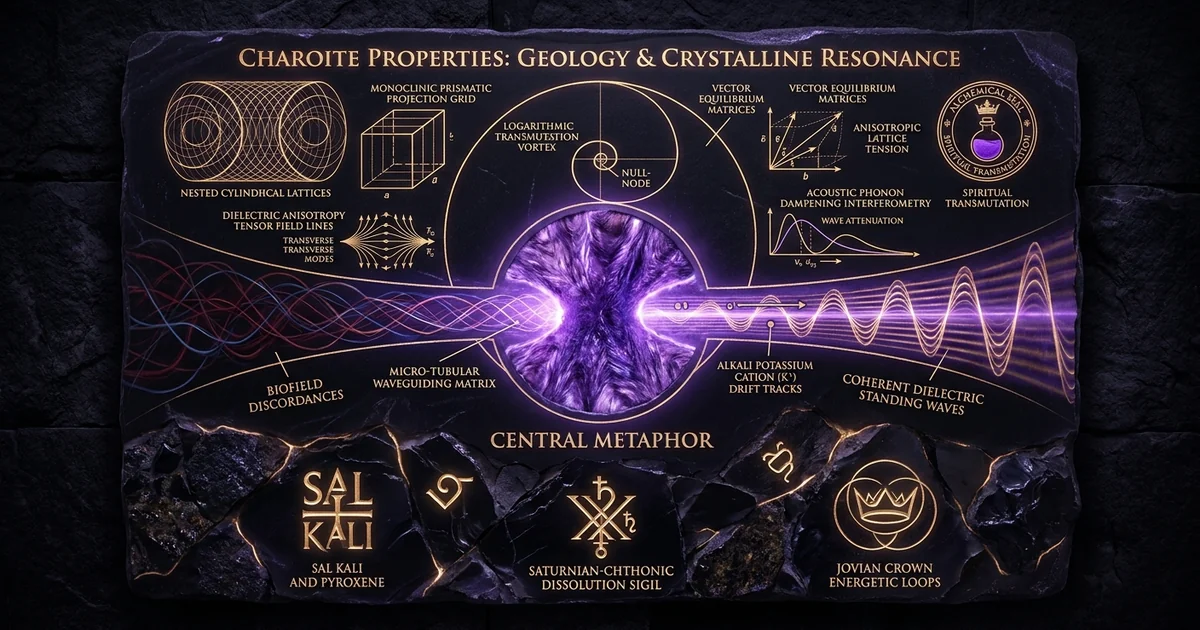
Charoite Properties: Geology & Crystalline Resonance
Mineral Classification & Crystallographic Thesis
Stoichiometry and the Complex Silicate / Oxide Matrix
Charoite defies elementary mineralogical categorization, presenting an exceptionally complex, modular crystal chemistry that puzzled crystallographers for decades following its formal recognition. Chemically classified as a hydrated alkali strontium barium calcium silicate, its empirical formula is resolved as $(\text{K},\text{Sr},\text{Ba},\text{Mn}){15-16}(\text{Ca},\text{Na}){32}(\text{Si}{70}(\text{O},\text{OH}){180})_{4.0} \cdot n\text{H}_2\text{O}$. Rather than forming simple discrete polymeric units, the structural spine of charoite comprises infinite, interleaved inosilicate tubular radicals that occupy an architectural middle ground between traditional double-chain inosilicates (such as the amphibole group) and modulated phyllosilicates. The silicon-dioxide-tetrahedra do not merely link vertex-to-vertex in planar ribbons; they fold into three distinct types of geometrically convoluted tubular chains running continuously parallel to the crystallographic $c$-axis.
This hyper-complex silicate / oxide matrix houses vast interstitial spaces occupied by large-radius alkali and alkaline-earth cations ($\text{K}^+$, $\text{Sr}^{2+}$, $\text{Ba}^{2+}$, $\text{Na}^+$), alongside volatile water dipoles. These interstitial populations are held within varying coordination spheres dictated by the undulating silicate walls. The presence of transition metal impurities—most decisively trivalent manganese ($\text{Mn}^{3+}$) substituting into octahedral calcium sites, along with trace iron ($\text{Fe}^{3+}$)—confers charoite’s signature lilac, lavender, and deep violet chromophores. This chemistry establishes an internally heterogeneous lattice where strong covalent $\text{Si}-\text{O}$ backbones contrast with ionically bounded, dynamic cation channels, producing an electrostatically reactive substrate.
Unique Paragenesis of the Murun Alkaline Complex
The formation of charoite is geologically anomalous and geographically unique. The mineral occurs solely within the Murun Alkaline Massif, located at the confluence of the Chara and Tokko rivers within the Aldan Shield of the Sakha Republic (Yakutia), Siberia. This solitary global occurrence is the direct consequence of extreme, multi-stage metasomatism. During the Mesozoic era, hyper-potassic peralkaline magmas intruded into late Proterozoic calcic-carbonatite and dolomitic sedimentary host lithologies at temperatures estimated between 450°C and 600°C, under moderate lithostatic pressures (approximately 1.5 to 2.5 kbar).
This geological collision produced a localized zone of profound potassic fenitization. The injection of hyper-alkaline, fluorine-rich, and silica-saturated hydrothermal fluids into magnesium- and calcium-bearing carbonates stripped the country rock of native equilibrium. The resulting chemical exchange catalyzed the simultaneous crystallization of charoite alongside an exotic paragenetic suite: tinaksite, fedorite, canasite, frankamenite, aegirine-augite, and microcline. As detailed in analyses of metamorphic paragenesis and subtle transmutation, this high-strain, hydrothermally dynamic regime generated complex intergrowth textures. The undulating shear stresses of the Murun intrusion folded these growing fibrous aggregates into swirled, charoitic schists, preventing the growth of macroscopic single crystals and locking the mineral into an intrinsically felted, microcrystalline state.
The Solid-State Resonance Proposition
From the standpoint of condensed matter physics and subtle energetic dynamics, charoite’s structural complexity establishes an anomalous physical boundary layer. The primary crystallographic thesis of this monograph states that charoite operates as a natural solid-state waveguiding matrix. The alternation between rigid silicon-oxygen tubular networks and mobile, highly polarizable alkali-water channels produces profound dielectric anisotropy. This spatial polarization profile allows the material to intercept, focus, and shear passing energetic vectors.
When mechanical or electromagnetic perturbations interface with this heterogeneous lattice, acoustic phonon modes couple directly with the loosely bound interstitial cations. The co-crystallization of fibrous silicates and metamorphic minerals within a dense matrix generates spontaneous dielectric boundary layers capable of modulating local subtle energetic topologies. The continuous structural modulation across sub-micron domains permits charoite to act not as a passive resonant reflector—like mono-elemental or binary lattices—but as an active, transmutative medium that systematically reorganizes localized electromagnetic turbulence into coherent vibrational harmonics.
Empirical Lattice Metrics (Rozhdestvenskaya et al., 2010)
- Space Group: $P2_1/m$ (Monoclinic system)
- Unit Cell Parameters: $a = 32.28(4)\text{ \AA}$, $b = 19.64(2)\text{ \AA}$, $c = 7.15(1)\text{ \AA}$, $\beta = 90.0(1)^\circ$
- Unit Cell Volume ($V$): $4533.1\text{ \AA}^3$
- Calculated Density ($\rho$): $2.54 - 2.58\text{ g/cm}^3$
- Mohs Hardness: $5.0 - 6.0$ (Directionally variable along fibrous cleavage)
- Optical Indices: Biaxial positive or negative, $n_\alpha = 1.550 - 1.553$, $n_\beta = 1.553 - 1.557$, $n_\gamma = 1.559 - 1.561$, $2V \approx 28^\circ - 30^\circ$
Lattice Geometry & Solid-State Physics
Tubular Silicate Architecture and Space Group P2_1/m
The absolute determination of the charoite crystal structure remained elusive until advanced automated electron diffraction tomography and high-resolution synchrotron powder diffraction unraveled its symmetry (Rozhdestvenskaya et al., 2010). Crystallizing in the monoclinic-system under space group $P2_1/m$, the lattice features a massive unit cell characterized by an elongated $a$-axis ($32.28\text{ \AA}$) and $b$-axis ($19.64\text{ \AA}$), with a comparatively short $c$-axis ($7.15\text{ \AA}$). This structural morphology is governed by modular stacking along the $[100]$ crystallographic direction.
Within this framework, the inosilicate building blocks organize into three geometrically unique, infinite silicate tubes running uninterrupted along the $c$-axis:
- Tube 1: A double-strand unbranched tubular radical composed of interconnected six-membered and eight-membered rings of $[SiO_4]$ tetrahedra.
- Tube 2: A hybrid ribbon-tube assembly containing alternating four-membered and tubular networks that form asymmetric nano-capillaries.
- Tube 3: An open, semi-tubular corrugated sheet with exposed apical oxygens that coordinate directly with external calcium-sodium octahedral ribbons.
These tubular columns are cross-linked laterally via continuous sheets of edge-sharing $(\text{Ca},\text{Na})\text{O}_6$ and $(\text{Ca},\text{Mn})\text{O}_6$ octahedra running parallel to $(010)$. This modular alternation between hard, covalently bonded silicate cylinders and ductile, ionically coordinated polyhedral layers gives rise to charoite’s macroscopic asbestiform-like parting and distinct silky luster.
Dielectric Anisotropy and Phonon Dispersion
The distinct boundary between the rigid silicate tubular walls and the fluidic internal channels creates extreme dielectric anisotropy. Parallel to the fiber axis $[001]$, charoite demonstrates a significantly elevated dielectric-constant ($\varepsilon_\parallel$) relative to the transverse axes ($\varepsilon_\perp$). This polarization differential arises because the univalent and divalent cations ($\text{K}^+$, $\text{Na}^+$, $\text{Ba}^{2+}$) and water molecules trapped within the structural nano-channels are not pinned to singular low-energy potential wells; rather, they inhabit shallow, multi-site energy landscapes along the channel trajectory.
Under the influence of external electric fields or subtle electromagnetic pulses, these interstitial charge carriers undergo collective displacement along the $c$-axis without disrupting the primary covalent architecture:
$$P_i = \varepsilon_0 \chi_{ij} E_j + \sum_k q_k \Delta r_k$$
Where:
- $P_i$ represents the induced net macroscopic polarization,
- $\chi_{ij}$ is the dielectric susceptibility tensor,
- $q_k$ represents the effective Born charge of the $k$-th interstitial alkali cation,
- $\Delta r_k$ represents the dynamic displacement vector within the tubular cavity.
This spatial freedom directly modulates the acoustic and optical phonon dispersion spectra of the crystal. Longitudinal acoustic phonons traveling parallel to the $[001]$ direction experience minimal scatter, whereas transverse acoustic phonons propagating across the inter-tubular boundaries are rapidly attenuated by structural disorder and boundary-layer friction. This solid-state phenomenon effectively dampens high-frequency thermal dissipation, redirecting localized mechanical micro-strains into coherent, low-frequency electromagnetic waveguiding channels.
Birefringence, Pleochroism, and Cation Mobility
Optically, charoite behaves as a biaxial crystalline medium with an intermediate optical angle ($2V$) consistently measuring between $28^\circ$ and $30^\circ$. Its refractive indices ($n_\alpha \approx 1.550$, $n_\beta \approx 1.555$, $n_\gamma \approx 1.559$) display low to moderate total birefringence ($\Delta = 0.009 - 0.011$). The most critical optical property of the material is its vivid, multi-axis pleochroism, demonstrating shifts from intense violet and magenta along the $Z$-vibration direction to pale rose, lavender, or near-colorless along the $X$- and $Y$-axes.
This optical pleochroism correlates directly with localized crystal field transitions. Octahedrally coordinated $\text{Mn}^{3+}$ ($d^4$ high-spin electronic configuration) undergoes Jahn-Teller structural distortion within the calcium-manganese octahedral strips. The transition:
$${}^5E_g \to {}^5T_{2g}$$
within the distorted octahedral field absorbs electromagnetic energy within the yellow-green band ($520 - 560\text{ nm}$), transmitting complementary high-energy violet ($400 - 440\text{ nm}$) and deep-red photon fluxes. Furthermore, charge-transfer interactions between trace structural $\text{Fe}^{2+}$ and $\text{Fe}^{3+}$ adjacent to $\text{Mn}^{3+}$ sites yield a dynamic electronic resonance across the silicate-octahedral boundary.
Because the channel-bound water molecules exhibit fluctuating hydrogen bonding configurations across temperature ranges from $100\text{ K}$ to $350\text{ K}$, thermal variations induce subtle spectral shifts in optical absorption. This makes the mineral’s color depth intrinsically responsive to environmental temperature gradients and external bio-energetic field fluctuations.
Subtle Energetic Dynamics & Resonance Mechanics
Waveguide Dynamics in the Inosilicate Micro-Tubes
At the subtle energetic interface, the structural nano-channels of charoite function as physical analog waveguides for non-Hertzian, longitudinal field components. While conventional transverse electromagnetic waves interact predominantly with surface electrons and surface polaritons, longitudinal field gradients—such as those produced by biological systems and localized subtle-energy-vortex configurations—penetrate deeply into porous, anisotropic dielectric arrays. The cylindrical architecture of charoite’s three discrete silicate tubes provides an ideal geometry for channeling and concentrating these displacement currents.
Silicate Tubular Wall (Rigid Covalent Shield)
=========================================================
  [+] K+        H2O        [++] Ba2+        H2O        [+] Na+
  --> Longitudinal Subtle Waveguide Direction [001] -->
  [+] Na+       H2O        [+] K+           H2O        [++] Sr2+
=========================================================
       Silicate Tubular Wall (Rigid Covalent Shield)
As turbulent bio-energetic fields encounter the boundary layer of a polished or raw charoite matrix, the misaligned, out-of-phase subtle frequencies are drawn into the path of least dielectric resistance: the parallel interstitial channels oriented along the $c$-axis. Within these sub-nanometer conduits, the electric vector of the subtle field couples to the mobile cation train ($\text{K}^+ \leftrightarrow \text{Ba}^{2+} \leftrightarrow \text{H}_2\text{O}$).
The collective movement of these loosely bound ions sets up an internal oscillating electrostatic screening effect. Erratic, discordant energetic noise is stripped of its chaotic phase distribution through continuous reflections against the dense, covalently rigid $[\text{Si}{70}(\text{O},\text{OH}){180}]$ outer walls, effectively collimating diffuse biofield emissions into an organized, coherent linear beam.
Biofield Transmutation and the Violet Spectrum Signature
The prominent metaphysical reputation of charoite as a premier mineral of systemic transmutation is directly underpinned by the spectroscopic resonance of its $\text{Mn}^{3+}$ crystal field environment. In vibrational biophysics, the human somatic biofield radiates an ultra-weak photon emission spectrum that peaks within specific optical and near-infrared bands, reflecting internal metabolic and psychophysiological coherence. Discordant emotional states, psychological trauma, and chronic somatic inflammation systematically degrade this emission profile, introducing broadband entropic noise predominantly concentrated in lower-frequency microwave and infrared thermal spectra.
Trigonal Alpha-Quartz
- Lattice Framework: Homogeneous three-dimensional framework of corner-sharing $[\text{SiO}_4]$ tetrahedra ($P3_121$ or $P3_221$).
- Dielectric Response: Highly isotropic dielectric tensor; minimal internal channel polarization; zero mobile interstitial alkali content.
- Piezoelectric Action: True linear piezoelectricity; direct transformation of macroscopic mechanical stress into discrete surface dipole charges.
- Subtle Field Mechanics: Amplifies input frequencies symmetrically; functions as a resonant carrier wave without internal filtering or qualitative frequency shifting.
Monoclinic Charoite
- Lattice Framework: Heterogeneous modular multi-tubular inosilicate radical linked by octahedral $(\text{Ca},\text{Na},\text{Mn})\text{O}_6$ layers ($P2_1/m$).
- Dielectric Response: Extreme dielectric anisotropy ($\varepsilon_\parallel \gg \varepsilon_\perp$); structural nano-capillaries populated by kinetic alkali-water dipoles.
- Electromechanical Action: Pseudo-electrostrictive and acoustic phonon dampening; structural dissipation of mechanical and subtle shear stresses.
- Subtle Field Mechanics: Transmutative attenuation; filters incoherent biofield noise through channel-guided displacement, converting entropic turbulence into higher-harmonic violet spectrum resonance.
Charoite’s fundamental absorption band within the $520 - 560\text{ nm}$ window creates an inverse radiative emitter profile centered within the violet-ultraviolet boundary ($400 - 430\text{ nm}$). This high-frequency optical signature directly matches the resonant threshold of the coronal and transpersonal chakric nodes. When placed in proximity to regions of biological disturbance, the mineral operates as an energetic bandpass filter:
- Absorption Phase: Low-frequency entropic emissions from disrupted human tissues penetrate the channel boundaries and are absorbed via non-radiative phonon conversions within the calcium-sodium octahedral sheets.
- Coupling Phase: The internal cation-dipole network converts this localized kinetic agitation into coordinated electronic charge transfer transitions between structural $\text{Mn}^{3+}$ and surrounding oxygen ligands.
- Re-emission Phase: The energy is transmuted and discharged along the $[001]$ fiber axes as coherent, high-vibrational violet harmonics, restoring structural symmetry to the surrounding auric field.
Comparative Dielectric Coupling: Quartz vs. Charoite
The operational distinction between standard trigonal silicates (such as alpha-quartz) and charoite illustrates why charoite is historically viewed as an energetic ballast and transmutative agent rather than a raw amplifier. While quartz possesses high crystalline perfection and exhibits strong, localized linear piezoelectricity, its rigid structural uniformity means it unconditionally amplifies whatever vibrational signal is introduced—whether that signal is coherent or chaotic.
Charoite, by contrast, possesses a continuous compound modular silicate matrix that is naturally self-dampening. Because it consists of intergrown, microcrystalline fibrous bundles surrounded by varied accessory phases (aegirine, microcline, canasite), internal structural dislocations and inter-channel friction absorb acoustic and subtle shockwaves. If a violently dysregulated bio-energetic impulse is directed into quartz, the quartz generates a proportional electrical surface charge that reflects the discordance back into the human subtle anatomy. If the same impulse is directed into charoite, the modular inosilicate tubes fractionate the wave-front across millions of sub-micron boundaries. The chaotic phase relationships are neutralized by the moving alkali ions, dissipating the disruptive potential while preserving the fundamental energetic momentum.
Historical Lapidary Lore & Paragenetic Emergence
The 20th-Century Discovery in the Chara River Basin
Unlike lapis lazuli, turquoise, or amethyst—minerals whose integration into human spiritual praxis spans millennia—charoite is an entirely modern mineralogical emergence. The mineral was entirely unknown to classical Western lapidaries; one finds no reference to its presence in the lapidary treatises of Theophrastus, Pliny the Elder’s Naturalis Historia, or the medieval compendiums of Marbode of Rennes and Albertus Magnus. This historical absence is a direct consequence of charoite’s geographical isolation within the impassable, frozen wilderness of the Aldan Shield in Eastern Siberia.
The initial geological encounter occurred in 1948 during a regional reconnaissance survey led by Soviet geologist V. G. Ditmar along the basin of the Chara River. Ditmar observed strange, massive, violet-hued metamorphic rocks forming prominent outcroppings within what would later be designated the Murun Alkaline Complex. However, working under the logistical constraints of post-World War II Soviet resource mapping, Ditmar misidentified the material as an unusual, manganese-rich cummingtonite or lilac-colored schist. The field samples were cataloged and placed into geological archives in Leningrad, where they remained unexamined for over a decade.
Soviet Geochemical Exploration vs. Classical Lapidary Silence
In the early 1960s, a dedicated expedition led by the husband-and-wife mineralogical team Yuri Gavrilovich Rogov and Vera Parfentievna Rogova re-located the deposits along Ditmar Creek. Vera Rogova conducted systematic petrographic and optical analyses, realizing that the physical, optical, and chemical constants of the mineral matched no known species in the global mineralogical corpus. The Soviet Ministry of Geology subjected the mineral to strict classification protocols, eventually sanctioning detailed structural and stoichiometric research throughout the 1970s.
Field Extraction: Rogova, Rogov, Drits, & Kuznetsova (1978) “During the detailed mapping of the Murun alkaline massif along the divide of the Chara and Tokko river basins, an extraordinarily rich, massive lilac-violet stone of unknown structural composition was identified… Initial petrographic field assessments categorizing the stone as a cummingtonite slate or canasite-bearing fluorite schist proved utterly untenable upon precise optical crystallography. The material exhibits an anomalous fibrous-felted architecture characterized by intense pleochroism from deep purple-violet to light rose, completely resistant to standard hydrochloric digestion, and forming dense, monomineralic aggregate veins ranging up to several meters in thickness. The unique combination of optical biaxiality, moderate hardness, and high structural resilience indicates the presence of a completely new silicate group mineral, here named charoite after the Chara River.” — Zapiski Vserossijskogo Mineralogicheskogo Obshchestva, Vol. 107, No. 1, pp. 94–100.
The formal approval of the name “charoite” was ratified by the International Mineralogical Association (IMA) in 1978. Yuri Rogov famously traveled to the mineralogical museum in Paris during this period, presenting a sample of the Siberian stone to leading Western curators; not a single specialist could identify the species, cementing its status as a uniquely Soviet mineralogical discovery. Because its emergence coincided with the height of the Cold War, the Soviet government tightly restricted raw exports, utilizing charoite almost exclusively for state-sponsored architectural mosaics, elite diplomatic gifts, and proprietary geochemical research.
Siberian Shamanic Traditions of Metamorphic Stones
Although the modern scientific identification of charoite dates only to the mid-20th century, indigenous Siberian populations within the Sakha (Yakut) and Evenki hunting territories maintained oral traditions concerning the high-potassium, violet-tinged boulders of the Murun mountains. Referred to in ancestral narratives as “the stone of the frozen river’s heart” or “the purple spirit-frost,” these stones were cautiously approached rather than casually exploited.
Evenki shamans recognized that the stones harvested from the high-altitude fenite ridges held severe grounding and dream-altering attributes. Rather than wearing the stone directly against the dermis for extended cycles, shamans positioned raw fragments outside the perimeter of the chum (nomadic tent) or used them during intense rites of psychological transition—specifically the kamsaniye rituals aimed at retrieving fragments of souls dispersed across lower spiritual realms. The stone was treated as a calcified lightning bolt—a bridge between the deep subterranean terrestrial fire (Ödör) and the crystalline chill of the celestial sky (Tengri).
When charoite finally breached international mineral markets in the late 1980s and early 1990s, lapidary metaphysicians immediately recognized that its physical origin—the absolute metamorphic transformation of dissimilar sedimentary rocks and intrusive alkaline lavas under extreme pressure into a unified, swirling matrix—mirrored the spiritual dynamic of non-dual synthesis. The stone came to represent the transmutation of polarized internal psychological complexes into integrated, higher-order awareness.
Practical Applications, Calibration & Safety Protocols
Geometric Gridding and Dielectric Attunement
When employing charoite within energetic architecture or spatial geometric gridding, practitioners must accommodate the mineral’s structural anisotropy. Because the inosilicate tubes direct vibrational flow along the $c$-axis, a haphazard arrangement of tumbled or irregularly oriented stones creates erratic, intersecting subtle vectors. Optimal field generation requires the systematic alignment of the macro-fibers.
To construct a coherent transmutative matrix:
- Specimen Selection: Utilize polished or rough tabular specimens where the direction of the fibrous sheen (chatoyancy) is visually evident.
- Radial Alignment: Position the stones along the perimeter of an energetic workspace with their $c$-axes ([001] direction of the silicate tubes) pointing directly toward a centralized focal point (typically a high-purity single-crystal quartz oscillator or a grounded metallic sink).
- Inter-Node Spacing: Maintain grid nodes at distances proportional to the golden ratio ($\Phi \approx 1.618$) to match the modular periodic boundaries of the crystal’s monoclinic super-cell, which naturally dampens acoustic and etheric dissonance across the grid field.
This configuration creates a convergent subtle vortex that systematically pulls ambient environmental static into the outer perimeter, processes the turbulence through the internal alkali-cation nano-channels, and discharges a stabilized, coherent field inward toward the center.
Cleavage Fragility, Porosity, and Chemical Vulnerability
Charoite exhibits distinct, highly directional mechanical properties that dictate strict handling protocols. With a directional mohs-hardness ranging from 5.0 (transverse to the fibers) to 6.0 (parallel to the fibers), it is significantly softer than quartz, beryl, or corundum. The mineral possesses distinct cleavage along the $[100]$ crystallographic plane, accompanied by an inherent fibrous parting.
Mechanical shock, dropping, or localized pressure can induce sudden structural delamination along these cleavage planes. Under no circumstances should charoite be cleaned or calibrated using ultrasonic jewelry cleaners. The ultrasonic high-frequency acoustic cavitations (typically $20 - 40\text{ kHz}$) generate localized pressure spikes within the fluid medium that directly destabilize the inter-tubular calcium-octahedral bonding layers, resulting in micro-fracturing, permanent loss of chatoyant luster, and eventual catastrophic structural degradation.
Furthermore, charoite’s nano-porosity makes it highly vulnerable to chemical attack. Standard household detergents, acids, cosmetic oils, and salt solutions penetrate deep into the structural alkali channels. Contact with acidic liquids initiates cation-exchange reactions, leaching mobile $\text{K}^+$, $\text{Na}^+$, and $\text{Ba}^{2+}$ ions from the silicate tubes and replacing them with hydronium ions ($\text{H}_3\text{O}^+$), transforming the vivid violet surface into a chalky, chemically degraded, white-grey amorphous residue.
Radiological Hazards and Leaching Vectors
- Accessory Mineral Radioactivity: The hyper-alkaline metasomatic conditions of the Murun Massif that yielded charoite also catalyzed the growth of rare actinide-bearing minerals. Charoite specimens frequently host micro-inclusions of:
- Steacyite: $\text{K}_{1-x}(\text{Na},\text{Ca})_2\text{ThSi}8\text{O}{20}$ (High Thorium content)
- Ekanite: $\text{Ca}_2\text{ThSi}8\text{O}{20}$ (Thorium / Uranium bearing)
- Thorite: $\text{ThSiO}_4$ Prolonged direct dermal contact with untested, high-activity charoite specimens poses a chronic ionizing radiation hazard. All metaphysical and lapidary specimens must be screened with an alpha/beta/gamma pancake GM detector prior to long-term biofield work.
- Strict Prohibition on Aqueous Elixirs: Under NO circumstances should charoite be utilized for direct aqueous maceration (gem elixirs or crystal waters). The exposed nano-channels permit the rapid leaching of toxic heavy and alkaline-earth metals, specifically Barium ($\text{Ba}^{2+}$), Strontium ($\text{Sr}^{2+}$), and Fluorine ($\text{F}^-$), directly into solution. Ingestion of these leached ions induces systemic neuro-muscular toxicity and severe cardiac dysrhythmias. Indirect immersion methods (sealing the stone inside an impermeable glass vessel before placing it into water) must be maintained at all times.
Protocol Integration: Cleansing and Resonance Calibration
Zero-Point Magnetic Nullification
Because charoite acts as an unceasing dielectric waveguiding filter, it accumulates profound energetic hysteresis—residual vibrational imprints left behind by continuous biofield shearing. Standard cleansing methodologies that utilize water submersion or direct salt packaging are strictly prohibited due to the chemical leaching and structural degradation outlined above. Instead, practitioners must utilize zero-point magnetic nullification to clear the lattice.
To reset the mobile cation baseline within the nano-channels:
- Place the specimen within a localized magnetic null chamber or expose it to a slow-decay alternating current (AC) magnetic degaussing field (field strength: $50 - 100\text{ Gauss}$ at $50/60\text{ Hz}$).
- Alternatively, position the charoite between the counter-opposed poles of two neodymium rare-earth magnets (North-to-North configuration) separated by precisely twice the width of the specimen.
- This configuration creates a localized scalar cancellation zone, causing the trapped $\text{K}^+$ and $\text{Ba}^{2+}$ ions within the inosilicate tubes to relax back into their lowest energetic equilibrium states, clearing accumulated phase-locked electrostatic stress without mechanical or chemical intervention.
Dry Harmonic Acoustic Coupling (432 Hz / 528 Hz)
To recalibrate the acoustic phonon modes of the monoclinic system without risking the catastrophic shear induced by ultrasonic baths, dry acoustic coupling must be utilized. Charoite resonates cleanly with mid-frequency harmonic sound waves that match the mechanical elasticity of its fibrous silicate framework.
A clinical calibration protocol requires exposing the stone to pure sinusoidal or tuning fork frequencies generated at 432 Hz (associated with terrestrial sub-harmonic resonance) or 528 Hz (associated with the molecular vibrational mode of structural water clusters).
Step-by-Step Acoustic / Scalar Recalibration
- Environmental Preparation: Position the charoite specimen on an acoustically neutral, non-conductive surface (natural undyed felt, dry unvarnished birch wood, or natural silica sand). Ensure ambient humidity is maintained between $35%$ and $50%$.
- Geomagnetic Orientation: Align the specimen’s primary fiber axis $[001]$ precisely parallel to the local geomagnetic North-South vector using a magnetic compass. This matches the flow of channel-bound cations to terrestrial field lines.
- Primary Acoustic Excitation (528 Hz): Strike an unweighted 528 Hz medical-grade aluminum tuning fork. Bring the vibrating stem to within 2–5 millimeters of the specimen’s polished surface without making mechanical contact. Sweep the fork slowly along the length of the fibers three consecutive times to clear secondary electrostatic boundary charges.
- Resonance Stabilization (432 Hz): Introduce a sustained 432 Hz acoustic source (such as an authentic quartz crystal bowl or pure algorithmic sine wave) at an amplitude of $70 - 75\text{ dB}$ for a duration of 12 minutes. The sound waves interact with the complex inosilicate tubes, purging incoherent phase information and locking the interstitial water dipoles into structural coherence.
- Scalar Grounding: Place a companion specimen of natural, non-fibrous black aegirine (which co-crystallizes with charoite in the Murun Massif) directly in contact with the base of the charoite to anchor the recalibrated lattice potential into the earth plane.
Subtle Field Alignment Along Fiber Axials
Following magnetic nullification and acoustic tuning, the final phase of protocol integration involves directed bio-energetic calibration. The practitioner must align the charoite’s internal conduits with their personal somato-energetic pathways. The human palm chakras exhibit an outward toroidal electromagnetic pulse; by orienting the charoite’s fibrous grain perpendicular to the palm’s central emission axis, the user prevents sudden energetic reflection, allowing the mineral’s natural dielectric waveguiding mechanics to gently entrain the biofield.
When working with clients suffering from profound emotional turbulence or psychological distress, the stone should be positioned at the base of the skull (the sub-occipital triangle), with its $c$-axis oriented downward toward the seventh cervical vertebra ($C7$). This positioning intersects the major informational conduits of the central nervous system, where the mineral’s continuous modular silicate matrix dampens erratic sympathetic nervous system spikes, transmuting bio-electric volatility into the stabilized violet harmonic spectrum.
Frequently Asked Questions
Distinguishing Genuine Charoite from Synthetic and Dyed Replicas
Due to its economic value and singular geological origin, an array of imitations and mineralogical simulants circulate within the international commercial market. However, genuine charoite possesses an intricate, fibrous, and swirling structural fabric that synthetic materials cannot replicate. To date, synthetic charoite does not exist; the hyper-complex, multi-stage hydrothermal metasomatism—requiring extreme potassic fenitization at temperatures of 500°C under dynamic shear pressures—presents an insurmountable thermodynamic barrier for commercial laboratory synthesis.
Imitations instead consist of treated, dyed minerals or reconstituted composite blocks:
- Dyed Purple Beryl or Marble: Natural white calcite, marble, or low-grade massive beryl is routinely pressure-infused with purple organic dyes. These fakes are immediately exposed through a simple solvent test: a cotton swab dipped in acetone and applied to an inconspicuous area will strip the synthetic dye, turning the cotton purple. Under a standard gemological refractometer, calcite exhibits extreme birefringence ($\Delta = 0.172$) with a refractive index dropping down to 1.486, completely distinct from charoite’s tight $1.550 - 1.560$ range.
- Purple Fluorite Composites: Massive purple fluorite is occasionally carved and passed off as charoite. Fluorite has an isotropic (singly refractive) optical profile, a dramatically lower Mohs hardness of 4.0 (it is easily scratched by a common copper coin), and a significantly higher specific gravity ($3.18\text{ g/cm}^3$, compared to charoite’s $2.54 - 2.58\text{ g/cm}^3$).
- Reconstituted Charoite Blocks: Lower-grade charoite dust and processing scraps are bound together using clear epoxy or polyurethane resins under vacuum pressure. These simulants display an unnaturally uniform, swirling plastic sheen, exhibit soft hardness (under 4.0 Mohs), smell strongly of petrochemicals when subjected to a hot-point thermal needle test, and demonstrate low bulk density ($\rho < 2.30\text{ g/cm}^3$).
Radiological Safety Limits for Metaphysical Work
Because charoite paragenetically co-crystallizes with actinide-bearing accessory minerals within the Murun Alkaline Complex, determining the radiological safety of any individual specimen is paramount. As established by Reguir et al. (2010), trace thorium ($\text{Th}$) and minor uranium ($\text{U}$) can concentrate within discrete mineral phases directly embedded within the purple charoite host, most notably microcrystalline grains of steacyite, ekanite, and thorite.
For safe handling within metaphysical, therapeutic, and lapidary contexts, specimens must be evaluated under the following operational guidelines:
- Baseline Background Comparison: Measure the ambient background ionizing radiation using a calibrated Geiger-Müller counter (expressed in microsieverts per hour, $\mu\text{Sv/h}$). A clean specimen should not exceed twice the ambient background level (typically $< 0.15 - 0.20\text{ \mu Sv/h}$).
- Action Thresholds: If a specimen registers between $0.25\text{ \mu Sv/h}$ and $0.50\text{ \mu Sv/h}$ at contact, it must not be used for direct-contact dermal therapies, worn continuously as personal jewelry, or positioned under pillows during sleep. It may, however, be kept as an environmental display specimen inside a glass vitrine.
- Prohibited Specimens: Any specimen exceeding $0.50\text{ \mu Sv/h}$ at contact must be retired from active bio-energetic practice and stored within an appropriate lead-lined or high-density containment box. Under no circumstances should high-activity stones be cut, ground, or polished without dry vacuum HEPA filtration and respiratory containment, as the inhalation of aerosolized thorium-bearing silicate dust poses a severe, irreversible internal alpha-radiation and chemical carcinogenicity risk.
Optimal Geometric Grid Configurations
Deploying charoite within crystal grids requires an understanding of its continuous modular waveguiding properties. Unlike isolated single-crystal quartz points that act as isotropic radiating nodes, charoite behaves as a directional circuit component. The optimal configuration for charoite involves a nested hexagonal or dodecahedral architecture centered on energetic grounding and transmutation.
[ Charoite Node 1 ] ------> [ Charoite Node 2 ]
              ^                            |
              |       (Vortex Vector)      |
              |              v             |
       [ Charoite Node 4 ] <------ [ Charoite Node 3 ]
              \                            /
               \                          /
                --> [ Central Grounding ] <--
                    [  Aegirine / Quartz]
To establish this circuit:
- Arrange an even number of charoite specimens (typically six or eight) in a symmetrical ring surrounding the subject or intention matrix.
- Orient each specimen so that its chatoyant grain follows the perimeter in a continuous, single-direction path (e.g., clockwise to stimulate spiritual integration; counter-clockwise to banish energetic intrusion). This alignment creates a closed-loop subtle-energy vortex that continuously strips turbulent low-frequency static from the interior space.
- Anchor the grid at the center using a heavy, non-fibrous grounding silicate—such as black tourmaline (schorl), smoky quartz, or raw aegirine. This anchor acts as an energetic heat sink, drawing the transmuted frequencies downward and preventing energetic static from saturating the surrounding environment. Check the nodes bi-weekly using dry acoustic clearing to maintain optimal throughput. :::