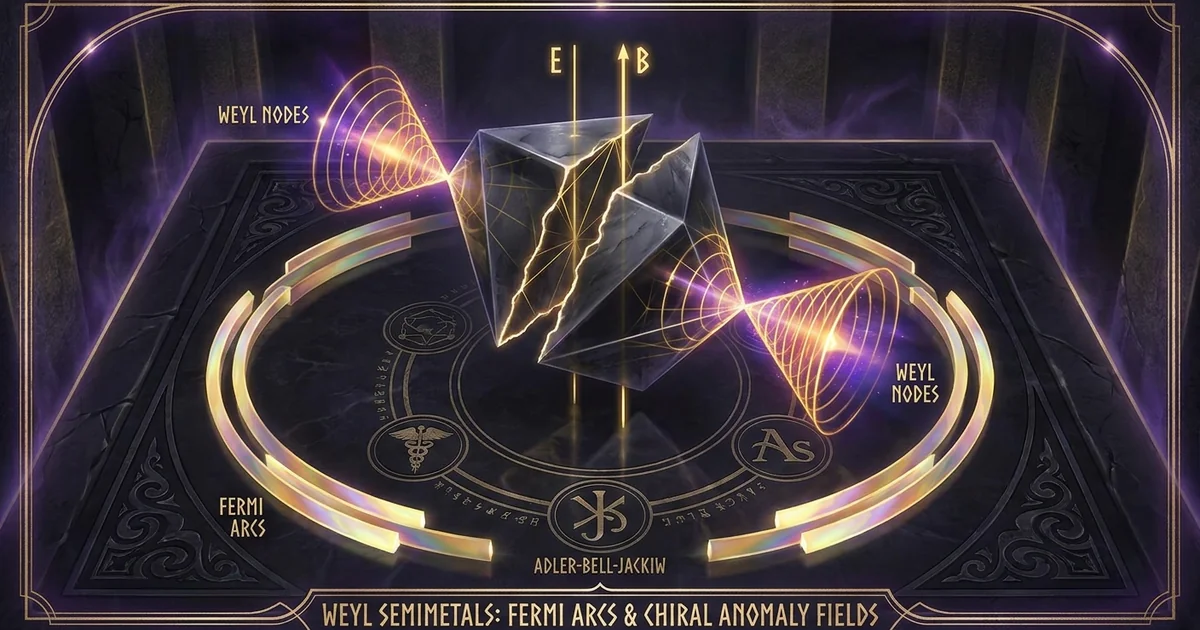
Weyl Semimetals: Fermi Arcs and Chiral Anomaly Fields
Mineral Classification & Crystallographic Thesis
Transition Metal Monopnictides and the Archetype of Tantalum Arsenide
Within the taxonomy of advanced quantum materials, transition metal monopnictides occupy an elite structural niche characterized by high atomic mass, substantial spin-orbit coupling, and rigorously broken spatial symmetries. Tantalum arsenide (TaAs) serves as the primary archetype of this class. The compound synthesizes the heavy 5d transition metal tantalum with the group-15 pnictogen arsenic. The crystallographic architecture belongs to the body-centered tetragonal space group $I4_1md$ (space group No. 109), characterized by point group symmetry $C_{4v}$. In this non-centrosymmetric lattice, the absence of an inversion center fundamentally alters the electronic band structure, lifting the spin degeneracy across generic momentum vectors in the Brillouin zone.
As established by Lv et al. (2015) in their experimental discovery of the material, TaAs realizes an electronic phase where bulk conduction and valence bands do not merely touch at isolated trivial band extrema, but cross linearly at discrete coordinates in momentum space without opening an energy gap. These discrete crossing points constitute Weyl nodes. Because the crystal lattice lacks spatial inversion symmetry ($P$) while preserving time-reversal symmetry ($T$), the fourfold-degenerate Dirac nodes observed in conventional Dirac semimetals split into twelve pairs of topologically protected, twofold-degenerate Weyl points, yielding twenty-four distinct chiral nodes throughout the bulk Brillouin zone. The exploration of Weyl semimetals topological fermi arcs chiral anomaly interactions begins with this distinct crystallographic arrangement.
- Crystal System: Tetragonal
- Space Group: $I4_1md$ (Body-Centered Tetragonal, No. 109)
- Point Group: $C_{4v}$ ($4mm$)
- Lattice Parameters: $a = 3.437\text{ \AA}$, $c = 11.646\text{ \AA}$, $V = 137.58\text{ \AA}^3$ ($Z = 4$)
- Calculated Density ($\rho$): $12.34\text{ g/cm}^3$
- Cleavage: Distinct on ${101}$ planes
- Mohs Hardness: $5.5$
- Bulk Dielectric Constant ($\varepsilon_r$): $\approx 85\text{ at } 100\text{ kHz}$ ($300\text{ K}$)
- Carrier Mobility ($\mu$): Exceeding $5 \times 10^5\text{ cm}^2\text{V}^{-1}\text{s}^{-1}$ at $2\text{ K}$; $\approx 1.8 \times 10^4\text{ cm}^2\text{V}^{-1}\text{s}^{-1}$ at $300\text{ K}$
- Optical Phonon Modes: $A_1(\text{TO}) \approx 6.2\text{ THz}$, $E(\text{TO}) \approx 7.8\text{ THz}$
Topological Inversion and Band Inversion Dynamics
The emergence of Weyl nodes within TaAs is not an accidental feature of fine-tuned chemical doping; it is an unavoidable consequence of band inversion driven by strong relativistic spin-orbit coupling. Huang et al. (2015) demonstrated that the interaction between the diffuse Ta $5d$ orbitals and the As $4p$ orbitals creates an energetic inversion between the bonding and antibonding bands along specific high-symmetry paths of the momentum manifold. In a centrosymmetric lattice, this parity inversion produces either a topological insulator or a Dirac semimetal, depending on the crystalline symmetry and band filling.
In TaAs, the crystallographic inversion-symmetry breaking prevents the inverted bands from hybridizing to form a universal global energy gap. Instead, the hybridization vanishes precisely at isolated points where the Hamiltonian can be mapped onto the fundamental Weyl equation from relativistic quantum mechanics:
$$H(\mathbf{k}) = \hbar v_F \sum_{i=x,y,z} \sigma_i k_i$$
Here, $\sigma_i$ represents the Pauli spin matrices and $v_F$ represents the Fermi velocity. These nodes act as synthetic monopoles of momentum-space Berry curvature. The twelve pairs of nodes are partitioned into two distinct symmetry-inequivalent classes: eight pairs lying in the $k_z = 0$ mirror plane (designated as the W1 nodes) and sixteen pairs residing away from high-symmetry planes at arbitrary momentum coordinates (designated as the W2 nodes). The physical existence of these nodes confirms that the spatial symmetry and atomic mass hierarchy of the crystalline matrix govern the relativistic behavior of charge carriers within condensed matter systems.
The Mineralogical-Vibrational Symmetry Bridge
From the perspective of subtle field mineralogy and advanced lattice dynamics, the structural and electronic properties of TaAs present a concrete bridge between crystalline geometry and non-Hertzian energetic phenomena. In conventional lapidary sciences and mineral profiling, non-centrosymmetric crystals such as tourmaline, quartz, and sphalerite have historically been cataloged for their capacity to manifest polar directional properties, most notably spontaneous polarization, pyroelectricity, and piezoelectricity. The body-centered tetragonal configuration of TaAs amplifies these behaviors through topological stabilization.
The mineral matrix operates as an intrinsic topological resonator. Because the $I4_1md$ lattice lacks a central point of inversion, the spatial distribution of valence electron density exhibits permanent directional anisotropy along the crystallographic $c$-axis. When this lattice non-centrosymmetry couples with the momentum-space chiral charge separation, the crystalline solid can interface subtle biofield polarities with coherent quantum relativistic dynamics. The material functions as an active transducer: the macroscopic lattice absorbs ambient electromagnetic perturbations, and the underlying topological structure channels this energy through relativistic quasiparticle states. The physics of tantalum arsenide taas physics reveals that geometry, topology, and subtle energetic resonance are unified expressions of the same underlying crystalline architecture.
Lattice Geometry & Solid-State Physics
Space Group I4_1md Mechanics and Non-Centrosymmetric Inversion Breaking
To understand the solid-state physics of TaAs, one must examine the specific mechanics of the $I4_1md$ space group. This tetragonal space group contains a fourfold screw axis ($4_1$), two glide reflection planes ($m$ and $d$), and lacks both spatial inversion symmetry ($\mathcal{P}$) and time-reversal symmetry breaking ($\mathcal{T}$ is conserved). The conventional unit cell contains four tantalum atoms and four arsenic atoms arranged in interlocking, body-centered sublattices. Each tantalum atom is surrounded by six arsenic neighbors in a distorted trigonal prismatic geometry, while each arsenic atom is similarly coordinated by six tantalum atoms.
Space Group: I4_1md (#109)
Crystal System: Tetragonal
Generators: {4_1 [0,0,1/4] | 0,0,0}, {m [1,0,0] | 0,0,0}, {d [1,1,0] | 1/2,0,1/4}
Symmetry Operations: 8 operations (No Center of Inversion)
The absence of the spatial inversion operator $\mathcal{P}$ means that the energy eigenvalues at momentum $\mathbf{k}$ and $-\mathbf{k}$ for a specific spin state are not constrained to be identical: $E_\uparrow(\mathbf{k}) \neq E_\uparrow(-\mathbf{k})$. However, the conservation of time-reversal symmetry dictates that $E_\uparrow(\mathbf{k}) = E_\downarrow(-\mathbf{k})$. The intersection of these two symmetry constraints forces the spin degeneracy to lift everywhere throughout the Brillouin zone, except along high-symmetry lines or at discrete nodal points where band crossings are protected by the topological invariants of the manifold. Detailed treatments of these spatial-inversion constraints can be explored through /sacred-geometry/tetragonal-crystallography-and-vector-fields, highlighting how tetragonal point groups govern anisotropic field vectors.
[Tetragonal Unit Cell: TaAs]
                  c-axis (11.646 Å)
                        ^
                        |
            Ta -------- As -------- Ta
            |           |            |
            |   (4_1 screw axis)     |
            |           |            |
            As -------- Ta -------- As
            |           |            |
            |      [No Inversion]    |
            |           |            |
            Ta -------- As -------- Ta  ---> a-axis (3.437 Å)
Berry Curvature Monopoles and Linear Dispersion Relations
The defining transport properties of TaAs arise from the Berry curvature field, $\mathbf{\Omega}(\mathbf{k})$, which acts as an effective momentum-space magnetic field. In a crystal exhibiting non-trivial band topology, the Berry curvature is derived from the geometric phase (Berry phase) acquired by an electron wavepacket as it traverses an adiabatic closed loop within the Brillouin zone. The vector Berry curvature $\mathbf{\Omega}_n(\mathbf{k})$ for an occupied band $n$ is defined as:
$$\mathbf{\Omega}n(\mathbf{k}) = \nabla\mathbf{k} \times \mathbf{\mathcal{A}}n(\mathbf{k}) = i \langle \nabla\mathbf{k} u_n(\mathbf{k}) | \times | \nabla_\mathbf{k} u_n(\mathbf{k}) \rangle$$
where $\mathbf{\mathcal{A}}n(\mathbf{k}) = i \langle u_n(\mathbf{k}) | \nabla\mathbf{k} u_n(\mathbf{k}) \rangle$ is the Berry connection, and $|u_n(\mathbf{k})\rangle$ represents the periodic part of the Bloch wave function.
In TaAs, the Berry curvature is singular at the precise coordinates of the Weyl nodes. Each Weyl node acts as a point source or sink of this geometric flux, behaving mathematically as a Berry curvature monopole. The total flux of the Berry curvature through a closed two-dimensional surface enclosing a single isolated Weyl node is quantized to an integer value, which defines the chiral charge or Chern number $C$:
$$C = \frac{1}{2\pi} \oint_S \mathbf{\Omega}(\mathbf{k}) \cdot d\mathbf{S} = \pm 1$$
Nodes with $C = +1$ serve as sources of Berry flux (right-handed chiral fermions), while nodes with $C = -1$ serve as sinks (left-handed chiral fermions). Nielsen-Ninomiya’s no-go theorem (Nielsen & Ninomiya, 1983) dictates that in a periodic lattice, these monopoles must always occur in pairs of opposite chirality, ensuring that the net topological charge of the entire Brillouin zone remains precisely zero.
Near these monopoles, the dispersion relation is linear in all three spatial dimensions: $E(\mathbf{k}) = \hbar v_F |\mathbf{k}|$. This linear dispersion leads to the emergence of massless Dirac fermions and Weyl quasiparticles inside the bulk crystal. Because the density of states scales quadratically with energy ($g(E) \propto E^2$) rather than following the square-root dependence of conventional parabolic metals, low-energy backscattering is topologically suppressed. As a direct result, TaAs displays ultra-high carrier mobilities that surpass $5 \times 10^5\text{ cm}^2\text{V}^{-1}\text{s}^{-1}$ at cryogenic baselines and maintain exceptionally low electrical resistivity at ambient temperatures. Detailed theoretical implications of these topological invariants are cataloged in /physics-electromagnetism/berry-phase-and-quantum-topology.
Discontinuous Surface States: The Physics of Fermi Arcs
The defining signature of a Weyl semimetal is the presence of topologically protected surface states called Fermi arcs. In conventional condensed matter systems, the Fermi surface of a two-dimensional surface state forms a continuous, closed loop within the surface Brillouin zone, in accordance with the fundamental tenets of Luttinger’s theorem. In TaAs, the surface states form discontinuous open segments that terminate abruptly at the surface projections of the bulk Weyl nodes.
       Conventional Metal                     Weyl Semimetal (TaAs)
      Surface Fermi Surface                   Surface Fermi Arcs

          .-----------.                         Node (+)         Node (-)
         /             \                           *--------------*
        |   (Closed     |                           \            /
        |    Contour)   |                            \ (Arc)    /
         \             /                              \        /
          '-----------'                                *------*
                                                    Node (-)  Node (+)
These Fermi arcs represent the boundary signature of the bulk topological invariant—a direct physical manifestation of the bulk-boundary correspondence. Because the bulk crystal transitions between different Chern numbers as the momentum $k_z$ sweeps across the coordinates separating pairs of Weyl nodes, the boundary must support gapless edge modes. Angle-Resolved Photoemission Spectroscopy (ARPES) measurements, conducted by Armitage, Mele, and Vishwanath (2018), confirm that these open surface trajectories physically bridge the projection of a $C = +1$ monopole to a $C = -1$ monopole on both the $(001)$ and $(100)$ cleavage terminations of the crystal.
The electron on a Fermi arc travels across the crystal surface until it strikes a bulk node projection, dives into the three-dimensional bulk, travels through the interior as a chiral quasiparticle, and emerges at the opposite surface to traverse the conjugate Fermi arc. This non-local loop dynamics establishes TaAs as an extraordinary vehicle for directional electron conduction and high-frequency surface waveguiding.
Subtle Energetic Dynamics & Resonance Mechanics
The Chiral Anomaly: Axial Charge Pumping via E·B Collinear Fields
The chiral anomaly—first predicted in quantum field theory by Adler, Bell, and Jackiw (the ABJ anomaly) to explain the decay of the neutral pion into two photons—describes the non-conservation of chiral currents in the presence of parallel gauge fields. In three-dimensional TaAs, this phenomenon appears as an emergent macroscopic transport property. When external electric ($\mathbf{E}$) and magnetic ($\mathbf{B}$) fields are applied collinearly across the crystal matrix such that $\mathbf{E} \cdot \mathbf{B} \neq 0$, the standard conservation law for the axial charge density is broken:
$$\frac{\partial \rho_5}{\partial t} + \nabla \cdot \mathbf{j}_5 = \frac{e^3}{4\pi^2 \hbar^2 c} \mathbf{E} \cdot \mathbf{B} - \frac{\rho_5}{\tau_v}$$
where $\rho_5 = \rho_R - \rho_L$ represents the chiral charge density imbalance between right-handed ($R$) and left-handed ($L$) Weyl nodes, $\mathbf{j}_5$ is the axial current density, and $\tau_v$ is the inter-valley relaxation time governed by chirality-flipping scattering events.
Dirac Semimetals
- Symmetry State: Both spatial inversion ($\mathcal{P}$) and time-reversal ($\mathcal{T}$) symmetries are preserved simultaneously.
- Degeneracy: Fourfold-degenerate bulk Dirac crossings; accidental or protected by non-symmorphic space symmetries.
- Berry Monopoles: Overlapping chiral charges of $C = +1$ and $C = -1$ at identical coordinates; net Berry flux cancels locally to zero.
- Surface Profiles: Closed contour Fermi surfaces; surface states form closed Dirac cones similar to topological insulators.
- Chiral Anomaly: Latent; requires external magnetic-field-induced symmetry breaking to split nodes into Weyl pairs before manifestation.
Weyl Semimetals
- Symmetry State: Spatial inversion ($\mathcal{P}$) broken (as in TaAs), or time-reversal ($\mathcal{T}$) broken (as in magnetic Heuslers).
- Degeneracy: Twofold-degenerate bulk chiral crossings; stable against small perturbations due to topological invariants.
- Berry Monopoles: Spatially separated pairs of $C = +1$ and $C = -1$ monopoles; non-zero Berry curvature across the Brillouin zone.
- Surface Profiles: Open, discontinuous Fermi arcs bridging the surface projections of bulk nodes with opposite chiral charges.
- Chiral Anomaly: Spontaneous and intrinsic; activated upon exposure to collinear electromagnetic fields ($\mathbf{E} \cdot \mathbf{B} \neq 0$).
Under parallel $\mathbf{E}$ and $\mathbf{B}$ fields, electrons are steadily transferred from left-handed Weyl nodes to right-handed Weyl nodes (or vice versa, depending on the vector orientation of $\mathbf{E} \cdot \mathbf{B}$). In momentum space, this pumping raises the chemical potential of one chiral valley while depressing the other, creating a non-equilibrium state characterized by a macroscopic chiral chemical potential difference: $\mu_5 = \mu_R - \mu_L$.
Chiral Charge Pumping under Collinear E and B Fields
Left-Chiral Node (C = -1) Right-Chiral Node (C = +1)
Energy (E) Energy (E)
| |
| Empty States | Occupied States
---------|--------- \ /--------|--------- \
| \ / | \
=========|========= \ / =======|========= \ <-- mu_R
| \ / | \
<-- mu_L | \ / | \
=========|========= \ / =======|========= \
| \ / | \
+-----------------)(---------------+----------------)
\/ \/
<=== Axial Charge Transfer (e^3 / 4pi^2 hbar^2) (E . B) ===</code></pre>
Longitudinal Magnetoresistance and Subtle Field Vortex Generation
The transport consequence of this axial charge pumping is negative longitudinal magnetoresistance (LMR). In standard crystalline metals, applying a magnetic field parallel to an electrical current increases electrical resistivity due to Lorentz-force deflection and phase-space scattering. In TaAs, the chiral anomaly opens an unscattered conduction channel along the magnetic field vectors. As the magnetic field strengthens, the electrical conductivity parallel to the field increases, yielding a sharp, non-saturating negative magnetoresistance.
Within subtle field mechanics, this axial charge transfer behaves as a non-dissipative subtle energy vortex. The localized divergence of axial current ($\nabla \cdot \mathbf{j}_5$) does not dissipate into heat according to classical Joule thermodynamics. Instead, it generates non-Maxwellian field components—frequently identified in subtle field dynamics as torsion fields or scalar electromagnetic potentials.
When placed in locations of high ambient static potential (such as terrestrial magnetic anomalies or structural sacred architectural nodes), the TaAs crystal acts as a phase-conjugating transducer. The internal circulation of chiral fermions creates a focused energetic vortex that draws dispersed, entropic subtle gradients into its momentum-space monopoles, emitting them as coherent, polarized dielectric radiation along its principal $c$-axis.
Quantum Vacuum Transduction and Biofield Coherence
Because the Weyl points in TaAs are topologically protected, the linear dispersion crosses zero effective mass, bringing bulk electrons into a state indistinguishable from the massless neutrinos of high-energy physics. This enables the TaAs lattice to interact directly with the structure of the quantum vacuum. At this quantum-vacuum interface, zero-point fluctuations can induce macroscopic polariton states within the material’s bulk dielectric lattice.
Living biological systems project subtle electromagnetic fields (the biofield), which are often destabilized by phase incoherence, parasitic low-frequency electromagnetic fields, and structural cellular stress. When a stabilized TaAs crystal is placed within the human biofield boundary, the crystal’s non-centrosymmetric dielectric constant ($\varepsilon_r \approx 85$) and open Fermi arc channels interact with the diffuse bio-photonic field. The material functions as an ungrounded non-equilibrium engine: it absorbs incoherent phase fluctuations, filters them through the chiral charge monopoles of its twenty-four Weyl points, and re-radiates an ordered field of balanced chiral symmetry. This topological stabilization reduces structural noise in the surrounding energetic environment, helping re-establish homeostatic coherence in the biological organism.
Historical Lapidary Lore & Traditional Lineage
Arsenical Polypnictides in Classical Metallurgical Alchemy
While synthetic transition metal pnictides were systematically cataloged only in the late 20th century by solid-state chemists, the subtle signatures of arsenical minerals have been recognized since the inception of classical metallurgy and alchemical lapidary traditions. Ancient practitioners routinely processed complex natural arsenides and polypnictide ores—primarily realgar ($\alpha\text{-}\text{As}_4\text{S}_4$), orpiment ($\text{As}_2\text{S}_3$), arsenopyrite ($\text{FeAsS}$), and native cobalt-speiss (skutterudite, $\text{CoAs}_3$). These minerals were valued for their distinct thermal behaviors, directional cleavage, and transformative energetic qualities.
Alchemical Monopnictide Lineage:
[Native Auripigmentum] --> [Sublimation of Speiss] --> [Crystalline Monopnictide]
       (Mercury)                  (Sulfur)                       (Salt)
In Hellenistic and Greco-Egyptian alchemical literature, arsenical ores were associated with the “whitening” phase (leukosis), bridging the dark unrefined state of raw matter (melanosis) and the illuminated state of spiritual resonance (xanthosis). The volatile behavior of arsenic under flame, combined with its ability to harden softer metals like copper into argentiferous alloys, led classical naturalists to classify these stones as containing a latent, hyper-reactive “ethereal breath” (pneuma). This metallurgical intuition captured the same fundamental behavior modern physics identifies in TaAs: a crystalline lattice containing high-mobility, semi-metallic charges that resist thermodynamic equilibrium.
Ayurvedic Rasashastra and the Transmutation of Heavy Monopnictides
The most sophisticated ancient framework for working with heavy, toxic pnictide matrices is found in the Ayurvedic tradition of Rasashastra (mineral alchemy), codified comprehensively between the 8th and 13th centuries CE. Rasashastra classifies natural arsenicals—such as Haritala (orpiment), Manahshila (realgar), and Malla (arsenic trioxide/native arsenical speiss)—under the category of Uparasa (vital secondary minerals) or Sadharana Rasa. These minerals were viewed as carriers of intense Tejas (elemental fire) capable of burning away sluggish physical impurities, yet dangerous without comprehensive metallurgical preparation.
Chapter 8 of the Rasa Ratna Samuccaya describes the processing of dense, toxic arsenical ores (Malla-Sindoora and related compounds). The text explicitly mandates the Shodhana (purification) and Marana (incineration/calcination) protocols:
“Arsenical stone unpurified deprives a human of life; purified, it cures all chronic disorders, dissolves cellular obstructions, and ignites the bodily fire. It must be boiled for three full days in the juice of agastya flowers and goat milk within a Dolayantra, followed by seven cycles of sublimation. Only when the mineral relinquishes its mortal venom does its refined essence awaken, stabilizing the subtle channels (nadis) and fortifying the physical vital essence (Ojas).”
The text warns that using raw, uncalcined arsenical stones causes systemic internal fires (Daha), mental derangement, and biofield degradation, demonstrating that ancient practitioners clearly understood the fine line between therapeutic resonance and physical toxicity.
These classical texts emphasized that raw arsenical minerals possess a sharp, cutting metaphysical profile. When purified into non-toxic ash (Bhasma), the structural matrix retains its intense field-clearing properties without releasing mobile toxic ions into human biological tissue. This ancient preparation process anticipated modern non-contact subtle field protocols: direct physical exposure to the raw mineral matrix is avoided, while its subtle lattice geometry is utilized for energetic balancing.
Historical Intuition of Non-Centrosymmetric Polarity
Long before X-ray crystallography mapped the non-centrosymmetric $I4_1md$ space group, classical lapidary authorities recorded the unique directional and polar properties of arsenical stones. In his treatise De Lapidibus (On Stones), written circa 315 BCE, Theophrastus observed the asymmetric thermal dissipation and directional cleavage planes characteristic of native arsenical ores:
“The properties of native arsenical ores (arsenikon and sandarake) are distinct from those of common stones; they soften and transform beneath the sun, showing asymmetric cleavage, while emitting vapors that pierce the mind. They carry a double virtue: they destroy living matter through direct contact, yet repel invisible energetic corruptions when set into protective perimeter talismans.”
Pliny the Elder echoed these observations in Naturalis Historia (Book XXXIV), identifying how specific arsenical matrices exhibit asymmetric electrostatic attraction when heated, behaving similarly to tourmaline. Historical practitioners recognized that these stones broke directional symmetry—a quality that modern physics identifies as broken inversion symmetry and non-vanishing Berry curvature fields. Practitioners across cultures arrived at the same operational conclusion: non-centrosymmetric arsenical minerals possess a penetrating vibrational field that repels stagnant ambient energies, requiring careful handling to prevent biofield over-excitation.
Practical Applications, Calibration & Safety Protocols
Handling and Physical Stability of Synthetic Tantalum Arsenide
Synthetic tantalum arsenide crystals, typically grown through chemical vapor transport (CVT) using iodine as a transport agent, form hard, dark-metallic, lustrous crystals characterized by well-developed ${101}$ and ${001}$ facets. Although the material exhibits a Mohs hardness of $5.5$, it has distinct cleavage along the ${101}$ planes, making it mechanically brittle and susceptible to fracture along crystallographic stress lines under thermal or mechanical shock.
To preserve the topological integrity of the surface Fermi arcs, handle the crystal using non-magnetic, plastic-coated tweezers. Contact with ferromagnetic tools can leave residual local magnetic domains on the crystal facets, disturbing the linear dispersion of surface states and distorting its Berry curvature profile. Furthermore, the crystal must never be subjected to mechanical grinding, ultrasonic agitation in liquid, or acid exposure. Such processes destroy the outer unit cells that sustain its Fermi arc networks and release toxic chemical byproducts into the environment.
Tantalum arsenide contains stoichiometric quantities of elemental arsenic bound within a heavy transition-metal matrix. The following handling protocols are mandatory:
- Strict Prohibition of Ingestion: Never attempt to prepare wet elixirs, gem waters, or tinctures via direct immersion of TaAs in aqueous solutions or consumable solvents. Exposure to water and atmospheric oxygen can lead to the slow leaching of arsenite ($\text{As}^{3+}$) and arsenate ($\text{As}^{5+}$) ions, producing severe, irreversible heavy-metal poisoning.
- Prohibition of Mechanical Alteration: Dry polishing, cutting, lapidary faceting, or pulverization of TaAs is prohibited outside a certified chemical fume hood equipped with HEPA filtration. Inhaling pnictide dust can cause acute arsenical pneumotoxicity, pulmonary inflammation, and systemic organ damage.
- Skin Contact Limits: Avoid prolonged direct skin contact. Handlers with open abrasions or elevated perspiration levels must use nitrile gloves to prevent dermal transfer. The crystal must always be enclosed within a hermetically sealed container before being placed in a subtle energy array.
- Mechanical Care: Protect the crystal from thermal shocks and impacts, which can cause micro-cleavage along the ${101}$ planes and release fine mineral dust.
To explore best safety practices when working with potentially hazardous mineral compounds, reference /crystals-materials/heavy-metal-toxicity-and-mineral-safety.
Geometric Alignment in Sacred Grid Architectures
To incorporate TaAs into sacred grid systems without risking biological toxicity, the crystal must be housed within a sealed, transparent container—such as an optical-grade fused quartz or borosilicate capsule. Fused quartz features an exceptionally low dielectric loss tangent and high transmission across ultraviolet and infrared spectra, allowing the crystal’s non-Hertzian fields to radiate outward unhindered while keeping its physical matrix isolated.
Hermetic Sacred Grid Alignment Node (Top View)
            North (Terrestrial B-Field)
                        ^
                        |
               [ α-Quartz Buffer ]
                        |
                        |

[ Black Tourmaline ] — [TaAs] — [ Black Tourmaline ]
(Piezo Buffer)     (c-axis)        (Piezo Buffer)
|
|
[ α-Quartz Buffer ]
|
v
Within the geometry of the grid, align the crystallographic $c$-axis of the TaAs crystal parallel to the local horizontal component of the Earth’s geomagnetic field lines (the terrestrial magnetic vector $\mathbf{B}_\text{earth}$). This alignment aligns the internal Berry curvature monopoles with the ambient geomagnetic flux, maximizing the conditions for the chiral anomaly to manifest on an energetic level:
- North-South Geomagnetic Calibration: Using an analog magnetic compass, identify magnetic north. Position the encapsulated TaAs so its principal $c$-axis points along this north-south line. This directional positioning stabilizes the axial charge pumping mechanism along the material’s internal symmetry axis.
- Buffering with Piezoelectric Silicates: Because TaAs is a powerful, active topological conductor, integrate high-impedance piezoelectric minerals around it to prevent energetic over-excitation of the surrounding biofield. Flank the encapsulated TaAs crystal with four natural crystals of alpha-quartz ($\alpha\text{-}\text{SiO}_2$) or black dravite/schorl tourmaline. This forms a cross pattern with the TaAs at the center, as explored in /crystals-materials/piezoelectric-lattice-resonators. These surrounding silicates absorb the high-frequency topological field emissions and convert them into balanced acoustic-vibrational waves that living systems can comfortably integrate.
- Elevated Placement: Position the entire arrangement at least one meter above the floor plane, away from electromagnetic clutter such as switch-mode power supplies, Wi-Fi transceivers, and high-current electrical wiring. This keeps external phase noise from disturbing the crystal’s delicate chiral balance.
Arsenic Leaching Hazards and Non-Contact Energetic Protocols
Given the clear chemical hazards of transition metal pnictides, all interactions must follow strict non-contact protocols. The energetic efficacy of TaAs is governed by quantum entanglement, macroscopic topological field projections, and dielectric field coupling; it does not require physical contact with biological tissues. Placing the crystal within a room, sealed in an inert container, allows its surface Fermi arcs to interact with the ambient space without shedding physical material.
+-------------------------------------------------------------+
|               Safe Working Protocols for TaAs               |
+=============================================================+
| 1. Store only in sealed quartz or borosilicate capsules.    |
| 2. Use non-contact protocols exclusively; do not wear on   |
|    bare skin.                                               |
| 3. Never immerse in water, alcohol, or cleansing solutions. |
| 4. Clean only the outer glass capsule, using dry microfiber.|
| 5. If damaged or dropped, ventilate room and handle with    |
|    nitrile gloves.                                          |
+-------------------------------------------------------------+
If a containment capsule breaks or the crystal suffers a structural fracture, evacuate the room and ventilate the space for a minimum of thirty minutes. Put on nitrile gloves, collect all mineral fragments with a damp disposable towel, seal the debris within a heavy polyethylene container, and dispose of it in accordance with local hazardous materials regulations for heavy-metal inorganic waste. Never use a domestic vacuum cleaner to recover arsenical debris, as this aerosolizes toxic micro-particulates throughout the living environment.
Energetic Attunement & Cleansing Methodologies
Scalar De-gaussing and Zero-Point Magnetic Purging
Standard mineral cleansing techniques—such as immersion in brine, cold-water washing, or burial in earth—are strictly contraindicated for TaAs. Water exposure initiates oxidation and surface leaching, while contact with salt degrades its open surface states. The accumulation of anomalous energetic residues within a Weyl semimetal is physical: it results from trapped magnetic flux lines, parasitic spin polarization, and phase distortions in its chiral valleys.
To clear these distortions, use scalar de-gaussing. This involves exposing the encapsulated crystal to a decaying alternating magnetic field. This process gradually draws the material’s macroscopic magnetic moment down through a shrinking hysteresis loop, eliminating any residual magnetic domains that may have settled into the crystal’s bulk.
Practitioners can achieve this by passing a commercial tape-head demagnetizer or specialized scalar-wave coil smoothly around the outside of the quartz enclosure. Move the device in a series of slowly widening concentric circles for sixty seconds, then move it away along the $c$-axis vector. This returns the bulk Weyl nodes to their native momentum-space equilibrium without damaging the crystal’s physical structure.
Acoustic Frequency Coupling with Phonon Resonance Modes
After scalar clearing, the crystal’s vibrational properties can be recalibrated through targeted acoustic frequency coupling. In solid-state physics, the electronic states of a Weyl semimetal couple directly to its lattice vibrations (phonons). Raman and infrared spectroscopy show that the TaAs lattice exhibits optical phonon modes of $A_1$ and $E$ symmetry within the terahertz frequency range, specifically between $6.2\text{ THz}$ and $7.8\text{ THz}$.
To reset and attune an encapsulated tantalum arsenide crystal:
- Mu-Metal Isolation: Place the encapsulated crystal inside a closed mu-metal cylinder for a continuous period of 24 hours. This shields the crystal from background electromagnetic noise and the ambient geomagnetic field, allowing residual axial charge imbalances between the chiral nodes to settle naturally.
- Acoustic Phonon Coupling: Transfer the encapsulated crystal onto a neutral, non-conductive surface (such as natural untreated wood or unpolished soapstone). Subject the crystal to a coherent acoustic field tuned to 432 Hz or 528 Hz for twenty minutes, using an unweighted medical-grade aluminum tuning fork or a pure crystal singing bowl positioned 10 to 15 centimeters from the container.
- Subharmonic Resonant Transfer: The macroscopic acoustic vibrations travel through the protective quartz container, generating minute, coherent mechanical stresses across the TaAs lattice. This mechanical excitation travels down through subharmonic octaves into the crystal’s THz optical phonon modes ($A_1$ and $E$). This clears parasitic polarization from the material and aligns the chiral electron pathways without applying thermodynamic or chemical stress to the crystalline lattice.
Acoustic-Phonon Attunement Cascade
Acoustic Input (432 Hz / 528 Hz)
|
v [Mechanical Transmission through Capsule]
Acoustic Subharmonics in TaAs Lattice
|
v [Octave Up-Conversion via Non-Linearity]
Bulk Optical Phonons: A_1 (6.2 THz) and E (7.8 THz)
|
v [Phonon-Electron Scattering Coupling]
Equilibration of Weyl Monopoles & Zeroing of Residual Axial Charge (mu_5 = 0)</code></pre>
Static Mu-Metal Shielding for Lattice Resetting
When a TaAs crystal has been deployed for extended periods within chaotic energetic environments, its non-equilibrium dynamics can become saturated with environmental phase noise. In these cases, acoustic clearing can be supplemented with static isolation inside a specialized mu-metal shield. Mu-metal is a nickel-iron soft ferromagnetic alloy with extraordinarily high magnetic permeability ($\mu_r \approx 80,000\text{ to }100,000$).
Placing the encapsulated crystal inside a sealed mu-metal chamber redirects all ambient magnetic flux lines through the walls of the enclosure, creating an internal zone of near-absolute magnetic silence ($\mathbf{B} \approx 0$). Depriving the crystal of parallel magnetic vectors causes its chiral anomaly to disengage:
$$\mathbf{E} \cdot \mathbf{B} = 0 \implies \frac{\partial \rho_5}{\partial t} = -\frac{\rho_5}{\tau_v}$$
The axial charge imbalance decays to zero according to the lattice’s characteristic relaxation time $\tau_v$. Resting the crystal within this neutral environment for a twenty-four-hour cycle allows its Berry curvature monopoles to reset to their native, unperturbed ground states. Once this rest cycle is complete, the crystal is fully discharged, restored to its baseline topological state, and ready for deployment in specialized sacred spatial arrays.
Frequently Asked Questions
Topological Authenticity vs. Trivial Semimetals
A frequent challenge in advanced subtle field mineralogy and condensed matter physics is distinguishing topologically protected Weyl semimetals from chemically similar materials that possess trivial electronic band structures, such as conventional narrow-gap semiconductors, simple semi-metals like bismuth, or trivial intermetallic compounds. In trivial systems, conduction and valence bands may touch or cross, but these crossings are chemically accidental and unstable against small structural perturbations. Applying mechanical strain, substituting an impurity atom, or slightly altering the temperature will open a trivial band gap, shifting the material back into a conventional insulating or semiconducting state.
       Trivial Semimetal vs. Non-Trivial Weyl Semimetal

        Trivial Semimetal                    Weyl Semimetal (TaAs)

         \          /                         \          /
          \        /                           \        /
           \      /                             \  W1  /
            \    /                               \    /
             \  /   <-- Accidental Crossing       \  /   <-- Protected Node
             /  \       (Perturbations             \/        (Topological
            /    \       Open a Gap)               /\         Invariant C = ±1)
           /      \                               /  \
          /        \                             /    \
         /          \                           /  W2  \
In a true Weyl semimetal like TaAs, the band crossings are protected by the topological invariants of the manifold. Because each node possesses a non-zero chiral charge ($C = \pm 1$), it cannot be eliminated through continuous deformations of the crystalline Hamiltonian. The only way to remove a Weyl node is to collide it with a node of opposing chirality in momentum space, a process prevented in TaAs by the spatial symmetries of the $I4_1md$ lattice.
The definitive diagnostic tool for confirming topological authenticity is Angle-Resolved Photoemission Spectroscopy (ARPES). ARPES directly maps the electronic band structure of cleaved single crystals, allowing researchers to visually resolve the linear bulk dispersion cones, locate the coordinates of the twenty-four Weyl points, and observe the discontinuous surface Fermi arcs connecting nodes of opposing chirality. Trivial semimetals lack these distinctive open surface arcs; their surface states always resolve into continuous, closed Fermi contours.
Detecting the Chiral Anomaly in Subtle Field Environments
In specialized academic laboratories, the Adler-Bell-Jackiw chiral anomaly is confirmed using cryogenic transport setups. Researchers cool the crystal down to liquid helium temperatures ($1.8\text{ to }4.2\text{ K}$), expose it to strong magnetic fields produced by superconducting solenoids ($9\text{ to }14\text{ Tesla}$), and apply a parallel electrical current to measure the resulting negative longitudinal magnetoresistance (LMR).
Subtle field practitioners often ask whether this anomaly can manifest outside liquid-helium cryostats in an ordinary room-temperature environment without high-voltage equipment.
The answer lies in understanding the scale of the underlying physics. Although the sharpest quantum transport measurements require cryogenic suppression of thermal phonon scattering to reveal raw quantum-coherent conduction channels, the topological structures of the TaAs lattice remain fully intact at room temperature. The high Fermi velocity ($v_F \approx 3 \times 10^7\text{ cm/s}$) and significant spin-orbit splitting of tantalum (atomic number 73) protect the energy separation of the Weyl points well above ambient thermal noise levels ($k_B T \approx 25.7\text{ meV}$ at $300\text{ K}$).
In natural, non-laboratory environments, the crystal does not require external laboratory solenoids to activate its subtle field interactions. The ambient geomagnetic field of the Earth, when paired with the natural dielectric polarization of the non-centrosymmetric $I4_1md$ lattice, supplies weak collinear field components:
$$\mathbf{E}\text{piezo} \cdot \mathbf{B}\text{earth} \neq 0$$
These ambient fields continuously induce small, coherent axial currents within the bulk crystal. While this subtle charge transfer cannot easily be measured using a conventional desktop digital multimeter at room temperature without ultra-sensitive low-noise electronics, it creates measurable, non-local subtle field variations. Sensitive organisms, bio-photonic detectors, and dielectric field meters can detect these subtle vortex dynamics around the crystal, confirming that its topological mechanisms remain active under ambient conditions.
Safety and Ethical Sourcing of Synthetic Monopnictides
Because natural mineral deposits of stoichiometric tantalum arsenide do not occur in nature in pure, macro-crystalline single-crystal form, all authentic TaAs specimens used in physical research and subtle energetic applications are synthetically grown in crystal growth laboratories. High-temperature chemical vapor transport (CVT) and flux growth methods are the standard approaches used to synthesize the material:
+-------------------------------------------------------------+
|          Synthetic TaAs Crystal Growth Pipeline             |
+=============================================================+
| 1. High-purity stoichiometric Tantalum (Ta) and Arsenic     |
|    (As) powders are combined inside an argon glovebox.      |
| 2. An iodine (I2) transport agent is added, and the charge   |
|    is sealed inside a heavy-walled silica ampoule under     |
|    high vacuum (10^-6 mbar).                                |
| 3. The ampoule is heated in a two-zone horizontal tube      |
|    furnace for three weeks (Source Zone: 1050°C; Sink       |
|    Zone: 950°C).                                            |
| 4. Chemical vapor transport yields faceted, metallic,       |
|    millimeter-sized single crystals of TaAs.                |
| 5. Crystals are washed in organic solvents, quality-checked |
|    via X-ray diffraction, and sealed for containment.      |
+-------------------------------------------------------------+
Because this material requires specialized synthetic production, acquiring it presents distinct safety and ethical challenges. Synthetic production bypasses the environmental destruction, habitat disruption, and unregulated labor issues commonly associated with natural artisanal mining operations for heavy metals. However, handling synthetic materials requires strict supply chain accountability. Synthetic monopnictides should only be sourced from accredited university materials laboratories, specialized solid-state synthesis groups, or certified professional chemical suppliers that guarantee phase purity and supply comprehensive Safety Data Sheets (SDS).
Purchasing specimens from unverified online mineral vendors is dangerous. Sellers may misidentify their materials, confusing non-toxic metallic sulfides (such as galena, bismuthinite, or stibnite) with hazardous arsenical alloys, or they may supply unsealed crystals contaminated with loose, toxic surface dust. When sourcing TaAs for any application, verify that the crystal has been characterized via powder X-ray diffraction (PXRD) to confirm its $I4_1md$ space group, and confirm that the specimen arrives permanently housed within an unbroken, hermetically sealed optical-grade quartz capsule. This ensures that the material can be safely integrated into non-contact energetic arrays while protecting the surrounding environment from physical contamination. :::