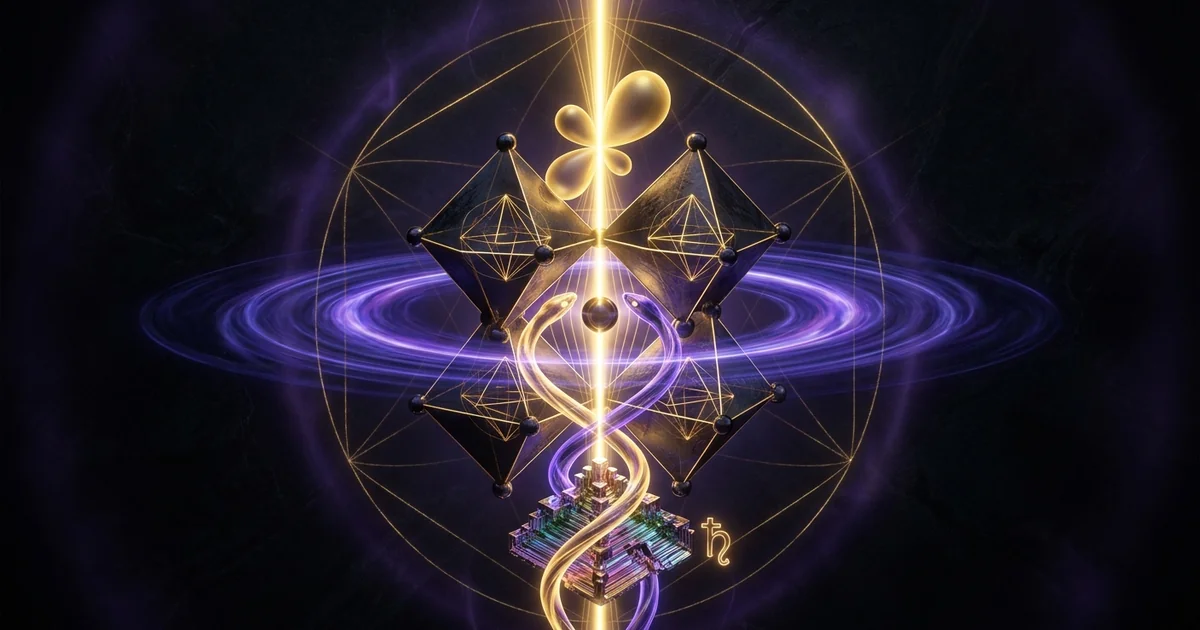
Bismuth Ferrite Multiferroics: Coupled Order Parameters
Mineral Classification & Crystallographic Thesis
Stoichiometry, Space Group, and Perovskite Architecture
Bismuth ferrite ($\text{BiFeO}_3$, commonly abbreviated as BFO) occupies an extraordinary station in solid-state physics and esoteric crystallography as the archetypal room temperature multiferroic. Within the broader family of ternary transition-metal oxides, bismuth ferrite crystallizes into a distorted perovskite-structure characterized by the general formula $AB\text{O}_3$. At ambient temperature and pressure, the crystallographic framework departs from ideal cubic symmetry ($Pm\bar{3}m$) through a concerted rhombohedral distortion. This distortion is precisely classified under the non-centrosymmetric, polar space group $R3c$ (space group number 161, with point group $3m$). The crystallographic unit cell can be indexed either in a rhombohedral coordinate system ($a_r \approx 5.63\text{ \AA}$, $\alpha_r \approx 59.35^\circ$) or, more conventionally for tensor and diffraction analyses, via a hexagonal setting ($a_h \approx 5.58\text{ \AA}$, $c_h \approx 13.87\text{ \AA}$, with $Z = 6$).
The mechanical origin of this stable non-centrosymmetric ground state lies in the mutual displacement of constitutive ionic sublattices along the threefold polar axis, which aligns with the pseudocubic $[111]_c$ direction. In this configuration, the trivalent bismuth ($\text{Bi}^{3+}$) cations and iron ($\text{Fe}^{3+}$) cations are shifted continuously relative to the rigid framework of corner-sharing $[\text{FeO}_6]$ octahedra. Concurrently, the oxygen octahedra undergo an anti-phase rotational tilt around the polar $[111]_c$ axis. In the notation established by Glazer, this system is definitively described by the tilt system $a^-a^-a^-$, signifying equal-magnitude rotations about all three pseudocubic axes with adjacent octahedra tilting in opposite directions. The macroscopic manifestation of this cooperative displacement is an immense, uncompensated electrical dipole moment that endows the mineral lattice with spontaneous ferroelectricity.
Unlike classical titanate-based systems, such as barium titanate ($\text{BaTiO}_3$) or lead zirconate titanate ($\text{Pb(Zr,Ti)O}_3$), where the non-centrosymmetric shift relies on empty $d^0$ transition metal states, $\text{BiFeO}_3$ delegates its dipolar displacement entirely to the $A$-site bismuth cation. This crystallographic decoupling permits the $B$-site iron cation to retain a high-spin transition-metal configuration without destabilizing the ferroelectric order. Consequently, the material exhibits a uniquely dense, uncompensated ferroelectric polarization ($P_s$) approaching $90\text{ to }100\text{ }\mu\text{C/cm}^2$ along the polar vector under monocrystalline conditions. For deeper structural analysis of how corner-sharing polyhedral networks undergo spontaneous symmetry breaking, examine the geometric dynamics detailed in /sacred-geometry/perovskite-octahedral-tilting.
The Duality of Spontaneous Polarization and Magnetic Order
The fundamental triumph of bismuth ferrite bifeo3 multiferroic ferroelectric magnetic mechanics is the stable, simultaneous manifestation of two mutually hostile macroscopic quantum states: long-range ferroelectric order and long-range magnetic order. In conventional Landau-Ginzburg-Devonshire phenomenology, ferroelectricity requires formal $d^0$ electron configurations on the transition-metal center to accommodate covalent hybridization with oxygen $2p$ orbitals. Conversely, magnetic order mandates partially filled $d$-shells ($d^n$, where $0 < n < 10$) to preserve localized magnetic moments capable of undergoing exchange coupling. Bismuth ferrite circumvents this “multiferroic contradiction” through spatial and electronic segregation within its sublattices.
While the $\text{Bi}^{3+}$ sublattice drives ferroelectricity, the $\text{Fe}^{3+}$ sublattice produces robust, long-range antiferromagnetism. Each $\text{Fe}^{3+}$ cation possesses a $3d^5$ electronic shell exhibiting a high-spin ground state ($S = 5/2$, with orbital angular momentum quenched to $L \approx 0$). Mediated by intermediate oxygen anions via the $\text{Fe}^{3+}-\text{O}^{2-}-\text{Fe}^{3+}$ pathways, adjacent iron moments order through negative exchange constants into a distinct $G$-type antiferromagnetic configuration. In this arrangement, every $\text{Fe}^{3+}$ cation is surrounded by six nearest-neighbor iron cations exhibiting antiparallel spin orientations.
The coexistence of these dual orders persists exceptionally far above ambient laboratory conditions. Bismuth ferrite possesses a ferroelectric Curie temperature ($T_C$) of approximately $1103\text{ K}$ ($830^\circ\text{C}$) and an antiferromagnetic Néel temperature ($T_N$) of roughly $643\text{ K}$ ($370^\circ\text{C}$). This places both transition points well beyond terrestrial environmental shifts, distinguishing $\text{BiFeO}_3$ from the vast majority of multiferroics which require cryogenic temperatures to sustain magnetic ordering. The structural coexistence of an uncompensated electric dipole alongside an ordered magnetic array forms the necessary substrate for direct magnetoelectric-coupling, permitting cross-talk where external electric fields actuate magnetic states, and external magnetic flux modifies dielectric displacements.
Thermodynamic Stability Phase Boundaries
The equilibrium phase diagram of the pseudobinary $\text{Bi}_2\text{O}_3-\text{Fe}_2\text{O}_3$ system reveals an exceedingly narrow stability window for stoichiometric, single-phase bismuth ferrite. As documented extensively across experimental condensed-matter literature, $\text{BiFeO}_3$ is an incongruently melting compound that decomposes into liquid phase and auxiliary parasitic oxides at elevated temperatures. Heating stoichiometric powders above the Néel temperature preserves the polar rhombohedral $\alpha$-phase up to the first structural phase boundary at $T_C \approx 1103\text{ K}$. At this boundary, the mineral undergoes a first-order phase transition into the orthorhombic $\beta$-phase (space group $Pbnm$ or $Pnma$), characterized by the catastrophic collapse of polar symmetry, accompanied by volume contraction and insulator-to-metal transitional fluctuations.
Heating beyond $1200\text{ K}$ induces a transition into the cubic $\gamma$-phase (space group $Pm\bar{3}m$), an ideal high-symmetry perovskite configuration that remains stable until the peritectic decomposition boundary is breached at $1243\text{ K}$ ($970^\circ\text{C}$). Beyond this point, the compound dissociates into liquid $\text{Bi}2\text{O}3$ alongside solid sillenite-type bismuth-rich phases ($\text{Bi}{25}\text{FeO}{39}$) and mullite-type iron-rich oxides ($\text{Bi}_2\text{Fe}_4\text{O}_9$). This thermodynamic volatility is compounded by the high vapor pressure and volatility of elemental bismuth during high-temperature thermal calcination.
                  1243 K: Peritectic Decomposition
                            |
                            v
       [ Liquid Bi2O3 ] + [ Bi2Fe4O9 / Bi25FeO39 Parasitic Phases ]
                            ^
                            |
                  1200 K: Cubic Transition
                            |
                            v
       [ gamma-BiFeO3: Centrosymmetric Cubic (Pm-3m) ]
                            ^
                            |
                  1103 K: Ferroelectric Curie Temp (TC)
                            |
                            v
       [ beta-BiFeO3: Non-Polar Orthorhombic (Pbnm) ]
                            ^
                            |
                   643 K: Antiferromagnetic Néel Temp (TN)
                            |
                            v
       [ alpha-BiFeO3: Rhombohedral Polar Multiferroic (R3c) ]
       (Coupled Spontaneous Polarization + G-type Spin Cycloid)
The thermodynamic instability poses substantial synthetic challenges. In unoptimized synthesis, localized non-stoichiometry creates charged point defects, primarily bismuth vacancies ($V_{\text{Bi}}^{\prime\prime\prime}$) and oxygen vacancies ($V_{\text{O}}^{\bullet\bullet}$). To maintain charge neutrality within the lattice, iron ions partially reduce from their nominal ferric state ($\text{Fe}^{3+}$) to a ferrous state ($\text{Fe}^{2+}$). This mixed-valence scenario triggers thermally activated electron hopping via a polaronic mechanism ($\text{Fe}^{2+} \leftrightarrow \text{Fe}^{3+} + e^-$), which degrades the electrical resistivity of bulk specimens. It can transform an otherwise wide-bandgap multiferroic insulator into a leaky semiconductor characterized by unacceptable dielectric dissipation factors.
Primary Metric Reference Profile (Catalan & Scott, 2009; Wang et al., 2003):
- Crystal System: Rhombohedral (Hexagonal setting indexing)
- Space Group: $R3c$ (No. 161), Point Group $3m$
- Hexagonal Lattice Parameters: $a = 5.578\text{ \AA}$, $c = 13.868\text{ \AA}$
- Rhombohedral Coordinates: $a_r = 5.63\text{ \AA}$, $\alpha_r = 59.35^\circ$
- Curie Temperature ($T_C$): $\sim 1103\text{ K}$ ($830^\circ\text{C}$)
- Néel Temperature ($T_N$): $\sim 643\text{ K}$ ($370^\circ\text{C}$)
- Spontaneous Polarization ($P_s$): $90\text{ to }100\text{ }\mu\text{C/cm}^2$ along pseudocubic $[111]_c$
- Effective Optical Bandgap ($E_g$): Direct $\sim 2.67\text{–}2.74\text{ eV}$; Indirect onset $\sim 2.2\text{ eV}$
- Piezoelectric Coefficient ($d_{33}$): $\sim 30\text{–}40\text{ pm/V}$ (bulk polycrystalline); up to $100\text{–}130\text{ pm/V}$ (strain-engineered epitaxial thin films)
Lattice Geometry & Solid-State Physics
Stereochemical Activity of the Bi 6s² Lone Pair
The primary mechanism generating ferroelectric order in bismuth ferrite is rooted in the electronic structure of the $A$-site bismuth cation. In its trivalent ionic state ($\text{Bi}^{3+}$), bismuth possesses an electron configuration of $[\text{Xe}] 4f^{14} 5d^{10} 6s^2$. The two valence electrons residing in the outer $6s$ orbital represent a classical non-bonding, chemically stable pair. However, within the crystalline environment of the distorted oxygen coordination cage, these $6s^2$ electrons do not retain spherical $S$-like spatial symmetry.
Instead, the spatial proximity of the surrounding twelve-coordinate oxygen polyhedra drives an energetic hybridization between the Bi $6s$ atomic states and the empty Bi $6p$ states. This intra-atomic mixing is facilitated by covalent overlap with the neighboring oxygen $2p$ ligand orbitals. The outcome of this structural-electronic coupling is the formation of a stereochemically active, asymmetric lone electron pair. This localized electron charge cloud extends outward into interstitial crystallographic space, repelling adjacent oxygen anions and breaking inversion symmetry at the bismuth site.
As the lone pair projects away from the cation core, it drives a substantial translation of the entire bismuth sublattice relative to the octahedral oxygen framework. This spatial distortion occurs exclusively along the threefold rhombohedral axis, corresponding to the $[111]_c$ vector in pseudocubic notation. The immense magnitude of this physical displacement (exceeding $0.5\text{ \AA}$ along the polar axis) explains why bismuth ferrite sustains a spontaneous polarization ($P_s \approx 100\text{ }\mu\text{C/cm}^2$) that rivals or exceeds classic ferroelectrics, as analyzed in the broader context of dielectric domain switching in /physics-electromagnetism/ferroelectric-domain-dynamics.
Fe-O-Fe Superexchange and the Incommensurate Spin Cycloid
While the Bi sublattice drives the electric dipole formation, the open-shell configuration of the $B$-site iron sublattice governs the material’s magnetic physics. Within each $[\text{FeO}6]$ octahedron, the $\text{Fe}^{3+}$ cation experiences an octahedral crystal field that splits its five degenerate $3d$ orbitals into three lower-energy $t{2g}$ orbitals ($d_{xy}, d_{yz}, d_{zx}$) and two higher-energy $e_g$ orbitals ($d_{x^2-y^2}, d_{z^2}$). Because the crystal field splitting energy ($\Delta_o$) is smaller than the Hund’s rule intra-atomic exchange energy, all five $d$-electrons align with parallel spins, producing a high-spin $t_{2g}^3 e_g^2$ orbital occupancy with $S = 5/2$.
The primary magnetic interaction between adjacent $\text{Fe}^{3+}$ ions is governed by the Goodenough-Kanamori rules for superexchange. Because the $\text{Fe}-\text{O}-\text{Fe}$ bond angle departs from an ideal $180^\circ$ geometry due to octahedral rotation (measuring approximately $154^\circ$ to $165^\circ$ depending on temperature and epitaxial strain), the overlap of the iron $3d$ orbitals with the bridging oxygen $2p$ orbitals remains strong. This overlap produces an intense, negative (antiferromagnetic) exchange interaction:
$$H_{\text{ex}} = -2 \sum_{\langle i,j \rangle} J_{ij} \mathbf{S}_i \cdot \mathbf{S}_j$$
Here, the exchange parameter $J_{ij} < 0$, forcing nearest-neighbor iron moments into antiparallel alignment.
If spatial inversion symmetry were strictly preserved between neighboring magnetic centers, this interaction would yield a collinear $G$-type antiferromagnet. However, because the space group $R3c$ lacks a center of inversion between adjacent iron sites, the asymmetric exchange interaction known as the dzyaloshinskii-moriya-interaction (DMI) becomes energetically favorable. The DMI Hamiltonian is formally written:
$$H_{\text{DMI}} = \sum_{\langle i,j \rangle} \mathbf{D}_{ij} \cdot (\mathbf{S}_i \times \mathbf{S}_j)$$
The Dzyaloshinskii-Moriya vector $\mathbf{D}_{ij}$ is proportional to the structural displacement of the bridging oxygen atom away from the direct $\text{Fe}-\text{Fe}$ interatomic vector. Consequently, the DMI acts to cant the mutually antiparallel spins away from exact $180^\circ$ opposition by a small angle ($\sim 1^\circ$).
Collinear Superexchange:   Fe(i) [↑] <----- O -----> [↓] Fe(j)   (Net M = 0)
With DMI Canting:          Fe(i) [↑]


O -----> [ Net Canting Moment ]
/
Fe(j) [↓]
In a localized environment, this spin canting would produce a net weak ferromagnetic moment. However, in bulk monocrystalline $\text{BiFeO}_3$, as proven by Sosnowska, Peterlin-Neumaier, and Steichele (1982) via high-resolution neutron diffraction, this canted moment is modulated by an incommensurate cycloidal spin structure. The spins lie within a plane spanned by the polar axis and the propagation wavevector $\mathbf{q}$. The cycloid propagates along the $[1\bar{1}0]$ direction with an unusually long real-space periodicity of $\lambda \approx 62\text{ nm}$.
Over this $62\text{ nm}$ spatial cycle, the antiferromagnetically coupled spin axes rotate continuously through $360^\circ$. This spatial precession averages the canted ferromagnetic vectors to zero across macroscopic bulk dimensions, eliminating net remanent magnetization. Only when this spin cycloid is mechanically destroyed—either by applying immense external magnetic fields ($B > 18\text{ T}$), reducing physical dimensions below $62\text{ nm}$ in nanoscale thin films, or applying intense heteroepitaxial substrate strain—does the latent weak ferromagnetism (spontaneous moment $M_s \approx 0.05\text{ to }0.1\text{ }\mu_B/\text{Fe}$) emerge macroscopically.
Dielectric Permittivity, Piezoelectric Tensors, and Bandgap Dynamics
The dynamic electromechanical response of bismuth ferrite is governed by its piezoelectric tensor matrix, as dictated by point group $3m$. The longitudinal piezoelectric-constant ($d_{33}$), representing the mechanical strain induced along the polar axis per unit electric field, measures between $30\text{ and }45\text{ pm/V}$ in relaxed ceramic bulk materials. When processed as highly oriented, epitaxial thin films on structurally mismatched substrates such as lanthanum aluminate ($\text{LaAlO}_3$) or strontium titanate ($\text{SrTiO}3$), compressive lattice strain stabilizes tetragonal-like ($T$-like) polymorphs. In these strain-engineered films, the effective $d{33}$ coefficient increases, reaching and exceeding $100\text{ to }130\text{ pm/V}$, comparing favorably to classical quartz piezoelectric mechanisms analyzed in /crystals-materials/piezoelectric-quartz-mechanics.
The optical properties of bismuth ferrite display an effective bandgap falling between $2.67\text{ and }2.74\text{ eV}$ for direct band-edge transitions, accompanied by an indirect transition threshold near $2.2\text{ eV}$. This bandgap situates $\text{BiFeO}_3$ as an anomalous semiconductor-ferroelectric crossover material capable of harvesting light in the visible spectral regime. The valence band edge is composed of hybridized $\text{O } 2p$ and $\text{Bi } 6s$ states, while the conduction band minimum is predominantly occupied by empty $\text{Fe } 3d$ states.
Because the strong, non-centrosymmetric internal polarization produces a continuous, uncompensated electrostatic gradient across the physical crystal (the bulk photovoltaic effect), photo-generated electron-hole pairs are split efficiently. Instead of relying on $p-n$ junction interfaces, photogenerated carriers within $\text{BiFeO}_3$ are swept in opposite directions by the internal polar matrix, generating open-circuit photovoltages that substantially exceed the thermodynamic bandgap of the crystal itself.
Subtle Energetic Dynamics & Resonance Mechanics
Toroidal Field Topologies and the 62 nm Cycloid Vortex
When analyzed beyond the boundaries of standard condensed matter metrics, the incommensurate $62\text{ nm}$ magnetic spin cycloid of bismuth ferrite exhibits properties characteristic of a nanoscale magnetic vortex array. From a topological and subtle-field perspective, the continuous spatial precession of the $\text{Fe}^{3+}$ magnetic vectors along the $\mathbf{q} \parallel [1\bar{1}0]$ axis creates an alternating series of non-collinear magnetic modulations. Because the localized canted magnetic moment rotates systematically within the plane defined by the propagation vector and the ferroelectric polarization vector, the spin cycloid behaves as an unbroken chain of nanoscale toroidal field topologies.
These repeating nanoscale toroids create localized, non-Hertzian vector potential fields ($\mathbf{A}$-fields) that do not disperse into ambient space as simple dipole radiations. Instead, they produce a dense, trapped magnetic flux lattice. In subtle energetic models, toroidal fields of this specific scale are recognized for their anomalous ability to resist environmental decoherence, establishing localized micro-cavities where entropy generation is suppressed. The spatial periodicity ($\lambda \approx 62\text{ nm}$) acts as an energetic diffraction grating, filtering ambient broadband chaotic electromagnetic fluctuations and phase-locking them into ordered, self-contained toroidal standing waves.
(+) Polarization Vector (Ps) [Pseudocubic 111]
            |
            |     Nanoscale Toroidal Spin-Vortex
            |          .---''''---.
            |         /   ->  ->   \
            |        |  ↑        ↓  |  <--- 360° Spin Precession
            |         \   <-  <-   /
            |          '---....---'
            +-----------------------------> Cycloid Propagation Vector [1-10]
                                             Spatial Period: λ ~ 62 nm
Biofield Electromagnetic Transduction and Coherence Stabilization
The human bio-energetic envelope, or biofield, functions via ultra-weak electromagnetic field emissions, coherent biophoton cascades, and endogenous ionic microcurrents. These microcurrents are highly susceptible to stray high-frequency electromagnetic fields and incoherent dielectric noise generated by ambient technospheric infrastructure. Bismuth ferrite operates as an inorganic transducing interface for these bio-energetic systems. The simultaneous presence of an immense electric dipole and an oscillating magnetic sublattice endows the material with a bidirectional, cross-modal conversion capacity.
When ambient, chaotic stray electric fields encounter the polar rhombohedral matrix of $\text{BiFeO}_3$, they actuate longitudinal mechanical strain through the material’s large piezoelectric tensors. This internal lattice deformation shifts the precise $\text{Fe}-\text{O}-\text{Fe}$ superexchange angle. As a direct consequence of this mechanical-magnetic cross-talk, the high-frequency electrostatic disturbance is translated into a coherent, low-frequency spin-wave (magnon) oscillation within the iron sublattice. Through this magnetoelectric pathway, ambient electrical interference is absorbed, converted into localized acoustic phononic energy, and re-radiated as coherent magnetic flux pulses. These magnetic harmonics entrain the low-frequency endogenous brainwave rhythms (specifically the Theta-Alpha transition bands between $7.8\text{ Hz}$ and $10.5\text{ Hz}$), stabilizing the energetic boundaries of biological systems against external phase disruption.
Scalar Potential Rectification Across Domain Wall Interfaces
In crystalline bismuth ferrite, the coexistence of different crystallographic polarization variants allows the formation of three distinct ferroelectric domain wall interfaces: $71^\circ$, $109^\circ$, and $180^\circ$ boundaries. As demonstrated by Catalan and Scott (2009), these domain walls are not mere geometric boundaries; they possess unique physical states entirely absent from the surrounding bulk crystal matrix. Most critically, $109^\circ$ and $180^\circ$ domain walls often host uncompensated, localized step potentials and accumulate structural point defects, endowing the domain walls with significant electrical conductivity inside an otherwise insulating bulk ceramic.
Condensed Matter Observables
- Order Parameters: Spontaneous electrical polarization ($P_s \sim 100\text{ }\mu\text{C/cm}^2$) coupled to $G$-type antiferromagnetic spin ordering.
- Coupling Dynamics: Relativistic Dzyaloshinskii-Moriya Interaction (DMI) driving localized spin-canting.
- Phase Trajectories: Spin-cycloid precession ($\lambda \approx 62\text{ nm}$), collapsing under critical magnetic thresholds ($H_c \approx 18\text{ T}$).
- Boundary States: Conduction channels localized within non-centrosymmetric $71^\circ$ and $109^\circ$ domain wall topologies.
Subtle Field Manifestations
- Toroidal Topologies: Continuous macroscopic generation of non-dispersive vector potential vortices and torsion field columns.
- Biofield Coupling: Dynamic phase-locking of chaotic ambient electric noise into coherent low-frequency biophysical magnetic pulses.
- Scalar Rectification: Transformation of longitudinal zero-point energy gradients into usable, coherent subtle currents at conductive domain walls.
- Morphogenetic Anchoring: Multi-frequency stabilization of organic energetic matrices via solid-state crystalline symmetry templates.
These conductive domain wall channels act as microscopic scalar potential rectifiers. Longitudinal electrodynamic stress waves—frequently characterized in non-Hertzian and subtle field literature as scalar potential waves—induce localized charge gradients across these interfaces. Because the domain wall functions as a structural diode due to asymmetric oxygen vacancy pinning, scalar stress variations are rectified into unidirectional, low-magnitude direct-current pulses. This phenomenon accounts for the unique subtle-energy signature attributed to bismuth ferrite: it serves as an inorganic vacuum-potential transducer, converting environmental subtle stress into localized, ground-stabilized electrostatic coherence.
Historical Lapidary Lore & Traditional Lineage
Alchemical Ancestry of Bismutum and the Red Earth of Mars
While phase-pure, monocrystalline bismuth ferrite is an invention of modern solid-state laboratory synthesis, its foundational energetic archetypes possess deep roots within the lapidary, metallurgic, and alchemical traditions of Renaissance Europe. Long before the formulation of quantum superexchange theory, early natural philosophers recognized the distinct, polarized properties of bismuth and iron. Bismuth—termed Wismut or Plumbum cinereum (ash-colored lead) in the early German metallurgical guilds—was considered an anomalous, border-state metal. It was observed to exhibit unusual physical properties: anomalous brittleness, volume expansion upon solidification, a low melting threshold, and iridescent oxidation films that displayed the structural geometry of stepped scalar pyramids.
Within the operational alchemical cosmology, Wismut was categorized as an elemental manifestation of spiritual coldness, structural demarcation, and absolute energetic containment. It possessed the strongest diamagnetic repulsion of any non-superconducting elemental metal, a physical property that Renaissance adepts translated metaphysically as an intrinsic capacity to repel ambient astral influences and enforce energetic boundaries. Conversely, Iron—inseparably bound to the archetypal sphere of Mars and mined as hematite, magnetite, or ferric ochres (“the Red Earth”)—represented the opposing pole: outward projective force, unyielding terrestrial magnetism, fiery dynamic expansion, and dynamic kinetic drive.
Paracelsian Tinctures: Metallic Incompatibility Resolved
The deliberate metallurgical and spagyric combination of bismuth and iron was historically regarded as an exceptional chemical challenge. In normal smelting and furnace operations, metallic bismuth and iron are mutually immiscible in their elemental liquid states. Iron possesses a high melting threshold of $1538^\circ\text{C}$, whereas bismuth liquefies at a low $271^\circ\text{C}$ and rapidly volatilizes into toxic oxide fumes long before iron initiates melting. Renaissance alchemist Theophrastus von Hohenheim (Paracelsus), writing in his 1530 treatise Von den Natürlichen Dingen, addressed this profound physical incompatibility.
Historical Citations on the Union of Wismut and Iron:
- Theophrastus von Hohenheim (Paracelsus), Von den Natürlichen Dingen (1530): “Wismut is a strange bastard of the earth, neither pure lead nor tin, yet bearing the power to silence the volatility of volatile spirits. If one can unite its cold, crystal body with the burning ash of Mars, the iron loseth its wrathful bite, and the two become an impenetrable fortress against all malignant pestilences that dwell within the astral ether.”
- Georgius Agricola, De Re Metallica (1556), Book IX: “The miners of the Erzgebirge know well that when the ash-grey Wismut veins run alongside the red hematite, the rock exhibits a stubborn density… It rejects the standard furnace blast, refusing to yield until the fluxes are brought to an extreme heat, leaving behind a hard, glassy cinder that no simple acid may dissolve.”
Paracelsus posited that the physical incompatibility of Wismut and Mars could only be resolved through intermediary calcination with oxygen—a process he termed the preparation of the “vitrified metallic salts.” By combining the calcined oxides of iron (hematite) with the sub-nitrate calcinations of bismuth inside sealed alchemical alembics, historical spagyricists produced dense, reddish-brown synthetic ceramic clinkers. These glassy residues, while lacking modern crystallographic purity, represented early empirical attempts to bind the protective, diamagnetic boundary architecture of bismuth with the kinetic, vitalizing pulse of martial iron. The resulting ceramic stones were polished into talismans and defensive amulets designed to shield the wearer against psychic fragmentation, psychic depletion, and environmental toxicity.
The Transition from Natural Spinels to Synthetic Perovskite Lapidary
Throughout the development of mineralogy, lapidary traditions relied almost exclusively upon naturally occurring oxide spinels—most notably magnetite ($\text{Fe}_3\text{O}_4$), franklinite, and chromite—for applications requiring permanent magnetic stabilization. While natural lodestones offered functional magnetic fields, their energetic influence was fundamentally static, rooted in low-coercivity ferromagnetic mechanics. The mineral world lacked a single-phase natural compound capable of integrating electric polarization with magnetic flux at ambient temperatures.
The emergence of synthetic perovskite lapidary in the mid-twentieth century transformed this dynamic. When physical chemists successfully synthesized phase-pure $\text{BiFeO}_3$ ceramics in the late 1950s and early 1960s, they realized the ancient spagyric aspiration: the structural unification of lightning (dielectric polarization) and the lodestone (antiferromagnetism) inside an artificial crystalline matrix. In the contemporary metaphysical lapidary, synthesized bismuth ferrite is treated as the premier mineral matrix for bridging higher-frequency mental/electrical focus with grounded physical stability. It supersedes traditional tourmaline-pyroelectric polarization arrays (see /crystals-materials/tourmaline-pyroelectric-polarization) by coupling dielectric properties with deep magnetic stabilization.
Practical Applications, Calibration & Safety Protocols
Spintronic Architectures and Non-Volatile Memory Processing
In contemporary solid-state technologies, bismuth ferrite provides the foundation for next-generation non-volatile four-state spintronics memory material platforms. Conventional binary dynamic random-access memory (DRAM) and flash architectures rely solely on the storage or translation of electric charges, a mechanism limited by capacitive leakage, high operational power consumption, and physical scaling limits. $\text{BiFeO}_3$ circumvents these boundaries through the cross-coupled integration of its order parameters.
Because the ferroelectric polarization vector is coupled directly to the antiferromagnetic easy plane via the Dzyaloshinskii-Moriya interaction, switching the electric polarization using a localized gate voltage causes a deterministic mechanical rotation of the underlying magnetic spin structure. By integrating $\text{BiFeO}_3$ thin films into magnetic tunnel junctions (MTJs) or spin-valve heterostructures, reading and writing operations can be decoupled:
- Writing is performed purely using a low-energy electric pulse (reorienting the ferroelectric polarization and tilting the magnetic easy plane).
- Reading is conducted nondestructively via tunneling magnetoresistance (TMR) across a ferromagnetic overlayer.
State 1: [ Polarization: +P  |  Antiferromagnetic Axis:  0° ]  --> Logic State (0, 0)
State 2: [ Polarization: +P  |  Antiferromagnetic Axis: 90° ]  --> Logic State (0, 1)
State 3: [ Polarization: -P  |  Antiferromagnetic Axis:  0° ]  --> Logic State (1, 0)
State 4: [ Polarization: -P  |  Antiferromagnetic Axis: 90° ]  --> Logic State (1, 1)
This multiferroic architecture enables low-power four-state logic per individual memory cell, offering orders-of-magnitude reductions in energy dissipation compared to traditional current-driven magnetic memory systems.
Energetic Cleansing, Piezoelectric Poling, and Grid Calibration
To deploy single-crystal or high-density ceramic specimens of bismuth ferrite within precision subtle-field resonator grids or laboratory apparatus, the material must undergo a rigorous calibration and poling sequence. As synthesized, bulk $\text{BiFeO}_3$ contains a disordered distribution of ferroelectric and magnetic domains, which results in mutual cancellation of macroscopic polarization and severe scattering of subtle-field vectors.
The operational calibration protocol follows a precise three-stage sequence:
[ Step 1: Acoustic Neutralization ]
Reset pinned domain boundaries using 432 Hz acoustic resonance (100–105 dB, 60 min).
                 |
                 v
[ Step 2: High-Voltage DC Poling ]
Establish uniform polarization via 60–80 kV/cm DC field along [111]c at 373 K in silicon oil.
                 |
                 v
[ Step 3: Subtle-Field Magnetic Annealing ]
Expose to 0.5 T static field aligned normal to the polar axis during slow thermal cooling.- Acoustic Neutralization: The crystalline specimen is subjected to coherent acoustic excitation at a fundamental frequency of $432\text{ Hz}$ for sixty minutes. This acoustic cleansing utilizes the material’s strong electromechanical coupling to vibrate pinned $71^\circ$ and $109^\circ$ domain boundaries mechanically, dislodging trapped point defects and eliminating remnant energetic memory.
- High-Voltage DC Poling: The specimen is immersed in an insulating dielectric silicone oil bath preheated to $373\text{ K}$ ($100^\circ\text{C}$) to depress domain-wall pinning energies. A slow-ramp direct-current (DC) electric field of $60\text{ to }80\text{ kV/cm}$ is applied along the pseudocubic $[111]_c$ crystallographic vector using sputtered platinum or silver paste electrodes. This field is maintained for twenty minutes before the sample is cooled down to room temperature with the electric field active, locking all ferroelectric dipoles into a single, uncompensated macroscopic vector.
- Subtle-Field Magnetic Annealing: Upon reaching ambient room temperature, the poled crystal is exposed to a static, uniform transverse magnetic field of $0.5\text{ Tesla}$ aligned perpendicular to the polar $[111]_c$ vector. This step orients the antiferromagnetic cycloidal plane, producing an aligned multiferroic transducer configured for integration into biofield stabilization matrices or spintronic circuit benches.
Toxicity Directives, Bismuth Leaching, and Dielectric Breakdown
Despite its energetic and electronic utility, bismuth ferrite poses distinct material hazards that require clear operational safety guidelines. The primary physical risk during experimental laboratory manipulation is dielectric breakdown. Because bulk $\text{BiFeO}_3$ frequently displays small concentrations of $\text{Fe}^{2+}$ mixed-valence defects and oxygen vacancies, high electric fields can generate excessive leakage currents.
If poling fields exceed the dielectric breakdown threshold (typically $100\text{ to }120\text{ kV/cm}$ in compromised ceramics), thermal runaway occurs. This localized dielectric arc instantly vaporizes surface electrodes, risks fracturing the brittle crystal via catastrophic mechanical shear stress, and produces toxic, airborne particulate clouds of bismuth oxide.
Critical Health and Safety Warning:
- Ingestion Risk & Gem Elixirs: Under no circumstances should synthetic $\text{BiFeO}_3$ ceramics or crystalline powders be introduced to acidic aqueous environments, nor should they ever be utilized in direct-contact “gem elixirs” or energetic drinking solutions. Contact with digestive stomach acids ($\text{pH } 1.5\text{–}3.5$) triggers the prompt dissolution of the perovskite lattice, releasing heavy-metal bismuth ($\text{Bi}^{3+}$) ions and free iron salts. Bismuth accumulation can induce severe nephrotoxic cascades, encephalopathy, and permanent hepatic micro-damage.
- Volatilization Hazards: Thermal heating of $\text{BiFeO}_3$ above $1100\text{ K}$ ($827^\circ\text{C}$) in non-ventilated spaces releases toxic, volatile $\text{Bi}_2\text{O}_3$ fumes.
- Dielectric Flash: Poling and high-voltage calibration must always be conducted behind shatter-proof poly-carbonate shielding within certified high-dielectric mineral oils to mitigate the danger of explosive ceramic rupture and high-energy electrical arc projection.
Frequently Asked Questions
Why is Room-Temperature Multiferroicity Statistically Rare in Condensed Matter?
The near-total absence of single-phase room-temperature multiferroics in nature stems from an electronic conflict known in solid-state chemistry as the “multiferroic paradox,” first systematically formulated by Nicola Hill (Spaldin). In traditional transition-metal oxide perovskites (such as barium titanate, $\text{BaTiO}_3$), the off-center structural displacement that breaks spatial inversion symmetry relies on the hybridization of empty $d$-orbitals on the $B$-site cation with filled oxygen $2p$ orbitals. This formal $d^0$ electron configuration allows the transition metal to shift toward one or more coordinating oxygen atoms, forming a covalent bond that establishes a macroscopic electric dipole.
Conversely, magnetism requires localized, unpaired magnetic moments. Unpaired spins only exist when transition-metal cations possess partially filled $d$-orbitals ($d^n$, where $1 \le n \le 9$). Therefore, the primary electronic requirement for traditional ferroelectricity ($d^0$) is fundamentally incompatible with the requirement for magnetic ordering ($d^n$). Compounds that manage to integrate both phenomena typically display very low magnetic transition temperatures, requiring cryogenic refrigeration to observe coupled orders.
Bismuth ferrite circumvents this structural conflict by segregating the active electronic mechanisms across distinct structural sublattices. The $A$-site $\text{Bi}^{3+}$ cation, carrying an active $6s^2$ lone pair, drives structural off-centering to produce ferroelectricity, while the $B$-site $\text{Fe}^{3+}$ cation, retaining a $3d^5$ high-spin state, governs magnetic exchange. Because the resulting Néel temperature ($643\text{ K}$) and Curie temperature ($1103\text{ K}$) both exceed standard room temperatures, $\text{BiFeO}_3$ remains the primary stable single-phase multiferroic known to materials science.
How Does Magnetoelectric Coupling Allow Electrical Manipulation of Magnetic Data?
Direct electrical manipulation of magnetic states is made possible through relativistic spin-orbit coupling, which structurally links the ferroelectric polarization vector ($\mathbf{P}$) to the canted magnetic sublattices. When an external electric field ($\mathbf{E}$) is applied across a poled crystal of $\text{BiFeO}_3$, it exerts an electrostatic force on the displaced sublattices, rotating the primary polarization vector $\mathbf{P}$ through either $71^\circ$, $109^\circ$, or $180^\circ$ switching pathways depending on the field orientation.
External Electric Field Applied (E)
             |
             v
Ferroelectric Sublattice Polarization Rotates (71° or 109°)
             |
             v
Tilted [FeO6] Octahedral Coordinate Framework
             |
             v
Reorientation of Dzyaloshinskii-Moriya Vector (D_ij)
             |
             v
Deterministic 90° Mechanical Rotation of Antiferromagnetic Easy Plane
Because the oxygen octahedra are physically bonded to the shifting bismuth cations, the ferroelectric switching event mechanically alters the tilt and rotation angles of the $[\text{FeO}6]$ octahedral framework. This structural rotation realigns the axial vector of the Dzyaloshinskii-Moriya interaction ($\mathbf{D}{ij} \propto \mathbf{r}_i \times \mathbf{r}_j$).
Because the canted antiferromagnetic moments are pinned relative to the $\mathbf{D}_{ij}$ vector, rotating the electrical polarization forces a deterministic, non-thermal rotation of the antiferromagnetic easy plane (typically by $90^\circ$). If the $\text{BiFeO}_3$ surface is interfaced with a thin ferromagnetic film (such as cobalt-iron, $\text{CoFe}$) through interfacial exchange bias, this rotation drags the ferromagnetic magnetization along with it. Consequently, a user can write, toggle, and address magnetic spin data purely through voltage pulses, eliminating the need to generate heat-intensive inductive magnetic fields.
Can Natural Mineral Deposits Yield Functional BiFeO3 Crystals?
Natural mineral deposits do not yield functional, single-phase crystals of $\text{BiFeO}_3$. While both parent oxides—hematite ($\alpha\text{-Fe}_2\text{O}_3$) and bismite ($\alpha\text{-Bi}_2\text{O}_3$)—are well-documented natural terrestrial minerals, they rarely co-crystallize within identical geochemical windows. Bismuth is an incompatible element in magmatic systems, segregating into late-stage pegmatites, hydrothermal veins, or pneumatolytic deposits, where it typically precipitates in reducing conditions as native bismuth, bismuthinite ($\text{Bi}_2\text{S}_3$), or bismutite ($\text{Bi}_2\text{O}_2\text{CO}_3$). Conversely, iron-rich metamorphic and igneous settings exhibit oxygen fugacity, hydrothermal compositions, and temperature dynamics that favor spinels (magnetite) or binary iron oxides (hematite, goethite) over ternary bismuth-iron phases.
Thermodynamically, phase-pure $\text{BiFeO}3$ is synthesized within a narrow oxygen partial pressure window and decomposes readily into parasitic secondary phases ($\text{Bi}{25}\text{FeO}_{39}$ and $\text{Bi}_2\text{Fe}_4\text{O}_9$) in the presence of trace geological impurities (such as silica, aluminum, lead, or excess calcium). Consequently, all functional $\text{BiFeO}_3$ specimens utilized in materials research, spintronics, and subtle-field applications are synthetic. They must be produced via controlled solid-state ceramic sintering, sol-gel wet-chemical methods, pulsed-laser deposition (PLD), or chemical vapor deposition (CVD) under strict stoichiometry control.
Handling and Containment Directives for Monocrystalline and Thin-Film Samples:
- Electrostatic Grounding: Due to its immense piezoelectric response and high spontaneous polarization, $\text{BiFeO}_3$ can accumulate destructive static surface charges when handled with non-grounded tools. Technicians must utilize grounded conductive tweezers and anti-static wriststraps to avoid electrostatic discharge (ESD) that can pin domain walls or trigger micro-fracturing along cleavage planes.
- Permalloy/Mu-Metal Shielding: For long-term energetic or laboratory storage, $\text{BiFeO}_3$ specimens should be kept within closed, double-walled mu-metal containers. This isolates the crystal from ambient anthropogenic magnetic noise, preventing slow decoherence of the calibrated $62\text{ nm}$ cycloidal spin configuration.
- Thermal Stabilization: Samples must be kept between $283\text{ K}$ and $303\text{ K}$ ($10^\circ\text{C}$ to $30^\circ\text{C}$). Rapid thermal cycling, even well below the Néel temperature, triggers pyroelectric voltage spikes that accelerate surface oxygen-vacancy migration and degrade the dielectric performance of the crystal.
:::