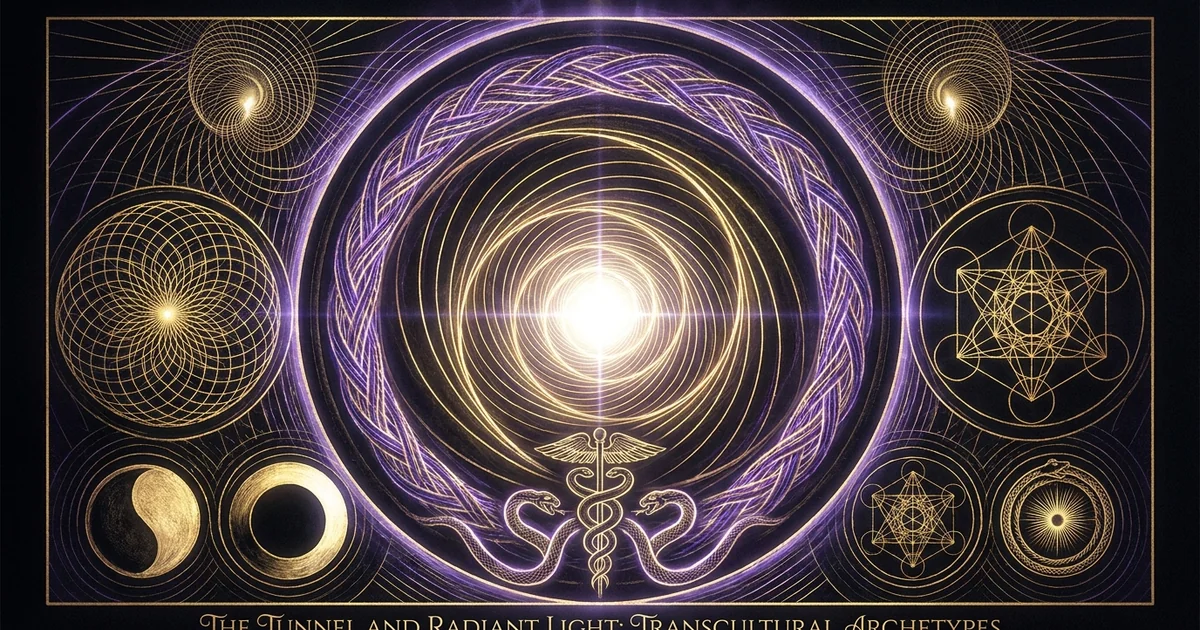
The Tunnel and Radiant Light: Transcultural Archetypes
Protocol Overview & Neurophysiological Thesis
The Transcultural Invariance of the Visual Gateway
Across disparate geographic landscapes, historical epochs, and ethnographically isolated spiritual traditions, experiential accounts of somatic dissolution systematically converge upon a distinct phenomenological sequence: the sudden sensation of entering a dark, accelerating conduit followed by emergence into an all-encompassing, hyper-real luminous field. Documented in the vision literature of medieval Christian mysticism—most visibly epitomized in Hieronymus Bosch’s Visions of the Hereafter—in the transitional mechanics of the Tibetan Bardo Thodol, in the Native American crossing of the star-conduit, and within modern clinical resuscitation archives, this motif persists independently of regional doctrinal conditioning. The tunnel and light near death experience universal archetype constitutes a fundamental threshold dynamic of human consciousness. Rather than functioning primarily as localized cultural allegory, the transcultural NDE motifs point toward invariant structural events occurring within the functional architecture of the central nervous system as it dissociates from exteroceptive baseline constraints.
When the human organism approaches the threshold of terminal somatic deafferentation, consciousness undergoes a standardized transition sequence. Western clinical cohorts typically describe this transition as passage through an architectural tunnel, an underground borehole, or an interstellar vortex. Conversely, non-Western traditions frequently encode the identical topological vector as crossing a dark river, scaling a narrow mountain chasm, or transiting a shadowy bridge. In every geographic permutation, the underlying kinetic and geometric parameters remain strictly identical: a bounded, low-luminance trajectory that induces high-velocity forward acceleration toward an infinitely radiating focal point. The final destination of this passage uniformly reveals a hyper-real luminous entity or an unbounded sea of coherent radiance characterized by an affective atmosphere of ineffable unconditional love. The invariance of these dynamics indicates that transcultural narratives utilize distinct lexical markers to capture a shared psychophysical threshold state.
Borjigin, J., et al. (2013). “Surge of neurophysiological coherence and connectivity in the dying brain.” Proceedings of the National Academy of Sciences, 110(35), 14432-14437; alongside Van Lommel, P., et al. (2001). “Near-death experience in survivors of cardiac arrest: a prospective study in the Netherlands.” The Lancet, 358(9298), 2039-2045.
Retinotopic Topography and Cortical Deafferentation
The biophysical substrate underlying the primary geometry of the tunnel resides in the functional architecture of primary visual cortex (striate cortex, area V1). Sensory deafferentation—whether initiated by systemic hypotension, hyperventilation-induced hypocapnia, or profound meditative sensory deprivation—systematically deprives the visual cortex of afferent thalamic driving. Striate cortex is organized through strict retinotopic mapping, wherein adjacent receptive fields on the retinal surface preserve their spatial proximity as they project via the lateral geniculate nucleus (LGN) to the cortical surface. Because metabolic vulnerability within the retina and striate cortex is distributed along an eccentricity gradient, peripheral receptive fields, which have lower capillary density and a higher dependence on sustained microvascular perfusion, fail before the foveal representation.
As peripheral neuronal populations drop below functional firing thresholds, local networks of inhibitory gamma-aminobutyric acid (GABA)-ergic interneurons undergo catastrophic metabolic fatigue. The resulting collapse of surround inhibition allows spontaneous, uncoordinated pyramidal cell discharges to propagate across the cortex. Because the central fovea possesses an overwhelmingly disproportionate volume of cortical representation—a biological feature known as cortical magnification—the selective preservation and localized hyperexcitability of central foveal neurons against a decaying, silent peripheral field produces an automatic topological illusion. The conscious subject experiences a stable circular frame of darkness enclosing a brightening, dynamic central locus. As central neuronal firing accelerates relative to the silent periphery, the visual processing apparatus interprets this spatial differential as rapid, forward-directed spatial translation through a cylindrical conduit.
Visual Cortex (V1) Deafferentation & Magnification
     Peripheral V1:                    Central Fovea:

[ Reduced Perfusion ]              [ Hyper-Represented ]
│                                  │
▼                                  ▼
[ Loss of GABA Inhibition ]         [ Sustained Discharge ]
│                                  │
└────────────────┬─────────────────┘
▼
Concentric Tunnel Geometry
(Apparent Forward Kinetic Vector)
Target Neuro-Endophenotype: Coherent Theta-Gamma Dissociation
To access this visual and transpersonal gateway intentionally, contemplative practice architects must bypass somatic ischemia entirely. Contemplative methodologies aim to reproduce the precise endophenotype of the threshold state without precipitating cellular hypoxia or metabolic acidemia. The target neuro-endophenotype is characterized by sustained cross-frequency coupling between the low-frequency theta-rhythm (4.0–8.0 Hz) and high-frequency gamma-synchrony (30.0–100.0 Hz), accompanied by profound functional uncoupling of the primary sensory cortices from the external sensorium. While the physiological crisis of terminal deafferentation generates a brief, uncontrolled surge of electrical synchrony across dying cortical networks, targeted entrainment protocols reproduce this configuration within an ecologically stable window of consciousness.
By applying dual-hemisphere acoustic driving paradigms utilizing calibrated binaural-beats alongside controlled somatic down-regulation, the practitioner induces an artificial de-coupling between sensory processing nodes and frontal executive monitoring networks. The low-theta carrier wave stabilizes default mode network suppression, while localized bursts of fronto-parietal gamma coherence sustain hyper-lucid experiential monitoring. Under these conditions, the internal visual field stabilizes, allowing the retinotopic tunnel geometry to organize systematically without the frantic, destabilizing noise typical of acute ischemic shock. The practitioner steps consciously into the threshold interface, maintaining cognitive stability while accessing transpersonal archetypes usually reserved for peri-agonal crises or spontaneous veridical perception during out-of-body phenomenology.
Biophysical Mechanisms & Brainwave Dynamics
Ermentrout-Cowan Mathematical Formulations of V1 Striping
The geometric morphology of visual hallucination patterns associated with the tunnel experience was first rigorously mapped through the mathematical modeling of neural field equations established by G. Bard Ermentrout and Jack D. Cowan (1979), subsequently expanded by Bressloff, Cowan, Golubitsky, Thomas, and Wiener (2002). The structural architecture of primary visual cortex can be represented as a continuous two-dimensional manifold where spatial coordinates $(x, y)$ map onto the retinal polar coordinates $(r, \theta)$ through a complex logarithmic conformal transformation:
$$w = \ln(z + \epsilon)$$
where $w = x + iy$ represents the cortical position and $z = r e^{i\theta}$ defines the retinal visual field coordinates, with $\epsilon$ preventing mathematical singularity at the central fovea. Under normal resting conditions, high levels of recurrent intracortical inhibition mediated by $GABA_A$ receptors maintain functional stability across the V1 cortical lattice.
When systemic or meditative deafferentation decreases afferent thalamocortical inputs, the underlying neural field equations cross a Turing-type bifurcation point:
$$\frac{\partial u(\mathbf{r}, t)}{\partial t} = -u(\mathbf{r}, t) + \int w(\mathbf{r}, \mathbf{r}‘) f[u(\mathbf{r}’, t)] d\mathbf{r}'$$
Here, $u(\mathbf{r}, t)$ denotes the local cortical activity, $w(\mathbf{r}, \mathbf{r}')$ represents the anatomical connectivity footprint consisting of short-range excitation and intermediate-range inhibition, and $f[u]$ is a nonlinear firing rate function. When the homogeneous baseline state loses stability through the attenuation of global inhibitory control, spontaneous periodic patterns emerge across the cortical sheet. In the planar coordinate space of V1, these bifurcations generate periodic stripes of cellular activation. When these parallel cortical stripes are transformed back into visual field coordinates through the inverse logarithmic mapping $z = \exp(w) - \epsilon$, they manifest phenomenologically as concentric annuli (alternating rings of light and dark) and radial spirals. To the observer, this geometric transformation generates the direct perceptual experience of a concentric, rotating funnel or tunnel converging upon an intense focal aperture.
Retinal Field (z)                 V1 Planar Manifold (w)
Polar Coordinates (r, θ)          Cartesian Coordinates (x, y)

       Radial Spokes /          Conformal Map           Parallel Functional
      Concentric Annuli     ───────────────────────►          Stripes
                               w = ln(z + ε)
Frequency Following Response (FFR) via Low-Theta Acoustic Physics
Acoustic induction of this threshold geometry relies upon the neurophysiological phenomenon known as the frequency-following-response (FFR). When two coherent acoustic sine waves of slightly differing frequencies are delivered dichotically through stereo headphones, the human auditory processing apparatus cannot isolate the two signals as independent pitches if their spatial and harmonic separations meet critical constraints. Instead, the signals pass through the cochlear nuclei to the superior olivary complexes located in the lower brainstem. Here, the micro-temporal phase differences between the left and right ear are computed, generating an internal amplitude-modulated binaural beat at the arithmetic difference frequency.
To evoke the deep hypnagogic stabilization necessary for retinotopic tunnel unfolding, the acoustic driver employs a base carrier frequency of 136.1 Hz—a frequency selected for its high acoustic impedance matching within human cranial structures and its resonance with fundamental resting tone archetypes—paired with a right-channel frequency of 140.6 Hz. This differential drives an exact 4.5 Hz low-theta modulation. As the superior olivary complex phase-locks to this sub-auditory envelope, it transmits rhythmic action potential cascades along the lateral lemniscus to the inferior colliculus, subsequently engaging the medial geniculate nucleus of the thalamus. This rhythmic thalamic driving rapidly recruits broad thalamocortical projections, entraining expansive cortical networks into coherent theta oscillations. This synchronization reduces extraneous cortical processing noise and induces the receptive state required for endogenous visual emergence.
Thalamic Reticular Gating and Endogenous Neurochemical Surges
The thalamic reticular nucleus (TRN)—a slender shell of inhibitory interneurons encapsulating the dorsal thalamus—serves as the primary operational gatekeeper of sensory afference. The TRN regulates information transfer between peripheral sensory organs and the primary neocortical processing centers. In typical waking consciousness, persistent ascending noradrenergic and cholinergic tone from the locus coeruleus and pontine reticular formation hyperpolarizes the TRN, maintaining high-fidelity transmission of environmental stimuli. Under sustained theta driving and rhythmic breath pacing, parasympathetic activation of the autonomic-nervous-system alters this neurochemical balance, shifting the TRN toward burst-firing modes.
This shift closes sensory relays to external visual, auditory, and somatosensory inputs, inducing functional thalamocortical deafferentation. With exteroceptive gating suppressed, the central visual pathways decouple from ambient light photons. Concurrently, the attenuation of sensory noise triggers the release of trace amines and endogenous neuromodulatory cascades, including putative agonists of the sigma-1 and $5\text{-HT}_{2A}$ receptors, along with trace-level endogenous $N,N$-dimethyltryptamine (DMT) synthesized within the pineal parenchyma and cerebral cortex. This endogenous neurochemical flux alters NMDA receptor kinetics within cortical pyramidal layers IV and V, reducing synaptic signal-to-noise ratios and enabling the spontaneous, highly structured archetypal imagery of the radiant light encounter to consolidate within focal awareness.
Step-by-Step Experiential Protocol: The Thanatoneuronal Gateway
Phase I: Somatosensory Quieting & Hypercapnic Breath Pacing
The preparation of the neurosomatic platform begins with targeted modification of the autonomic-nervous-system through controlled breath pacing. The practitioner reclines in a zero-gravity or fully supported supine posture within an absolute dark environment (or wearing a contoured sleep mask), ensuring the elimination of residual ocular photons. The ambient room temperature must remain stabilized between 20°C and 22°C to prevent thermal stress responses that trigger sympathetic arousals. The practitioner initiates hypercapnic breath pacing utilizing a strict 4-second inspiration, 7-second retention, and 8-second expiration ratio (the 4:7:8 cadence).
   Inhale (4s)        Hold (7s)                Exhale (8s)
┌──────────────┐─────────────────────┐───────────────────────────────┐
  Slight Sympa-   Mild Hypercapnia     Vagal Nerve Stimulation (Ach)
  thetic Drive    Vascular Dilatation  Respiratory Sinus Arrhythmia
Inhalation must occur entirely through the nasal passages, engaging the diaphragmatic architecture without elevating the clavicles or upper thoracic ribs. The 7-second retention phase elevates blood carbon dioxide ($p\text{CO}_2$) levels slightly, inducing mild transient hypercapnia. This physiological shift promotes cerebral vascular dilation, ensuring optimal tissue oxygenation while lowering systemic vascular resistance.
The elongated 8-second exhalation phase activates pulmonary stretch receptors, driving profound vagal nerve stimulation via cholinergic pathways that slow sinoatrial pacing. This dynamic amplifies respiratory sinus arrhythmia, shifting the systemic state toward deep parasympathetic dominance. Continue this breathing cycle uninterrupted for exactly 12 minutes until somatosensory inputs fade and muscular tone drops entirely.
Phase II: Dual-Hemisphere Acoustic Driving & Physis Cleansing
At the twelve-minute threshold, the practitioner activates the acoustic entrainment vector using calibrated over-ear circumaural headphones. Acoustic drivers must utilize a pure sine carrier wave of 216.0 Hz routed to the left auditory canal and a secondary frequency of 220.5 Hz routed to the right auditory canal. The resulting 4.5 Hz binaural differential engages the inferior and superior olivary nuclei, initiating the process of interhemispheric synchronization across the corpus callosum. To review the broad structural foundations of this technique, examine the methodologies detailed within our analysis of the Monroe Gateway Experience frequency protocols.
Left Audio Canal:  216.0 Hz Sine Wave ──┐
                                        ├──► Superior Olivary Complex ──► 4.5 Hz Theta Entrainment
Right Audio Canal: 220.5 Hz Sine Wave ──┘
During this phase, somatic awareness must be directed away from peripheral muscular vectors toward the visceral core of the torso. As the acoustic driving destabilizes typical beta-frequency wakefulness, practitioners routinely encounter the “physis cleansing” state—manifesting as spontaneous somatic tremors, cold micro-currents running along the spinal column, and perceptual sensations of somatic expansion or levitation.
These markers reflect the nervous system shedding peripheral somatic tension as alpha rhythms (8.0–12.0 Hz) suppress and theta activity consolidates across parietal and central electrodes. The practitioner maintains absolute non-reactivity, treating these sensations as secondary systemic discharge events while continuing steady, unforced nasal breathing.
Phase III: Transiting the Concentric Threshold into Radiant Luminosity
As the 32-minute mark arrives, acoustic entrainment stabilizes the 4.5 Hz theta baseline, establishing conditions for visual field restructuring. The practitioner shifts internal attentional gaze toward the anatomically projected position of the optic chiasm—perceived internally as a point situated approximately three inches behind the nasal bridge along the midline axis. Fixating upon this locus stabilizes residual phosphene activity. Within minutes, the visual static organizes into concentric geometries: concentric rings begin to expand or contract, forming an accelerating geometric vortex.
- Minutes 00–12: Autonomic Deceleration — Execute 4:7:8 hypercapnic breath cycles. Establish profound muscular flaccidity, drop peripheral sympathetic resistance, and stabilize baseline parasympathetic dominance.
- Minutes 12–32: Acoustic Immersion — Deliver 216 Hz / 220.5 Hz acoustic stimuli (4.5 Hz differential). Surrender bodily awareness to sensory deafferentation; allow somatosensory discharge currents to resolve naturally.
- Minutes 32–42: Threshold Immersion — Fixate attention upon the optic chiasm. Observe phosphene convergence into the concentric tunnel. Accelerate focal awareness directly into the central luminous aperture without cognitive hesitation.
- Minutes 42–45: Grounding and Somatic Return — Cease audio stimulation. Re-establish motor control via subtle extremities activation, breathe deeply, and ground the biofield into somatic circuits.
The practitioner must resist the instinct to analyze this unfolding geometry cognitively. Analytical processing activates left-hemisphere fronto-striatal circuits, disrupting thalamocortical synchrony and collapsing the visual matrix. Instead, the practitioner directs the point of observing consciousness into the vanishing point of the vortex. As internal velocity peaks, the boundaries of the tunnel dissolve, and awareness emerges into an expansive visual domain dominated by a hyper-real luminous entity or a field of radiant, non-blinding white-gold light.
Concurrently, spontaneous cross-frequency coupling of gamma oscillations to the underlying theta troughs triggers an affective state of ineffable unconditional love. The practitioner stabilizes this non-dual immersion for up to ten minutes, resting in pure awareness before beginning somatic re-entry.
Operational Safety, Contraindications & Biofield Grounding
Photoparoxysmal and Auditory Seizure Vulnerabilities
While the thanatoneuronal gateway protocol is non-pharmacological, it engages potent neurodynamic forces that present tangible physiological risks to vulnerable populations. The application of precise acoustic differentials between 4.0 and 8.0 Hz, particularly when paired with the spontaneous visual oscillations produced by V1 disinhibition, significantly lowers seizure thresholds in individuals with subclinical epileptogenic foci. The superior olivary complex acts as an electrical pacemaker under continuous binaural stimulation; if aberrant hyperexcitable pathways exist within the temporal lobes or thalamocortical loops, this rhythmic driving can trigger generalized paroxysmal discharges.
┌───────────────────────────────┐
                    │ Acoustic/Visual Synchrony     │
                    │ (4.5 Hz Theta Entrainment)    │
                    └──────────────┬────────────────┘
                                   │
                    ┌──────────────▼────────────────┐
                    │ Thalamocortical Hyper-        │
                    │ Synchronization               │
                    └──────────────┬────────────────┘
                                   │
            ┌──────────────────────┴──────────────────────┐
            ▼                                             ▼
  [ Normal Resilient Brain ]                    [ Latent Seizure Focus ]
  - Stable Gateway State                        - Paroxysmal Sharp-Wave Surges
  - Coherent Theta-Gamma Coupling               - Temporal Lobe Seizure Activity
Practitioners with a personal or first-degree familial diagnosis of idiopathic epilepsy, photosensitive epilepsy, or unprovoked seizure history must strictly avoid this protocol. Furthermore, individuals presenting with structural cerebrovascular anomalies—such as arteriovenous malformations or intracranial aneurysms—must not engage in the 4:7:8 hypercapnic breathing phase. Mild variations in blood gas composition alter intracranial pressures and transiently increase cerebral arterial flow velocity, introducing unnecessary vascular risk.
Psychological Depersonalization and Persistent Derealization Syndromes
Navigating the transpersonal threshold involves an abrupt, voluntary disengagement of the default mode network (DMN), the neural scaffold that generates the egoic construct and anchors personal identity. For individuals possessing a resilient, integrated psychological architecture, this temporary deconstruction is experienced as liberating, mystical, or therapeutic. However, for practitioners with unresolved trauma, borderline personality organization, or active dissociative tendencies, the abrupt detachment from somatosensory reference points can induce severe clinical depersonalization and derealization (DPDR).
The experience of crossing the tunnel archetype and encountering an overwhelming, hyper-real luminous entity can destabilize an individual’s baseline ontological moorings. When non-dual oceanic immersion abruptly dissolves back into ordinary waking consciousness, the individual may struggle to re-integrate physical reality, perceiving the somatic environment as artificial, hollow, or ungrounded. If feelings of pervasive unreality or affective flattening persist beyond several hours post-session, the practitioner must discontinue all entrainment protocols immediately and initiate cognitive-behavioral grounding and somatic re-afferentation practices.
Strict Clinical Exclusion Criteria: Absolutely contraindicated for individuals diagnosed with epilepsy, schizoaffective disorders, bipolar I disorder, severe dissociative disorders, or active cardiac arrhythmias. Volitional Protocol Abort: If severe existential terror, panic, or unmanageable somatic tremors arise during Phase II or Phase III, immediately abort the protocol. Remove the headphones, open the eyes, aggressively contract the abdominal and limb musculature, and anchor tactile awareness into a solid physical surface.
Biofield Re-anchoring via Somatosensory Re-afferentation
The return from non-local, de-afferented states requires an active protocol to re-anchor consciousness within the physical envelope, preserving physiological equilibrium and the structural integrity of the individual biofield. Residual dissociation occurs when the primary somatosensory cortex (S1) remains functionally uncoupled from motor output channels despite the resumption of waking beta frequencies. To resolve this imbalance, execute the following somatic sequence immediately upon concluding Phase III:
[ Discontinue Audio ] ──► [ Axial Muscle Contraction ] ──► [ Suboccipital Decompression ] ──► [ Biofield Tactile Grounding ]
Begin by curling the toes and clenching the fists tightly for five seconds, then releasing; repeat this cycle three times. This activates peripheral afferent pathways, driving motor feedback cascades directly up the spinal cord to the ventral posterolateral nucleus of the thalamus, which reactivates baseline sensorimotor loops.
Next, place the palms directly over the eyes, feeling the warmth of the hands while applying gentle tactile pressure to the supraorbital ridges to stimulate the ophthalmic branch of the trigeminal nerve.
Finally, engage deep diaphragmatic breathing without retentions, and drink 250–500 ml of mineral-dense water to ground systemic fluid balance and facilitate neuroplastic integration.
Phenomenological Correlates & Veridical Evidence
Cross-Cultural Morphologies: Western Tunnel vs. Eastern Open Vistas
The experiential landscape of the transition threshold displays both universal invariances and culturally conditioned morphological variations. Systematic phenomenological surveys reveal that while Western subjects heavily describe the transitional conduit using architectural and spatial tunnel metaphors, individuals embedded in traditional East Asian, South Asian, or indigenous cosmologies frequently experience functional morphological equivalents. Within Chinese and Japanese archives, the threshold is often encountered as transiting the Sanzu River or crossing the Naihe Bridge, dark aquatic boundaries that must be navigated prior to arriving at judgments or entering higher paradisiacal realms.
       Universal Deep Structure: Bounded Kinetic Vector Toward Illumination
                                      │
              ┌───────────────────────┴───────────────────────┐
              ▼                                               ▼
       Western Iconography                             Eastern Iconography
  - Concentric Architectural Tunnel               - Crossing the Sanzu River
  - Interstellar Vortex / Conduit                 - Traversing the Naihe Bridge
  - Industrial Shaft or Corridors                 - Narrow Mountain Defile / Canyon
              │                                               │
              └───────────────────────┬───────────────────────┘
                                      ▼
           Common Phenomenon: Oceanic Emergence into Radiant Light
These regional iconographies represent cultural templates applied to an identical neurodynamic vector. The core visual dynamic—a bounded, linear path marked by low lateral visual information that opens into an unbounded space of coherent, luminous intensity—remains invariant across all traditions. The symbolic language used reflects the conceptual vernacular available to the subject, while the underlying mathematical topology remains anchored to the architecture of the human visual system.
Encounter with the Hyper-Real Luminous Entity and Radical Affective Shift
Upon exiting the transitional conduit, the practitioner or NDE subject enters a realm dominated by a brilliant illumination that exhibits unique phenomenological characteristics. Subjects consistently emphasize that this light does not conform to the physical properties of typical electromagnetic radiation. It does not cause retinal pain, generate blinding glares, or cast shadows. Instead, the radiance is experienced as a self-luminous, conscious, living presence: a hyper-real luminous entity that radiates an affective atmosphere of ineffable unconditional love.
Neuro-Reductionist Paradigm
- Mechanism: Peripheral-to-central ischemic visual field decay producing concentric geometric illusions.
- Light Source: Uncontrolled terminal firing of foveal V1 pyramidal neurons during metabolic failure.
- Affective State: Massive release of endogenous beta-endorphins and dopamine triggering emotional euphoria.
- Epistemology: An internal, subjective hallucinatory defense mechanism buffering against the existential terror of biological death.
Non-Local Entrainment Paradigm
- Mechanism: Thalamocortical gating reduction permitting access to fundamental, non-local informational fields.
- Light Source: Direct perceptual encounter with unmediated zero-point consciousness or universal ground luminosity.
- Affective State: Inherent resonance with non-dual awareness, characterized by ineffable unconditional love.
- Epistemology: An objective transpersonal transition state wherein consciousness disengages from the physical nervous system.
This encounter typically initiates a profound epistemological transformation. The light is perceived not merely as “real,” but as “hyper-real”—a state carrying an ontological validity that feels superior to everyday sensory waking reality. The boundary between the observing self and the observed light softens; subjects describe being saturated with, dissolved in, and recognized by this presence. The affective impact is immediate and transformative: deep-seated existential dread dissolves, fear of physical death is permanently attenuated, and the individual experiences radical cognitive shifts that persist across their lifespan.
Veridical Perception Anomalies during Thalamocortical Silence
The primary challenge to purely neuro-reductionist explanations of these phenomena lies in the documentation of veridical perception during episodes of cardiac arrest. In prospective studies conducted by researchers such as Pim van Lommel and Sam Parnia, patients resuscitated from documented ventricular fibrillation or asystole reported accurate observations of emergency resuscitation procedures from an elevated, out-of-body perspective. These accurate perceptions occurred during periods when cortical blood flow had ceased and the electroencephalogram (EEG) had progressed to an isoelectric, flatline state.
Under established neurophysiological paradigms, an isoelectric cortex cannot support complex, organized cognitive awareness, let alone the consolidation of detailed visual memories. The occurrence of hyper-lucid experiences, clear spatio-temporal reasoning, and confirmed veridical perception during clinical flatline challenges the hypothesis that the tunnel and light are merely chaotic hallucinations generated by a dying brain. Instead, these findings suggest that the physical central nervous system may act as an informational filter. When this filter collapses, consciousness does not automatically extinguish; rather, it expands into an unmediated transpersonal baseline state.
Frequently Asked Questions
Overcoming Aphantasia during the Tunnel Phase
Question: How can an individual with congenital or acquired aphantasia (the inability to voluntarily construct mental visual imagery) effectively navigate the tunnel phase of this protocol?
Response: Aphantasia is primarily a deficit in the voluntary, top-down activation of visual cortices via frontal-striatal executive loops; it does not represent an impairment of primary visual cortex architecture or the underlying retinotopic mapping. When primary visual deafferentation occurs under low-theta acoustic entrainment, the emerging geometric dynamics are generated bottom-up through spontaneous neural field bifurcations rather than voluntary visualization. As a result, many aphantasic individuals perceive authentic geometric transformations during this protocol despite an inability to visualize intentionally in daily life.
Furthermore, aphantasic individuals frequently experience the transitional conduit kinesthetically rather than visually. The primary phenomenological marker shifts from visual striping to an intense somatic kinetic vector: the sensation of rapid, forward acceleration through a narrow spatial conduit. Aphantasic practitioners should anchor their attention entirely into this vestibular-proprioceptive sensation of motion, avoiding the impulse to force a visual image. The eventual emergence into the light phase manifests as a sudden, unmistakable somatic and emotional saturation: an expansion into radiant, warm spatial openness coupled with the affective signature of ineffable unconditional love.
Quantitative EEG Signatures Differentiating Sleep from Induced NDE Coherence
Question: What specific quantitative electroencephalographic (qEEG) metrics differentiate the brain states generated by this protocol from ordinary Slow-Wave Sleep (SWS) or hypnagogic REM sleep transitions?
Response: While both slow-wave sleep and hypnagogic transitions exhibit substantial elevations in low-frequency power (delta 0.5–4.0 Hz and theta 4.0–8.0 Hz, respectively), the thanatoneuronal gateway state demonstrates a distinct, bifurcated spectral architecture characterized by cross-frequency phase-amplitude coupling. In ordinary Stage 3 NREM sleep, high-frequency oscillations are largely absent, dominated by broad slow-wave delta complexes lacking functional inter-regional phase coherence. In REM states, theta rhythms are prominent but exhibit desynchronized, low-amplitude patterns across frontal leads.
Waking State:
Beta/Gamma Dominance (15-40 Hz) ──► Desynchronized, Task-Oriented

Stage 3 / Slow-Wave Sleep:
Delta Dominance (0.5-4 Hz) ────────► High Amplitude, Low High-Frequency Power

Induced Gateway State:
Theta Baseline (4-8 Hz) ───────────┐
        +                          ├─► Cross-Frequency Phase-Amplitude Coupling
Bursts of Fronto-Parietal Gamma ───┘   (Lucid, Transpersonal Monitoring)
In contrast, the state induced through this protocol displays high phase-locking of fronto-parietal gamma-synchrony (35.0–80.0 Hz) riding precisely upon the peaks or troughs of the entrained 4.5 Hz theta wave. This cross-frequency theta-gamma coupling enables high-level informational synthesis, conscious working memory, and lucid introspection to persist within a profoundly de-afferented physiological baseline. The presence of heightened fronto-parietal gamma coherence provides an unambiguous empirical marker distinguishing this state from ordinary sleep transitions.
McDonnell, W. C. (1983). Analysis and Assessment of Gateway Process. US Army Operational Group, Defense Intelligence Agency (Declassified 2003). Demonstrating that specialized acoustic entrainment alters interhemispheric phase coherence, enabling subjective transit through spatial and dimensional thresholds.
Epistemological Integration of Hyper-Real Mystical Encounters
Question: How should a practitioner psychologically and philosophically integrate the encounter with the hyper-real luminous entity to prevent ontological shock and social alienation?
Response: Experiencing a domain perceived as more real than physical existence can trigger ontological shock—a condition where ordinary societal, occupational, and relational commitments feel trivial or disjointed. To prevent persistent alienation, the practitioner must actively ground the experience using an epistemological model that validates the reality of the encounter without devaluing physical existence. The luminous encounter should be viewed not as an escape from the physical world, but as an engagement with its foundational substrate, intended to inform and enrich waking life.
Systematic transpersonal psycho-education is critical during this period. Practitioners should contextualize their experiences within established historical lineages—such as the Tibetan Bardo traditions, the Mundus Imaginalis of Islamic Sufism, or the rigorous frameworks of non-dual philosophy (e.g., Advaita Vedanta, Kashmir Shaivism). Keeping a detailed phenomenological journal helps process the cognitive material, translating ineffable experiential memories into grounded linguistic structures. Additionally, pursuing intentional grounding rituals, engaging in consistent physical activity, and connecting with integrated transpersonal practitioners helps anchor these deep insights into daily life, allowing transformative encounters with the radiant light to foster enduring psychological resilience, compassion, and creative balance.