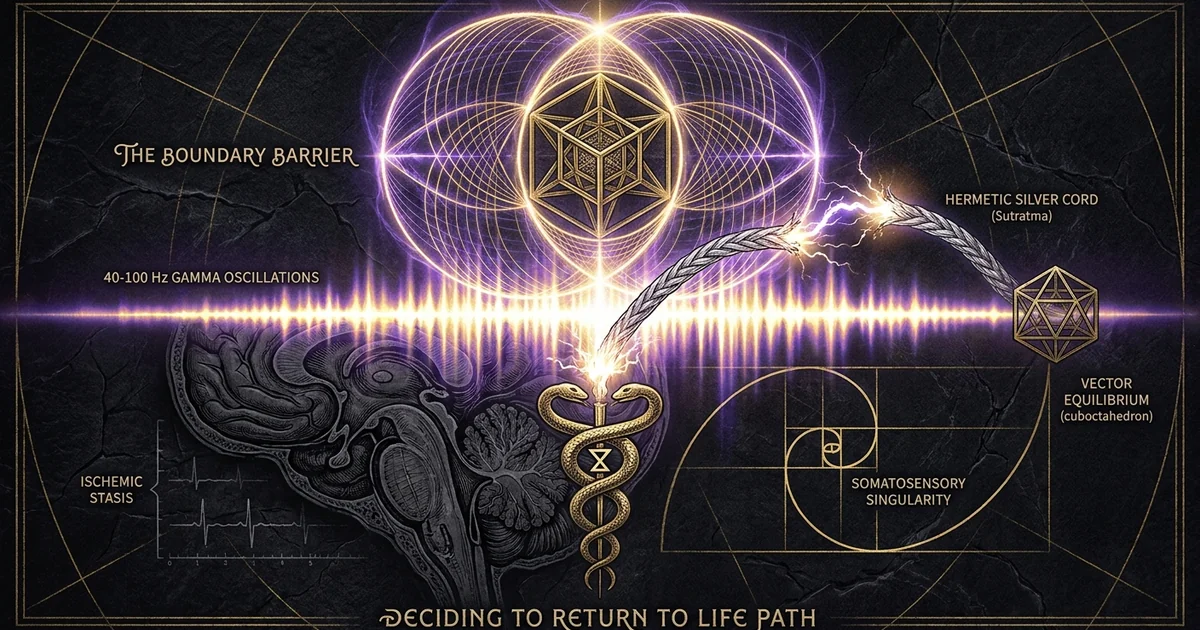
The Boundary Barrier: Deciding to Return to Life Path
1. Protocol Overview & Neurophysiological Thesis of the Liminal Threshold
Phenomenology of the Transpersonal Horizon: Rivers, Fences, and Luminous Abysses
Across centuries of transpersonal cartography and cross-cultural resuscitation archives, an invariant topographical feature marks the outer limit of human dissociation: an absolute somatic boundary. Subjects undergoing extreme clinical compromise or deep contemplative interiorization report an encounter with an insurmountable marker, frequently conceptualized through archetypal motifs such as a raging river, an ancient stone wall, a wire fence, a misty chasm, or a radiant event horizon. This phenomenon—historically termed the border, the verge, or the liminal veil—is functionally defined as the boundary barrier. Within near-death phenomenology, crossing this demarcated perimeter is perceived subjectively as irreversible; to step over the fence, wade through the river, or bridge the luminous abyss implies the total severing of consciousness from its biological substrate.
The universal manifestation of this archetype points directly to an invariant functional architecture within the human central nervous system. Rather than representing an arbitrary hallucination, the topological boundary represents the mind’s spatialized translation of a physiological ultimatum: the precipice between recoverable metabolic arrest and biological brain death. When an individual stands before this subjective demarcation, they occupy a unique nexus of reversible somatosensory decoupling. The transpersonal literature, alongside empirical cardiology studies cataloged by researchers exploring /consciousness/near-death-experience-neurobiology, reveals that this space is rarely static. It operates as an existential decision node—a location where the subject evaluates an unfinished business choice regarding their incarnate path, relationships, creative responsibilities, or karmic duties. The perception of the boundary barrier threshold river fence near death return motif constitutes the sensory-symbolic interface of this structural choice.
Cortico-Thalamic Decoupling and the Surge of Endogenous Gamma Oscillations
From a rigorous neurophysiological standpoint, the experiential architecture of the boundary barrier corresponds to severe cortico-thalamic decoupling accompanied by a paradoxically hyper-synchronized neuroelectric state. When cerebral perfusion drops precipitously, or when deep contemplative entrainment artificially mimics hypoxic metabolic states, normal corticocortical dialogue breaks down. The primary afferent pathways responsible for feeding sensory information to the cortex collapse, depriving the temporoparietal junction (TPJ) of its continuous stream of proprioceptive, vestibular, and somatomotor signals. Under ordinary operational conditions, the temporoparietal junction continuously integrates these multidimensional streams to generate the embodied sense of self located precisely within physical flesh.
When the TPJ undergoes functional deactivation or profound phase disruption, the egocentric spatial coordinate frame decouples from physical anatomy. This state is deeply documented within the research protocols of /meditation/out-of-body-experience-obe-protocol. In this somatosensory void, cortical disinhibition occurs. Starved of inhibitory GABAergic regulation, the dying or profoundly sequestered brain unleashes an extraordinary electrical phenomenon: a massive burst of phase-locked gamma oscillations (30–100 Hz). This end-stage neuroelectric surge, observed across both human clinical cases and controlled animal models, exhibits heightened anterior-posterior coherence and cross-frequency coupling between high-gamma and lower brainwave bands. It is precisely within this hyper-coherent gamma window—emerging paradoxically against a background of global electroencephalographic slowing or clinical flatline—that the boundary barrier manifests. The vivid hyper-reality of the threshold represents not neural quiescence, but the terminal, hyper-organized firing of an uninhibited associative cortex.
Borjigin, J., et al. (2013). ‘Surge of neurophysiological coherence and connectivity in the dying brain.’ Proceedings of the National Academy of Sciences (PNAS), 110(35), 14432-14437.
Borjigin et al. demonstrated that within the critical 30-second window following cardiac arrest in rodent models, the globally ischemic brain does not immediately cease organized activity. Instead, it generates a transient, highly coherent surge of neurophysiological activity characterized by high-frequency gamma oscillations (30–100 Hz). This state features unprecedented cortico-cardiac functional connectivity, global anterior-posterior phase synchrony, and pronounced cross-frequency coupling between high-gamma and theta bands. These findings provide a definitive biophysical baseline for the heightened lucidity, hyper-real subjective processing, and structural visual clarity reported during near-death thresholds, demonstrating that severe ischemic stress can transiently trigger an intensely organized, information-dense cognitive framework.
The Volitional Vector: Mapping Return Dynamics to Autonomic Neuromodulation
The pivotal moment at the boundary barrier is the enactment of the return vector. In clinical resuscitation cases, patients universally report that crossing back into somatic containment is initiated either by an external, non-negotiable decree (“You must go back; your time has not come”) or by an internally realized unfinished business choice—the sudden remembrance of a child, an unfulfilled creative work, or a vital relational debt. From an integrated neuro-metaphysical view, this cognitive inflection point acts as a massive top-down trigger that fundamentally recalibrates the autonomic nervous system.
When the decision to return crystallizes within decoupled awareness, it projects an instantaneous neuromodulatory demand upon the quiescent brainstem. The dorsal motor nucleus of the vagus nerve and the rostral ventrolateral medulla, which regulate core visceral and vascular tone, are jolted out of ischemic hibernation. This induces a violent activation of the sympathetic-adrenomedullary (SAM) axis. The subjective experience shifts abruptly from peaceful, oceanic disembodiment at the boundary to a precipitous descent down an energetic vortex. Volitional intention functions here as a neuro-energetic phase shift: the abstract decision to return to the life path re-polarizes the biofield, drives phase coherence back into the medullary respiratory centers, and forces cortical networks to bind once more with afferent somatosensory streams.
2. Biophysical Mechanisms & Brainwave Dynamics at the Boundary
Binaural Beat Mechanics and the Auditory Frequency Following Response (FFR)
To reliably access the liminal coordinates of the boundary barrier without inducing hazardous physiological hypoxia, experimental neuro-contemplative science utilizes precise psychoacoustic driving protocols. These protocols leverage binaural beats to induce an auditory frequency-following-response (FFR) within brainstem processing networks. When two coherent, sinusoidal acoustic tones of slightly differing frequencies are delivered independently to each ear through stereophonic isolation (for example, a 136.1 Hz carrier wave in the left ear and a 140.1 Hz wave in the right ear), the peripheral auditory apparatus cannot mechanically resolve the mathematical difference.
Instead, the signals travel along the auditory pathways to the superior olivary complex located in the pons. Here, the central auditory neurons calculate the interaural phase disparity. In synthesizing this disparity, the superior olivary complex generates an internal, amplitude-modulated sub-audible beat—in this instance, exactly 4.0 Hz. This internal beat drives phase-locking in both the inferior colliculus and the medial geniculate bodies of the thalamus. Through continuous cortical recruitment, this auditory driving triggers widespread hemispheric synchronization, forcing disparate cortical zones across both the left and right hemispheres to align their firing patterns to the 4.0 Hz theta rhythm. This acoustic architecture provides the fundamental mechanism for structural consciousness displacement detailed in /sound-cymatics/binaural-beats-brainwave-entrainment.
The Spectral Shift: From Sub-Delta Collapse to Transient Neocortical Gamma Synchrony
The progression into the boundary state demands a highly specific electroencephalographic trajectory. Initially, the conscious subject is guided through an acoustic deceleration cascade, shifting from baseline wakeful Beta rhythms (14–30 Hz) down through relaxing Alpha patterns (8–12 Hz), until stabilizing in deep Theta (4–7 Hz). As the protocol deepens, the brainwave profile enters the critical Theta-Delta transition zone (3.5–4.5 Hz). At this cross-band boundary, the neuroelectric signature begins to mirror the earliest stages of slow-wave sleep and terminal dissociation. Somatosensory evoked potentials (SEPs) diminish in amplitude, indicating that somatic sensory signals are successfully gated at the thalamic level.
Frequency Spectrum Modulation Cascade:
Phase 1:  14–20 Hz (Wakeful Sensorimotor Integration)
Phase 2:  8–10 Hz (Alpha Bridge: Sensory Attenuation)
Phase 3:  3.5–4.5 Hz (Theta-Delta Liminal Threshold: TPJ Dissociation)
Barrier:  Synchronized Gamma Bursts (30–80 Hz) nested within 0.5 Hz Slow Oscillations
Return:   Abrupt 14–28 Hz Desynchronization via Noradrenergic Locus Coeruleus Burst
Once afferent somatic data streams are successfully severed, a distinct electrographic transformation occurs. The background EEG shows a profound drop in low-frequency power—a state analogous to the early phases of metabolic arrest or deep anesthetic burst suppression. Yet, precisely out of this near-quiescent sub-delta sea (0.5–1.5 Hz), transient bursts of hyper-synchronized gamma oscillations (30–80 Hz) erupt across the frontal, temporal, and parietal networks. These gamma bursts are structurally coupled with the phase of the slow delta rhythms. This cross-frequency coupling (CFC) represents an optimal bio-computational regime for complex subjective consciousness. It permits the vivid, panoramic memory retrieval, lucid hyper-dimensional perception, and crisp sensory encounters characteristic of the boundary barrier threshold river fence near death return, all while the physical vessel remains entirely immobile and non-responsive.
Neurochemical Disinhibition: NMDA Antagonism, Dynorphin Cascades, and Somatosensory Re-entry
The transition across the liminal interface involves a neurochemical sequence that mimics endogenous survival mechanisms. During acute cerebral hypoxia, ischemia, or severe contemplative sensory deprivation, the central nervous system deploys an array of neuroprotective biochemicals designed to mitigate excitotoxic damage. Foremost among these are endogenous antagonists of the N-methyl-D-aspartate (NMDA) receptor complex. By suppressing excessive calcium ion influx, endogenous NMDA blockade fundamentally alters synaptic transmission across the hippocampus, neocortex, and cerebellum.
        Ischemic / Entrainment Stress
                     │
       ┌─────────────┴─────────────┐
       ▼                           ▼
Endogenous NMDA Blockade   Dynorphin Release (Kappa-Opioid)
       │                           │
       ▼                           ▼
Cortico-Limbic Disinhibition   Parietal-Vestibular Gating
       │                           │
       └─────────────┬─────────────┘
                     ▼
  TPJ Somatosensory Decoupling (Out-of-Body State)
                     │
                     ▼
  Encounter with the Boundary Barrier Threshold
Concurrently, a profound release of dynorphins occurs. As endogenous agonists of the kappa-opioid receptor (KOR) system, dynorphins induce significant alterations in spatial perception, depersonalization, and somatic detachment. When dynorphins flood the claustrum and the temporoparietal junction, the internal perceptual construct of the subtle body detaches from physical flesh. This neurochemical milieu produces cortico-limbic disinhibition: subcortical emotional, autobiographical, and memory circuits fire unchecked by lateral prefrontal sensory monitoring. The subject experiences an unrestricted informational manifold. However, this same neurochemical environment renders re-entry profoundly challenging. To initiate re-embodiment, the consciousness must issue a top-down volitional shock capable of breaking this receptor-level blockade, clearing the kappa-opioid gating, and flooding the postsynaptic densities with noradrenaline, acetylcholine, and glutamate to re-establish somatic control.
3. Step-by-Step Experiential Protocol: Navigating the Return Horizon
Phase I: Acoustic Entrainment and Somatic Dissociation Induction
The practical navigation of the boundary barrier requires a strict environmental, postural, and psychoacoustic architecture. The practitioner must assume a supine position (the Savasana posture) on an orthopedically supportive surface, ensuring that the cervical spine is aligned to prevent any carotid or vertebral vascular compression. Sensory isolation is established using total-blackout eye shielding and calibrated over-ear circumaural monitoring headphones capable of linear frequency reproduction down to 10 Hz.
Breathing Dynamics: 4:7:8 Vagal Modulation
[ Inhale: 4 Count (Sympathetic Priming) ]
  --> [ Retention: 7 Count (Vascular Hypercapnic Shift) ]
  --> [ Exhale: 8 Count (Parasympathetic Dominance / Vagal Reset) ]
The induction phase initiates an acoustic program using a 136.1 Hz carrier wave (the psychoacoustic “Om” frequency, corresponding mathematically to the trans-orbital frequency of the Earth’s annual rotation) matched with an initial 8.0 Hz Alpha offset. Over the course of 15 minutes, the binaural differential is continuously modulated downward at a linear rate of 0.23 Hz per minute, drawing cortical activity smoothly down toward 4.5 Hz. Simultaneously, the practitioner executes a conscious respiratory pattern of 4:7:8 vagal breathing (inhale through the nasal passages for 4 counts, retain the breath for 7 counts, and execute a slow, sub-vocal exhalation through pursed lips for 8 counts). This controlled hypercapnia slightly increases arterial partial pressure of carbon dioxide ($PaCO_2$), inducing mild cerebral vasodilation while optimizing vagal tone. By minute 15, the somatic frame is characterized by profound physical lethargy, limbs feel dense and leaden, and the sensory input from the surface beneath the body begins to fade entirely from primary awareness.
Phase II: Stabilizing the Liminal Barrier State and Engaging the Choice Vector
Entering the operational boundary zone (minutes 16 through 35) demands the acoustic system lock firmly into a dual-carrier configuration. The primary carrier at 136.1 Hz sustains a fixed 4.0 Hz Theta offset, while a secondary, low-amplitude carrier at 68.05 Hz (the precise lower sub-octave) introduces a 0.5 Hz sub-delta pulse. This dual configuration stabilizes the brain in the Theta-Delta transition zone, generating the subjective phenomenological state known within the Gateway archives as Focus 15: a state of decoupled awareness without physical sensory interference.
Technical Specifications and Environmental Parameters:
- Auditory Hardware: Planar magnetic circumaural open-back headphones, driven by a 24-bit/96kHz digital-to-analog converter.
- Frequency Cascade Matrix:
- Phase 1 (00:00–15:00): Carrier 136.1 Hz; Binaural Beat descends linearly from 8.0 Hz to 4.5 Hz. Target: Sensorimotor suppression.
- Phase 2 (15:00–35:00): Primary Carrier 136.1 Hz (4.0 Hz Theta offset); Secondary Sub-Carrier 68.05 Hz (0.5 Hz Sub-Delta offset). Target: Somatosensory TPJ decoupling and barrier horizon stabilization.
- Phase 3 (35:00–45:00): Carrier 250.0 Hz; Binaural Beat rises instantly to 14.0 Hz (Sensorimotor Beta activation). Target: Sympathetic rebound and dense physical vessel re-innervation.
- Linguistic Command Formulation: The internal phrase must be formulated in absolute present-tense declaratives: “I enact the choice to return. Life path confirmed. Re-enter the vessel now.”
At this juncture, the subjective field shifts. The darkness behind closed eyes resolves into a high-contrast architectural space: the boundary barrier. The practitioner perceives a definite edge—a sheer drop, a luminous membrane, an expansive body of water, or a dense wall of coherent electromagnetic fog. Proprioception registers this as a spatial threshold beyond which individual identity cannot maintain coherence if physical life is to continue. Here, the practitioner consciously accesses the choice vector. They summon the psychological construct of their unfinished business choice. They hold in mind the specific, uncompleted biographical tasks—the life path agreements, creative works, familial protections, or spiritual obligations that anchor them to physical incarnation. The barrier acts as a mirror: it refuses passage to the uncompleted mind, yet demands a clear declaration of intent. One does not casually gaze past it; one either surrenders to dissolution or affirms the somatic mandate.
Phase III: The Resolute Re-entry Command and Dense Somatic Integration
The enactment of re-entry must be decisive, swift, and authoritative. Lallygagging or ambivalence at the boundary invites profound autonomic instability, severe energetic disorientation, and post-session dissociation. The moment the choice to return is affirmed, the practitioner must cease all passive observation and issue an internal linguistic command: a structured command to return to body. This internal decree must be mentalized with absolute, single-pointed volition, focused directly upon the center of the physical heart and the respiratory diaphragm.
Trajectory of Re-Entry Enactment:
[ Choice Vector Affirmed ]
        │
        ▼
[ Mental Command: "Re-enter the vessel now" ]
        │
        ▼
[ Thalamic Gating Reversal ]
        │
        ▼
[ Phrenic Nerve Firing -> Immediate Sharp Inhalation ]
        │
        ▼
[ Sensorimotor Re-Anchoring: Distal to Proximal Somatic Sweeps ]
Instantly upon issuing the command to return to body, the practitioner switches the acoustic track to the Phase III re-integration protocol: a sharp jump to a 14.0 Hz sensorimotor beta entrainment frequency delivered at 250.0 Hz. Mechanically, the practitioner draws an immediate, sharp, maximum-capacity inhalation through the nostrils, activating the phrenic nerve and expanding the thoracic cage. As the lungs expand, the consciousness is violently compressed back into its biological casing. The practitioner deliberately engages the distal extremities: pressing the tips of the thumbs firmly against each pad of the fingers, driving the heels downward into the surface of the bed, and grinding the molars once with controlled tension. This deliberate kinesthetic grounding breaks the last vestiges of cortico-thalamic decoupling, anchoring the perceptual sphere back within the dense physical framework.
4. Operational Safety, Contraindications & Biofield Grounding
Neurological Contraindications: Photosensitivity, Epilepsy, and Dissociative Tendencies
Because the boundary barrier protocol relies upon driving the central nervous system into extreme transition zones (the Theta-Delta border interspersed with transient gamma-band synchrony), it presents substantial physiological and psychological risks for vulnerable populations. The fundamental risk profile concerns individuals with personal or familial histories of idiopathic or structural epilepsy. Binaural driving within low-frequency bands—especially if coupled with subtle photic entrainment or spontaneous cortical gamma synchronization—can lower seizure thresholds in hyperexcitable cortical networks, triggering localized focal seizures or generalized tonic-clonic episodes.
Furthermore, this protocol is absolutely contraindicated for individuals diagnosed with structural dissociative disorders, including Dissociative Identity Disorder (DID), Depersonalization/Derealization Disorder (DPDR), or unmanaged Bipolar I disorder. Inducing deep decoupling at the temporoparietal junction artificially mimics and exacerbates pathological dissociative defense mechanisms. Individuals with fragile personality structures or severe baseline trauma may experience prolonged fragmentation of the ego-construct, rendering the post-session return phase fundamentally incomplete and precipitating acute psychological crises.
Absolute Contraindications:
- Diagnosed epileptic syndromes, history of unprovoked seizures, or unverified childhood febrile convulsions.
- Severe cardiovascular pathology, including paroxysmal arrhythmias, unmanaged hypertension, or history of transient ischemic attacks (TIAs).
- Current psychiatric diagnoses within the psychotic or dissociative spectrums.
Acute Neuro-Dissociative Emergency Intervention: If a practitioner manifests persistent somatosensory decoupling, uncalibrated out-of-body symptoms, or severe affective panic post-session:
- Immediately remove acoustic transducers and visual shielding.
- Apply high-intensity cold thermal input ($10^\circ–12^\circ\text{ C}$) directly to the sub-orbital facial zone (activating the trigeminal-vagal diving reflex to force immediate parasympathetic stabilization).
- Force deep proprioceptive plantigrade anchoring: place bare feet firmly upon cold masonry, bare earth, or solid wood, bearing the full gravitational load of the body.
- Administer 500 mL of an isotonic electrolyte solution containing sodium, potassium, and magnesium at room temperature to restore peripheral vascular osmolarity and neural conduction.
Pathophysiology of Abrupt Somatosensory Shock: Cortisol and Adrenaline Spikes
The act of disengaging from the liminal threshold and executing a rapid somatosensory re-entry imposes a severe metabolic shock upon the autonomic nervous system. In near-death survivors, this moment is universally described as agonizing: the sudden transition from an expansive, frictionless, non-local realm back into biological flesh is marked by acute visceral pain, suffocating pressure, and violent atmospheric heaviness. This subjective suffering has a clear physiological origin: the pain of re-entering dense physical vessel is driven by an unmitigated surge of catecholamines.
       Liminal Decoupling (Hypo-Adrenergic Peace)
                          │
                          ▼
            Rapid Volitional Re-Entry
                          │
       ┌──────────────────┴──────────────────┐
       ▼                                     ▼
Systemic Locus Coeruleus Burst    Adrenal Epinephrine / Norepinephrine Surge
       │                                     │
       ▼                                     ▼
Transient Sinus Tachycardia          Severe Peripheral Vasoconstriction
       │                                     │
       └──────────────────┬──────────────────┘
                          ▼
   Intense Nociceptive Re-Innervation & Somatosensory Compression
           ("The Pain of Re-Entering Dense Physical Vessel")
When the command to return to body is issued, the locus coeruleus fires an explosive burst of noradrenaline throughout the neocortex. Concurrently, the adrenal medulla floods the systemic vasculature with adrenaline and cortisol. This sudden hormonal surge triggers profound peripheral vasoconstriction, transient sinus tachycardia, and sudden cold diaphoresis. Simultaneously, the brain’s pain matrix—including the dorsal anterior cingulate cortex and the primary somatosensory cortex ($S1$)—comes back online. As sensory gating dissolves, the consciousness is instantly re-exposed to the entirety of the body’s baseline nociceptive signals: musculoskeletal tension, visceral inflammation, micro-traumas, and gravitational load. This immediate contrast between the frictionless boundary state and the biological realities of the organism registers neurologically as intense compressive friction.
Post-Session Biofield Grounding and Somatic Coherence Restoration
Following re-entry, the physiological and energetic envelope (contextualized in non-local physics as the human biofield; see /physics-electromagnetism/biofield-electrodynamics) exists in a state of hyper-permeability and geometric dysregulation. To restore somatic coherence and avoid post-session psychic fragmentation, the practitioner must execute a disciplined grounding protocol. They must not attempt to stand immediately or engage in analytical conversation, which can lock lingering dissociative states into cognitive structures.
Systematic Post-Session Biofield Restoration Sequence:
[ Step 1: Axial Grounding ] -> Supine prone-shift; manual contact with abdomen.
[ Step 2: Caloric Anchoring ] -> Ingestion of complex carbohydrates and sodium.
[ Step 3: Tactile Calibration ] -> Systematic palpation of major muscle groups.
[ Step 4: Kinetic Integration ] -> Controlled spinal flexion and deep diaphragmatic settling.
The grounding sequence demands immediate caloric and tactile anchoring. The individual must ingest dense, complex caloric sustenance—preferably involving complex carbohydrates, lipids, and sodium—to stimulate the enteric nervous system, redirect blood pool volume to the splanchnic circulation, and signal the systemic cessation of the liminal crisis. The practitioner then performs self-administered proprioceptive tactile calibration: firmly palpating their thighs, forearms, chest, and face, applying consistent pressure to re-establish the boundary between the somatic envelope and the external environment. Finally, they transition into slow, controlled spinal flexion movements, allowing the cerebrospinal fluid (CSF) pressure gradients along the neuroaxis to normalize before resuming upright, gravitational locomotion.
5. Phenomenological Correlates, Metaphysical Friction, and Veridical Evidence
The Sensation of Physical Viscosity: The Pain of Re-entering Dense Physical Vessel
The return from the boundary barrier introduces a distinct phenomenological state: the sensation of intense physical viscosity. While decoupled consciousness moves effortlessly through internal topologies, the re-embodiment process forces that non-local awareness back into the molecular grid of biological matter. Resuscitation survivors and advanced Gateway initiates systematically describe this phase as trying to force oneself into an agonizingly tight, freezing-cold, or lead-weighted diving suit.
This viscosity is the perceptual correlate of downshifting between dimensional degrees of freedom. In the boundary state, consciousness operates free from classical space-time constraints; upon re-entry, it is instantaneously subjected to the thermodynamic entropy of dense matter. Every joint, nerve ending, and muscular unit asserts its immediate physical resistance. This transition is not subtle; it is an abrasive, claustrophobic collision with biology. The pain of re-entering dense physical vessel is the energetic cost of localized incarnation. Understanding this discomfort in advance prevents the practitioner from recoiling in panic during re-entry—a reaction that can trap consciousness in an unstable semi-dissociated twilight state.
Uninhibited Boundary State (Non-Local Decoupled)
- Temporal Metrics: Absolute timelessness (McDonnell “Focus 15”); non-linear access to memory topologies; instantaneous thought-directed shifts.
- Sensory Architecture: Transmodal or omnidirectional synesthesia; complete absence of classical nociceptive afferents; perception of topological boundaries (rivers, luminous abysses).
- Bio-Energetic Dynamics: Unconstrained biofield geometry; high-frequency phase-locked gamma oscillations (30–100 Hz); minimal energetic drag or friction.
- Autonomic Load: Absolute quiescence; suppression of medullary-pons efferent signaling; profoundly attenuated heart-rate variability (HRV) signatures.
Somatic Re-Entry State (Dense Physical Vessel)
- Temporal Metrics: Classical chronological serialization; rigid past-to-future vectors; cognitive processing speeds limited by axonal conduction velocity.
- Sensory Architecture: Somatotopic sensory maps localized precisely to S1/S2; re-engagement of gravitational down-force; cold diaphoresis and dense tissue load.
- Bio-Energetic Dynamics: Biofield compressed into dense cellular anatomy; restoration of 14–20 Hz sensorimotor beta activity; intense viscous resistance.
- Autonomic Load: Intense sympathetic activation; catecholaminergic systemic flood (adrenaline/cortisol spike); transient sinus tachycardia and phrenic re-activation.
Declassified Gateway Insights: The Monroe Institute’s Focus 21 and the Barrier Phenomenon
The study of this liminal perimeter was systematically documented by the United States Army Intelligence and Security Command (INSCOM) during its operational evaluation of the Monroe Institute of Applied Sciences. In the declassified 1983 monograph authored by Lieutenant Colonel F. X. McDonnell—accessible within foundational studies at /consciousness/gateway-process-monroe-technique—the operational cartography of human consciousness was broken down into numbered Hemi-Sync phase-states.
Monroe Architectural Transition:
[ Focus 10: Mind Awake / Body Asleep ]
                   │
                   ▼
[ Focus 12: Expanded Awareness Beyond Somatosensory Gating ]
                   │
                   ▼
[ Focus 15: The State of "No Time" / Afferent Decoupling ]
                   │
                   ▼
=================== THE BOUNDARY BARRIER ===================
                   │
                   ▼
[ Focus 21: The Edge of Other Realities / Irreversible Vector ]
In the Gateway taxonomy, Focus 15 is defined as the state of “no time”—a subjective realm of profound stillness where the individual ego disconnects from spatial-temporal causality. However, when a subject attempts to move from Focus 15 toward Focus 21 (defined as “the edge of other realities” or the ultimate liminal threshold), they encounter an unyielding boundary. McDonnell documented that this boundary functions as an energetic frequency gate. If the consciousness exploring this sector fails to sustain a precise harmonic resonance, or if it carries unintegrated psychological instability (unresolved ego attachments or existential unfinished business), the barrier proves impenetrable. The subject is either violently rejected back toward the base physical state or confronted by a phenomenological perimeter—a vibrational wall, dark expanse, or uncrossable energetic edge—that precisely parallels the river, fence, and threshold archetypes found in near-death research.
Veridical Perception and Empirical Case Studies Across Liminal Thresholds
The objective reality of the boundary state is grounded in empirical cardiology and resuscitation medicine. In landmark prospective investigations, such as those conducted by Dr. Pim van Lommel in the Netherlands and published in The Lancet, patients resuscitated from cardiac arrest demonstrated veridical perception during verified periods of electroencephalographic silence and absent cortical evoked potentials. These subjects were able to accurately detail the mechanical actions of medical staff, the precise sequence of defibrillator shocks, the location of instruments hidden in drawers, and conversations that took place while their brains were clinically flatlined.
A consistent feature in these prospective studies is the moment of reversal. The patient reports floating outside their physical form, drifting through clinical spaces, and moving toward an archetypal landscape that terminates at a boundary barrier: an energetic border, a fence across a pastoral expanse, or a dark river. At this frontier, the patient explicitly encounters their unfinished business choice. They describe a moment of communication—either internal or mediated by an archetypal guide—where the choice between passing the barrier or returning to life is made. The moment that choice is confirmed, veridical perception of the room abruptly ends. The individual experiences a disorienting, often violent falling sensation, followed immediately by the agony of gasping for breath, agonizing chest pain from rib fractures, and the harsh sensory overload of the intensive care unit. This transition confirms that the boundary barrier is not an imaginative post-resuscitation construct, but an actual perceptual state marking the absolute division between decoupled non-locality and biological containment.
6. Historical Lineages & Esoteric Cosmologies of the Terminal Border
The River of Forgetfulness vs. The River of Remembrance: Lethe and Mnemosyne in Orphic Mystery
The phenomenology of the boundary barrier is central to ancient initiatory traditions, which preserved exact cartographies of this threshold to prepare initiates for somatic death. In the Orphic mysteries of classical Greece, the deceased soul reaches the underworld realm of Hades and encounters a critical division marked by two distinct subterranean springs: the Spring of Lethe (the River of Forgetfulness) and the Lake of Mnemosyne (the Spring of Memory).
The Orphic initiatory texts explicitly warned the traveler against drinking from the first spring. Drinking from Lethe brought instant forgetfulness of their divine origin, erasing autobiographical continuity and forcing the consciousness to tumble back into the reincarnation cycle without self-awareness. Instead, the initiate was commanded to bypass this river and approach the cold waters flowing from the Lake of Mnemosyne, guarded by ancient sentinels. To drink from Mnemosyne was to retain unbroken memory, integrate the lessons of the physical path, and either pass beyond the cycle entirely or execute a conscious, volitional return to the world of form. The River Lethe represents the historical archetype of the boundary barrier: an unexamined crossing forces amnesic reset, whereas a conscious, deliberate return preserves the memories and achievements of the life path.
Petelia Orphic Gold Tablet (4th Century BCE, British Museum): “You will find on the left of the House of Hades a spring, and near it standing a white cypress; to this spring you must not approach… You will find another, cold water flowing from the Lake of Memory… Say, ‘I am a child of Earth and starry Heaven, but my race is of Heaven alone.’ And they will give you to drink of the divine spring, and thereafter you will reign among the other heroes.”
Analysis & Declassified Context (McDonnell Gateway INSCOM Report, 1983): McDonnell’s declassified assessment of the Gateway Process maps the identical epistemological framework into modern psychoacoustics. The Gateway protocol posits that transitioning past Focus 15 toward Focus 21 requires the consciousness to hold an unambiguous, coherent self-identity. If an individual encounters this liminal perimeter without resolving their cognitive-emotional balance, the boundary acts as an energetic tripwire. The consciousness is thrust back into lower frequencies. Both the ancient Orphic funeral instruction and the military-academic Gateway evaluation confirm that encountering the boundary barrier requires clear memory, stable emotional-energetic coherence, and an integrated life path intent.
The Chinvat Bridge and the Bardo Thodol: Navigating the Inescapable Choice Vector
This spatialized threshold archetype appears with identical mechanics in Zoroastrian and Tibetan traditions. In the Zoroastrian eschatological framework, the soul must cross the Chinvat Bridge (the Bridge of the Separator) spanning the abyss between the physical and spiritual realms. For an integrated soul who lived in alignment with Asha (cosmic truth and duty), the bridge expands into a wide, luminous highway leading to the Abode of Song. For the fragmented, untruthful soul, the bridge twists onto its edge, narrowing to a blade-thin line, causing the soul to plunge into the abyss. The bridge functions as a dynamic boundary barrier: its topological structure mirrors the subjective psychological integration of the traveler.
Comparative Transpersonal Cartography:
Orphic Mystery:      [ Spring of Lethe / Lake of Mnemosyne ]  --> Memory vs. Amnesia
Zoroastrian Eschatology: [ The Chinvat Bridge ]              --> Moral-Energetic Coherence
Tibetan Vajrayana:   [ Bardo of the Clear Light / Karmic Winds ] --> Awareness vs. Hallucination
Modern Protocol:     [ The Boundary Barrier Threshold ]      --> The Unfinished Business Choice Node
In the Bardo Thodol (the Tibetan Book of the Dead), the consciousness moves through successive transitional states (bardos) following somatosensory collapse. At the primary clear light threshold, the practitioner is confronted by the radiant, unmediated essence of reality. If the individual lacks advanced contemplative training, the raw intensity of this threshold triggers instinctual terror. Blinding karmic winds sweep across the landscape, forcing the subtle body (yid-kyi-lus) toward one of the six realms of cyclic existence. The Tibetan tradition emphasizes that at this barrier, the mind must recognize these luminous projections as the play of its own uninhibited awareness. The choice made at this threshold dictates the subsequent vector: liberation, controlled reincarnation to complete Bodhisattva vows (the quintessential unfinished business choice), or unconscious re-absorption into the somatic realm.
Monastic and Yogic Parallels: Utkranti and Deliberate Somatosensory Withdrawal
Within high-order Indian yoga and tantric methodologies, navigating this boundary is not left to chance, but systematically trained through the practice of Utkranti—the science of conscious disincarnation and deliberate somatic decoupling. Documented in Patanjali’s Yoga Sutras and advanced Upanishadic texts, Utkranti involves drawing the life force (prana) out of the peripheral channels (nadis) and consolidating it through the central spinal axis (sushumna nadi).
Utkranti Pranic Withdrawal Dynamics:
[ Peripheral Nadi Retraction ]
              │
              ▼
[ Sushumna Nadi Consolidation (Biofield Coherence) ]
              │
              ▼
[ Ajna / Sahasrara Piercing (The Threshold Barrier) ]
              │
       ┌──────┴──────┐
       ▼             ▼
[ Terminal Exit ] [ Volitional Re-Entry: Pranic Descent & Re-Sensitization ]
When an advanced yogic practitioner engages Utkranti experimentally without terminal intent, they guide consciousness through a profound state of sensory withdrawal (pratyahara). Proprioceptive feedback ceases completely. The subtle body detaches from physical sensory anchors, reaching the aperture at the crown of the head (Brahmarandhra). This aperture serves as the physiological and energetic equivalent of the boundary barrier. The yogi stands upon the edge of bodily life. From this summit, the practitioner must not surrender to involuntary detachment; they must hold absolute control over their energetic currents. To return, the yogi consciously reverses the pranic ascent, driving the life currents back down through the chakras and into the heart center (hridaya), deliberately re-engaging the physical nervous system. The historical practice of Utkranti demonstrates that navigating the liminal threshold and executing a structured, controlled re-entry relies entirely upon unwavering volitional intent and rigorous neuro-energetic discipline.
7. Frequently Asked Questions: Practical Dynamics and Scientific Troubleshooting
EEG Verification of Liminal Entrainment
To confirm that an entrainment protocol has brought the practitioner to the edge of the boundary barrier rather than a conventional trance, clinical neuro-monitoring tools are invaluable. Using consumer-grade open-source EEG hardware (such as OpenBCI platforms) or laboratory-grade multi-channel systems, specific neuroelectric signatures verify access to this liminal threshold.
Key Neuroelectric Markers of the Boundary Horizon:
1. Frontal Theta/Beta Ratio (TBR) elevation exceeding 6.5:1.
2. Bilateral Phase-Locking at the 4.0 Hz entrainment frequency across F3-F4 and P3-P4.
3. Somatosensory Gating: Suppression of primary evoked potentials (N20-P25 complexes).
4. Gamma Nesting: Spontaneous high-gamma bursts (40–70 Hz) cross-frequency coupled
   to the crest of 0.5 Hz sub-delta oscillations.
When the practitioner stabilizes at the barrier, the Frontal Theta/Beta Ratio (TBR) rises dramatically, consistently exceeding a 6.5:1 ratio, indicating that wakeful cortical monitoring is suppressed. Simultaneously, the Phase Locking Value (PLV) in the theta band (4.0 Hz) between frontal and occipital electrodes climbs toward 0.8. This indicates high inter-areal coherence. The definitive marker of the boundary state is the appearance of transient, burst-suppression gamma signatures: high-gamma activity (40–70 Hz) appearing in short bursts nested directly within the crests of slow, sub-delta waves (0.5–1.0 Hz). This cross-frequency nesting confirms that the temporoparietal junction has gated somatic afferents, leaving the associative cortex free to sustain the hyper-lucid phenomenological encounters characteristic of the threshold.
Remediating Post-Return Dissociation and Sensory Lag
Following a deliberate return from the boundary barrier, practitioners frequently encounter an uncomfortable sensory lag: a subjective dissociation where motor planning feels disconnected from actual physical execution. A simple movement, like lifting a hand, may feel delayed by several hundred milliseconds, accompanied by a hollow depersonalization where limbs are visually perceived as belonging to someone else.
Step-by-Step Sensory Lag Remediation Drill:
1. Physiological Sigh: Double nasal inhalation followed by prolonged, unforced oral exhalation.
2. Cold Trigeminal Stimulation: Press an ice pack or cold water across the nose and upper cheeks.
3. Rapid Isometric Activation: Grip the hands into fists at 100% capacity for 5 seconds; release fully.
4. Gaze-Fixation Vestibular Reset: Fixate eyes on a stationary object 1 meter away; tilt the head
   slowly from side to side to recalibrate the vestibulo-ocular reflex (VOR).
This sensory lag is the direct result of residual kappa-opioid receptor binding and temporary desynchronization between motor planning in the supplementary motor area (SMA) and proprioceptive feedback processing in the primary somatosensory cortex ($S1$). To remediate this lag, practitioners must engage in rapid isometric activation. Lie flat, clench both fists to 100% maximum voluntary contraction for exactly 5 seconds, and release; immediately repeat this sequence with the quadriceps, gluteal muscles, and abdominal wall. This burst of motor efference sends massive proprioceptive volleys back through the spinothalamic tracts and the dorsal column-medial lemniscal pathways, overriding residual gating and forcing the sensory-motor loops to re-synchronize in real time.
Navigating Involuntary Barrier Rejection vs. Conscious Choice
It is crucial to distinguish between an involuntary rejection from the boundary barrier and a conscious, volitional return. An involuntary rejection occurs when the practitioner encounters the threshold with unintegrated psychological material, sudden panic, or somatic resistance. In this scenario, the amygdala fires an emergency threat signal, precipitating an uncontrolled autonomic shock. The practitioner is violently thrust back into the body, waking with a gasp, rapid tachycardia, acute terror, and lasting depersonalization.
An authentic, deliberate re-entry, by contrast, is anchored in the resolution of the unfinished business choice. Here, the practitioner stands steadily before the threshold—whether perceived as a misty chasm, an ancient stone fence, or a shining river—and dispassionately evaluates their life trajectory. They deliberately identify their vital reasons for continued incarnation: an unfinished creative work, an unfulfilled spiritual duty, or a human connection that requires their continued physical presence.
Upon identifying this anchor, the practitioner does not fall backwards in panic. They stand in their sovereignty and issue the mental command to return to body. This volitional return is characterized by focused intentionality: the descent through the dimensional strata is rapid, and the pain of re-entering dense physical vessel is fully acknowledged and accepted as the natural cost of biological embodiment. The authentic return leaves the practitioner grounded, clear, and energized, carrying an unshakable conviction to complete their unfinished business along the life path.