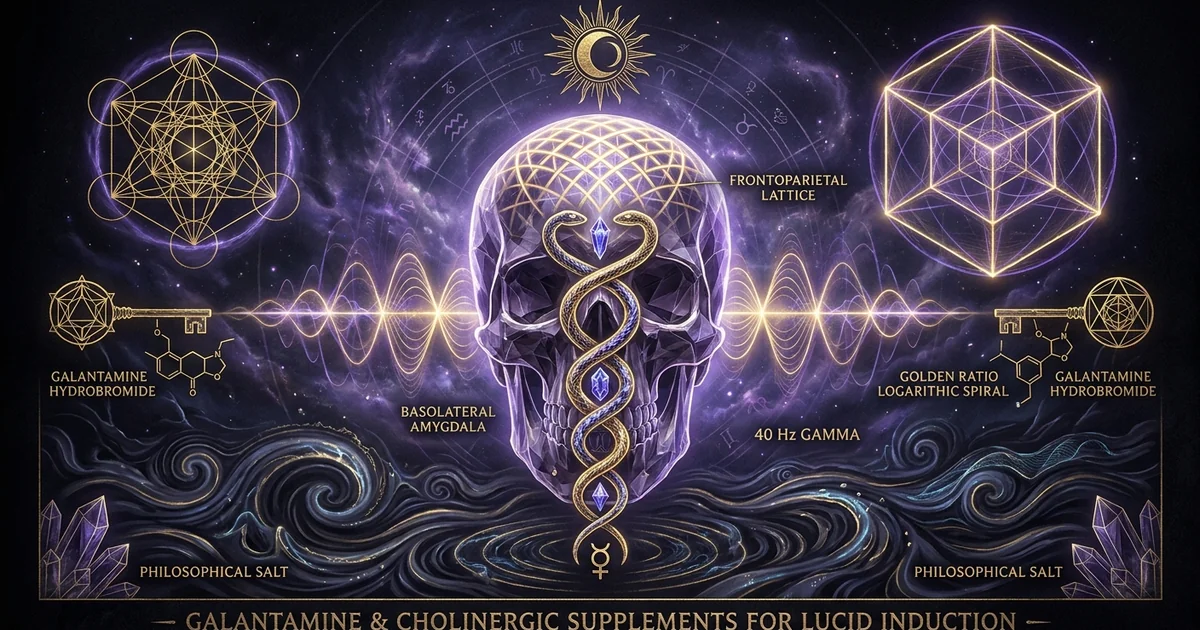
Galantamine & Cholinergic Supplements for Lucid Induction
Protocol Overview & Neurophysiological Thesis
The Cholinergic Engine of Metacognitive Dream States
Human consciousness during baseline rapid eye movement (REM) sleep is characterized by an internal paradox: profound neurochemical activation underlying sensorimotor hallucination coupled with an almost total abrogation of higher-order metacognition. The dreamer participates in bizarre, fluid, and narrative-defying events with complete credulity, wholly lacking the capacity to recognize that the experienced environment is endogenous. This uncritical immersion is directly governed by sleep microarchitecture and regional monoaminergic-cholinergic equilibria. During unaugmented REM sleep, the brain is flooded with acetylcholine, driving vivid imagery via bottom-up activation of sensory cortices, but it operates beneath a functional lesion: the quiescent state of the frontoparietal networks responsible for reality testing and self-referential monitoring.
The targeted administration of pharmacological agents capable of crossing the blood-brain barrier—specifically reversible acetylcholinesterase inhibitors (AChEIs)—fundamentally reconfigures this dynamic. By deploying the galantamine lucid dreaming acetylcholinesterase inhibitor protocol, investigators selectively prevent the enzymatic degradation of acetylcholine within the synaptic cleft. This enzymatic blockade elevates cholinergic tone beyond physiological baseline thresholds precisely when the dream engine is primed, triggering a cascade that awakens the latent cognitive machinery of the waking mind without destabilizing the neurophysiological underpinnings of the dream itself.
                  CHOLINERGIC / AMINERGIC TRANSITIONS

 WAKING:          High ACh  |  High NE  |  High 5-HT   --> Executive Control Active
 BASELINE REM:    High ACh  |  Low NE   |  Low 5-HT    --> Hallucinosis, No Metacognition
 GALANTAMINE REM: Supra-ACh |  Low NE   |  Low 5-HT    --> Lucidity, 40 Hz Gamma Coherence
Neuromodulatory Shifts: The Aminergic-Cholinergic Ratio
The neurochemical landscape of the mammalian sleep-wake cycle oscillates along a spectrum formalized by J. Allan Hobson’s AIM (Activation, Input-source, Neuromodulation) model. Waking consciousness relies upon an aminergic dominance wherein high concentrations of norepinephrine from the locus coeruleus and serotonin from the dorsal raphe nuclei maintain cortical tone, analytical vigilance, and critical reflection. As the brain transitions into non-rapid eye movement (NREM) sleep, both aminergic and cholinergic systems decline, reaching quiescent troughs in slow-wave sleep. Upon the transition into REM sleep, an enzymatic bifurcation occurs: aminergic neurons fall near-completely silent, whereas cholinergic neurons situated within the pedunculopontine tegmental (PPT) and laterodorsal tegmental (LDT) nuclei fire at rates equal to or exceeding those observed during alert wakefulness.
This aminergic nadir coupled with endogenous cholinergic surges produces primary-process mentation: narrative fragmentation, spatial discontinuity, and emotional intensification driven by uninhibited limbic activation. Because aminergic transmission normally stabilizes working memory and logic gates, its absence blinds the dreamer to the impossibility of the ongoing simulation. Pharmacological intervention via an AChEI does not artificially introduce aminergic vigilance; instead, it hyper-potentiates the cholinergic arm of this ratio. Acetylcholine acts not merely as a localized depolarizing agent, but as a potent neuromodulatory scalar that tunes the signal-to-noise ratio across neocortical columns, shifting sensory priority from external thalamic gating to associative cortex resonance.
Frontoparietal Reactivation During Phasic REM
The definitive neural correlate separating standard, unreflective REM sleep from lucid REM sleep is the selective metabolic reactivation of the dorsolateral prefrontal cortex (dlPFC), the frontopolar cortex, and the bilateral precuneus. In ordinary dreaming, the dlPFC exhibits profound regional deactivation, explaining the total loss of episodic memory retrieval, metacognitive self-assessment, and voluntary agency. When synaptic acetylcholine concentrations are supra-physiologically sustained during phasic bursts of REM sleep, the cholinergic input from the basal forebrain (nucleus basalis of Meynert) to the neocortex triggers localized depolarization across cortical layers II/III and V.
This targeted influx awakens the frontoparietal network, which directly interfaces with the default-mode-network to re-establish the subjective “I” within the oneiric field. This neurobiological event merges secondary-process waking cognition—characterized by abstract reasoning, episodic memory access, and intentional volition—with the fluid, sensorimotor substrate of primary-process REM architecture. The result is the emergence of conscious self-awareness within an endogenous sensory construct: the subject realizes they are dreaming while remaining biochemically pinned within the physiological state of REM atonia. Far from inducing premature awakening, the hyper-cholinergic state sustains the continuity of REM sleep while granting the prefrontal networks the critical energetic bandwidth required for lucid metacognition.
LaBerge, S., LaMarca, K., & Baird, B. (2018). Pre-sleep treatment with galantamine stimulates lucid dreaming: A double-blind, placebo-controlled, crossover study. PLOS ONE, 13(8), e0201246.
In this landmark randomized, double-blind, placebo-controlled crossover study involving 121 participants undergoing cognitive training alongside pharmacological intervention:
- Active Placebo: Induced verified lucidity in 14% of participants.
- 4 mg Galantamine: Elevated lucidity incidence to 27% (a near two-fold increase).
- 8 mg Galantamine: Yielded a 42% lucidity induction rate (a three-fold increase).
The trial confirmed a rigorous dose-response relationship between acetylcholinesterase inhibition, sleep-architecture stabilization, and the emergence of volitional metacognitive consciousness during phasic REM periods.
Biophysical Mechanisms & Brainwave Dynamics
Acetylcholinesterase Inhibition & nAChR Allosteric Modulation
Galantamine hydrobromide—a tertiary isoquinoline alkaloid isolated originally from Galanthus caucasicus—possesses a dual mechanism of action distinct from simple synthetic AChEIs. Its primary action is the reversible, competitive inhibition of the enzyme acetylcholinesterase (AChE), the primary serine protease responsible for the hydrolytic degradation of acetylcholine into choline and acetate within the synaptic cleft. By competitively binding to the active site of AChE, galantamine prevents the termination of cholinergic neurotransmission, magnifying the spatial and temporal half-life of naturally released acetylcholine.
Beyond basic enzymatic inhibition, galantamine functions as a potent positive allosteric modulator (PAM) of nicotinic acetylcholine receptors (nAChRs), primarily the $\alpha_4\beta_2$ and homomeric $\alpha_7$ receptor subtypes. By binding to a specific, non-competitive allosteric site structurally distinct from the agonist-binding pocket, galantamine induces a conformational shift in the receptor channel. This structural change lowers the kinetic barrier for ion-channel opening upon endogenous acetylcholine binding, substantially increasing cation influx ($Na^+$ and $Ca^{2+}$) across post-synaptic membranes.
This dual-action pharmacodynamic profile produces rapid electrophysiological depolarization throughout the central nervous system, heightening axonal signaling velocity and lowering the threshold required to achieve regional neuroplasticity.
Gamma Oscillations (40 Hz) and Interhemispheric Coherence
Electrophysiological investigations utilizing quantitative high-density electroencephalography (qEEG) demonstrate that ordinary REM sleep is dominated by desynchronized, low-amplitude mixed-frequency patterns primarily situated within the theta (4–8 Hz) and beta bands. However, the exact moment of lucid awakening within the dream state correlates with a sudden, robust surge in coherent gamma-oscillations, peaking precisely within the 38 to 42 Hz frequency corridor. This neurochemical dynamic reflects what is established in the research concerning /consciousness/gamma-wave-synchronization-dlpfc, wherein high-frequency synchronization binds disparate perceptual features into a unified conscious experience.
The emergence of 40 Hz gamma coherence is not diffuse; it exhibits strong topographical distribution over the frontocentral, frontotemporal, and dorsolateral prefrontal cortices. This localized fast-wave synchrony represents the temporal binding of conscious awareness. The hyper-cholinergic tone induced by the galantamine protocol facilitates this synchronization by enhancing the operational precision of parvalbumin-positive ($PV^+$) GABAergic fast-spiking interneurons, which are rich in $\alpha_7$ nicotinic receptors. When these interneurons receive sustained cholinergic excitation, they generate tight, rhythmic, inhibitory post-synaptic potentials across pyramidal cell populations, synchronizing pyramidal output into uniform 40 Hz oscillatory bursts. This interhemispheric coherence bridges the left-hemispheric verbal-analytical processing engines with right-hemispheric visuospatial dream generation, directly yielding the self-reflexive breakthrough characterizing the lucid state.
Pontine-Geniculate-Occipital (PGO) Burst Dynamics and Phasic REM
Phasic REM sleep is distinguished from tonic REM sleep by the rapid, intermittent manifestation of pontine-geniculate-occipital (PGO) waves, transient eye movements, muscle twitches, and vegetative irregularities within the autonomic-nervous-system. PGO waves originate as high-amplitude electrical spikes in the cholinergic peribrachial region of the pons, propagate through the lateral geniculate nucleus of the thalamus, and terminate within the primary visual (occipital) cortices. These waveforms represent the primary neurobiological triggers for the visual frames of the dream state.
Under the influence of galantamine and supplementary choline and huperzine a, the frequency and amplitude of PGO burst complexes are markedly amplified. The massive cholinergic discharge within the pontine reticular formation accelerates the transition into phasic REM. This amplification produces an oneiric environment marked by heightened visual clarity, stable spatial geometry, and vibrant photism. Because PGO waves concurrently relay signals to the amygdaloid complex, the emotional tone of the dream intensifies.
However, because the frontoparietal cortex has simultaneously achieved 40 Hz gamma coherence, this raw visual and emotional energy does not destabilize the dreamer into fright-induced arousal; rather, it provides a stable, sensory matrix within which the lucid investigator can intentionally navigate and manipulate the dream environment.
Step-by-Step Experiential Protocol
The Wake-Back-To-Bed (WBTB) Synchronization Window
The administration of an acetylcholinesterase inhibitor must not occur at initial nocturnal sleep onset. The homeostatic drive for slow-wave sleep (NREM Stage 3/4, Delta band: 0.5–4 Hz) is maximal during the first three to four hours of the nocturnal period, driven by accumulated adenosine. Administering an AChEI at this juncture induces severe sleep-onset insomnia, disrupts non-REM restorative processes, precipitates acute nightmares via premature REM intrusion, and wastes the active plasma half-life of the compound during sleep phases devoid of long-duration REM episodes.
The protocol mandates synchronization with the Wake-Back-To-Bed (WBTB) methodology, as detailed in the technical parameters of /consciousness/wbtb-wake-back-to-bed-mechanics. The practitioner must secure 4.5 to 5.0 hours of unaugmented, consolidated sleep. During this primary window, the brain clears the vast majority of homeostatic sleep pressure and satisfies its requirements for deep physical and metabolic restoration.
Upon arousal at the 4.5-hour mark, the sleep architecture shifts dramatically: the subsequent three to four hours of sleep are dominated by prolonged REM intervals characterized by maximal endogenous cholinergic sensitivity and minimal aminergic impedance.
Execution Matrix:
- T-0:00 (Baseline Sleep Onset): Retrospective journal review. Zero pharmacological agents. Ensure total darkness (0 lux), ambient temperature 18°C (65°F). Enter baseline sleep.
- T-4:30 (Arousal & WBTB Trigger): Wake via low-intensity, progressive alarm. Rise immediately out of bed to prevent sleep-inertia consolidation.
- T-4:35 (Substrate Stacking): Ingest 4 mg to 8 mg Galantamine Hydrobromide combined with 300 mg to 500 mg Alpha-GPC (L-alpha-glycerylphosphorylcholine) or 250 mg Citicoline on an empty stomach with 150 ml of spring water.
- T-4:40 – T-5:05 (Cognitive & Auditory Priming): Maintain quiet, upright waking focus for 25 minutes. Engage in analytical reading or review dream-log targets. Concurrently deploy acoustic protocols such as /sound-cymatics/binaural-beats-40hz-gamma through headphones to synchronize baseline cortical oscillations to 40 Hz.
- T-5:10 (Hypnagogic Anchoring & Re-entry): Return to bed in a semi-lateral or supine position. Deploy the Wake-Initiated Lucid Dream (WILD) anchor: observe hypnagogic phosphenes while maintaining an unbroken thread of passive, detached awareness as sensory attenuation occurs. Transition directly into the pharmacologically primed REM cycle.
Pharmacokinetic Titration and Substrate Stacking
Proper calibration of the neurochemical substrate requires precise accounting of pharmacokinetics. Galantamine hydrobromide features a rapid absorption profile, reaching peak plasma concentration ($T_{max}$) within 45 to 60 minutes when ingested orally on an empty stomach, displaying an elimination half-life ($t_{1/2}$) of approximately 7 hours. This pharmacokinetic curve matches the duration of the final circadian REM sleep windows, ensuring that peak synaptic concentration directly overlaps with the extended, highly plastic REM periods occurring between hours 5.5 and 8.0 of the sleep cycle.
To maximize the therapeutic efficacy of acetylcholinesterase inhibition, one must ensure that sufficient raw substrate exists for acetylcholine biosynthesis. Choline acetyltransferase (ChAT) synthesizes acetylcholine via the transfer of an acetyl group from acetyl-coenzyme A to free choline:
$$\text{Choline} + \text{Acetyl-CoA} \xrightarrow{\text{ChAT}} \text{Acetylcholine} + \text{CoA}$$
If pre-synaptic choline stores are depleted, AChE inhibition merely conserves an insufficient baseline pool of neurotransmitter. Therefore, the protocol dictates co-administration of an exogenous, highly bioavailable choline donor. Alpha-GPC (L-alpha-glycerylphosphorylcholine) represents the gold standard substrate, as it easily traverses the blood-brain barrier and donates its choline moiety directly to neuronal stores, preventing presynaptic exhaustion.
Citicoline (CDP-Choline) serves as a secondary alternative, simultaneously donating cytidine (which converts to uridine) to enhance nAChR density. Dosages must be rigorously adhered to: beginners should initiate titration at 4 mg Galantamine paired with 300 mg Alpha-GPC. Only after verifying individual somatic and psychological tolerance should the dose be titrated to the maximal ceiling of 8 mg Galantamine and 500 mg Alpha-GPC.
Mnemonic Re-Entry and Hypnagogic Anchoring
Pharmacological elevation of acetylcholine provides the neurochemical opening, but it does not displace the absolute necessity for cognitive and intentional scaffolding. The mental discipline employed during the re-entry phase determines whether the elevated neurochemical substrate converts into metacognitive lucidity or devolves into hyper-vivid, chaotic, and uncontrollable non-lucid delirium. During the 25-minute conscious awake period between T-4:40 and T-5:05, the practitioner executes targeted mnemonic rehearsal, repeating autosuggestive formulas anchored to upcoming dream cues while visualizing the exact subjective realization of dream awareness.
Upon returning to the sleep state, the practitioner should cultivate a hypnagogic bridge, alternating between two primary methodologies: Mnemonic Induction of Lucid Dreams (MILD) or the Wake-Initiated Lucid Dream (WILD) technique. In the WILD framework, the practitioner utilizes hypnagogic imagery as a conscious stepping stone.
As the body enters sleep paralysis—indicated by heaviness, vibrational sensations, and acoustic rushes—the mind retains passive, dispassionate observation. Rather than fighting these intense somatic markers, the practitioner anchors attention to the phosphenes coalescing in the visual field, allowing the endogenous imagery to solidify into a fully realization-bearing dreamscape, stepping directly from waking awareness into an intact, highly lucid oneiric simulation.
Operational Safety, Contraindications & Biofield Grounding
Cardiovascular Parasympathetic Spikes and Vagal Tone Risks
Because acetylcholine functions as the master neurotransmitter of the parasympathetic branch of the autonomic-nervous-system, systemic acetylcholinesterase inhibition is not confined to the central nervous system. Galantamine exerts profound peripheral actions that demand strict physiological caution. Acetylcholine binds directly to muscarinic $M_2$ receptors located within the sinoatrial and atrioventricular nodes of the myocardium, opening inward-rectifying potassium channels ($I_{K,ACh}$) via G-protein-coupled ($\text{G}_{\beta\gamma}$) signaling. This hyperpolarizes cardiac tissue, generating significant negative chronotropic and dromotropic effects.
Consequently, galantamine administration can precipitate severe sinus bradycardia, heart block, or syncopal episodes in individuals with subclinical conduction defects. Furthermore, the peripheral stimulation of muscarinic $M_3$ receptors located on bronchial smooth muscle induces bronchoconstriction and increases bronchial secretions, presenting an acute hazard to individuals with asthma, chronic obstructive pulmonary disease (COPD), or obstructive sleep apnea.
Gastrointestinal hypermotility, mediated by enteric $M_3$ receptor activation, regularly generates nausea, hyper-salivation, and acute abdominal cramps if the peripheral autonomic tone is overly provoked.
Absolute Medical Contraindications:
- Documented history of cardiac dysrhythmias, Sick Sinus Syndrome, prolonged QTc interval, or resting sinus bradycardia (<50 bpm).
- Active or reactive airway disease: moderate-to-severe asthma or COPD.
- Active peptic ulcer disease or mechanical gastrointestinal/urinary tract obstruction.
- Severe renal or hepatic impairment ($\text{CrCl} < 30 \text{ mL/min}$).
- Concurrent administration of potent CYP2D6 or CYP3A4 inhibitors (e.g., paroxetine, ketoconazole, erythromycin), which dangerously amplifies systemic galantamine exposure.
Acute Protocol for Terrifying Sleep Paralysis / Panic Cascades: Pharmacologically forced REM states frequently trap the ego within hypnopompic sleep paralysis accompanied by hypnagogic intrusions. Never attempt to break sleep paralysis through violent muscular engagement of the limbs, as this escalates autonomic sympathetic panic cascades.
Instead, initiate vestibular-ocular grounding: rapid, intentional, lateral horizontal eye movements (saccades) bypass the pontine motor inhibition (which spares the oculomotor and abducens cranial nerves). Pair this with slow, deliberate, diaphragmatic inhalation to down-regulate amygdalar hyperarousal, dissolving the autonomic-nervous-system loop and breaking the paralysis state within 10 to 15 seconds.
Receptor Downregulation, REM Sleep Rebound, and Chronic Depletion
The sustained, uncalibrated use of acetylcholinesterase inhibitors inevitably degrades endogenous sleep architecture through homeostatic compensatory mechanisms. The human central nervous system maintains equilibrium via the dynamic regulation of its receptor landscapes. Chronic, repeated flooding of the synaptic cleft with non-degraded acetylcholine induces the rapid internalization and down-regulation of both muscarinic ($M_1, M_3$) and nicotinic ($\alpha_7, \alpha_4\beta_2$) receptors, coupled with compensatory up-regulation of the AChE enzyme itself.
When the practitioner halts exogenous administration after chronic usage, they plunge into an acute cholinergic deficit state. This is characterized by severe cognitive fog, dream amnesia, fragmented sleep, and an adverse compensatory phenomenon known as rem sleep rebound cholinergic dysregulation. In this rebound state, the sleep architecture suffers from chaotic, destabilized micro-arousals and an inability to maintain deep NREM slow-wave recovery.
To prevent receptor downregulation and neuroplasticity fatigue, the galantamine protocol must never be deployed on consecutive nights. A mandatory washout period of not less than four to seven days between active administrations must be strictly observed, treating the protocol as an intentional metaphysical intervention rather than a chronic nootropic habit.
CHRONIC VS. PULSED CHOLINERGIC EXPOSURE
CHRONIC REGIMEN (Consecutive Nights):
Day 1:  [High ACh]  –> Lucidity Triggered
Day 2:  [High ACh]  –> Partial Desensitization / Fragmented Sleep
Day 3+: [Flooded]   –> Receptor Downregulation, Paralysis, Insomnia
Washout: [Deficit]  –> REM Rebound, Severe Amnesia, Brain Fog
PULSED REGIMEN (Every 4–7 Days):
Protocol Night: [Supra-ACh Spike]  –> Coherent Lucidity
Days 2–5:       [Washout / Homeostasis] –> Receptors Resensitize
Cycle Repeats:  Full Efficacy Retained / No Architectural Damage
Somatic Grounding Protocols for Sleep Paralysis and Parasomnias
The emergence of conscious awareness within an atonic body frequently invokes deep-seated survival terrors. When the brain transitions into REM sleep, the sublaterodorsal (SLD) nucleus activates glycinergic and GABAergic premotor interneurons within the ventromedial medulla, projecting down the reticulospinal tract to hyperpolarize alpha-motoneurons in the spinal cord. This motor paralysis prevents the somatic enactment of dreams. When galantamine accelerates cortical lucidity prior to the stabilization of the dream hallucination, the practitioner finds themselves hyper-aware, fully awake cognitively, but locked within an immovable physical form—a condition termed hypnagogic or hypnopompic sleep paralysis.
In traditional esoteric terms, this boundary crossing involves the conscious extraction of the subtle body from the dense vehicle. If the subject misinterprets the paralysis as physical asphyxiation or demonic intrusion—archetypal misinterpretations produced by an active amygdala processing vestibulocochlear drift—the resulting terror spikes systemic adrenaline, collapsing the experience into a nightmare.
Biofield grounding protocols dictate that the subject immediately drop all attempts at physical motor resistance. The practitioner focuses the entire locus of awareness into the energetic midline (sushumna), deploying rhythmic pacing of breath (which remains partially under voluntary control via the diaphragm) and deliberately surrendering to the vibrational hum, guiding the energetic current out of paralysis and into smooth, deliberate oneiric projection or waking stabilization.
Phenomenological Correlates & Veridical Evidence
Comparative Pharmacodynamics: Galantamine vs. Huperzine A and Synthetic AChEIs
While multiple compounds operate via acetylcholinesterase inhibition, their specific pharmacodynamics dictate vastly different functional outcomes within sleep research. The two primary naturalistic agents utilized in oneironautics are Galantamine Hydrobromide and Huperzine A (a sesquiterpene alkaloid derived from Huperzia serrata).
Despite shared enzymatic targets, their pharmacokinetic curves yield profoundly distinct phenomenological experiences and safety metrics. The key operational difference lies in elimination half-life and auxiliary receptor affinities.
Galantamine Hydrobromide
- Enzymatic Mechanism: Competitive, reversible acetylcholinesterase inhibitor.
- Auxiliary Action: Positive allosteric modulator (PAM) of $\alpha_7$ and $\alpha_4\beta_2$ nAChRs; directly enhances cholinergic signal velocity.
- Elimination Half-Life ($t_{1/2}$): Approximately 7 hours.
- Pharmacokinetic Profile: Rapid $T_{max}$ (45–60 min); clears systemic circulation quickly enough to avoid interfering with subsequent diurnal wake-sleep cycles.
- REM Alignment: Perfect structural fit for late-morning sleep cycles (Hours 5 through 8).
- Insomnia Risk: Moderate during WBTB, rapidly fading post-awakening.
Huperzine A
- Enzymatic Mechanism: Non-competitive, reversible acetylcholinesterase inhibitor.
- Auxiliary Action: Secondary NMDA receptor antagonist; provides neuroprotection but attenuates fast-wave plasticity.
- Elimination Half-Life ($t_{1/2}$): 10 to 14+ hours.
- Pharmacokinetic Profile: Prolonged clearance; remains active at significant plasma concentrations well past awakening.
- REM Alignment: Excessive duration often bleeds into waking daylight, blunting circadian rhythms.
- Insomnia Risk: High; carries elevated potential for subsequent-night sleep fragmentation and long-term desensitization.
Synthetic pharmaceutical AChEIs—such as Donepezil (Aricept) and Rivastigmine—are completely unsuited for oneiric protocols. Donepezil possesses an elimination half-life of 70 hours, saturating central receptors continuously for days, inducing profound chronic sleep fragmentation, severe nocturnal cramps, and total desensitization of the prefrontal cortical nodes critical for lucidity. Rivastigmine, an irreversible pseudo-inhibitor, binds AChE for upwards of 10 hours with extensive peripheral cholinergic side effects. Thus, Galantamine Hydrobromide remains the single most viable pharmacological candidate for precisely targeted, pulsed lucid dream induction.
Electrophysiological Signatures of Drug-Induced Lucidity
When lucid states induced by galantamine are captured in polysomnographic laboratory environments, their electrophysiological profiles reveal distinct divergences from baseline dreaming. As detailed in the comprehensive literature review by Baird, Mota-Rolim, and Dresler (2019), voluntary lucidity exists as a hybrid state of consciousness: the subject remains objectively in verified stage R (REM) sleep, characterized by low submental EMG muscle tone (atonia) and continuous polysomnographic markers of sleep, but their EEG demonstrates an unprecedented recovery of frontoparietal coherence.
Spectral power analysis demonstrates that unaugmented lucid dreams typically express modest, transient elevations in the gamma corridor. In contrast, dreams initiated via the galantamine lucid dreaming acetylcholinesterase inhibitor protocol exhibit prolonged, continuous bursts of high-amplitude 40 Hz gamma activity, tightly coordinated with theta power in the parietal nodes.
This distinct electrophysiological signature accounts for the phenomenological hyper-reality universally reported by subjects: visual fields present with mathematical exactitude, architectural details within the dream scape remain temporally stable rather than shape-shifting, and abstract metacognitive processes—such as calculating equations or remembering biographical waking memories—become directly accessible within the simulation.
 POLYSOMNOGRAPHIC FREQUENCY PROFILES IN REM STATES

 BAND:        FREQUENCY:  BASELINE REM:      GALANTAMINE LUCID REM:
 ─────────────────────────────────────────────────────────────────
 Delta        0.5 - 4 Hz  Low                Low
 Theta        4 - 8 Hz    Dominant (Limbic)  Dominant (Synchronized)
 Alpha        8 - 12 Hz   Suppressed         Occasional Frontal Spikes
 Beta         13 - 30 Hz  Transient Mixed    Moderate Synchrony
 Gamma        38 - 42 Hz  Near Absent        PROFOUND SUSTAINED POWER
 ─────────────────────────────────────────────────────────────────
Objective Volitional Signaling via Left-Right-Left-Right (LRLR) EOG
To scientifically validate that a subject has attained veridical metacognitive lucidity rather than merely dreaming about being lucid, laboratory protocols utilize the intentional electrooculogram (EOG) signaling technique pioneered by Stephen LaBerge. Because somatic motor neurons are locked in atonia while the extraocular motor system remains under voluntary control via the brainstem’s cranial nerves, the lucid subject can communicate out of the dream state into physical reality through pre-agreed eye movement trajectories.
       EOG ELECTRODE ARRANGEMENT & SIGNAL DEFLECTION

                     [ - ] Left Outer Canthus
                            (Above Eye)

         Ocular Axis:  <── L ── R ── L ── R ──>

                     [ + ] Right Outer Canthus
                            (Below Eye)

 EOG TRACE:
        /\          /\          /\          /\
       /  \        /  \        /  \        /  \
 ─────/────\──────/────\──────/────\──────/────\────── (Volitional Polygraph Trace)
            \    /      \    /      \    /      \    /
             \__/        \__/        \__/        \__/
Upon attaining metacognition, the dreamer deliberately looks to the extreme lateral edges of their dream visual field: Left, Right, Left, Right (LRLR). In the physical sleep laboratory, the polygraph records immediate, extreme, antiphasic deflections on the horizontal EOG channels.
In trials analyzing galantamine-assisted induction, the precision, speed, and intentional cadence of these LRLR signals are identical to those generated by veteran naturalistic oneironauts, proving that pharmacological induction drives an authentic, fully grounded reconfiguration of the internal conscious architecture, converting a purely involuntary hallucinosis into an active laboratory for empirical metaphysical investigation.
Frequently Asked Questions
Tolerance Titration and Optimal Dosing Frequency
The most critical vulnerability encountered by practitioners utilizing cholinergic compounds is rapid receptor tolerance. Why does galantamine cease to function when taken across consecutive nights?
The mechanism is neurochemically deterministic: prolonged occupancy of the acetylcholinesterase active site cascades into compensatory desensitization of the postsynaptic receptor network. Muscarinic acetylcholine receptors, specifically the $G_q$-coupled $M_1$ subtype responsible for cortical depolarization, undergo phosphorylation by G-protein-coupled receptor kinases (GRKs), followed by beta-arrestin binding and rapid endocytosis (internalization into intracellular vesicles).
To preserve high receptor sensitivity and safeguard the baseline sleep microarchitecture, the protocol demands absolute adherence to a strict dosing cadence:
- Maximum Frequency: Once every 4 to 7 nights.
- Golden Rule: Never execute back-to-back sessions.
- Tolerance Reset: If efficacy wanes, a full 3-week absolute cessation period must be observed to allow receptor resensitization and up-regulation back to homeostatic baseline.
Managing Nausea and Cholinergic Gut Hyperactivity
Nausea is the most prevalent adverse somatic symptom reported during cholinergic induction, occurring in approximately 15% to 20% of users at the 8 mg dose. This emetic response is mediated by two parallel pathways: centrally, via cholinergic stimulation of the muscarinic receptors within the area postrema (the chemoreceptor trigger zone in the medulla oblongata), and peripherally, via hyper-stimulation of muscarinic $M_3$ receptors residing within the enteric nervous system of the gastrointestinal wall, initiating hyper-peristalsis and spasmodic gastric contraction.
To preemptively neutralize cholinergic gastrointestinal distress:
- Gastric Buffering: Take the dose with a small, easily digestible carbohydrate (e.g., half a slice of bread or a dry cracker). Do not administer on a heavily fed stomach (which delays $T_{max}$) or during absolute, dry fasting.
- Herbal Antiemetics: Co-administer 500 mg of standardized Ginger Root extract (Zingiber officinale) 15 minutes prior to the galantamine dose. Gingerols and shogaols act as natural antagonists at the serotonergic 5-$\text{HT}_3$ receptor and possess direct antispasmodic properties on gastrointestinal smooth muscle, eliminating nausea without dampening central prefrontal cholinergic transmission.
Resolving Fragmented Sleep and Hypnopompic Tremors
A frequent operational complication of the cholinergic protocol is sudden, hyper-aroused sleep fragmentation—waking up repeatedly after only 10 to 20 minutes of dream immersion—or experiencing hypnopompic somatic tremors upon emerging from REM sleep. This occurs when the cholinergic spike overflows into the reticular activating system, driving the cortex beyond the boundary of REM stability directly into high-Beta waking arousal.
To stabilize the oscillatory field and secure the REM continuity:
- Dosage Attenuation: Immediately drop the titration from 8 mg down to 4 mg. The 8 mg ceiling is reserved exclusively for non-responsive individuals or those with high metabolic clearance rates.
- Neurochemical Buffering via L-Theanine: Co-administer 100 mg to 200 mg of L-Theanine alongside the Alpha-GPC and Galantamine. L-Theanine structurally resembles glutamate and acts as an antagonist at AMPA and NMDA receptors while elevating central levels of GABA. This calms peripheral sympathetic arousal and dampens hyper-vigilance, preventing early micro-awakenings while preserving the integrity of the 40 Hz gamma oscillations within the frontoparietal networks.
- Physical Integration: If hypnopompic tremors occur upon waking, recognize them as non-pathological somatic discharges resulting from sudden monoaminergic-cholinergic phase shifts. Lie still, match the rhythm of the tremors with slow abdominal respiration, and allow the excess motor-cortex excitability to discharge smoothly through the extremities into the earth.
- Hobson, J. A., & Friston, K. J. (2012). Waking and dreaming consciousness: Neurobiological and functional perspectives. Progress in Neurobiology, 98(1), 82-98.
- Mamelak, M. (1991). Hallucinations, dreaming, and the cholinergic system. Journal of Clinical Psychiatry, 52(Suppl), 23-32.
- Dresler, M., et al. (2012). Neural correlates of dream lucidity obtained from combined EEG/fMRI recordings in a single subject. Sleep, 35(7), 1017-1020.
- Albuquerque, E. X., et al. (2001). Properties of the nicotinic acetylcholine receptor and its allosteric modulation by galanthamine: New approaches to treat Alzheimer’s disease. Journal of Molecular Neuroscience, 17(2), 235-245.