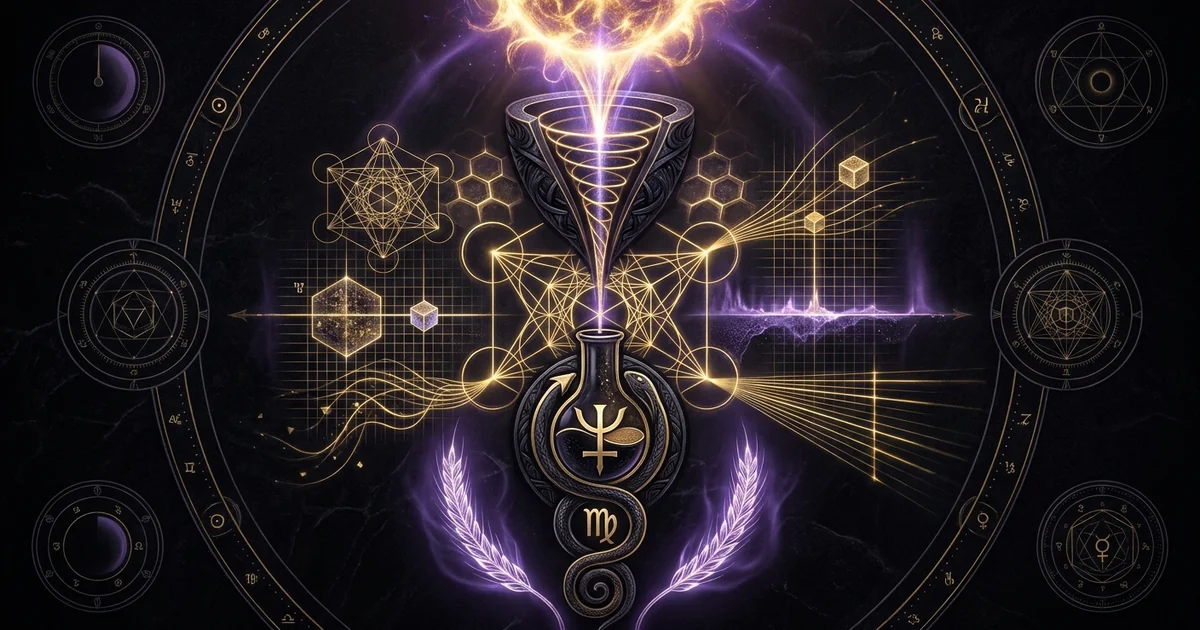
Virgo: Mutable Earth and the Sacred Laboratory of Soul
Archetypal Thesis & Systemic Paradigm: The Alchemical Matrix of Mutable Earth
The tropical zodiac operates as a continuous, closed thermodynamic circuit mapping the cyclic transmutations of psychic energy. Within this structural sequence, the sixth archetypal sign, Virgo, constitutes the indispensable phase transition wherein the unmitigated, radiant output of the fifth archetype undergoes systemic condensation and empirical critique. If the preceding sign expresses the expansive, undifferentiated sovereignty of solar individuation—the dramatic projection of ego-consciousness into the external theater—Virgo acts as the thermodynamic heat sink of the cosmic order. It halts the entropic expenditure of pure vitality, forcing the radiant psychic libido inward and downward through the filter of somatic discipline, critical taxonomy, and functional calibration. Through this crisis of adjustment, consciousness discovers that raw vitality without mechanical optimization inevitably collapses under its own systemic friction.
Thermodynamic Transmutation: From Solar Sovereignty to Microcosmic Calibration
In the geometry of the ecliptic, the shift from fixed fire to mutable earth marks a fundamental ontological crisis. In Leo, consciousness experiences its own central presence as an unassailable absolute, asserting its will upon the cosmos through expressive theatricality. Yet untempered radiance depletes its fuel source; unchecked, it burns through psychic structures without leaving behind enduring infrastructure. Virgo arrests this dissipative expenditure. Within this phase of the cycle, examined thoroughly in /astrology/the-geometry-of-the-zodiac, the primary creative impulse must justify its systemic viability against the strict physical laws of resource expenditure, organic fatigue, and material resistance.
This thermodynamic stabilization operates through microcosmic calibration. The macrocosmic fire must be throttled down into a precisely metered flame capable of powering the alchemical alembic without cracking the vessel. The virgo zodiac archetype meaning fundamentally concerns this reduction of scale: the macrocosm is consciously folded into the microcosm. The grand narrative of personal destiny is systematically disassembled into daily protocols, dietary regimens, hygienic maintenance, and deliberate craft. By shifting focus from the dramatic display of the whole to the operational integrity of its constituent sub-routines, mutable earth ensures that the psychological apparatus does not incinerate itself, but instead achieves thermodynamic efficiency.
The Epistemology of Mutable Earth: Matter as an Iterative Computational Matrix
The designation of mutable earth frequently introduces an apparent conceptual paradox within classical cosmological schemes. Earth as an element represents density, inertia, boundary definition, and tangible form, whereas the mutable modality represents change, kinetic adaptability, dispersion, and phase shifting. Far from signifying structural fragility or geological erosion, mutable earth describes matter configured as an iterative computational matrix. It is the molecular porosity of soil, the granular precision of silica, and the enzymatic flux of organic biochemistry. Mutable earth is dynamic matter: physical substance deployed as an open system that perpetually metabolizes its environment.
Through this lens, physical reality is approached not as an immutable monolith, but as an endlessly editable computational script. Mutable earth approaches the physical plane with analytical granularity, disassembling complex phenomena into atomic variables, identifying structural bottlenecks, applying corrective feedback, and reassembling the apparatus toward optimal performance. This elemental-modal synthesis produces an epistemology founded upon radical empirical pragmatism. Truth is measured neither by aesthetic elegance nor abstract theoretical symmetry, but by whether the mechanism functions under operational stress. Matter is interrogated, ground down, tested, and iterated until it yields maximum utility with minimum metabolic waste.
The Virgins of Antiquity: Parthenogenesis and the Autonomous Self
The modern conflation of the virgin archetype with passive, asexual moral purity represents an ideological degradation of an ancient metaphysical principle. In antiquity, the title Parthenos was bestowed upon sovereign deities such as Athena, Artemis, and the primordial mother-goddesses whose authority was derived not from marital alliances or dynastic lineages, but entirely from within their own psychic architecture. The ancient virgin was precisely the autonomous woman: one who belonged solely to herself, whole and self-contained, operating under an internal, inviolable sovereign necessity (anankē).
This parthenogenic autonomy signifies psychic integration. In psychological cartography, the virgin embodies the psyche that has established firm defenses against unconscious contamination and external psychic projections. She does not look outward to a counterpart for structural equilibrium or identity validation; rather, she contains her own reproductive and creative power through internal alchemical operations. This self-containment provides the pristine psychological containment vessel required for the hermetic art of distillation. To be “virginal” in the classical, esoteric sense is to possess a pristine interiority—an operational chamber wherein the prima-materia of lived experience can be processed and refined entirely isolated from external emotional distortion or sociopolitical co-optation.
Classical Provenance & Textual Lineage: From Erigone to the Spica Mysteries
The celestial coordinate of Virgo traces an ancient path through the historical development of Western astromancy and astral theology. The iconographic presence of a celestial maiden clutching agricultural produce across Mesopotamian, Hellenistic, and medieval star catalogs demonstrates that long before the sign was psychologized as an index of modern cognitive traits, it served as an objective celestial timepiece governing agrarian civilization’s boundary between survival and starvation. The historical transmission of this archetype reveals how the seasonal imperative of the harvest became codified into a sophisticated metaphysical system of civic justice, natural law, and empirical calculation.
“Virgo is of a moist and cold nature, yet dry by reason of its earthy quality… It is the house and exaltation of Mercury, wherein the planet acquires an exactitude of computation, discerning the parts from the whole through the office of discrimination.”
Babylonian Roots: The Furrow (AB.SIN) and the Wheat Ear of Shala
The earliest formal celestial mapping of this sector appears in the Babylonian cuneiform compendia known as the MUL.APIN (c. 1000 BCE). There, the asterism corresponding to modern Virgo is designated as AB.SIN, literally translated as “The Furrow.” This spatial sector of the heavens was personified as the goddess Shala, an agrarian and weather divinity closely associated with storm gods, depicted holding an ear of barley or a double-headed ear of wheat. The astronomical alignment was fundamentally functional: the heliacal rising of Spica (Alpha Virginis, known to the Babylonians as the bright star of the Furrow) marked the precise moment in the seasonal calendar when the land demanded methodical furrowing, cultivation, and agricultural extraction.
The attribution of the furrow as the core celestial signifier indelibly stamped the archetype with the marks of agricultural technology, rigorous geometrical surveying, and physical labor. The furrow is not nature in its untamed, chaotic wilderness; it is the physical soil reorganized by the human mind through technical intervention. The furrow imposes linear discipline, depth regulation, and mathematical distribution upon the earth so that the seed may germinate without choking. Consequently, the Babylonian lineage situates the virgo zodiac archetype meaning within the domain of measurement, technical intervention, agrarian logistics, and the rigorous transformation of raw natural terrain into predictable nutritional reserves.
Graeco-Roman Astral Myth: Dike, Astraea, and the Departed Golden Age
In Hellenistic and Roman mythography, the maiden assumed a profound socio-cosmic dimension through her identification with Dike, the goddess of natural justice, and her Roman equivalent Astraea, the daughter of Astraeus and Eos. According to the celestial narrative preserved in Aratus’s Phaenomena and Ovid’s Metamorphoses, Astraea dwelt among mortal humanity during the primordial Golden Age, walking freely across the earth when humans required neither written laws, litigations, nor judicial punishment, as natural virtue and cosmic equilibrium governed all interactions.
As the Silver Age introduced seasonal harshness, and the Bronze and Iron Ages degraded human society through warmongering, deceit, and base violence, Astraea retreated progressively into the mountains. Finally, repulsed by the moral corruption and the desecration of natural boundaries, she abandoned the terrestrial sphere entirely, ascending to the firmament as the constellation Virgo.
       [ Golden Age: Terrestrial Presence (Direct Immanence) ]
                                 │
                                 ▼
       [ Silver/Bronze Age: Mountain Hermitage (Ascetic Retreat) ]
                                 │
                                 ▼
       [ Iron Age: Celestial Constellation (Astraea/Spica in the Heavens) ]
This mythical trajectory positions the sign as the final remaining celestial archive of absolute cosmic order (Themis and Dike). Astraea’s departure directly links this sector of the sky to the adjacent constellation Libra (the Scales of Justice, originally conceptualized as the Claws of the Scorpion or the Balance held by the Maiden). Virgo, in this context, represents the memory of a lost paradise preserved entirely through the meticulous maintenance of personal integrity, functional ethics, and technical virtue. When objective divine justice no longer reigns effortlessly upon the earth, humanity can access it solely through the intentional, exacting labor of Astraea’s remaining disciples: the scribes, the healers, the scientists, and the craftsmen who painstakingly reconstruct the cosmic order within the terrestrial sphere.
Ptolemaic and Medieval Canons: Classifications in the Tetrabiblos and Picatrix
In the systematization of astral science established by Claudius Ptolemy in the Tetrabiblos (Book I and II), the sign of the maiden receives its foundational physical and temperamental taxonomy. Ptolemy characterizes the sign as feminine, nocturnal, earthy, and mutable—classifying it among the “bi-corporeal” or double-bodied signs (dizōdia). Crucially, Ptolemy emphasizes that its elemental quality of cold and dry places it under the governance of the melancholic temperament. This temperament, contrary to modern psychological diagnoses of depressive pathology, was understood throughout antiquity and the Middle Ages as the physiological state most conducive to rigorous intellectual labor, prolonged concentration, scientific observation, and diagnostic neutrality.
This classical canon was preserved, expanded, and esotericized within the medieval and Renaissance grimoires, most prominently the Arabic synthetic treatise Ghayat al-Hakim (translated into Latin as the Picatrix), and Marsilio Ficino’s De Vita Libri Tres (1489). Within these lineages, the planetary intelligence of Mercury finding its home and exaltation in an earthy sign transforms Virgo into an intellectual citadel. The Picatrix prescribes specialized astrological talismans etched under specific virgonian decans to cure chronic illnesses, organize messy administrative states, extract hidden treasures from the earth, and master technical crafts. Ficino, writing as both a physician and a Neoplatonic philosopher, explicitly cautioned scholars against the combustive, scattershot excesses of ungrounded contemplation, urging them to anchor their intellectual endeavors within the cool, discriminating, and physically therapeutic boundaries of the virgonian matrix to avoid the cognitive burnout of scholastic saturninity.
Structural Mechanics & Symbolic Geometry: Decanates, Dignities, and Qabalistic Paths
To decipher the internal circuitry of this archetype, one must analyze its position within the complex mathematical lattice of traditional planetary dignities and Western esoteric hermeneutics. Unlike modern psychological frameworks that treat the zodiac as a catalog of personality traits, classical astromancy maps planetary positions as precise algebraic ratios of elemental power, structural essentiality, and operational function. Within this schema, Virgo presents several critical anomalies in the system of essential dignities.
• Element: Terra (Cold & Dry / Melancholic)
• Modality: Mutable (Bi-corporeal / Double-bodied)
• Ruler & Exaltation: Mercury (Dignified and Exalted at 15° Virgo)
• Fall: Venus (27° Virgo) | Detriment: Jupiter (Opposite Pisces)
• Tarot Arcanum: Key IX (The Hermit)
• Qabalistic Path: 20th Path (Yod: Connecting Chesed to Tiphareth)
• Decanates: 1st (0°–10°: Sun / 8 of Disks), 2nd (10°–20°: Venus / 9 of Disks), 3rd (20°–30°: Mercury / 10 of Disks)
The Mercurial Citadel: Rulership and Exaltation in a Single Coordinate
The most glaring technical anomaly within the traditional scheme of planetary-dignities is the structural fact that Virgo serves simultaneously as both the domicile (astrological home) and the exaltation (hypsoma) of Mercury, with its exact exaltation degree mathematically pinpointed at 15° Virgo. In no other sector of the zodiac does a single celestial body exercise both rulership and exaltation within the identical thirty-degree arc. This dual dignity renders the sign the consummate Mercurial citadel:
$$\text{Mercurial Potency} = \text{Domicile (Inherent Resonance)} + \text{Exaltation (Peak Functional Performance)}$$
This structural consolidation demonstrates a profound cosmological principle: the absolute realization of the intellect occurs not in the abstract realms of pure ideation, but precisely at the point where intellect intersects with, manipulates, and rectifies physical matter.
In Gemini (Mercury’s airy domicile), the cognitive faculties remain aerial, kinetic, communicative, and laterally diffuse, operating without the ballast of gravity. In Virgo, Mercury descends into the earth element. The mind is grounded directly into the physical plane, binding the intellect to the material laws of cause, effect, friction, and structural degradation.
Here, Mercury’s exaltation signifies that intellect reaches its sovereign apotheosis when it ceases to merely converse about forms and instead actively operates upon them as a surgeon, a mathematician, a programmer, or an architect. The simultaneous detriment of Jupiter and fall of Venus within this sign further illuminates this dynamic: Jovian broad-brush philosophical generalizations, theological dogma, and optimism are systematically invalidated by Virgo’s forensic demand for empirical verification, while Venusian aesthetic indulgence, romantic illusion, and pleasure-seeking are subjected to rigorous functional critique, sterilization, and moral boundary-setting.
Decanic Division: The Three Faces of Prudence, Renunciation, and Mastery
The internal thirty-degree arc of the sign is divided into three distinct decanates of ten degrees each, mapping the progressive developmental trajectory of consciousness through mutable earth. These faces, preserved across the lineages of Agrippa’s De Occulta Philosophia (1533) and the hermetic tarot attributions of the Golden Dawn, articulate the operational phases of technical and spiritual refinement:
-
First Decan (0° to 10° Virgo): The Face of Prudence and Calibration (Governed by the Sun; Tarot: Eight of Pentacles/Disks).
Here, the consciousness begins its departure from the unbridled solar fire of Leo by bending the knee to the master’s bench. The Sun’s decanic governance signifies the deliberate harnessing of personal vital will into disciplined manual craft. It represents the apprentice state: the repetitive, patient chiseling, hammering, and measuring through which the ego abandons dramatic grandiosity in exchange for procedural mastery. Every action is observed, calibrated, and repeated with mechanical exactitude. -
Second Decan (10° to 20° Virgo): The Face of Renunciation and Discernment (Governed by Venus; Tarot: Nine of Pentacles/Disks).
This decan, containing the exact degree of Mercury’s exaltation (15°), marks the cultivation of the walled garden of self-sufficiency. The Venusian rulership within this austere earth sign operates not through hedonic indulgence, but through refined taste, biological boundary management, and aesthetic cultivation. Here, the individual discovers that true security and refinement require radical renunciation: pruning dead branches, ejecting non-essential social entanglements, and cultivating an independent ecosystem where the soul feeds upon the fruits of its own deliberate labor. -
Third Decan (20° to 30° Virgo): The Face of Structural Mastery and Continuity (Governed by Mercury; Tarot: Ten of Pentacles/Disks).
The final decan of the sign represents the consummation of empirical methodology into systemic legacy. Mercury governs this terminal sector, ensuring that the fruits of the harvest and the technical discoveries cultivated throughout the preceding phases are codified into enduring catalogs, protocols, and institutional architectures. It is the threshold where mutable earth finishes its work of dynamic distillation, preparing to hand its perfected, structured harvest over to the dialectical scales of cardinal air in Libra.
The Qabalistic Axis: The Path of Yod and the Hermit (Key IX)
In the esoteric cartography of the Hermetic Order of the Golden Dawn, as codified by S.L. MacGregor Mathers and Arthur Edward Waite, Virgo is attributed to the 20th Path on the Tree of Life. This path bridges the sephira Chesed (Mercy/Expansion) with the central sephira-tiphareth (Beauty/Harmony), and corresponds to the tenth letter of the Hebrew alphabet, Yod (י). The letter Yod—itself the foundational glyph from which all other Hebrew letters are calligraphically derived—literally signifies the closed “hand of man” or the isolated, pointed seed of divine fire.
       [ CHESED (Mercy / Jovian Archetypal Expansion) ]
                             │
                             │  Path 20: The Letter YOD
                             │  (The Hermit / Key IX)
                             ▼
       [ TIPHARETH (Beauty / Solar Ego Consciousness) ]
This structural correspondence links the sign directly to Major Arcanum Key IX: The Hermit. Far from an image of pathetic social reclusion or intellectual misanthropy, The Hermit represents the introspective adept traversing the dark wilderness of physical existence, guided entirely by the inner light of a six-pointed star shielded within an octagonal lantern. This lantern embodies the pristine, purified intellect: an empirical guide that illumines precisely one step ahead upon the treacherous path. The Hermit’s staff acts as a grounding rod, rooting divine consciousness into the physical terrain. Virgo as the Path of Yod confirms that the transcendent divine light is not discovered through ecstatic planetary ascension, but is uncovered hidden in the dark, dense center of matter—the mysterious Lumen Naturae (Light of Nature) accessible solely to the solitary researcher who walks the rigorous path detailed in /tarot/the-hermit-path-of-yod.
The Duality of Perception: Mercury’s Domiciles in Systemic Contrast
To fully comprehend the structural function of the mercury ruler archetype within the earth element, its operational mechanics must be contrasted with its expression in Gemini. While classical and Hellenistic traditions unified these signs under the single planetary rulership of the divine messenger Hermes, their modes of cognitive processing, epistemological postures, and psychological orientations represent two entirely opposed approaches to information architecture.
Gemini (Diurnal Air)
- Vector: Horizontal expansion of information
- Methodology: Synthesizes disparate abstract links
- Epistemology: Curiosity, play, linguistic fluency
- Metabolism: Accelerates data throughput without digestion
- System Role: The Pollinator (Distributing conceptual seeds)
- Shadow: Superficiality, kinetic agitation, intellectual fragmentation
Virgo (Nocturnal Earth)
- Vector: Vertical distillation of functional data
- Methodology: Dissects systems to locate mechanical flaws
- Epistemology: Empirical praxis, calibration, somatic diagnostics
- Metabolism: Rigorously digests, assimilates, and excretes waste
- System Role: The Sieve (Filtering gold from mundane dirt)
- Shadow: Hyper-critical paralysis, somatization, neurotic purism
Gemini vs. Virgo: Aerial Synthesis Versus Somatic Sifting
Gemini expresses Mercury through the diurnal polarity of the air element: light, buoyant, rapidly moving, and fundamentally communicative. In Gemini, the intellect operates horizontally across the social and intellectual surface of reality. It is the pollinator of the pantheon, concerned with linguistic agility, the establishment of novel semantic links between previously unrelated paradigms, and the collection of data points. Gemini prioritizes connection over verification; it is perpetually curious, delighting in theoretical puzzles, wordplay, and kinetic social exchange. Its epistemological velocity is rapid, expansive, and intentionally non-committal.
Virgo, by absolute contrast, represents Mercury’s nocturnal descent into the earth element. Here, the vector of perception shifts from the horizontal to the vertical. Virgo is not seduced by novel terminology, nor is it satisfied with mere conceptual connectivity. The Virgonian mind operates not as a telephone switchboard, but as a forensic sieve or an alchemical centrifuge. It receives the incoming stream of raw phenomena, immobilizes it, and subjects it to forensic dissection. Where Gemini asks, “How can this idea be linked to another?”, Virgo asks, “What are the structural mechanics of this claim? Does it hold weight under gravity? Which parts are redundant, and which are diseased?”
Epistemic Architecture: The Divergence Between Gathering and Filtering
This elemental divergence determines their distinct epistemic architectures. Gemini represents the phase of intellectual acquisition: gathering books, opening communications channels, and browsing intellectual landscapes. It is an information accumulator. Virgo, however, embodies the phase of metabolic assimilation and hygiene. In the human organism, it is not the ingestion of food that guarantees life, but the selective capacity of the intestinal villi to absorb essential nutrients while efficiently routing toxic waste toward excretion.
Virgo is the planetary sieve of the cosmos. Its cognitive posture is inherently diagnostic and skeptical. It recognizes that in a universe flooded with low-grade informational noise, the most sacred intellectual act is not the generation of more content, but the ruthless elimination of error. It filters the signal from the surrounding static. This epistemic architecture is examined at length in /astrology/mercury-epistemic-speed-and-shadow, where the speed of mental processing is balanced against the imperative of somatic verification. Virgo insists that knowledge is worthless unless it can be translated into an exact physical procedure that reduces suffering, optimizes systemic health, or elevates the standard of functional craft.
Pathology of the Modalities: Dispersal Versus Neurotic Fixation
When these two Mercurial systems experience psychological decompensation, their elemental pathology reflects their modal and structural orientations. Unintegrated Gemini suffers from radical intellectual dissipation: the mind splinters into a thousand shallow curiosities, chasing ephemeral notifications across the digital sphere, trapped in endless kinetic agitation without ever sinking a taproot deep enough to produce sustained creative fruit. Its neurosis is an aerial hurricane of gossip, anxiety, and ungrounded cognitive hyperactivity.
The pathological shadow of Virgo, conversely, is characterized by obsessive-compulsive fixation, microscopic scrupulosity, and systemic paralysis induced by hyper-analysis. When the critical faculty becomes disconnected from its transpersonal context, it turns its forensic scalpel inward and outward with devastating cruelty. The individual falls into a state of chronic hypochondriasis, interpreting every minor somatic fluctuation as a sign of terminal decay. External reality is perceived as an unbearable swamp of contamination, chaos, and inefficiency. Paralyzed by the dread of producing an imperfect artifact, the shadow Virgonian personality retreats into endless revisions, toxic administrative micromanagement, and a cold, hyper-critical purism that suffocates spontaneity, joy, and the messy, vital current of organic life.
Psychological Dynamics & Operational Praxis: Somatic Calibration and the Individuation Process
Within the framework of analytical psychology established by Carl Gustav Jung, archetypes are structural nodes within the collective unconscious that organize human perceptual experience. The Virgo archetype governs the threshold where the psychological and the somatic enter into direct, reciprocal dialogue. Because mutable earth binds consciousness to physical mechanics, Virgo is the primary psychological driver of somatic calibration, framing the body as the ultimate diagnostic laboratory through which the unconscious articulates its hidden conflicts, complexes, and developmental trajectories.
“The alchemist’s dark laboratory corresponds to the unconscious mind, and the labor of purifying the unrefined prima materia is an unmistakable projection of the individuation process. Without this meticulous, painstaking dissection of the base matter, the true lapis cannot crystallize.”
The Somatic Unconscious: The Gut-Brain Axis as Archetypal Sensorium
In the anatomical assignments of classical astrology, Virgo governs the abdominal region, the viscera, and specifically the intestines and the enteric nervous system. Modern medical neuroscience has increasingly validated this ancient symbolic intuition through the discovery of the extensive bidirectional communication network known as the gut-brain axis. The enteric nervous system—possessing hundreds of millions of neurons operating semi-independently of the central nervous system—functions precisely as the somatic sensorium attributed to Virgo.
       [ Archetypal / Psychological Stress ]
                         │
                         ▼ (Sympathetic Nervous System Cascade)
       [ Enteric Nervous System / Viscera ]
                         │
                         ▼ (Somatic Symptoms: Irritable Bowel, Inflammation)
       [ Diagnostic Feedback Loop to Ego-Consciousness ]
The gut is the primary bodily organ that negotiates the boundary between the “self” and the “non-self.” It physically ingests foreign substances from the external world, breaks them down through aggressive enzymatic acid, discerns what is chemically assimilable for the organism’s continued survival, and violently rejects what is toxic. When an individual operating under strong Virgonian psychic dynamics undergoes acute psychological stress, moral conflict, or relational dissonance, the conflict rarely registers first as an abstract philosophical dilemma. Instead, it somatizes immediately within the gut.
The stomach tightens, digestion halts, visceral inflammation flares, and nausea sets in. The body acts as an incorruptible diagnostic instrument; it refuses to swallow what the conscious ego attempts to rationalize. Somatic calibration demands that the individual honor these visceral warnings, treating chronic physical discomfort not as an arbitrary medical nuisance, but as the unconscious mind screaming through the flesh that systemic boundaries have been violated.
The Shadow of the Laboratory: Pathological Perfectionism and Neurotic Splitting
The fundamental psychological shadow of the virgo zodiac archetype meaning is the defense mechanism of pathological perfectionism. From an analytical perspective, perfectionism is not an elevated aesthetic or moral standard; it is a rigid ego-defense deployed against the terrifying, subterranean abyss of the unintegrated unconscious. The unconscious is, by nature, messy, chaotic, primitive, chthonic, and unpredictable. For the Virgonian ego, whose stability relies entirely upon order, predictability, taxonomy, and technical control, the irrational nature of the shadow represents a direct existential threat.
To prevent the eruptive breakthrough of this unconscious chaos, the perfectionist personality engages in a process of neurotic splitting:
$$\text{Splitting Mechanics} \Longrightarrow \begin{cases} \text{The “Clean” (Purified, Controlled, Rational, Sterile)} \ \text{The “Dirty” (Visceral, Chaotic, Unconscious, Repressed)} \end{cases}$$
The individual systematically projects the internal “dirty” aspects onto their environment. This manifests as obsessive cleaning, hyper-fixation on nutritional purism (orthorexia), relentless critique of colleagues and partners, and an inability to tolerate the slightest ambiguity or flaw. The individual lives in perpetual terror that if the external boundary fails, the pristine laboratory will be overwhelmed by the toxic, putrefying reality of the repressed unconscious. The ego attempts to secure its safety by sterilizing the environment, failing to realize that life thrives only in unsterilized, fertile soil.
Operational Praxis: Craft as Contemplation and the Sacred Daily Liturgy
The therapeutic remediation and psychological maturation of this sign does not occur through intellectual analysis alone, but through embodied operational praxis. The anxiety born of hyper-analytical cognition is resolved when mental energy is directed downward through manual artistry, physical discipline, and craft. Craft functions as an active meditation wherein the split between mind and matter is harmonized. When a person engages in the deliberate, physical labor of carpentry, pottery, botanical gardening, calligraphy, or surgery, they enter into a direct dialogue with the resistance of the material world.
       [ Hyper-Analytical Anxiety (Abstract Mind) ]
                         │
                         ▼ (Descent through Somatic Engagement)
       [ Physical Medium (Wood, Clay, Seed, Code, Human Tissue) ]
                         │
                         ▼ (Feedback of Material Resistance)
       [ Grounded Contemplative Presence (Integrated Craft) ]
In this operational state, the neurotic perfectionist who demands impossible ideals from reality is replaced by the humble craftsman who respects the grain of the wood. The craftsman does not impose their tyrannical will upon the material; they listen to the material, adapting their technique to its internal structural realities.
This daily discipline transforms mundane routine into a sacred liturgy. Daily work is no longer regarded as an administrative sentence to be suffered through until leisure arrives. Rather, the maintenance of the body, the tidying of the physical study, the methodical preparation of pure nourishment, and the precise execution of professional labor become the daily liturgical operations through which the soul is calibrated and consecrated, grounding the ego firmly within the sacred architecture of the present moment.
Philosophical Synthesis & Macrocosmic Correspondence: The Lapis as Purified Matter
In the broader context of Western esoteric philosophy, Virgo stands as the zodiacal monument to the sacralization of the physical plane. Esoteric spirituality has perpetually been plagued by the escapist heresy of Gnosticism—the philosophical belief that physical matter is inherently fallen, a cosmic mistake manufactured by a blind demiurge, from which the enlightened spirit must violently liberate itself. The virgo zodiac archetype meaning provides the absolute structural antidote to this spiritual pathology, asserting that the divine is not found by fleeing the material realm, but by actively transmuting it from within through the operations of the sacred laboratory.
The Hermetic Axiom of Separation: Solve et Coagula in the Virgonian Vessel
The foundational axiom of alchemical laboratory operations is Solve et Coagula—dissolve and coagulate. Within this operational sequence, detailed systematically in /alchemical-psychology/solve-et-coagula-mechanics, the specific alchemical phase governed by Virgo is Separatio. The alchemists recognized that the unrefined starting material of their work—the dark, despised, rejected prima-materia found in the streets and gutters—could not be transformed into the philosophical gold while its constituent elements remained fused in an unconscious, chaotic mass.
       [ Chaotic Prima-Materia (Undifferentiated Matter) ]
                             │
                             ▼
       [ SEPARATIO (Virgonian Forensic Dissection / The Sieve) ]
                             │
                             ▼
       [ Distillation: Subtle Extracted from the Gross ]
                             │
                             ▼
       [ Coagulatio: Crystallization of the Lapis Philosophorum ]
Separatio is the deliberate, rigorous labor of separating the subtle from the gross, the pure from the impure, the essential from the contingent. This is not an act of moral condemnation, but of ontological clarification. The alchemical vessel of Virgo acts as the alembic wherein the volatile spirit is cooled, condensed into liquid drops, and dripped back onto the purified sediment below.
This cyclical distillation ensures that the divine essence does not escape into the stratosphere as useless steam, but returns downward to thoroughly saturate, elevate, and transfigure the physical vehicle. The ultimate goal of the Virgonian work is not the evacuation of spirit from the earth, but the creation of the Lapis Philosophorum (the Philosopher’s Stone)—which is spirit rendered completely visible, tangible, and operating as incorruptible matter.
Human Design and Biocosmology: The Splenic Center and Gate 47/64 Nexus
In contemporary systems of psycho-cosmological cartography, particularly within the Rave Biocosmology and Human Design systems synthesized by Ra Uru Hu, the Virgonian operational matrix maps directly to specific centers of biological intelligence. Most prominent among these is the splenic-center—the oldest awareness center in the human organism, responsible for moment-to-moment physical survival, toxicological detection, and lymphatic immune response. The Spleen operates without words or linear conceptual logic; it communicates exclusively through subtle, immediate, somatic intuition. It recognizes in a split second whether a substance, an environment, or an individual is biologically healthy or toxic to the organism.
Furthermore, within the systemic architecture of the I Ching hexagrams mapped along the zodiacal wheel, the Virgonian sector encompasses critical evolutionary hexagrams governing mental clarity, such as Hexagram 47 (Oppression / Exhaustion—The Transmutation of Mental Distress) and Hexagram 64 (Before Completion). This nexus governs the critical mental labor of sorting through historical memories, extracting the golden wisdom from past suffering, and systematically rejecting the traumatic debris of the ego’s past. The systemic immune architecture of the organism, operating through the spleen and the lymphatic system, perfectly reflects this Virgonian imperative: it conducts an unceasing, silent, molecular audit of the blood, isolating pathogens, eliminating metabolic debris, and maintaining the sovereign biological integrity of the living vessel against thermodynamic decay.
The Esoteric Harvest: Transmuting Mortality into the Bread of Life
The supreme celestial glyph of the sign is the pristine star Spica, the golden ear of wheat clutched in the hand of the celestial maiden. This agrarian symbol preserves the deepest mystery of the archetype: the transformation of human mortality into spiritual sustenance. The wild, raw wheat berry, fallen into the dark earth, must die to its original form, undergo the subterranean dissolution of winter, absorb the seasonal minerals of the soil, and ascend upward to meet the solar rays.
Yet the work is not complete with mere biological growth. The harvested wheat must be severed from the earth by the sickle, beaten upon the threshing floor to separate the chaff from the kernel, ground between the heavy millstones of discipline, mixed with salt and water, and subjected to the intense heat of the domestic oven before it can become the pure, nourishing loaf of bread.
This process is the exact metaphor for the Virgonian life trajectory. Raw, chaotic human experience—with all its biological vulnerability, suffering, and mortality—is painstakingly processed through the internal disciplines of self-reflection, manual craft, somatic hygiene, and unselfish service. Through this laboratory labor, mortality is transfigured into living bread: a functional, conscious offering that feeds the collective community and opens the portal to the objective, relational harmony that awaits in the subsequent sign of Libra.
Frequently Asked Questions Regarding the Virgo Archetype
Why is Mercury Both Ruler and Exalted in Virgo?
Within the classical Ptolemaic and Hellenistic system of planetary-dignities, Mercury’s dual rulership and exaltation within the sign of the maiden constitutes a deliberate mathematical and philosophical imperative. Other planets have their domiciles and exaltations distributed across different elemental sectors—for instance, the Moon has its domicile in watery Cancer and its exaltation in earthy Taurus; Mars rules fiery Aries and watery Scorpio while exalting in earthy Capricorn. This distribution balances differing dimensions of the planetary nature.
Mercury, however, requires physical constraints to achieve its ultimate functional expression:
Theoretical Ratiocination (Air: Gemini) + Structural Resistance (Earth: Virgo) = Absolute Applied Intellect
Gemini represents pure potentiality: the speed of thought, linguistic dexterity, semantic expansion, and theoretical calculation. Yet without earth, intellect remains perpetual vapor—it can plan a structure, but it cannot build it; it can draft a blueprint, but it cannot test the tensile strength of the iron.
By placing Mercury’s exaltation at precisely 15° Virgo, classical astrology asserts that cognition attains its highest metaphysical purpose when it is bound to the material plane. In mutable earth, Mercury is compelled to submit its theories to the unforgiving laws of physics, organic biology, and empirical measurement. The mind is exalted not when it ascends into esoteric detachment, but when it operates upon physical matter with such extraordinary diagnostic precision, craftsmanship, and clinical exactitude that it cures a disease, perfects a machine, or rectifies an injustice within the physical world.
How Does Mutable Earth Relate to Classical Melancholia?
In the humoral medicine formalized by Hippocrates and Galen, and integrated into astrology by Ptolemy, the four elements correspond to the four fundamental human humors: Fire to Yellow Bile (Choleric), Air to Blood (Sanguine), Water to Phlegm (Phlegmatic), and Earth to Black Bile (Melancholic). Virgo, as a nocturnal, cold, and dry sign, is structurally classified under the melancholic humor.
• Taurus (Fixed Earth): The Resource Baseline. Accumulation of mass, sensory stability, structural inertia, and caloric retention.
• Virgo (Mutable Earth): The Calibration Engine. Metabolic distillation, functional hygiene, systemic repair, and enzymatic turnover.
• Capricorn (Cardinal Earth): The Institutional Architecture. Strategic boundary establishment, sociopolitical hierarchy, temporal durability, and administrative scaffolding.
In the pre-modern medical canon, the melancholic temperament was understood not as clinical depression, but as the physiological disposition necessary for profound intellectual focus, sober diagnostic realism, and sustained solitary investigation. Marsilio Ficino devoted the first book of De Vita to the specific relationship between the melancholic humor, the planet Mercury, and the life of scholars.
Coldness condenses, slows down kinetic speed, and creates distance; dryness establishes precise boundaries, separates elements, and resists dissolution. Consequently, the melancholic earth of Virgo provides the psychological apparatus with the specific cognitive architecture required to resist the intoxicating illusions of euphoria, uncritical optimism, and emotional hysteria. It enables the scholar, the physician, and the investigator to look directly at the diseased, broken, or imperfect mechanics of reality with cold, unblinking diagnostic neutrality, calmly identifying the algorithmic source of systemic failure so that precise remedies can be engineered.
What Distinguishes Virgo’s Practicality from Taurus and Capricorn?
The three signs of the earthy triplicity represent three fundamentally distinct phases of material engagement. They must not be conflated under the generalized label of “materialism” or “practicality.” Each engages the physical plane through a different dynamic modality:
-
Taurus (Fixed Earth) embodies the primary, organic mass of the material world. It is the unworked clay, the rich topsoil, the sensory pasture, and the biological impulse toward physical self-preservation. Taurus operates through inertia, accumulation, sensory indulgence, and the retention of resources. Its practical concern is foundational stability: securing land, building caloric and economic reserves, and preserving energetic equilibrium through minimum unnecessary movement. It is matter in its generative, immovable baseline state.
-
Capricorn (Cardinal Earth) embodies matter organized into sociopolitical power, temporal structures, and overarching civilizational hierarchies. Capricorn is the mountain peak, the stone fortress, the legal constitution, and the corporate monolith. Its practical concern is executive governance, strategic ascension, and historical durability. Capricorn approaches matter strategically, imposing structural boundaries, delegating labor across institutional matrices, and constructing systemic fortresses designed to outlast individual human mortality. It is matter deployed as structural architecture and sociopolitical authority.
-
Virgo (Mutable Earth) embodies matter operating as an active, enzymatic, metabolic process. Virgo is neither the inert resource baseline of Taurus nor the institutional fortress of Capricorn; it is the microbiological laboratory, the repair shop, the organic gut, and the quality-control inspector. Virgo operates within the porous seams of material systems, locating mechanical flaws, clearing metabolic waste, sanitizing contamination, and maintaining daily operational efficiency. Its practical concern is not the acquisition of territory or the ascent to institutional dominion, but the relentless, diagnostic optimization of existing structures. Virgo is dynamic matter constantly refining, repairing, and transmuting itself toward an incorruptible standard of functional excellence.