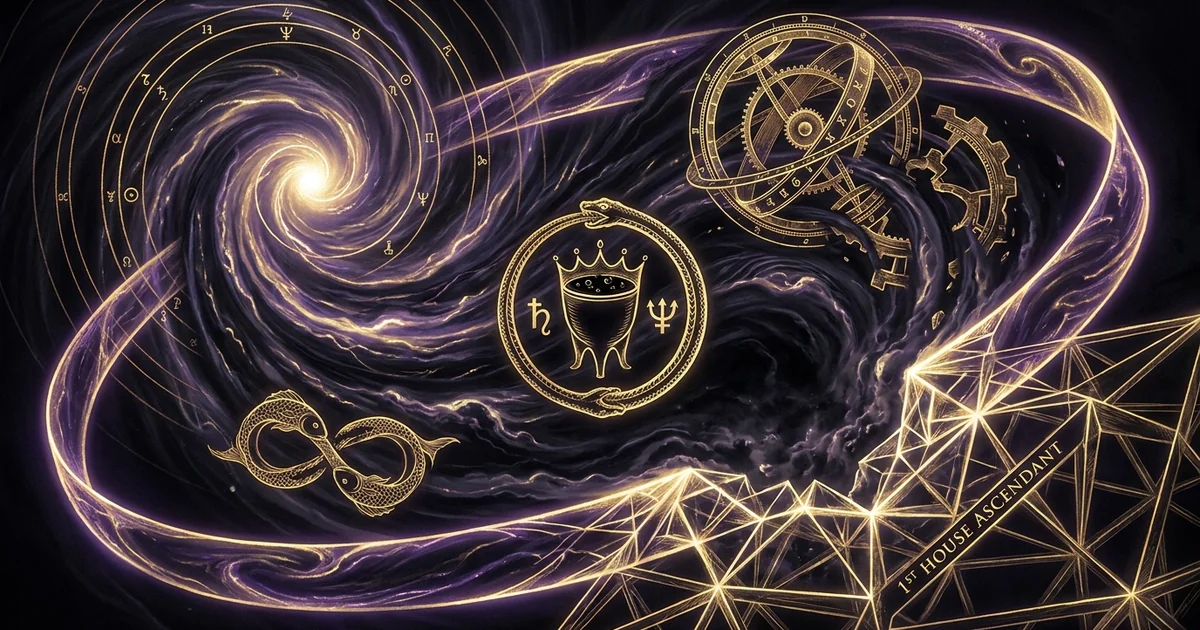
Twelfth House: The Great Unconscious and Cosmic Return
Archetypal Thesis & Systemic Paradigm: The Inverted Horizon and Dissolution of the Ego
The Kakodaimon and the Mechanics of Asyndeton
In the architectural framework of classical genethliacal astrology, the twelfth house represents an epistemic rupture within the manifest cosmos. Positioned immediately above the eastern horizon, this sector does not partake in the radiant emergence of the First House (the Horoskopos), but rather operates as its structural antithesis. In the conceptual geometry formalized by Hellenistic astrologers, the twelfth house was designated as the Kakodaimon—the domain of the “Evil Daimon” or “Bad Spirit.” This terminology was not merely an empirical cataloging of misfortune, but a rigorous deduction derived from the doctrine of aspectual optics.
According to Ptolemaic and pre-Ptolemaic optical mechanics, a celestial house derives its discursive intelligibility through its capacity to cast rays of aspect—configured along the traditional Platonic harmonic polygons of the sextile (60°), square (90°), trine (120°), or opposition (180°)—toward the Ascendant. The twelfth house, being separated from the Ascendant by an adjacent arc of thirty degrees, is technically inconjunct. In the precise terminology of the Hellenistic tradition, it exists in a state of asyndeton—literally disconnected, unbound, or averted. Because the Ascendant marks the locus of physical incarnation, somatic vitality, and the nascent crystallization of the conscious ego-complex, any house that cannot “see” this horizon is rendered invisible to conscious apperception.
The twelfth house is thus mathematically blind to the waking personality. This lack of aspectual communion prevents the diurnal ego from recognizing the contents, motivations, and planetary functions operating within this space. Consequently, the psychic energies resident within the twelfth house are experienced phenomenologically not as expressions of personal agency, but as alien, intrusive, and externally imposed conditions. The ancient attribution of “hidden enemies” (inimici occulti) directly emerges from this optical deprivation: that which dwells within the psychospiritual blind spot cannot be integrated into the deliberate self-concept, and therefore announces its presence through involuntary fate, systemic blind spots, and projected psychisms that appear to assail the native from outside the sovereign perimeter of the self.
The Liminal Chronotope: Pre-Natal Engrams and Terminal State-Spaces
Understood through the lens of psycho-cosmological topology, the twelfth house functions as a liminal chronotope—a specialized threshold space-time where the boundary conditions governing temporal sequencing collapse. In the sequential progression through the twelve natal chart houses, House 12 represents the terminal state-space of the celestial sphere. It is the final cosmological station wherein the accumulated structural differentiation of the previous eleven houses undergoes thermodynamic exhaustion and psychic composting.
Simultaneously, within the prenatal developmental matrix, the twelfth house corresponds to the intrauterine environment: the twilight continuum of the amniotic sac preceding biological parturition. Here, the nascent entity possesses no differentiated persona; it floats within an unmediated, sympoietic communion with the maternal organism and the collective unconscious. The prenatal engrams encoded within this sector register the emotional, psychological, and environmental currents circulating within the ancestral field during the gestation cycle. When planetary bodies occupy the twelfth house, their operational archetypes are filtered through this pre-linguistic, somatosensory substrate.
The twelfth house captures both ends of the biological and existential lifecycle: it is at once the liminal chamber immediately prior to the first gasp of breath at the Ascendant and the terminal hospice of the psyche where local identity dissolves back into the universal plenum. It represents the state of structural suspense—the bardo of Tibetan eschatology—wherein the soul-complex sheds its historic vehicle while retaining the subtle energetic residue, or karmic traces (samskaras), that will mandate the parameters of the subsequent incarnation.
Ego-Shattering as Cybernetic Entropy: Reintegrating the Persona
When examined as a cybernetic feedback system, the human psyche functions by maintaining boundary integrity, processing localized information, and mitigating systemic entropy to preserve structural homeodynamics. The conscious persona, synthesized across the First through Tenth Houses, stabilizes an operational model of personal reality. However, the Twelfth House operates as an entropic sink: a boundary layer engineered to decelerate the diurnal drive and systematically dismantle the rigid psychological armoring erected by the ego-complex.
The psychological experience of ego-shattering characteristic of intensive twelfth-house activations is not an arbitrary pathology, but a necessary homeostatic mechanism. When the conscious personality becomes excessively ossified, calcified in its defenses, or severed from its mythopoetic substrate, the twelfth house induces structural failure. This failure manifests as deep melancholia, sudden disorientation, the dissolution of worldly standing, or states of mystical panic.
Within this framework, the twelfth house astrological meaning is understood not as punitive damnation, but as an archetypal digestive apparatus. It executes the metabolic breakdown of structural karma. The persona must be broken down into its prima materia so that the toxic accumulations of hyper-individuation may be neutralized, filtered, and rendered porous before the cyclical dawn of the First House can be achieved with renewed vital potency.
First House: The Horoskopos
- Operative Principle: Ego-crystallization, somatic emergence, conscious agency.
- Aspectual Mechanics: The origin point of sight; casts and receives all direct Ptolemaic rays.
- Psychological Locus: The waking Persona; the self-concept; somatic embodiment.
- Hellenistic Denomination: Anaphora / Life / Breath (Pneuma).
- Temporal Alignment: Dawn; primary emergence into external spatiality.
Twelfth House: The Kakodaimon
- Operative Principle: Ego-dissolution, prenatal latency, transpersonal oceanic return.
- Aspectual Mechanics: Inconjunct / Asyndeton; blind spot averted from the horizon.
- Psychological Locus: The Collective Unconscious; the dissociated Shadow; prenatal engrams.
- Hellenistic Denomination: Kakodaimon / Carcer / The Binding.
- Temporal Alignment: The pre-dawn twilight; lingering darkness preceding spatial awakening.
Classical Provenance & Textual Lineage: From Hellenistic Kakodaimon to Medieval Carcer
The Anthologiae of Vettius Valens and Planetary Joys
The classical lineage of the twelfth house requires rigorous historical contextualization within the surviving corpora of antiquity, principal among them the Anthologiae of the second-century Antiochian astrologer Vettius Valens. Unlike the neat, idealized philosophical geometry of Claudius Ptolemy’s Tetrabiblos, Valens’ compilation reflects the empirical working mechanics of Hellenistic astrological praxis. Valens routinely designates the twelfth place (dodekatopos) as an infernal threshold, inextricably tied to the subterranean realities of the human condition: involuntary exile, psychic torment, physical bondage, and ruinous wandering.
Central to Valens’ cosmology is the systemic assignment of the planetary joys (gaudia). In this distribution, the twelfth house is designated as the Joy of Saturn (Phainon). This assignment is foundational to deciphering the phenomenological architecture of the house. The planetary joys are not assigned arbitrarily; they reflect profound structural symmetries between planetary temperament and spatial topography.
Saturn—the outermost classical wanderer, characterized by extreme cold and dryness, planetary patron of boundaries, decay, isolation, and temporal duration—finds its joy in this averted, diurnal house above the horizon. While Saturn’s diurnal sect status permits it to wield constructive structure in celestial sectors configured to the Ascendant, its placement in the house of its joy highlights its archetypal function as the binder, the sequesterer, and the master of temporal decay.
“The twelfth place is the Bad Daimon. It is averted from the Horoskopos and is a place of labor, confinement, foreign travel, exile, and ruin. When malefics occupy this place or cast their rays upon it without the presence of benefics, they bring about physical restraints, shipwrecks, diseases of the mind, and the subjection of the native to hidden enmities and the chains of servitude.”
The Latin Transmission: Transformation into Carcer and Hidden Treachery
As the Hellenistic astrosophical corpus migrated through Sasanian Persia and the Islamic Golden Age—via translators and theorists such as Abu Ma’shar and Masha’allah—and subsequently crystallized into the medieval Latin West through Guido Bonatti and Firmicus Maternus, the conceptual matrix of the twelfth house underwent a profound socio-material literalization. Firmicus Maternus, writing in the twilight of the Roman Empire (Matheseos Libri VIII), describes the twelfth house as an omen of material catastrophe, designating it as the locus through which the native is dragged into physical slavery, public degradation, or incurable chronic afflictions.
During the high medieval period, the house was formally cataloged under the Latin moniker Carcer—the Prison. The subtle ontological aversion (asyndeton) identified by early Hellenistic philosophers was transformed by medieval scholasticism into specific, tangible societal institutions: penal dungeons, leper colonies, psychiatric asylums, and clandestine monastic cloisters.
The existential dread of psychic blindness hardened into the doctrine of “hidden treachery.” In the manual traditions of horary and natal evaluation, astrological house 12 became the primary domicile of backbiters, conspirators, thieves, and malicious sorceries. This shift reflected the feudal anxieties of an era wherein unseen social subversion posed an immediate threat to physical sovereignty and lineage continuity.
The Joy of Saturn: Melancholia, Confinement, and Systemic Boundary Degradation
The intrinsic affinity between Saturn and the twelfth house governs the psychopathology of melancholia. As articulated in medieval humoral medicine and Renaissance Neoplatonism—most notably in Marsilio Ficino’s De Vita Triplici—Saturn regulates the black bile (melaina chole), the cold, heavy, dry humor that causes psychic withdrawal, intellectual fixation, and somatic calcification.
When Saturn governs the twelfth house or occupies it by natal ingress, it imposes an extreme chronopathic weight upon the psyche. The native is subjected to the phenomenological sensation of time as a physical weight—a slow, relentless degradation of the boundaries that divide the self from the environment. This structural boundary degradation operates paradoxically. Saturn represents the mythology and boundary mechanics of limits, walls, and defenses; however, placed within the dissolutionary crucible of the twelfth house, Saturn’s walls do not protect the native from the world. Instead, they isolate the native from their own vitality.
The walls of Carcer become an internal fortress that turns into a tomb. The native constructs complex compensatory defenses to shield themselves from deep-seated unconscious dread, only to discover that the defenses themselves constitute the very prison of isolation against which they struggle. Only through the profound transmutation of Saturnian discipline—converting solitary confinement into intentional ascetic contemplation—can this archetype be reclaimed as the cornerstone of transpersonal realization.
Structural Mechanics & Symbolic Geometry: The Geometry of Inconjunct Darkness
The 150-Degree and 30-Degree Inconjunct Topologies
The structural architecture of the twelfth house is governed by its precise geometric relationship to the primary framework of the natal chart. The tropical zodiac and the quadrant house frameworks construct a field of resonance based upon regular geometric divisions of the 360-degree circle. The twelfth house is characterized by two distinct topological relationships with other sectors of the chart: the 30-degree adjacent inconjunction with the First House, and the 150-degree quincunx inconjunction with the Seventh House of overt relational engagement.
The 30-degree interval between the twelfth house and the Ascendant represents a structural disjunction. In traditional Euclidean aspect theory, no regular polygon can construct an aspect between adjacent signs that share neither gender (masculine/feminine), element (fire/earth/air/water), nor quadruplicity (cardinal/fixed/mutable). The adjacent signs forming the twelfth and first houses possess completely discordant modes of energetic transmission.
Because of this radical geometric incompatibility, the twelfth house exists in a spatial and energetic blind spot. Energy cannot bridge this gap via direct aspectual resonance; it can only leak across the boundary through somatic conversion, psychological projection, or entropic collapse.
Furthermore, the 150-degree relationship between the twelfth house and the seventh house (the Descendant) creates a subterranean axis of alienation. The seventh house governs explicit, negotiated social contracts and overt relational mirrors. The quincunx linking it to the twelfth house ensures that twelfth-house contents continuously disrupt open relational contracts through unacknowledged, sabotaging dynamics that emerge from the collective shadow.
Pre-Ascendant Vectoring: Diurnal Drift versus Primary Motion
To comprehend the mechanics of the twelfth house, one must differentiate between the two fundamentally opposing motions that govern the astrological cosmos: secondary motion (the counter-clockwise movement of planets through the zodiacal signs, driven by orbital momentum) and primary motion (the clockwise rotation of the celestial sphere caused by the daily rotation of the Earth on its axis).
   Secondary Motion (Zodiacal Progression): Counter-Clockwise [Signs: Aries -> Taurus -> Gemini]
   Primary Motion (Diurnal Rotation): Clockwise [Houses: Ascendant -> House 12 -> Midheaven]
Under primary motion, any celestial body that emerges across the eastern horizon into the First House is immediately swept upward and backward across the cusp of the twelfth house. This diurnal drift means that the moment a planet is born into the light of the physical world at the Ascendant, the primary movement of the cosmos drags it into the liminal confinement of the twelfth house.
Planets in the twelfth house are hovering immediately above the horizon, yet they are structurally transitioning toward the midheaven via diurnal rotation, while their zodiacal motion attempts to drive them in the opposite direction. This creates a state of immense rotational tension.
The planet’s standard functional archetypes are inverted: its solar, assertive, outward expressions are suppressed, forcing its energetic vectors inward toward the subterranean layers of the psyche. Rather than illuminating the external landscape, a planet in the twelfth house acts like an inverted lighthouse, casting its radiant beams into the abyssal depths of the unmanifest self.
Cross-Systemic Parallels: Qabalistic Qliphoth and Gate 47 of the BodyGraph
The architectural mechanics of the twelfth house possess striking structural correspondences across diverse esoteric and psycho-symbolic coordinate systems. Within the Hermetic Qabalah, the twelfth house corresponds dynamically to the trans-rational boundary conditions of the Tree of Life—specifically the interface between the supernal triad and the fallen astral realms, as well as the dark mirror of the Tree: the Qliphoth. The Qliphoth are denominated as the “shells” or “husks” (Klippot) of discarded, unbalanced forms that persist in the wake of cosmic creation.
The twelfth house is the reservoir of these systemic husks. When psychic structures, outmoded archetypes, and fragmented soul-aspects are discarded by the evolving conscious personality, they do not evaporate; they drop into the twelfth-house basement, where they aggregate as semi-autonomous Qliphothic complexes. Left unintegrated, these phantom residues drain vital prana from the native’s conscious enterprise.
In the contemporary synthesis of Human Design—which integrates astrological coordinates with the I Ching and the somatic BodyGraph—this dynamic finds profound correspondence within the Ajna Center, specifically through Gate 47: The Gate of Realizing, derived from the 47th hexagram of the I Ching (K’un / Oppression, Exhaustion). Gate 47 represents the mental pressure to extract coherent, historical meaning from a chaotic ocean of past sensory memories and systemic karmic intake.
Just as the 47th Gate operates under an intrinsic sense of cognitive oppression—experiencing the weight of past actions without immediate clarity on their resolution—the twelfth house immerses the mental faculty in an ambiguous, unintegrated past. Both structural systems articulate the precise same mechanical reality: the human organism bound in a state of cognitive and emotional confinement, subjected to an internal pressure that cannot be resolved through linear intellectual mechanics, but only through radical surrender to the transpersonal process of psychic realization.
Psychological Dynamics & Operational Praxis: The Unconscious, Shadow Work, and Transpersonal Redemption
Shadow Projection and the ‘Hidden Enemy’ Complex
In the nomenclature of Jungian analytical psychology, the twelfth house is the primary architectural reservoir of both the personal and collective shadow-archetype. The shadow comprises those aspects of the psychic apparatus, instinctual drives, and structural potentials that the developing ego-complex has deemed intolerable, incompatible, or dangerous to its social survival during the enculturation process.
Because the twelfth house is characterized by the optical silence of asyndeton, these disowned fragments cannot be viewed directly through introspective examination. Consequently, the unconscious utilizes the automatic mechanism of projection to render these interior contents visible.
The psychological dynamic of the “hidden enemy” is thus decoded as the externalization of disowned internal drives. If an individual possesses a twelfth-house Mars, the archetype of raw aggression, boundary assertion, and primal desire is fundamentally severed from the conscious self-concept. The individual perceives themselves as completely peaceful, harmless, and incapable of systemic cruelty.
Inevitably, the repressed Martian current gathers critical charge within the unconscious until it is projected outward onto the environment. The native experiences the world as inherently hostile, chronically attracting individuals who act out overt betrayal, sabotage, and unprovoked aggression. The “hidden enemy” is nothing less than the native’s own disowned assertiveness, returning from the exterior world to shatter the false, one-sided integrity of the conscious persona.
“The shadow is that hidden, repressed, for the most part inferior and guilt-laden personality whose ultimate ramifications reach back into the realm of our animal ancestors… If the shadow is completely repressed and isolated from consciousness, it does not become inactive; on the contrary, it falls into the unconscious and acts from there as an autonomous complex, projecting its own demonic reality upon our neighbors and turning our reality into a theater of unseen persecutions.”
Somatic Imprisonment: Addiction, Escapism, and Chronic Dissociation
When the transpersonal tides of the twelfth house overwhelm the somatic boundaries of the physical vessel, the personality frequently seeks refuge in pathological defense mechanisms. The most ubiquitous of these manifestations are chemical and behavioral addictions, compulsive escapism, and states of chronic dissociative derealization.
Under the influence of strong twelfth-house activations—especially those involving Neptune, Jupiter, or the Moon—the ego experiences profound psychic exhaustion from maintaining its artificial separateness in the waking world. The longing encoded within this sector is an existential homesickness: an unquenchable desire to return to the boundaryless, oceanic safety of the amniotic sac, the pristine realm preceding ego-differentiation.
Addiction, viewed through this transpersonal framework, is a tragic, misdirected spiritual quest. The native attempts to simulate the mystical experience of cosmic dissolution through somatic chemicals or behavioral loops (alcoholism, opiates, digital immersion, continuous fantasy). The substance temporarily dissolves the painful, rigid boundaries of the ego, granting a brief, counterfeit taste of unmanifest unity.
However, because this dissolution occurs without conscious spiritual architecture, it leaves the somatic vessel severely compromised. The ancient designation of the twelfth house as the place of Carcer is realized somatically: the native becomes a prisoner of the very substance or behavior they utilized to escape their psychic confinement, trapped in a recursive feedback loop of self-undoing that systematically erodes their worldly agency.
[ Unconscious Longing for Transpersonal Dissolution ]
                        │
                        ▼
[ Somatic Chemical / Dissociative Escape (Counterfeit Unity) ]
                        │
                        ▼
[ Erosion of Egoic Boundary & Somatic Vitality ]
                        │
                        ▼
[ External Institutionalization / Psychic Imprisonment (Carcer) ]
Hermetic Alchemy of Confinement: Solitude, Active Imagination, and Meditation
The operational redemption of the twelfth house demands a deliberate inversion of its classical polarity. If passive abandonment to this sector results in victimization, psychological projection, and institutional confinement, then active, conscious engagement converts the prison into a consecrated laboratory of Hermetic transmutation. The ancient remedy for the afflictions of the Kakodaimon is the voluntary adoption of the monastic posture: deliberate, structural ascesis (solitude, silence, and sensory deprivation).
Through intentional withdrawal from the hyper-stimulating social matrix, the practitioner eliminates the external screens upon which their unconscious complexes are automatically projected. In the silence of voluntary retreat, the “hidden enemies” lose their external disguises and reveal themselves as unintegrated autonomous complexes within the subjective psyche.
Here, the Jungian methodology of Active Imagination functions as a primary operational tool. The native consciously enters the hypnagogic, liminal boundary states governed by the twelfth house, granting conscious voice, form, and agency to the subterranean figures residing within the shadow.
Planetary forces occupying the twelfth house must be addressed directly through contemplative ritual, expressive creative immersion, and disciplined meditative absorption. By consciously providing an altar, a canvas, or a monastic space for these transpersonal currents, the practitioner prevents them from staging catastrophic insurrections in their external life. The heavy, leaden chains of the Saturnian prison are thereby alchemically transmuted into the golden vessel of spiritual sovereignty and transpersonal wisdom.
Philosophical Synthesis & Macrocosmic Correspondence: The Ouroboros and Cosmic Return
The Twelfth House as the Cosmic Amniotic Ocean (Ain Soph Aur)
From an ultimate philosophical perspective, the twelfth house is the cosmological realization of the ouroboros—the mythical serpent devouring its own tail, symbolizing the eternal circularity of manifestation, dissolution, and regeneration. It represents the primordial ocean of pre-creation: the chaotic waters of Nun in Egyptian cosmology, the unformed abyss of Tiamat in the Mesopotamian epic, and the fathomless mystery of the Qabalistic Ain Soph Aur (The Limitless Light) concealed behind the veil of absolute darkness.
[ The Ouroboric Horizon ]
                     ╭───╮
                 ┌───╯   ╰───┐
                ╭╯           ╰╮
               ╱               ╲
  [ House 12: Dissolution ]   [ House 1: Emergence ]
  (Ain Soph / Pre-Being)       (Kether / The Spark)
               ╲               ╱
                ╰╮           ╭╯
                 └───╮   ╭───┘
                     ╰───╯
The terror that the twelfth house evokes within the conventional, worldly personality is rooted in the ego’s conflation of nothingness with annihilation. The ego assumes that the dissolution of its personal narrative equates to terminal oblivion. However, the esoteric doctrine preserved across Hermetic and Vedic traditions demonstrates that this apparent void is not an empty vacuum, but a state of hyper-saturated plenitude.
It is the unmanifest zero-point field from which all distinct forms, thoughts, and material manifestations continually precipitate. The darkness of the twelfth house is not the absence of illumination; it is the blinding luminescence of absolute reality, so concentrated that it paralyzes the limited optical apparatus of the mortal mind.
The Kybalion’s Principle of Rhythm and Circular Teleology
The structural dynamics of this terminal house demonstrate the immutable validity of the Fifth Hermetic Axiom articulated in The Kybalion: The Principle of Rhythm. This universal law dictates that “the measure of the swing to the right is the measure of the swing to the left; rhythm compensates.” In the context of the celestial sphere, the outward, evolutionary arc of manifestation—the swing from the First House of individual birth, through the fourth house of domestic roots, culminating in the tenth house of worldly empire—must inevitably reach its maximum apogee and begin its reciprocal swing back toward source.
       [ Outer Zenith: House 10 / Worldly Manifestation ]
                          ▲
                         ╱ ╲
                        ╱   ╲  (The Arc of Rhythm)
                       ╱     ╲
  [ House 1: Emergence ]       [ House 12: The Great Return ]
                       ╲     ╱
                        ╲   ╱
                         ▼
       [ Inner Nadir: House 4 / The Subterranean Root ]
The twelfth house is that compensatory return swing. It is the teleological attractor of the entire horoscope. Humanity’s collective suffering stems predominantly from an obstinate refusal to honor this rhythmic compensation. The modern ego demands perpetual growth, unceasing external expansion, and continuous visibility, treating the necessary phases of decay, withdrawal, and dissolution as societal or medical failures.
The twelfth house asserts the spiritual necessity of entropy. It teaches that the cyclical decay of structures, identities, and relationships is not a tragic anomaly, but the cosmic mechanism whereby the universe prevents its creations from becoming eternal monstrosities. Dissolution is the absolute structural guarantee of liberation.
The Great Return: Dissolution as Precondition for the Aries Dawn
The circularity of the zodiacal mandate demands that the Twelfth House, fundamentally aligned with the archetypal signatures of Pisces and the planetary energies of Neptune and Jupiter, must yield without interruption to the First House, traditionally signified by the archetype of Aries and the martial spark. This transition across the great cosmological threshold—from the 360th degree of the zodiac back to the 0th degree of Aries—is the ultimate mystery of the astrological apparatus: the Cosmic Return.
Individual consciousness cannot be initiated into its next evolutionary iteration without first undergoing the systemic baptism of the twelfth house. The persona must be submerged within the amniotic ocean until all historic calcifications, false identifications, and outmoded karma are dissolved into their constituent elements.
The Twelfth House is the holy composting ground where the dead husk of the past personality serves as the rich, fertile humus from which the new shoot of the self will sprout at the dawn of the Ascendant. To traverse the twelfth house with deliberate spiritual awareness is to participate willingly in the archetypal death-and-resurrection mystery, recognizing that every dawn is purchased with the silent surrender of the dark night that preceded it.
- Tarot Major Arcana Key XII: The Hanged Man (Attributed to the Hebrew Mother Letter Mem—Water). Signifies conscious surrender, voluntary suspension, the reversal of mundane perspectives, and prenatal incubation.
- Tarot Major Arcana Key XVIII: The Moon (Attributed to the Hebrew Letter Qoph—Corporality/Sleep/Pisces). Signifies the twilight journey through the unintegrated instinctual landscape, hypnagogic visions, illusions, and the dissolution of rational cognitive structures.
- Hermetic Operation: Solutio—the complete dissolution of dry, calcified psychic compounds within the universal alchemical solvent, enabling the subsequent Coagulatio at the Ascendant horizon.
Frequently Asked Questions: Navigating the Mysteries of the Twelfth House
Does having natal malefic planets in the Twelfth House guarantee institutionalization or tragedy?
The placement of classical malefics (Mars or Saturn) within the twelfth house does not constitute a deterministic sentence of physical institutionalization, imprisonment, or overt personal catastrophe. Such fatalistic interpretations are the consequence of conflating Hellenistic structural conditions with absolute phenomenological outcomes. In traditional astrology, the malefics in this sector certainly describe intense, unintegrated instinctual forces operating in the native’s psychological blind spot (asyndeton).
If left unexamined, Mars in the twelfth house may manifest as passive-aggressive self-sabotage, internalized rage that somaticizes as autoimmune conditions, or the projection of violent motivations onto others. Saturn in the twelfth house can produce paralyzing existential dread, severe psychological isolation, and a pervasive, irrational terror of societal failure or invisible authority structures.
However, when these planetary energies are engaged through rigorous psychological analysis and operational self-discipline, their manifestation shifts dramatically. Saturn finds its planetary joy in the twelfth house; once its requirements for solitude, emotional sobriety, and ascetic rigor are met, it ceases to act as an external prison warden and becomes an impregnable internal fortress of spiritual authority, conferring immense psychological stamina and the capacity to bear solitary responsibilities that would crush a typical ego.
Similarly, an integrated twelfth-house Mars acts as an unseen spiritual champion—a capacity for selfless, tireless advocacy on behalf of the marginalized, institutionalized, or forgotten sectors of society, operating with formidable tactical efficiency precisely because it does not require personal praise or public applause to sustain its drive.
How does one distinguish Twelfth House planetary expression from Eighth House occult processes?
While both the Eighth and Twelfth Houses are cataloged among the classical “dark houses” (apoklima and averted places), their mechanics and psychological topologies are fundamentally distinct. The Eighth House (the Hellenistic Epicataphora or “Descent”) operates as an active, relational crucible. It is configured to the Ascendant via a classical sextile to the Midheaven and a trine to the Fourth House, meaning its operations are dynamically tethered to material and psychological exchanges with an external “other.”
The Eighth House governs shared trauma, emotional enmeshment, the confrontation with mortality through intimacy, inheritance, the energetic debts owed to and by others, and the alchemical crisis of psychological transformation (metanoia). It is an intense, active confrontation with the shadow of another human being.
In radical contrast, the Twelfth House is absolute, non-relational, and trans-personal. It does not negotiate with an external partner, nor does it trade in psychological or financial assets. The Twelfth House represents the unmediated substrate of the collective unconscious itself: the pristine, lonely ocean where the individual ego is extinguished entirely.
While the Eighth House is the experience of walking through an alchemical fire with a partner and undergoing psychological death, the Twelfth House is the quiet, solitary drifting of the disembodied soul through the infinite waters of pre-existence and post-existence. The Eighth House transforms the persona; the Twelfth House dissolves it back into the cosmic source.
Can a Twelfth House stellium produce worldly success, or is it exclusively monastic?
A Twelfth House stellium—defined as an accumulation of three or more celestial bodies within this sector—can produce immense, visible worldly success, provided the structural parameters of that success conform to the archetypal laws governing the house. History demonstrates that numerous extraordinarily influential figures in cinema, literature, spiritual philosophy, and institutional research possess prominent twelfth-house planetary clusters.
The critical caveat lies in the mechanism of achievement: the twelfth house will violently undermine and dismantle any enterprise rooted in personal narcissism, shallow vanity, or the aggressive aggrandizement of the sovereign ego.
Because the twelfth house channels the currents of the collective unconscious, individuals with a stellium in this domain function as psychic lightning rods for their historical era. They possess an instinctive, pre-verbal connection to the latent longings, unspoken griefs, and mythic dreams circulating within the collective field. If they channel these transpersonal tides through an objective, creative, or humanitarian medium—such as cinematic arts, depth psychology, transpersonal medicine, or large-scale institutional architecture—the world rewards them immensely, as they provide a voice for that which was historically silent and invisible.
The prerequisite for sustainable worldly success with a twelfth-house stellium is absolute egoic surrender: the practitioner must view themselves not as the sovereign author of their genius, but merely as a humble, transparent conduit through which the collective ocean expresses its own evolutionary requirements.
What is the operational effect of transit activations across the Twelfth House cusp?
When outer planetary heavyweights (Saturn, Uranus, Neptune, or Pluto) or prolonged profection cycles activate the cusp and interior degrees of the twelfth house, the native enters a prolonged, unavoidable period of psychospiritual decompression and thermodynamic clearing. This transit phase consistently marks the closing of a major biographical epoch.
Operationally, the individual typically experiences a pronounced drop in outward, kinetic drive. Projects, ambitions, and social structures that previously sustained the worldly persona begin to lose their vital charge, stalling out or disintegrating entirely. The psychic immune system becomes porous, demanding that the individual decelerate and turn their attention inward toward unprocessed material from the preceding cycle.
The strategic error most frequently committed during twelfth-house transit activations is the desperate attempt to maintain previous levels of external productivity and control. Forcing outward outcomes while the cosmos mandates inward composting results in severe somatic depletion, medical crises, and catastrophic professional exhaustion.
The correct operational response to twelfth-house transit activations is proactive surrender: intentionally scaling back external commitments, terminating outmoded relationships with minimal resistance, increasing sleep and solitary meditation, and seeking therapeutic or psychoanalytic support to consciously catalog the contents being cast up from the deep. By allowing the house of dissolution to execute its necessary cleansing function, the native ensures that when the transiting body eventually crosses the eastern horizon into the First House, they emerge unencumbered, purified, and structurally prepared to initiate a brilliant new evolutionary cycle.