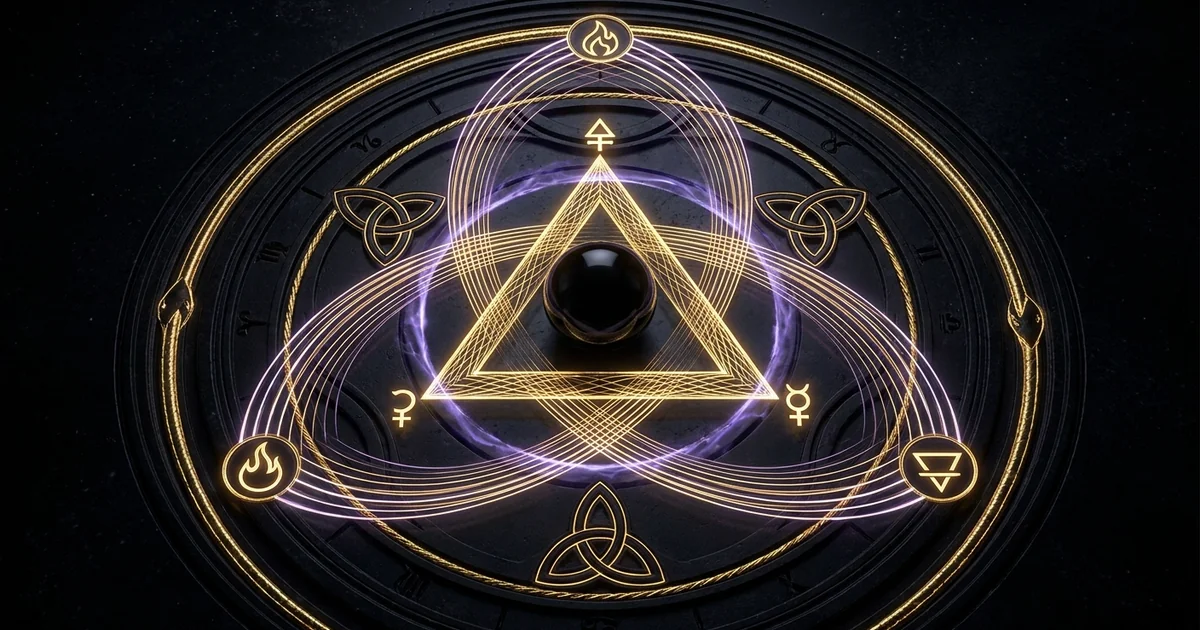
The Trine: Effortless Flow and Elemental Synergy Waves
Archetypal Thesis & Systemic Paradigm: The Geometry of Harmonic Resonance
The trine aspect, an angular separation of 120 degrees along the ecliptic, constitutes the primary harmonic infrastructure of thermodynamic equilibrium within natal astrology. Generated by the ternary division of the 360-degree celestial circle ($360^\circ / 3 = 120^\circ$), the trine inscribes an equilateral triangle within the geocentric framework. In the lexicon of archetypal psychology and psycho-cosmological coordinate frameworks, this geometric configuration does not merely signify passive good fortune or benign happenstance. Rather, it operates as an energetic conduit governed by the physical principle of least action, mediating an unobstructed exchange of archetypal data between planetary nodes. Where two or more planetary bodies occupy this spatial distribution, the systemic impedance of the psychic apparatus approaches zero, allowing elemental forces to interlock in mutual reinforcement.
The Square (90° Aspect)
- Kinetic Mechanics: Divides the circle by four (Tetraktys base); creates orthogonal structural friction and energetic collision.
- Psychodynamic Impact: Generates acute cognitive dissonance, crises of action, and teleological necessity via defensive compensation.
- Phenomenological State: Manifests as dynamic labor, externalized struggle, systemic tension, and the conscious demand for mastery.
- Systemic Vulnerability: Risk of hyper-reactivity, somatic exhaustion, projection of structural conflict, and cyclic neurosis.
The Trine (120° Aspect)
- Harmonic Mechanics: Divides the circle by three (Trinitarian base); aligns planets within identical triplicities and mutual gender orientations.
- Psychodynamic Impact: Induces homeostatic flow states, frictionless informational transfer, and innate archetypal coherence.
- Phenomenological State: Experienced as innate talent, unforced operational synthesis, spontaneous facility, and psychospiritual grace.
- Systemic Vulnerability: Risk of thermodynamic inertia, atrophy of the will, lack of developmental impetus, and unexamined complexes.
The 120-Degree Topology: Trinitarian Symmetry and the Triplicity Matrix
The structural integrity of the 120-degree aspect rests upon the arithmetic and geometric properties of the number three. In sacred geometry and the tradition of /sacred-geometry/the-pythagorean-tetractys-and-harmonic-intervals, the triad represents the first formal resolution of dualistic polarity, synthesising the thesis and antithesis of the monad and dyad into an integrated systemic whole. When projected upon the ecliptic plane, the 120-degree division naturally maps to the zodiacal triplicity matrix, linking signs that share the identical elemental classification—Fire, Earth, Air, or Water.
This spatial architecture creates a self-referential closed circuit. Unlike the hard aspect-geometry found within /astrology/the-square-friction-and-crisis-of-action, where orthogonal forces must continually negotiate competing qualitative drives, the trine binds celestial points possessing consonant qualitative polarities (either masculine/diurnal or feminine/nocturnal) and identical elemental states. The structural result is an absolute absence of phase friction. The energetic output of planet $A$ is inherently intelligible to planet $B$, requiring no translational medium, no psychological defense mechanism, and no cognitive adaptation. The psychic manifold experiences this condition as an effortless channel of systemic transmission.
Homeostasis and the Principle of Least Action in Planetary Energetics
From a biophysical and systems-theory perspective, planetary aspects can be modeled as vector fields operating across the state-space representations of human consciousness. The 120-degree aspect exemplifies the Principle of Least Action—originally formulated by Maupertuis and formalized by Hamilton—wherein a dynamic system naturally traverses the path that minimizes the path integral of the Lagrangian. Within the psycho-cosmic field, the trine represents this geodesic path of least resistance. Energetic potentials stored within the planetary archetypes discharge effortlessly across the elemental trines, bypassing the systemic friction typically generated by the ego-complex.
Because the system expends negligible energy in mediating communication between the two planetary centers, it achieves an instantaneous homeostasis. This state of stable equilibrium allows complex archetypal combinations—such as the synthesis of cognitive agility (Mercury) with expansive pattern-recognition (Jupiter)—to operate automatically. The conscious ego experiences this effortless transmission as an instinctual fluency or natural talent. The faculties governed by the involved planets operate with an uninhibited velocity, manifesting as spontaneous insight, somatic coordination, or affective stability without necessitating deliberate self-reflection or mechanical will.
Psychodynamic Resonance: Flow States versus Entropy of Inertia
In archetypal depth psychology, this unobstructed transmission induces what contemporary cognitive science identifies as optimal flow states. Dane Rudhyar noted in The Astrology of Personality (1936) that the trine represents the effortless realization of vision and the spontaneous actualization of organic form. Because the archetypal nodes are bound by elemental amity, the individual does not experience their interactions as internal conflict. There is no perceived imperative to master, defend against, or project the qualities involved; the psychic components exist in a condition of unprompted mutual acceptance.
Yet, this thermodynamic fluency introduces an insidious psychic hazard: the entropy of inertia. Systemic evolution across any organic or psychological domain requires energetic resistance. When internal structural tension is eradicated, the developmental impetus frequently flatlines. Within the individual psyche, the effortless flow of the trine can manifest as unconscious competence that resists deliberate integration. The native takes the archetypal facility entirely for granted, declining to forge the rigorous conscious containers required to elevate natural talent into durable, creative mastery. The trine aspect astrology elemental harmony can swiftly degenerate into an entropic sinkhole where potential remains perpetually latent precisely because it never encounters the transformative friction of crisis.
Classical Provenance & Textual Lineage: From Ptolemaic Rays to Keplerian Harmonics
The technical evaluation of the trine within the Western esoteric tradition has evolved through continuous geometrical and philosophical refinement. Hellenistic and medieval practitioners did not view the trine as an emotional or sentimental influence; they conceived it as an objective physical and optical geometry governing how celestial bodies cast their radiation upon one another across the sublunary sphere.
“Now the space between signs of the same gender is two signs, and between signs of the same element, four signs; and the trine configuration is formed by an interval of four signs, containing one hundred and twenty degrees. The trine is considered harmonious and of peaceful agreement because the planets configure across signs that are of the same nature and share an identical gender—either both masculine or both feminine—thereby casting rays of concordant mixture through an equalized geometric interval.”
Ptolemaic Optica: Visual Rays, Geometric Amity, and the Tetrabiblos Doctrine
In the foundational framework of classical astrology, Claudius Ptolemy (c. 150 CE) established the doctrine of configurations (schemata) based upon the optical theory of emission, wherein planetary bodies and zodiacal signs cast visual rays (aktinobolia) across the celestial sphere. In Tetrabiblos (Book I, Chapter 13), Ptolemy categorized the trine as the most inherently harmonious of the classical ptolemaic-aspects, explicitly contrasting its structural amity with the destructive discord of the quartile and the severe alienation of the diameter (opposition).
Ptolemy demonstrated that the 120-degree aspect is universally concordant because it operates exclusively between signs that share both elemental properties (hot/cold, wet/dry distributions) and gender (hairesis alignment). A masculine, diurnal fire sign (such as Aries) casts its trine ray exclusively toward other masculine, diurnal fire signs (Leo and Sagittarius). Ptolemy argued that this mutual constitution engenders geometric sympatheia. The visual rays do not refract, fracture, or collide upon impact; they mingle through qualitative similitude, projecting a smooth, unimpeded stream of influence onto the earth.
Hellenistic Trigona and Arabic Lords of the Triplicity
Following the Hellenistic foundation, medieval Islamic astrologers elevated the geometric trigona to the core of socio-political, dynastic, and individual prognosis. In his seminal historical treatise Kitāb al-Milal wa-al-Duwal (Book of Religions and Dynasties), Abu Ma’shar (848 CE) systematized the great conjunctions of Saturn and Jupiter across the triplicity matrix. Abu Ma’shar recognized that the shift of these planetary conjunctions from one elemental triplicity to another—occurring roughly every 240 years—marked fundamental transformations in global religious paradigms, imperial dynasties, and civilizational structures.
       [Fire Triplicity]
         /           \
        /             \
[Air Triplicity] --- [Water Triplicity]
        \             /
         \           /
       [Earth Triplicity]
Furthermore, medieval Arabic astrology refined the Hellenistic doctrine of the triplicity rulers (arbāb al-muthallathāt), utilizing the texts of Dorotheus of Sidon to construct an elaborate temporal management system. Each elemental trine was assigned three planetary lords: a diurnal lord, a nocturnal lord, and a participating lord. By assessing the cosmic status, elemental-dignity, and relational aspects of these triplicity rulers, astrologers could track the sequential unfolding of a native’s life trajectory across three distinct epochs. Here, the trine was transformed from a static geometry into a dynamic chronometric mechanism governing human fate across the horizontal axis of time.
Keplerian Geometrization: Musical Intervals and the Consonance of the Sesquitertian
During the Scientific Revolution, Johannes Kepler undertook a radical purge of traditional astrological mechanics, seeking to rescue its mathematical core from what he perceived as superstitious Arabist additions. In Harmonices Mundi (The Harmonies of the World, 1619, Book IV), Kepler rejected the arbitrary division of the zodiac into twelve conventional signs, asserting instead that celestial efficacy derived solely from the mathematical and musical configurations established between planetary rays striking the terrestrial center.
Kepler derived the power of the 120-degree aspect directly from the construction of regular Euclidean polygons. The equilateral triangle, generated by the trine, represents the first constructible regular polygon that can be completely inscribed within the circle after the diameter. Transposing this geometric division into Pythagorean harmonic ratios, Kepler demonstrated that the division of the circle by three corresponds to the musical interval of the perfect fourth (the diatessaron), structured upon the sesquitertian ratio ($4:3$). Kepler proved that the 120-degree separation acts as an objective cosmic consonance, producing an acoustic and energetic harmony within the sensitive terrestrial archetypal receiver (anima telluris), thereby ratifying the trine as a fundamental structural constant of harmonic-astrology.
Structural Mechanics & Symbolic Geometry: Elemental Triplicities and Harmonic Coupling
The operational reality of the trine aspect hinges upon the medium through which its harmonic energy propagates. The zodiacal circle distributes the four primordial elements—Fire, Earth, Air, and Water—across alternating, regular sequences. Because each element appears precisely every fourth sign, the 120-degree chord permanently unites signs of identical elemental attribution. This structural certainty enables astrologers to model the trine not as an isolated line between two isolated points, but as a resonance chamber operating within a broader elemental circuit.
The Four Elemental Circuits: Fire, Earth, Air, and Water Ensembles
The psychological and phenomenological output of a trine is fundamentally dictated by the elemental highway across which it travels:
-
The Fire Triplicity (Aries, Leo, Sagittarius): Operates as an energetic superconductor of somatic intuition, vitality, and teleological ambition. When planets are coupled via fire trines, they process reality through radiant willpower, sudden visionary insight, and uninhibited creative expansion. Systemic friction is eradicated, allowing the native to act with dramatic conviction and immediate charisma, though often with a marked deficit in self-reflective contemplation or grounded follow-through.
-
The Earth Triplicity (Taurus, Virgo, Capricorn): Establishes a circuit of pragmatic substantiation, sensory perception, and structural manifestation. Planetary archetypes bound within the earth trine coordinate through tactile feedback, material efficacy, and systemic organization. The flow manifests as an innate mastery of concrete systems, institutional longevity, and instinctual resource management, carrying the systemic pathology of material fixity, empirical reductionism, and resistance to metaphysical abstractions.
-
The Air Triplicity (Gemini, Libra, Aquarius): Functions as an ethereal matrix of conceptual translation, theoretical synthesis, and relational network distribution. Air trines allow planets to exchange symbolic and linguistic data at exceptionally high velocities. Archetypal dynamics translate into effortless interpersonal charm, systemic intellectual mapping, and abstract ideological fluency, often dissociating the consciousness from visceral somatic states and somatic emotional reality.
-
The Water Triplicity (Cancer, Scorpio, Pisces): Forms an oceanic, empathic conduit of affective cohesion, somatic memory, and unconscious imaginal processing. Water trines facilitate instantaneous emotional comprehension, creative psychism, and intuitive communion between disparate psychic complexes. The lack of defensive boundaries between the planetary nodes allows profound depths of therapeutic integration, balanced by the peril of emotional enmeshment, psychic porousness, and regressive escapism.
Orb Tolerances, Angular Velocity, and Exactitude of Aspect
The functional phenomenology of the trine is rigorously mediated by the precision of its orbital parameters. In contemporary algorithmic and psychological astrology, the aspect is evaluated across a spectrum of orb exactitude:
| Aspect Range | Orb Tolerance | Functional Mechanics | Phenomenological Manifestation |
|---|---|---|---|
| Partile (Exact) | $0^\circ 00’ - 1^\circ 00’$ | Direct harmonic lock; maximum coherence | Conscious cognitive integration, active flow, exceptional talent |
| Close Application | $1^\circ 01’ - 3^\circ 30’$ | Compressing wave field; increasing energy | Dynamic instinctual fluency, developmental ease, purposeful utility |
| Wide Separation | $3^\circ 31’ - 6^\circ 00’$ | Dissipating resonance; background harmony | Baseline somatic comfort, latent ability, passive stabilization |
| Platick (Extreme) | $6^\circ 01’ - 8^\circ 30’$ | Residual harmonic drag; structural link | Unconscious assumption of ease, high vulnerability to static inertia |
The directional motion of the aspecting bodies fundamentally alters the systemic delivery. An applying trine—where the faster-moving planet advances toward the exact 120-degree chord of the slower planet—exhibits a dynamic, forward-leaning intentionality. It presses toward integration, functioning as an active teleological resource that the native can mobilize for creative or operational execution.
Conversely, a separating trine denotes a dissipating wave field. Here, the energetic coherence represents a legacy state, an established baseline of ease that often sinks entirely below the threshold of waking consciousness. The native takes this functional competence so thoroughly for granted that it operates as a psychological blind spot—a region of the psyche so thoroughly free of friction that it is never critically examined.
The Grand Trine: Closed Feedback Loops and Dissipative Energy Traps
When three planets synchronize within a singular elemental triplicity, each positioned approximately 120 degrees apart, they configure the primary macro-pattern of celestial geometry: the Grand Trine. This layout constructs an equilateral triangle spanning the entirety of the zodiacal sphere, establishing a closed, self-sustaining feedback loop.
Within this triadic configuration, archetypal energy circulates in an unbroken thermodynamic cycle: $$\text{Planet } A \longrightarrow \text{Planet } B \longrightarrow \text{Planet } C \longrightarrow \text{Planet } A$$ Energy transmitted from one node is immediately received, amplified, and passed onward by the subsequent nodes without encountering external resistance or dissipative boundaries.
In psychological diagnostics, the Grand Trine represents a profound paradox. While it bestows exceptional, almost savant-like innate gifts, an impenetrable inner sanctuary, and remarkable self-sufficiency, it functions simultaneously as an energy trap. Because the energetic circuit is entirely self-contained, it requires zero contact with external, non-elemental reality to sustain its operation. The native experiences an immense internal equilibrium that can lead to developmental self-encapsulation. Lacking the disruptive, outward-driving friction found in crosses or T-squares, individuals possessing a Grand Trine may retreat into an ivory tower of self-satisfaction, operating in an elemental echo chamber that permanently insulates them from the developmental evolutionary catalysts necessary for true individuation.
Psychological Dynamics & Operational Praxis: Transmuting Passive Ease into Conscious Agency
The integration of the 120-degree harmonic into clinical and self-developmental praxis demands a clear-eyed departure from simplistic astrological optimism. An aspect devoid of systemic friction inherently subverts the primary mechanism through which the conscious ego-complex develops: namely, the confrontation with compensatory resistance.
- Determine Elemental Purity: Verify whether the trine is sign-consonant (occupying identical elements) or dissociated/out-of-sign. Out-of-sign trines demand that the cognitive faculties bridge incongruent elements (e.g., Fire and Earth), which introduces inherent friction and reduces systemic complacency.
- Locate Hard Planetary Anchors: Survey the chart for any third planet forming an orthogonal hard aspect (square, opposition, or quincunx) to either of the trine’s focal points. The presence of a square to a trine creates a dynamic release point, transforming passive ease into an active evolutionary driver.
- Calibrate Conscious Resistance: When prescribing active imagination or psychological praxis, assign deliberate constraints to the functions governed by the trine planets. Forcing the innate talent into structured, resistant mediums (e.g., channeling an effortless artistic flow into strict metric classical forms) rescues the potential from entropic decay.
The Shadow of Facility: Unconscious Competence and Entropic Decay
In Jungian analytical psychology, the shadow consists not merely of repressed trauma, forbidden desires, or aggressive drives; it also encompasses unactualized potential and unearned competence. Because the trine operates with natural talent and organic simplicity, the conscious ego rarely has to fight for its expression. Consequently, the faculties governed by the trine planets remain anchored in what depth psychology terms “unconscious competence.” The individual performs the functions brilliantly, but possesses no technical understanding of how the results are achieved.
This lack of analytical deconstruction leads directly to the shadow of facility: an acute vulnerability to stagnation, entitlement, and developmental avoidance. When an individual accustomed to the frictionless flow of a trine suddenly encounters external resistance, they frequently abandon the pursuit entirely, mistaking standard developmental friction for an existential impasse. The trine can thus become a systemic refuge for psychological avoidance, wherein the individual retreats into their effortless gift to evade the grueling labor demanded by their unintegrated, discordant complexes—a dynamic thoroughly documented across /archetypes/the-shadow-and-creative-friction.
[Innate Potential (Trine)]
         │
         ▼ (Lack of Resistance)
[Unconscious Competence]
         │
         ▼ (Encounter with Reality)
[Developmental Avoidance / Systemic Inertia]
Frictional Mobilization: Catalyzing Trines via Transiting Hard Aspects
The raw, undifferentiated gold of the trine can rarely be extracted without the introduction of structural stress. In practical natal analysis, an isolated trine requires an external or internal catalyst to awaken its creative potential. The most potent natural mechanics for this activation are hard transits and progressions—specifically Saturnian, Martian, or Uranian squares and oppositions—striking one of the participating trine nodes.
When a transiting Saturn forms a square to a natal Venus-Jupiter trine, it introduces mechanical compression, chronological limitations, and systemic accountability into what was previously a diffuse, aesthetic self-indulgence. The orthogonal impact breaks the closed equilibrium of the trine, forcing the planetary energy to discharge externally into concrete form. Astrological practitioners must recognize that the most fruitful chart configurations are not those populated exclusively by trines, but rather those dynamic hybrid systems wherein fluid, effortless channels feed directly into the pressurized engine rooms of squares and oppositions (see /astrology/the-opposition-polarity-and-dynamic-integration). In such architectures, the trine supplies the necessary fuel and resource resilience, while the hard aspect directs that energetic payload toward a tangible teleological crisis of action.
Hermetic Contemplative Praxis: Active Imagination within Harmonic Circuits
To prevent the harmonic circuit from decaying into entropic rest, the practitioner can deploy deliberate Hermetic contemplative praxis and Jungian active imagination. Rather than permitting the trine to operate as an automatic, subconscious program, the practitioner intentionally enters the state-space between the two planetary nodes during altered states of meditation.
The operational method requires isolating the dual planetary archetypes (e.g., Mars in Aries trine Moon in Sagittarius). The practitioner visualizes the two archetypes seated at the extremities of an open, luminous conduit. By consciously tracking the flow of somatic energy between them—the assertive, initiating drive of Mars harmonizing effortlessly with the receptive, meaning-seeking container of the Moon—the practitioner inserts the observing ego into the circuit. Through this act of conscious witness, the flow ceases to be merely instinctual; it becomes an operational psychospiritual tool. The individual actively directs the elemental fire toward creative, academic, or spiritual outputs, transmuting passive facility into deliberate, sovereign agency.
Philosophical Synthesis & Macrocosmic Correspondence: Cybernetics, Morphic Resonance, and Hermetic Law
The 120-degree aspect is not an isolated convention of natal astrology; it serves as a regional expression of universal self-organizing dynamics that govern systems at micro- and macrocosmic scales. When evaluated through modern scientific and philosophical frameworks, the trine reveals deep structural consonances with cybernetics, morphogenetic field theory, and the foundational axioms of the Western esoteric tradition.
“The number three is not merely a quantitative signifier, but a dynamic archetypal rhythm. As the primary qualitative symbol of purposeful motion, three represents the directional unfolding of energy in time, acting as the dynamic resolution to the tension of dualistic opposites. It does not possess the static structural completion of the quaternity, but provides the vital, flowing impetus that allows life-systems to continuously mediate, self-organize, and resolve systemic conflicts without catastrophic collapse.”
The Principle of Polarity and Gender: Equilateral Transmutation
In Hermetic philosophy, the universe is governed by the interwoven laws of Polarity and Gender. The Kybalion asserts that “everything is dual; everything has poles; opposites are identical in nature, but different in degree.” The opposition aspect ($180^\circ$) reflects this law in its raw, unreconciled state, presenting the human psyche with extreme, contradictory poles that demand exhaustive balance and dialectical synthesis.
The trine aspect, however, enacts the Hermetic Axiom of Polarity in a state of frictionless, perfected transmutation. Because it links poles that share an elemental medium and gender classification, the polarity does not manifest as conflicting opposites, but as complementary gradations of a unified current. It bypasses the agonizing pendulum swing endemic to the opposition. The masculine polarity projects outward through fire or air along congruent vectors, while the feminine polarity internalizes and binds through earth or water. The 120-degree geometry demonstrates that balance need not always be forged through collision and struggle; it can exist a priori as an intrinsic, geometrical symmetry within the macrocosmic order.
Cybernetic Feedback Loops: The Trine as a Homeostatic Servomechanism
In cybernetics and general systems theory, as developed by Norbert Wiener and W. Ross Ashby, complex systems survive environmental turbulence by employing homeostatic servomechanisms driven by negative feedback loops. A negative feedback loop detects variations from a set systemic norm and automatically dampens the fluctuations, restoring the operational balance of the system.
Within the psycho-cosmic architecture of the psyche, the trine functions precisely as such a homeostatic feedback loop. When stress, trauma, or external volatility assaults the individual, it is the natal trine configurations that provide the structural elasticity necessary to prevent catastrophic breakdown:
[Systemic Shock / Trauma]
         │
         ▼
[Planetary Node A] ──(Frictionless Trine Axis)──► [Planetary Node B]
         │                                                │
         └────────◄─── [Homeostatic Dampening] ───────────┘
The unobstructed communication between the two planetary archetypes instantly dissipates psychic shock across the shared elemental reservoir. If one planetary function is paralyzed, the other immediately compensates by shouldering the energetic burden, preserving the coherence of the personality matrix. The trine is the celestial archetype of psychic resilience, ensuring that despite severe disruptions along more vulnerable vectors, an irreducible core of functional equilibrium remains anchored.
Morphic Resonance: The Trine as an Attractor in Consciousness Space
Extending this macroscopic view through Rupert Sheldrake’s hypothesis of formative causation, the recurring archetypal geometries of the heavens may be conceived as celestial attractors within morphogenetic fields. Morphic resonance suggests that forms, behaviors, and ideas organize across space and time according to non-local field structures conditioned by past iterations.
The 120-degree aspect, anchored in the eternal mathematical properties of the equilateral triangle, acts as a primary morphic attractor within the evolutionary field of consciousness. When an individual’s birth configuration mirrors this spatial symmetry, their cognitive and somatic nervous system falls into phase with a universal harmonic pattern that has organized matter, energy, and biological life since the genesis of the cosmos. The synastry-flow observed between individuals whose charts link through mutual elemental trines confirms this reality on the interpersonal plane: their subjective fields interlock without translational resistance, reflecting the universal, self-organizing fractal patterns through which the macrocosm maintains its eternal, effortless coherence.
Frequently Asked Questions: Analytical Clarifications on the Trine
Can a Trine Aspect Manifest Destructively in an Individual Chart?
A trine aspect can operate in a distinctly destructive or pathological fashion when the planetary bodies involved are intrinsically destabilizing or when the psychological apparatus completely lacks constructive friction. The core operational mechanism of the trine is not benevolence, but fluidity and acceleration. It facilitates the frictionless transfer of energy regardless of the moral or functional valence of that energy.
For example, a close trine between an afflicted Neptune in the 12th house and a debilitated Mars in the 8th house does not inherently produce spiritual ecstasy or benevolent compassion. Instead, it can construct an unobstructed superhighway for escapist addictions, deceptive financial patterns, or passive-aggressive self-sabotage. Because the planets encounter no internal systemic resistance (squares or oppositions) to check their mutual amplification, the individual slides down the path of least resistance with zero conscious friction. The destructive habit loop feels utterly natural, familiar, and psychically “comfortable” to the native, rendering the pathology exceptionally difficult to identify, confront, and rehabilitate.
How Does an ‘Out-of-Sign’ Trine Alter the Elemental Dynamics?
An out-of-sign trine—frequently termed a dissociated trine—occurs when two planetary bodies are separated by a mathematical arc of approximately 120 degrees, but, due to their positioning across boundary cusps, occupy signs of discordant elemental triplicities. An example is a planet located at $29^\circ$ Aries (Fire) forming an exact $120^\circ$ aspect to a planet located at $29^\circ$ Virgo (Earth).
In this condition, the mathematical resonance of the aspect-geometry is maintained, but the elemental synergy is fundamentally severed:
Mathematical Chord:  [29° Aries] <====== 120° Harmonic ======> [29° Virgo]
                             ▲                                    ▲
Elemental Medium:       (Fire: Intuitive/Dynamic)             (Earth: Empirical/Pragmatic)
                             └──────────── [Elemental Dissonance] ────────────┘
The planets must now transmit their harmonic wave through dissonant media. The dynamic intuition of the Fire archetype crashes directly into the analytical, empirical caution of the Earth sign. The native experiences an intrinsic split: the archetypal flow remains structurally accessible, but it demands an active, cognitive translation between two entirely different perceptual registers. Consequently, dissociated trines rarely manifest as passive laziness; the elemental dissonance introduces just enough native resistance to force the conscious ego to build a deliberate, functional bridge between the two distinct dimensions of reality.
What Differentiates a Grand Trine from an Isolated 120-Degree Aspect?
The structural differentiation between an isolated 120-degree aspect and a Grand Trine is the difference between a dyadic bridge and a triadic ecosystem. An isolated trine establishes a direct, bidirectional channel between two discrete psychic complexes (e.g., Sun and Mars). This channel provides a localized resource—such as the effortless alignment of the core identity with decisive physical will—which must still interact with, and navigate the tensions of, the remaining non-trined sectors of the psyche.
A Grand Trine, by contrast, constitutes a closed, three-node hyper-circuit that commands the entire dynamic field of the individual’s chart. The addition of the third node creates an autonomous, self-referential energy dynamic:
        [Planet A]
          /    \
         /      \
        /        \
   [Planet B] ── [Planet C]
The internal equilibrium of this equilateral geometric engine is so profound that it often overrides external evolutionary pressures. While an isolated trine provides a localized talent that can be readily marshaled to address challenges elsewhere in the chart, the Grand Trine can act as an energetic fortress, walling off the personality from the broader psychic environment. Unless breached or pierced by external hard aspects—such as an opposing planet creating a “Kite” formation—the Grand Trine risks trapping the native in a self-enclosed cycle of effortless ease, where developmental crises are systematically neutralized before they can ignite the transformative fires of conscious individuation. :::