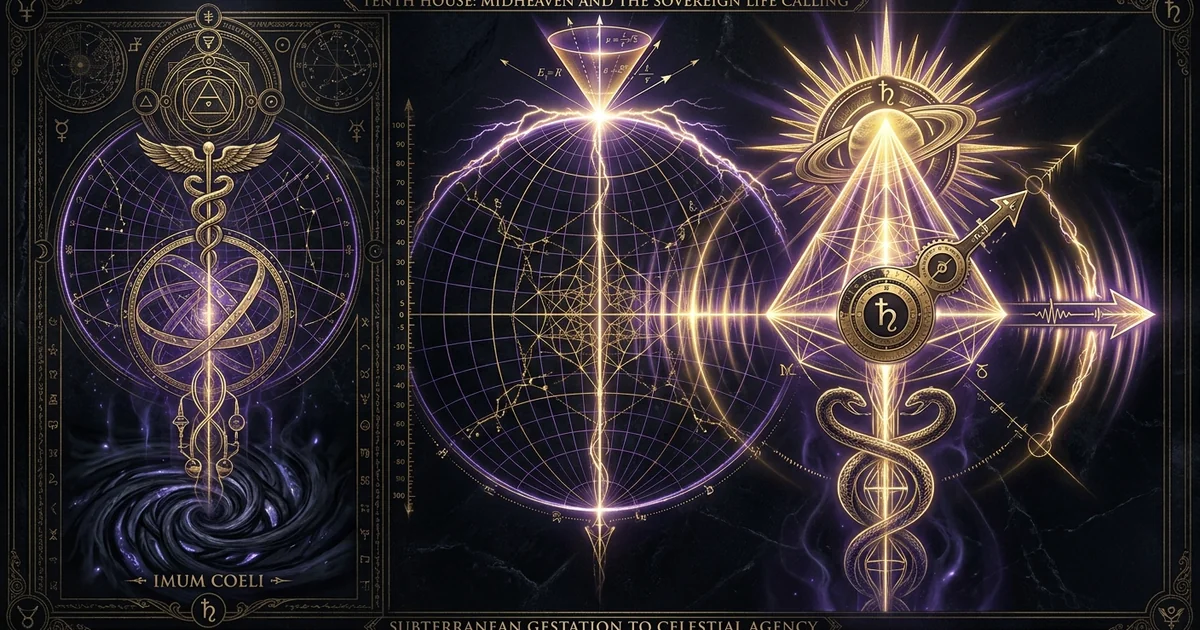
Tenth House: Midheaven and the Sovereign Life Calling
Archetypal Thesis & Systemic Paradigm: The Zenith of Individuation
The Medium Coeli as Phenomenological Meridian
The tenth house astrological meaning transcends reductionist assignments of vocational titles, social status, or bureaucratic employment. Within the architecture of natal chart houses, the Tenth House constitutes the spatial and ontological zenith of the diurnal cycle: the Medium Coeli (MC), or Midheaven. Astronomically defined by the intersection of the local celestial meridian with the plane of the ecliptic, this coordinate represents the exact point where a celestial body reaches its diurnal culmination. Phenomenologically, it serves as the threshold where subjective, nascent, interior psychodynamics achieve structural visibility, externalizing into collective reality. The Medium Coeli marks the conversion of latent potential into teleological execution; it is the psyche’s most exposed interface with the objective world.
In the language of analytical psychology and esoteric cartography, the Tenth House delineates the apex of conscious manifestation. While the eastern horizon—the Ascendant—operates as the dawn of subjective self-awareness and personal somatic emergence, the southern meridian pivot (in northern hemisphere projections) represents the psychic midday. At this degree, solar illumination reaches maximum clarity, casting no shadows and permitting no solipsistic retreat. The Tenth House forces the contents of the individual unconscious, previously tempered in the underworld of the chart, to face the unforgiving scrutiny of the collective order. It demands an accounting of how the ego-complex responds to societal institutions, collective ethical architectures, and historical continuity.
The Meridian Axis: Teleological Dialectic of the IC and MC
The psychological and spiritual mechanics of the Tenth House cannot be deciphered in isolation; they exist in structural opposition and symbiotic resonance with the Fourth House, the Imum Coeli (IC) or subterranean root. This meridian axis forms the vertical spine of the horoscope, separating the diurnal eastern hemisphere of self-determination from the western hemisphere of relationship and otherness. To understand the externalized agency of the MC, one must trace its roots to the ancestral, biological, and unconscious sediment stored within the subterranean abyss of the IC, explored in detail in the context of /astrology/fourth-house-imum-coeli-lineage.
The dialectic between the IC and the MC traces the teleological journey of human consciousness. The Imum Coeli houses the vegetative, maternal, and archetypal substrata—the historical conditioning, familial inheritance, and primal repressions that anchor the psyche within an unconscious heritage. Conversely, the Tenth House demands the sublimation and architectural transformation of those subterranean matrices into conscious, autonomous sovereignty. Without a fortified, integrated IC, Tenth House attainment degenerates into brittle compensation: a fragile persona erected over an unexamined emotional void. Conversely, an overdeveloped Fourth House without Tenth House articulation confines the psyche to infantile fixation, eternal preparation, and ancestral paralysis. The vertical axis represents the Great Work of self-actualization: drawing prima materia from the chthonic depths of the nadir and crystallizing it into the radiant, solar authority of the zenith.
From Passive Conditioning to Conscious Sovereignty
The transition from passive social conditioning to conscious sovereignty encapsulates the journey of /psychology/archetypal-individuation-jung. In the early developmental trajectory, the Tenth House operates as a theater of internalized expectations. The individual absorbs parental projections, cultural mandates, and civilizational dogmas, mistaking the collective Persona for their intrinsic identity. Under this dynamic, the Tenth House acts merely as a compensatory apparatus through which the fragile ego seeks validation from societal arbiters: institutional awards, corporate hierarchies, socio-economic prestige, or ancestral vindication.
“The persona is a complicated system of relations between individual consciousness and society, fittingly a kind of mask, designed on the one hand to make a definite impression upon others, and, on the other, to conceal the true nature of the individual. That the latter is superfluous, and that the persona is the reality, is an illusion… To the extent that the ego identifies with the persona, it becomes identical with the collective psyche; it loses its individual foundation and becomes a plaything of collective forces.” — Carl Gustav Jung, Aion: Researches into the Phenomenology of the Self (Collected Works Vol. 9, Part 2, para. 34–35)
The realization of the Tenth House requires the systematic dissolution of this psychic identification. The Medium Coeli functions as an operational feedback loop where the individual’s idiosyncratic mythos—forged along the horizontal axis of relational engagement—is brought into direct friction with the archetypal laws governing the collective unconscious. Sovereignty is achieved only when the individual stands at the zenith of the chart without relying on the structural crutches of institutional masks. Here, the person does not merely inhabit a societal role; they become the deliberate author of their cultural contributions, aligning the personal will with the transpersonal teleology of the Self.
Classical Provenance & Textual Lineage: The Evolution of Mesouranema and Regnum
The Hellenistic Foundation: Mesouranema as the Culminating Pivot
In the Hellenistic astrological paradigm, the Tenth House was designated as Mesouranema (Culmination) or the Kentrōn Ano (Upper Pivot). It was classified as the primary among the four kentra (cardinal angles), possessing the highest dynamic operational strength (chrēmatistikos) for planetary manifestation. While the Ascendant (Horoskopos) was acknowledged as the origin of physical life, vitality, and personal identity, Hellenistic authorities, notably Vettius Valens and Claudius Ptolemy, recognized the Tenth House as the definitive theater of praxis (action, enterprise, and execution), professional eminence, reputation, and fate-ordained impact upon human society.
“The Midheaven (Mesouranema) is the cardo that determines our actions, our practical capacities, our eminence in the community, and the nature of our advancement. Any planet culminating at this station, or casting its ray into this place through legitimate configurations, will exercise supreme administrative governance over the native’s destiny, bringing forward the tangible reality of whatever things are promised by the nativity. It is here that the soul’s labor (praxis) meets the material conditions of the Kosmos, revealing whether one will rule, construct, suffer ignominy, or attain durable honor.” — Vettius Valens of Antioch, Anthologiae (c. 175 CE), translated by Mark Riley
Hellenistic astrology treated Mesouranema not merely as a description of what an individual might accomplish, but as an index of their public survival and cosmological alignment. In Book III of his Tetrabiblos, Claudius Ptolemy methodically correlates the Tenth House with the quality of dignities, the condition of parents (specifically when analyzed in relation to the diurnal or nocturnal sect), and the material quality of action. Ptolemy argued that the planetary rulers of the Midheaven, examined alongside their configurations to the Sun and the Moon, reveal whether the individual’s destiny will be driven by administrative stewardship, craft mastery, intellectual authority, or catastrophic disgrace. The upper cardo was seen as an engine of cosmic judgment: any planet occupying or configuring to this pivot was brought into an acute state of visibility, stripped of its hidden, nocturnal reservations, and compelled to yield its fruits into the civic architecture of the polis.
Medieval-Arabic Codification: Praedicamenta, Honor, and Kingdom
During the translation movements of the eighth through twelfth centuries, Hellenistic astrological doctrines were absorbed, mathematically refined, and systematized by Persian and Arabic practitioners, including Abu Ma’shar, al-Kindi, and Masha’allah. Through this transmission, Mesouranema was transformed into the Latinized concept of Regnum—the Tenth House as the House of the Kingdom, Sovereign Power, Magisterium, and Divine Providence. The Arabic astrologers introduced analytical precision to Tenth House mechanics by developing intricate systems of triplicity-rulers of the angles, the parsing of the Arabic Parts (particularly the Part of Kingdom and the Part of Vocation), and rigorous delineations of planetary elevation.
Within the medieval framework, the Tenth House measured the degree of divine mandate granted to an individual. It was no longer strictly bounded by Hellenistic fatalism; instead, it reflected the hierarchical structure of feudal and cosmological orders. If an individual possessed a well-fortified Tenth House, endowed with benefics enjoying high essential dignity, the soul was seen as carrying an authentic terrestrial mandate—an echo of celestial order reflected within secular government or religious leadership. Abu Ma’shar articulated that the tenth place indicated the stability of princes, the continuity of dynastic lineage, and the preservation of divine law within mundane administration. The condition of the Tenth House thus determined whether an individual was an architect of the social contract or an agent of civic dissolution.
The Renaissance Transformation: Magisterial Authority and Planetary Promoters
The Italian and English Renaissance revivals of classical astrology brought a synthesis of medieval rigor and humanist philosophy to the Tenth House. Astrologers such as Marsilio Ficino, Girolamo Cardano, and later William Lilly synthesized Ptolemaic astronomy with Hermetic theology. They viewed the Tenth House as the structural theater of the individual’s Magisterium—their specialized calling and capacity to manipulate worldly conditions via practical and esoteric intelligence.
In his Christian Astrology (1647), William Lilly designated the Tenth House as the signifier of kings, princes, judges, prime magistrates, advancement, offices, trade, and the mother (drawing on legacy variants of the Latin tradition). Lilly underscored the doctrine of the “planetary promoter”: the specific celestial body in the Tenth House, or ruling its cusp, that serves as the engine of worldly advancement. In this era, the Tenth House symbolized an individual’s active participation in their own destiny within a Christian-Hermetic universe. Man was conceived as a co-creator under God, with the Midheaven measuring the degree of his executive responsibility in the earthly sphere.
Structural Mechanics & Symbolic Geometry: Mathematical Coordinates of the Meridian Pivot
Quadrant Versus Whole Sign Mechanics: MC Separation and Intercepted Axes
The mathematical determination of the Tenth House introduces foundational divergences between house calculation systems. In the Whole Sign house paradigm—the primary system of antiquity—the Tenth House is simply the tenth consecutive zodiacal sign counting from the sign of the Ascendant. Under this framework, the mathematical Midheaven degree (the intersection of the local meridian and the ecliptic) does not serve as the permanent cusp of the Tenth House. Instead, it is treated as a dynamic, floating point of culmination that can fall in the Ninth, Tenth, or Eleventh Whole Sign house, depending on the latitude of the birthplace and the obliquity of the ecliptic.
[ Zenith: Local Meridian ]
                                |
                                v
               [ Culmination Point: Nonagesimal / MC ]
                                |
        =================================================  Ecliptic Plane
       /                                                 \
[ Ascendant: Horizon ]                          [ Descendant: Horizon ]
       \                                                 /
        =================================================
                                |
                                v
                    [ Nadir: Imum Coeli (IC) ]
In quadrant-based systems (such as Placidus, Regiomontanus, Koch, and Campanus), the Midheaven is fixed as the immutable cusp of the Tenth House. The ecliptic arc between the Ascendant and the Midheaven is then divided according to various mathematical rationales (spatial, temporal, or equatorial projections). This geometric divergence produces intercepted signs and house shifts at high northern or southern latitudes. When the ecliptic intersects the local horizon at an oblique angle, the MC degree diverges significantly from the nonagesimal (the point of the ecliptic 90 degrees from the Ascendant).
This structural variance carries deep symbolic significance:
- In Whole Sign configurations where the MC falls into the Ninth House, the individual’s teleological zenith is mediated through philosophical, esoteric, or academic frameworks.
- When the MC falls into the Eleventh House, public agency operates through collective assemblies, institutional patronage, and network distribution.
- In quadrant frameworks, the Tenth House represents the immediate structural crucible of the local horizon’s relationship to universal diurnal time. The sign on the MC and its exact numerical degree denote the precise archetypal lens through which internal power is projected into the civic matrix.
Planetary Dignity Hierarchies: Domicile, Exaltation, and Sect at the Zenith
A rigorous assessment of Tenth House potency demands an evaluation of planetary dignity hierarchies, grounded in /astrology/planetary-dignities-essential-accidental. Planets situated in the Tenth House occupy the most elevated position in the nativity, a condition the Greeks termed hypsoma (elevation). An elevated planet dominates the psychological landscape of the native, exerting a structural pull over all other planetary configurations.
However, elevation without essential dignity generates hubris and eventual collapse. A planet in its fall or detriment residing on the Midheaven possesses immense accidental dignity (the ability to manifest worldly events due to angularity) but lacks essential dignity (the ethical, structural, and cosmic capacity to manifest beneficent results). This configuration often produces public visibility that culminates in institutional scandal, overextension, or tyrannical impulses.
Furthermore, the mechanics of sect-astrology fundamentally dictate Tenth House performance:
In a diurnal nativity, diurnal planets (the Sun, Jupiter, and Saturn) culminating at the Tenth House express their structural potential with coherence. Saturn in a diurnal chart in the Tenth House—functioning within its proper diurnal sect—confers long-term, durable authority, philosophical patience, and constructive institutional mastery. Conversely, if Saturn culminates in a nocturnal chart, it acts out of sect, introducing severe institutional alienation, cold autocratic impulses, and sudden, public descents from power. The condition of the triplicity rulers of the Tenth House cusp further determines the continuity of the life calling across the early, middle, and final phases of incarnation.
Aspect Vectors: Square to the Horizon and the Tension of Manifestation
The angular geometry of the Tenth House reveals its intrinsic psychodynamic tension. The cusp of the Tenth House forms a superior, sinister square (90-degree aspect) to the eastern horizon (Ascendant) and a dexter square to the western horizon (Descendant). By its very geometric constitution, the Medium Coeli exists in continuous structural friction with the personal identity and relational harmony of the native.
The square to the Ascendant ensures that worldly eminence and the actualization of one’s calling demand the sacrifice of purely subjective ease. The soul cannot construct an enduring public work while remaining passively accommodated to early conditioning or narcissistic self-regard. The square to the Descendant forces a relentless negotiation with the ‘other’: professional execution inevitably strains intimate partnerships, demanding that the native differentiate personal allegiance from public duty. The Tenth House is not a place of comfortable repose; it is an engine of systemic stress wherein the individual ego is systematically hammered against the anvil of objective cultural reality.
Psychological Dynamics & Operational Praxis: Navigating the Archetypes of Authority
Delineating the Midheaven Ruler: Tracing the Telos Through the Dispositor Chain
In operational astrological praxis, delineation of the sovereign life calling begins with the lord of the Midheaven—the planetary ruler of the sign governing the Tenth House cusp. This planetary sovereign serves as the ultimate dispositor of the native’s teleological drive. The house position, essential dignity, sect condition, and aspectual network of this ruler reveal where and how the native’s public mission is structurally anchored.
To diagnose the trajectory of the calling, the practitioner must trace the dispositor chain to its final repository:
- The Tenth House Cusp Ruler: Identifies the primary planetary archetype through which the soul expresses its public duty. If the MC falls in Aries, the vehicle of praxis is Mars: direct, pioneering, combative, and catalytic.
- The Dispositor of that Ruler: Reveals the operational feeder system. If Mars resides in Taurus in the Second House, the pioneer drive of the MC is grounded in material architecture, financial stabilization, and the concrete preservation of systemic value.
- The Terminal Point (Final Dispositor or Mutual Reception): Pinpoints the core engine of sovereignty. If Venus (dispositing Mars) resides in Libra in the Fourth House, the individual’s public, martial assertion is ultimately governed by a deep-seated ancestral mandate to restore relational justice, beauty, and psychic equilibrium within the collective lineage.
Without tracing this dispositor chain, any interpretation of the Tenth House remains superficial, mistaking the external aesthetic of the Midheaven sign for the structural engine that drives the sovereign vocation.
The Senex and Sovereign: Saturnian Scaffolding versus Solar Radiance
The natural, archetypal architecture of the Tenth House is configured through the dialectic between the senex-archetype (historically linked to Saturn as the traditional ruler of Capricorn, the natural tenth sign) and the Sovereign (linked to the Sun as the principle of absolute creative illumination). Every encounter with the Tenth House demands a reckoning with this archetype. The Senex governs the scaffolding of civilization: temporal boundaries, historical precedent, bureaucratic discipline, systemic limitation, and the cold reality of consequence.
When the Tenth House is engaged unconsciously, the Senex manifests as a rigid, authoritarian shadow. The native either bows pathologically to societal authority—paralyzed by imposter syndrome, bureaucratic inertia, and fear of institutional retribution—or conversely, adopts the persona of the tyrant, imposing dogmatic control upon their subordinates to mask inner fragility. The conscious integration of the Tenth House demands that the individual assimilate the constructive virtues of the Senex: persistence, gravitas, structural integrity, and the willingness to labor within temporal limits. Upon this disciplined foundation, the solar radiance of the true Sovereign can emerge—an internal authority that exercises power not through administrative coercion, but through the radiant legitimacy of integrated individuation.
Tenth House: Regnum (Zenith)
- Cosmological Coordinate: Upper Meridian Pivot (Medium Coeli)
- Psychological Function: Conscious sovereignty, individualization of public authority, integration of the creative Persona
- Hermetic Polarity: As Above—The crystallized light of consciousness visible to the collective
- Developmental Vector: Maturity, professional praxis, institutional legacy, objective reality testing
- Pathological Shadow: Authoritarian tyranny, narcissistic exploitation of collective power, careerist hollow persona
Fourth House: Patris (Nadir)
- Cosmological Coordinate: Lower Meridian Pivot (Imum Coeli)
- Psychological Function: Subconscious foundation, ancestral inheritance, biological grounding, primitive affective roots
- Hermetic Polarity: As Below—The occult, fertile darkness of the chthonic matrix
- Developmental Vector: Infancy, familial conditioning, psychological sanctuary, vegetative security
- Pathological Shadow: Infantile regression, enmeshment in ancestral curses, solipsistic agoraphobia, psychic inertia
Planetary Imprints at the MC: Archetypal Expressions of the Great Work
Planets situated within the Tenth House act as public lenses, refracting the native’s interior drive into specialized modes of transpersonal contribution:
- The Sun: Demands absolute visibility, authentic creative stewardship, and the confrontation with sovereignty. The native cannot hide in collective anonymity; they are called to embody the archetype of the leader, the visible exemplar whose public life is their primary canvas. The shadow manifests as blinding egocentricity and the terror of public failure.
- The Moon: Anchors the public calling in collective emotional responsiveness, intuitive stewardship, and the capacity to nourish or mirror the masses. The vocation fluctuates cyclically, requiring the native to balance profound public vulnerability with systemic protection. The shadow manifests as debilitating hypersensitivity to public criticism and manipulation of collective sentiment.
- Mercury: Transmutes the Tenth House into an intellectual broadcasting engine. The native functions as a scribe, translator, systemic analyst, or mercurial intermediary within the collective. The voice, written word, or logistical capacity is the vehicle of authority. The shadow yields opportunistic duplicity, fragmentation of calling, and intellectual charlatanism.
- Venus: Demands the injection of aesthetic harmony, relational balance, diplomatic equilibrium, and cultural elegance into the public sphere. Authority is asserted through conciliation, artistic excellence, and social cohesion. The shadow generates superficial placation, reliance on shallow vanity, and the compromise of core ethics for collective approval.
- Mars: Thrusts the soul into the arena of public struggle, pioneering enterprise, technical conquest, and institutional disruption. The native is seen as a warrior, an innovator, or an instigator of cultural change. The shadow invites public conflict, professional destruction through unbridled aggression, and sovereign martyrdom.
- Jupiter: Magnifies the public scope, imbuing the vocation with philosophical optimism, institutional benevolence, judicial authority, and transpersonal vision. The native functions as a mentor, broad-minded executive, or philosophical guide. The shadow manifests as hubristic overextension, grandiosity, and ideological dogmatism.
- Saturn: Imposes the ultimate test of endurance, integrity, and temporal maturation. The native achieves sovereignty slowly, through early deprivation, structural friction, and relentless discipline, culminating in unassailable institutional authority in the second half of life. The shadow produces tyrannical rigidity, crushing depression, and devastating falls from grace.
- The Outer Planets (Uranus, Neptune, Pluto): When culminating, the outer planets demand that the individual act as an evolutionary conduit for collective transpersonal shifts. Uranus demands systemic revolution and technical liberation; Neptune calls for the spiritualization, artistic mythologizing, or sacrificial dissolution of conventional status; Pluto demands the descent into collective underworlds, catalyzing institutional death and structural rebirth.
Philosophical Synthesis & Macrocosmic Correspondence: The Hermetic Axis of As Above, So Below
The Tenth House as the Cosmic Noon: Solar Culmination and Chronos
Within the esoteric philosophy of time, the Tenth House embodies the cosmic noon: the precise station where Helios ascends to his highest glory, conquering darkness before the inevitable decline into the western horizon. It is governed by the structural tension between the blazing vitality of the Solar Noon and the cold, regulating measurement of Chronos (Saturn). The Tenth House thus represents the ultimate temporal reality check. It asserts that spiritual insights, esoteric visions, and psychological integrations achieved within the subterranean chambers of the psyche are meaningless unless they survive the exposure of the midday sun.
Here, the Hermetic axiom As Above, So Below—a principle formalized in /esoteric-systems/hermetic-principles-correspondence—undergoes its most demanding operational test. The Tenth House represents the Below in its most organized, civilized, and structured form, forced to construct an earthly mirror of the celestial cosmos (Above). It is the sacred duty of the Tenth House to manifest cosmic law (Themis) through human civic codes, ethical administration, and tangible vocational output. When the native achieves alignment with their sovereign calling, their worldly labor ceases to be a secular struggle for survival and becomes an act of cosmic maintenance: anchoring archetypal patterns into terrestrial reality.
Qabalistic Bridge: Malkuth Structured by the Sephirah Binah
In the esoteric cartography of the Qabalah, the Tenth House occupies a unique position, acting as an operational bridge between the lowest Sephirah on the Tree of Life—malkuth (the Kingdom, the physical world of manifest form)—and the primordial matrix of Binah (Understanding, the third Sephirah, ruled by Saturn). Binah provides the structural architecture, the cosmic laws of limitation, and the severe, formative vessels (kelim) that enable divine light to descend into concrete manifestation without shattering the fabric of reality.
[ BINAH: Primordial Structure / Saturnian Vessel ]
                             |
                   (Architectural Ray of Form)
                             |
                             v
               [ TENTH HOUSE: Medium Coeli ]
             (The Crucible of Materialization)
                             |
                             v
[ MALKUTH: The Kingdom / Material Realization ]The Tenth House serves as the precise operational locus where the cosmic scaffolding of Binah (Form, Restriction, Law) directly imprints upon Malkuth (The Kingdom, Physical Reality). While the Ascendant reflects the infusion of the Life Force (Chokmah descending through Kether), the Midheaven is the structural governor: it dictates the limits, forms, and duties under which that raw life force must operate within the civic matrix.
In classical planetary joy assignments, while the Tenth House possesses no direct joy (the joy of Mercury being in the 1st, the Moon in the 3rd, Venus in the 5th, Mars in the 6th, the Sun in the 9th, Jupiter in the 11th, and Saturn in the 12th), it occupies an overarching magisterial position as the Praedicamentum. It is the place where all planetary energies are held accountable to the systemic requirements of cosmic equilibrium (Ma’at).
When the soul approaches the Tenth House through this Hermetic lens, the mundane career is elevated into the sanctified Great Work of the alchemists: the opus. The vocational path becomes the vessel through which the divine light is extracted from the chaotic prima materia of early circumstance and forged into the Philosopher’s Stone of integrated character, responsible leadership, and civilizational service. The Tenth House insists that spirituality that cannot construct an enduring, ethical form in the material world is mere escapist delusion.
Integration of the Transpersonal Will: Vocation as Cybernetic Equilibrium
From the standpoint of metaphysical cybernetics, the sovereign life calling represents a homeostatic balance between the individual consciousness and the macrocosmic ecosystem. The psyche is not an isolated, closed system; it is an open, self-regulating node within an interconnected web of social, historical, and cosmic processes. The Tenth House operates as the cybernetic feedback sensor of this system, continually adjusting the individual’s output based on the collective’s developmental needs.
When an individual attempts to pursue a vocational path driven solely by personal narcissism or mechanical ambition, the Tenth House feedback loop registers systemic friction. This manifests as professional stagnation, public exposure, somatic collapse, or profound psychological alienation. Conversely, when the individual aligns their unique gifts with an authentic transpersonal requirement—answering what the world actually requires rather than what the ego desires—the feedback loop stabilizes. True sovereign vocation is achieved when the personal will (thelema) acts in cybernetic equilibrium with the evolutionary trajectory of the collective, transforming the individual into a conscious instrument of cosmic evolution.
Frequently Asked Questions: Decoding the Sovereign Life Calling
Resolving Interceptions Between the Tenth House and the Midheaven
A primary point of technical confusion in natal astrology arises from the divergence between quadrant-based house cusps and the Whole Sign house system, or the phenomenon of intercepted signs across the meridian axis in systems such as Placidus or Koch.
When analyzing a nativity where the Midheaven degree is detached from the Whole Sign Tenth House—for example, when an individual possesses a Scorpio Ascendant, establishing Leo as the Whole Sign Tenth House, yet has an early Virgo Midheaven falling in the Eleventh House—the practitioner must divide their interpretation into two distinct functional vectors:
- The Tenth Whole Sign House (Leo): Represents the native’s foundational praxis—their natural career archetype, the general environment of their public life, and the inherent thematic nature of their societal contributions (in this case, expressive, creative, sovereign, and centralized leadership).
- The Midheaven Coordinate (Virgo in the 11th): Functions as the acute, concentrated point of teleological destiny. It reveals the exact mechanism through which that career is recognized and mobilized. In this configuration, the creative, sovereign leadership of Leo is channeled directly through the analytical, service-oriented, logistical precision of Virgo, finding its public manifestation within group movements, societal networks, or reformative collectives (11th House).
When signs are intercepted across the Tenth House axis in quadrant systems—where an entire sign is contained within the house without appearing on either cusp—the planetary ruler of that intercepted sign represents an occulted, interior vocation. The qualities of that intercepted sign cannot be easily expressed through conventional social pathways. The native must consciously excavate these latent gifts through rigorous psychological integration, often experiencing a vocational rebirth in middle life once the intercepted dispositor is activated by transit or secondary progression.
Differentiating the Sixth, Tenth, and Second House Vocational Triangle
A complete vocational assessment requires distinguishing the components of the “vocational triangle”—the three earth-aligned houses of the astrological wheel:
- The Second House: Governs kinetic resources, material self-sufficiency, biological values, and the energetic capital the native brings to the table. It answers the operational question: What material tools, assets, and intrinsic talents sustain my physical existence?
- The Sixth House: Represents functional daily labor, operational service, technical mastery, apprenticeships, somatic maintenance, and the capacity to execute subordinate tasks within a larger operational system. It answers: What daily, detailed labor must I perform, and how do I refine my craft through disciplined utility?
- The Tenth House: Represents teleological destiny, ultimate societal agency, and sovereign legacy. It does not concern itself with daily routines or initial income streams; it governs the ultimate purpose toward which the labor of the Sixth House and the resources of the Second House are directed. It answers: What sovereign mark do I leave upon the historical fabric of the collective?
Conflating the Sixth House with the Tenth House leads to vocational frustration. An individual may generate significant income through a Second House talent, or maintain stable employment through a Sixth House skill set, while remaining unfulfilled at the level of the Tenth House. The Tenth House demands an existential commitment that transcends security and routine: it requires the confrontation with one’s ultimate historical and cosmic responsibility.
Navigating Empty Tenth Houses and Unaspected Midheaven Rulers
A persistent misconception among students of astrology is that an “empty” Tenth House—one devoid of natal planets—denotes a lack of public impact, professional ambition, or worldly success. In classical and psychological astrology, this assumption is incorrect.
An empty Tenth House signifies that the realm of career and public authority is not an arena of intense internal archetypal conflict; rather, it operates as a neutral theater whose outcomes are governed entirely by the condition of the planetary ruler of the Midheaven cusp. If the Midheaven cusp ruler is well-placed, dignified, and supported by beneficial aspect vectors, the native will achieve profound vocational recognition, regardless of whether planets occupy the Tenth House itself.
When the ruler of the Midheaven is “unaspected”—lacking major Ptolemaic aspects (conjunction, sextile, square, trine, or opposition) to any other planetary body—it operates as an isolated, concentrated psychological drive. The sovereign calling functions in an unmitigated, highly idiosyncratic manner, decoupled from the remainder of the chart’s dynamics:
- The individual may experience their vocation as an obsessive, singular pursuit that operates outside conventional societal categories.
- Because the unaspected ruler does not receive structural friction or direct assistance from other planets, the native often struggles early in life to integrate their public career with their personal relationships or inner emotional life.
- Once the native consciously masters the solitary nature of this planetary engine, the unaspected MC ruler can produce unprecedented professional focus. It permits an unswerving dedication to a singular craft or mission, unburdened by conflicting psychic attachments.
The sovereign life calling of the Tenth House is ultimately an internal realization externalized into form. Whether delineated through complex planetary configurations or an austere, solitary Midheaven ruler, the Tenth House remains the sacred coordinate where the soul steps forward, claims its structural authority, and answers the demand of the cosmos to build a legacy that endures within the collective memory of the world.