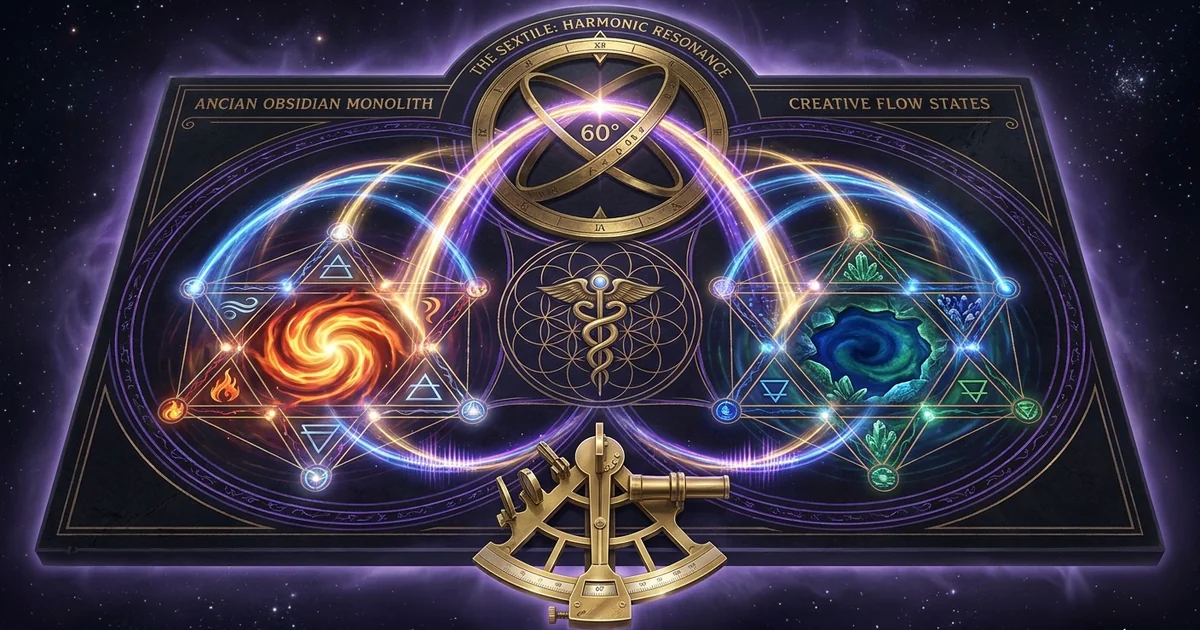
The Sextile: Harmonic Resonance and Creative Flow States
Archetypal Thesis & Systemic Paradigm: The Senary Division and Attractor Dynamics
Pythagorean Senary Geometry and the Musico-Mathematical Division of the Circle
The sextile aspect, subtending an angular separation of 60° across the ecliptic coordinate framework, constitutes the primary operational manifestation of the senary division of the circle. When the complete $360^\circ$ cyclical continuum is partitioned by six, the geometric operation inscribes a regular equilateral hexagon within the circumscribing perimeter. In the epistemological framework of pythagorean-monochord-harmonics, this operation directly invokes the structural logic of the musical interval of the fifth ($3:2$) and the higher-order third ($5:4$), translating geometric proportion into vibrational frequency. The senary structure embodies the intersection of the primary triad (the active, generative principle) and the dyad (the principle of material manifestation and polarity). Consequently, the 60 degree aspect does not signify a static geometric position, but an ontological interface where differentiated energetic polarities achieve a state of synchronized oscillation.
Within the architecture of planetary-aspects-geometry, the hexagon acts as the bridge between the structural rigidity of the square ($90^\circ$, quaternary division) and the fluid, unresisted inertia of the trine ($120^\circ$, ternary division). The mathematics of the hexagon dictates that its chord length is precisely equal to the radius of its circumscribed circle ($R = s$). This absolute equality between the radial extension from the center and the linear boundary between adjacent vertices establishes a unique psycho-cosmological condition: the internal distance of manifestation precisely mirrors the central generative impulse. Thus, the 60 degree aspect establishes an intrinsic equilibrium where planetary archetypes communicate without the structural trauma of angular friction or the entropic dispersion common to uncontained trines.
The Sextile as an Unstable Attractor: Latent Energy versus Kinetic Crystallization
In dynamic systems theory and computational psychodynamics, the sextile functions as an open attractor state within consciousness. While the trine acts as a closed, passive thermodynamic sink—a configuration of low potential energy where equilibrium is reached automatically and often regresses into psychological stagnation—the sextile establishes a distinct state-space gradient. This systemic dynamic is fundamentally characterized as an opportunity aspect. The 60° separation maintains an energetic potential difference between the participating planetary nodes that does not resolve itself spontaneously. It produces a condition of unstable or metastable equilibrium: the circuit is chemically and geometrically prepared to conduct charge, but it lacks the deterministic catalytic compulsion inherent to the hard aspects (the square and opposition).
This structural dynamic requires the intervention of volitional consciousness to precipitate kinetic crystallization. Without deliberate psychic activation, the harmonic potential of the sextile remains dormant within the natal matrix as an unrealized aptitude or latent cognitive reserve. Dane Rudhyar contextualized this phenomenon in The Astrology of Personality (1936), noting that the sextile represents an operative balance that facilitates structural production, but only when met by subjective intent and organized activity. The aspect represents the structural scaffolding of talent; yet talent without execution is merely an uncharged systemic loop. The psychic energy must be actively mobilized across the angular bridge to shift the planetary functions from potential capacity into functional autopoiesis.
Thermodynamic Dissipation and the Information Theory of Elemental Compatibility
From the vantage of thermodynamic systems and information theory, the sextile aspect astrology harmony models a state of low-friction energetic exchange governed by elemental affinity. In classical astrological taxonomy, the 60° configuration operates exclusively across signs of compatible elemental polarities: Fire engages with Air, and Earth collaborates with Water. These elemental pairings represent complementary thermodynamic vectors. Air acts as a convective and oxidative carrier for the expansive thermal output of Fire, while Water provides the soluble matrix and cohesive viscosity necessary for the structural organization of Earth.
Information theory defines communication efficiency through the minimization of systemic entropy and noise within a given transmission channel. Because the sextile couples compatible yet non-identical elemental fields, the informational channel operates with an optimized signal-to-noise ratio. The planetary forces do not collide in violent resistance, nor do they dissolve into redundant identity. Instead, they sustain a differentiated dialogue. The sextile configures an autopoietic system wherein two psychological sub-personalities cross-catalyze one another, allowing consciousness to attain high-order complexity and cognitive flow without triggering defensive egoic resistance.
Classical Provenance & Textual Lineage: From Ptolemy to Keplerian Harmonics
The Ptolemaic Canon: Tetrabiblos and the Nature of Friendly Affinities
The formalization of the sextile within the Western astrological lineage reaches its foundational systematic codification in the Tetrabiblos of Claudius Ptolemy (c. 150 CE). In Book I, Chapter 13, Ptolemy establishes the doctrine of aspects through the natural divisions of the zodiacal circle, identifying the sextile (hexagōnos, measuring two signs or 60°) as an aspect of friendship and affinity, albeit one possessing a secondary magnitude of power when compared to the trine (trigōnos). Ptolemy’s mechanical rationale relies on the configuration of the zodiac according to gender and seasonal progression.
Ptolemaic Aspect Hierarchy:
Hexagon (Sextile)  : 60°  | Modality: Sub-Benefic  | Mechanism: Shared Gender / Elemental Affinity
Tetragon (Square)  : 90°  | Modality: Malefic      | Mechanism: Incompatible Gender / Conflicting Modality
Trigon (Trine)     : 120° | Modality: Full Benefic | Mechanism: Shared Triplicity / Identical Element
Diameter (Opposite): 180° | Modality: Full Malefic | Mechanism: Total Structural Opposition
Ptolemy observes that the sextile connects signs of the same gender—masculine (diurnal) signs aspect only masculine signs, and feminine (nocturnal) signs aspect only feminine signs—yet these signs belong to disparate elements. This structural nuance led Ptolemy to designate the sextile as an aspect of weaker beneficence than the trine. The trine links signs belonging to the exact same elemental triplicity, generating an immediate and complete sympathy. The sextile, by contrast, operates across divergent triplicities that nonetheless share a basic diurnal or nocturnal polarity. It demands an act of structural alignment, establishing its classical standing as a configuration that facilitates constructive negotiation, mutual alliances, and programmatic development rather than automatic fortune.
“Of the distances, that by diameter is the greatest, being made up of six signs or half a circle; that by the trigon is the next, consisting of four signs or a third of a circle; that by the tetragon is three signs or a fourth of a circle; and that by the hexagon is two signs or a sixth of a circle. The hexagon is considered to be of a friendly nature because it is formed between signs of the same gender, yet it is less powerful than the trigon because the signs are not of the same triplicity.” — Claudius Ptolemy, Tetrabiblos (c. 150 CE), translated by F.E. Robbins, 1940.
Keplerian Geometrization: The Sextile in the System of World Harmonies
In his 1619 treatise Harmonices Mundi (The Harmony of the World), Johannes Kepler enacted a radical epistemological shift in astrological theory. Dismantling the traditional Aristotelian and Ptolemaic dependence on the zodiacal signs and their hypothetical elemental qualities, Kepler relocated the causal efficacy of astrological aspects entirely into the domain of pure Euclidean geometry and musical harmonia. For Kepler, the human soul (anima terrae and anima hominis) possesses an instinctive, archetypal capacity to recognize geometric proportions inscribed by planetary angular separations relative to the terrestrial center.
Kepler derived the authority of the sextile from the constructibility of the regular polygon via straightedge and compass. Because the regular hexagon is fundamentally constructible and belongs to the figurae congruentes—directly derived from the primary division of the circle through the equilateral triangle—it belongs to the aristocratic order of primary harmonious configurations. Kepler demonstrated that the 60° angle produces the musical interval of the sixth when evaluated against the whole, serving as a structural consonant in the macrocosmic polyphony. The soul, perceiving this 60° angularity, experiences a psychological illumination—an interior resonance that Kepler characterized as an instigation to productive, harmonic action rather than passive contemplation.
The Hermetic and Medieval Transmission: Al-Biruni and Guido Bonatti on Aspect Efficacy
During the medieval translation movement and the flourishing of Islamic astronomy, the operative mechanics of the sextile were refined by polymaths such as Abu Rayhan al-Biruni (973–1048 CE) in his Book of Instruction in the Elements of the Art of Astrology. Al-Biruni mapped the aspect to interpersonal reconciliation and institutional diplomacy. In this framework, the sextile is an aspect of “incomplete friendship” or conditional alliance: it represents agents who possess the willingness to cooperate, yet lack the absolute identity of objective found in the trine.
This concept was codified in the Latin West by Guido Bonatti in the thirteenth-century Liber Astronomiae. Bonatti analyzed the sextile as an instrument of moderated, consultative application (applicatio). In horary and electioneering techniques, a sextile aspect between significators indicated that the desired matter would come to fruition, but explicitly through mediation, labor, and the conscious intervention of a third party or deliberate operational effort. Medieval astrology thus preserved the functional reality of the sextile: it is an aspect that requires labor (laboriositas) and management to bridge planetary intentions, distinguishing it definitively from the effortless, unmediated resolution promised by the trine.
Structural Mechanics & Symbolic Geometry: Elemental Cross-Fertilization
Binary Gender Polarity: Diurnal (Air-Fire) and Nocturnal (Earth-Water) Vectors
The structural engine of the 60° aspect is the systemic cross-fertilization of divergent elemental mediums belonging to the same fundamental binary gender polarity. The zodiacal matrix alternates in a strict binary rhythm: diurnal/masculine/positive polarity (encompassing Fire and Air) and nocturnal/feminine/receptive polarity (encompassing Earth and Water). This alignment is explored extensively in elemental-dignities-polarities.
The Fire-Air dynamic forms an expansive, volatile, and expressive circuit. Fire generates psychic libido, teleological ambition, and radiant kinetic drive, but it lacks structural perspective and objective reflection. Air introduces conceptual abstraction, communicative articulation, and symbolic syntax, preventing the Fire archetype from consuming its own fuel source in blind volatility. When Mars in Aries forms a sextile to Mercury in Gemini, the physical initiative and raw instinctual thrust of Mars are immediately translated into symbolic strategies, informational speed, and intellectual dexterity. The heat of the fire expands the gaseous medium of the air, producing intellectual velocity and expressive vitality.
Conversely, the Earth-Water vector represents a cohesive, assimilative, and consolidating circuit. Water embodies emotional fluidity, intuitive perception, depth psychology, and subjective interconnectedness; yet without structural containment, it disperses into formless boundary dissolution. Earth provides the tectonic boundary, structural durability, material manifestation, and temporal patience required to condense fluid psychic material into lasting institutional or physical artifacts. When Venus in Taurus forms a sextile to Saturn in Cancer, the subjective emotional vulnerability and historical awareness of the Cancerian archetype are anchored and stabilized by the tactile pragmatism and somatic realism of Taurus. The earth absorbs and channels the water, while the water softens the crystalline rigidity of the earth, preventing calcification.
Sextile Polarity Pairings:
Diurnal (Masculine / Positive) Vector:
  [Fire] <-------- 60° Harmonic Coupling --------> [Air]
  Thermal radiation, volition, libido           Abstraction, articulation, syntax
Nocturnal (Feminine / Negative) Vector:
[Earth] <------- 60° Harmonic Coupling --------> [Water]
Tectonic mass, boundary, endurance            Solvency, affective depth, interiority
Orb Tolerances, Decan Resonances, and Planetary Dignity Modifications
The mechanical integrity of the 60° aspect is governed by the structural parameters of orbs-of-aspect. In contemporary technical cartography, the standard operational orb allocated to the sextile spans $0^\circ$ to $6^\circ$, though classical methodologies dictate that orbs belong to the planetary bodies themselves (the moieties of the planetary rays) rather than the aspect angle. When luminaries (the Sun and the Moon) are involved, the effective envelope of influence may extend to $7^\circ$ or $8^\circ$, whereas inter-planetary engagements among inferior or superior bodies operate with greatest cognitive clarity between $0^\circ$ and $4^\circ$.
The phenomenological expression of the sextile shifts dramatically according to orb proximity:
- Tight Orbs ($0^\circ00’ - 2^\circ30’$): The planetary archetypes exist in immediate psychophysical coherence. The pathways between the cognitive modules represented by the planets are myelinated, yielding intuitive synergy and spontaneous creative invocation.
- Intermediate Orbs ($2^\circ31’ - 4^\circ30’$): The bridge exists as an intellectual or structural aptitude that demands focused attention and operational rituals to activate. The planets require conscious scaffolding to interface.
- Wide Orbs ($4^\circ31’ - 6^\circ00’$): The harmonic affinity operates beneath the threshold of conscious automaticity; it manifests primarily during transiting triggers that temporarily narrow the energetic gap through celestial amplification.
Planetary dignities introduce profound modifications to this dynamic. If a planet situated in its domicile or exaltation casts a sextile to a planet residing in its fall or detriment, an asymmetrical feedback loop is established. The dignified planet acts as a generous patron, providing structural resources and mitigating the systemic dysfunctions of the debilitated planet. For instance, a dignifying Jupiter in Sagittarius sextile an afflicted Mars in Libra elevates the unfocused, conflict-avoidant nature of that Mars, granting it strategic breadth and ideological purpose through the 60° channel.
- Arc Length: Exactly $60^\circ$ ($1/6$ of the $360^\circ$ circle).
- Standard Orb Matrix: Partile: $0^\circ00’$; Close: $0^\circ01’ - 2^\circ30’$; Wide: $2^\circ31’ - 6^\circ00’$ (up to $8^\circ$ for solar/lunar geometries).
- Harmonic Series: Fundamental resonance of the 6th Harmonic ($H6$ chart in vibrational astrology), signifying productive integration and mental adaptability.
- Polarity Matrix: Strict binary preservation: Diurnal (Air-Fire) to Diurnal; Nocturnal (Earth-Water) to Nocturnal.
The Dissociate Sextile: Out-of-Sign Geometries and Cross-Elemental Cognitive Friction
An anomalous dynamic occurs in the presence of a dissociate-aspect—commonly termed an out-of-sign sextile. This structural phenomenon manifests when two planets achieve an exact mathematical separation of $60^\circ$ (within allowable orbs), yet the signs they inhabit do not correspond to the natural elemental affinities of the binary gender matrix.
Consider an extreme manifestation: a planet located at $29^\circ$ Aries forming a partile 60° sextile to a planet at $29^\circ$ Gemini. Aries is Fire, Gemini is Air; this preserves the natural sign-based configuration. However, if a planet at $29^\circ$ Pisces forms an exact 60° aspect to a planet at $29^\circ$ Taurus, it is congruent. But should a planet at $28^\circ$ Aries form an aspect to a planet at $2^\circ$ Cancer, the angular distance is $64^\circ$—if an orb of $5^\circ$ is used, this cross-boundary geometry constitutes a dissociate relationship. More strictly, a planet at $1^\circ$ Taurus forming an exact 60° aspect to a planet at $1^\circ$ Cancer bridges Earth to Water; but a planet at $29^\circ$ Aries aspecting a planet at $29^\circ$ Gemini bridges Fire to Air.
The true dissociate sextile occurs across mismatched signs: for example, a planet at $29^\circ$ Aries forming a 60° aspect to a planet at $29^\circ$ Taurus is mathematically a semi-sextile ($30^\circ$). But consider an angle of 60° that spans from $2^\circ$ Aries to $2^\circ$ Gemini (normal Fire-Air), versus an aspect measuring exactly 60° from $29^\circ$ Leo (Fire) to $29^\circ$ Libra (Air). What if a planet at $29^\circ$ Cancer (Water) forms an exact 60° aspect to a planet at $29^\circ$ Virgo (Earth)? That preserves harmony. The true rupture occurs when a planet at $29^\circ$ Gemini (Air) reaches an exact 60° distance to a planet at $29^\circ$ Leo (Fire)—this is standard.
The dissociation manifests when a planetary body in the terminal degrees of a sign casts an aspect into an initial degree that breaks the triplicity pattern: for example, Mars at $29^\circ$ Aries (Fire) aspecting Jupiter at $1^\circ$ Cancer (Water). The physical angle between $29^\circ$ Aries and $1^\circ$ Cancer is $62^\circ$, falling well within a standard $4^\circ$ to $6^\circ$ sextile orb. Yet, the signs Aries and Cancer stand in natural square ($90^\circ$) relationship to one another.
In this anomalous dissociate dynamic, the celestial mechanics generate an intensive cognitive paradox: the harmonic distance ($60^\circ$) demands collaborative synthesis, while the elemental environment (Fire meeting Water, Cardinal meeting Cardinal) demands a crisis of action and mutual friction. The native experiences an archetype trying to function as a collaborative flow state, yet filtered through contradictory operational syntax. This dissociate sextile eliminates psychic complacency. It forces the conscious mind to construct an idiosyncratic semantic bridge between two archetypal energies that do not possess natural elemental or modal vocabulary for one another, resulting in highly original, unconventional, and intellectually demanding creative problem-solving capacities.
Psychological Dynamics & Operational Praxis: The Architecture of Creative Flow
Csikszentmihalyi’s Autotelic Circuit and the Astrological ‘Opportunity Aspect’
In Flow: The Psychology of Optimal Experience (1990), Mihaly Csikszentmihalyi delineates the parametric conditions required to induce the psychological state of flow—an optimal state of consciousness wherein the individual is fully immersed in an activity marked by energized focus, total involvement, and spontaneous enjoyment. Central to Csikszentmihalyi’s formulation is the precise topological balance between challenge and skill:
Csikszentmihalyi Flow Channel Dynamic:
High Challenge + Low Skill  = Severe Anxiety / Panic (The Square / Opposition Dynamic)
Low Challenge  + High Skill = Entropic Boredom / Stagnation (The Trine Dynamic)
Calibrated Challenge + Adaptive Skill = The Flow Channel (The Sextile Dynamic)
The sextile aspect astrology harmony mirrors this autotelic flow channel with extreme psycho-cosmological fidelity. The trine aspect, correlating to high innate capacity coupled with low structural resistance, routinely precipitates complacency; the ego encounters no dynamic barrier and thus requires no evolutionary adaptation. The square aspect, inversely, introduces such violent systemic disruption and psychic tension that the ego often lapses into defense mechanisms, anxiety, or traumatic overcompensation before resolution can be extracted.
The sextile, as an opportunity aspect, introduces precisely enough systemic difference between the interconnected planetary archetypes to provoke engagement without inducing psychological paralysis. It presents an invitation to action. The individual recognizes an innate bridge of efficiency, yet acknowledges that the crossing of that bridge demands technical competence, dedicated attention, and deliberate execution. It operates as an autotelic loop: the enactment of the sextile yields immediate, low-friction creative feedback, which sustains psychic focus, further optimizing performance and deepening the creative flow state.
Jungian Transcendent Function: Resolving Polar Duality via Sextile Synthesis
Within the analytical psychology of Carl Gustav Jung, the integration of fundamentally polarized psychic components relies upon the activation of the transcendent function. In The Structure and Dynamics of the Psyche (Collected Works Vol. 8), Jung outlines how the confrontation between the conscious ego and the unconscious contents produces a profound energetic deadlock. The psyche cannot resolve this tension through the unilateral dominance of one pole over the other; instead, it requires the emergence of a tertium datur—a third operative factor that transcends and synthesizes the opposing drives.
“The shuttling to and fro of arguments and affects represents the transcendent function of opposites. The confrontation of the two positions generates a tension charged with energy and creates a living, third thing—not a logical stillbirth in accordance with the tertium non datur but a movement out of the suspension between opposites, a living birth that leads to a new level of being, a new situation.” — Carl Gustav Jung, The Structure and Dynamics of the Psyche, CW 8, §189.
The sextile serves as an architectural blueprint for the activation of this transcendent function. Unlike the opposition, which stages an open war across an irreconcilable chasm, and unlike the quincunx, which imposes an alienating blind spot within perception, the sextile presents two distinct archetypal vectors that naturally desire an interpretive mediator. When a native possesses a natal sextile between Mercury (the function of cognition and semiotic articulation) and Pluto (the function of subterranean psychic instinct and catalytic transformation), the mind does not oscillate between neurosis and obsessive suppression. Instead, the 60° aspect provides an innate structural channel for psychological diagnostic depth, investigative penetration, and linguistic empowerment. The tertium datur emerges through the creative medium itself: investigative writing, depth psychoanalysis, or esoteric cartography. The sextile provides the psychological conditions under which two antithetical archetypal forces can achieve symbolic integration without passing through psychic fragmentation.
Consultation and Meditative Protocols: Activating Inert Planetary Talents
In professional esoteric consultation and dynamic astrological praxis, the fundamental challenge presented by the sextile is its chronic vulnerability to dormancy. Clients routinely present charts containing extraordinary sextile configurations that have produced zero measurable creative, spiritual, or external manifestations. Because the aspect lacks the pain-driven catalytic drive of the square, the native experiences the aspect merely as a vague comfort, an elusive fantasy of capacity, or an unactualized potential.
The consulting astrologer must employ structured operational protocols to awaken these dormant circuits. The clinical protocol entails a three-phase intervention:
Phase 1: Diagnostic Identification
  - Locate the 60° planetary nodes.
  - Determine house governance and planetary condition to identify the dormant talent vector.
Phase 2: Intentional Friction Scaffolding
  - Artificially engineer cognitive tasks requiring simultaneous deployment of both planetary archetypes.
Phase 3: Autopoietic Flow Anchoring
  - Establish self-sustaining somatic and creative habits that convert cognitive effort into automated intuition.
- Diagnostic Identification: The astrologer isolates the two planetary archetypes, noting their respective houses and signs. For example, a sextile between Venus in the 3rd house (communication, immediate environment) and Uranus in the 5th house (creative innovation, rupture, individuation) indicates an unactivated capacity for avant-garde literary production, digital media design, or non-linear pedagogical communication.
- Intentional Friction Scaffolding: Because the native has not developed this pathway, the practitioner must prescribe intentional cognitive friction. The native is directed to engage in activities that cannot be executed by Venus or Uranus independently. In the cited example, the prescription involves structured, high-frequency creative writing using algorithmic constraints or cutting-edge technical media—forcing the relational aesthetic sensibility of Venus to submit to the disruptive, experimental demands of Uranus.
- Autopoietic Anchoring: As the native executes this deliberate hybrid task, the low-friction nature of the 60° circuit rapidly asserts itself. The native encounters an unexpected acceleration of competence—the signature of the flow channel. The astrologer then anchors this state-space by establishing continuous somatic and creative habits, shifting the aspect from a passive natal potential into an autopoietic psychological asset.
Comparative Topology: The Sextile in the Aspect Ecosystem
The Trine (120°) versus the Sextile (60°): Inertia of Ease versus Active Flow
To comprehend the dynamic specificity of the sextile, it must be evaluated directly against its major benefic sibling, the trine. Astrological tradition routinely aggregates these two aspects under the imprecise category of “soft” or “benefic” configurations. However, systemic modeling exposes a radical energetic divide between their operational modes. The comparative dynamics are explored deeply in the-trine-dynamic-inertia.
The Trine (120°)
- Mode of Action: Closed-loop homeostatic equilibrium; spontaneous, unconscious operation requiring zero egoic intervention.
- Elemental Dynamic: Operates entirely within the identical elemental triplicity (Fire-Fire, Earth-Earth, Air-Air, Water-Water).
- Thermodynamic State: Low potential energy; high structural entropy; terminal equilibrium.
- Psychological Vulnerability: Complacency, psychic entitlement, dynamic atrophy, inability to withstand external environmental friction.
- Agency Requirement: Strictly non-volitional; runs on deep evolutionary instinct and baseline energetic inheritance.
The Sextile (60°)
- Mode of Action: Open-loop metastable attractor; conscious, autotelic operation requiring deliberate intentional invocation.
- Elemental Dynamic: Operates across complementary elemental polarities (Fire-Air, Earth-Water).
- Thermodynamic State: Sustained potential difference; low internal friction; optimized capacity for creative work ($W = \Delta E$).
- Psychological Vulnerability: Chronic latency, underutilization, dormancy, failure to manifest absent external catalytic demand.
- Agency Requirement: Volitional and active; requires the conscious ego to forge and maintain the operational bridge.
The trine represents a state of psychological completion that often lacks evolutionary momentum. A native blessed with an abundance of trines may glide through biographical landscapes with minimal structural stress, yet fail to generate lasting cultural, artistic, or psychological artifacts due to the absolute absence of existential tension. The sextile preserves the structural necessity of labor. It possesses the kinetic grace of the trine, but couples it with an interior structural gradient that demands that the individual pick up the tools and perform the work. It is the signature of the master craftsman, whereas the trine is the signature of the heir who expends an inherited fortune without renewal.
The Semi-Sextile (30°) and Quincunx (150°): Non-Ptolemaic Inconjunct Disjunction
The uniqueness of the 60° aspect becomes even clearer when contrasted with its adjacent iterations within the senary and dodecameric families: the semi-sextile ($30^\circ$) and the quincunx ($150^\circ$, or inconjunct). Both the $30^\circ$ and $150^\circ$ configurations divide the circle by multiples of twelve, yet they were fundamentally excluded from the classical Ptolemaic canon because they are asynkrita—unconnected by traditional geometric harmony.
The semi-sextile links adjacent signs. Adjacent signs possess neither the same elemental nature nor the same gender polarity nor the same modal orientation (e.g., Aries is Fire/Cardinal/Masculine, while Taurus is Earth/Fixed/Feminine). The semi-sextile is an aspect of immediate adjacent dissonance; it requires relentless, step-by-step cognitive readjustment to reconcile two contiguous phases of awareness that possess no natural commonality.
The quincunx connects signs that are five signs apart, combining divergent elements, genders, and modalities with no structural affinity whatsoever (e.g., Aries and Scorpio, or Gemini and Scorpio). It generates a perpetual, non-negotiable psychological blind spot—a dynamic of alienation that requires systemic compensation, continuous sacrifice, and psychosomatic realignments.
The sextile ($60^\circ$) stands as the exact topological tipping point where sign asymmetry converts into harmonic coherence. By skipping an entire intervening sign, the 60° separation bypasses the fundamental friction of adjacency (the semi-sextile) while avoiding the deep blindness of the quincunx. It preserves gender compatibility while integrating elemental diversity, establishing the absolute minimum geometric span across which two planetary archetypes can collaborate without fundamental disjunction.
The Hexagram Archetype: Microcosmic Integration and the Star of David Chart Pattern
The ultimate topological magnification of the senary principle is the Grand Sextile, also designated in esoteric cartography as the Star of David or the Hexagram configuration. This configuration occurs when six planetary bodies or calculated angles configure six interlocking sextiles around the ecliptic wheel, simultaneously generating two intersecting Grand Trines, six oppositions, and six sextiles.
Topology of the Grand Sextile (Star of David):
        [Point 1: Fire/Earth]
       /          |          \
[Point 6: Air]    |    [Point 2: Air/Water]
      | \         |         / |
      |  \        |        /  |
      |   [Central Core]   |
      |  /        |        \  |
      | /         |         \ |
[Point 5: Earth]  |    [Point 3: Earth/Fire]
       \          |          /
        [Point 4: Water/Air]
(Interlocking: 6 Sextiles, 2 Grand Trines, 6 Oppositions)
The Grand Sextile represents one of the rarest and structurally hyper-stable configurations in astrological cartography. It achieves the total integration of all four astrological elements across the macrocosm: two Fire points, two Air points, two Earth points, and two Water points (or equivalent elemental polar distributions). The oppositions that crisscross the center of the configuration supply the intense kinetic tension and existential propulsion that individual trines lack, while the enclosing perimeter of six sextiles continuously metabolizes and discharges that tension into creative execution.
In the psychological dynamic of the native, the Grand Sextile functions as a vast internal particle accelerator. It constitutes a self-contained, autopoietic psychological ecology. The systemic danger of the Grand Sextile is hyper-closure: the psychic system is so structurally integrated, self-sufficient, and dynamically balanced that the native can become impervious to external environmental influences, caught within an unbreakable loop of self-referential cognitive and archetypal feedback. When mobilized by conscious will, however, the Grand Sextile functions as a transformative psychospiritual engine, granting an unprecedented capacity for multidimensional systemic synthesis, creative productivity, and archetypal embodiment.
Philosophical Synthesis & Macrocosmic Correspondence: Hermetic Polarities and Cybernetic Resonance
The Principle of Polarity and Gender on the Hermetic Tree of Life
In the esoteric metaphysics of the Hermetic tradition, the sextile aspect serves as the primary geometric vessel for the operational expression of the Principle of Polarity and the Principle of Gender, as articulated in the Corpus Hermeticum and later esoteric commentaries. The universe expands and maintains autopoietic vitality through the dynamic tension and loving reconciliation of opposing polar currents. Total unity (Kether) remains unmanifest and undifferentiated; unmitigated opposition (the dyad) threatens permanent psychic rupture and structural cleavage.
On the Kabbalistic Tree of Life, the central Sephirah, Tiphereth (Beauty, Balance, the Sun), functions as the cosmic mediator. Tiphereth sits at the intersection of six connecting paths that radiate out into the structural matrix of the Sephirotic system, mirroring the senary geometry of the hexagon. The sextile represents this Tiphereth-centered harmonization: it is the celestial mechanism through which masculine potency and feminine receptivity interpenetrate without destroying one another’s functional integrity. The Fire-Air and Earth-Water pairings represent the sacred hieros gamos—an alchemical marriage wherein neither element is colonized or extinguished, but both are elevated into an expressive, unified operational register.
- The Tree of Life: Corresponds to the six radiating pathways intersecting at Tiphereth (Beauty/Harmony), balancing the Pillar of Severity and the Pillar of Mercy.
- The I Ching: The 64 hexagrams derive from six sequential binary lines (solid Yang, broken Yin), demonstrating how the senary division generates the total combinatorial matrix of material and spiritual transformation.
- Human Design System: The 64 gates possess a foundational architecture of six individual lines per gate, wherein Line 4 and Line 6 represent externalized, transpersonal, and harmonic networking principles that mirror the sextile’s capacity for bridging disparate archetypes.
Somatic and Neurobiological Parallels: Hemispheric Bilateral Integration
Modern neurobiology and cognitive science illuminate the somatic dimensions of this astrological geometry. The human encephalon is structured upon a binary hemispheric polarity: the left hemisphere processes analytical, linear, linguistic, and temporal data, whereas the right hemisphere operates through spatial, gestalt, holistic, and affective modalities. Optimal cognitive functioning and peak performance—the neurobiological correlates of creative flow states—do not occur when one hemisphere suppresses the other, but when there is robust, bilateral communication across the corpus callosum.
Neurobiological Mapping of Aspect Dynamics:
Hard Aspects (90°/180°) : Inter-hemispheric desynchronization, high-beta wave spikes,
                          sympathetic nervous system fight-or-flight dominance.
The Trine (120°)        : High alpha/theta wave dominance, profound parasympathetic
                          relaxation, low dynamic cross-talk urgency.
The Sextile (60°)       : Synchronized bilateral gamma/alpha band coherence, sustained
                          focus with minimal limbic stress, optimal creative flow.
The sextile aspect astrology harmony mirrors this precise bilateral integration. When an individual engages a natal or transiting 60 degree aspect, neuroimaging analogs suggest a synchronization of disparate neural networks. The analytical and executive networks (Air/Earth) engage in low-friction, simultaneous signaling with the emotional, instinctual, and integrative networks (Fire/Water). The sympathetic and parasympathetic nervous systems reach a state of dynamic coherence: the individual is neither hyper-aroused in panic nor hypo-aroused in lethargy. This physiological baseline constitutes the somatic platform necessary to sustain deep creative concentration and complex problem-solving over extensive chronological durations.
Chronobiological Attunement: Navigating Sextile Transits as Windows of Efficacy
Within chronobiology and transpersonal timing mechanics, transiting sextiles represent temporal phase windows of maximum operational leverage. A transiting hard aspect (a square or opposition from an outer planet to a natal point) arrives as a seismic imperative: the external environment imposes a crisis that forces systemic restructuring. A transiting trine arrives as a seasonal ease: environmental resources are abundant, internal resistance dissolves, yet the transit frequently slips past without tangible creative manifestation because the native experiences no evolutionary demand to act.
Transiting sextiles operate as celestial doors standing ajar: they do not kick the door down, nor do they carry the native through it on a wave of inertia. They construct a temporal gateway where external friction drops to an absolute minimum while systemic resources become accessible.
To utilize a transiting sextile:
- The operator must recognize the incoming phase window before exactitude ($1^\circ$ to $2^\circ$ applying).
- The operator must deliberately design an action plan, a research initiative, or a diplomatic outreach that explicitly couples the transiting planet’s archetype with the natal planet’s house and sign governance.
- During the applying window, the input of dedicated effort encounters an outsized return on psychic and material investment.
The transiting 60 degree aspect operates as an informational multiplier. When approached with intentionality, it allows the individual to negotiate complex institutional obstacles, complete intricate creative projects, and harmonize strained relational networks with a minimal expenditure of defensive energy.
Frequently Asked Questions
Operational Inquiries Regarding Orb Widths and Elemental Mismatches
A critical diagnostic dilemma arises when determining the efficacy of a sextile that breaches normative structural parameters. What occurs when an aspect is mathematically a sextile ($60^\circ$), but the sign boundaries place the planets in an out-of-sign, dissociate configuration?
In clinical analysis, an out-of-sign sextile must never be interpreted as an inert aspect. Its operational capacity is fully functional, but its expression shifts from instinctive, organic harmony to high-friction cognitive synthesis. In an in-sign sextile (e.g., $15^\circ$ Taurus to $15^\circ$ Cancer), the shared nocturnal polarity of Earth and Water provides a pre-conscious, culturally intelligible bridge. The native intuitively understands how to deploy practical resources to support emotional security.
When the sextile is dissociate (e.g., $29^\circ$ Aries to $1^\circ$ Cancer, an angular separation of $62^\circ$), the elemental medium is broken: Fire is forced to communicate with Water across a sign boundary that naturally implies a square. In such instances, the aspect operates as an idiosyncratic opportunity aspect. The native does not experience immediate comfort; rather, they are forced to invent entirely original psychic syntax to enable dialogue between these disconnected parts of the self. The output of an out-of-sign sextile is often far more intellectually or artistically novel than that of an in-sign sextile, precisely because the native had to build the cognitive bridge through conscious trial and error rather than relying on inherited elemental sympathy.
Discerning Latent Sextile Potential from Active Talent
How does the cartographer determine whether a natal sextile is functioning as an active, autopoietic engine of flow or languishing as an inert, unactualized capacity?
Diagnostic differentiation relies on the structural assessment of three distinct chart metrics:
- Angular House Activation: If either planet participating in the sextile occupies an angular house (the 1st, 4th, 7th, or 10th), the aspect is continuously catalyzed by the native’s direct interface with their biographical reality. It is forced into expression through environmental feedback. If both planets reside in cadent houses (the 3rd, 6th, 9th, or 12th), the probability of psychological latency rises exponentially, requiring deliberate spiritual or intellectual cultivation to awaken.
- Hard Aspect Intersections: A sextile whose nodes are simultaneously impacted by hard aspects (such as one planet forming a square to a third planetary body, configuring a semi-square/sesquiquadrate or focal point) is systematically activated by the crisis energy of the hard aspect. The tension of the square provides the kinetic combustion that drives the sextile’s harmonic engine.
- Planetary Speed and Maturity: Sextiles involving personal, rapid-moving planets (Mercury, Venus, Mars) are integrated into daily egoic operations far earlier in the biographical life cycle than sextiles connecting outer, transpersonal bodies (Uranus, Neptune, Pluto) to one another. Outer-planet sextiles (such as the generational sextile between Neptune and Pluto that spanned several decades of the twentieth century) function purely as ambient cultural and transpersonal currents until tethered to the personal ego through an exact natal aspect to an inner luminary.
Diagnostic Matrix for Sextile Activation:
[Angular Placement / Hard Aspect Cross-Links] ----> High Spontaneous Activation (Kinetic Flow)
[Cadent Placement / Purely Isolated Soft Aspects] -> High Latency Risk (Requires Deliberate Scaffolding)
Synastry and Interpersonal Dynamics: Sextiles in Relational State-Spaces
In synastric cartography and the evaluation of interpersonal relational state-spaces, the sextile is arguably the most resilient and constructive aspect configuration accessible to two interacting psychological systems.
Pop-astrological paradigms routinely overvalue the synastric trine, presuming that trines between partners’ personal planets guarantee relationship success. Clinical experience reveals the inverse: excessive synastric trines routinely produce a relationship devoid of dynamic tension. The partners encounter so little structural resistance that the relational system collapses into inertia, mutual boredom, and an inability to navigate external socio-material crises.
The synastric sextile, by contrast, establishes an enduring dynamic of elemental cooperation. Because the aspect connects compatible yet distinct elements (e.g., Partner A’s Sun in Gemini forming a 60° aspect to Partner B’s Moon in Leo), the individuals do not duplicate each other’s psychological mechanics. Instead, they fascinate and complement one another.
The Air partner provides conversational conceptualization, intellectual perspective, and social articulation for the Fire partner’s creative drive, executive warmth, and dramatic presence. They speak languages that are mutually comprehensible yet definitively distinct. The synastric sextile functions as an inter-subjective opportunity aspect: it invites communication, demands ongoing mutual discovery, and provides a continuous, low-friction channel for collaborative creative, domestic, and intellectual partnership. It is the structural aspect of conscious companionship, shared projects, and sustainable romantic dialogue.